FOREWORD The information contained in this service manual has been prepared for the professional automotive technician involved in daily repair operations. This manual does not cover theory of operation, which is addressed in service training material. Tightening torques are provided as a specific value throughout this manual. This value represents the midpoint of the acceptable engineering torque range for a given fastener application. These torque values are intended for use in service assembly and installation procedures using the correct OEM fasteners. When replacing fasteners, always use the same type (part number) fastener as removed. Information in this manual is divided into groups. These groups contain general information, diagnosis, testing, adjustments, removal, installation, disassembly, and assembly procedures for the components. The Component and System Index of this manual identifies the correct group for the component or system to be serviced. In addition, a Service Manual Comment form is included at the rear of this manual. Use the form to provide Chrysler Corporation with your comments and suggestions. To assist in locating a group title page, use the Group Tab Locator on the following page. The solid bar after the group title is aligned to a solid tab on the first page of each group. The first page of the group has a contents section that lists major topics within the group. Chrysler Corporation reserves the right to change testing procedures, specifications, diagnosis, repair methods, or vehicle wiring at any time without prior notice or incurring obligation. Information describing the operation and use of standard and optional equipment is included in the Owner’s Manual provided with the vehicle. NOTE: The acronyms, terminology and nomenclature used to identify emissions related components in this manual may have changed from prior publications. These new terms are in compliance with S.A.E. recommended practice J1930. This terminology standard (J1930) is required to comply with the 1993 California Air Research Board (CARB) requirements. NEXT PAGE '
NOTE: Groups with the suffix “-S” are supplements to the original service manual publication. GROUP TAB LOCATOR PAGE IN Introduction 0 Lubrication and Maintenance 2 Front Suspension and Axle 3 Rear Suspension and Axles 5 Brakes 6 Clutch 7 Cooling System 8 Electrical 9 Engines 11 Exhaust System and Intake Manifold 13 Frame and Bumpers 14 Fuel System 16 Propeller Shafts 19 Steering 21 Transmissions and Transfer Cases 21-S Transmissions and Transfer Cases 22 Wheels and Tires 23 Body Components 24 Heating and Air Conditioning 25 Emission Control Systems Index Index Supplement Service Manual Comment Forms (Rear of Manual)
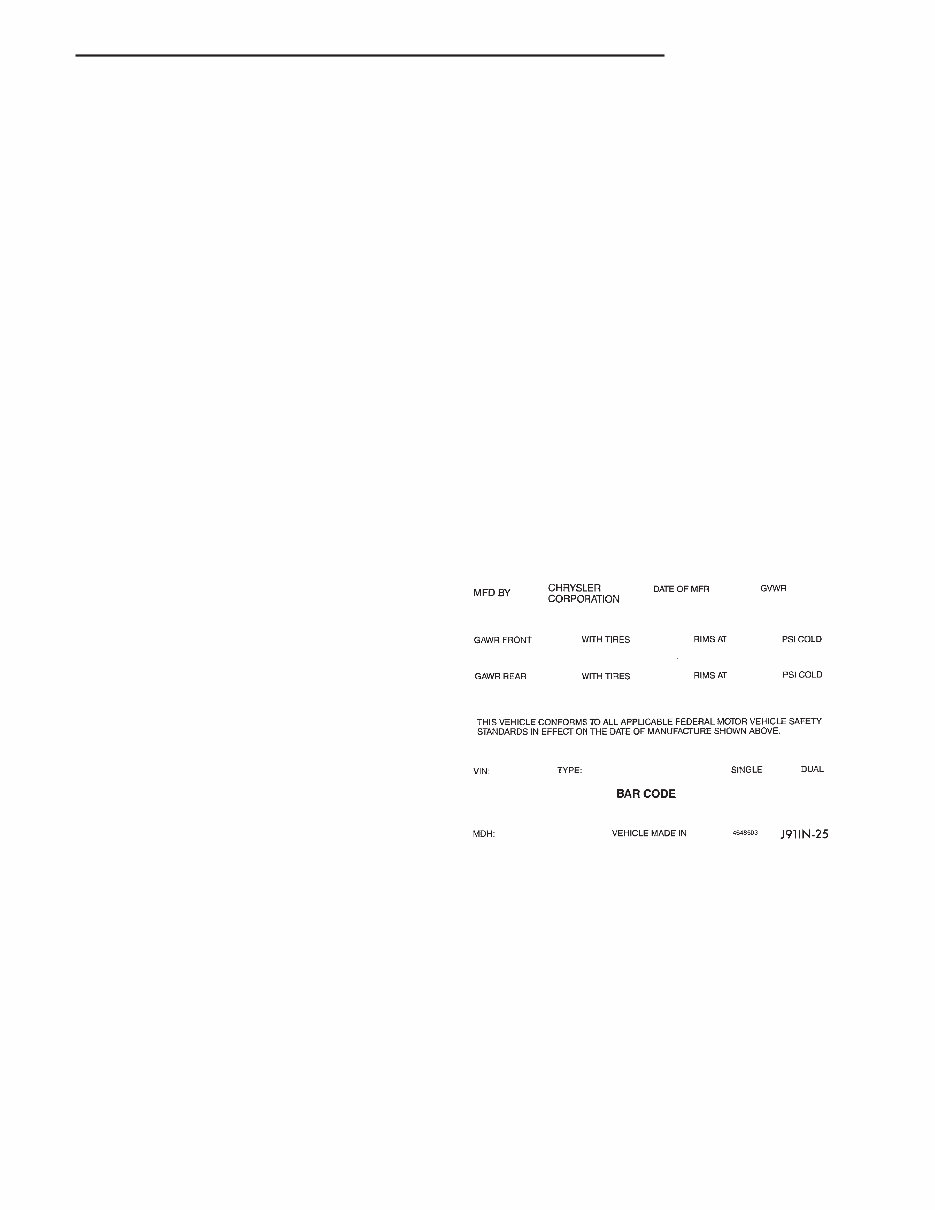
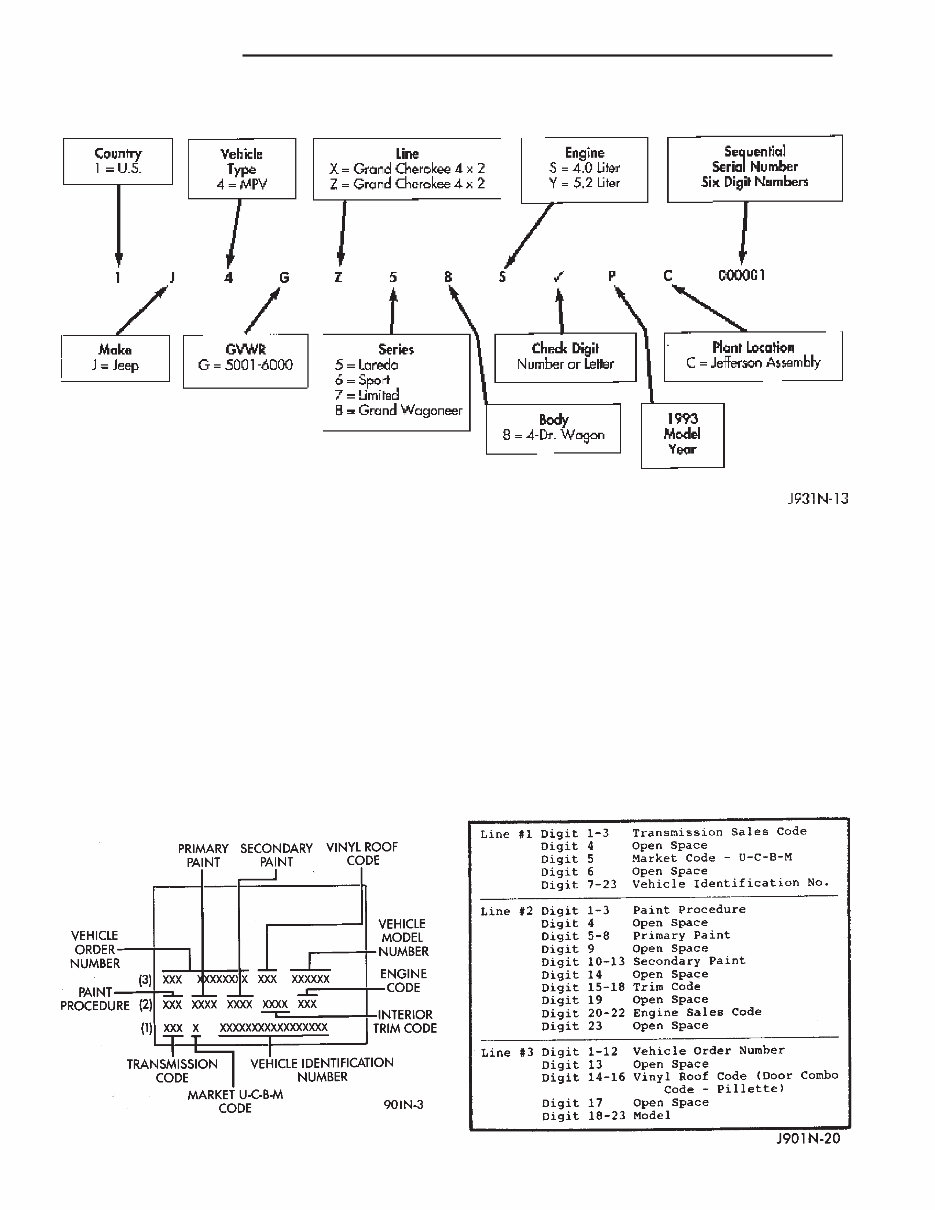
INTRODUCTION CONTENTS page page DESIGNATIONS, LABELS/PLATES/DECALS, CODES AND DIMENSIONS/WEIGHTS ....... 1 MEASUREMENT AND TORQUE SPECIFICATIONS ....................... 5 DESIGNATIONS, LABELS/PLATES/DECALS, CODES AND DIMENSIONS/WEIGHTS INDEX page page Body Code Plate .......................... 1 Engine and Transmission/Transfer Case Identification ............................ 2 International Vehicle Control and Display Symbols .4 Major Component Identification ............... 2 Trailer Towing Specifications .................. 4 Vehicle Designation ........................ 1 Vehicle Dimension ......................... 3 Vehicle Identification Number (VIN) Plate ........ 1 Vehicle Safety Certification Label .............. 1 Vehicle Weights ........................... 3 VEHICLE DESIGNATION The Vehicle Code Designation for Grand Cherokee vehicles is ZJ. The code is used to identify the vehicle in charts, captions and in service procedures. The vehicle code is different than the Vehicle Identifica- tion Number (VIN) or the wheelbase/model code. VEHICLE SAFETY CERTIFICATION LABEL A certification label is attached to the left side B-pillar (Fig. 1). The label certifies that the vehicle conforms to Federal Motor Vehicle Safety Standards (FMVSS).The label also lists the: • Month and year of vehicle manufacture • Gross Vehicle Weight Rating (GVWR). The gross front and rear axle weight ratings (GAWR’s) are based on a minimum rim size and maximum cold tire inflation pressure • Vehicle Identification Number (VIN) • Type of vehicle • Type of rear wheels • Bar code • Month, Day and Hour (MDH) of final assembly VEHICLE IDENTIFICATION NUMBER (VIN) PLATE The Vehicle Identification Number (VIN) plate is attached to the top left side of the instrument panel. The VIN contains 17 characters that provide data concerning the vehicle. Refer to the decoding chart to determine the identification of a vehicle. The Vehicle Identification Number is also imprinted on the: • Body Code Plate • Equipment Identification Plate • Vehicle Safety Certification Label • Frame rail BODY CODE PLATE A metal Body Code plate is attached (riveted) to the top, left side of the radiator reinforcement. There can be a maximum of seven rows of vehicle information imprinted on the plate. The information should be read from left to right, starting with line 1 at the bottom of the plate up to line 7 (as applicable) at the top of the code plate (Fig.2). Refer to the decoding chart to decode lines 1 through 3. Fig. 1 Vehicle Safety Certification Label Z INTRODUCTION 1
Lines 4 through 7 on the plate are imprinted in sequence according to the following descriptions: • 3-character sales code • 3-digit numerical code • 6-digit SEC code If there is not enough space left in the row for all of the 6-digit SEC code: • The unused space will remain blank • The code will be listed in the next row. The last nine positions of row 7 will contain a 2-digit code and a 6-digit serial number. The last code on a body code plate will be followed by the imprinted word END. When two plates are required, the last available spaces on the first plate will be imprinted with the letters CTD (for contin- ued). When a second body code plate is necessary, the first four spaces on each row will not be used because of the plate overlap. ENGINE AND TRANSMISSION/TRANSFER CASE IDENTIFICATION Refer to Group 9—Engines for all engine identifica- tion data. Refer to Group 21—Transmissions for all transmission/transfer case identification data. MAJOR COMPONENT IDENTIFICATION Refer to the applicable group for identification data. VEHICLE IDENTIFICATION NUMBER (VIN) DECODING Fig. 2 Body Code Plate BODY CODE DECODING 2 INTRODUCTION Z
The JEEP Grand CHEROKEE Service Repair Workshop Manual 1996-1997 is a comprehensive guide designed to assist owners and mechanics in maintaining and repairing their vehicles.
This manual covers the 1996 and 1997 models of the JEEP Grand Cherokee, providing detailed instructions and diagrams for a wide range of repairs.
Whether you are a professional mechanic or a DIY enthusiast, this workshop manual is a valuable resource. It includes step-by-step procedures for servicing, troubleshooting, and repairing various components of the JEEP Grand Cherokee.
The manual covers a wide range of topics, including engine, transmission, suspension, brakes, electrical system, and more. With clear and concise instructions, accompanied by detailed illustrations, this manual makes it easier than ever to tackle repairs and maintenance tasks.
By following the instructions provided in this workshop manual, you can save time and money by doing the repairs yourself. The manual also includes recommended maintenance schedules, ensuring that you can keep your JEEP Grand Cherokee in optimal condition.
Investing in the JEEP Grand CHEROKEE Service Repair Workshop Manual 1996-1997 is a wise choice for anyone who wants to take better care of their vehicle and handle repairs with confidence.
Recently Viewed
5,521,897Happy Clients
2,594,462eManuals
1,120,453Trusted Sellers
15Years in Business
Price:
Actual Price:
1996-1997 Jeep Grand Cherokee Service & Repair Manual



 Lifetime Access