



TUCSON Fuel Cell(LM FCEV) > 2016 > 100KW > General
- General Safety Information and Caution
This Fuel Cell Electric Vehicle (FCEV) uses approximately DC 180 ~ 400 voltage and high pressure hydrogen gas. Be
sure to follow safety instructions below. Failure to follow safety instructions may result in serious injury or
electrocution.
[Safety precaution for Hydrogen system]
Hydrogen Gas Features
Hydrogen is a unique gaseous element that possesses the lowest molecular weight of any gas.
It is colorless, odorless, tasteless, non-corrosive, flammable and high volatile.
Hydrogen therefore is necessary to be handled with care due to its gaseous properties.
However, it is no more dangerous and it is rather less dangerous than other commonly used fuels in some respects.
Hydrogen has much lower density which gives it a comparative advantage from a safety point of view.
Owing to this, hydrogen gas tends not to mix with air and disperses upwards in the air.
This means that the concentration levels of hydrogen necessary for ignition or detonation are unlikely to be achieved.
A hydrogen gas leak should be prevented for hazard of ignition or detonation for a safety point of view.
The followings are properties of gaseous hydrogen.
• It has the lowest molecular weight, and has the smallest molecules of any elements.
• It has the lowest density and the highest buoyancy of any element.
• It can cause brittleness in some materials, including metals (but materials chosen for hydrogen applications are
not susceptible to brittleness).
• It is colorless, odorless and tasteless.
• It burns invisibly and without smoke.
• It has the lowest ignition energy of any fuel (less than one-tenth that of other fuels).
• It has a wide flammability concentration range of 4% to 75%
When servicing the hydrogen storage and supply system, pay attention to the following items.
• Clean all work shop and surrounding areas before removing the part.
• Place removed parts on a clean cover and surface.
• Use lint-free cloths only.
• Carefully cover or seal opened parts with a tape if repairs cannot be carried out immediately.
• Install clean components only.
• Concrete regulations for hydrogen system service may vary with countries.
Therefore all service and maintenance instructions are based on local country requirements safety regulations.
• Fuel Cell Electric Vehicle must be repaired in authorized workshops that are equipped with ventilation and
hydrogen detection system.
• There must be no ignition sources around the vehicle.
For example, exposed flame, sparks, electrostatic discharge or hot surfaces that could cause hydrogen gas to
ignite.
When servicing the part related to hydrogen supply system, you must abide by the following items.
1) When escaping hydrogen gas, there must be no ignition sources around the release path.
2) Always empty the hydrogen tank according to the following safety instructions.
3) It might be dangerous or could cause injury due to escaping gas because the system is pressurized.
4) The hydrogen tank is charged with high pressure hydrogen gas. Never remove the hydrogen tank before
emptying the tank.
5) Never disassemble the hydrogen tank and safety solenoid valve even though the hydrogen tank is empty.
Because it may cause fire and explosion if the hydrogen tank is disassembled arbitrarily.
6) Be sure to remove inflammable materials around the vehicle before servicing.
7) Be sure to remove the residual fuel gas completely first in the fuel line before servicing hydrogen supply
system.
(Refer to “Release Residual Pressure in Fuel Line” in this group.)
8) When removing the hydrogen storage and supply system, do not work with compressed air if this can be
avoided.
9) Before removing the hydrogen system, cover a cloth around the connection part. And then, remove the parts
carefully.
Caution labels for high voltage are attached to the hydrogen storage system components. The hydrogen storage
system is composed of two cylinders which are filled with Hydrogen gas. Each tank is made of aluminum and
covered additionally with carbon fiber which makes the storage tank sustain high pressures. This cylinder contains
flammable gas under high pressure. Serious injury or death can result from improper installation, lack of
maintenance or overfilling. Do not attempt to remove this cylinder or any of its fittings from this vehicle. It may
contain residual gases under pressure, which could cause fire or explosion.
Removal and disposal shall only be done by a qualified technician. Installation of this cylinder must be done in
accordance with the manufacturer’s instruction and local regulation.
Hydrogen storage components: Hydrogen Storage System Control Unit (HSCU), Hydrogen Sensor, Hydrogen
Tank, Hydrogen Tank Solenoid Valve Assembly, Hydrogen Tank Purge Valve, Filling Receptacle Assembly, etc
[Safety precaution for High voltage system]
Warning labels for high voltage are attached to the high voltage components. The color of the high voltage cables
and connectors are orange. Do not touch any of these high voltage components, cables, and connectors without
proper Personal Protection Equipment (PPE).
High voltage components: Fuel cell stack assembly, Fuel cell Control Unit (FCU), Air Blower, COD Heater, High
voltage Junction Box, High Voltage Battery Pack Assembly, Power Relay Assembly (PRA), BMS ECU, Drive
Motor, Electric A/C Compressor, High voltage DC/DC Converter (HDC), Low DC/DC Converter (LDC), Power
Cable, etc.
Use Mega Ohm Tester when measuring insulation resistance of the high voltage system.
Specification :
High impedance Digital Volt / Ohm Meter
Leads and Meter rated to 1,000 voltage.
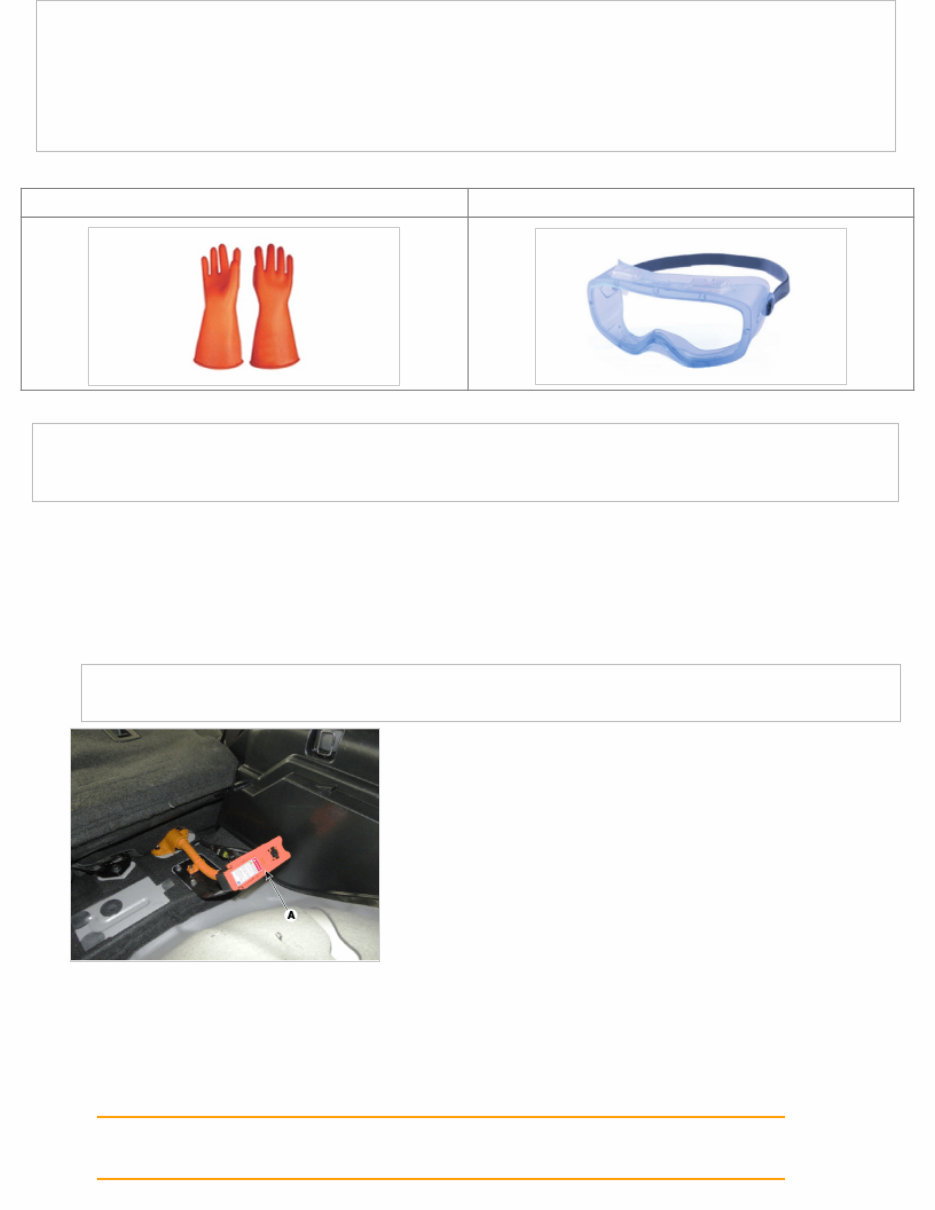
• For your safety when servicing the Fuel Cell Electric Vehicle (FCEV):
– Wear Personal Protection Equipment (Insulation Gloves and Safety Glasses)
– Do not carry any metallic object (watch, ring etc.) which can cause short circuit.
– Use insulated tools
• Before wearing the protective gear, make sure that they are not torn or broken and free of moisture.
Insulating Gloves Safety Glasses
Before repair work for any Fuel cell, High voltage, Hydrogen system component, be sure to perform the procedures
as below.
1. Start the fuel cell system by pressing the power button.
2. Check the hydrogen gas leak detection lamp on the cluster.
3. Shut off the high voltage circuit shown in the procedures below.
(Refer to "High Voltage Shut off Procedure" for more detailed procedures.)
(1) Turn the fuel cell system off and disconnect the auxiliary 12V battery negative (-) cable.
(2) Remove the safety plug (A).
Starting the fuel cell system with the safety plug removed may damage the fuel cell control system.
(3) Wait for more than 5 minutes so that the capacitor in the high voltage system can be naturally discharged.
(4) Measure the voltage between the inverter positive and negative power cable terminals to check for inverter
discharge.
(1) Remove the high voltage junction box cover.
(2) Measure the voltage between the inverter positive and negative bus bar terminals to check for capacity
discharge.
Below 30V: High voltage circuit properly shut
More than 30V: High voltage circuit faulty

Re-check by removing the safety plug, if the voltage is measured over 30V.
If the voltage is over 30V even though the safety plug is removed, a serious problem will occur in the
high voltage circuit. In this case, perform the DTC diagnosis and do not do any work associated with the
high voltage system.
(5) Remove the high voltage junction box cover. And measure the voltage between the positive and negative bus bar
terminals to check the shut off of the fuel cell.
Below 5V: Fuel cell system circuit properly shut
More than 5V: Fuel cell system circuit faulty
Re-measure the voltage after 10 minutes, if the voltage is measured over 5V.
If the voltage is over 5V again, a serious problem will occur in the fuel cell system circuit.
In this case, perform the DTC diagnosis and do not do any work associated with the fuel cell system.
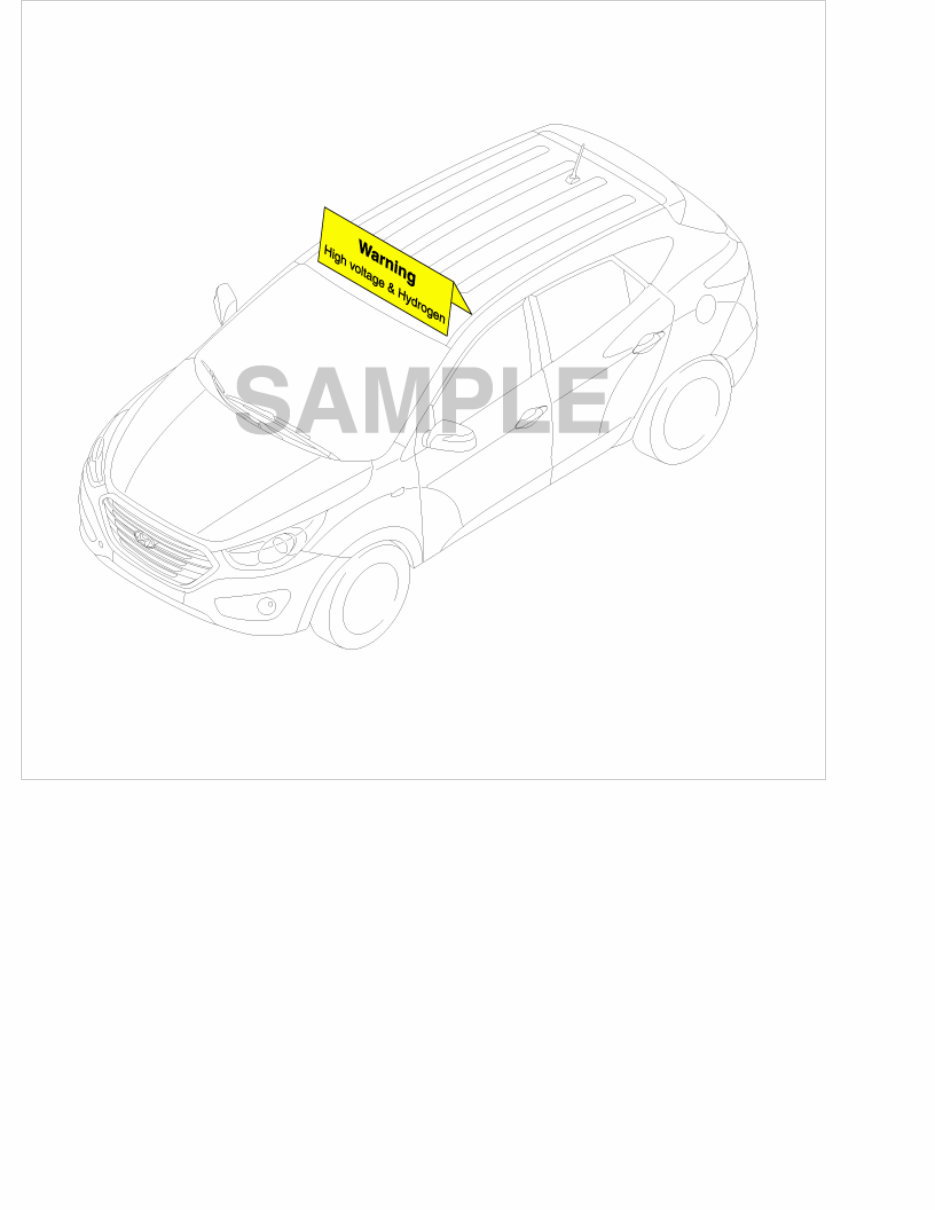
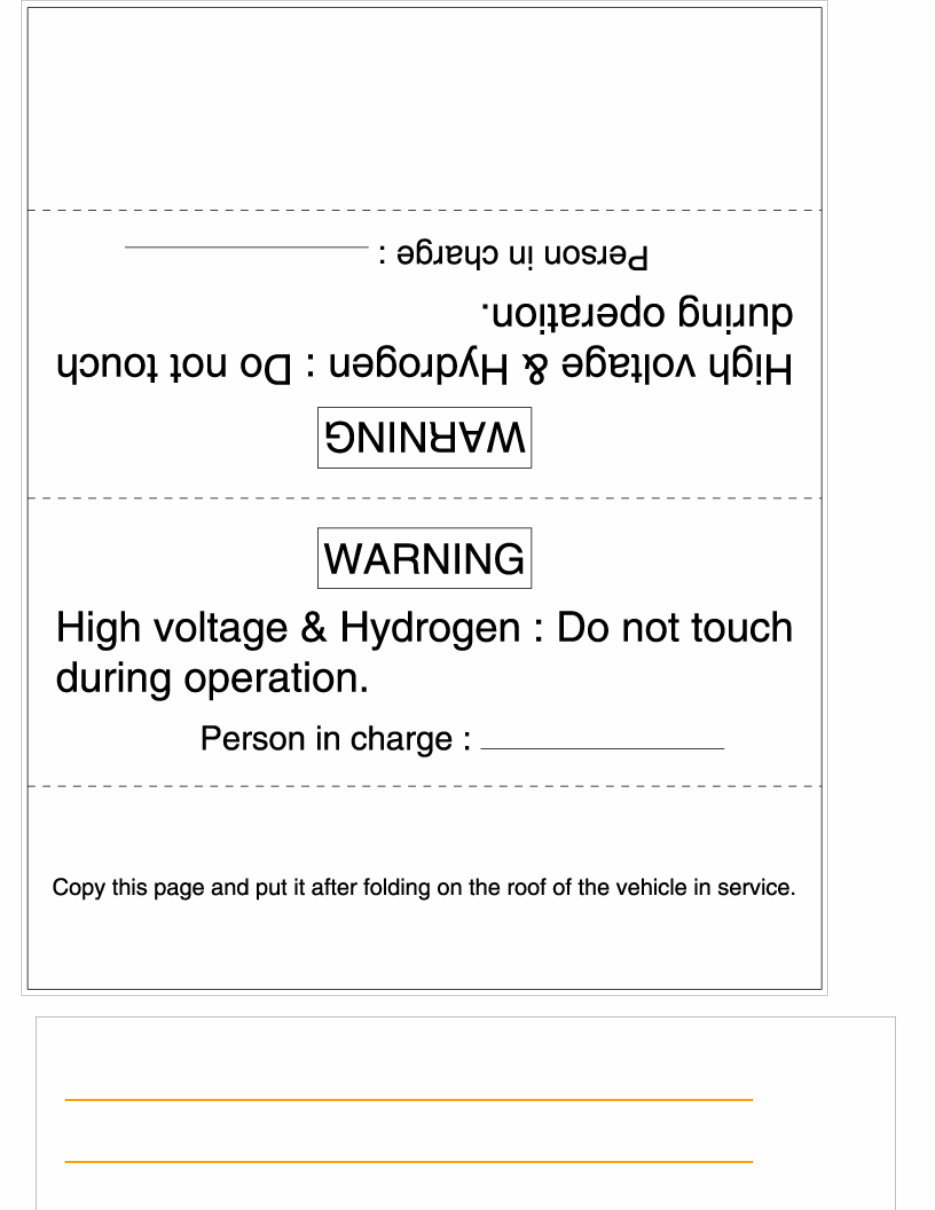
Attach the 'High Voltage Caution Car Topper' to the vehicle roof to inform other people of the danger of high
voltage.
Be sure to follow instructions below when repairing the high voltage cable.
• Check the voltage of the high voltage connector, terminal or bus bar before repairing.
Below 30V: High voltage circuit properly shut
More than 30V: High voltage circuit faulty
• Be careful not to short circuit between positive (+) and negative (-) terminals.
• Insulate the high voltage connector or terminal with an insulation tape after disconnecting.
• Tighten the high voltage terminal with the specified torque.
The high voltage battery must be always handled horizontally during repairing or storage. Otherwise, battery
performance may decline or its life may shorten.
Exposing the high voltage battery to intense heat may cause deterioration.
Do not bake over 158°F (70°C) / 30 min or 176°F (80°C) / 20 min when painting.
Fuel Cell Electric Vehicle Refrigerant Recovery / Charging Precautions
• Since the electric compressor uses high-voltage, you should use POE oil which have high Volumetric
Resistivity.
• Do not use the same A/C recovery / charging equipment as conventional belt-driven compressors.
If the POE oil of the system gets mixed with PAG oil, then dielectric breakdown due to decreased volumetric
resistivity can deteriorate A/C compressor performance or it may not work.
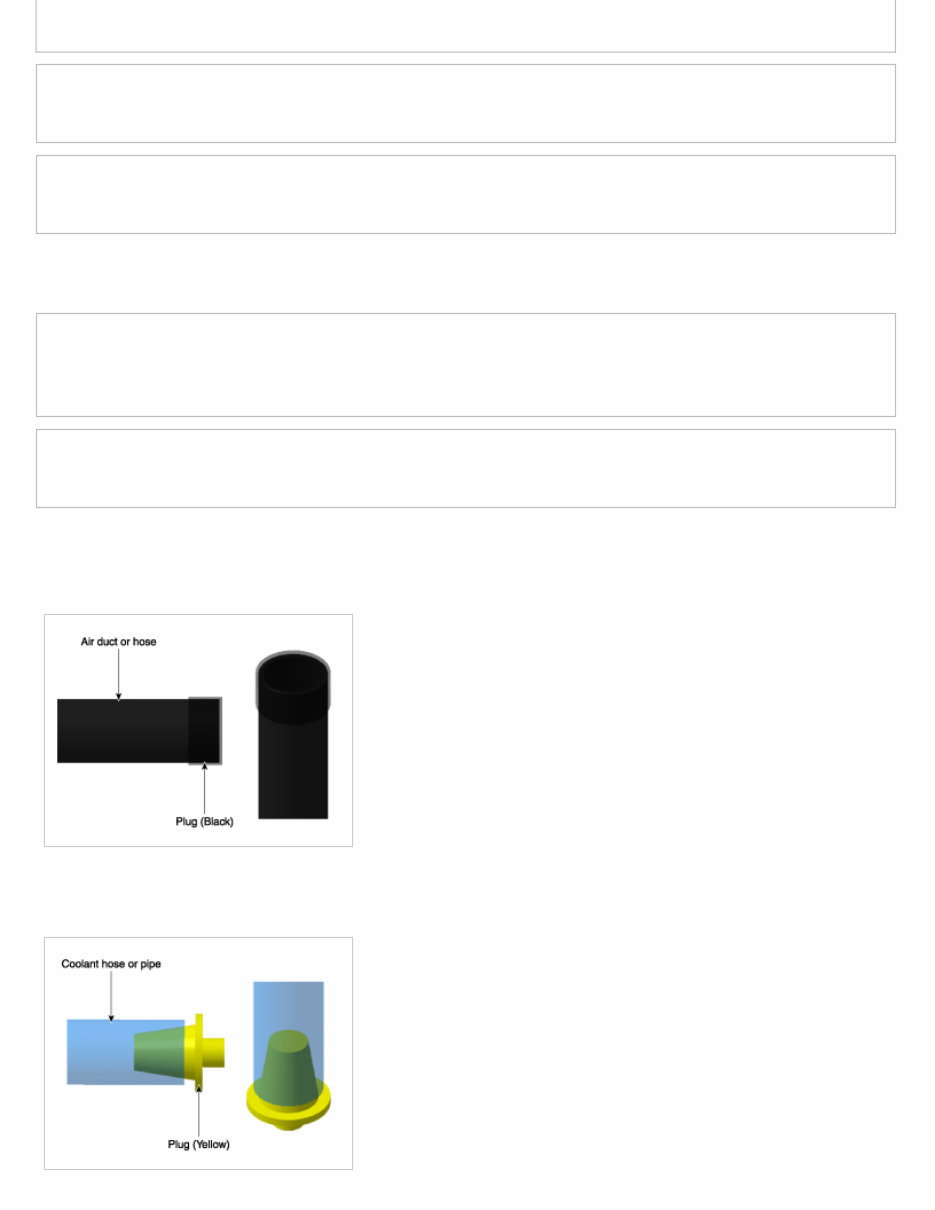
Air Processing System, Thermal Management System and Fuel Processing System Repairing Precautions
• Air Ducts and Hoses
- To protect fuel cell system, block the open end of the air ducts and hoses using the plugs (09356-4W170).
• Coolant Hoses and Pipes
- To prevent technicians coming in contact with coolant and protect electrical systems, block the open end of the
coolant hoses and pipes using the plugs (09356-4W170).
Stack Cooling System
Motor Cooling System
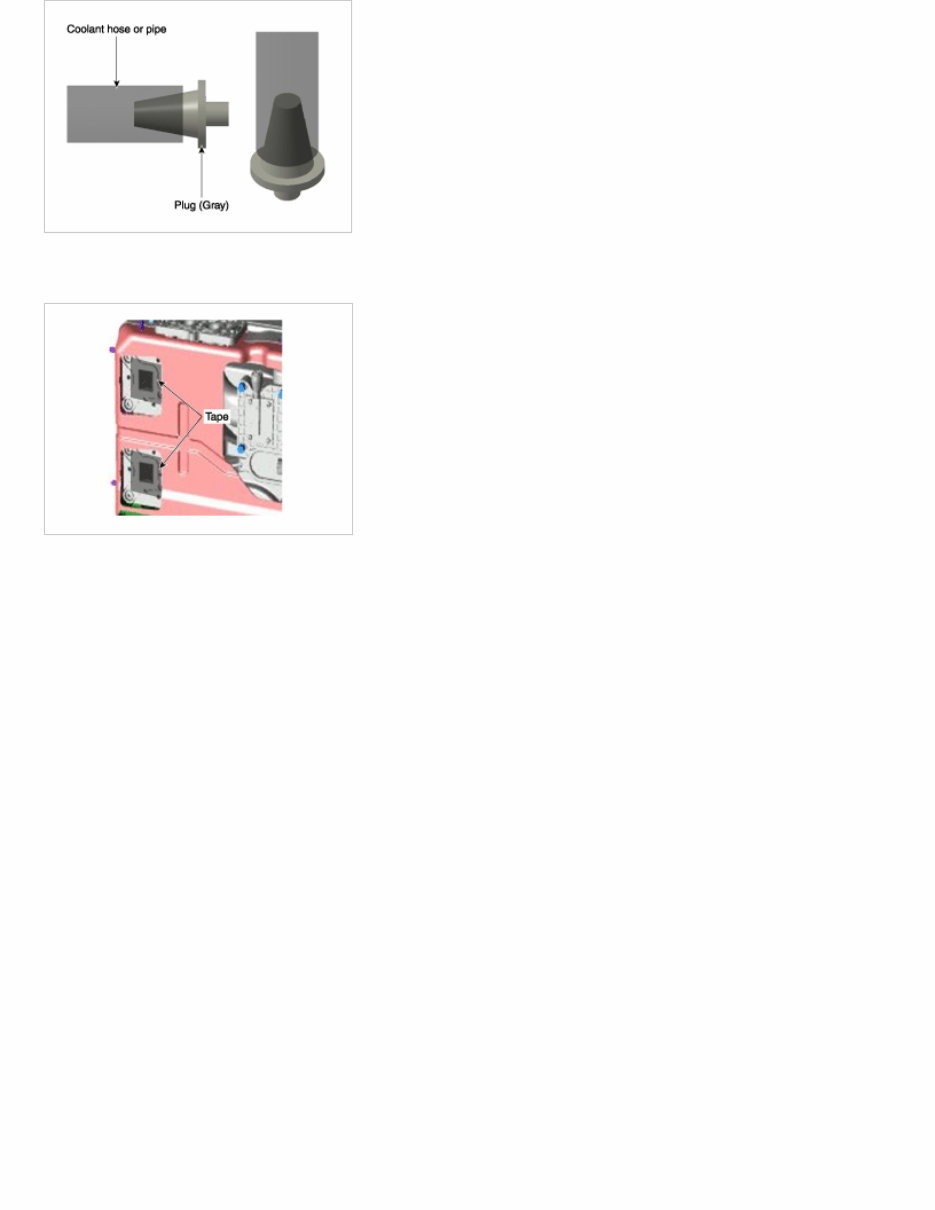
• Fuel, Air and Coolant Paths of Fuel Cell System Components
- To protect the fuel cell system, seal the fuel, air or coolant path with tape after removing the fuel cell system
componets.
TUCSON Fuel Cell(LM FCEV) > 2016 > 100KW > General
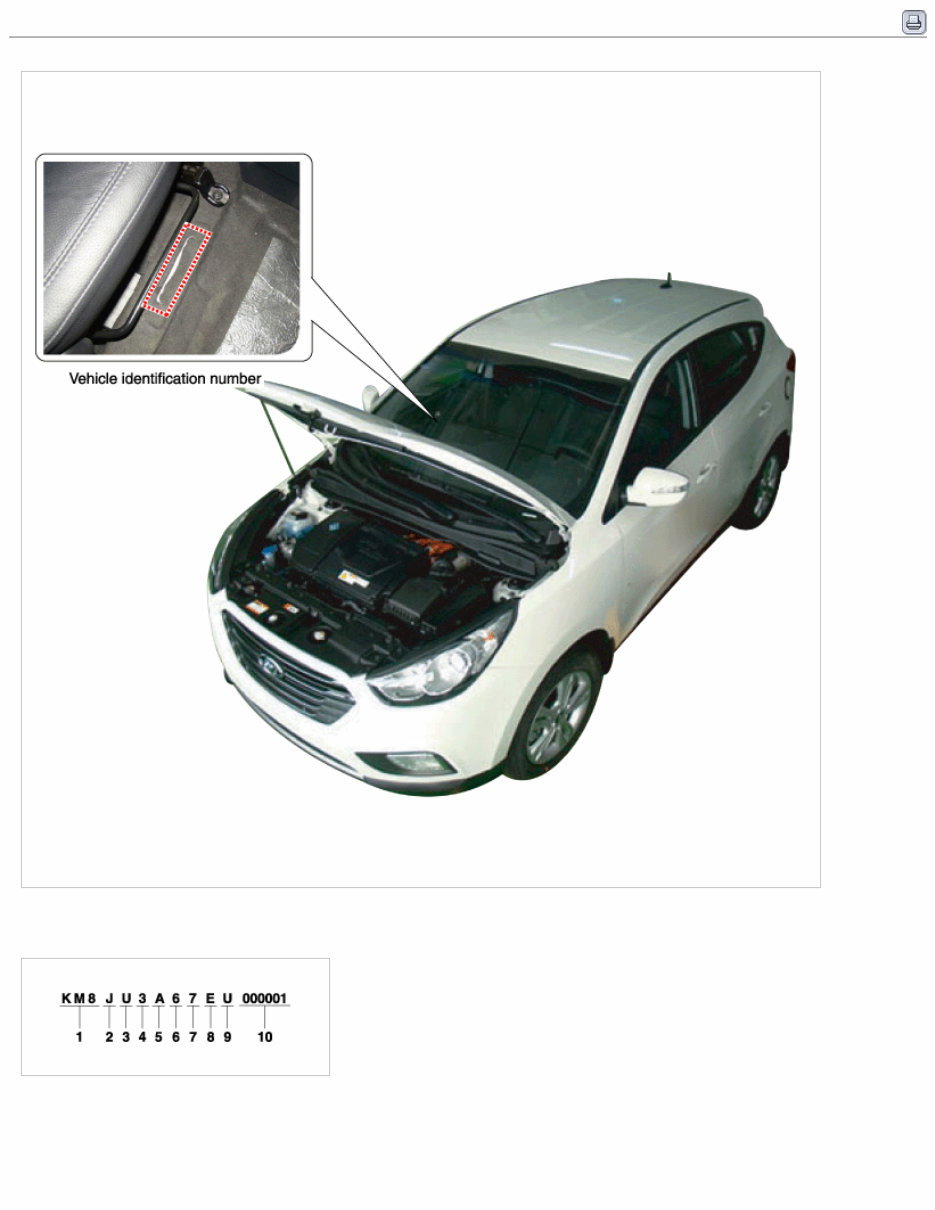
- Identification Number Locations
Identification Number Description
Vehicle Identification Number
1. World Manufacturer Identifier (WMI)
- KMF : Commercial vehicle (Van)
- KMH : Passenger vehicle or MPV(Multipurpose Passenger Vehicle)/SUV(Sports Utility Vehicle)/RV(Recreational
Vehicle)
- KMJ : Van
- KM8 : MPV/SUV/RV (For U.S.A, Canada, Mexico only)

- TMA : Passenger vehicle
2. Vehicle line
- J : ix35 FCEV
3.
Model & Series
- S : Low grade (L)
- T : Middle-Low grade (GL)
- U : Middle grade (GLS, JSL, TAX)
- V : Middle-High grade (HGS)
- W : High grade (TOP)
4.Body/Cabin type, Gross Vehicle Weight Rating
KMF (Commercial vehicle / Van)
Except U.S.A, Canada, Mexico, Gulf Cooperation Council, China
- X : Standard Cabin / Semi-Bonnet
- Y : Double Cabin / Bonnet
- Z : Super Cabin / Box
For U.S.A, Canada, Mexico, Gulf Cooperation Council, China
- 3 : Standard Cabin Class-E 4×2 / Semi-Bonnet Class-E 4×2
- 4 : Standard Cabin Class-E 4×4 / Semi-Bonnet Class-E 4×4
- 5 : Standard Cabin Class-F 4×2 / Semi-Bonnet Class-F 4×2
- 6 : Standard Cabin Class-F 4×4 / Semi-Bonnet Class-F 4×4
- 7 : Double Cabin Class-E 4×2 / Bonnet Class-E 4×2
- 8 : Double Cabin Class-E 4×4 / Bonnet Class-E 4×4
- 9 : Double Cabin Class-F 4×2 / Bonnet Class-F 4×2
- 0 : Double Cabin Class-F 4×4 / Bonnet Class-F 4×4
- A : Super Cabin Class-E 4×2 / Box Class-E 4×2
- B : Super Cabin Class-E 4×4 / Box Class-E 4×4
- C : Super Cabin Class-F 4×2 / Box Class-F 4×2
- D : Super Cabin Class-F 4×4 / Box Class-F 4×4
KMH, TMA
- 1 : Limousine
- 2 : Sedan - 2 door
- 3 : Sedan - 3 door
- 4 : Sedan - 4 door
- 5 : Sedan - 5 door
- 6 : Coupe
- 7 : Convertible
- 8 : Wagon
- 9 : Commercial Van
- 0 : Pick-Up
KMJ
- 1 : Box
- 2 : Bonnet
- 3 : Semi-Bonnet
KM8
- 1 : Wagon 4×2 Class-A
- 2 : Wagon 4×2 Class-B
- 3 : Wagon 4×2 Class-C
- 4 : Wagon 4×2 Class-D
- 5 : Wagon 4×2 Class-E
- 6 : Wagon 4×2 Class-F
- 7 : Wagon 4×2 Class-G
- A : Wagon 4×4 Class-A
- B : Wagon 4×4 Class-B
- C : Wagon 4×4 Class-C
- D : Wagon 4×4 Class-D
- E : Wagon 4×4 Class-E
- F : Wagon 4×4 Class-F
You're Reading a Preview
What's Included?
 Lifetime Access
Fast Download Speeds
Online & Offline Access
Access PDF Contents & Bookmarks
Full Search Facility
Print one or all pages of your manual
$37.99
2016 Hyundai TUCSON Fuel Cell (LM FCEV) 100KW Service & Repair Manual
Viewed 56 Times Today

What's Included?
Lifetime Access
Fast Download Speeds
Online & Offline Access
Access PDF Contents & Bookmarks
Full Search Facility
Print one or all pages of your manual
$37.99

Secure transaction
What's Included?
Lifetime Access
Fast Download Speeds
Online & Offline Access
Access PDF Contents & Bookmarks
Full Search Facility
Print one or all pages of your manual
Description
The 2016 Hyundai TUCSON Fuel Cell (LM FCEV) 100KW Service & Repair Manual provides detailed information for both professional mechanics and DIYers on the maintenance, troubleshooting, and repair of the vehicle.
- Comprehensive coverage of the vehicle's systems, components, and assemblies
- Detailed diagrams and illustrations for better understanding and clarification
- Step-by-step procedures for routine maintenance and repairs
- Troubleshooting guides for diagnosing and resolving issues
- In-depth technical information for advanced procedures and modifications
This manual is designed to provide users with the knowledge and skills necessary to maintain and repair the 2016 Hyundai TUCSON Fuel Cell (LM FCEV) 100KW, ensuring optimal performance, safety, and longevity.


