



IONIQ Plug-in Hybrid(AE PHEV) > 2020 > G 1.6 GDI PHEV >
- Safety Precaution
Precautions to take before servicing high voltage system
• Since hybrid vehicles contain a high voltage battery, if the high voltage system or vehicles are handled
incorrectly, this might lead to a serious accidents like electric shock and electric leakage.
• Be sure to shut off the high voltage by removing the safety plug before performing inspection or repairing the
high voltage system.
(Refer to Hybrid Control System - "High Voltage Shut-off Procedure")
• The responsible worker keeps the removed safety plug to prevent the plug from being connected by mistake.
• Do not keep any metal objects (watch, ring etc.) while working on the high voltage system, which it can cause
serious accidents like electric shock.
• Before beginning work on the high voltage system, the worker should wear personal protective equipment to
prevent safety accidents.
(Refer to "Personal Protective Equipment")
• Never allow workers who are not wear personal protective equipment to touch the high voltage system. High
voltage components should be covered with an insulation sheet to prevent safety accidents.
• Use insulation tools when working on the high voltage system.
• Put the removed high voltage components on the insulation mat.
• After disconnecting the high-voltage connector, be sure to remove any coolant around the high-voltage
connector as there may be a risk of fire.
• All the high voltage wiring and connectors are orange.
• A caution label for high voltage is attached to the high voltage components.
• High voltage components :
High Voltage Battery Pack Assembly, Power Relay Assembly (PRA), BMS ECU, Hybrid Power Control Unit
(HPCU), Hybrid Drive Motor, HSG, Electric A/C Compressor, Low DC/DC Converter (LDC), Power Cable,
Electric Compressor etc.
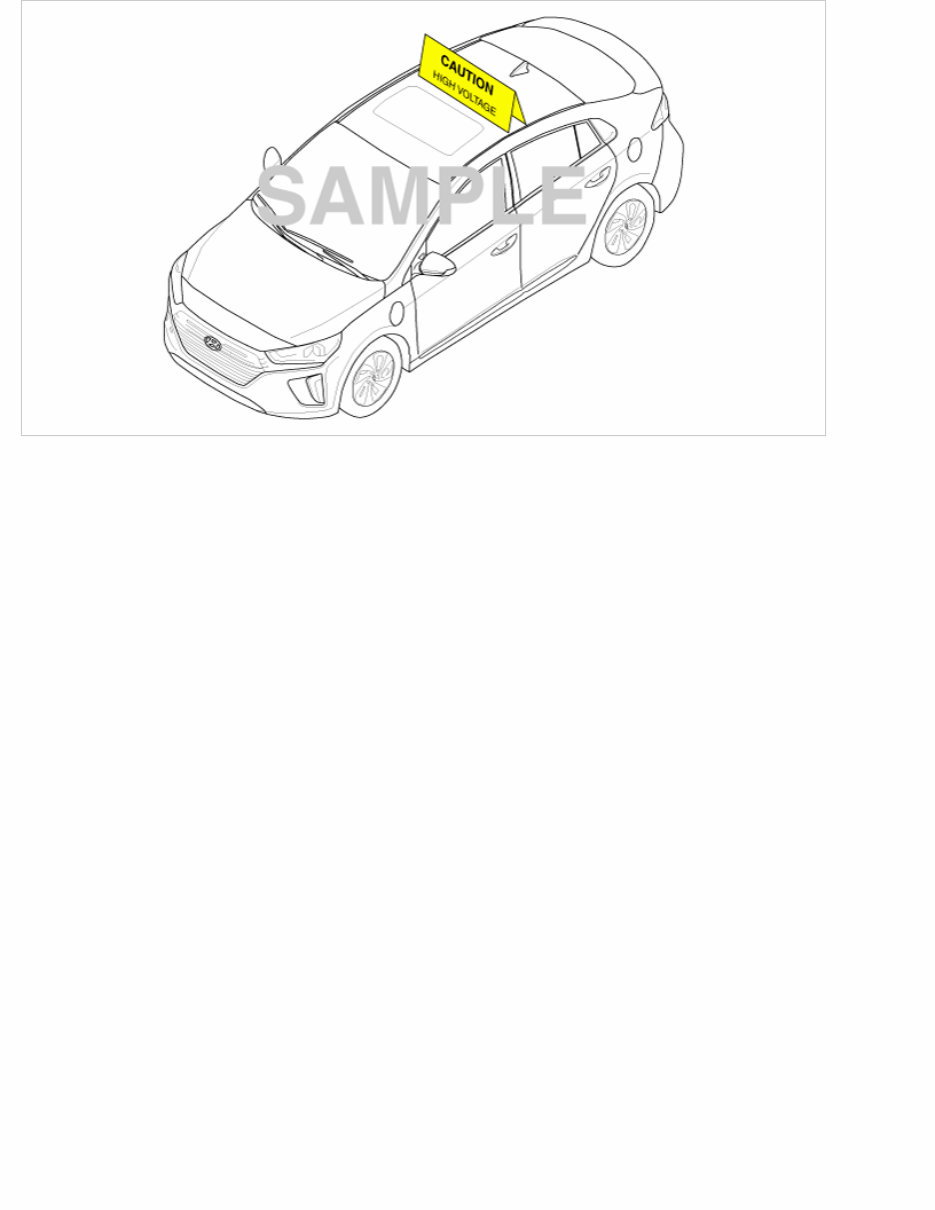
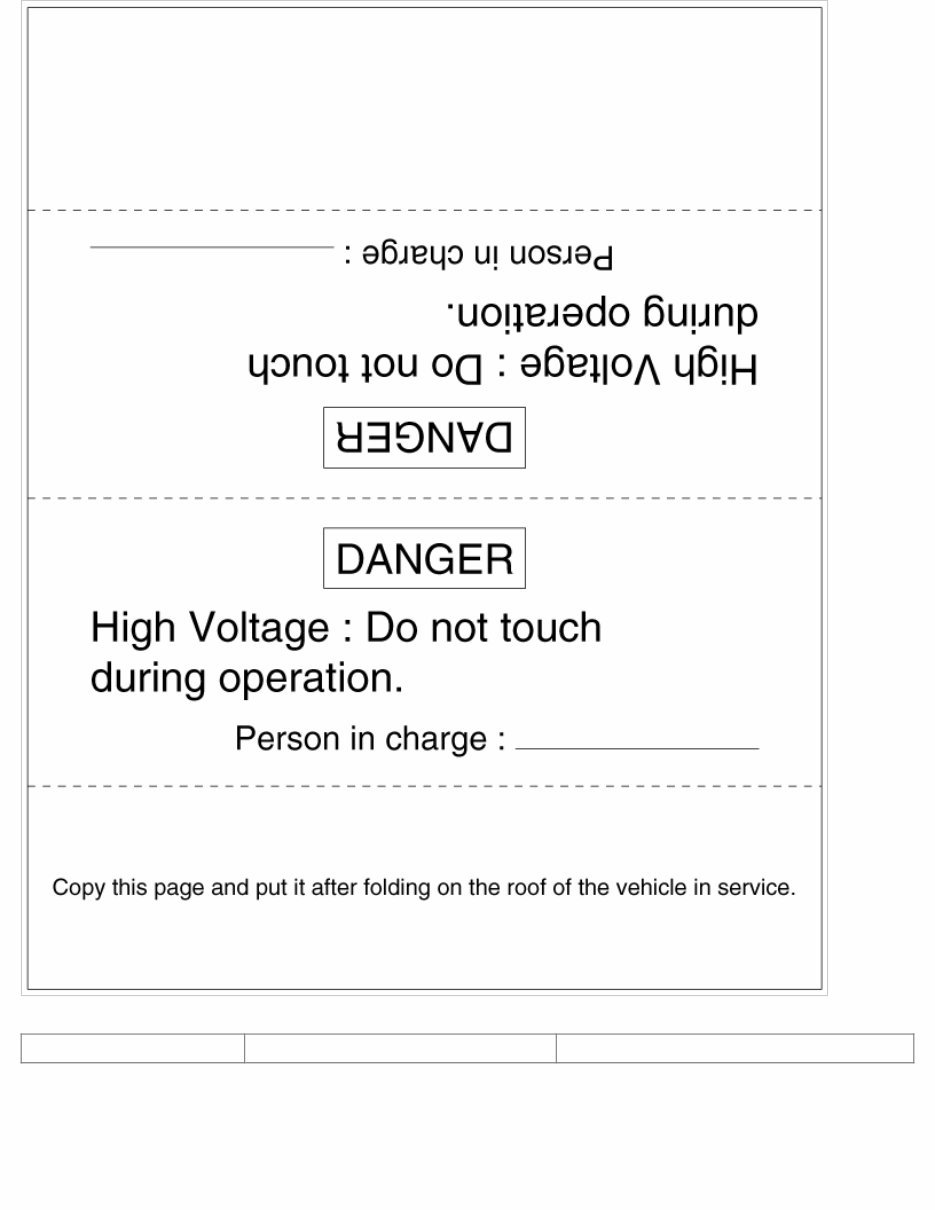
• Inform of danger of high voltage by putting the "high voltage caution" on the vehicle as image below.
Personal Protective Equipment
Name Illustration Description

Insulation glove
Used when inspecting or working on the high
voltage components
[Insulation performance : 1000V / 300A or
above]
Insulation shoes
Used when inspecting or working on the high
voltage components
Insulation clothes
Insulation helmet
Safety glasses
Used in the case below
• During Removal & installation or inspection
of the high voltage battery terminals or wiring,
which spark might happen.
• During working on the high voltage battery
pack assembly.
Face shield
Insulation mat
Putting the removed high voltage components
on the insulation mat to prevent safety
accidents.
Insulation sheet
Covering the high voltage components with
insulation sheet to prevent people who don’t
wear the personal protective equipment from
safety accidents.

Precautions to take when handling power cable
• Immediately insulate the high voltage terminal after reconnecting the terminal (use insulation tape).
• Tighten the high voltage terminal screw to spec torque.
• Be careful that (+) and (-) terminals do not come in contact when connecting or disconnecting power cable and
busbar.
Precautions to take when handling high voltage battery
• When transporting high voltage battery, be sure to keep it flat and leveled. Failure to do so may decrease the battery
performance and/or its life-span.
• High voltage battery's performance may decrease if it is exposed to high temperature for a lengthy period. As a
result, heat-treatment after painting must not exceed 70°C/ 30 minutes, or 80°C/ 20 minutes.
Precautions in case of fire on the high voltage battery system
• Turn OFF the Start button. Keep the Smart Key at least 2 meters away from the vehicle to prevent unintended engine
start.
• Quickly disconnect the service interlock connector plug in the early stage of fire.
(Refer to Hybrid Control System - "High Voltage Shut-off Procedure")
• Turn OFF the vehicle key as soon as possible and evacuate to the outside if the vehicle stops after a
flooding/collision accident.
• If a small fire occurs, use an extinguisher for electrical fire (ABC or BC) to extinguish.
• If the fire has not been put down in early stage, escape to the safe place and keep people out of the vehicle.
• Call fire station and report the vehicle is on fire. Follow the instruction from the fire station.
• If it is difficult to supress the fire, promptly move to safe place and wait until the rescue arrives.
• The fire on the drive motor battery at the bottom of the vehicle requires constant supply of a large volume of
water to extinguish. It is difficult to extinguish the fire if there are not enough water or proper fire
extinguisher. Approaching the vehicle may lead to life damage such as electrical shock.
Precautions in case of high voltage battery gas or electrolyte leakage
• Turn OFF the Start button. Keep the Smart Key at least 2 meters away from the vehicle to prevent unintended engine
start.
• Gas is hydrogen and alkaline vapor. If the leakage is indoor, ventilate the area immediately and evacuate to a safe
location.
• If the leaked liquid comes in contact with skin, immediately neutralize the affected area with boric acid solution, then
clean with tap water or saline solution.
• If the leaked vapor or liquid gets in the eye, immediately clean the affected eye with water then get medical attention.
• If the gas leakage is caused by high temperature, then do NOT use the battery until the high voltage battery fully
cools down to room temperature.
Precautions when handling the vehicle after an accident
• Be sure to wear insulated gloves (or rubber gloves), protective goggles, insulated suite, and insulated boots.
• Do NOT touch bare cable under any condition.
(Refer to "Precautions when handling power cable")
• If the vehicle is flooded, do not come close to the high voltage related parts. If the situation is unavoidable, move the
vehicle to a safe place before taking action.
• Gas is hydrogen and alkaline vapor. If the leakage is indoor, ventilate the area immediately and evacuate to a safe
location.

• If the leaked liquid comes in contact with skin, immediately neutralize the affected area with boric acid solution, then
clean with tap water or saline solution.
• Refer to "High voltage cut-off procedure" if the high voltage needs to be cut off.
Precaution for vehicle fire
If a small fire occurs, use an extinguisher for electrical fire (ABC or BC) to extinguish.
• If the fire has not been put down in early stage, escape to the safe place and keep people out of the vehicle.
• Call fire station and report the vehicle is on fire. Follow the instruction from the fire station.
• If it is difficult to supress the fire, promptly move to safe place and wait until the rescue arrives.
• The fire on the drive motor battery at the bottom of the vehicle requires constant supply of a large volume of
water to extinguish. It is difficult to extinguish the fire if there are not enough water or proper fire
extinguisher. Approaching the vehicle may lead to life damage such as electrical shock.
Preparations when servicing the accident vehicle
• Be sure to wear insulated gloves (or rubber gloves), protective goggles, insulated suite, and insulated boots.
• Boric Acid Power or Solution
• ABC Extinguisher
• Towel for cleaning electrolyte
• Vinyl tape (for insulating terminal)
• Mega ohm tester (for checking high voltage)
Precautions in case HEV is left unattended for a lengthy period
• Turn OFF the Start button. Keep the Smart Key at least 2 meters away from the vehicle to prevent unintended engine
start.
• We recommend that HEV is driven at least 1 time for over 30 minutes every 2 months to protect and manage the high
voltage battery (inquire at relevant team in HMC).
• When inspecting or exchanging the auxiliary battery, check high voltage battery SOC reset related problems.
Hybrid Vehicle Refrigerant Recovery / Charging Precautions
• Since the electric compressor uses high-voltage, you should use POE oil which have high Volumetric Resistivity.
• Do not use the same A/C recovery / charging station as conventional belt-driven compressors.
• If the POE oil of the system gets mixed with PAG oil, then dielectric breakdown due to decreased volumetric
Resistivity can occur and inoperative A/C compressor may result, A/C compressor may not work
IONIQ Plug-in Hybrid(AE PHEV) > 2020 > G 1.6 GDI PHEV >
- High Voltage Shut-off Procedures
• Be sure to read and follow the "General Safety Information and Caution" before doing any work related with the
high voltage system. Failure to follow the safety instructions may result in serious electrical injuries.
• Be sure to read and follow the "High Voltage Shut-off Procedures" before doing any work related with the high
voltage system. Failure to follow the safety instructions may result in serious electrical injuries.
• High voltage components :
High Voltage Battery Pack Assembly, Power Relay Assembly (PRA), BMS ECU, Hybrid Power Control Unit
(HPCU), Hybrid Drive Motor, HSG, Electric A/C Compressor, Low DC/DC Converter (LDC), Power Cable,
Electric Compressor etc.
1. Turn the ignition switch OFF.
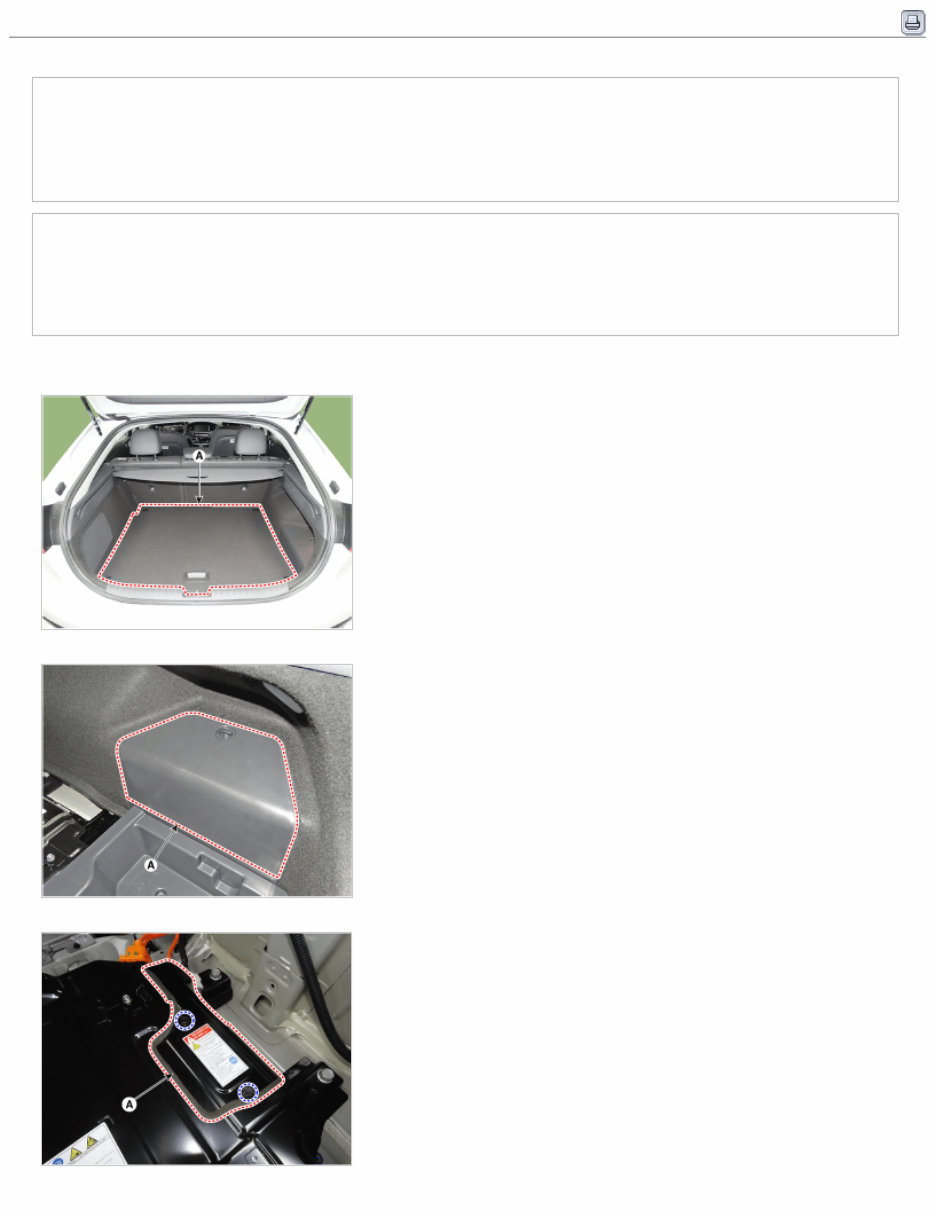
2. Remove the luggage board (A).
3. Remove the 12V battery cover (A) and then disconnect the auxiliary 12V battery negative (-) terminal.
4. Remove the safety plug cover (A).
5. Unfasten the hook (A) and then remove the safety plug (C) by pulling the lever (B) to the direction of arrow.
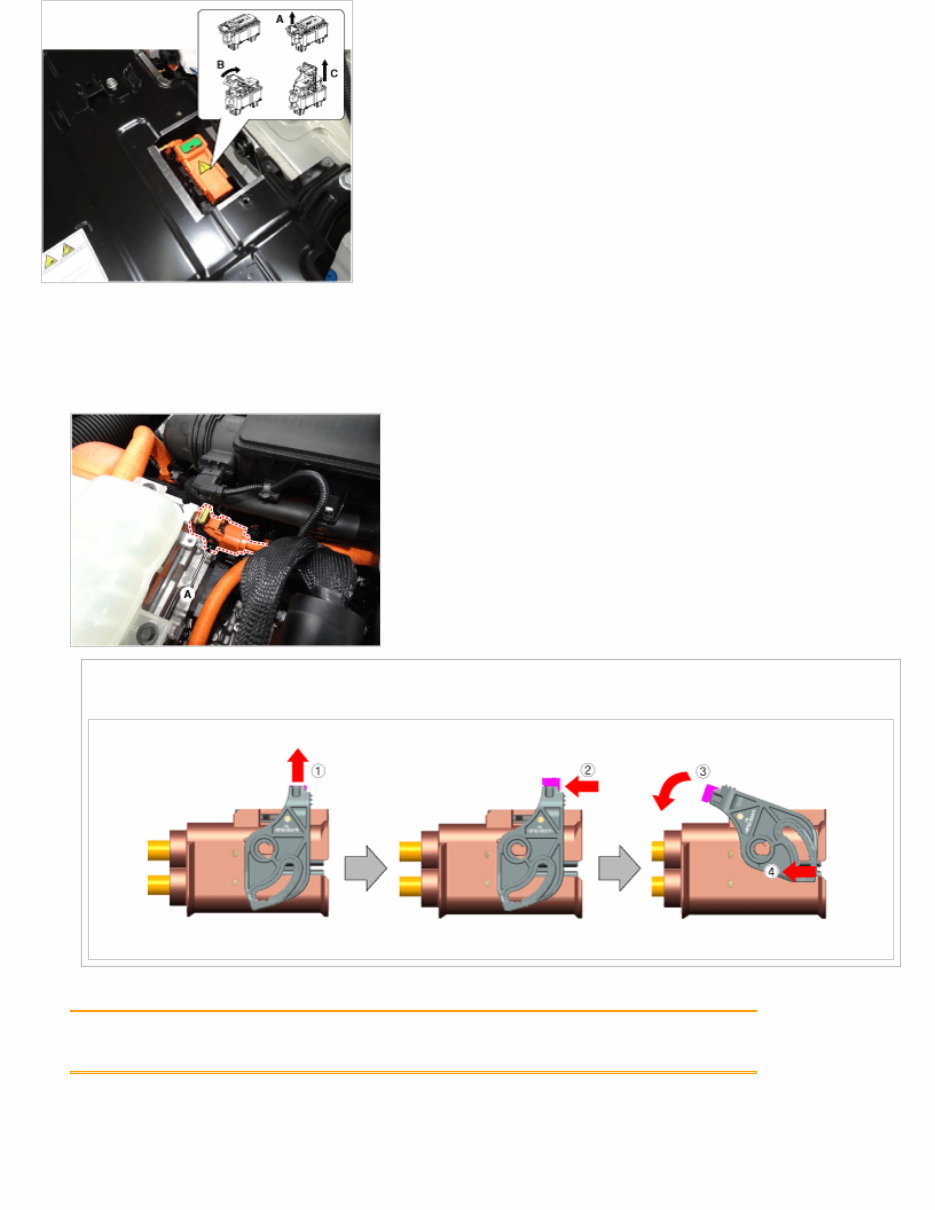
6. Wait for more than 5 minutes so that the capacitor in the high voltage system can be fully discharged.
7. Measure the voltage between the inverter terminals to check that the capacitor in the inverter is discharged completely.
(1) Remove air cleaner assembly and air duct.
(Refer to Engine Mechanical System - "Air Cleaner")
(2) Disconnect the inverter power cable (A).
• Disconnect the inverter power cable as the procedures below.
(3) Measure the voltage between the inverter (+) terminal and the inverter (-) terminal.
Less than 30V : High voltage circuit properly shut
More than 30V : Fault on high voltage circuit
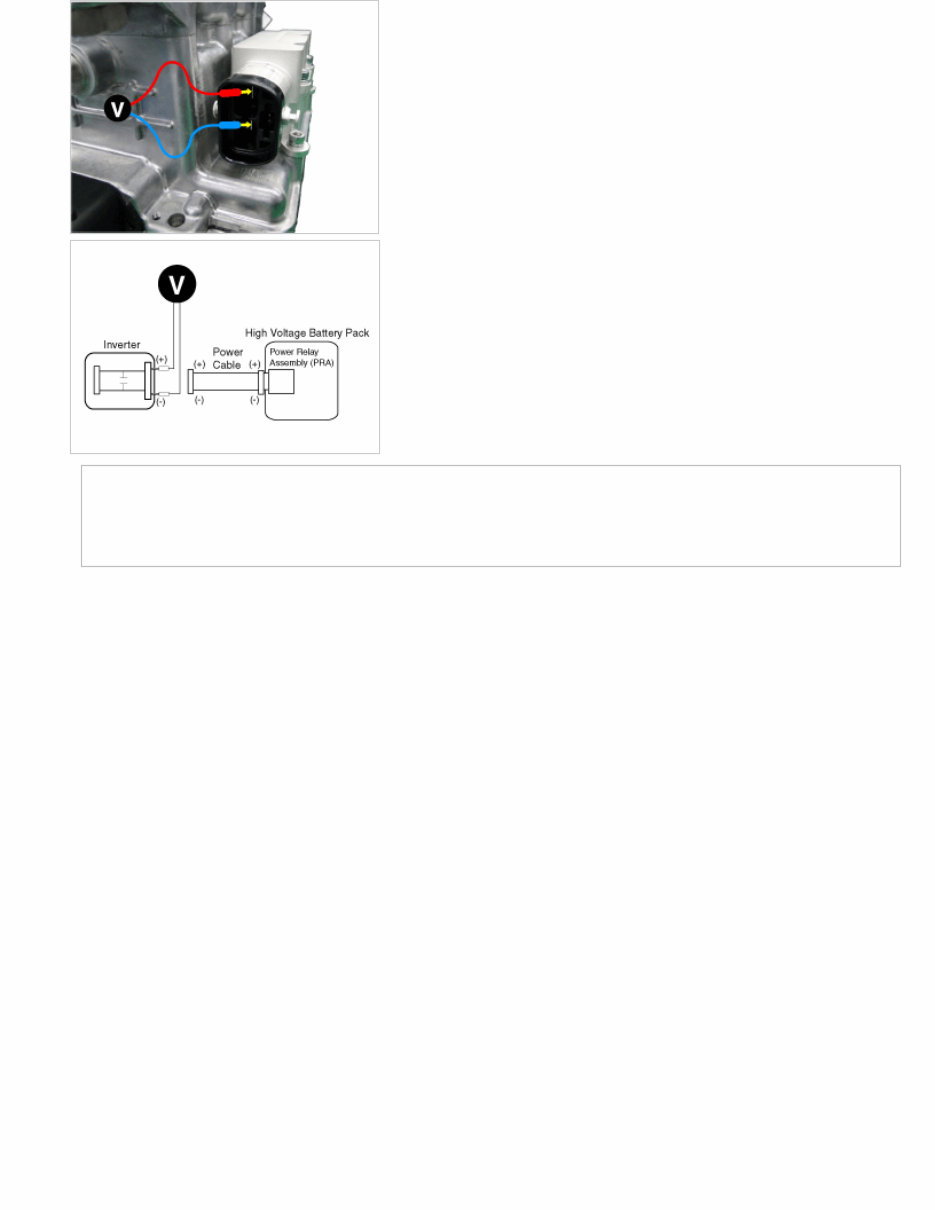
• If measured more than 30V, check if the safety plug is removed completely.If measured more than 30V
despite the safety plug is removed, there can be serious problems on the high voltage circuit. In this case,
check DTC and never touch the high voltage system circuits.

IONIQ Plug-in Hybrid(AE PHEV) > 2020 > G 1.6 GDI PHEV >
- Procedure for entering engine forced activation mode
If the engine needs to be running constantly while the vehicle is stopped to inspect emission gas or perform maintenance
on the vehicle, follow below procedure to enter engine forced activation mode.
1. Place the shift lever in P range while the vehicle is stopped. Engage the parking brake. Then follow below procedure
and enter engine forced activation mode.
• Below procedure [(1) - (5)] for engine forced activation mode must be completed within 60 sec. In case the
procedure is not completed within the time, the process is reset and you must start again from step (1).
(1) Do NOT press on the brake pedal and press the Engine Start/Stop button 2 times to enter IG ON mode.
(2) Place the shift lever in P range and then press the accel pedal 2 times.
(3) Place the shift lever in N range and then press the accel pedal 2 times.
(4) Place the shift lever in P range and then press the accel pedal 2 times.
(5) Press on the brake pedal and press the Engine Start/Stop button to start the engine, and maintain idling.
• Engine will continue to remain idling and engine forced activation mode is maintained even if the gear is
shifted to different range.
2. "READY" lamp blinks in the Cluster when the vehicle is in engine forced activation mode. Check that the "READY"
lamp is blinking to ensure that engine forced activation mode is entered correctly.
• "READY" lamp will continue to blink until engine forced activation mode is cancelled. "READY" lamp will
stop blinking when the forced activation mode is cancelled.
3. Engine forced activation mode can be cancelled by pressing the Engine Start/Stop button and switching to IG OFF
mode.
You're Reading a Preview
What's Included?
 Lifetime Access
Fast Download Speeds
Online & Offline Access
Access PDF Contents & Bookmarks
Full Search Facility
Print one or all pages of your manual
$57.99
2020 Hyundai IONIQ Plug-in Hybrid (AE PHEV) G 1.6 GDI PHEV Service & Repair Manual
Viewed 41 Times Today

What's Included?
Lifetime Access
Fast Download Speeds
Online & Offline Access
Access PDF Contents & Bookmarks
Full Search Facility
Print one or all pages of your manual
$57.99

Secure transaction
What's Included?
Lifetime Access
Fast Download Speeds
Online & Offline Access
Access PDF Contents & Bookmarks
Full Search Facility
Print one or all pages of your manual
The 2020 Hyundai IONIQ Plug-in Hybrid (AE PHEV) G 1.6 GDI PHEV Service & Repair Manual is a comprehensive technical guide designed for both professional mechanics and DIY enthusiasts.
- Suitable for technicians, mechanics, and individuals who need in-depth knowledge to diagnose, repair, and maintain their vehicle.
- Provides detailed instructions on troubleshooting, repair, and comprehensive maintenance, including step-by-step procedures and diagrams.
- Tailored for individuals who need to understand and address the complex inner workings of their vehicle.
- Covers essential information on the vehicle's systems, components, and functions, allowing users to make informed decisions about maintenance and repair.
- Valuable resource for maintaining the performance, reliability, and safety of the vehicle over its lifespan.
This manual is an indispensable tool for anyone who wants toτέchnically maintain and repair their 2020 Hyundai IONIQ Plug-in Hybrid (AE PHEV) G 1.6 GDI PHEV.


