

GENESIS(DH) > 2015 > G 5.0 GDI > General Information
- Important Safety Notice
Proper service methods and repair procedures are essential for safe, reliable operation of all motor vehicles as well as
personal safety of the operator. The service procedures and descriptions in this shop manual provide general directions
for service and repair.
There are various procedures, techniques, tools and pars for service as well as the skill of technicians.
Therefore, it is impossible for this manual to provide advice or caution for each case.
Accordingly, if you use a replacement part, service procedure, or tool which are not recommended by the vehicle
manufacturer, make sure that neither the personal safety nor the safe operation of the vehicle is jeopardized.
Reminds you to be especially careful in those areas where carelessness will cause death or serious injury.
Reminds you to be especially careful in those areas where carelessness may cause death or serious injury.
Reminds you to be especially careful in those areas where carelessness may cause personal injury.
Gives you information that will prevent you from making errors that could damage the vehicle.
Gives you additional information that will help you complete a particular procedure.
The following list contains some general WARNINGS that you should follow while working on a vehicle.
• Always wear safety glasses for eye protection.
• Use safety stands whenever a procedure requires you to be under the vehicle.
• Make sure that the ignition switch is always in the OFF position, unless otherwise required by the procedure.
• Set the parking brake when working on the vehicle. If you have an automatic transaxle, set the vehicle in the P
position.
• Place supporters against the front and rear surfaces of the tires to prepare for the vehicle suddenly moving.
• Operate the engine only in a well-ventilated area to avoid the danger of carbon monoxide poisoning.
• Keep yourself and your clothing away from moving parts when the engine is running, especially the drive belts.
• To prevent serious burns, avoid contact with hot metal parts such as the radiator, exhaust manifold, tail pipe, catalytic
converter and muffler.
• Do not smoke while working on a vehicle.
• To avoid injury, always remove rings, watches, loose hanging jewelry, and loose clothing before beginning to work on
a vehicle.
• When it is necessary to work under the hood, keep hands and other objects clear of the radiator fan blades! Your
vehicle may be equipped with a cooling fan that may turn on, even though the ignition switch is in the OFF position.
For this reason care should be taken to ensure that the radiator fan electric motor is completely disconnected when
working under the hood and that the engine is not running.
GENESIS(DH) > 2015 > G 5.0 GDI > General Information
- Identification Number
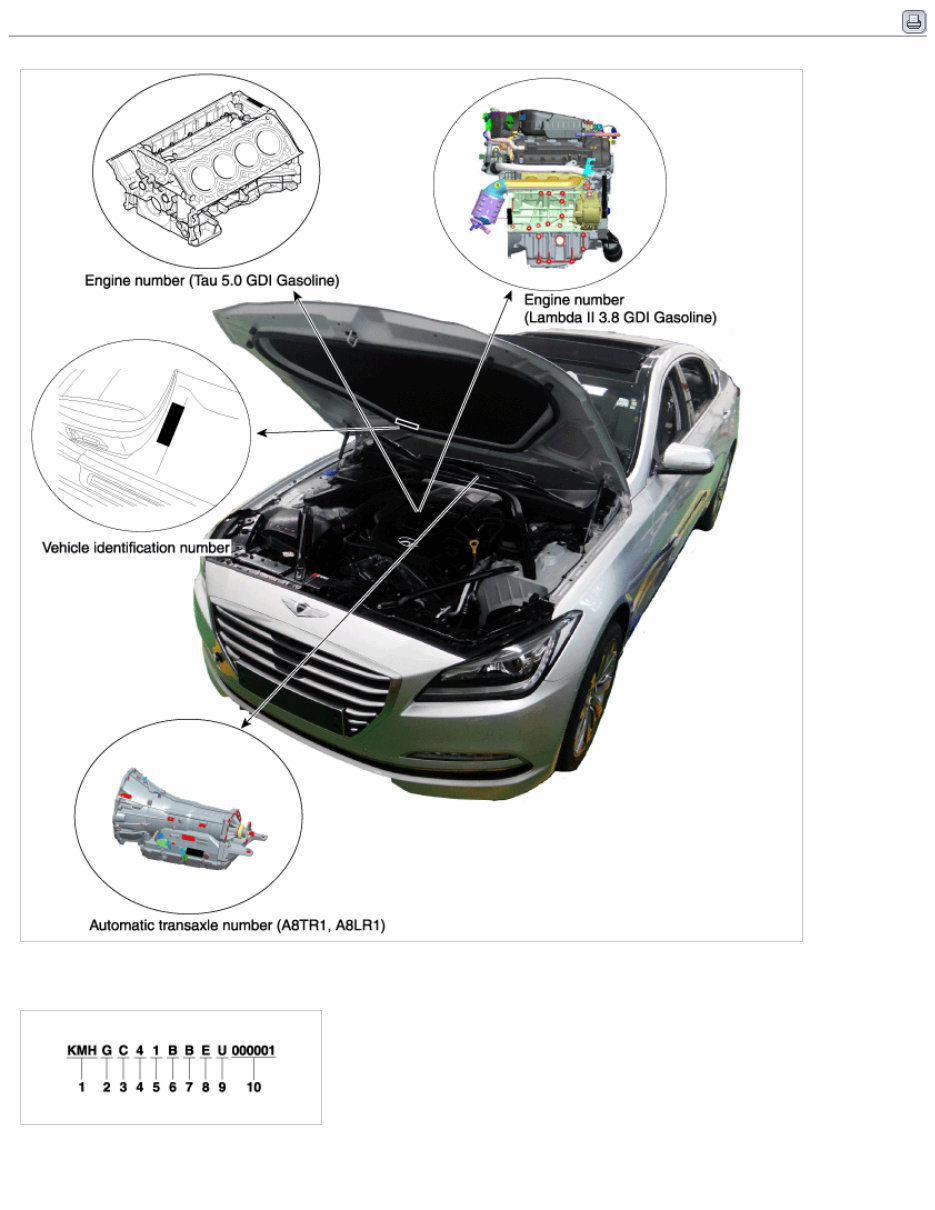
Identification Number Description
Vehicle Identification Number
1. World Manufacturer Identifier (WMI)
- KMF : Commercial vehicle (Van)
- KMH : Passenger vehicle or MPV(Multipurpose Passenger Vehicle)/SUV(Sports Utility Vehicle)/RV(Recreational
Vehicle)

- KMJ : Van
- KM8 : MPV/SUV/RV (For U.S.A, Canada, Mexico)
2. Vehicle line
- G : GENESIS
3.
Model & Series
- L : Low grade (L)
- M : Middle-Low grade (GL)
- N : Middle grade (GLS, JSL, TAX)
- O : Middle-High grade (HGS)
- P : High grade (TOP)
4.Body/Cabin type, Gross Vehicle Weight Rating
KMF (Commercial vehicle / Van)
Except U.S.A, Canada, Mexico, Gulf Cooperation Council, China
- X : Standard Cabin / Semi-Bonnet
- Y : Double Cabin / Bonnet
- Z : Super Cabin / Box
For U.S.A, Canada, Mexico, Gulf Cooperation Council, China
- 3 : Standard Cabin Class-E 4×2 / Semi-Bonnet Class-E 4×2
- 4 : Standard Cabin Class-E 4×4 / Semi-Bonnet Class-E 4×4
- 5 : Standard Cabin Class-F 4×2 / Semi-Bonnet Class-F 4×2
- 6 : Standard Cabin Class-F 4×4 / Semi-Bonnet Class-F 4×4
- 7 : Double Cabin Class-E 4×2 / Bonnet Class-E 4×2
- 8 : Double Cabin Class-E 4×4 / Bonnet Class-E 4×4
- 9 : Double Cabin Class-F 4×2 / Bonnet Class-F 4×2
- 0 : Double Cabin Class-F 4×4 / Bonnet Class-F 4×4
- A : Super Cabin Class-E 4×2 / Box Class-E 4×2
- B : Super Cabin Class-E 4×4 / Box Class-E 4×4
- C : Super Cabin Class-F 4×2 / Box Class-F 4×2
- D : Super Cabin Class-F 4×4 / Box Class-F 4×4
KMH
- 1 : Limousine
- 2 : Sedan - 2 door
- 3 : Sedan - 3 door
- 4 : Sedan - 4 door
- 5 : Sedan - 5 door
- 6 : Coupe
- 7 : Convertible
- 8 : Wagon
- 9 : Commercial Van
- 0 : Pick-Up
KMJ
- 1 : Box
- 2 : Bonnet
- 3 : Semi-Bonnet
KM8
- 1 : Wagon 4×2 Class-A
- 2 : Wagon 4×2 Class-B
- 3 : Wagon 4×2 Class-C
- 4 : Wagon 4×2 Class-D
- 5 : Wagon 4×2 Class-E
- 6 : Wagon 4×2 Class-F
- 7 : Wagon 4×2 Class-G
- A : Wagon 4×4 Class-A
- B : Wagon 4×4 Class-B
- C : Wagon 4×4 Class-C
- D : Wagon 4×4 Class-D
- E : Wagon 4×4 Class-E
- F : Wagon 4×4 Class-F
- G : Wagon 4×4 Class-G

5. Restraint system, Brake system
KMH, KM8
Except U.S.A, Canada, Mexico
- 0 : Both side - None
- 1 : Both side - Active belt
- 2 : Both side - Passive belt
For U.S.A, Canada, Mexico
Code
Seat
belt
Front air bag Knee air bag Side air bag Curtain air bag
Driver''s Passenger''s Driver''s Passenger''s 1st row 2nd row
3rd
row
1st row 2nd row 3rd row
A ○ ○ ○ × × ○ × × ○ ○ ×
B ○ ○ ○ × × × × × × × ×
C ○ ○ ○ × × ○ × × ○ ○ ○
D ○ ○ ○ × × ○ ○ × ○ ○ ×
E ○ ○ × × × × × × × × ×
F ○ ○ ○ × × ○ × × × × ×
J ○ ○ ○ ○ × ○ ○ × ○ ○ ×
L ○ ○ ○ ○ × ○ × × ○ ○ ×
N ○ × × × × × × × × × ×
KMJ
Except U.S.A, Canada, Mexico
- 7 : Hydraulic brake system
- 8 : Pneumatic brake system
- 9 : Mixed brake system
For U.S.A, Canada, Mexico
- X : Hydraulic brake system
- Y : Pneumatic brake system
- Z : Mixed brake system
KMF
Except U.S.A, Canada, Mexico
- 7 : Hydraulic brake system
- 8 : Pneumatic brake system
- 9 : Mixed brake system
For U.S.A, Canada, Mexico
Code
Restraint system Brake system
Seat
belt
Front air bag Knee air bag Side air bag
Curtain air
bag
Hydrauric Pneumatic Mixed
Driver''s Passenger''s Driver''s Passenger''s
1st
row
2nd
row
3rd
row
1st
row
2nd
row
3rd
row
X ○ × × × × × × × × × × ○ - -
V ○ ○ × × × × × × × × × ○ - -
W ○ ○ ○ × × × × × × × × ○ - -
6. Engine type
- E : Gasoline engine 3.8 (Lambda II GDI)
- F : Gasoline engine 5.0 (Tau GDI)
7. Check digit or Driver’s side & Transmission
Except U.S.A, Canada, Mexico, Gulf Cooperation Council, China, Yemen
- A : LHD & MT
- B : LHD & AT
- C : LHD & MT+Transfer

- D : LHD & AT+Transfer
- E : LHD & CVT
- L : RHD & MT
- M : RHD & AT
- N : RHD & MT+Transfer
- S : RHD & AT+Transfer
- T : RHD & CVT
For U.S.A, Canada, Mexico, Gulf Cooperation Council, China, Yemen
- Check digit : 0 ~ 9, ×
8. Model year
- A : 2010, B : 2011, C : 2012, D : 2013, E : 2014, F: 2016 …
9. Plant of production
- A : Asan (Korea)
- C : Cheonju (Korea)
- U : Ulsan (Korea)
10. Vehicle production sequence number
- 000001 ~ 999999
Paint Code
Code Color
AU Sterling Silver
YB6 Onyx Black
YW6 Marble White
Y6S Platinum Silver
V6S Polished Metal
U6G Urban Gray
P6G Sand Opal
YR6 Burgundy Red
WU6 Cost Blue
XU6 Haze Blue
YN6 Ten Braun
NR6 Black Purple
Engine Number
1. Engine fuel
– G : Gasoline
2. Engine range
– 6 : 4 cycle 6 cylinder
– 8 : 4 cycle 8 cylinder
3 : Engine development order
– D : Lamda engine
– B : Tau engine
4. : Engine capacity
– E : (Tau 5.0 GDI)
– J : 3778cc (Lambda Ⅱ 3.8 GDI)
5. Model year

– A : 2010, B : 2011, C : 2012, D : 2013, E : 2014, F: 2016 …
6. Plant of production
– A : Asan (Korea)
– B : Beijing (China)
– H : Hwasung (Korea)
– K : Montgomery (U.S.A)
– M : Chennai (India)
– P : Poseung (Korea)
– S : Sohari (Korea)
– T : Izmit (Turkey)
– U : Ulsan (Korea)
– W : Shandong (China)
– Z : Zilina (Slovakia)
– 1 : Yancheng (China)
7. Engine production sequence number
– 000001 ~ 999999
Transaxle Number
Automatic
1. Model
- XA : A8TR1
- YA : A8LR1
2. Model year
- A : 2010, B : 2011, C : 2012, D : 2013, E : 2014, F: 2016 …
3. Engine
- A : Lambda engine
- M : Tau engine
4. Detailed classification
- B : SBC
5. Transaxle production sequence number
- 000001 ~ 999999
GENESIS(DH) > 2015 > G 5.0 GDI > General Information
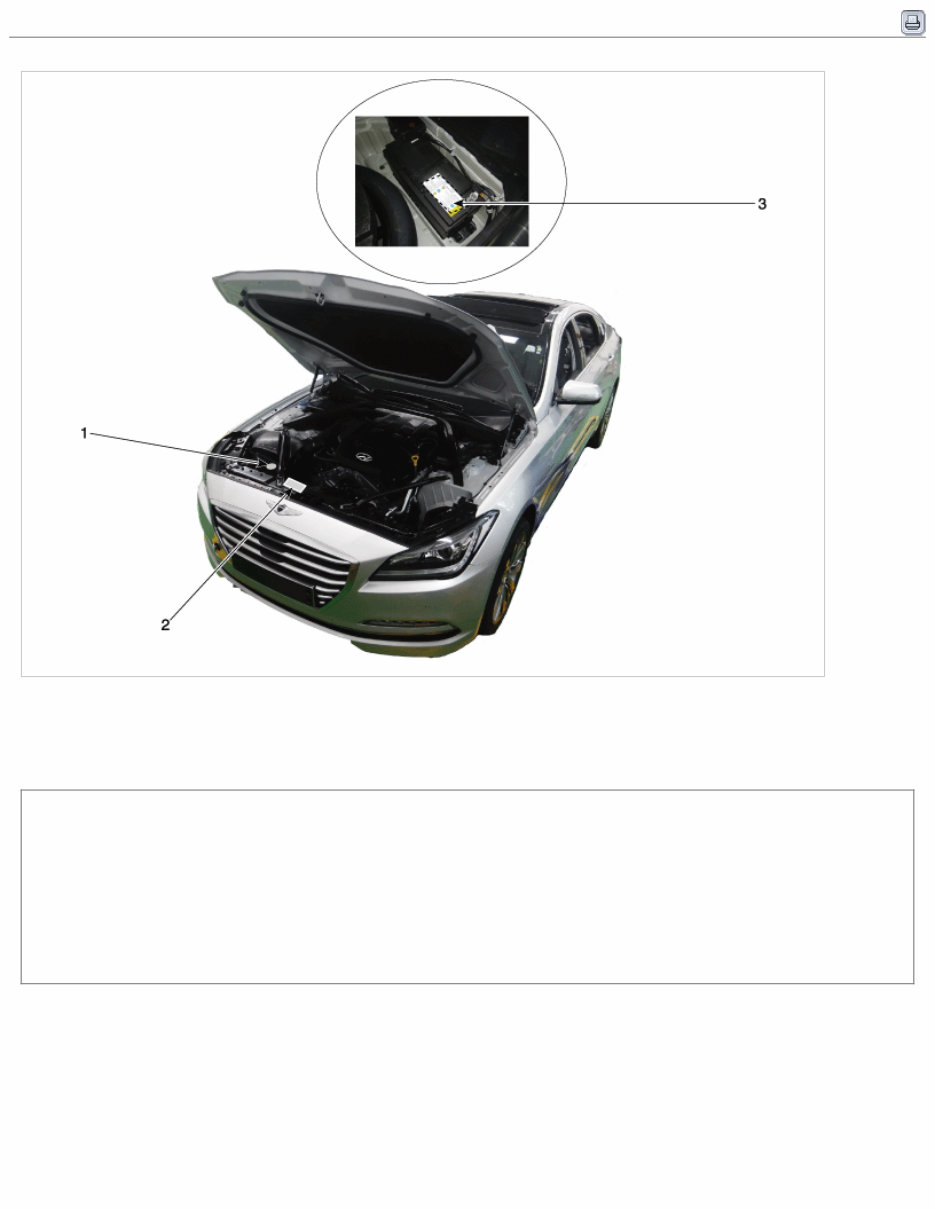
- Warning and Caution Labels
1. Radiator cap caution
2. Fan caution
3. Battery caution
Attention
Srs Vehicle
This car is equipped with a supplemental restraint system. To provide continued reliability, certain elements of the
supplemental restraint system shall be serviced or replaced by an authorized dealer ten years after vehicle label.For
further information. see owner''s manual.
Side Air Bag
This vehicle is equipped with a side airbag system. To provide continued reliability, certain elements of the side airbag
system shall be serviced or vehicle manufacturing date shown on the certification label. For further information, refer to
the owner’s manual.
Battery Caution Label Description
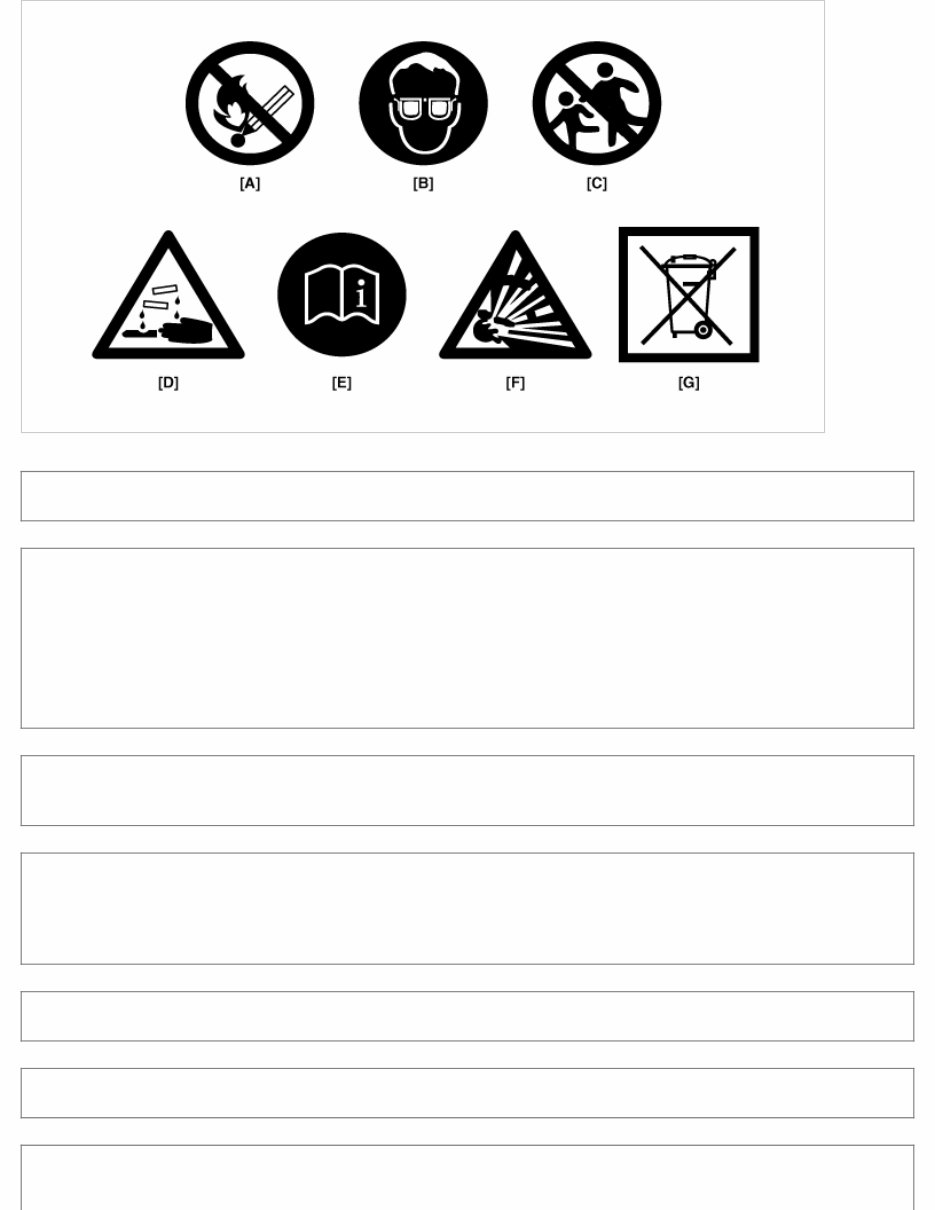
Warning / Caution Label (Cont''d)
A.
Keep lighted cigarettes and all other flames or sparks away from the battery.
B.
Wear safety glasses for eye protection when charging or working near a battery. Always provide ventilation when
working in an enclosed space.
• When lifting a plastic-cased battery, excessive pressure could cause acid leakage, resulting in personal injury. Lift a
battery with a battery carrier or with your hands on opposite corners.
• Never attempt to change the battery when the battery cables are connected.
• The electrical ignition system works with high voltage.
Never touch these components with the engine running or the ignition switch on.
C.
Keep batteries out of the reach of children because batteries contain highly corrosive SULFURIC ACID. Do not allow
battery acid to contact your skin, eyes, clothing or paint finish.
D.
If any electrolyte gets into your eyes, rinse off your eyes with clean water for at least 15 minutes and get immediate
medical attention. If possible, continue to apply water with a sponge or cloth until medical attention is received.
If electrolyte gets on your skin, thoroughly wash the contacted area. If you feel a pain or a burning sensation, get
medical attention immediately.
E.
Always read the following instructions carefully before handling a battery.
F.
Hydrogen, which is a highly combustible gas,is always contained in battery cells and may explode if ignited.
G.
An improperly disposed battery can be harmful to the environment and human health.

Always confirm local regulations for battery disposal.
Battery Handling and Storage
Battery • Batteries should be stored in cool, dry (27 degrees Celsius) places and out of
direct sunlight.
• MF batteries are tightly sealed to prevent acid leakage.
However, tilting the battery to an angle of 45 degrees can cause acid to leak
through the vents on the sides. Therefore, batteries should always be stored in
their upright positions. Do not place any solution or objects (i.e. conductors) on
top of the battery.
• It is extremely dangerous to use tools, such as hammers, on the battery terminals
when connecting cables to the mounted battery.
Battery installed in vehicle • When storing the vehicle for long periods of time, make sure to remove the
battery fuse from the junction box to prevent natural discharging.
• In case of the vehicle stored with the battery fuse connected, run the engine for
battery charging within one month from the start of vehicle storage.
In case of the vehicle stored with the battery fuse disconnected, run the engine
for battery charging within three months from the start of vehicle storage.
After reconnecting or recharging a discharged battery, the ESP OFF indicator may illuminate.
In this case, turn the handle half way to the left and right whilst the ignition switch is in the ON position.
Then, restart the engine after the ignition is OFF.
The ESP OFF indicator may turn OFF.
If the ESP OFF indicator does not turn OFF, have the system checked by referring to DTC. (Refer to the BR group.)
GENESIS(DH) > 2015 > G 5.0 GDI > General Information
- Lift And Support Points
When heavy rear components such as suspension, fuel tank, spare tire, tailgate and trunk lid are to be removed,
place additional weight in the luggage area before hoisting. When substantial weight is removed from the rear of the
vehicle, the center of gravity may change and can cause the vehicle to tip forward on the hoist.
• With each tire/wheel assembly weighing approximately 30lbs (14kg), placing the front wheels in the luggage
area can help the weight distribution.
• Use the same support points to support the vehicle on safety stands.
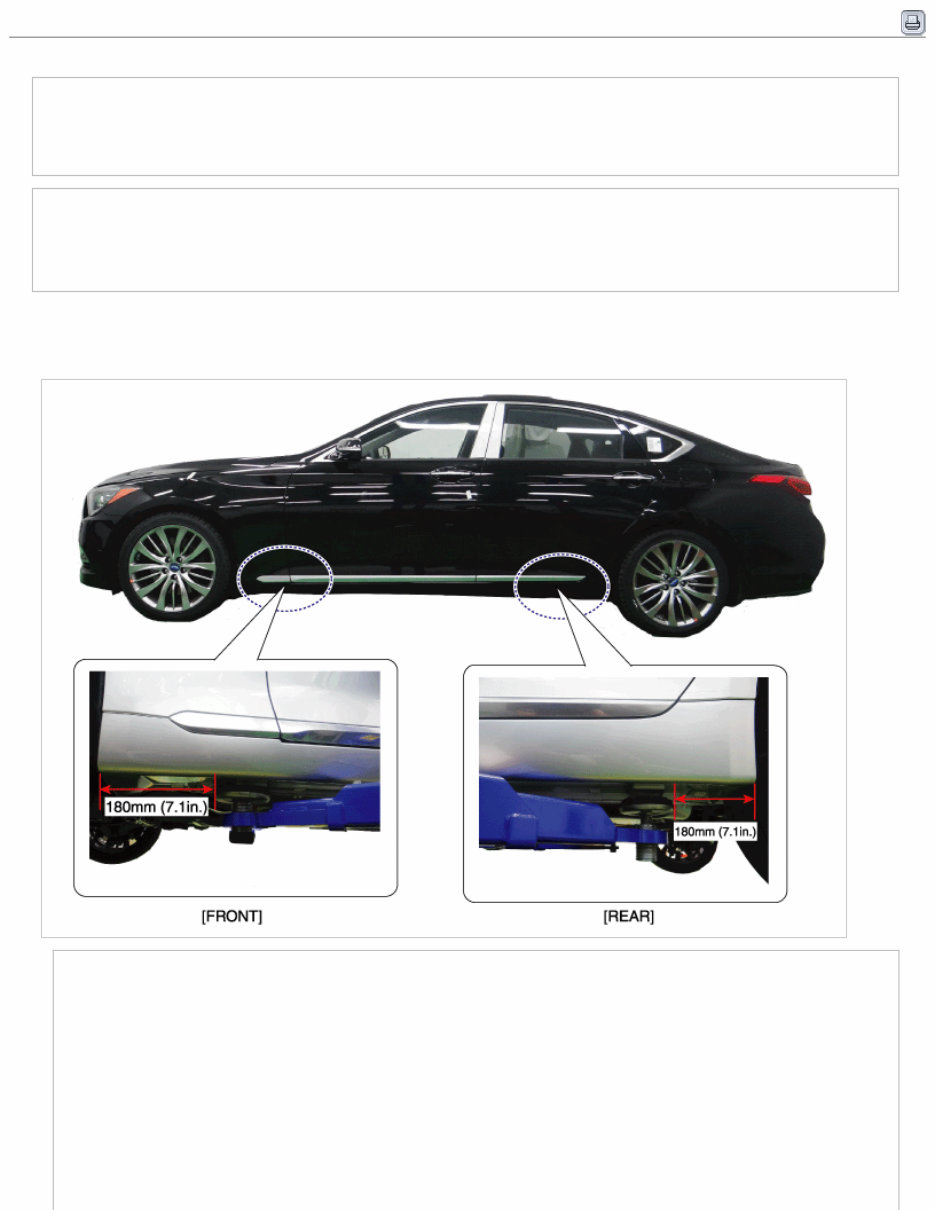
1. Place the lift blocks under the support points as shown in the illustration.
2. Raise the hoist a few inches (centimeters) and rock the vehicle to make sure that the vehicle is firmly supported.
3. Raise the hoist to full height to check whether the vehicle is firmly supported.
• Do not jack up about 180mm (7.1 in.) from the edge of S/SILL MLD''s.
• Place the support within 45mm (1.7in.) from the back or forth of jack up notch.
You're Reading a Preview
What's Included?
 Lifetime Access
Fast Download Speeds
Online & Offline Access
Access PDF Contents & Bookmarks
Full Search Facility
Print one or all pages of your manual
$37.99
2015 Hyundai GENESIS (DH) G 5.0 GDI Service & Repair Manual
Viewed 13 Times Today

What's Included?
Lifetime Access
Fast Download Speeds
Online & Offline Access
Access PDF Contents & Bookmarks
Full Search Facility
Print one or all pages of your manual
$37.99

Secure transaction
What's Included?
Lifetime Access
Fast Download Speeds
Online & Offline Access
Access PDF Contents & Bookmarks
Full Search Facility
Print one or all pages of your manual
Description
The 2015 Hyundai GENESIS (DH) G 5.0 GDI Service & Repair Manual provides comprehensive guidance for diagnosing, repairing, and maintaining your vehicle. This technical guide is suitable for both professional mechanics and DIY enthusiasts.
- Includes detailed instructions on troubleshooting and repair procedures for various systems and components
- Features diagrams, specifications, and step-by-step procedures for in-depth understanding and repair
- Covers regular maintenance and servicing requirements, ensuring your vehicle runs smoothly and efficiently
- valve clearance adjustment, brake flushing, and timeout replacement
- Airbag system reset and testing procedures
- In-depth information on engine and transmission maintenance
- General maintenance information, such as tire pressure, lubrication, and battery maintenance
This manual is designed to provide the technical information needed to understand and address the inner workings of your vehicle, making it an essential resource for anyone looking to perform routine maintenance, diagnose issues, or perform repairs.


