1991 Ford Thunderbird Service & Repair Manual Software
What's Included?
Lifetime Access
Fast Download Speeds
Offline Viewing
Access Contents & Bookmarks
Full Search Facility
Print one or all pages of your manual
E - THEORY/OPERATION - 4.6L 1996 ENGINE PERFORMANCE Ford Motor Co. - Theory & Operation - EEC-V INTRODUCTION This article covers basic description and operation of engine performance-related systems and components. Read this article before diagnosing vehicles or systems with which you are not completely familiar. COMPUTERIZED ENGINE CONTROLS CONTROLS Powertrain Control Module (PCM) PCM monitors engine operating conditions by input received from engine sensors. Control of output actuators determines fuel mixture and idle speed. PCM is located behind right kick panel. The engine control system consists of the PCM, relays, modules, sensors, switches and actuators. The PCM sends out electrical reference signals to engine sensors and then analyzes the return signals. The engine sensors supply the PCM with specific information, in the form of electrical signals, to determine engine operating conditions. In the event of a sensor or actuator failure, the PCM initiates an alternative strategy called Failure Mode Effects Management (FMEM) to allow the vehicle to maintain driveability. In the event of PCM failure, Hardware Limited Operation Strategy (HLOS) will be activated. HLOS is a system of alternate circuitry that provides minimal engine operation if the PCM fails. During HLOS, all self-test function will stop and system will be controlled by electronic hardware. Malfunction Indicator Light (MIL) will remain on whenever FMEM or HLOS is in operation. FMEM and HLOS substitute a fixed signal and continue to monitor system failure. If signal(s) return to within operating limits, PCM will resume normal operation. Constant Control Relay Module (CCRM) CCRM interfaces with the PCM to control cooling fan, A/C clutch and fuel pump operation. The CCRM also incorporates electronic engine control power relay to supply power to the EEC-V system. Fuel Pump Driver Module (FPDM) FPDM interfaces with the PCM to control fuel pump operation. By controlling fuel pump operation, noise and the amount of hot fuel returned to the fuel tank is minimized. If FPDM or system fail self-test, DTC P1230, P1233, P1234, P1235 P1236, P1237 or P1238 may be set in PCM memory. NOTE: Components are grouped into 2 categories. The first category covers INPUT DEVICES, which control or produce voltage signals monitored by the control unit. The second category covers OUTPUT SIGNALS , covering components controlled by the PCM. 1996 Ford Thunderbird LX E - THEORY/OPERATION - 4.6L 1996 ENGINE PERFORMANCE Ford Motor Co. - Theory & Operation - EEC-V 1996 Ford Thunderbird LX E - THEORY/OPERATION - 4.6L 1996 ENGINE PERFORMANCE Ford Motor Co. - Theory & Operation - EEC-V
INPUT DEVICES Vehicles are equipped with different combinations of input devices. Not all devices are used on all models. To determine the input device used on a specific model, see wiring diagram in the WIRING DIAGRAMS article. The available input signals include the following: Brake On/Off (BOO) Switch BOO switch is wired to brakelight circuit. It signals the PCM when the brake is applied. The BOO input is used to adjust engine idle when A/C is in use and to control torque converter clutch lock/unlock strategy. Camshaft Position (CMP) Sensor EEC-V uses 2 types of CMP sensors. A variable reluctance sensor is used. CMP sensor is used to determine the position of the camshaft and to identify when piston No. 1 is at TDC of compression stroke. CMP sensor provides cylinder identification information during engine start-up for PCM to initiate correct firing order. Cylinder identification information signal is sent from CMP sensor to PCM through CID circuit. Clutch Pedal Position (CPP) Switch CPP switch is mounted near clutch pedal. CPP indicates clutch pedal position by means of an on/off switch signal. This signal is used by PCM to determine clutch pedal position and on some models, gear shift selector position. Coolant Temperature Sensor See ENGINE COOLANT TEMPERATURE (ECT) SENSOR (Below). Crankshaft Position (CKP) Sensor CKP sensor is a Hall Effect magnetic switch. The Hall Effect switch is activated by vanes on the crankshaft damper and pulley assembly. The Profile Ignition Pick-Up (PIP) is a crankshaft position signal that is sent to the PCM. The PIP signal generated by the Hall Effect sensor provides base timing and RPM information to the PCM. Cylinder Head Temperature (CHT) Sensor CHT sensor is the input signal used for the cooling system failsafe strategy. CHT sensor signals PCM to activate failsafe strategy if cylinder head temperature exceeds pre-programmed conditions. If CHT sensor or system fail self-test, DTC P1288, P1289, P1290 or P1299 may set in PCM memory. Data Link Connector (DLC) The 16-pin Data Link Connector (DLC) is used to perform the Quick Test diagnostic procedure. When scan tool connected to DLC, fault code output function can be activated. Differential Pressure Feedback EGR (DPFE) Sensor 1996 Ford Thunderbird LX E - THEORY/OPERATION - 4.6L 1996 ENGINE PERFORMANCE Ford Motor Co. - Theory & Operation - EEC-V
See EGR SYSTEM under EMISSION SYSTEMS. Electronic Vacuum Regulator (EVR) Solenoid See EGR SYSTEM under EMISSION SYSTEMS. Engine Coolant Temperature (ECT) Sensor ECT sensor is a thermistor device which changes resistance proportionate to temperature changes. ECT sensor inputs coolant temperature to the PCM. ECT sensor is threaded into heater outlet fitting or coolant passage. Engine RPM/Vehicle Speed Limiter System The engine RPM/vehicle speed limiter system is integrated into PCM. The purpose of this system is to prevent damage to the powertrain in overspeed conditions. Whenever engine RPM or vehicle speed is detected, PCM will disable some or all of the fuel injectors. This will cause engine to run rough and DTC P1270 will set in PCM memory. When overspeed condition has been discontinued, normal engine operating conditions will be restored. Fan Monitor (FANM) FANM circuit is spliced into the Power-To-Low Speed Fan circuit. PCM monitors FANM circuit for diagnostic purposes. When cooling fan(s) is off, FANM circuit voltage is pulled low by path to ground through cooling fan. With FANM circuit voltage low, PCM can verify FANM circuit and Power-To-Low Speed Fan circuit are complete from FANM splice through cooling fan to ground. This also confirms that circuits are not shorted to power. When fan is on, voltage is supplied from CCRM to the appropriate Power-To-Fan and FANM circuit. With cooling fan on and FANM circuit high, PCM can verify fan control relay contacts in the CCRM are closed and that battery voltage is being supplied to the CCRM for the LFC and HFC relays. See CCRM circuit schematic in CIRCUIT TEST X in the TESTS W/CODES article for more information. Fuel Pump Monitor (FPM) FPM circuit is spliced into the Power-To-Pump circuit and used by the PCM for diagnostic purposes. The PCM sources a low current voltage down the FPM circuit. With the fuel pump off, voltage is pulled low by the path to ground through the fuel pump. With the fuel pump off and the FPM circuit low, the PCM can verify that FPM and, circuit and Power-To-Pump circuit are complete from the FPM splice through the fuel pump to ground. With the fuel pump on, voltage is supplied from the CCRM to the Power-To-Pump and FPM circuits. With the fuel pump on and FPM circuit high, PCM can verify that Power-To-Pump circuit from CCRM to FPM splice is complete. It can also verify that fuel pump relay contacts are closed and battery voltage is supplied to CCRM for the relay. See CCRM circuit schematic in CIRCUIT TEST X in the TESTS W/CODES article for more 1996 Ford Thunderbird LX E - THEORY/OPERATION - 4.6L 1996 ENGINE PERFORMANCE Ford Motor Co. - Theory & Operation - EEC-V
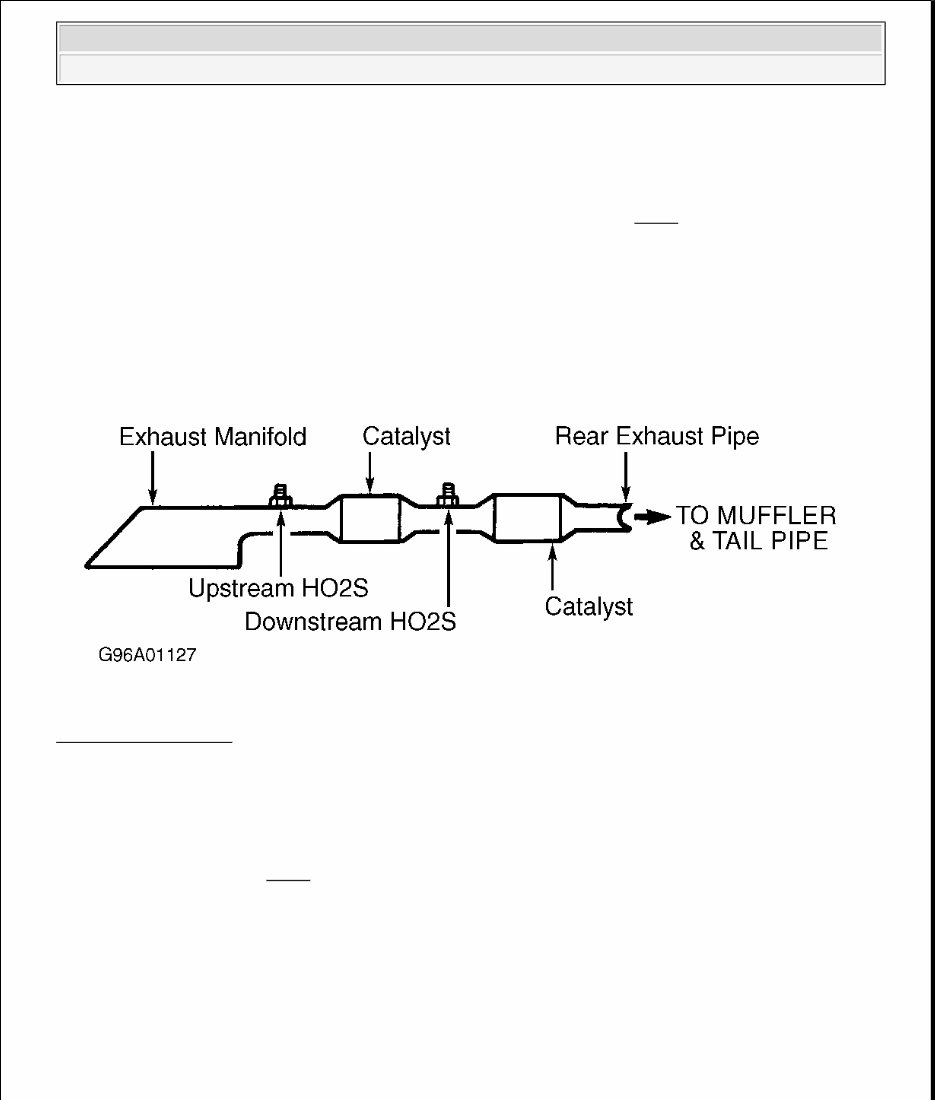
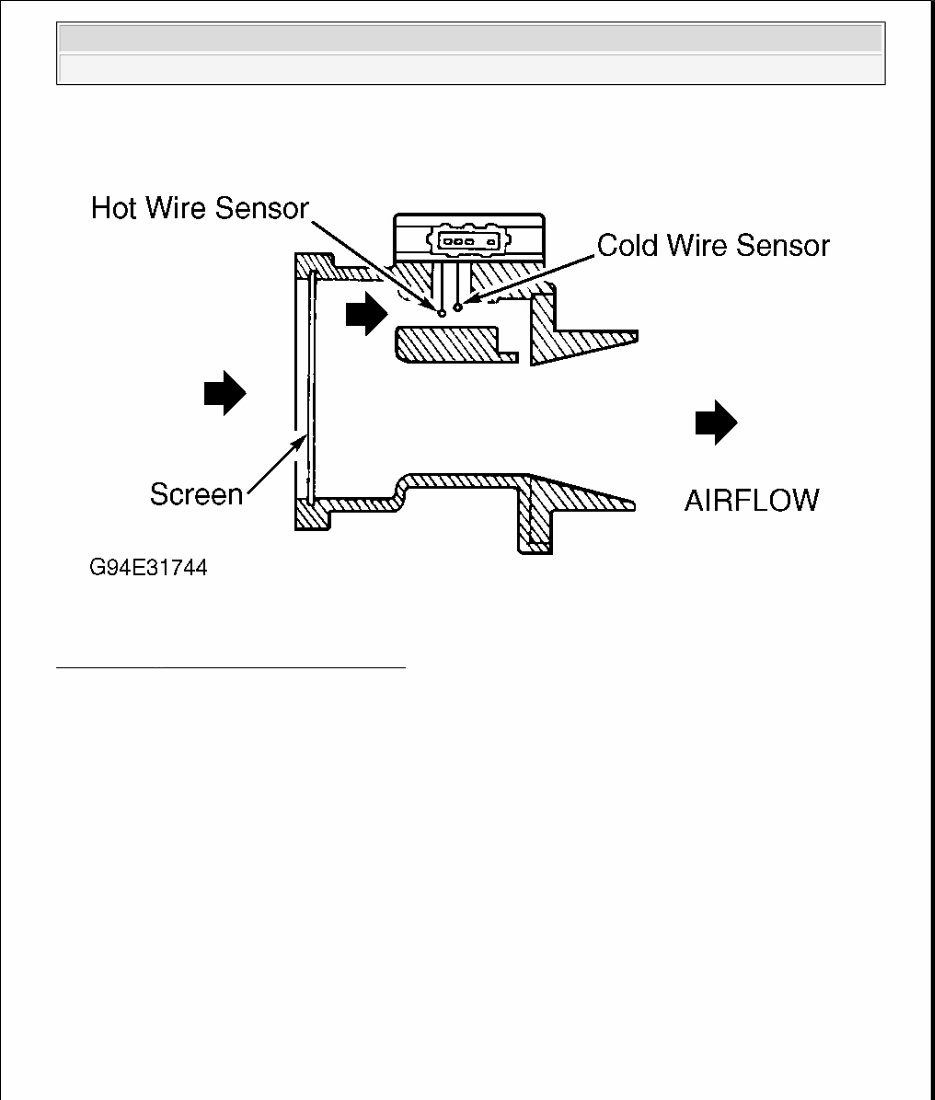
information. Heated Oxygen Sensor (HO2S) The heated oxygen sensors are mounted in the exhaust manifold and pipe. See Fig. 1 . HO2S sensor uses a built-in heating circuit. The heating circuit is used to bring the HO2S sensor up to operating temperature, enabling faster conversion to closed-loop operation. HO2S monitors oxygen content of exhaust gases. When HO2S is at operating temperature, a voltage signal is produced, which varies according to oxygen content of exhaust gases. Signal is transmitted to the PCM and is translated into a rich or lean mixture signal. Fig. 1: Locating HO2S Courtesy of FORD MOTOR CO. Mass Airflow (MAF) Sensor MAF sensor uses a hot wire sensing element to measure amount of air entering the engine. Air passing over the hot wire causes it to cool. The hot wire is maintained at 392°F (200°C) above ambient temperature, as measure by a constant cold wire. See Fig. 2 . The current required to maintain hot wire operating temperature is proportional to the intake air mass. The PCM calculates the fuel injector pulse width in order to provide the desired air/fuel ratio. 1996 Ford Thunderbird LX E - THEORY/OPERATION - 4.6L 1996 ENGINE PERFORMANCE Ford Motor Co. - Theory & Operation - EEC-V
Fig. 2: Cross - Sectional View Of MAF Sensor Courtesy of FORD MOTOR CO. Octane Adjust Shorting Bar The octane adjust shorting bar is used to retard spark. A diagnostic trouble code will set if Octane Adjust Shorting Bar is removed or, if an open circuit is present. Output Shaft Speed (OSS) Sensor The OSS sensor is a magnetic pick-up that sends a voltage signal to the PCM. This signal tells the PCM transmission output shaft speed. Voltage is also used for shift schedules, modulated converter clutch control, and determining EPC pressure. OSS sensor is located on the rear of transmission case, on driver's side of vehicle. Control functions associated with OSS sensor are limiting vehicle speed, converter clutch control and shift quality. Park/Neutral Position (PNP) Switch PNP switch is mounted on transmission selector lever. PNP indicates shift lever position by means of a variable resistance signal. This signal is used by PCM to determine gear shift selector position. Throttle Position (TP) Sensor 1996 Ford Thunderbird LX E - THEORY/OPERATION - 4.6L 1996 ENGINE PERFORMANCE Ford Motor Co. - Theory & Operation - EEC-V
The 1991 Ford Thunderbird Service & Repair Manual is a comprehensive guide designed to assist owners in maintaining and repairing their vehicles. This manual provides detailed step-by-step instructions, diagrams, and illustrations for a range of repair and maintenance tasks.
Whether you are a professional mechanic or a DIY enthusiast, this manual is a valuable resource that provides accurate and reliable information. It covers various models, including:
1991 Ford Thunderbird Base 3.8L V6
1991 Ford Thunderbird SC 3.8L V6
1991 Ford Thunderbird LX 3.8L V6
By following the instructions provided in this manual, you can save time and money by performing repairs and maintenance tasks yourself. It is compatible with Windows computers and offers easy navigation and search functionality.
Don't let minor issues with your 1991 Ford Thunderbird become major headaches. With the 1991 Ford Thunderbird Service & Repair Manual, you can confidently tackle various repairs and keep your vehicle in optimal condition.
Recently Viewed
5,521,897Happy Clients
2,594,462eManuals
1,120,453Trusted Sellers
15Years in Business
Price:
Actual Price:
1991 Ford Thunderbird Service & Repair Manual Software



 Lifetime Access