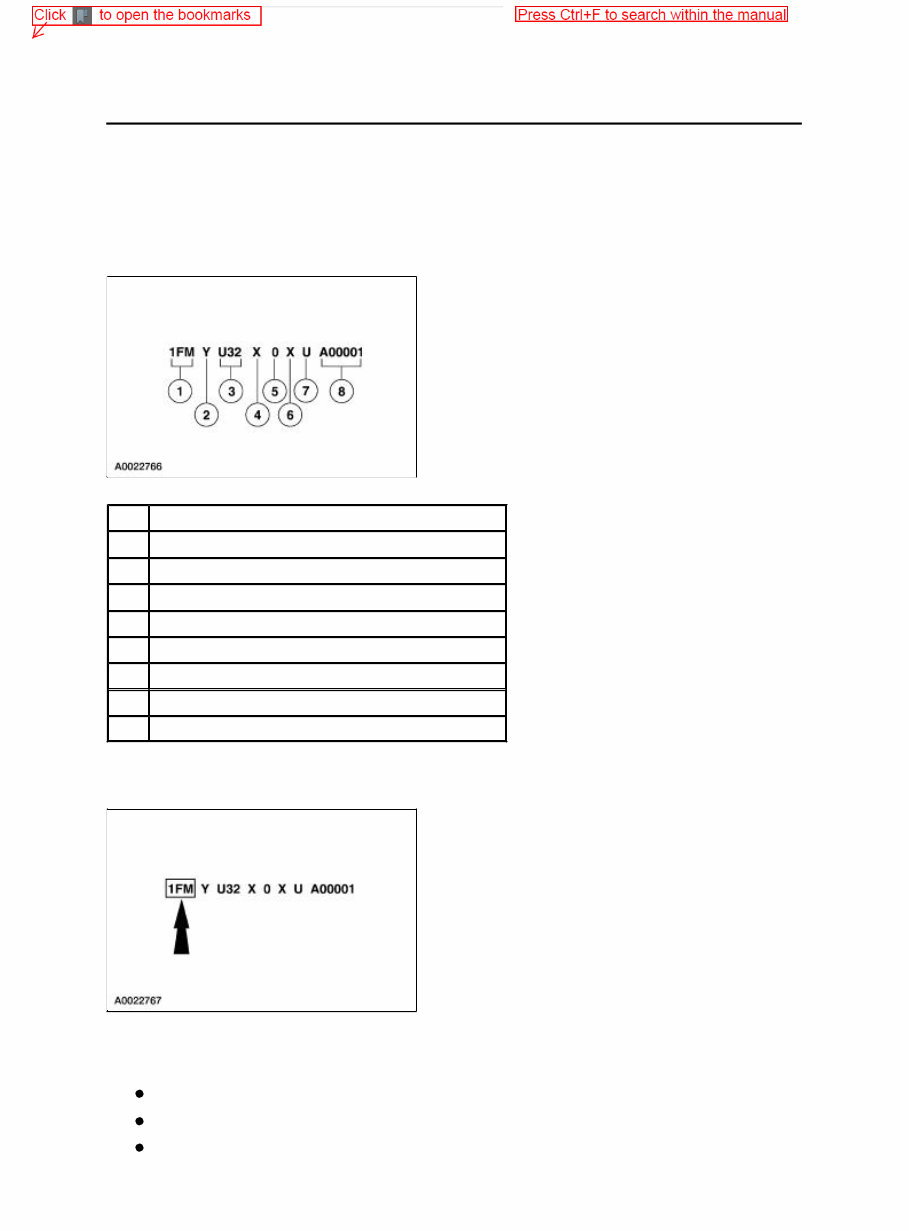
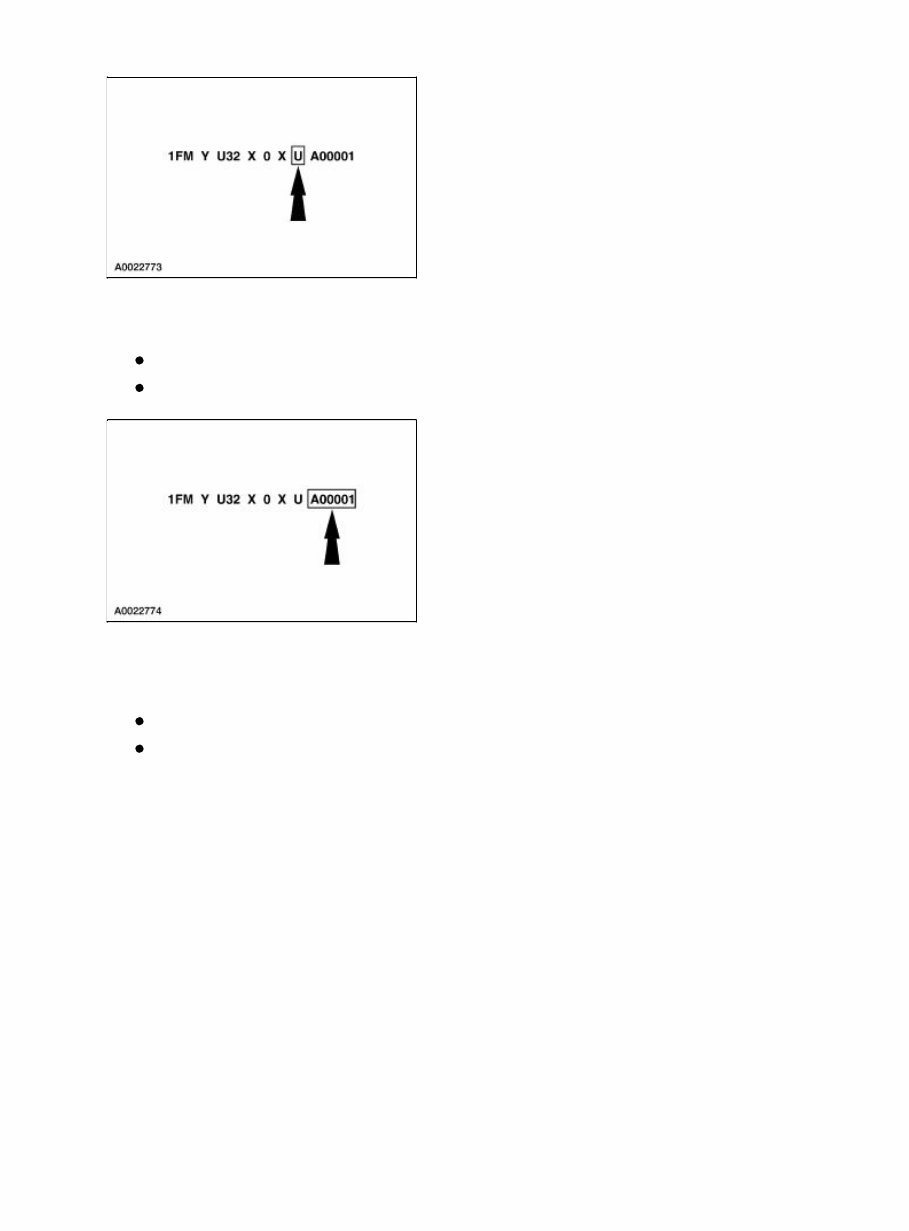
DESCRIPTION AND OPERATION Identification Codes The vehicle identification number (VIN) is a seventeen-digit combination of letters and numbers. The VIN is stamped on a metal tab riveted on the instrument panel top upper left of the dash. The VIN number is also found on the vehicle certification (VC) label. Vehicle Identification Number The first three vehicle identification number (VIN) positions are the world manufacturer code. 1FM — Ford Motor Company, USA, multi-purpose vehicle 2FM — Ford Motor Company, Canada 4M2 — Mercury, USA, multi-purpose vehicle SECTION 100-01: Identification Codes 1999 Explorer/Mountaineer Workshop Manual Item Description 1 World manufacturer identifier 2 Brake type and gross vehicle weight rating (GVWR) 3 Vehicle line, series, body type 4 Engine type 5 Check digit 6 Model year 7 Assembly plant 8 Production sequence number 25.03. 2012 file:///C:/Ford/1996-1999/tsocache/SHEF_5252/SXN~us~en...
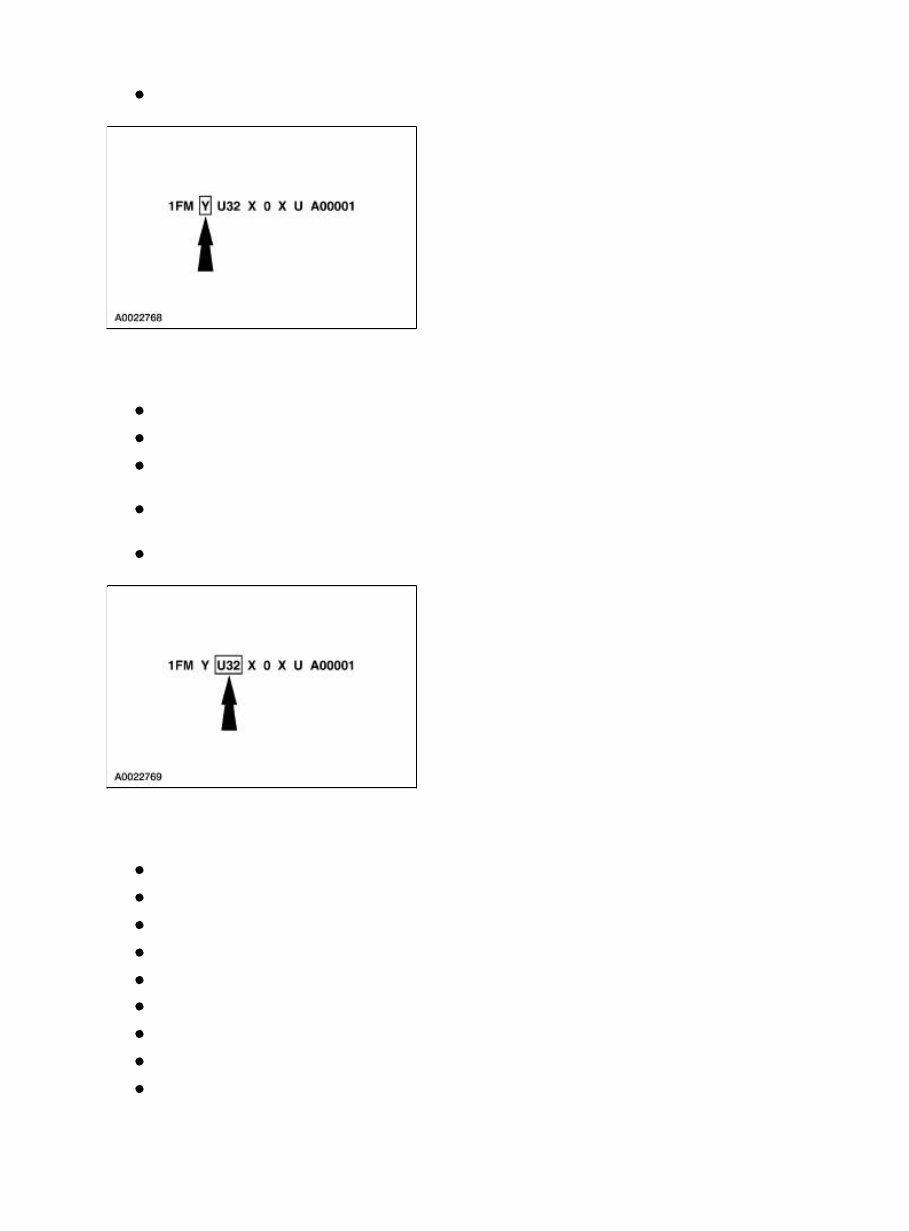
IFC — Ford Motor Company, USA, basic stripped chassis The fourth VIN position is the vehicle brake type and GVW code (all vehicles use hydraulic brakes). Y — 4,001-5,000 pounds GVWR with driver and front passenger second generation air bags. Z — 5001-6000 pounds GVWR with driver and front passenger second generation air bags. C — 4,001-5,000 pounds GVWR with driver and front passenger second generation air bags, driver and passenger side impact air bags D — 5,001-6,000 pounds GVWR with driver and front passenger second generation air bags, driver and passenger side impact air bags. M — 5,001-6,000 pounds GVWR without air bags (US Postal). Positions 5 through 7 indicate vehicle line, series and body type. U22 — Explorer (2-door), 4x2 U32 — Explorer (4-door), 4x2 U24 — Explorer (2-door), 4x4 U34 — Explorer (4-door), 4x4 U35 — Explorer (4-door), AWD U52 — Mountaineer (4-door) 4x2 U54 — Mountaineer (4-door) 4x4 U55 — Mountaineer (4-door) AWD U69 — Explorer, Postal stripped chassis (RDH), 4x2 25.03. 2012 file:///C:/Ford/1996-1999/tsocache/SHEF_5252/SXN~us~en...
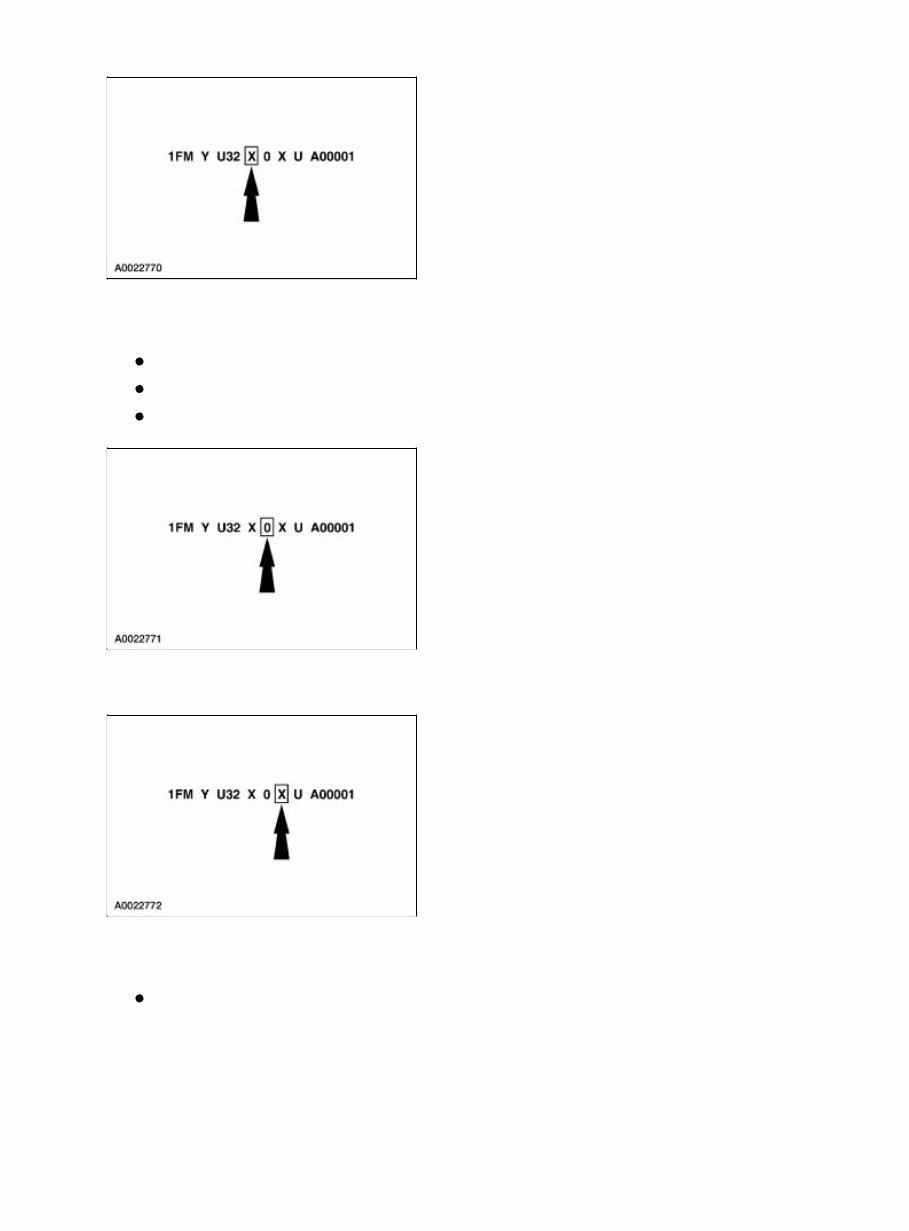
The eighth VIN position is the engine displacement and number of cylinders. X — 4.0L EFI-OHV, six cylinder E — 4.0L EFI-SOHC, six cylinder P — 5.0L EFI, eight cylinder The ninth VIN position is a check digit. The tenth VIN position is the model year code. X — 1999 25.03. 2012 file:///C:/Ford/1996-1999/tsocache/SHEF_5252/SXN~us~en...
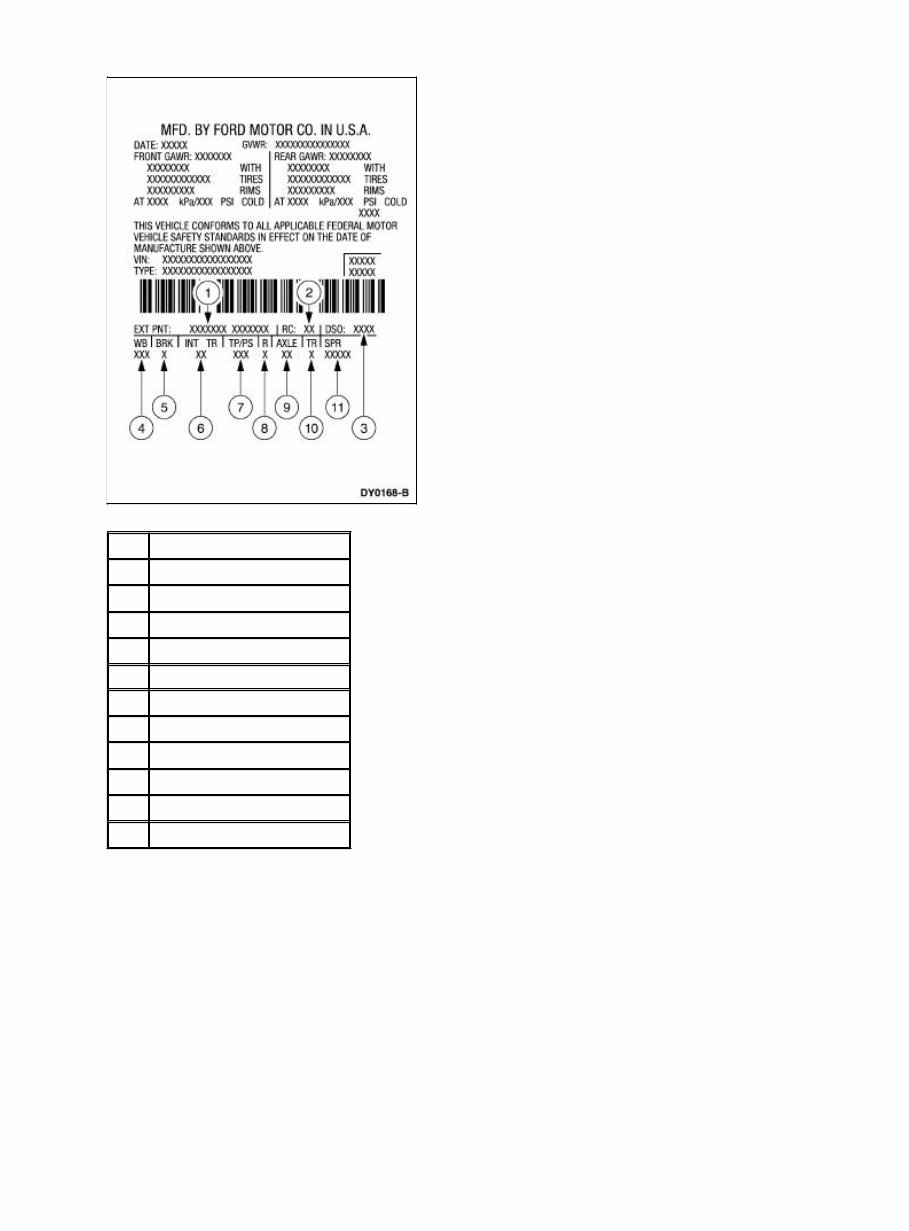
The eleventh VIN position is the assembly plant code. U — Louisville (Louisville, Kentucky) Z — St. Louis (Hazlewood, Missouri) The last six VIN positions are an alphanumeric code for the vehicle build sequence. This is also the vehicle serial and warranty number. A00001-E99999 — Ford Division J00001-L99999 — Lincoln-Mercury Division Vehicle Certification (VC) Label 25.03. 2012 file:///C:/Ford/1996-1999/tsocache/SHEF_5252/SXN~us~en...
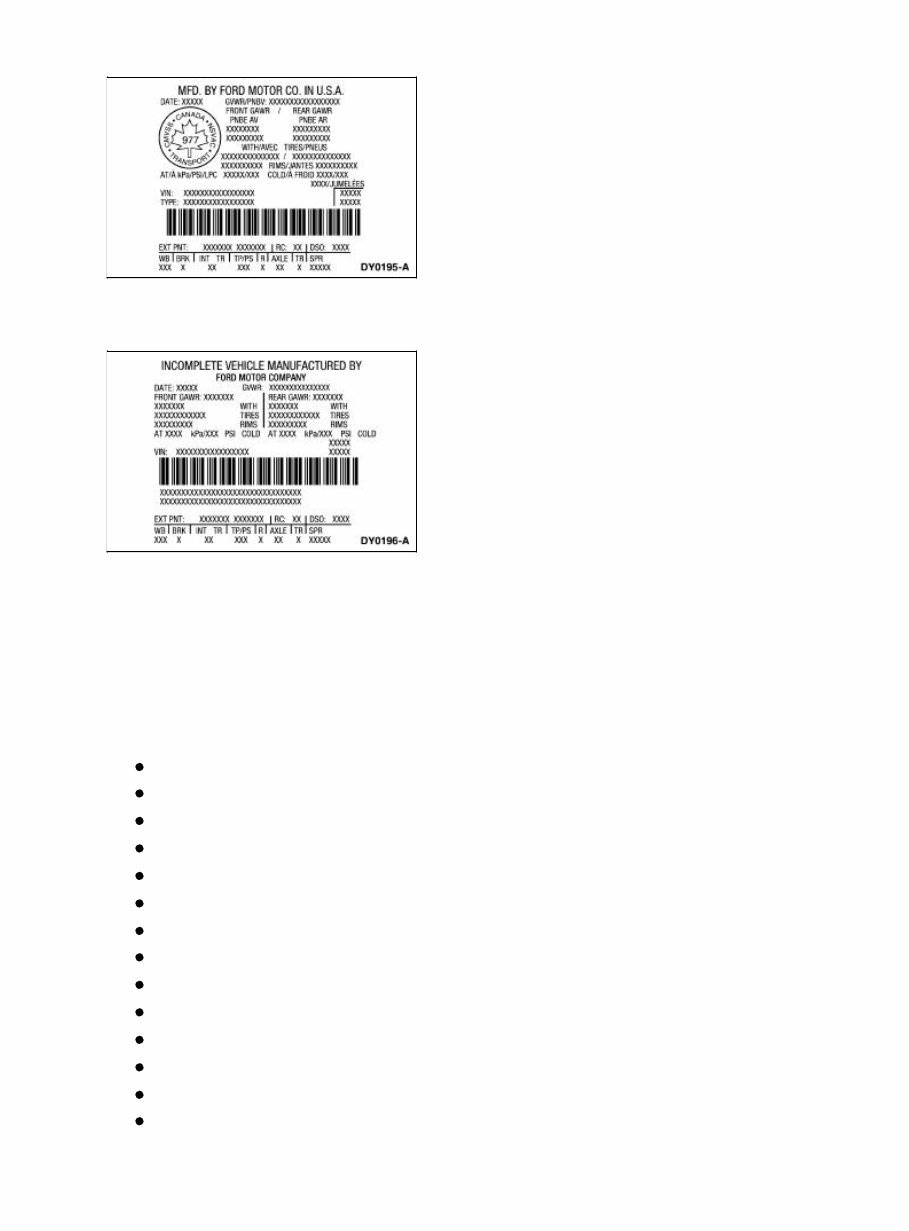
The vehicle certification (VC) label contains the manufacturer name, the month and year of manufacture, the certification statement, and the VIN. It also includes gross vehicle weight ratings (GVWR). Vehicle Certification (VC) Label — Canada (Typical) Item Description 1 Exterior paint code 2 Region code 3 Domestic special order code 4 Wheel base code 5 Brake code 6 Interior trim code 7 Tape/paint pinstripe code 8 Radio code 9 Axle code 10 Transmission code 11 Spring code 25.03. 2012 file:///C:/Ford/1996-1999/tsocache/SHEF_5252/SXN~us~en...
Vehicle Certification (VC) Label — Incomplete Vehicle (Typical) Paint Codes NOTE: The first set of codes list the primary body color, the second set of codes list the lower body two-tone paint code (if applicable). The following lists the exterior paint codes: Primary body color codes UA — Ebony, Explorer/Mountaineer YZ — Oxford White, Explorer/Mountaineer FL — Toreador Red, Explorer/Mountaineer SU — Amazon Green, Explorer/Mountaineer E4 — Vermillion, Explorer LD — Medium Wedgewood Blue, Explorer LL — Deep Wedgewood Blue, Explorer/Mountaineer FS — Spruce Green, Explorer/Mountaineer B2 — Harvest Gold, Explorer RC — Medium Platinum, Explorer BG — Bright Amber, Explorer WF — White Pearl (Tri-Coat), Explorer (St. Louis only) B4 — Autumn Brown, Explorer FT — Charcoal Green, Explorer (St. Louis only) Lower two-tone exterior paint codes 25.03. 2012 file:///C:/Ford/1996-1999/tsocache/SHEF_5252/SXN~us~en...
RC — Medium Platinum, Explorer XLT LD — Medium Wedgewood Blue, Mountaineer FT — Charcoal Green, Mountaineer JL — Dark Toreador Red, Mountaineer Radio Codes 8 — AM/FM stereo with cassette, Premium Sound (P100LL) 9 — AM/FM stereo with cassette and clock (M100C) K — AM/FM stereo with cassette, compact disc player and digital sound processing Axle Codes The following lists the gear ratios on axles. 41 — 3.27 non-limited slip 45 — 3.55 non-limited slip 46 — 3.73 non-limited slip 42 — 4.10 non-limited slip D1 — 3.27 limited slip D4 — 3.73 limited slip D2 — 4.10 limited slip Transmission Codes U — automatic 4R70W-AOD M — five-speed manual overdrive D — automatic five-speed Spring Codes The following lists available spring codes. Front Springs 1 — 5B326 (RH), 5B327 (LH) torsion bar 2 — 5B326 (RH), 5B327 (LH) torsion bar G — 5B326 (RH), 5B327 (LH) torsion bar E — 5B326 (RH), 5B327 (LH) torsion bar F — 5B326 (RH), 5B327 (LH) torsion bar B — 5B326 (RH), 5B327 (LH) torsion bar D — 5B326 (RH), 5B327 (LH) torsion bar H — 5B326 (RH), 5B327 (LH) torsion bar J — 5B326 (RH), 5B327 (LH) torsion bar L — 5B326 (RH), 5B327 (LH) torsion bar 25.03. 2012 file:///C:/Ford/1996-1999/tsocache/SHEF_5252/SXN~us~en...
P — automatic ride control Rear Springs F — 5560 spring H — 5560 spring L — 5560 spring Interior Trim Codes The following lists the interior trim and interior color codes. Interior Trim A — vinyl bucket seats J — premium bucket seats Z — cloth sport bucket seats G — cloth sport bucket seats — less power F — leather sport bucket seats Y— premium Amay cloth bucket seats M — cloth split bench seat 1 — limited leather sport bucket seats Interior Color Codes X — Medium Prairie Tan 2 — Medium Graphite T — Dark Graphite Tape Stripe Codes P — Platinum (Explorer XLT) T — Light Prairie Tan (Explorer XLT) S — Silver (Explorer XLT) L — Light Prairie Tan (Explorer Limited) X — Limited Logo (Explorer Limited) 25.03. 2012 file:///C:/Ford/1996-1999/tsocache/SHEF_5252/SXN~us~en...
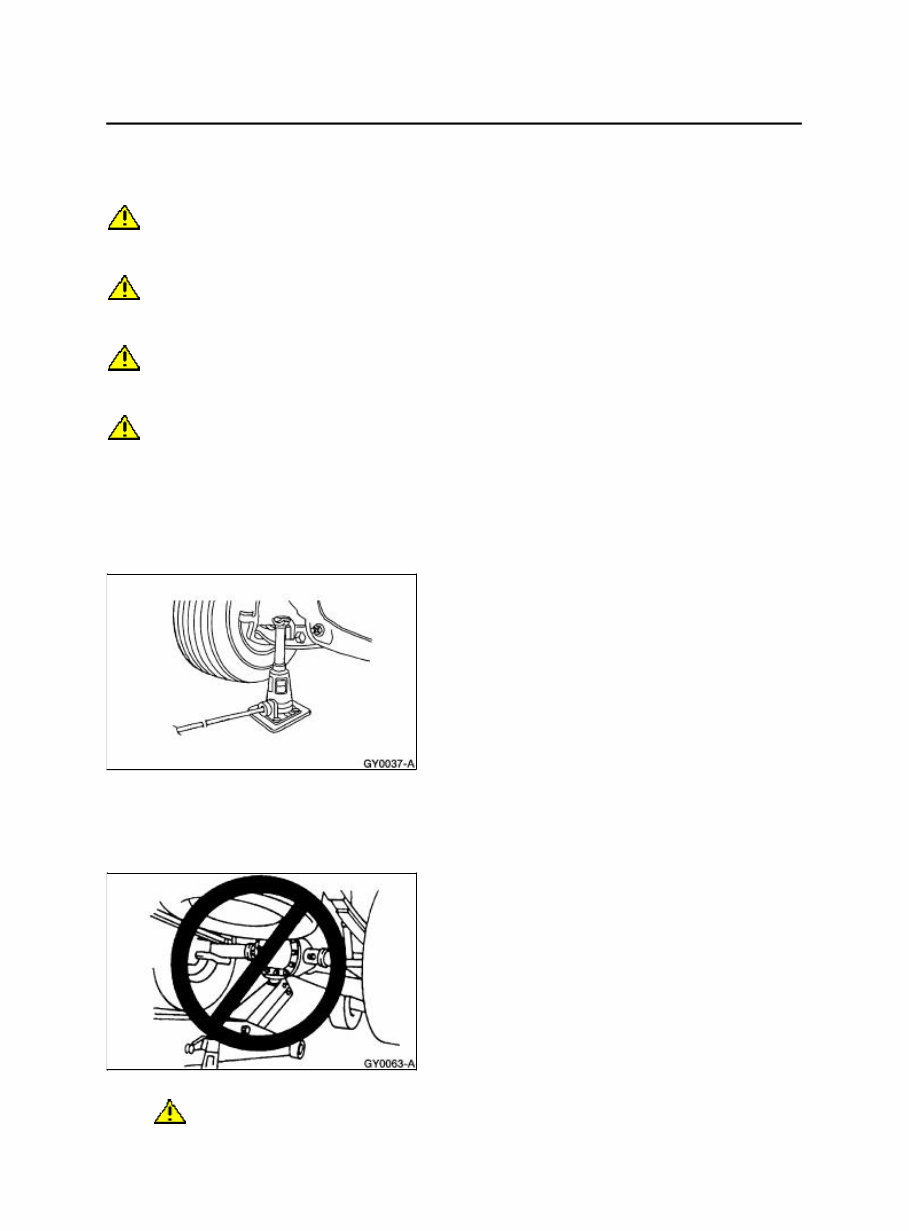
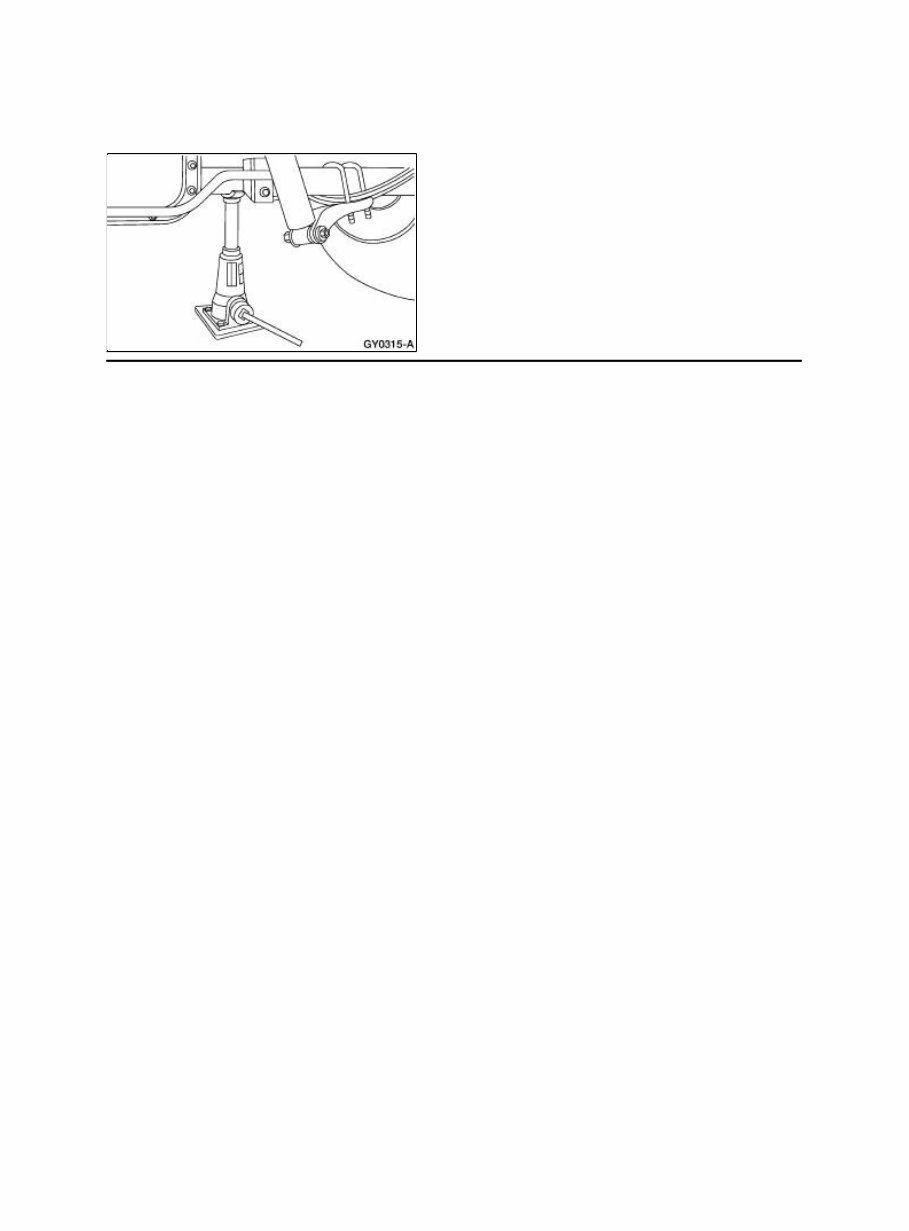
DESCRIPTION AND OPERATION Jacking WARNING: Do not run the engine when jacking the vehicle. The wheels contacting the ground could cause the vehicle to move. WARNING: Make sure the jack and jack stands are properly located to prevent the vehicle from falling. WARNING: Wheel chocks should be used to prevent the vehicle from rolling and falling off the jack. WARNING: The electrical power to the air suspension system must be shut off prior to hoisting, jacking or towing an air suspension vehicle. This can be accomplished by turning off the air suspension switch located in the rear jack storage area. Failure to do so may result in unexpected inflation or deflation of the air springs which may result in shifting of the vehicle during these operations. Jacking Points — Front 1. The front jacking point is a tab that extends from the lower control arm. Jacking Points — Rear 1. CAUTION: Do not use the differential housing as a lift point. Leaks or damage to the rear axle cover and adjoining differential housing surface may occur if a floor jack or any lifting device is allowed to contact the cover at any point where the cover joins the SECTION 100-02: Jacking and Lifting 1999 Explorer/Mountaineer Workshop Manual 25.03. 2012 file:///C:/Ford/1996-1999/tsocache/SHEF_5252/SXN~us~en...
housing. The rear jacking points are located on the rear axle tube. 25.03. 2012 file:///C:/Ford/1996-1999/tsocache/SHEF_5252/SXN~us~en...
Introducing the 1999 Ford Explorer OEM Service & Repair Manual, your ultimate guide to maintaining and repairing your vehicle. This manual is specifically designed for the 1999 Ford Explorer models and is a must-have for any owner.
With the 1999 Ford Explorer OEM Service & Repair Manual, you'll have access to comprehensive information and step-by-step instructions to tackle any repair or maintenance task. From basic oil changes to complex engine repairs, this manual has got you covered.
Key features of the 1999 Ford Explorer OEM Service & Repair Manual include:
Clear and detailed instructions for all repair and maintenance procedures
Diagnostic information to help you identify and troubleshoot potential issues
Wiring diagrams and electrical schematics for easy understanding
Exploded views and parts diagrams for accurate identification of components
Tips and tricks from experienced technicians to save you time and money
Conveniently organized chapters and sections for quick navigation
Whether you're a seasoned mechanic or a DIY enthusiast, the 1999 Ford Explorer OEM Service & Repair Manual is an essential tool to keep your vehicle in top shape. Don't rely on generic repair manuals, invest in the specific manual for your model.
Order your 1999 Ford Explorer OEM Service & Repair Manual today and unleash the full potential of your vehicle!



 Lifetime Access




