FLUID AND FILTER DIAGNOSIS AND TESTING EFFECTS OF INCORRECT FLUID LEVEL A low fluid level allows the pump to take in air along with the fluid. Air in the fluid will cause fluid pressures to be low and develop slower than normal. If the transmission is overfilled, the gears churn the fluid into foam. This aerates the fluid and causing the same conditions occurring with a low level. In either case, air bubbles cause fluid overheating, oxidation, and varnish buildup which interferes with valve and clutch operation. Foaming also causes fluid expansion which can result in fluid overflow from the transmission vent or fill tube. Fluid overflow can easily be mistaken for a leak if inspection is not careful. CAUSES OF BURNT FLUID Burnt, discolored fluid is a result of overheating which has two primary causes. 1. A result of restricted fluid flow through the main and auxiliary cooler. This condition is usually the result of a damaged main cooler, or severe restrictions in the coolers and lines caused by debris or kinked lines. 2. Heavy duty operation with a vehicle not properly equipped for this type of operation. Trailer towing or similar high load operation will overheat the transmission fluid if the vehicle is improperly equipped. Such vehicles should have an auxiliary transmission fluid cooler, a heavy duty cooling system, and the engine/axle ratio combination needed to handle heavy loads. FLUID CONTAMINATION Transmission fluid contamination is generally a result of: Adding incorrect fluid. Failure to clean dipstick and fill tube when checking level. Engine coolant entering the fluid. Internal failure that generates debris. Overheat that generates sludge (fluid breakdown). Failure to replace contaminated converter after repair. The use of non-recommended fluids can result in transmission failure. The usual results are erratic shifts, slippage, abnormal wear and eventual failure due to fluid breakdown and sludge formation. Avoid this condition by using recommended fluids only. The dipstick cap and fill tube should be wiped clean before checking fluid level. Dirt, grease and other foreign material on the cap and tube could fall into the tube if not removed beforehand. Take the time to wipe the cap and tube clean before withdrawing the dipstick. Engine coolant in the transmission fluid is generally caused by a cooler malfunction. The only remedy is to replace the radiator as the cooler in the radiator is not a serviceable part. If coolant has circulated through the transmission, an overhaul is necessary. 2007 Dodge Nitro R/T 2007 AUTOMATIC TRANSMISSION 42RLE - Service Information - Nitro 2007 Dodge Nitro R/T 2007 AUTOMATIC TRANSMISSION 42RLE - Service Information - Nitro
The torque converter should be replaced whenever a failure generates sludge and debris. This is necessary because normal converter flushing procedures will not remove all contaminants. STANDARD PROCEDURE TRANSMISSION FILL To avoid overfilling transmission after a fluid change or overhaul, perform the following procedure: 1. Remove dipstick and insert clean funnel in transmission fill tube. 2. Add following initial quantity of Mopar® ATF +4, Automatic Transmission Fluid, to transmission: If only fluid and filter were changed, add 6 pints (3 quarts) of ATF +4 to transmission. If transmission was completely overhauled, or torque converter was replaced or drained, add 10 pints (5 quarts) of ATF +4 to transmission. 3. Apply parking brakes. 4. Start and run engine at normal curb idle speed. 5. Apply service brakes, shift transmission through all gear ranges then back to NEUTRAL, set parking brake, and leave engine running at curb idle speed. 6. Remove funnel, insert dipstick and check fluid level. If level is low, add fluid to bring level to MIN mark on dipstick. Check to see if the oil level is equal on both sides of the dipstick. If one side is noticably higher than the other, the dipstick has picked up some oil from the dipstick tube. Allow the oil to drain down the dipstick tube and re-check. 7. Drive vehicle until transmission fluid is at normal operating temperature. 8. With the engine running at curb idle speed, the gear selector in NEUTRAL, and the parking brake applied, check the transmission fluid level. 9. Add fluid to bring level up to MAX arrow mark. When fluid level is correct, shut engine off, release park brake, remove funnel, and install dipstick in fill tube. FLUID LEVEL CHECK The transmission sump has a dipstick to check oil similar to most automatic transmissions. It is located on the left side of the engine. Be sure to wipe all dirt from dipstick handle before removing. The torque converter fills in both the PARK and NEUTRAL positions. Place the selector lever in PARK to be sure that the fluid level check is accurate. The engine should be running at idle speed for at least one minute, with the vehicle on level ground. At normal operating temperature (approximately 82°C or 180°F), the fluid level is correct if it is in the HOT region (cross-hatched area) on the oil level indicator. The fluid level should be in COLD region at 21°C (70°F) fluid temperature. Adjust fluid level as necessary. Use only Mopar® ATF+4, Automatic Transmission Fluid. CAUTION: Do not overfill transmission, fluid foaming and shifting problems can result. 2007 Dodge Nitro R/T 2007 AUTOMATIC TRANSMISSION 42RLE - Service Information - Nitro
FILL TUBE EQUIPPED WITH INDICATOR Fig. 148: 42RLE Fluid Temperature Chart Courtesy of CHRYSLER LLC 1. Start engine and apply parking brake. 2. Connect scan tool and select transmission. 3. Select sensors. 4. Read the transmission temperature value. 5. Compare the fluid temperature value with the chart. 6. Adjust transmission fluid level shown on the dipstick according to the 42RLE Fluid Temperature Chart. See Fig. 148 . Use only Mopar® ATF+4, Automatic Transmission Fluid. 7. Check transmission for leaks. CAPPED FILL TUBE 1. Verify that the vehicle is parked on a level surface. 2. Remove the dipstick tube cap. NOTE: Engine and Transmission should be at normal operating temperature before performing this procedure. WARNING: There is a risk of accident from vehicle starting off by itself when engine running. There is a risk of injury from contusions and burns if you insert your hands into the engine when it is started or when it 2007 Dodge Nitro R/T 2007 AUTOMATIC TRANSMISSION 42RLE - Service Information - Nitro
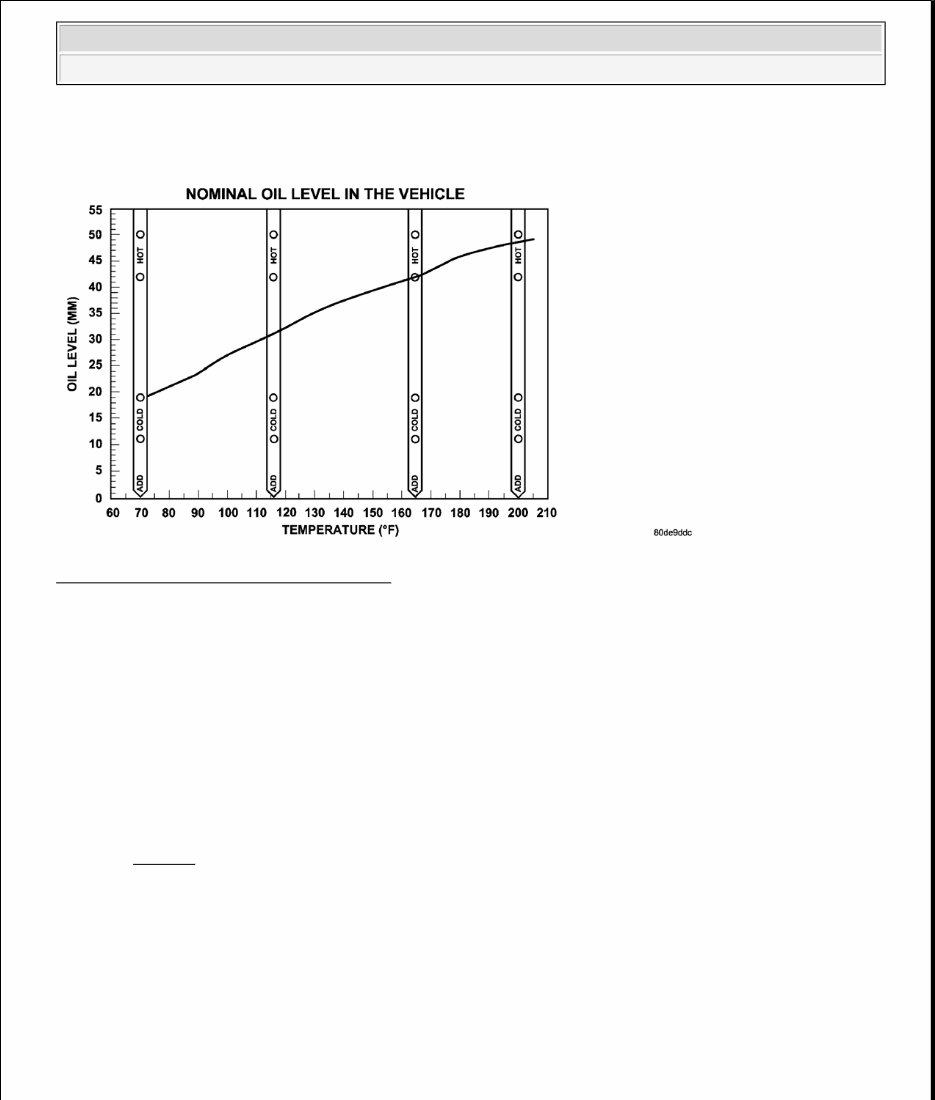
3. Actuate the service brake. Start engine and let it run at idle speed in selector lever position "P". 4. Shift through the transmission modes several times with the vehicle stationary and the engine idling 5. Warm up the transmission, wait at least 2 minutes and check the oil level with the engine running. Push the Oil Dipstick 9336 into transmission fill tube until the dipstick tip contacts the oil pan and pull out again, read off oil level, repeat if necessary. Fig. 149: NAG1 Transmission Fill Graph Courtesy of CHRYSLER LLC 6. Check transmission oil temperature using the appropriate scan tool. 7. The transmission Oil Dipstick 9336 has indicator marks every 10mm. Determine the height of the oil level on the dipstick and using the height, the transmission temperature, and the Transmission Fluid Graph, determine if the transmission oil level is correct. 8. Add or remove oil as necessary and recheck the oil level. 9. Once the oil level is correct, install the dipstick tube cap. FLUID/FILTER SERVICE is running. Secure vehicle to prevent it from moving off by itself. Wear properly fastened and close-fitting work clothes. Do not touch hot or rotating parts. NOTE: The dipstick will protrude from the fill tube when installed. NOTE: The true transmission oil temperature can only be read by a scan tool in REVERSE or any forward gear position. NOTE: Only fluids of the type labeled Mopar® ATF+4, Automatic Transmission Fluid, should be used in the transmission sump. A filter change should be made at the 2007 Dodge Nitro R/T 2007 AUTOMATIC TRANSMISSION 42RLE - Service Information - Nitro
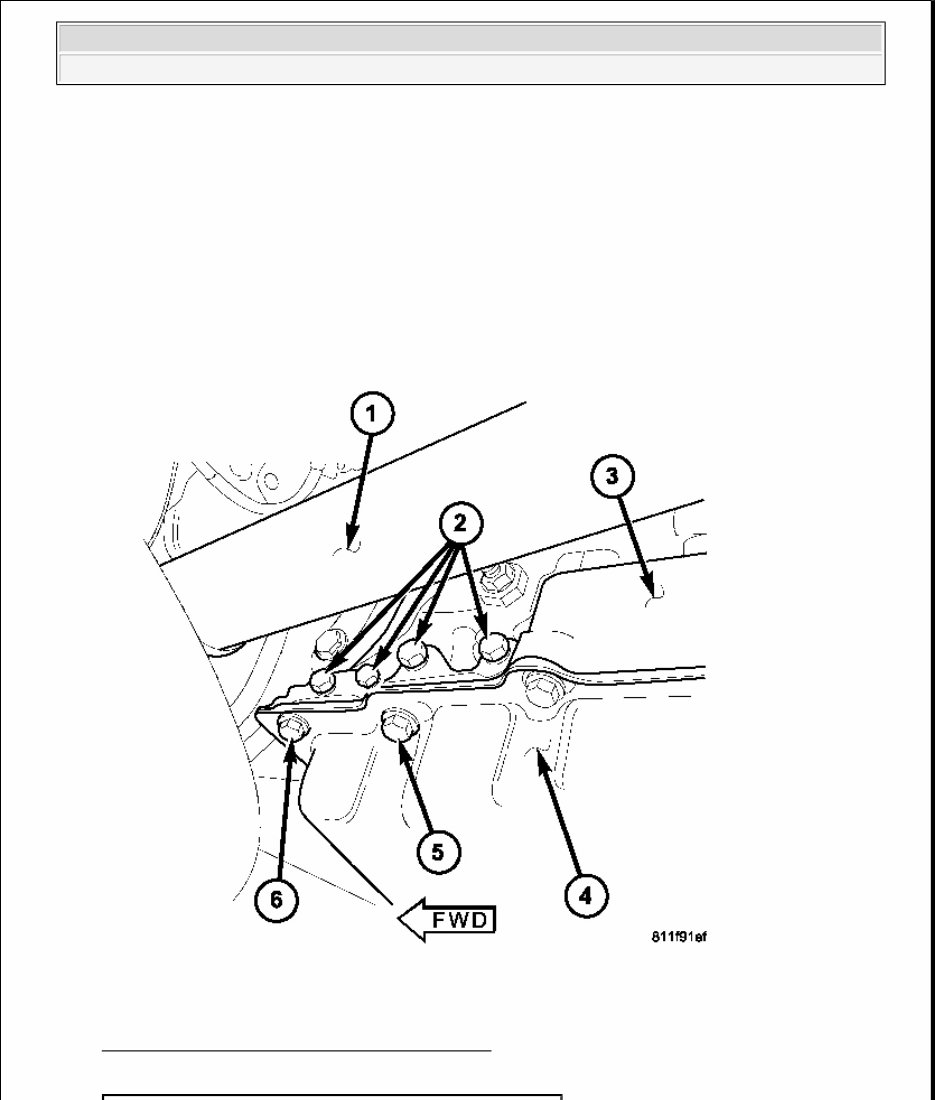
1. Raise vehicle on a hoist. Place a drain container with a large opening, under transmission oil pan. Fig. 150: Locating Oil Pan Bolts & Pressure Ports Courtesy of CHRYSLER LLC time of the transmission oil change. The magnet (on the inside of the oil pan) should also be cleaned with a clean, dry cloth. NOTE: If the transmission is disassembled for any reason, the fluid and filter should be changed. 2007 Dodge Nitro R/T 2007 AUTOMATIC TRANSMISSION 42RLE - Service Information - Nitro
The 2007-2011 Dodge Nitro Service & Repair Manual provides comprehensive technical documentation for Chrysler's rugged compact SUV throughout its production lifecycle. This digital resource contains detailed specifications, diagnostic procedures, and repair instructions for both available powerplants—the reliable 3.7L PowerTech V6 and the performance-oriented 4.0L SOHC V6—alongside complete service information for all critical vehicle systems.
These Nitros might look straightforward with their boxy styling, but they pack some genuine Chrysler engineering quirks that'll leave you puzzled without proper guidance. Whether you're diagnosing a mysterious 42RLE transmission issue or tackling your first ball joint replacement, this manual provides the critical procedures—like the specific bleeding sequence for the ABS system—that forum posts consistently miss.
Content overview:
Complete engine service for 3.7L and 4.0L engines
ABS system electrical service and diagnostics
Airbags, occupant safety systems
Audio, video, and navigation system repairs
Automatic transmission service: 42RLE and NAG1 assembly, diagnostics, removal, and installation
Clutch service procedures
Cooling system maintenance
Cruise control troubleshooting
Exhaust system and turbocharger service
Exterior and interior lighting systems
Fuel system repair
HVAC (Heating, Ventilation, and Air Conditioning) systems
Ignition control system service
Manual transmission repairs
Differential and driveline maintenance
Power accessories: locks, mirrors, and seats
Starter motor service
Steering system repairs
Suspension system overhaul
Transfer case servicing for MP140 and MP143
Wiper and washer system repairs
Complete wiring diagrams and electrical troubleshooting
Service specifications and technical standards
Skip the YouTube guesswork and access authentic repair procedures anywhere. With detailed information for both NAG1 and 42RLE transmissions, the MP140/MP143 transfer cases, and Chrysler's unique suspension geometry, this resource helps professionals work efficiently while giving DIY enthusiasts the confidence to handle projects that would otherwise require expensive dealer visits.
Printable: Yes Language: English Compatibility: Pretty much any electronic device, incl. PC & Mac computers, Android and Apple smartphones & tablet, etc. Requirements: Adobe Reader (free)




 Lifetime Access




