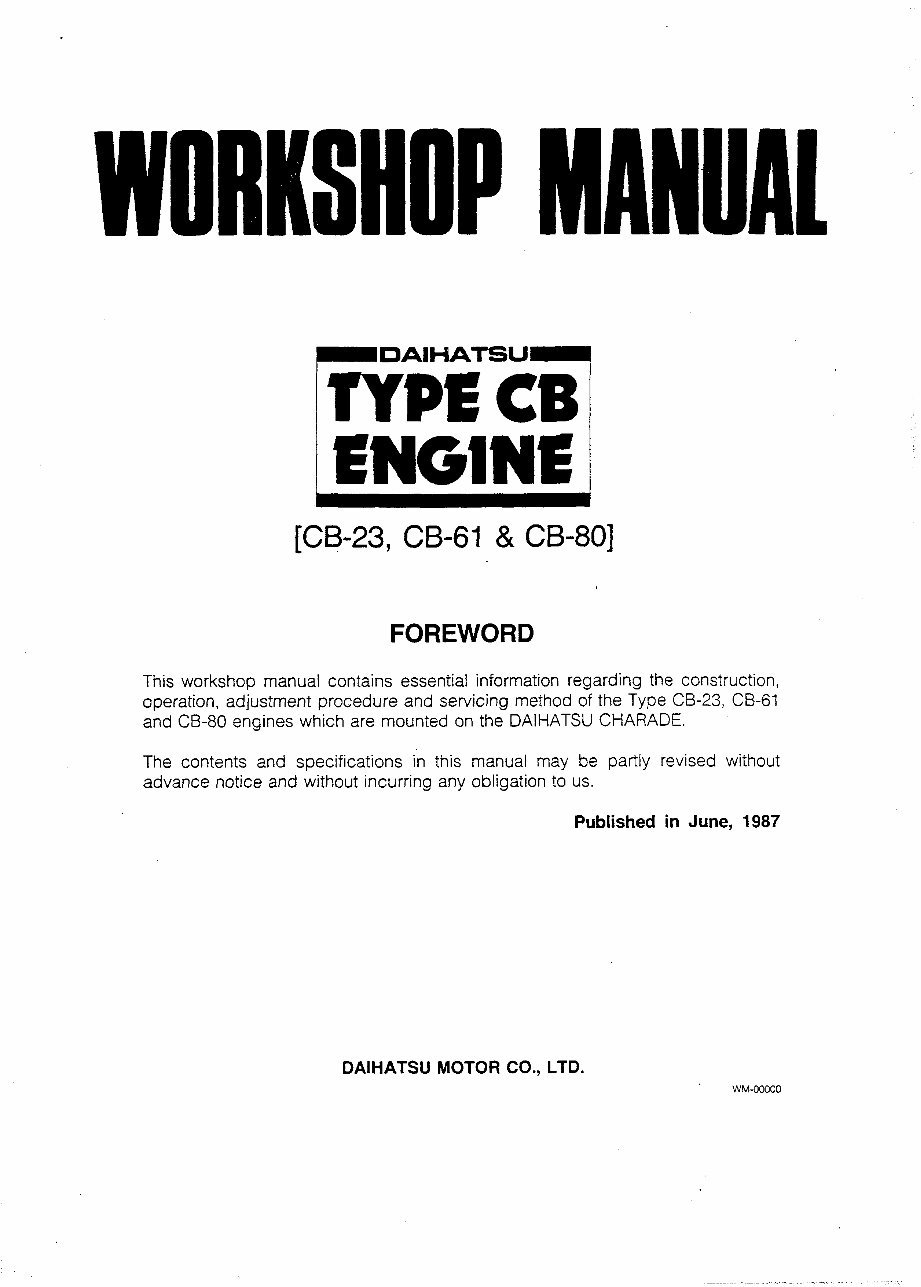
FOREWORD This workshop manual contains essential information regarding the construction, operation, adjustment procedure and servicing method of the Type CB-23, CB-61 and CB-80 engines which are mounted on the DAIHATSU CHARADE. The contents and specifications in this manual may be partly revised without advance notice and without incurring any obligation to us. Published in June, 1987 DAIHATSU MOTOR CO., LTD.
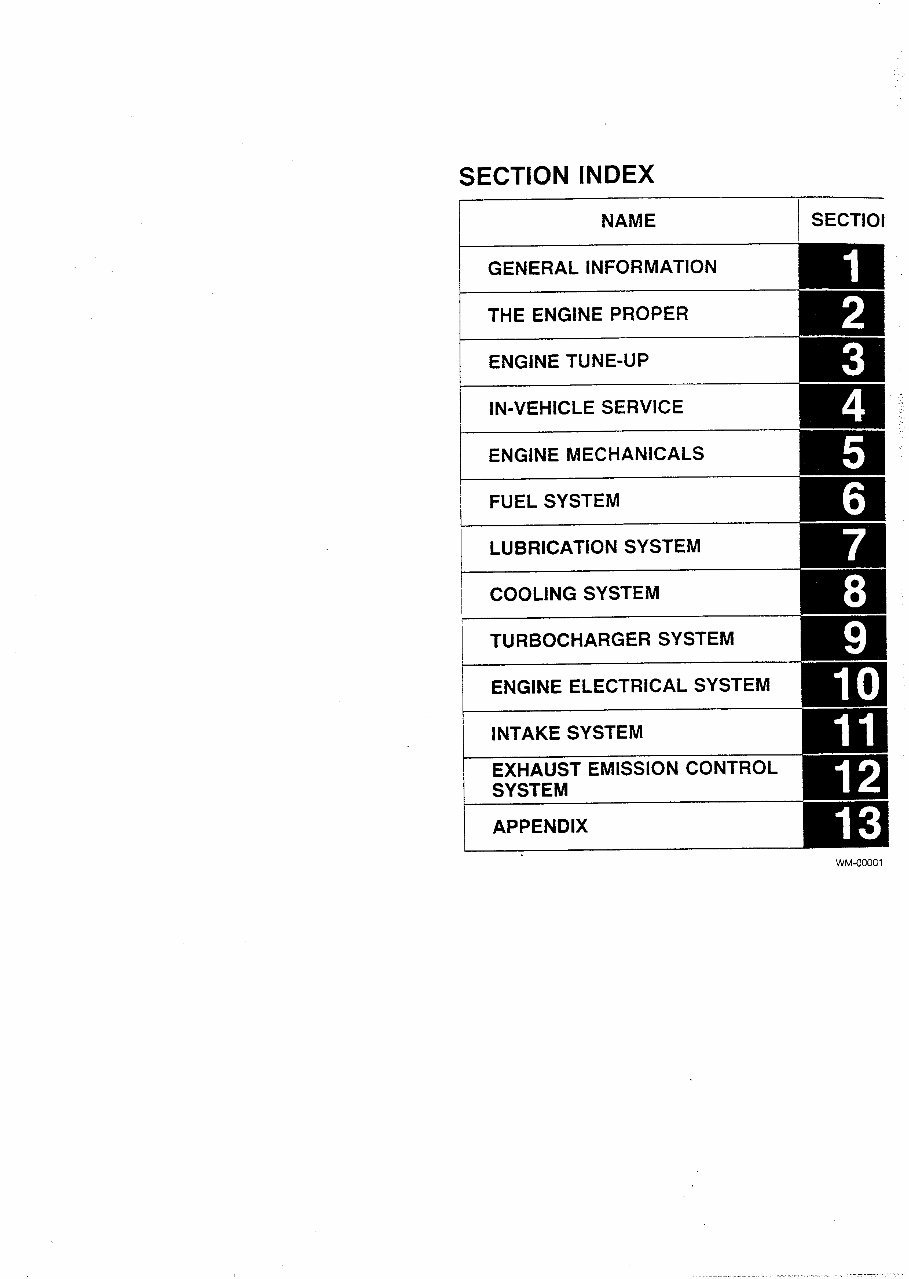
SECTION INDEX NAME
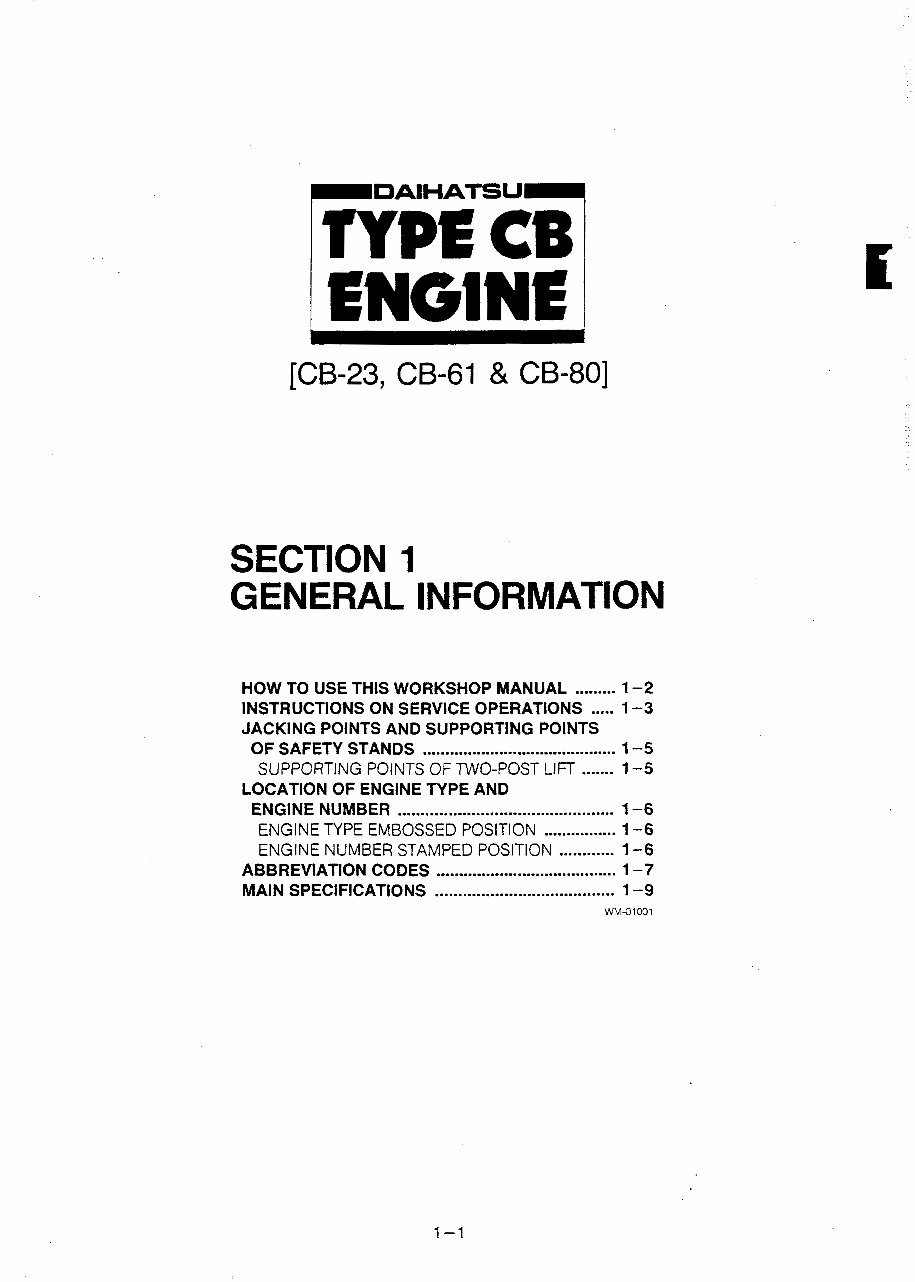
TYPE CB SECTION 1 GENERAL INFORMATION HOW TO USE THIS WORKSHOP MANUAL ......... 1-2 INSTRUCTIONS ON SERVICE OPERATIONS ..... 1-3 JACKING POINTS AND SUPPORTING POINTS OF SAFETY STANDS ......................................... . 1-5 SUPPORTING POINTS OF TWO-POST LIFT ....... 1-5 LOCATION OF ENGINE TYPE AND ENGINE NUMBER ............................................... 1-6 ENGINE TYPE EMBOSSED POSITION ................ 1 -6 ENGINE NUMBER STAMPED POSITION ............ 1 -6 ABBREVIATION CODES ........................................ 1 -7 MAIN SPECIFICATIONS ....................................... 1-9 WM-01001
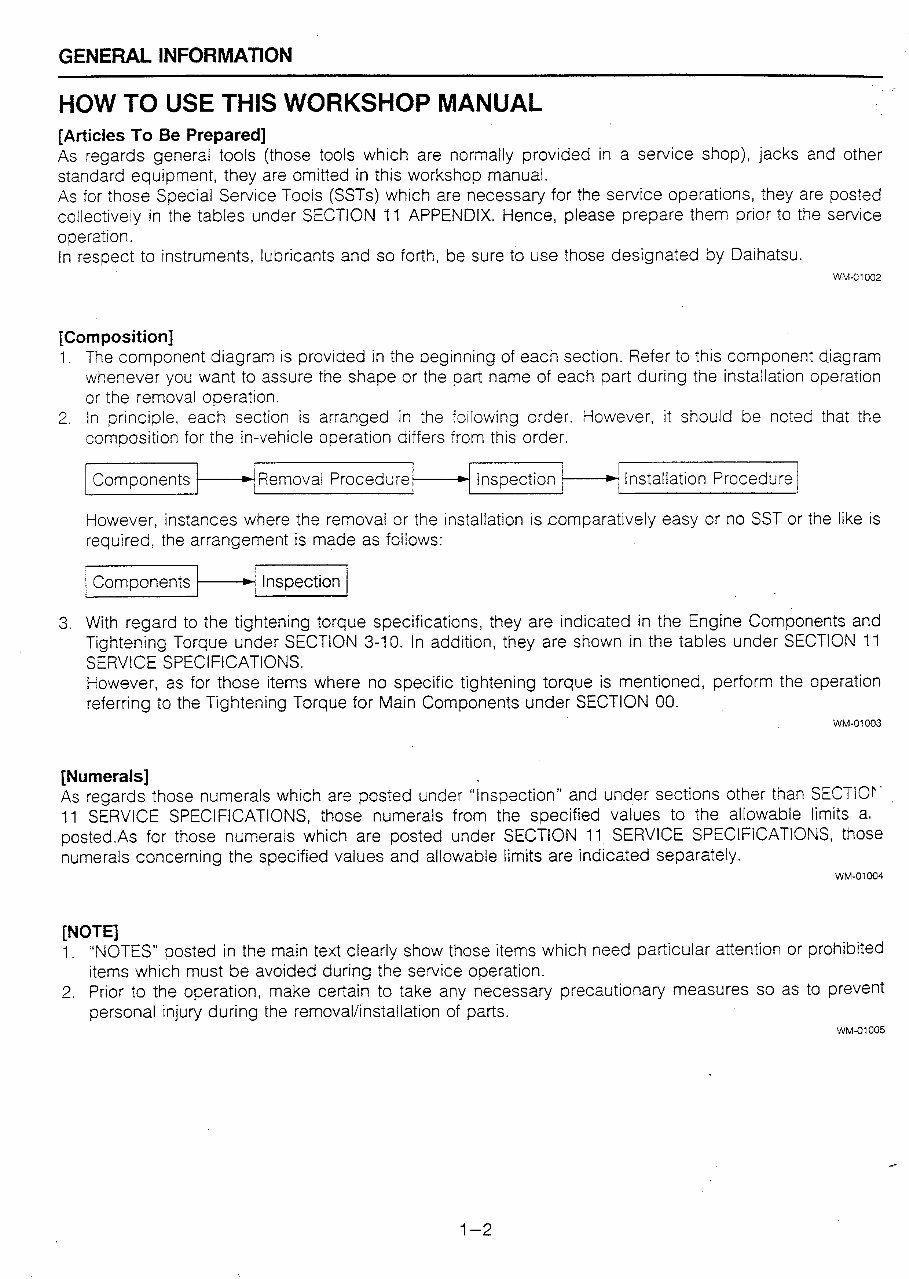
GENERAL INFORMATION HOW TO USE THIS WORKSHOP MANUAL [Articles To Be Prepared] As regards general tools (those tools which are normally provided in a service shop), jacks and other standard equipment, they are omitted in this workshop manual. As for those Special Service Toois (SSTs) which are necessary for the service operations, they are posted collective!y in the tables under SECTION 11 APPENDIX. Hence, please prepare them prior to the service operation. In respect to instruments, lubricants and so forth, be sure to use those designated by Daihatsu. WM-C1002 [Composition] 1. The component diagram is provided in the beginning of each section. Refer to this component d.iagram whenever you want to assure the shape or the part name of each part during the installation operation or the removal operation. 2. In principle, each section is arranged in the foilowing crder. However, it should be noted that the composition for the in-vehicle operation differs from this order. However, instances where the removal or the installation is comparatively easy or no SST or the like is required, the arrangement is made as follows: Removal Procedure 3. With regard to the tightening torque specifications, they are indicated in the Engine Components and Tightening Torque under SECTION 3-10. In addition, they are shown in the tables under SECTION 11 SERVICE SPECIFICATIONS. However, as for those items where no specific tightening torque is mentioned, perform the operation referring to the Tightening Torque for Main Components under SECTION 00. WM-01003 I Inspection -~lnstallation Procedure [Numerals] As regards those numerals which are posted under "Inspection" and under sections other than SECTIOr' 11 SERVICE SPECIFICATIONS, those numerals from the specified values to the allowable limits a* posted.As for those numerals which are posted under SECTION 11 SERVICE SPECIFICATIONS, those numerals concerning the specified values and allowable limits are indicated separately. WM-01004 [NOTE] 1. "NOTES" posted in the main text clearly show those items which need particular attention or prohibited items which must be avoided during the service operation. 2. Prior to the operation, make certain to take any necessary precautionary measures so as to prevent personal injury during the removal/installation of parts. 'NM-01005
GENERAL INFORMATION STRUCTIONS ON SERVICE OPERATIONS 1. Make sure that only the specified bolts and nuts are used. Also, where specified, be sure to employ a torque wrench to tighten bolts or nuts to specifications. 2. When tightening or slackening bolts, be sure to progressively tighten or slacken them over several stages, slightly at a time. This caution must be observed to prevent the tightened parts from being distorted or damaged. 3. Use only genuine parts for every replacement operation. 4. For increased working efficiency and improved accuracy, utilize SSTs (Special Service Tools) effectively. 5. When both front and rear sections of the vehicle or only the rear section thereof is jacked up, make certain to place chocks at the wheels correctly in order to assure safe operations. 6. When the vehicle is jacked up, make sure to support the vehicle with safety stands positioned at the specified jacking points. 7. Before any repair work is made on the electrical system or the engine is removed or installed, first be sure to disconnect the negative (-) terminal of the battery. 8. Disassembly (1) When complicated part are disassembled, put stamped marks or mate marks on suitable non-functional sections of the parts in order that the said parts may be easily assembled in the correct original positions. (2) Replacements of the cylinder block or crankshaft, etc. should be carried out after the engine assembly has been removed from the vehicle. 9. Checks to be performed during disassembly Each time a part is removed, check conditions under which the part has been assembled. Also, check to see if the part exhibits any evidence of distortion, breakage, wear or scores, etc. 10. Arrangement of disassembled parts Put disassembled parts in a good order. Moreover, divide disassembled parts into two groups: those parts to be replaced and those parts which can be reused. 11. Washing disassembled parts As for those parts which can be reused, thoroughly clean or wash them. (except grease sealed bearing) 12. Inspection Those parts which are to be reused must becarefully inspected or measured, as required. 13. Those operations specified under "lnspection" are performed, in principle, in combination with the checks and repairs. It is, therefore, necessary to replace any part which does not conform to the ;pecifications. However, in cases where otherwise specified in the main text, be sure to follow the given instructions. 14. Assembly of parts Those satisfactory parts only should be assembled in accordance with the prescribed standards (e.g. specified adjustment values, tightening torque and so forth). Furthermore, seal packing or grease should be applied, as required. Furthermore, in respect to packings, gaskets, oil seals and similar items, be certain to install new parts. 15. Adjustments and checking of service operations Service operations must be carried out correctly by means of gauges or testers, if the use of these instruments is required. 16. Never smoke during the service operation. Also, be sure not to allow any fire to be brought near the working bay. 17. Under no circumstances should your hand touch with the front side and back sides, the installation surfaces of each bearing insert. Also, be very careful not to scratch the surfaces. Do not wipe off the bearing surfaces with a cloth. Be certain to blow off them, using compressed air: Protect your eyes with safety glasses during this cleaning.
GENERAL INFORMATION - 18. The warming-up state of the engine means a state in which the temperature of the cooling wati reaches at least 75 - 85°C (167 - 185 F) and the temperature of the engine oil reaches at least 65°C (1 49 F). These temperatures can be judged by observing a point where the cooling fan motor ceases its rotation. NOTE: When the idle speed is checked on Type CB-80 engine, special warming-up procedure is required. Hence, be sure to refer to the section under "Checking Idle Speed." 'uVM-01006
You're Reading a Preview
What's Included?
Lifetime Access
Fast Download Speeds
Online & Offline Access
Access PDF Contents & Bookmarks
Full Search Facility
Print one or all pages of your manual
$31.99
Daihatsu Charade Type CB Engine (CB-23, CB-61, CB-80) Service & Repair Manual - !
The Daihatsu Charade Type CB Engine Service & Repair Manual is a comprehensive guide for maintaining and repairing the CB series engines in Daihatsu Charade vehicles. It is designed for both professional mechanics and DIY enthusiasts, providing detailed instructions and diagrams for troubleshooting, servicing, and repairing the engine.
This manual is compatible with the CB-23, CB-61, and CB-80 engine models, covering a wide range of maintenance and repair procedures. Whether it's routine tasks like oil changes and filter replacements or more complex repairs such as engine overhauls and timing belt replacements, this manual has you covered.
CB-23 engine model
CB-61 engine model
CB-80 engine model
With step-by-step instructions, clear illustrations, and helpful tips, this manual is essential for anyone working on Daihatsu Charade vehicles with CB series engines. By following the procedures outlined in this manual, you can ensure the longevity and optimal performance of your engine.
Invest in the Daihatsu Charade Type CB Engine Service & Repair Manual to empower yourself to confidently tackle engine maintenance and repairs. Get your copy today and keep your Daihatsu Charade running smoothly for years to come.
Reviews
Q&A
Recently Viewed
5,521,897Happy Clients
2,594,462eManuals
1,120,453Trusted Sellers
15Years in Business
Price:
Actual Price:
Daihatsu Charade Type CB Engine (CB-23, CB-61, CB-80) Service & Repair Manual - !






 Lifetime Access