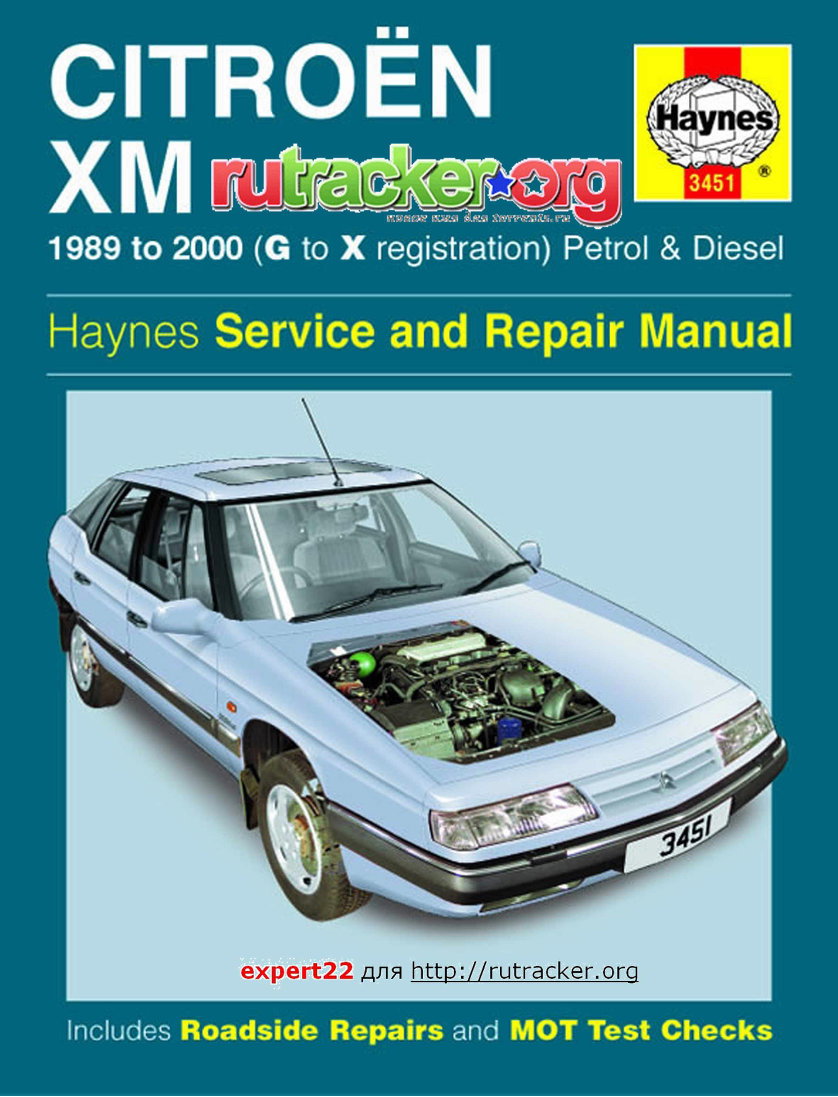
CITROEN XM jtteSar rcwaoa? buss mas SavrosiSScra 1 1989 to 2000 (G to X registration) Petrol & Diesel Haynes Service and Repair Manual expert22 fl/ia http://rutracker.org Includes Roadside Repairs and MOT Test Checks
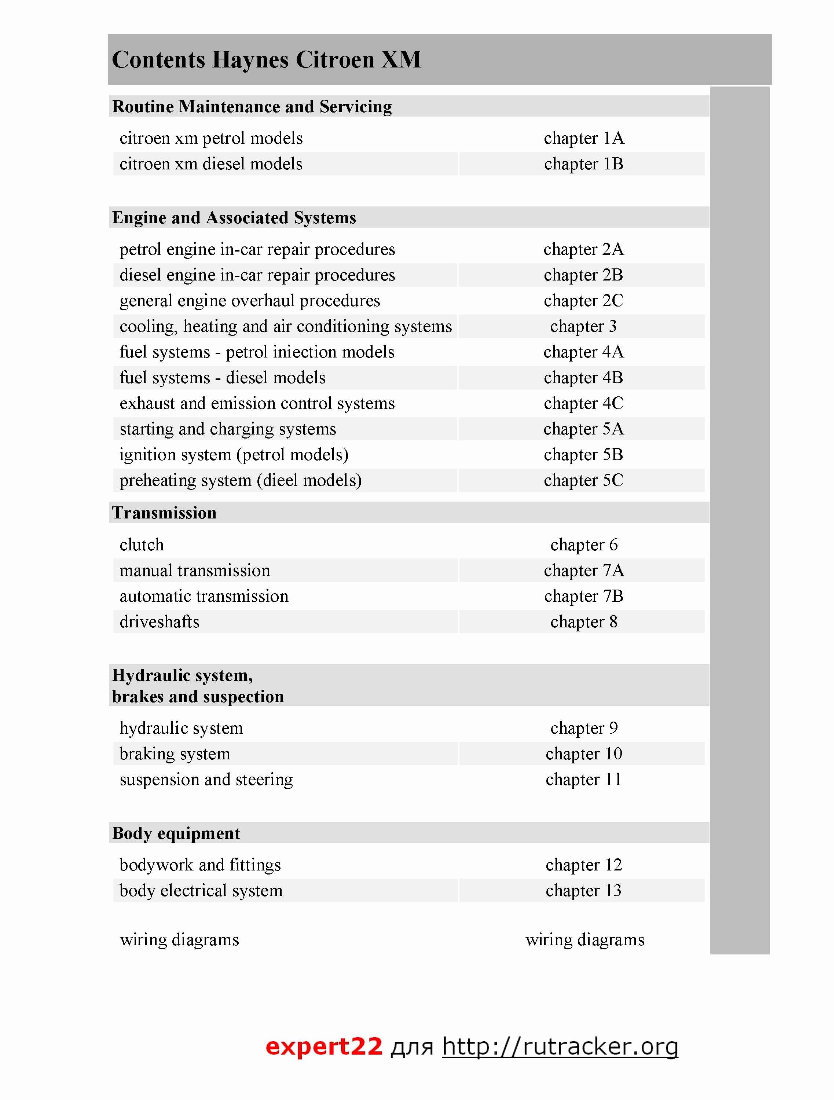
Contents Haynes Citroen XM Routine Maintenance and Servicing Citroen xm petrol models chapter 1A citroen xm diesel models chapter IB Engine and Associated Systems petrol engine in-car repair procedures chapter 2A diesel engine in-car repair procedures chapter 2B general engine overhaul procedures chapter 2C cooling, heating and air conditioning systems chapter 3 fuel systems - petrol iniection models chapter 4A fuel systems - diesel models chapter 4B exhaust and emission control systems chapter 4C starting and charging systems chapter 5A ignition system (petrol models) chapter 5B preheating system (dieel models) chapter 5C Transmission clutch chapter 6 manual transmission chapter 7A automatic transmission chapter 7B drive shafts chapter 8 Hydraulic system, brakes and suspection hydraulic system chapter 9 braking system chapter 10 suspension and steering chapter 11 Body equipment bodywork and fittings chapter 12 body electrical system chapter 13 wiring diagrams wiring diagrams expert22 fl/ifl http://rutracker.org
1 A*1 Chapter 1 Part A: Routine maintenance and servicing - petrol engine models 1A . Contents Airfilter element renewal (normally-aspirated models}.................... 15 f t filter element renewal (Turbo models) ........................................ 11 Automatic transmission fluid strainer cleaning ........ ........................ 20 Automatic transmission fluid renewal ............................................... 4 Auxiliary drivebelt c h e c k .................. ................................................19 Clutch pedal height check .............................................................. 5 Coolant renewal .............................................................................. 14 Driveshaft c h e c k ................ ............................................................. 8 Engine oil and filter renewal ............................................................ 3 Fault diagnosis system memory check ............................................ 10 Front and rear brake pad and disc check ........................................ 13 Fuel filter renewal .....................................................- ...................... 17 Hinge and lock lubrication................................................................. 9 Hose and fluid leak ch e ck ................................................................. 6 Hydraulic fluid renewal and fluid return filter cleaning .................... 16 Introduction....................................................................................... 1 Manual transmission oil level c h e c k .............. ..................... 18 Regular maintenance .................... .............................................. 2 Road te s t ........................................................................................... 21 Spark plug renewal ...................................... .................................... 12 Steering and suspension check ....................................................... 7 Timing belt renewal ...........................................................................22 Degrees of difficulty Easy, suitable for ;i novice with little expenence Fairfy easy, su itable for beginner with some experience ^ Fairly difficult, suitable for competent ^ DIY mechanic ^ Difficult, suitable for ^ experienced DIY mechanic ^ Very difficult, ^ suitable for expert DIY or professional ^
ia -2 Servicing specifications - petrol models Champion F104 Champion F118 Protection down to -15°C (5°F) Protection down to -30°C (-22°F) Lubricants and fluids Refer to the end of Weekly checks Capacities (approximate) Engine oil Non-turbo modeis ...................................................................... 5.40 litres Turbo models: Models without air conditioning ........................................................ 4.75 litres Models with air conditioning.............................................................. 4.50 litres Cooling system Non-turbo models ................................................................................ 7.30 litres Turbo models ........................................................................................ 10.80 or 11.30 litres (according to equipment) Transmission Manual transmission........................................ ...................................... 1.90 litres Automatic transmission: From d r y ............................................................................................ 7.50 litres Fluid c h a n g e ...................................................................................... 2.40 litres Hydraulic LHM fluid All models .............................................................................................. 5.40 litres Fuel tank All models .............................................................................................. 80.00 litres Engine Oil filter: Models up to 1994 ........................................................................ Models from 1995 .......................................................................... Cooling system Antifreeze mixture: 28% antifreeze .................................... . ...................................... 50% antifreeze ...................................... ....................................... Note: Refer to antifreeze manufacturer's recommendations Fuel system Air filter element ............ ....................................................................... Champion U561 Fuel filte r ................................................................................................ Champion L206 Ignition system Spark plugs: Non-turbo models without catalytic converter.................................. Champion RC7YCC Non-turbo models with catalytic converter ...................................... Champion RC9YCC Turbo models .................................................................................... Champion RC7BMC Spark plug electrode gap* .................................................................... 0.8 mm Ignition HT lead set: Models with distributor ignition system ............................................ Champion LS-55 Models with distributorfess ignition system ...................................... Champion LS-51 *The spark plug gap quoted is that recommended by Champion for their specified plugs listed above. If spark plugs of any other type are to be fitted, refer to their manufacturer’s recommendations Brakes Brake pad friction material minimum thickness: Front pads ...................................................................................... Rear pads ...................................................................................... Wiper blades Front .................................................................................................. Rear: Hatchback models ........................................................................ Estate models .............................................. . ............................ Clutch Clutch pedal travel .......................................................................... Tyre pressures See end of Weekly checks Torque wrench settings Roadwheel b o lts .............................................................................. 3.0 mm 2.0 mm Manual transmission oil filler/level plug Champion X55 Champion X45 Champion X41 45 -0+10 mm Nm Ibf ft 90 66 25 16 20 15 30 22
Maintenance schedule - petrol models 1A .3 1 The maintenance intervals in this manual are provided with the assumption that you, not the dealer, will be carrying out the work. These are the minimum maintenance intervals recommended by us for vehicles driven daily. If you wish to keep your vehicle in peak condition at all times, you may wish to perform some of these procedures more often. We encourage frequent maintenance, because it enhances the efficiency, performance and resale value of your vehicle. 2 If the vehicle is driven in very dusty areas, used to tow a trailer, spends long periods with the engine idling, is driven frequently at slow speeds (eg in heavy traffic) or is used mainly for short journeys, then more frequent maintenance intervals are recommended. 3 When the vehicle is new, it should be serviced by a factory- authorised dealer service department, in order to preserve the factory warranty. Every 250 miles (400 km) or weekly □ Refer to Weekly checks. Every 9000 miles or 12 months, whichever comes first □ Renew the engine oil and filter (Section 3) D Renew the automatic transmission fluid - where applicable (Section 4) □ Check the clutch pedal height - models with cable- operated clutch {Section 5) Ip Check all components, pipes and hoses for fluid leaks (Section 6) I Check the condition and security of the steering and suspension components (Section 7) ' Check the condition of the driveshafts (Section 8) I Lubricate all hinges and locks (Section 9) I Check the fault diagnosis system memory for fault codes (Section 10) Every 18 000 miles n Renew the air filter element - Turbo models (Section 11) □ Renew the spark plugs (Section 12) □ Check the condition of the front and rear brake pads and discs {Section 13) Every 2 years, regardless of mileage □ Renew the coolant (Section 14) Every 36 000 miles □ Renew the air filter element - normally-aspirated models (Section 15) □ Renew the hydraulic fluid and clean the hydraulic fluid return filters (Section 16) □ Renew the fuel filter (Section 17) □ Check the manual transmission oil level (Section 18) □ Check the condition of the auxiliary drivebelts {Section 19) Q Clean the automatic transmission fluid strainer - where applicable (Section 20) □ Carry out a road test (Section 21) Every 72 000 miles □ Renew the tinning belt (Section 22) Note: Although this is the normal interval for timing belt renewal, it is strongly recommended that the interval is reduced on vehicles which are subjected to intensive y§e, ie, mainly short journeys or a lot of stop-start driving. The actual belt renewal is therefore very much up to the individual owner, but bear in mind that severe engine damage may result if the belt breaks
ia .4 Component locations - petrol models Underbonnet view of a 2.0 litre turbo petrol engine 1 Headlight washer fluid reservoir 2 Air suspension hydraulic fluid reservoir bulb 3 Hydraulic fluid reservoir 4 Windscreen 'tailgate washer fluid reservoir 5 Air cleaner housing 6 Battery 7 Headlight beam adjustment screws S Engine oil filler cap 9 Engine oil level dipstick 10 VIN plate 11 Cruise control vacuum actuator 12 Hydraulic fluid pump 13 Electronic control unit housing 14 Coolant reservoir <expansion tank) Underbonnet view of a 2.0 litre non-turbo petrol engine 1 Air suspension hydraulic fluid reservoir bulb 2 Engine oil level dipstick 3 Hydraulic fluid reservoir 4 Windscreen/tailgate washer fluid reservom 5 Battery 6 Headlight beam ad/ustment screw 7 Automatic transmission fluid level dtpstich 8 Engine oil filler cap 9 Engine oil filter 10 VIN plate 11 Alternator 12 Hydraulic fluid pump 13 Electmnic control unit housing 14 Coolant reservoir lexpanston tank)
Component locations - petrol models ia* s Front underbody view (diesel engine model shown, petrol engine model similar) 1 Manual transmission 2 Driveshaft 3 Brake caliper 4 Front suspension lower arm 5 Track-rod 6 Anti-roll bar 7 Suspension soft-setting hydraulic fluid reservoir bulb 8 Front suspension subframe 1A Rear underbody view (diesel engine model shown, petrol engine model similar) 7 Exhaust expansion box 2 Spare wheel carrier 3 Hydraulic fluid reservoir bulb 4 Rear suspension trailing arm 5 Rear suspension hydraulic unit 6 Fuel tank 7 Rear suspension crosstube 8 Rear anti-mii bar
1 a *6 Routine maintenance - petrol models 1 Introduction 1 This Chapter is designed to help the home mechanic maintain his/her vehicle for safety, economy, iong life and peak performance. 2 The Chapter contains a maintenance schedule, followed by Sections dealing specifically with each task in the schedule. Visual checks, adjustments, component renewal and other helpful items are included. Refer to the accompanying illustrations of the engine compartment and the underside of the vehicle for the locations of the various components. 3 Servicing your vehicle in accordance with ttie above recommendations and the following Sections wilt provide a planned maintenance programme, which should result in a long and reliable service life. This is a comprehensive plan, so maintaining some items but not others at the specified service intervals, will not produce the same results. 4 As you service your vehicle, you will discover that many of the procedures can - and should - be grouped together, because of the particular procedure being performed, or because of the proximity of two otherwise- unrelated components to one another. For example, if the vehicle is raised for any reason, the exhaust can be inspected at the same time as the suspension and steering components. 5 The first step in this maintenance programme is to prepare yourself before the actual work begins. Read through all the Sections relevant to the work to be carried out, then make a list and gather all the parts and tools required. If a problem is encountered, seek advice from a parts specialist, or a dealer service department. 2 Regular maintenance 1 If, from the time the vehicle is new, the routine maintenance schedule is followed closely, and frequent checks are made of fluid levels and high-wear items, as suggested throughout this manual, the engine will be kept in relatively good running condition, and the need for additional work will be minimised. 2 (t is possible that there will be times when the engine is running poorly due to the lack of regular maintenance. This is even more likely if a used vehicle, which has not received regular and frequent maintenance checks, is purchased. In such cases, additional work may need to be carried out. outside of the regular maintenance intervals. 3 If engine wear is suspected, a compression test {refer to the relevant Part of Chapter 2) will provide valuable information regarding the overall performance of the main internal components. Such a test can be used as a basis to decide on the extent of the work to be carried out. if, for example, a compression test indicates serious internal engine wear, conventional maintenance as described in this Chapter will not greatly improve the! performance of the engine, and may prove a waste of time and money, unless extensive overhaul work is carried out first. 4 The following series of operations are those most often required to improve the perform* ance of a generally poor-running engine: Primary operations a) Clean, inspect and test the battery (See ' Weekly checks and Chapter 5A). b) Check all the engine-related fluids (See Weekly checks). c) Check the condition and tension of the auxiliary drivebeltfs) (Section 19). d) Renew the spark plugs (Section 12). e) Check the condition of the air filter, and renew if necessary (Sections 1J and 15). f f) Check the fuel filter (Section 17). g) Check the condition of all hoses, and check for fluid leaks (Section 6). 5 If the above operations do not prove fully! effective, carry out the following secondary operations: Secondary operations All items listed under Primary operations, plus the following: a) Check the charging system (Chapter 5A). b) Check the ignition system (see relevant I Part of Chapter 5). c) Check the fuel system (see relevant Part of Chapter 4). Every 9000 miles or 12 months, whichever comes first 3 Engine oil and filter renewal Note: A suitable square-section wrench may be required to undo the sump drain plug on some models. These wrenches can be obtained from most motor factors or your Citroen dealer. 1 Frequent oil and filter changes are the most important preventative maintenance procedures which can be undertaken by the DIY owner. As engine oil ages, it becomes diluted and contaminated, which leads to premature engine wear. 2 Before starting this procedure, gather together all the necessary tools and materials. Make sure that you have plenty of clean rags and newspapers handy, to mop up any spills, and a container of suitable size to drain the oil into. Ideally, the engine oil should be warm, as it will drain better, and more built-up sludge will be removed with it. Take care, however, not to touch the exhaust or any other hot parts of the engine when working under the vehicle. To avoid any possibility of scalding, and to protect yourself from possible skin irritants and other harmful contaminants in used engine oils, it is advisable to wear gloves when carrying out this work. Access to the underside of the vehicle will be greatly improved if it can be raised on a lift, driven onto ramps, or jacked up and supported on axle stands (see Jacking and Vehicle Support). Whichever method is chosen, make sure that the vehicle remains level, or if it is at an angle, that the drain plug is at the lowest point. Where necessary remove the sptash guard from under the engine. 3 Slacken the drain plug about half a turn; on some models, a square-section wrench may be needed to slacken the plug. Position the draining container under the drain plug, then remove the plug completely. If possible, try to keep the plug pressed Into the sump while! unscrewing it by hand the last couple of turns; (see illustration and Haynes Hint). 3.3 Slackening the sump drain plug As the drain plug re/eases from the threads, move if away sharply, so that ! the stream of oil issuing from the sump I runs into the container -not down your | arm.
Every 9000 miles - petrol models ia .7 slacken the filter... I iRtcover the sealing ring from the drain 15 Mow some time for the old oil to dram. Uet^g that (t may be necessary to reposition M container as the oil flow slows to a |h> I After all the oil has drained, wipe off the wain .Jug with a clean rag. and fit a new i s» ig wasfiet Clean around the drain plug nertng, then refit and tighten the plug, if II the fitter is also to be renewed, move the pontainer into position under the oil filter. On ^models the filler is located on the front :•& ot the cylinder block 1 Uwxj an oil filter removal tool if necessary. MKken the filter initially, then unscrew it by ■ line the rest of the way (see illustrations) If any O il remains in the old titter, empty it into T4container I Use a clean rag to remove all oil, dirt and !*uOfle from the filter sealing area on the mg^e Check the old filter to make sure that M rubber sealing ring hasn't sluck to the Vgre W it has, carefully remove it 10 Apply a light coating ol engine oil to the M ing nng on the new filter, then screw it onto the engine. Tighten the (liter firmly bt hand only do not use any tools. If fMtessary refit the splash guard under the tapme It Remove the old oil and all tools from under the car. then lower the car lo the ground (it applicable!. 12 Remove the dipstick, then unscrew the oil tt« cap from the cylinder head cover. Fill the mpr-t- using the correct grade and type of oil Bee Wee*/K checks) An oil can spout or linnet may help to reduce spillage. Pour in kalf the specified quantity of oil first, then wart a few minutes for the oil to fall to the sump. Continue adding oil a small quantity at a time urtt the level is up to the tower mark on the Opstick Adding approximately 1.5 litres will bring the level up to the upper mark on the dpstick Refit the filler cap. 13 Start the engine and run it tor a few minutes, check for leaks around the oil filter seal and the sump dram plug There may be a delay ot a few seconds before the oil pressure nming, light goes out when the engine is firsl tuned, as the oil circulates through the 3.81) .. . then unscrew it by hand the rest of the way engine oil galleries and the new oil fitter (where fitted) before the pressure buiMs up. 14 Switch off the engine, and wait a few minutes for the oil to settle in the sump once more. With the new oil circulated and the filter completely full, recheck the level on the dipstick, and add more oil as necessary 15 Dispose ot the used engine oil safely, with reference to Genera/ Repair Procedures. 4 Automatic transmission fluid renewal 'iy S i 1 T ake the vehicle on a short rim, to warm the transmission up to normal operating temperature, 2 Park the car on level ground, then switch off the ignition and apply the parking brake firmly. For Improved access, chock the rear wheels then jack up the front of the car and support it securely on axle stands (see Jacking and Vehicle Support) When refilling and checking the fluid level, the car must be towered to the ground, and level, to ensure accuracy. 3 Remove the dipstick, then position a suitable container under the transmission. The transmission unit has one drain plug, located at the bottom of the differential housing. A Warning: It the fluid is hot, take precautions against scalding. 4 Unscrew the drain plug, and allow the fluid to drain completely into the container. Clean the dram plug, being especially careful to wipe any metallic particles off the magnetic Insert. Discard the original sealing washers: these should be renewed whenever they are disturbed. 5 When the fluid has finished draining, clean the drain plug threads and those of the transmission casing. Fit a new sealing washer to the drain plug, and refit the plug to the transmission, tightening ft securely. If the car was raised for the draining operation, now lower it lo the ground. Make sure that the car is level (Iront-to-rear and side-to- SKJe) 6 Refilling the transmission is an awkward operation, adding the specified type of fluid to the transmission a little at a time via the dipstick tube. Alternatively, use the filler cap (breather) having cleaned around the area first. Use a funnel with a fine-mesh gauze, to avoid spillage, and to ensure that no foreign matter enters the transmission, Allow pJenty ot time for the fluid level to settle properly 7 Once the level is up to the MAX mark on the dipstick, refit the dipstick. Start the engine, and allow It to idle for a lew minutes In P, then recheck the level, topping-up if necessary Take the car on a short run to fully distribute the new fluid around the transmission, then recheck the fluid level. 5 Clutch pedal height check - models with cable-operated , clutch ^ t The clutch adjustment Is checked by measuring the dutch pedal travel, If a new cable has been fitted, settle it in position by depressing the clutch pedal at least thirty times. 2 Ensure that there are no obstructions beneath the clutch pedal then measure the distance (L1) from the centre of the clutch pedal pad to the base of the steering wheel with the pedal in the at-resl position. Depress the clutch pedal fully to the floor, and measure the distance (L 2) from the centre ot the clutch pedal pad to the base of the steering wheel (see Illustration) 3 Subtract the first measurement from the second to obtain the clutch pedal travel. If this is not with the range given in the Specifications at the start of this Chapter, adjust the clutch as follows, 4 The clutch cable is ad|usted by means of the adjuster nut on the transmission end of the cable. Access to the locknut is limited and. if required, the air cleaner duct or housing component can be removed or disconnected to improve access (refer to Chapter 4A). Access can be further LI Pedal height at rest L2 Pedal height tulfy depressed X Clutch pedal travel
ia *8 Every 9000 miles - petrol models 1 Locknut 2 Ad/ustment nut 3 Clutch release arm 6 Hose and fluid leak check * impoved by removing the battery and its holder (refer to Chapter 5A) (see Illustration) 5 Working in the engine compartment, slacken the locknut from the end of the clutch cable Adjust the position of the adiuster nut. then depress the clutch pedal ten times and re-measure the clutch pedal travel. Repeat this procedure until the clutch pedal travel is as specified. 6 Once the adjuster nut is correctly positioned, and the pedal travel is correctly set. securely tighten the cable locknut. Where necessary, refit any disturbed air cleaner duct/housing components (see Chapter 4A). 1 Visually inspect the engine joint faces, gaskets and seals for any signs of water or oil leaks. Pay particular attention to the areas around the cylinder head cover, cylinder head, oil filter and sump )oint faces. Bear in mind that, over a period of time, some very slight seepage from these areas is to be expected - what you are really looking for is any indication of a serious leak. Should a leak be found, renew the offending gasket or oil seal by referring to the appropriate Chapters in this manual. 2 Also check the security and condition of all the engine-related pipes and hoses, and all hydraulic and braking system pipes and hoses (see illustration) Ensure that all cable ties or securing dips are m place, and in good condition Clips which are broken or missing can lead to chafing of the hoses, pipes or wiring, which could cause more serious problems In the future. 3 Carefully check the radiator hoses and heater hoses along their entire length . Renew any hose which Is cracked, swollen or deteriorated Cracks will show up better if the hose is squeezed Pay close attention to the hose clips that secure the hoses to the 6.2 Check the hydraulic fluid pipes for leaks cooling system components. Hose clips can pinch and puncture hoses, resulting in cooling system leaks If the cnmped-type hose clips are used, it may be a good idea to replace them with standard womvdrive clips 4 Inspect all the cooling system components (hoses, joint faces, etc) for leaks (see Haynes Hint) 5 Where any problems are found on system components, renew the component or gasket with reference to Chapter 3. 6 With the vehicle raised, inspect the fuel tank and tiller neck lor punctures, cracks and other damage The connection between the filler neck and tank is especially critical. Sometimes a rubber filler neck or connecting hose will leak due to loose retaining damps or deteriorated rubber 7 Carefully check all rubber hoses and metal fuel lines leading away from the fuel tank. Check for loose connections, deteriorated hoses, cnmped lines, and other damage Pay particular attention to the vent pipes and hoses, which often loop up around the filler neck and can become blocked or crimped. Follow the lines to the front of the vehicle, carefully inspecting them all the way Renew damaged sections as necessary Similarly, whilst the vehicle is raised, take the opportunity to Inspect all underbody brake fluid pipes and hoses 8 From within the engine compartment. HAYNES A leak in the cooling system will usualIf show up as white or rust-coloured deposits on the area adjoining the leak 7. check the security of all fuel, vacuum an| brake hose attachments and pipe unions. *1 inspect all hoses for kinks, chafing m deterioration. 9 Check the condition of the power steentfl fluid pipes and hoses and. where applicatHa| the automatic transmission fluid cooler p i M and hoses. ■ 6 I 7 Steering and suspension ^ check £|j I I securJ king Suspension and steering check 1 Raise the front ot the vehicle, and support it on axle stands (see Jacking Vehicle Support) i 2 Visually inspect the balljoint dust covofl and the steering gear gaiters for splits, chafing or deterioration (see illustrations) Any wea | of these components will cause loss a lubricant, together with dirt and water entrjJ resulting in rapid deterioration of the balltoirfl or steering gear 3 Check the hydraulic fluid hoses and pip for chafing or deterioration, and the pipe I hose unions for fluid leaks. Also check signs of fluid leakage under pressure from t steering gear rubber gaiters, which wc 7.2a Inspect the ball)oint dust covers... 7.2b . . . and the steering gear gaiters
Get your hands on the 1999 Citroen XM Service and Repair Manual, a comprehensive guide to fixing problems in your vehicle. Whether you're a professional mechanic or a DIY enthusiast, these auto repair manuals provide detailed instructions and procedures to help you maintain and repair your car with ease.
With over 20 years of experience in auto repair and body work, the manual offers invaluable customer support via email, ensuring that you can fix your car right the first time. The manual covers all models and repairs A-Z, providing vehicle-specific information used by technicians at dealerships.
Featuring complete step-by-step instructions, diagrams, illustrations, wiring schematics, and specifications, this manual equips you with everything you need to service and repair your vehicle. It includes maintenance, engine, control system, mechanical, fuel service specifications, emission control, and much more.
Compatible with all versions of Windows and Mac, the manual is printable and easy to use. It allows you to print only the pages and diagrams you require, eliminating the hassle of flipping through books to find what you need. The detailed repair manuals also cover electrical, multiplex/can communication, and other essential aspects of car maintenance.
By having a trusty repair manual, you not only save money but also get to experience the fun of do-it-yourself projects. The manual comes with comprehensive details regarding technical data, diagrams, a complete list of car parts, and pictures, making it accessible even for novice car mechanics.
Additionally, you can find a complete list of accessories that can further enhance the performance of your engine. The manual's factory highly detailed nature ensures that you can easily follow the step-by-step guides, which are made simple by the illustrations and drawings.
Auto Repair Manuals can save you a lot of time and provide you with all the necessary car information. Whether it's engine mechanical, cooling system, brake system, steering system, or any other component, these manuals make car repair a fun and educational activity that allows you to enter the realm of your car.
Now, you don't have to rely solely on your mechanic for the simplest car repairs. You can do it at the comfort of your garage, with all pages printable for easy reference. The manual will never get dirty and rip as you can keep it safely on your PC and print the pages you need in a matter of seconds.



 Lifetime Access