

i
The 2002 Chevrolet Tracker Owner’s Manual
1-1 Seats and Restraint Systems
This section tells you how to use your seats and safety belts properly. It also explains the air bag system.
2-1 Features and Controls
This section explains how to start and operate your vehicle.
3-1 Comfort Controls and Audio Systems
This section tells you how to adjust the ventilation and comfort controls and how to operate your audio system.
4-1 Your Driving and the Road
Here you’ll find helpful information and tips about the road and how to drive under different conditions.
5-1 Problems on the Road
This section tells you what to do if you have a problem while driving, such as a flat tire or overheated engine, etc.
6-1 Service and Appearance Care
Here the manual tells you how to keep your vehicle running properly and looking good.
7-1 Maintenance Schedule
This section tells you when to perform vehicle maintenance and what fluids and lubricants to use.
8-1 Customer Assistance Information
This section tells you how to contact Chevrolet for assistance and how to get service and owner publications.
It also gives you information on “Reporting Safety Defects” on page 8-10.
ii
GENERAL MOTORS, GM, the GM Emblem,
CHEVROLET, the CHEVROLET Emblem and
the name TRACKER are registered trademarks of
General Motors Corporation.
This manual includes the latest information at the time
it was printed. We reserve the right to make changes
after that time without further notice. For vehicles first
sold in Canada, substitute the name “General Motors
of Canada Limited” for Chevrolet Motor Division
whenever it appears in this manual.
Please keep this manual in your vehicle, so it will
be there if you ever need it when you’re on the road.
If you sell the vehicle, please leave this manual in it so
the new owner can use it.
We support voluntary
technician certification.
For Canadian Owners Who Prefer a
French Language Manual:
Aux propriétaires canadiens: Vous pouvez vous
procurer un exemplaire de ce guide en français chez
votre concessionaire ou au:
Helm, Incorporated
P.O. Box 07130
Detroit, MI 48207
Litho in U.S.A. Copyright General Motors Corporation 07/23/01
Part Number 22662721 A First Edition All Rights Reserved
iii
About Driving Your Vehicle
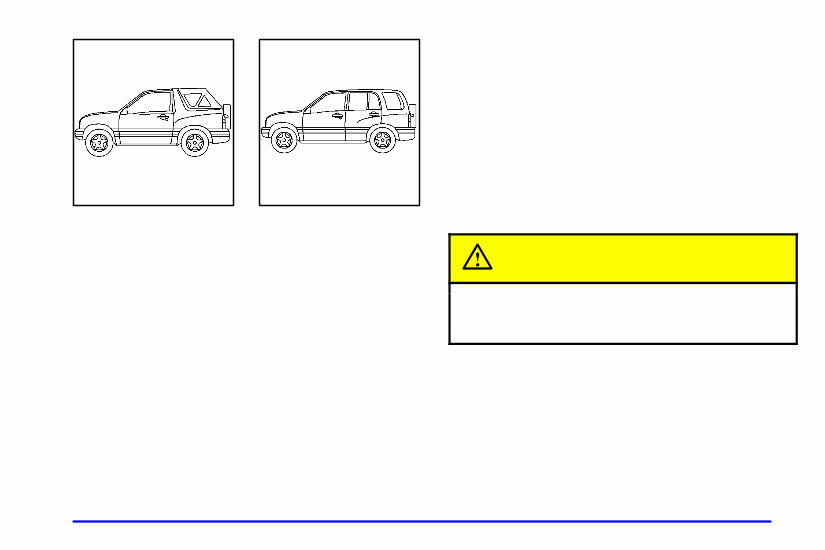
As with other vehicles of this type, failure to operate
this vehicle correctly may result in loss of control or an
accident. Be sure to read the “on-pavement” and
“off-road” driving guidelines in this manual.
See “Your Driving, the Road and Your Vehicle” and
“Off-Road Driving with Your Four-Wheel-Drive
Vehicle” in the Index.
How to Use this Manual
Many people read their owner’s manual from beginning
to end when they first receive their new vehicle. If you do
this, it will help you learn about the features and controls
for your vehicle. In this manual, you’ll find that pictures
and words work together to explain things quickly.
Safety Warnings and Symbols
You will find a number of safety cautions in this book.
We use a box and the word CAUTION to tell you
about things that could hurt you if you were to ignore
the warning.
CAUTION:
These mean there is something that could hurt
you or other people.
In the caution area, we tell you what the hazard is.
Then we tell you what to do to help avoid or reduce
the hazard. Please read these cautions. If you don’t,
you or others could be hurt.
iv
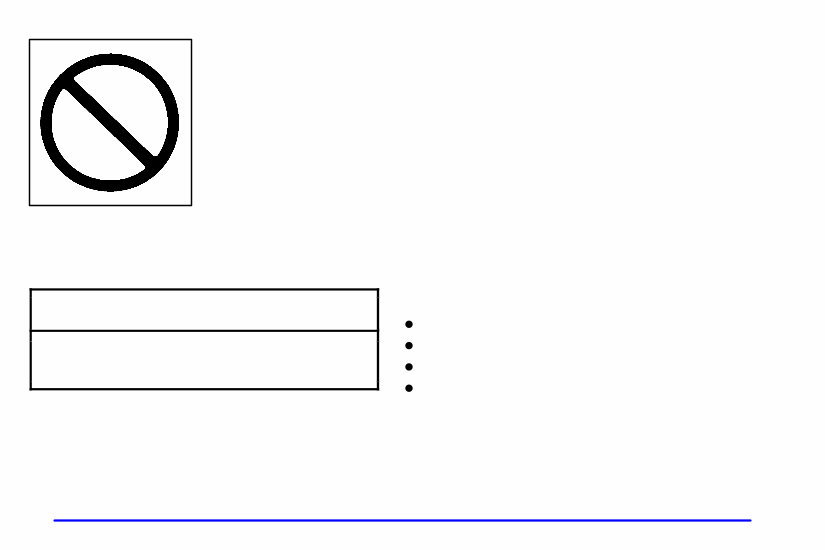
You will also find a circle
with a slash through it
in this book. This safety
symbol means “Don’t,”
“Don’t do this” or “Don’t
let this happen.”
Vehicle Damage Warnings
Also, in this book you will find these notices:
NOTICE:
These mean there is something that could damage
your vehicle.
In the notice area, we tell you about something that can
damage your vehicle. Many times, this damage would
not be covered by your warranty, and it could be costly.
But the notice will tell you what to do to help avoid
the damage.
When you read other manuals, you might see
CAUTION and NOTICE warnings in different
colors or in different words.
You’ll also see warning labels on your vehicle.
They use the same words, CAUTION or NOTICE.
Vehicle Symbols
Your vehicle may be equipped with components and
labels that use symbols instead of text. Symbols,
used on your vehicle, are shown along with the text
describing the operation or information relating to a
specific component, control, message, gage or indicator.
If you need help figuring out a specific name of a
component, gage or indicator reference the following
topics in the Index:
“Engine Compartment Overview”
“Instrument Panel”
“Comfort Controls”
“Audio Systems”
Also see “Warning Lights and Gages” in the Index.
You're Reading a Preview
What's Included?
 Lifetime Access
Fast Download Speeds
Offline Viewing
Access Contents & Bookmarks
Full Search Facility
Print one or all pages of your manual
$26.99
2000-2004 Chevrolet Tracker Owners Manual
Viewed 90 Times Today

What's Included?
Lifetime Access
Fast Download Speeds
Offline Viewing
Access Contents & Bookmarks
Full Search Facility
Print one or all pages of your manual
$26.99

Secure transaction
What's Included?
Lifetime Access
Fast Download Speeds
Offline Viewing
Access Contents & Bookmarks
Full Search Facility
Print one or all pages of your manual
Description
Chevrolet Tracker Owner's Manual
These manuals are available in .PDF format and are loaded onto a quality CD.


