GENERAL INFORMATION Air Bag Deactivation Procedures - BMW SPECIAL CARE DURING MECHANICAL REPAIRS In some instances, it may be necessary to remove steering column or instrument panel to gain access to blower motor housing, heater assembly, evaporator assembly, or other A/C-heater system related components. Observe manufacturer service precautions when working on a vehicle equipped with an air bag system. See SERVICE PRECAUTIONS . Electrical sources should never be allowed near inflator on back of air bag module. Never probe air bag system electrical wires with analog volt-ohmmeter or test light. Always disable air bag system before servicing vehicle. See DISABLING & ACTIVATING AIR BAG SYSTEM procedure. Failure to do so could result in accidental air bag deployment and possible personal injury. If air bag system is not fully functional for any reason, DO NOT drive vehicle until system is repaired and is again operational. DO NOT remove bulbs, modules, sensors or other components, or in any way disable system from operating normally. If air bag system is not functional, park vehicle until system is repaired and functions properly. SYSTEM OPERATION CHECK 1. Turn ignition switch to ON position, with engine off. SRS is operational if AIR BAG warning light comes on and then goes out after about 6 seconds with engine off. 2. If AIR BAG warning light remains on, this indicates a fault in the SRS. If AIR BAG warning light fails to illuminate when ignition is first turned on, this indicates bulb is faulty or there is a fault in the wiring circuit to the bulb. WARNING: To avoid injury from accidental air bag deployment, read and carefully follow all SERVICE PRECAUTIONS and DISABLING & ACTIVATING AIR BAG SYSTEM procedures. WARNING: Some vehicles are equipped with a passenger's side air bag ON/OFF switch. This switch should NOT be used in place of specified vehicle air bag system disabling and activating procedures. WARNING: DO NOT use any type of back-up power supply (memory saver) from outside vehicle to avoid memory loss in memory systems, if equipped. Back-up power supplies can provide enough voltage to deploy air bags. NOTE: When the battery is disconnected, vehicle computer and memory system may lose data. Driveability problems may exist until computer systems have completed a relearn cycle.
SERVICE PRECAUTIONS Observe these precautions when working on SRS: When working around steering column and before any repairs are performed, disable SRS. See DISABLING & ACTIVATING AIR BAG SYSTEM . Before straightening damaged metal or arc-welding, disable SRS and disconnect front sensors, front air bag modules, seat belt tensioners (if equipped) and side air bag modules connectors. See DISABLING & ACTIVATING AIR BAG SYSTEM . After disabling SRS, wait at least 5 minutes before servicing vehicle. SRS control unit maintains SRS voltage for about 5 minutes after system is disabled. Servicing SRS before 5 minutes may cause accidental air bag deployment and possible personal injury. Always wear safety glasses and gloves when handling a deployed air bag module. Air bag module may contain sodium hydroxide deposits, which irritates skin. Handle sensors carefully. Never strike or jar sensors. All sensors and mounting bracket bolts must be tightened to specification to ensure proper sensor operation. Never use any SRS component that has been dropped from a height of 2 feet or higher. DO NOT repair any SRS component or wiring harness; replace only. Wiring harnesses and connectors are Orange for immediate identification. To avoid air bag deployment, DO NOT use self-powered electrical test equipment on driver's or passenger's air bag modules. This equipment includes battery powered circuit testers, voltmeters and ohmmeters. Always handle air bag module with trim cover away from body. Always place air bag module on workbench with trim cover up, away from loose objects. DO NOT leave air bag modules unattended. Never expose SRS components to temperatures greater than 167°F (75°C). Front air bag modules, belt tensioners and side air bag modules (if equipped) can only be checked while installed in vehicle and using a BMW Service Tester/DIS. Only attempt SRS inspections using specified procedures and checking devices. Never expose any SRS system components to cleaning agents such as solvents, gasoline, lye, etc. DISABLING & ACTIVATING AIR BAG SYSTEM 1. Before proceeding, see SERVICE PRECAUTIONS . Retrieve fault codes before disconnecting battery. Ensure radio and ignition is off. Disconnect and shield negative battery cable. WAIT at least 5 minutes (one minute on 7-series models) for energy capacitor in SRS control unit to discharge. System is now disabled. 2. Ensure no one is inside vehicle and connect negative battery cable. System is now activated. Perform system operation check to ensure system is functioning properly and no fault codes are set. See SYSTEM CAUTION: Ensure radio is off before disconnecting battery. This will prevent damage to radio microprocessor. On cars with radio codes, ask customer for radio code card before disconnecting battery. Make a note of stored transmitters, restore these transmitters after reconnecting the battery.
OPERATION CHECK .
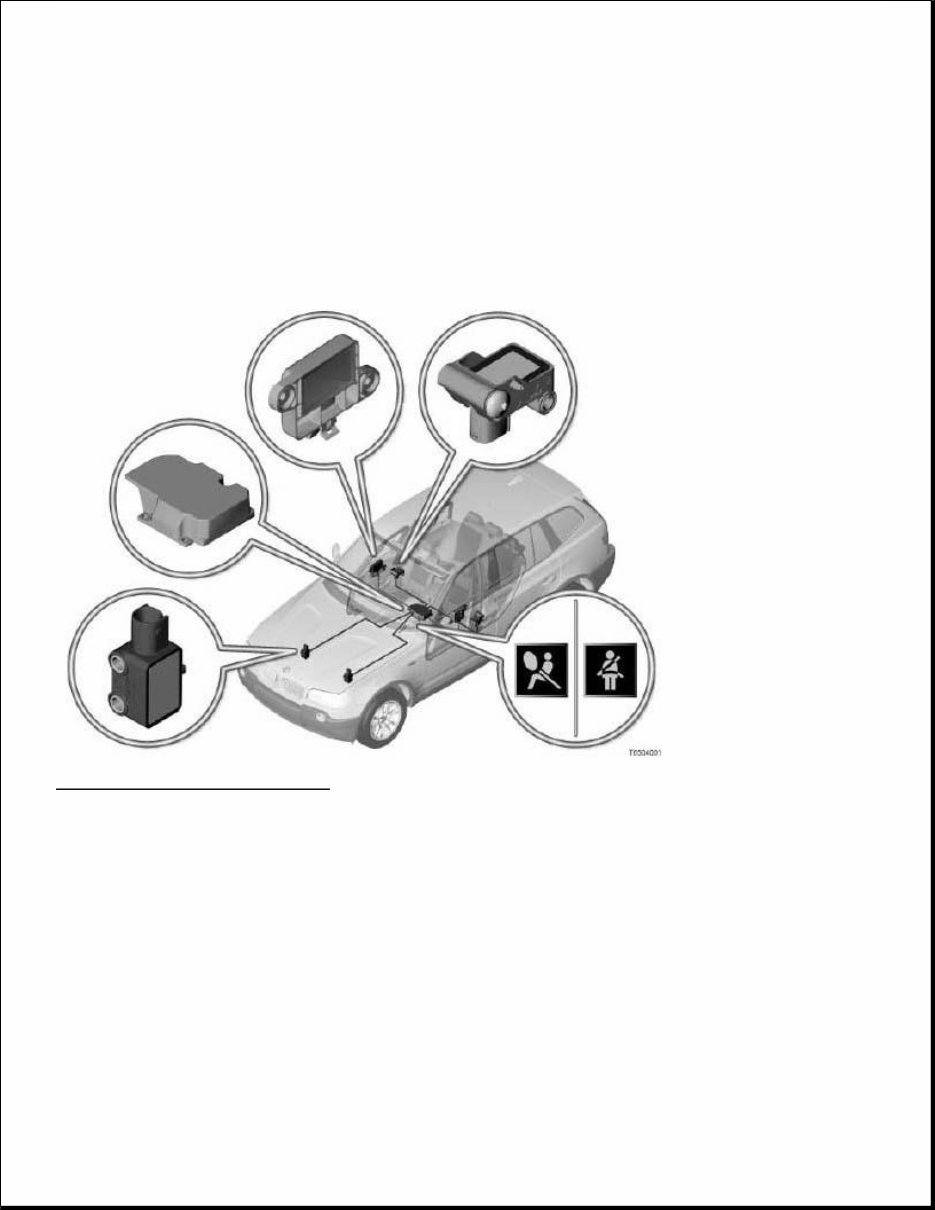
ACCESSORIES AND EQUIPMENT Audio, Navigation and Anti-Theft - SI Techniques - X3 MULTIPLE RESTRAINT SYSTEM 4 E83 Fig. 1: Multiple Restraint System 4 Courtesy of BMW OF NORTH AMERICA, INC. INTRODUCTION Multiple restraint system 4 is a further development of the multiple restraint system (MRS) in the E46. The MRS performs the following functions: Detects an accident situation which could be critical for the occupants Activates the necessary restraint systems (selectively, depending on the severity and type of accident) New features, compared to the previous MRS (E46): 2 airbag front sensors
Front left door satellite and front right door satellite Left-hand B-pillar satellite and right-hand B-pillar satellite with lateral and longitudinal acceleration sensors The MRS control unit interfaces have been expanded to 75 pins (50 pins in the E46). Discontinuation of the MRS acceleration sensors under the front seats The lateral acceleration sensors are now in the left and right-hand B-pillar satellites. An advantage compared to the previous multiple restraint system is more precise airbag trigger control BRIEF DESCRIPTION OF COMPONENTS The following sensors detect the direction and severity of an impact: Airbag front sensors The airbag front sensors are longitudinal acceleration sensors. The front airbag sensors detect a head-on collision. Front left door satellite and front right door satellite There is a pressure sensor in each satellite door. The pressure sensors detect a side impact. Left-hand B-pillar satellite and right-hand B-pillar satellite The B-pillar satellites each contain a lateral acceleration sensor and a longitudinal acceleration sensor. The sensors are arranged at 90 degrees to each other. Acceleration sensors in the MRS control unit There is a lateral acceleration sensor and a longitudinal acceleration sensor in the MRS control unit. The sensors are arranged at 90 degrees to each other. The following components provide input signals for the multiple restraint system (MRS): Seat-belt-lock switch (driver and passenger seat) The seat-belt-lock switch indicates whether the seat belt is engaged or not. The seat-belt-lock switch is powered by the MRS control unit. The power consumption of the switch forms the signal for the switch position (seat belt engaged or not engaged). The seat-belt-lock switches on the driver and passenger seats are permanently monitored when terminal R is ON. For example, if a seat belt is released while the vehicle is in motion, there is a seat-belt warning. A seat-belt warning is started when terminal 15 is ON.
The seat-belt warning indicates to the occupants that they should fasten their seat belts. The seat-belt warning is an extension of the previous time-dependent display (seat-belt warning lamp in the instrument cluster for approximately 6 seconds after terminal 15 is switched ON). Seat-belt-lock switch (US version) When terminal 15 is ON, a seat-belt warning lamp lights up and a warning sounds if the driver and passenger seat belts are not engaged. Once the driver and passenger seat belts are engaged in the corresponding buckles, the seat-belt warning lamp and the audible warning are switched off. If a seat belt is released while the vehicle is in motion, the seat-belt warning lamp lights up and a warning signal sounds for approximately 90 seconds. The MRS control unit uses the signal from the seat-belt-lock switch to determine whether an airbag should be triggered at stage 1 (seat belt not engaged) or at stage 2 (seat belt engaged). Passenger seat occupancy detector The passenger seat-occupancy detector recognizes whether the seat is occupied or not. When a weight is placed on the seat, resistance in the seat-occupancy mat changes. If the multiple restraint system (MRS) triggers the driver's airbag, the passenger airbag and belt tensioner will not be triggered if the passenger seat is unoccupied. Passenger seat-occupancy detector (US version) Due to legal requirements in the USA, a child seat securing a one-year-old child which is placed on the passenger seat must be automatically detected. Upon detection, the airbags on the passenger side are automatically deactivated (passenger airbag and front right-hand side airbag). The passenger seat-occupancy detector is based on an evaluation of the surface pressure generated by the person sitting down. The electronic evaluation decides whether a person or a child seat is occupying the seat. If a one-year-old child in a child seat is detected, the airbags on the passenger side are deactivated (warning lamp for passenger-airbag deactivation lights up). Several control units make up the multiple restraint system (MRS): Multiple restraint system control unit All gas generators and sensors in the multiple restraint system (MRS) are connected to the MRS control unit. The MRS control unit evaluates the data it receives from the sensors. In the event of a head-on or side impact, the control unit determines whether it is necessary to deploy any airbags and which airbags should be deployed.
Digital motor electronics or digital diesel electronics When an airbag is triggered, the electric fuel pump is switched off by the DME or DDE (DME = Digital Motor Electronics, DDE = Digital Diesel Electronics). Signal path: MRS control unit -> K bus -> instrument cluster -> PT-CAN -> DME or DDE -> direct line - > fuel-pump relay> electric fuel pump Instrument cluster The instrument cluster triggers the optical and audible seat-belt warning. The MRS control unit only sends a message on the status of the seat belts and the seat-occupancy detector. The instrument cluster receives the status message from the MRS control unit via the body bus when terminal R is ON. Depending on the status, the optical and audible warning is triggered when terminal 15 is ON. The following components are controlled: Ignition circuit for the airbags With the maximum amount of equipment, the multiple restraint system consists of the following ignition circuits: Driver's airbag (stage 1) Passenger airbag (stage 1) Driver's airbag (stage 2) Passenger airbag (stage 2) Side airbag in the front left door Side airbag in the front right door Side airbag in the left rear door (option 261) Side airbag in the right rear door (option 261) Left-hand head airbag Right-hand head airbag Belt tensioner, front left Belt tensioner, front right Safety battery terminal Driver and passenger airbag The driver and passenger airbag reduce the risk of injury to the occupants in the event of a head-on collision.
The driver airbag is located in the center pad on the steering wheel. The passenger airbag is integrated into the instrument panel above the glove compartment. The driver and passenger airbags each have a dual-stage gas generator. The airbags are triggered at different levels depending on the severity of the accident. Side airbags The side airbags reduce the risk of injury to the occupants in the event of a side collision. The side airbags are located behind the door trim panel. The side airbags are always triggered at stage 1. Head airbags The head airbags protect the occupants' head in the event of an impact to the side body panels. They also protect the head from objects that may enter the vehicle. Belt tensioners The pyrotechnic belt tensioners pull the front seat belts tight against the occupants' body in the event of a head- on or rear-end collision. In a normal situation, the seat belt does not sit completely tight against the body. The seat belt always has a small degree of play to guarantee the occupants an adequate degree of comfort. The play of a fastened seat belt is know as slack. The prevent the negative effects of this slack, the seat belt buckle is pulled down several centimeters by gas generators in the event of an accident. This pulls the seat belt tight. Safety battery terminal Depending on the severity of the accident, the safety battery terminal disconnects the starter motor and the alternator from the power circuit. This minimizes the risk of short circuits in a serious accident. The trigger signal comes from the MRS control unit. Airbag warning lamp The airbag warning lamp shows the operational capability of the multiple restraint system (MRS). The airbag warning lamp is located in the instrument cluster and is controlled by the MRS control unit (via the K bus). After the ignition is switched on, the MRS performs a self test. While this is being run, the airbag warning lamp lights up (approximately 3 to 5 seconds). When the system is ready, the airbag warning lamp goes out. If, during the self test or while the vehicle is in motion, the MRS control unit detects an existing fault or one that has been stored, the airbag warning lamp remains on. If the MRS detects a fault, the operational capability is partially maintained, if possible, subject to the following: If a fault is detected in an MRS circuit, only the affected circuit is deactivated. The other airbags
and belt tensioners remain operational. If there is a fault in the airbag warning lamp circuit, the lamp does not light up. If there is no other fault, the MRS remains fully operational. If there is an internal fault in the MRS control unit or in the power supply, the entire system is deactivated. Deactivation of the passenger airbag and the front right-hand side airbag The passenger airbag and the front right-hand side airbag are deactivated by a coding procedure. Warning lamp for passenger-airbag deactivation (US version) If the warning lamp for passenger-airbag deactivation (passenger airbag off lamp) is lit, both airbags on the passenger side have been deactivated: the passenger airbag and the front right-hand side airbag The passenger airbag off lamp is constantly monitored by the MRS control unit. A fault in the power supply or a defective lamp is stored in the MRS control unit's fault memory. If this occurs, the airbag warning lamp is switched on. The passenger airbag OFF lamp is located in the control panel in the overhead console. Shutting off the fuel pump When an airbag is triggered, the fuel feed is also shut off. Mechanical components in the multiple restraint system (MRS): Seat belts The seat belts are the primary restraint system for all occupants. A lap and diagonal automatic belt is fitted on each seat. If there is a very severe impact, the seat belt strap may cause injuries to the chest of the person it is securing. To minimize this risk, the front seat belts are fitted with belt force limiters as standard. The belt force limiters allow the seat belt to be unrolled in a controlled fashion if the belt force exceeds a critical value. The risk of injury due to the belt force acting on the body is therefore reduced. Passive knee protection (US version) Not every state in the USA has a requirement for seat belts to be worn. Therefore, the E83 also has additional plastic impact protection on the driver and passenger sides. In the event of an impact, the passive knee protection provides a flat support for the lower leg, especially if the front passengers are not wearing their seat belts. This causes the forwards movement of the upper body to be controlled towards the relevant airbag (driver or passenger airbag). SYSTEM FUNCTIONS
Triggering the multiple restraint system Emergency call (EURO version) Emergency call (US version) Triggering the multiple restraint system Extensive testing has allowed the triggering thresholds to be determined for all possible types of accidents. Various triggering thresholds were set for activating the different restraint systems: The multiple restraint system comprises: Belt tensioners Front airbags Side airbags Head airbags Safety battery terminal Electric fuel pump The following examples illustrate how the various restraint systems are triggered: Head-on collision The belt tensioners, the front airbags and the safety battery terminal are triggered if the head-on collision is so severe that the triggering threshold of the MRS control unit is exceeded. The belt tensioners have a lower triggering threshold than the front airbags. The belt tensioners are therefore triggered earlier. If the seat-belt-lock switch is faulty, the triggering threshold for the front airbag on this side is lowered. Even though there is a fault message, the MRS control unit will try to trigger the belt tensioners. If the seat-occupancy detector is faulty, the control unit assumes that the passenger seat is occupied. The restraint systems are activated. The electric fuel pump is switched off. An automatic emergency call is initiated (only in vehicles with the relevant equipment fitted). Side impact The side impact must be severe enough for the triggering threshold in the MRS control unit to be exceeded. The side airbag and the head airbag are deployed on the side affected. The safety battery terminal is also triggered.
Introducing the 2008 BMW X3 (E83) Service & Repair Manual. This comprehensive manual is a must-have for all BMW X3 owners looking to maintain, service, and repair their vehicle.
With this manual, you'll have access to a wealth of detailed information and step-by-step instructions on how to perform various tasks on your 2008 BMW X3. Whether you're a DIY enthusiast or a professional mechanic, this manual will be your ultimate resource.
Features of the 2008 BMW X3 (E83) Service & Repair Manual include:
Complete maintenance procedures for all systems, including engine, transmission, suspension, brakes, electrical, and more.
Detailed troubleshooting guides to help you identify and solve common issues.
Easy-to-follow instructions with clear diagrams and illustrations.
Specifications, tightening torques, and fluid capacities for all components.
Step-by-step removal and installation procedures for various parts.
Wiring diagrams to assist with electrical repairs.
Special tools and equipment required for specific tasks.
Whether you need to perform routine maintenance, such as oil changes and filter replacements, or tackle more complex repairs, this manual has got you covered. It's your go-to guide for keeping your 2008 BMW X3 running smoothly and efficiently.
Invest in the 2008 BMW X3 (E83) Service & Repair Manual today and empower yourself with the knowledge and skills needed to take care of your vehicle. Don't let maintenance and repairs be a hassle - with this manual, you'll have everything you need at your fingertips.













 Lifetime Access




