Protected by copyright. Copying for private or commercial purposes, in part or in whole, is not permitted unless authorised by AUDI AG. AUDI AG does not guarantee or accept any liability with respect to the correctness of information in this document. Copyright by AUDI AG. Workshop Manual Audi A6 2011 ➤ Audi A6 China 2012 ➤ Audi A7 Sportback 2011 ➤ 4-cylinder direct injection engine (1.8, 2.0 ltr. 4-valve TFSI - generation II) Engine ID CAE B CDN B CDZ A CHJA CAE D Edition 10.2016 Service Service Department. Technical Information
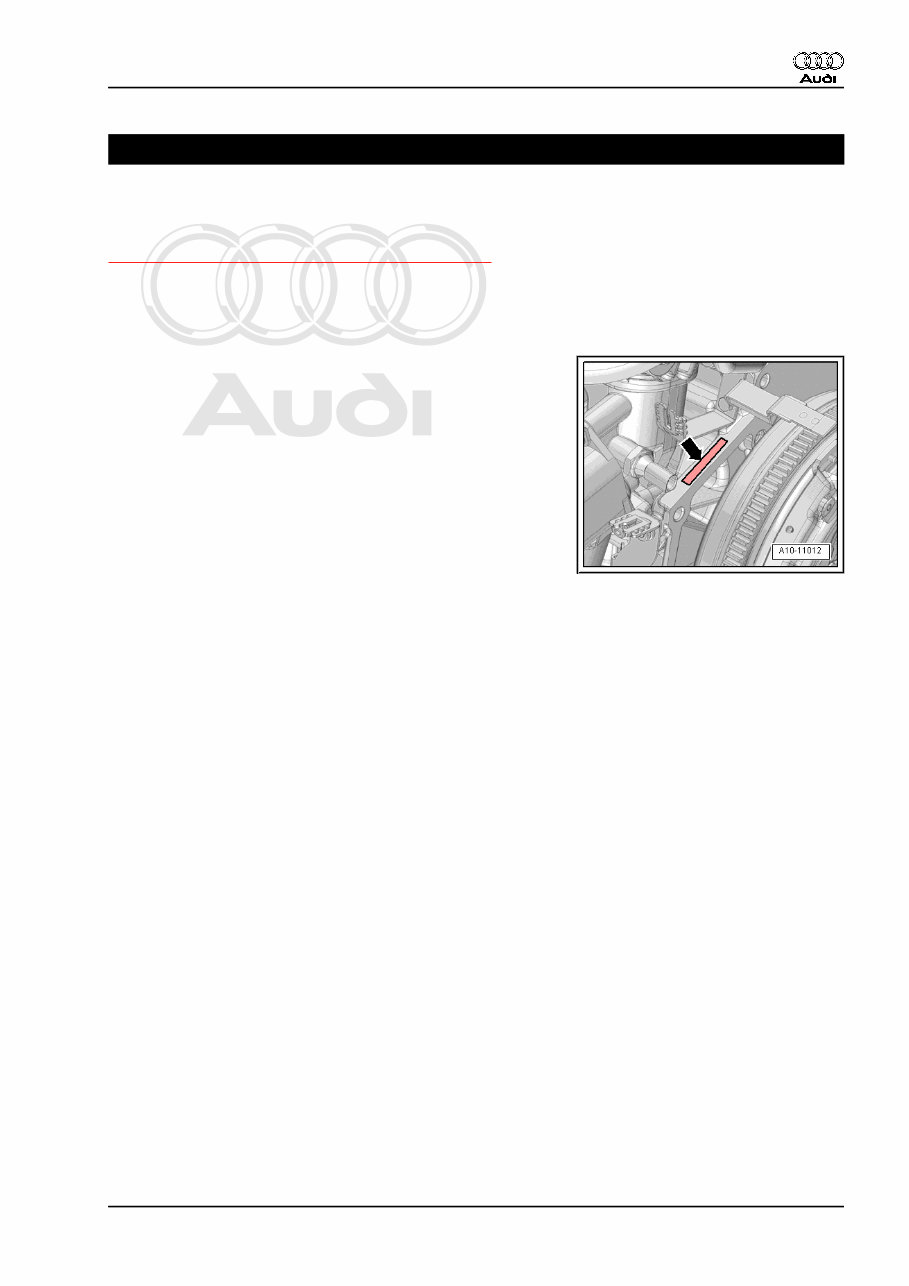
Protected by copyright. Copying for private or commercial purposes, in part or in whole, is not permitted unless authorised by AUDI AG. AUDI AG does not guarantee or accept any liability with respect to the correctness of information in this document. Copyright by AUDI AG. 00 – Technical data 1 Identification (ARL004955; Edition 10.2016) ⇒ “1.1 Engine identification number/engine data”, page 1 1.1 Engine identification number/engine da‐ ta Engine number ♦ The engine number (“engine code” and “serial number”) can be found at the joint between engine and gearbox -arrow-. ♦ Additionally there is a sticker on the toothed belt cover (top) with engine code and serial number. ♦ Engine codes starting with the letter “C” have four letters (pre‐ viously three letters). ♦ The first 3 characters of the engine code stand for the engine capacity and the mechanical construction and design. They are stamped onto the cylinder block together with the serial number. ♦ The 4th character indicates the power output and torque of the engine and is determined by the engine control unit. ♦ The engine code can be found on the type plate (in versions for some countries only) and on the vehicle data sticker and the engine control unit. ♦ Fitting locations of the type plate (certain countries only) and the vehicle data sticker ⇒ Maintenance ; Booklet 411 . For engine data refer to ⇒ Technical data for engines; Rep. gr. 00 ; Overview of engines . Audi A6 2011 ➤ , Audi A6 China 2012 ➤ , Audi A7 Sportback 2011 ➤ 4-cylinder direct injection engine (1.8, 2.0 ltr. 4-valve TFSI - generation II) - Edition 10.2016 1. Identification 1
Protected by copyright. Copying for private or commercial purposes, in part or in whole, is not permitted unless authorised by AUDI AG. AUDI AG does not guarantee or accept any liability with respect to the correctness of information in this document. Copyright by AUDI AG. 2 Safety precautions ⇒ “2.1 Safety precautions when working on high-voltage vehi‐ cles”, page 2 ⇒ “2.2 Safety precautions when working on the fuel supply sys‐ tem”, page 9 ⇒ “2.3 Safety precautions when working on vehicles with start/ stop system”, page 9 ⇒ “2.4 Safety precautions when working on the subframe”, page 10 ⇒ “2.5 Safety precautions when using testers and measuring in‐ struments during a road test”, page 10 ⇒ “2.6 Safety precautions when working on the ignition system”, page 10 ⇒ “2.7 Safety precautions when working on the cooling system”, page 11 2.1 Safety precautions when working on high-voltage vehicles ⇒ “2.1.1 Working on high-voltage vehicles”, page 2 ⇒ “2.1.2 Performing visual check of high-voltage components and wires for damage”, page 7 2.1.1 Working on high-voltage vehicles WARNING Safety hazard: the engine can start unexpectedly. Before carrying out general work on a vehicle with high-voltage electrical system, switch off the ignition and remove the ignition key from the vehicle. WARNING Working on vehicles with high-voltage wiring: • Do not support yourself or tools on high-voltage wiring or associated components --> this can damage the insula‐ tion. • High-voltage wiring must not be excessively bent or kinked --> this can damage the insulation. • The round high-voltage connectors are colour-coded with an external coloured ring and are provided with mechan‐ ical coding or guide lugs. It is important to observe this coding when joining up the round high-voltage connec‐ tors, otherwise the connectors can be damaged. Audi A6 2011 ➤ , Audi A6 China 2012 ➤ , Audi A7 Sportback 2011 ➤ 4-cylinder direct injection engine (1.8, 2.0 ltr. 4-valve TFSI - generation II) - Edition 10.2016 2 Rep. gr.00 - Technical data
Protected by copyright. Copying for private or commercial purposes, in part or in whole, is not permitted unless authorised by AUDI AG. AUDI AG does not guarantee or accept any liability with respect to the correctness of information in this document. Copyright by AUDI AG. DANGER! Risk of fatal injury if high-voltage components are damaged. Observe the following when working in the vicinity of high-volt‐ age components or wiring: ♦ It is not permitted to use cutting or forming tools, other sharp-edged tools or heat sources such as welding, braz‐ ing, soldering, hot air or thermal bonding equipment. ♦ Before starting work, visually inspect the high-voltage components in the areas involved. ♦ Before working in the engine compartment, visually in‐ spect the power and control electronics for electric drive - JX1- , electric drive motor - V141- , air conditioner compressor - V470- and high-voltage wiring. ♦ Before working on the vehicle underbody, visually inspect the high-voltage wiring and covers. ♦ Before working on the rear section of the vehicle, visually inspect the high-voltage wiring and the electronics box with the maintenance connector for high-voltage system - TW- . ♦ Visually inspect all potential equalisation lines. Check the following when making the visual inspection: ♦ There must be no external damage on any component. ♦ The insulation of the high-voltage wiring and potential equalisation lines must not be damaged. ♦ There must be no unusual deformation of the high-voltage wiring. ♦ All high-voltage components must be identified by a red warning sticker. De-energising high-voltage system DANGER! High voltage can cause fatal injury. Danger of severe or fatal injuries from electric shock. ♦ The high-voltage system may only be de-energised by a suitably qualified person (Audi high-voltage technician). ♦ It must be definitely confirmed that the high-voltage sys‐ tem is de-energised. The system may only be de-ener‐ gised using the vehicle diagnostic tester via “Guided Fault Finding”. ♦ The qualified person (Audi high-voltage technician) con‐ firms that the system is de-energised and uses the locking cap - T40262- to ensure that the system cannot be re- energised. As an additional precaution, the ignition key and the maintenance connector for high-voltage system - TW- are then stored in a safe place by the qualified per‐ son. ♦ The qualified person (Audi high-voltage technician) marks the vehicle by attaching the appropriate warning signs. Audi A6 2011 ➤ , Audi A6 China 2012 ➤ , Audi A7 Sportback 2011 ➤ 4-cylinder direct injection engine (1.8, 2.0 ltr. 4-valve TFSI - generation II) - Edition 10.2016 2. Safety precautions 3
Protected by copyright. Copying for private or commercial purposes, in part or in whole, is not permitted unless authorised by AUDI AG. AUDI AG does not guarantee or accept any liability with respect to the correctness of information in this document. Copyright by AUDI AG. Note ♦ De-energising high-voltage system: ♦ Connect vehicle diagnostic tester. ♦ Select Guided Fault Finding mode ♦ Using the Go To button, select the following menu options in succession: ♦ Selecting function/component ♦ Body ♦ Electrical system ♦ Self-diagnosis compatible systems ♦ 8C - Hybrid battery management -J840 ♦ 8C - Hybrid battery management, functions ♦ 51 - De-energise high-voltage system (Rep. gr. 93) ♦ The system must first be de-energised by an Audi high-voltage technician before any work is performed on the high-voltage system ⇒ Electrical system, hybrid; Rep. gr. 93 ; De-ener‐ gising high-voltage system . ♦ The types of work for which the high-voltage system has to be de-energised are indicated in the instructions for the proce‐ dure. For further information, see ⇒ Electrical system, hybrid; Rep. gr. 93 ; General warning instructions for work on the high- voltage system . Note ♦ The high-voltage system must be de-energised before begin‐ ning any work on components of hybrid vehicles that are connected to the high-voltage system (e.g. electrically driven air conditioner compressor). ♦ Work on the air conditioning system of hybrid vehicles that does not directly affect the high-voltage system (e.g. perform‐ ing pressure test on refrigerant circuit, running Guided Fault Finding for air conditioner or control unit for air conditioning compressor - J842- etc.) must only be carried out by "electri‐ cally instructed persons" ⇒ Electrical system, hybrid; Rep. gr. 93 ; General warning instructions for work on the high-voltage system and ⇒ Vehicle diagnostic tester in “Guided Fault Find‐ ing” mode for air conditioner and battery power regulation . ♦ For certain work on hybrid vehicle components that are instal‐ led near high-voltage system components (e.g. battery cooling module, expansion valve to air conditioner etc.), the high-volt‐ age system must be de-energised prior to beginning work ⇒ Electrical system, hybrid; Rep. gr. 93 ; De-energising high- voltage system . Audi A6 2011 ➤ , Audi A6 China 2012 ➤ , Audi A7 Sportback 2011 ➤ 4-cylinder direct injection engine (1.8, 2.0 ltr. 4-valve TFSI - generation II) - Edition 10.2016 4 Rep. gr.00 - Technical data
You're Reading a Preview
What's Included?
Lifetime Access
Fast Download Speeds
Online & Offline Access
Access PDF Contents & Bookmarks
Full Search Facility
Print one or all pages of your manual
$52.99
2014 Audi RS7 Sportback Download Service & Repair Manual
This 2014 Audi RS7 Sportback Service & Repair Manual is the same manual used by Audi technicians and completely covers your specific model and its variants. It contains every troubleshooting and replacement procedure provided by the manufacturer, including step-by-step instructions, clear images, and exploded-view illustrations.
Whether you're a professional mechanic or a DIY enthusiast, this manual enables a Do-It-Yourself approach to fixing problems on your vehicle. Regular maintenance is essential for the durability of your vehicle, and this manual provides the manufacturer's recommended troubleshooting charts and replacement procedures for Audi vehicles.
No need for thick and heavy manuals anymore— this repair manual is the one-stop solution for any weekend DIY’er and professional mechanic regularly maintaining and repairing Audi vehicles!
This 2014 Audi RS7 Sportback Service & Repair Manual provides everything you'll need to rebuild the engine and replace every component, including wiring diagrams, torque specs, and exploded-view illustrations. The manufacturer's troubleshooting charts enable you to quickly find the cause of any issue based on specific symptoms, making it simple to follow, even for beginners!
Put simply, this 2014 Audi RS7 Sportback Service & Repair Manual will allow you to save thousands on repairs and maintenance and will pay off for itself after the first oil change. You'll thank us later!
Printable: Yes
Compatibility: Pretty much any electronic device, incl. PC & Mac computers, Android and Apple smartphones & tablet, etc.
Requirements: Adobe Reader (free)
Reviews
Q&A
Recently Viewed
5,521,897Happy Clients
2,594,462eManuals
1,120,453Trusted Sellers
15Years in Business
Price:
Actual Price:
2014 Audi RS7 Sportback Download Service & Repair Manual






 Lifetime Access