00 GENERAL, TECHNICAL DATA > GENERAL INFORMATION > AUTOMATIC TRANSMISSION > Transmission Design and Function Audi 8-Speed Automatic Transmission 0C8 Transmission Control Module -J217- Installed location: The transmission control module is under the right front seat. Refer to Transmission Control Module -J217- . Shift Point Changes on Inclines and Declines An additional gear change map automatically selects the gear changes for gradients dependent upon accelerator pedal position and driving speed. The gear change map for extreme uphill stretches is matched to engine output The gear change map for extreme downhill stretches is matched to the braking effect of the engine. Direct gear selection by the way of the Tiptronic function permits utilization of engine braking action with a specific gear engaged, for example, on a downhill gradient with a trailer. 00 GENERAL, TECHNICAL DATA > GENERAL INFORMATION > CLEAN WORKING CONDITIONS > Always clean connection places and surrounding areas with engine or brake cleaner before loosening and dry cleaned places. Clean the transmission and transmission components using cleaning solution -D 009 401 04-. Use lint-free cloths when cleaning, for example, the "WYPALL X70/WORKHORSE" cloth made by Kimberly-Clark Professional. Seal all open lines and connections immediately with clean plugs or caps from the engine bung set VAS 6122. Place removed parts on a clean surface and cover. Only use lint-free cloths for this! Carefully cover or plug unpacked components if repairs cannot be performed immediately. Only install clean components: Remove the replacement parts from their packaging just prior to installing them. Protect the disconnected connectors from dirt and moisture and only connect them when they are dry. 00 GENERAL, TECHNICAL DATA > GENERAL INFORMATION > CONTACT CORROSION > Contact corrosion can occur if non-approved fasteners are used such as bolts, nuts, washers, etc.
For this reason, only connecting elements with a special surface coating are installed. In addition, rubber or plastic parts and adhesive are made of materials that do not conduct electricity. If you are not sure about the suitability of parts, install new parts. NOTE: We recommend using original replacement parts only. They have been inspected and are compatible with aluminum. It is recommended to use Audi accessories. Damage resulting from contact corrosion is not covered by the warranty. 00 GENERAL, TECHNICAL DATA > GENERAL INFORMATION > REPAIR INFORMATION > Carefulness, cleanliness and the correct tools are required for transmission repairs to be successful. The usual basic safety precautions also, naturally apply when carrying out vehicle repairs. Some general repair information that applies to several procedures throughout this information is summarized here. They apply to this repair information. Guided Fault Finding, OBD and Test Instruments Determine the cause of the malfunction as accurately as possible using Guided Fault Finding , OBD and Test Instruments before starting any repairs on the automatic transmission using the vehicle diagnostic tester. Oil, Environmental and Disposal Regulations Handle ATF, axle oil and other fluids with care. Dispose of drained ATF properly. Follow the legal environmental and disposal regulations. Follow the information provided on oil packaging. Special Tools and Equipment For a complete list of special tools used in the Repair Information. See ServiceNet under Special Tools and Equipment. Selector Mechanism Emergency Release If the battery has been disconnected or is discharged and the vehicle must be towed or pushed, it will be necessary to push the shift mechanism emergency release to shift the selector lever from "P" to "N". Refer to SELECTOR MECHANISM, PERFORM EMERGENCY RELEASE . Transmission Clean working conditions for the automatic transmission, refer to CLEAN WORKING CONDITIONS . Do not let the engine run or tow the vehicle when the oil pan is removed or when there is no ATF in
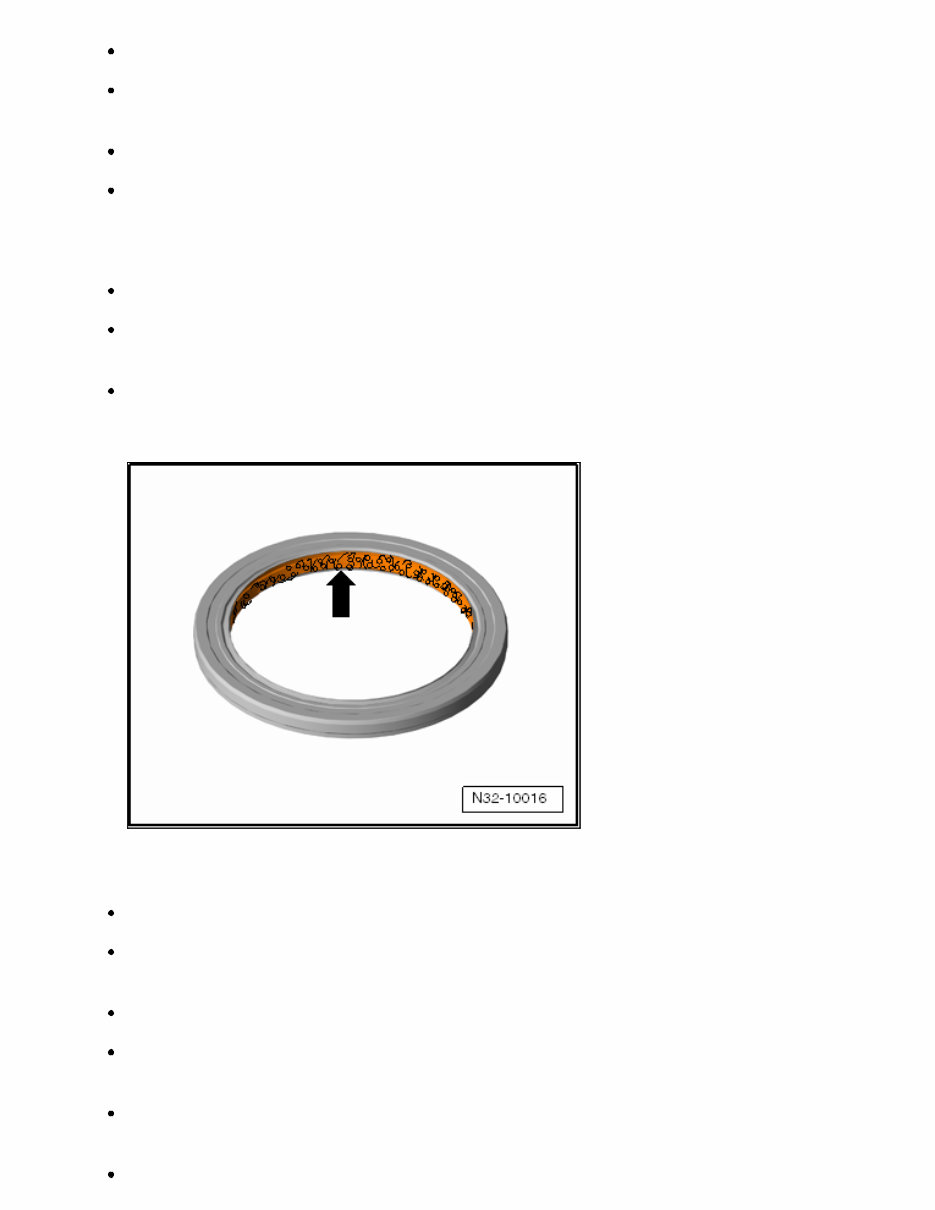
the transmission. With the transmission removed, secure the torque converter so that it cannot fall out. Check installation dimension of torque converter before installing the transmission TORQUE CONVERTER, INSTALLING => Installed Dimension . When installing the transmission, make sure that the alignment bushings are installed correctly. When exchanging automatic transmission or components, all fluid levels should be checked and corrected, if necessary. Likewise, all lines must be cleaned. Capacities, refer to CAPACITIES . Shaft Seals, Sealing Rings, O-rings, Seals O-rings, shaft seals and seals must be replaced. After removing gaskets, examine contact surface on housing/shaft for burr resulting from removal or for other signs of damage. Before installing radial shaft seal, fill the space between sealing lips -arrow- halfway with grease G 052 128 A1. The open side of the seals point toward the fluid to be sealed in. Before installing, lightly lubricate shaft seal outer circumference and sealing lips with ATF or gear oil, depending on installation location. Coat O-rings with ATF before inserting to prevent crushing rings during installation. Always use approved ATF. Other types of lubrication cause faults to occur in the transmission hydraulics. Press in new shaft seal, so that the sealing lip does not run on the same point as the sealing lip of the old shaft seal (use insertion depth tolerances). Replace paper gaskets, thoroughly clean sealing surfaces and completely remove old seals. Fig 1: Identifying Oil Seal Courtesy of AUDI OF AMERICA, LLC
After installing, check the relevant fluid levels and fill if necessary. Capacities CAPACITIES . Bolts and Nuts Loosen bolts in the opposite of tightening sequence if another sequence is not specified. Nuts and bolts which secure covers and housings should be loosened and tightened crosswise in stages if no tightening sequence is specified. The tightening specifications stated apply to non-oiled nuts and bolts. Always replace self-locking nuts and bolts. Use a wire brush to clean the threads of the bolts that were screwed in with locking compound. Install the bolts with locking fluid AMV 185 101 A1. Threaded holes into which self-locking bolts or bolts coated with locking fluid are screwed, must be cleaned (for example tap). Otherwise there is a risk that the bolts will shear the next time they are removed. Circlips Do not overstretch the circlips. Always replace damaged or stretched circlips. The circlips must fit completely inside the groove. Bearings Insert bearing with axle oil or ATF, depending on installation location. Replace the transmission if any of the shift elements are scorched. Control Modules, Electronic Components and Contacts Only touch electrical components after discharging static electricity on a grounded object, for example by touching (skin contact) vehicle or vehicle lift. Connector contacts in electric connectors, control modules and electrical components must not be touched with the hands under any circumstances. They can be destroyed by static discharge. 00 GENERAL, TECHNICAL DATA > GENERAL INFORMATION > SAFETY PRECAUTIONS > TEST DRIVES WITH THE USE OF TEST AND MEASURING DEVICES > If testing equipment must be used during a road test, observe the following: WARNING: Distraction and testing equipment that is not secured properly can cause accidents. The passenger airbag could pose a risk if it deploys in a collision. Operating testing equipment while driving causes it to shift position.
There is an increased risk of injury due to unsecured testing equipment. Always secure testing equipment on the rear seat using a strap and have a second person in the rear seat operate it. 00 GENERAL, TECHNICAL DATA > GENERAL INFORMATION > SAFETY PRECAUTIONS > WORKING ON AUTOMATIC TRANSMISSION > Observe the following to avoid personal injury and vehicle damage: WARNING: There is a risk of injury and accident from accidentally engaging a gear when the engine is running. Before working with engine running, move the selector lever to "P" and set the parking brake. To prevent personal injury and damage or destruction of electrical and electronic components, observe the following: Connect and disconnect test equipment only when the ignition is off. CAUTION: Risk of damaging electronic components when disconnecting the battery. Complete the steps for disconnecting the battery. Always turn off the ignition before disconnecting the battery. -- Disconnect the battery. Refer to BATTERY, DISCONNECTING AND CONNECTING . 00 GENERAL, TECHNICAL DATA > GENERAL INFORMATION > TOWING > CAUTION: Danger of causing damage to the transmission. The selector lever must be in "N" when towing the vehicle. Do not tow the vehicle further than 50 km and do not drive faster than 50 km/h.
Here's a comprehensive service and repair manual for the 2006-2012 Audi Q7. Whether you're a professional mechanic or a DIY enthusiast, this manual equips you with the manufacturer's recommended troubleshooting charts and replacement procedures, including step-by-step instructions, clear images, and exploded-view illustrations.
Regular maintenance is essential for the durability of your vehicle. Over time, certain parts will wear out and require replacement. This manual provides you with everything you need to address these issues, ultimately saving on repairs and increasing your vehicle's reliability.
Conveniently, the manual is easily accessible and searchable on electronic devices such as PC, Mac computers, Android and Apple smartphones, and tablets. It's available in English and requires Adobe Reader for viewing. If preferred, you can also print a physical copy for easy reference.
Get your hands on this manual to keep your Audi Q7 in top condition and minimize trips to the repair shop.






 Lifetime Access




