1 Safety briefing/employee qualifica‐ tion (AKAH000017; Edition 10.2021) 1.1 Qualification The vehicle-specific training modules must be completed to en‐ sure that repair work can be performed correctly and reliably in the workshop. ⇒ Rep. gr. 00; Safety briefing/employee qualification; Qualifica‐ tion General InformationBody Repairs, General Body Repairs - Edition 10.2021 1. Safety briefing/employee qualification 1
2 Safety information ⇒ i2.1 nformation”, page 2 ⇒ p2.2 recautions when working on the cooling system”, page 4 ⇒ p2.3 recautions when using testers and measuring instru‐ ments during a road test”, page 5 ⇒ c2.4 omponents / electric vehicles”, page 5 2.1 Safety information Observe country-specific accident prevention and industrial safety regulations. Always use an extraction system when performing welding and grinding operations. WARNING Risk of explosion due to concentration of aluminium and steel dust caused by welding and cutting work. Danger of severe or fatal injuries due to explosion. – Before starting work, check that extraction system is work‐ ing properly and clean it. – Remove any dust caused by sanding using the vacuum cleaner approved for the corresponding material. – Always separate dust from different materials (separation of aluminium, steel, CFRP). – Keep work station free of aluminium and steel dust. Re‐ move any accumulation of dust. – Do not use compressed air to remove dust deposits. – Do not perform simultaneous welding and grinding work in the same working area. – To prevent external sparks, use only compressed-air grinding and cutting devices (as far as possible). – Empty extraction system after use. – Avoid water and moisture when performing cutting or grinding work. ⇒ o3.1 n handling fine dust, aluminium dust and steel dust”, page 6 Safety precautions for fibre composite materials (CFRP) ⇒ f7.5.5 eatures of carbon fibre-reinforced plastics (CFRP)”, page 25 Danger due to gases which are hazardous to health Sparks are generated during welding and cutting work. Gases which are hazardous to health are generated if sparks make contact with foam-filled areas within the vehicle body. – Do not use spark-generating tools to perform welding and cutting work in the vicinity of foam-filled areas. General InformationBody Repairs, General Body Repairs - Edition 10.2021 2 2. Safety information
WARNING Danger of explosion if sanding, welding or cutting work is performed near fuel tank or components carrying fuel. Risk of severe injuries and burns. – Remove fuel tank or components carrying fuel before per‐ forming sanding, welding or cutting work in the vicinity of the fuel system. DANGER Damaged natural gas fuel tanks constitute an explosion risk - risk of death! – If components at the rear and/or rear side of the vehicle (e.g. bumper cover, rear lid, underbody trim, longitudinal member, rear cross panel, etc.) are removed due to acci‐ dent damage, the natural gas fuel tanks must be checked for damage. – Carry out assessment of damage to fuel tanks ⇒ Natural gas engines - General information; Rep. gr. 20; Assessing damage to fuel tanks. CAUTION Risk of injury caused by flying metal shavings. Eyes and skin can suffer irritation or injuries. – Put on safety goggles. – Put on protective gloves. CAUTION Risk to health due to dust. Risk of irreversible dust deposits in lungs and respiratory problems when performing grinding and cutting work. – Wear a dust protection mask. – Use a suitable extraction system. – Do not use cutting tools for working on CFRP materials. CAUTION Gases hazardous to health can be given off if spark-generat‐ ing tools for welding, brazing or cutting are used in the vicinity of foam material. – Never perform welding, brazing or cutting work closer than 15 mm to moulded foam inserts. – Use an extraction system when performing work. Use an extraction system when performing welding and grind‐ ing operations. Welding and grinding must never be performed simultaneously in the same working area. Working area must be cleaned at regular intervals as necessary to remove dust. Do not use compressed air to remove dust deposits. Empty extraction system after use. General InformationBody Repairs, General Body Repairs - Edition 10.2021 2. Safety information 3
Observe the relevant country-specific accident prevention and industrial safety regulations. Separating bonded joints Bonded joints on the body can be separated by applying heat. The adhesives used during vehicle manufacture and repairs are destroyed at temperatures between 180 and 200°C. Note ♦ Wear protective gloves and safety goggles. ♦ Ensure that adhesives do not make direct contact with skin. ♦ Avoid breathing in solvent vapours. ♦ Only work on adhesives in well ventilated areas. ♦ It is essential to pay attention to warnings provided by manu‐ facturers. ♦ Also observe all safety regulations which apply in your coun‐ try. ♦ The corresponding safety data sheets for the adhesives must be observed. ♦ Use suitable extraction system. Galvanised body parts CAUTION Welding galvanised sheet steel gives off toxic zinc oxide in the welding fumes. – Use an extraction system when performing work. 2.2 Safety precautions when working on the cooling system Risk of scalding as hot coolant can escape The cooling system is under pressure when the power unit is hot. Risk of scalding due to hot steam and hot coolant – Put on protective gloves. – Put on safety goggles. – Cover filler cap on expansion tank with a cloth and open carefully to release pressure. Risk of injury if auxiliary air conditioner is activated On electric and hybrid vehicles, the auxiliary air conditioner can switch itself on if it has been activated. The radiator fans can start up automatically and trap or draw in parts of the body. – Deactivate auxiliary air conditioner. General InformationBody Repairs, General Body Repairs - Edition 10.2021 4 2. Safety information
2.3 Safety precautions when using testers and measuring instruments during a road test Risk of injury if test equipment is not secured If an accident occurs and the front passenger's airbag is trig‐ gered, test equipment which is not secured adequately may be catapulted through the vehicle with potentially serious con‐ sequences. – Secure test equipment on the rear seat with a strap. Or: – Have a second mechanic operate test equipment on the rear seat. 2.4 High-voltage components / electric vehicles High voltage can cause fatal injury. The voltage levels in the high-voltage system constitute a safety hazard. Danger of severe or fatal injuries from electric shock or electric arcs if high-voltage components or high-voltage wiring are damaged. – Carry out a visual inspection of high-voltage components and high-voltage wiring. – Never use cutting/forming tools or other sharp-edged imple‐ ments in the vicinity of high-voltage components and high- voltage wires. – Never perform work using welding, brazing, thermal bonding or hot air in the vicinity of high-voltage components or high- voltage wires. General InformationBody Repairs, General Body Repairs - Edition 10.2021 2. Safety information 5
3 Repair instructions ⇒ o3.1 n handling fine dust, aluminium dust and steel dust”, page 6 ⇒ s3.2 urfaces for self-adhesive components”, page 7 ⇒ t3.3 hreaded connections”, page 7 ⇒ p3.4 lates”, page 7 ⇒ w3.5 renches”, page 7 ⇒ m3.6 ix”, page 8 ⇒ s3.7 ystems for steel/aluminium body repair station ("multi- material-mix" workplace) ”, page 8 3.1 Information on handling fine dust, alu‐ minium dust and steel dust Separating aluminium dust and steel dust All emissions from the new lightweight materials are classified under the German ordinance on dangerous substances (or equivalent national regulations). This requires a risk assess‐ ment to be conducted by the company performing the repairs, in addition to the requirements of the vehicle manufacturer with regard to repair quality. The employer must only permit activities involving dangerous substances to be started after a risk assessment has been performed and the required protective measures have been implemented. In the specific case, this means that every workshop performing repairs is obligated to perform this risk assessment and that this must be done before starting or continuing the work. Fine aluminium dust Physical properties: ♦ Aluminium dust is flammable; it can be explosive depending on the particle sizes and concentrations. Chemical properties: ♦ Aluminium dust and water produce flammable/explosive hy‐ drogen gas. ♦ Aluminium dust and iron oxide (rust) react with each other by releasing heat (exothermic redox reaction). ♦ Aluminium dust and iron oxide and a powerful ignition source can trigger a thermite reaction with a mixture ratio of 1:3. This metal fire burns at temperatures of up to 2400°C and cannot be extinguished with water. ♦ Aluminium dust is a dangerous substance and must be dis‐ posed of correctly in accordance with local regulations. Fine steel dust Physical properties: ♦ Steel particles can build up a static charge and can also be an ignition source for the aluminium dust even when cold. ♦ Flying sparks when processing steel provide the perfect igni‐ tion source for aluminium dust. General InformationBody Repairs, General Body Repairs - Edition 10.2021 6 3. Repair instructions
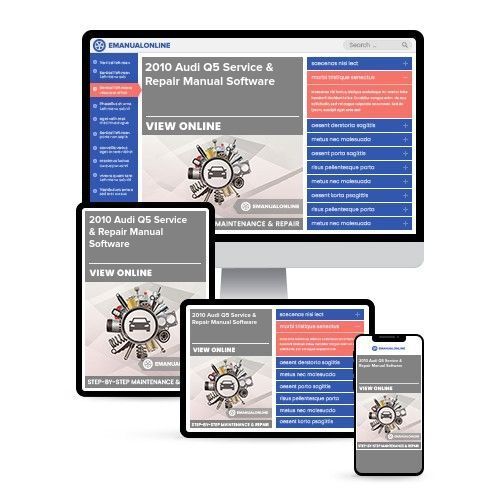
Get your hands on the 2010 Audi Q5 Service & Repair Manual in software format. These Auto Repair Manuals provide comprehensive instructions and procedures for fixing vehicle problems. Whether you're a professional mechanic or a DIY enthusiast, these manuals can be invaluable. They contain technical data, diagrams, a complete list of car parts, and pictures, making it easy for even novice car mechanics to follow along.
The repair manual covers a wide range of sections, including maintenance, engine, control system, mechanical, fuel service specifications, emission control, and much more. It comes with complete step-by-step instructions, diagrams, illustrations, wiring schematics, and specifications to help you repair your vehicle with ease.
These manuals are compatible with Windows Vista 32 and 64, XP, ME, 98, NT, 2000, and Mac. They are not interactive and are available in .OVA file format for software manuals and .PDF format for other manuals.
With this repair manual, you can save time and money by learning how to repair different parts of your car on your own. The information contained in these manuals is the same as the ones used by the engineers of the company, ensuring reliability and accuracy.
So, if you want to maintain, service, diagnose, and repair your 2010 Audi Q5, this repair manual is the perfect tool to have. It's a comprehensive guide that will keep your vehicle in top condition for years to come.
Maintenance
Engine
Control System
Mechanical
Fuel Service Specifications
Emission Control
Intake Exhaust Cooling
Lube
Ignition Starting Charging
Auto Transmission Clutch
Manual Transmission
Transfer Propeller Shaft
Drive Shaft
Differential
Axle Suspension
Tire & Wheel
Brake Control
Brake
Parking Brake
Steering Column
Power Steering
Air Condition
Suppl Restraint System
Seat Belt
Engine Immobilizer
Cruise Control
Wiper & Washer
Door Lock
Meter Audio/Visual
Horn
Windshield/Glass Mirror
Instrument Panel
Seat
Engine Hood/ Door
Exterior & Interior
Electrical
Multiplex/ Can Communication
And much more...
Compatible with all versions of Windows and Mac, these manuals are printable and come with detailed instructions and illustrations to help you service and repair your vehicle with ease. They are a must-have for anyone looking to maintain their 2010 Audi Q5 in top condition.









 Lifetime Access