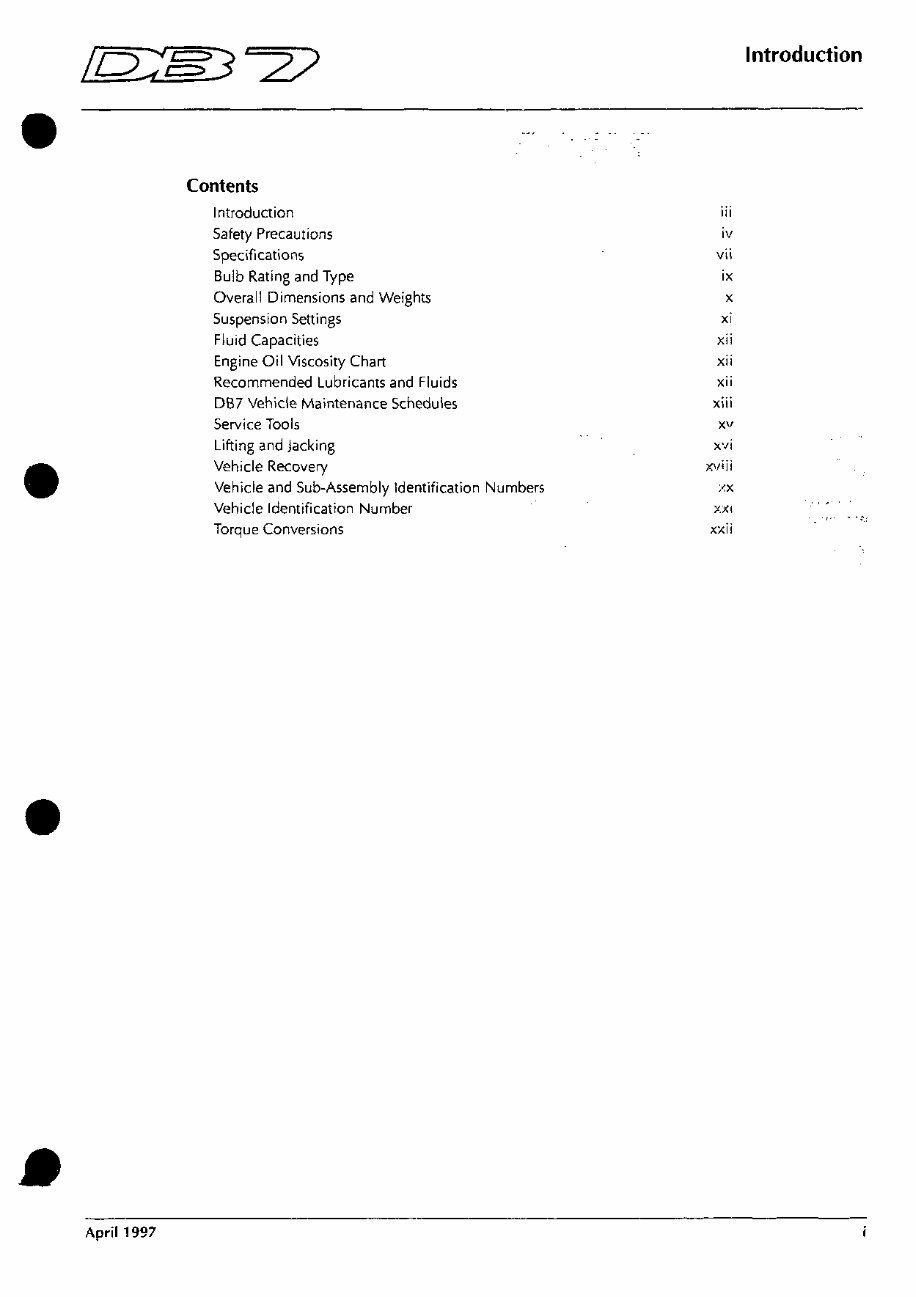
E:[M3'=2? Introduction Contents Introduction Safety Precautions Specifications Bulb Rating and Type Overall Dimensions and Weights Suspension Settings Fluid Capacities Engine Oil Viscosity Chart Recommended Lubricants and Fluids DB7 Vehicle Maintenance Schedules Service Tools Lifting and Jacking Vehicle Recovery Vehicle and Sub-Assembly Identification Numbers Vehicle Identification Number Torque Conversions III iv vii ix X xi xii xii X xi XV XV i xviii XX XXI xxii April 1997
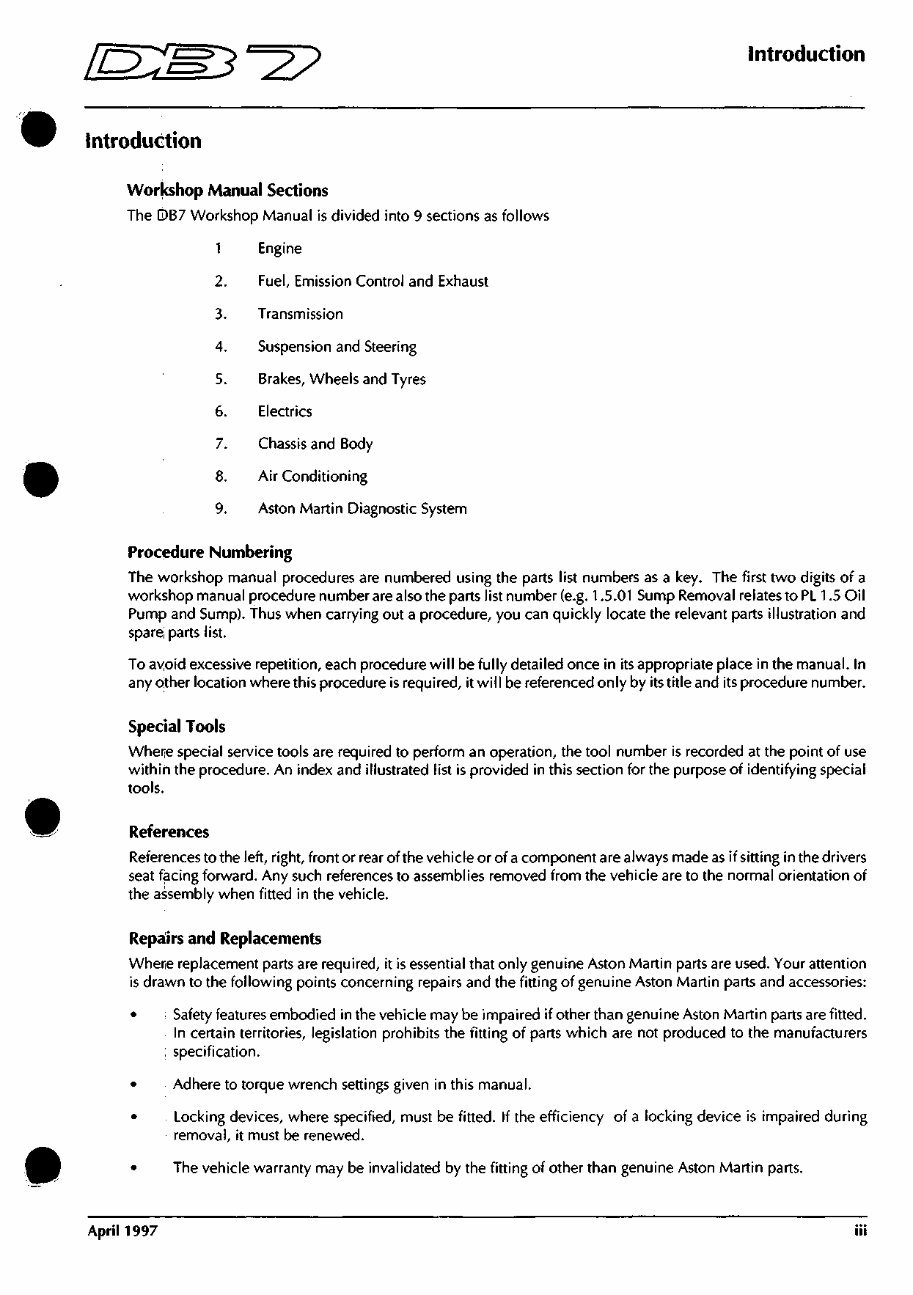
•^? Introduction Introduction Workshop Manual Sections The DB7 Workshop Manual is divided into 9 sections as follows 1 Engine 2. Fuel, Emission Control and Exhaust 3. Transmission 4. Suspension and Steering 5. Brakes, Wheels and Tyres 6. Electrics 7. Chassis and Body 8. Air Conditioning 9. Aston Martin Diagnostic System Procedure Numbering The workshop manual procedures are numbered using the parts list numbers as a key. The first two digits of a workshop manual procedure number are also the parts list number (e.g. 1.5.01 Sump Removal relates to PL 1.5 Oil Pump and Sump). Thus when carrying out a procedure, you can quickly locate the relevant parts illustration and spare parts list. To ayoid excessive repetition, each procedure will be fully detailed once in its appropriate place in the manual, in any other location where this procedure is required, it will be referenced only by its title and its procedure number. Special Tools Wheije special service tools are required to perform an operation, the tool number is recorded at the point of use within the procedure. An index and illustrated list is provided in this section for the purpose of identifying special tools. References References to the left, right, front or rear of the vehicle or of a component are always made as if sitting in the drivers seat facing forward. Any such references to assemblies removed from the vehicle are to the normal orientation of the assembly when fitted in the vehicle. Repairs and Replacements Where replacement parts are required, it is essential that only genuine Aston Martin parts are used. Your attention is drawn to the following points concerning repairs and the fitting of genuine Aston Martin parts and accessories: • i Safety features embodied in the vehicle may be impaired if other than genuine Aston Martin parts are fitted. In certain territories, legislation prohibits the fitting of parts which are not produced to the manufacturers specification. • Adhere to torque wrench settings given in this manual. • Locking devices, where specified, must be fitted. If the efficiency of a locking device is impaired during removal, it must be renewed. • The vehicle warranty may be invalidated by the fitting of other than genuine Aston Martin parts. April 1997 iii
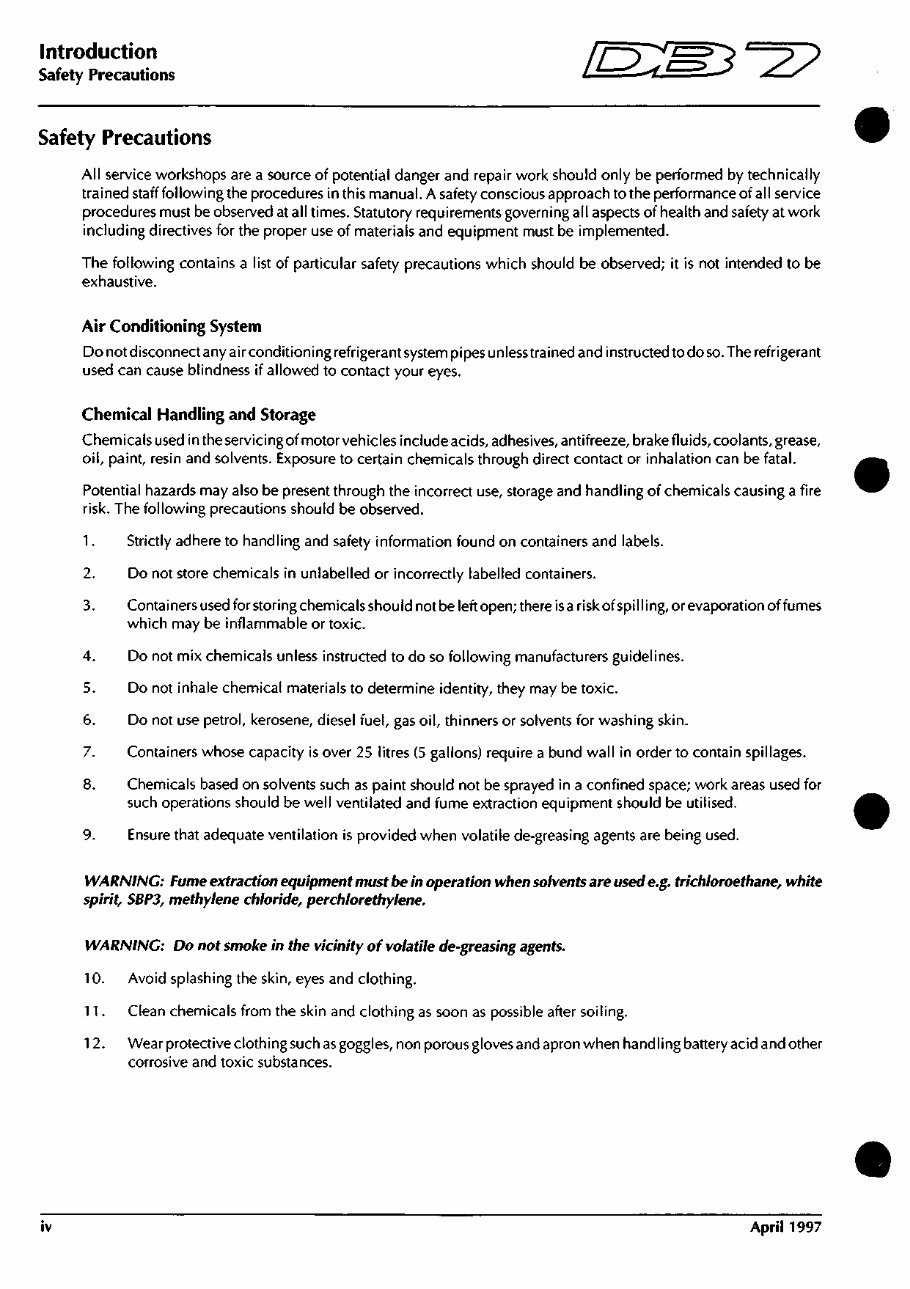
Introduction /7=^~>^^3^ ' 5^ Safety Precautions L "^ ^ ^ ^ Safety Precautions All service workshops are a source of potential danger and repair work should only be performed by technically trained staff following the procedures in this manual. A safety conscious approach to the performance of all service procedures must be observed at all times. Statutory requirements governing all aspects of health and safety at work including directives for the proper use of materials and equipment must be implemented. The following contains a list of particular safety precautions which should be observed; it is not intended to be exhaustive. Air Conditioning System Do not disconnect any air conditioning refrigerant system pipes unless trained and instructed to do so. The refrigerant used can cause blindness if allowed to contact your eyes. Chemical Handling and Storage Chemicalsusedintheservicingofmotorvehiclesincludeacids,adhesives, antifreeze, brake fluids, coolants, grease, oil, paint, resin and solvents. Exposure to certain chemicals through direct contact or inhalation can be fatal. Potential hazards may also be present through the incorrect use, storage and handling of chemicals causing a fire risk. The following precautions should be observed. 1. Strictly adhere to handling and safety information found on containers and labels. 2. Do not store chemicals in unlabelled or incorrectly labelled containers. 3. Containers used for storing chemicals should not be left open; there is a risk ofspil ling, or evaporation of fumes which may be inflammable or toxic. 4. Do not mix chemicals unless instruaed to do so following manufacturers guidelines. 5. Do not inhale chemical materials to determine identity, they may be toxic. 6. Do not use petrol, kerosene, diesel fuel, gas oil, thinners or solvents for washing skin. 7. Containers whose capacity is over 25 litres (5 gallons) require a bund wall in order to contain spillages. 8. Chemicals based on solvents such as paint should not be sprayed in a confined space; work areas used for such operations should be well ventilated and fume extraction equipment should be utilised. 9. Ensure that adequate ventilation is provided when volatile de-greasing agents are being used. WARNING: Fume extraction equipment must be in operation when solvents are used e.g. trichloroethane, white spirit, SBP3, methylene chloride, perchlorethylene. WARNING: Do not smoke in the vicinity of volatile de-greasing agents. 10. Avoid splashing the skin, eyes and clothing. 11. Clean chemicals from the skin and clothing as soon as possible after soiling. 1 2. Wear protective clothing such as goggles, non porous gloves and apron when handling battery acid and other corrosive and toxic substances. iv April 1997
Ir~-^ ^^1^^^^ ' J ^ Introduction Safety Precautions Safety Precautions (continued) Electrical Equipment 1. Ensure that electrical equipment is in safe working order before use. 2. Inspect power leads of all mains electrical equipment for damage and security, and check that it is properly earthed. 3. Ensure that electrical equipment is protected by a fuse of the correct current rating. 4. Disconnect the battery before commencing repair operations to the electrical system, fuel system and engine or when working beneath the vehicle. Exhaust Fumes Engines should not be run in confined spaces, exhaust fumes contain harmful and toxic substances including carbon monoxide which can prove fatal if inhaled. Engines must only be run where there is fume extraction equipment in operation or where there is adequate ventilation. Fire Precautions 1. Ensure that a suitable form of fire extinguisher is conveniently located near the work area. 2. Keep oils, solvents and combustible materials away from naked flames and other sources of ignition. 3. Ensure that NO SMOKING signs are posted around areas where combustible materials and vapour may be present and ensure that the warnings are strictly observed. 4. Ensure that dry sand is available to soak up any spillage of fuel or other flammable solutions. 5. Fume extraction equipment must be available and in full working order to remove combustible and toxic vapours. 6. All personnel should be aware of the fire drill procedures and precautions. Jacking and Lifting 1. The recommended procedures iox lifting, jacking B.T\6 towing are included later in this section and must be strictly observed to ensure personal safety. 2. Always use a vehicle hoist, ramp or pit for working beneath the car in preference to jacking. 3. Never rely on a jack to support a car independently, use axle stands or blocks carefully placed at the jacking points to provide rigid support. 4. When working beneath a vehicle, chock the wheels as well as applying the handbrake. 5. Ensure that the vehicle is standing on firm level ground before jacking or lifting. 6. Check any lifting equipment used has adequate capacity for the load being lifted and is in full working order. Tools and Equipment 1. Do not leave tools, equipment, spilt oil, etc. around or on the work area. 2. Ensure that tools and equipment used are in good condition; do not use damaged or defective tools or equipment. 3. Do not apply heat in an attempt to free stiff nuts or fittings; as well as causing damage to protective coatings, there is a risk of damage to electronic equipment and brake lines from stray heat. 4. Use the recommended service tool where instructed to do so. April 1997 v
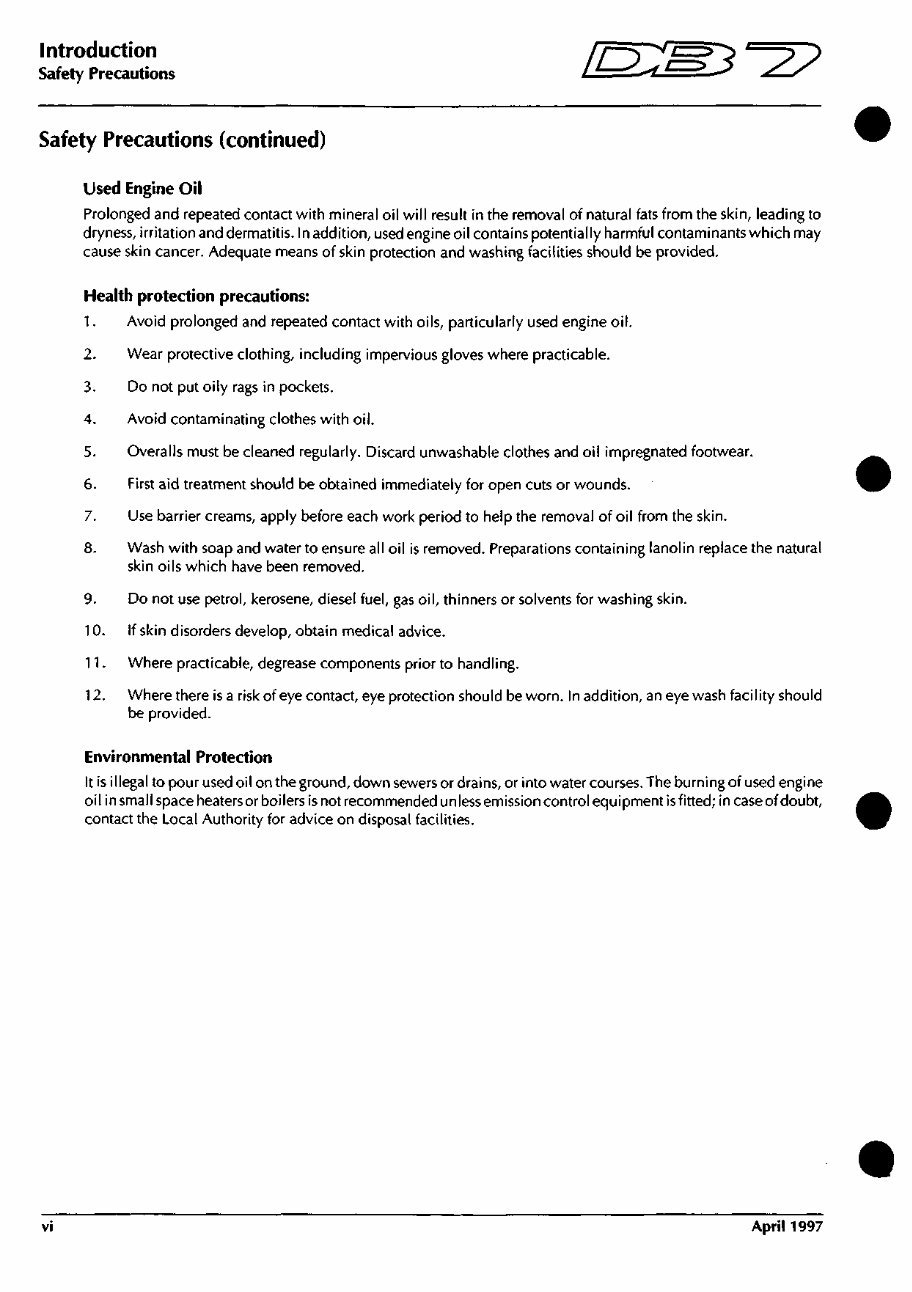
Introduction 11—^ ^cz^^ • > ^ Safety Precautions f -^ -—^ ^ ^ Safety Precautions (continued) Used Engine Oil Prolonged and repeated contact with mineral oil will result in the removal of natural fats from the skin, leading to dryness, irritation and dermatitis. In addition, used engine oil contains potentially harmful contaminants which may cause skin cancer. Adequate means of skin protection and washing facilities should be provided. Health protection precautions: 1. Avoid prolonged and repeated contact with oils, particularly used engine oil. 2. Wear protective clothing, including impervious gloves where practicable. 3. Do not put oily rags in pockets. 4. Avoid contaminating clothes with oil. 5. Overalls must be cleaned regularly. Discard unwashable clothes and oil impregnated footwear. 6. First aid treatment should be obtained immediately for open cuts or wounds. 7. Use barrier creams, apply before each work period to help the removal of oil from the skin. 8. Wash with soap and water to ensure all oil is removed. Preparations containing lanolin replace the natural skin oils which have been removed. 9. Do not use petrol, kerosene, diesel fuel, gas oil, thinners or solvents for washing skin. 10. If skin disorders develop, obtain medical advice. 11. Where practicable, degrease components prior to handling. 12. Where there is a risk of eye contact, eye protection should be worn. In addition, an eye wash facility should be provided. Environmental Protection It is illegal to pour used oil on the ground, down sewers or drains, or into water courses. The burning of used engine oil in small space heaters or boilers is not recommended unless emission control equipment is fitted; in case of doubt, contact the Local Authority for advice on disposal facilities. vi April 1997
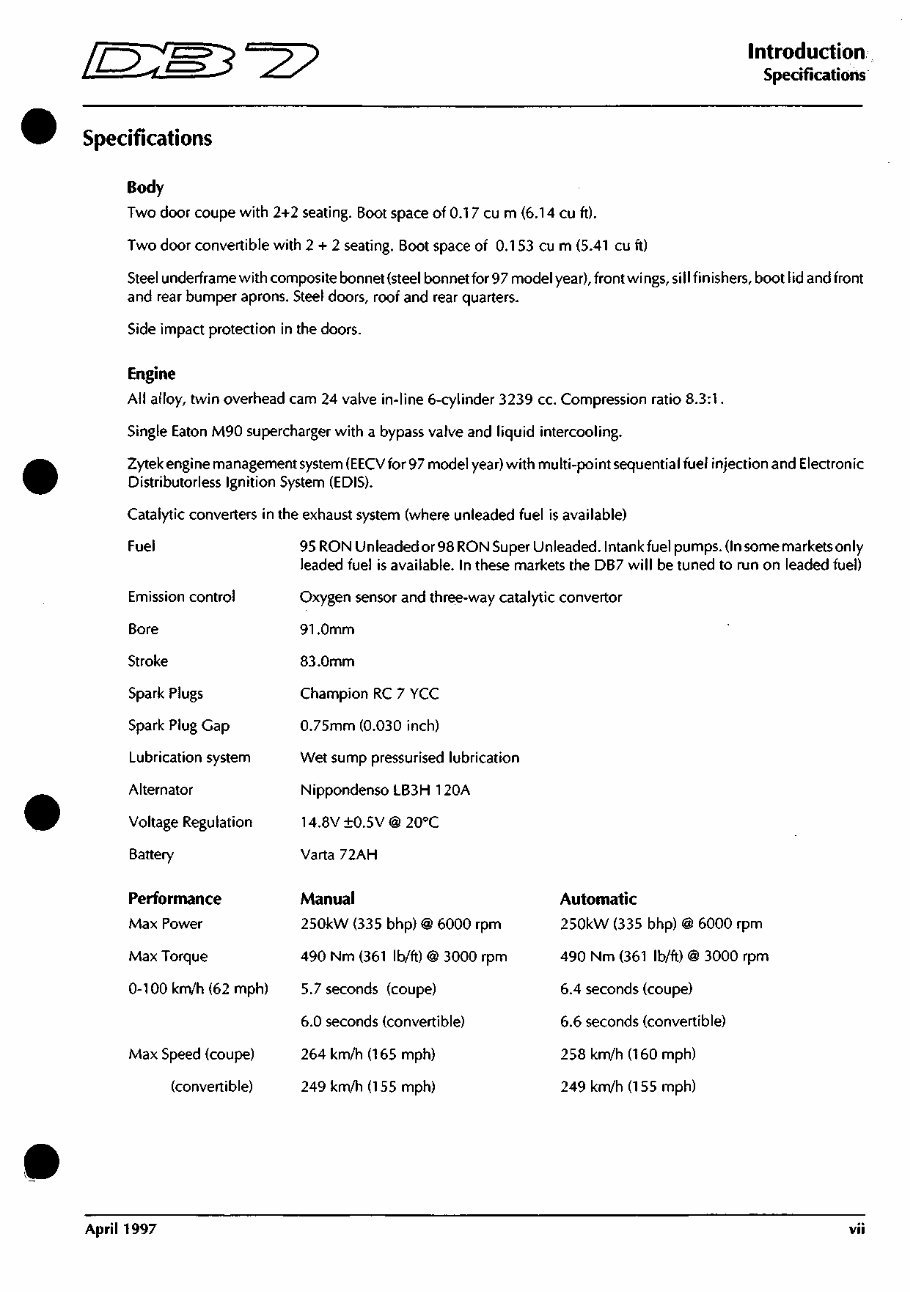
^=2? Introduction Specifications Specifications Body Two door coupe with 2+2 seating. Boot space of 0.17 cu m (6.14 cu ft). Two door convertible with 2 + 2 seating. Boot space of 0.153 cu m (5.41 cu ft) Steel underframe with composite bonnet (steel bonnet for 97 model year), front wings, sill finishers, boot lid and front and rear bumper aprons. Steel doors, roof and rear quarters. Side impact protection in the doors. Engine All alloy, twin overhead cam 24 valve in-line 6-cylinder 3239 cc. Compression ratio 8.3:1. Single Eaton M90 supercharger with a bypass valve and liquid intercooling. Zytek engine management system (EECVfor 97 model year) with multi-point sequential fuel injection and Electronic Distributorless Ignition System (EDIS). Catalytic converters in the exhaust system (where unleaded fuel is available) Fuel Emission control Bore Stroke Spark Plugs Spark Plug Cap Lubrication system Alternator Voltage Regulation Battery Performance Max Power Max Torque 0-100 km/h (62 mph) Max Speed (coupe) (convertible) 95 RON Unleaded or 98 RON Super Unleaded. Intank fuel pumps. (In some markets only leaded fuel is available. In these markets the DB7 will be tuned to run on leaded fuel) Oxygen sensor and three-way catalytic convertor 91.0mm 83.0mm Champion RC 7 YCC 0.75mm (0.030 inch) Wet sump pressurised lubrication Nippondenso LB3H 120A 14.8V±0.5V@20°C Varta 72AH Manual 250kW (335 bhp) @ 6000 rpm 490 Nm (361 lb/ft) @ 3000 rpm 5.7 seconds (coupe) 6.0 seconds (convertible) 264 km/h (165 mph) 249 km/h (155 mph) Automatic 250kW (335 bhp) @ 6000 rpm 490 Nm (361 lb/ft) @ 3000 rpm 6.4 seconds (coupe) 6.6 seconds (convertible) 258 km/h (160 mph) 249 km/h (155 mph) April 1997 VII
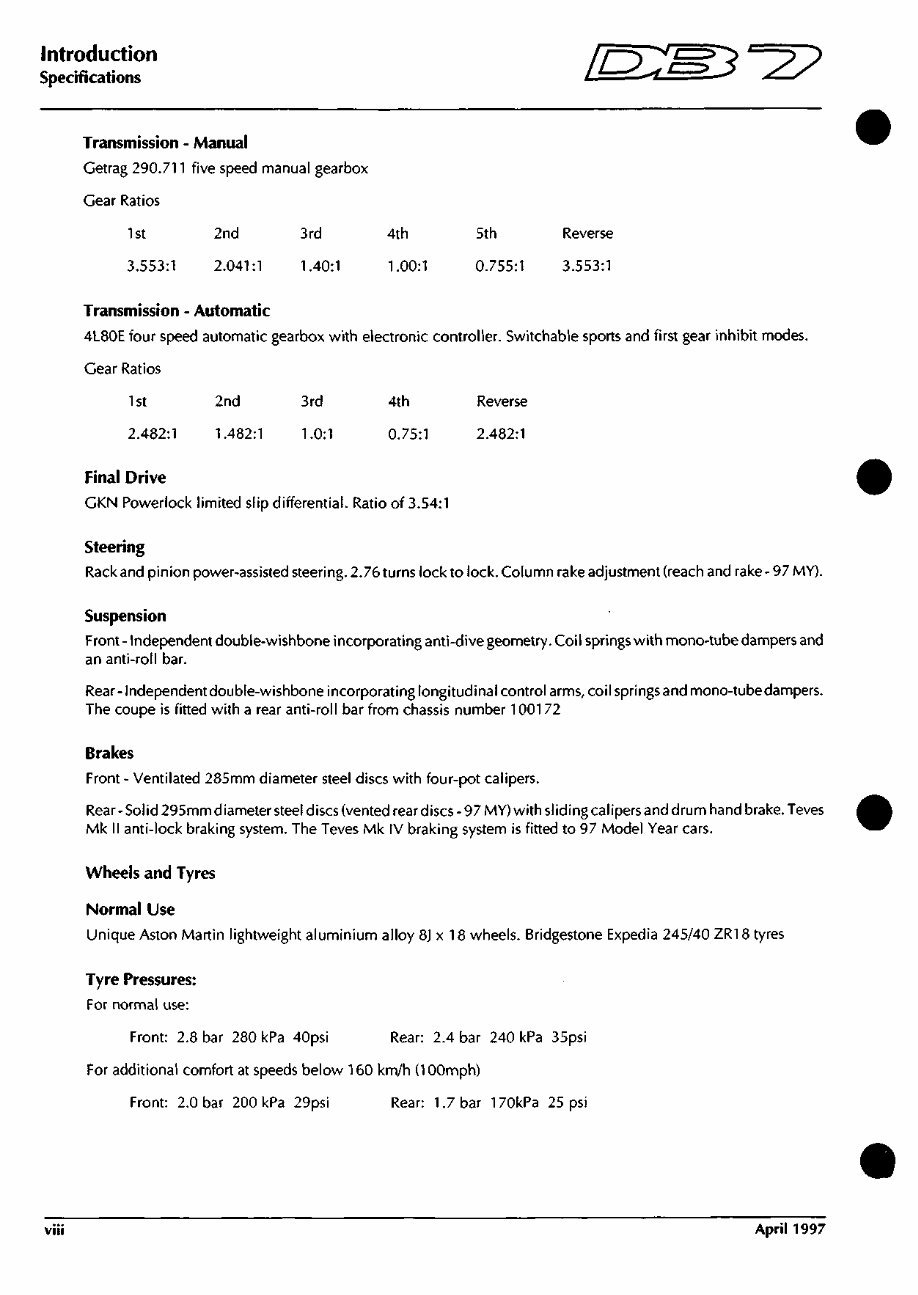
Introduction 11"^ ^^~F~^^ "~? ) Specifications L ^^—i. ^ >^_/ Transmission - Manual Getrag 290.711 five speed manual gearbox Gear Ratios 1st 2nd 3rd 4th 5th Reverse 3.553:1 2.041:1 1.40:1 1.00:1 0.755:1 3.553:1 Transmission - Automatic 4L80E four speed automatic gearbox with electronic controller. Switchable sports and first gear inhibit modes. Gear Ratios 1st 2nd 3rd 4th Reverse 2.482:1 1.482:1 1.0:1 0.75:1 2.482:1 Final Drive GKN Powerlock limited slip differential. Ratio of 3.54:1 Steering Rack and pinion power-assisted steering. 2.76 turns lock to lock. Column rake adjustment (reach and rake - 97 MY). Suspension Front - Independent double-wishbone incorporating anti-dive geometry. Coil springs with mono-tube dampers and an anti-roll bar. Rear-Independentdouble-wishbone incorporating longitudinal control arms, coil springsand mono-tube dampers. The coupe is fitted with a rear anti-roll bar from chassis number 1001 72 Brakes Front - Ventilated 285mm diameter steel discs with four-pot calipers. Rear- Sol id 295mm diameter steel discs (vented rear discs - 97 MY) with si iding calipers and drum hand brake. Teves Mk II anti-lock braking system. The Teves Mk IV braking system is fitted to 97 Model Year cars. Wheels and Tyres Normal Use Unique Aston Martin lightweight aluminium alloy 8J x 18 wheels. Bridgestone Expedia 245/40 ZR18 tyres Tyre Pressures: For normal use: Front: 2.8 bar 280 kPa 40psi Rear: 2.4 bar 240 kPa 35psi For additional comfort at speeds below 160 km/h (lOOmph) Front: 2.0 bar 200 kPa 29psi Rear: 1.7 bar 170kPa 25 psi viii April 1997
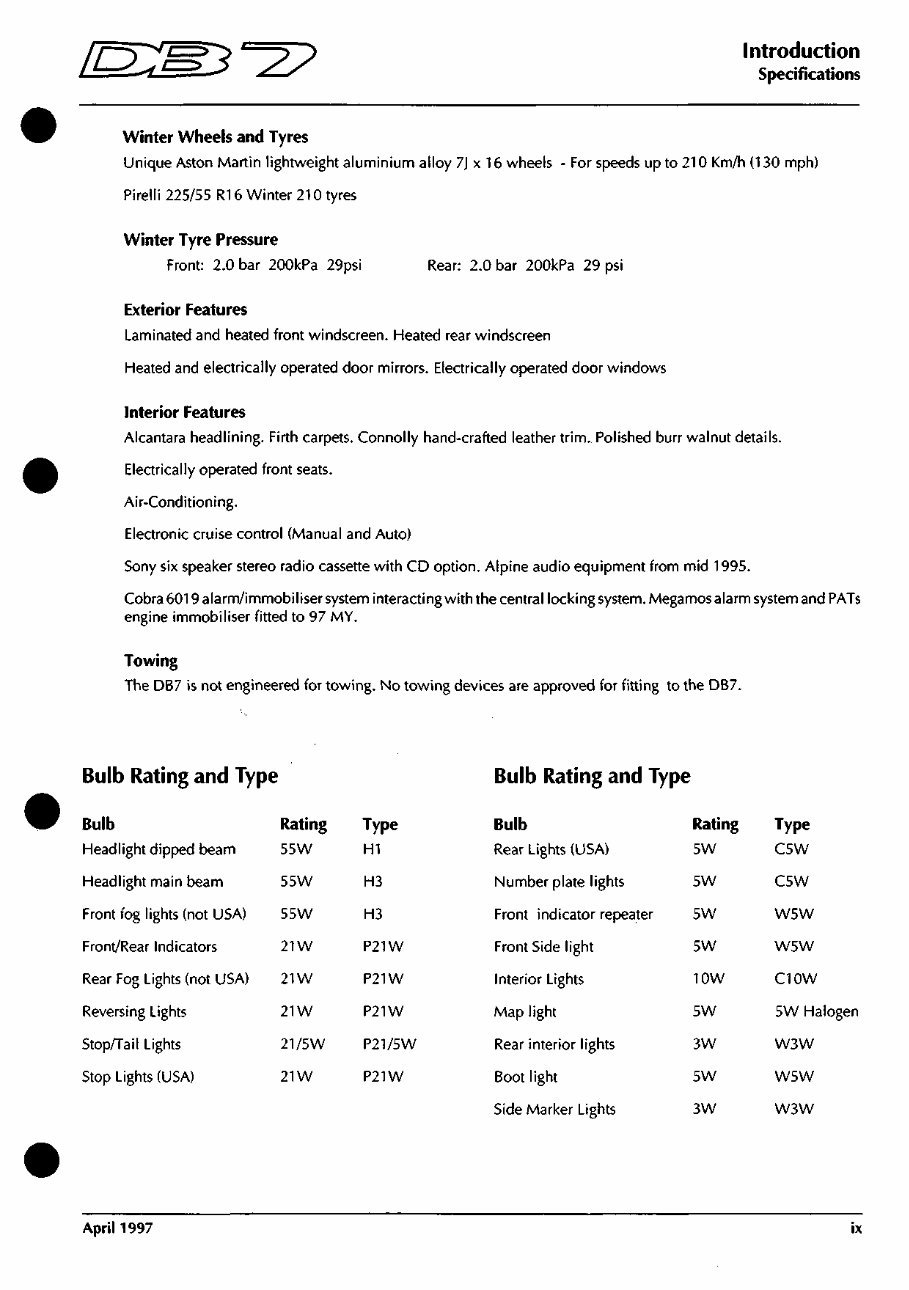
^^7 Introduction Specifications Winter Wheels and Tyres Unique Aston Martin lightweight aluminium alloy 7J x 16 wheels - For speeds up to 210 Km/h (130 mph) Pirelli 225/55 R16 Winter 210 tyres Winter Tyre Pressure Front: 2.0 bar 200kPa 29psi Rear: 2.0 bar 200kPa 29 psi Exterior Features Laminated and heated front windscreen. Heated rear windscreen Heated and electrically operated door mirrors. Electrically operated door windows Interior Features Alcantara headlining. Firth carpets. Connolly hand-crafted leather trim. Polished burr walnut details. Electrically operated front seats. Air-Conditioning. Electronic cruise control (Manual and Auto) Sony six speaker stereo radio cassette with CD option. Alpine audio equipment from mid 1995. Cobra 6019 alarm/immobiliser system interacting with the central locking system. Megamos alarm system and PATs engine immobiliser fitted to 97 MY. Towing The DB7 is not engineered for towing. No towing devices are approved for fitting to the DB7. Bulb Rating and Type Bulb Rating and Type Bulb Headlight dipped beam Headlight main beam Front fog lights (not USA) Front/Rear Indicators Rear Fog Lights (not USA) Reversing Lights Stop/Tail Lights Stop Lights (USA) Rating 55W 55W 55W 21W 21W 21W 21/5W 21W Type HI H3 H3 P21W P21W P21W P21/5W P21W Bulb Rear Lights (USA) Number plate lights Front indicator repeater Front Side light Interior Lights Map light Rear interior lights Boot light Side Marker Lights Rating 5W 5W 5W 5W 10W 5W 3W 5W 3W Type C5W C5W W5W W5W C10W 5W Halogen W3W W5W W3W April! 997 IX
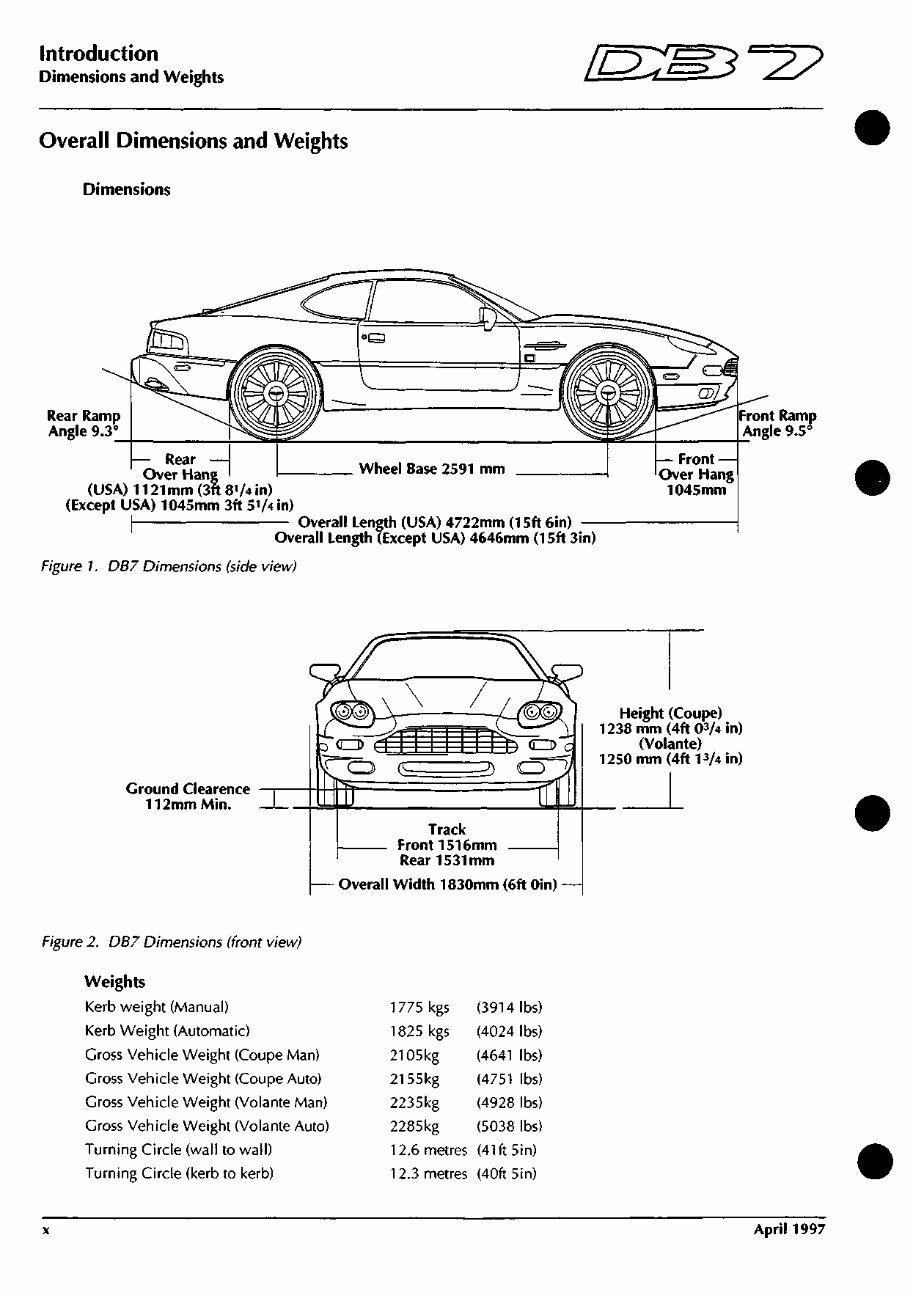
Introduction Dimensions and Weights (O D-^? Overall Dimensions and Weights Dimensions Rear Ramp Angle 9. ' — Rear —| Over Hang (USA) 1121mm (3ft 81/4 in) (Except USA) 1045mm 3ft 5V4 in) Wheel Base 2591 mm — Front — Over Hang 1045mm Overall Length (USA) 4722mm (15ft 6in) Overall Length TExcept USA) 4646mm (15ft 3in) Figure 1. DB7 Dimensions (side view) Front Ramp Angle 9.5° Ground Clearence n2mmMin. Height (Coupe) 1238 mm (4ft 03/4 in) (Volante) 1250 mm (4ft 13/4 in) Track Front 1516mm Rear 1531mm Overall Width 1830mm (6ft Oin) Figure 2. DB7 Dimensions (front view) Weights Kerb weight (Manual) Kerb Weight (Automatic) Gross Vehicle Weight (Coupe Man) Cross Vehicle Weight (Coupe Auto) Gross Vehicle Weight (Volante Man) Gross Vehicle Weight (Volante Auto) Turning Circle (wall to wall) Turning Circle (kerb to kerb) 1 775 kgs 1825 kgs 2105kg 2155kg 2235kg 2285kg (3914 lbs) (4024 lbs) (4641 lbs) (4751 lbs) (4928 lbs) (5038 lbs) 12.6 metres (41ft Sin) 12.3 metres (40ft 5in) April 1997
You're Reading a Preview
What's Included?
Lifetime Access
Fast Download Speeds
Online & Offline Access
Access PDF Contents & Bookmarks
Full Search Facility
Print one or all pages of your manual
$35.99
1994-1999 Aston Martin DB7 OEM Service & Repair Manual (+ Parts Catalog)
1994-1999 Aston Martin DB7 OEM Service & Repair Manual (+ Parts Catalog)
Engine covered:
3.2L AJ6 Supercharged I6
Transmissions covered:
GM 4L80-E 4-speed Automatic
Getrag 290 5-speed Manual
The 1994-1999 Aston Martin DB7 OEM Service & Repair Manual (+ Parts Catalog) covers the first-gen DB7 with the 3.2L supercharged AJ6 inline-six. Whether it’s the 4-speed automatic or the 5-speed manual, this manual includes the factory procedures for keeping things running as they should.
It walks through engine servicing, cooling system maintenance, transmission removal and installation, drivetrain components, suspension, brakes, and general mechanical work. You’ll also find torque specs, service intervals, and part references pulled straight from the OEM parts catalog.
If you’re planning to do your own maintenance—or just want to understand exactly what’s under the hood—this manual keeps things organized and to the point. It’s a proper technical reference that doesn’t sugarcoat anything; the kind of manual you’ll be glad you have when that rare coupe needs more than a polish.
Printable: Yes Language: English Compatibility: Pretty much any electronic device, incl. PC & Mac computers, Android and Apple smartphones & tablet, etc. Requirements: Adobe Reader (free)
Reviews
Q&A
Recently Viewed
5,521,897Happy Clients
2,594,462eManuals
1,120,453Trusted Sellers
15Years in Business
Price:
Actual Price:
1994-1999 Aston Martin DB7 OEM Service & Repair Manual (+ Parts Catalog)



 Lifetime Access




