WORKSHOP MANUAL EXPLORER II Special 70 - 75 HP 80 - 85 - 90 - 95 HP
WORKSHOP MANUAL EXPLORER II Special 70 - 75 HP 80 - 85 - 90 - 95 HP Introduction This publication is addressed to the specialised technicians who work on our tractors. It contains all the general information about the tractors, with particular emphasis on checking, overhaul and adjust- ment operations, as well as general removal and refitting procedures. The workshop manual is the obvious text for technicians attending the annual courses held at our training centre as it contains the information required to enable them to work safely and effectively on the tractor. It also provides a useful reference work for trained technicians seeking confirmation on the correct procedures; we therefore recommend that all authorised service centres keep a copy of this manual ready to hand for consultation whenever necessary. We wish to thank all those who have contributed by offering their suggestions for corrections and improvements to our publications. CAUTION: For instruction on engine servicing procedures, testing and adjustment, please to the refer specific manual for SDFG engines code 307.1072.3.5 Head Offices: V.le Ing. F. Cassani, 15 24047 Treviglio (BG) Tel. 0363/4211 Telex: 311472 Samtra I
Der Nachdruck des Textes und der Abbildungen ist, auch auszugsweise, verboten. La reproduction du présent ouvrage, du texte et des ìllustratìons, mème partìelle est interdite. Text and illustrations herewith enclosed may not be reproduced, not even in part and by any means. E’ vietata la riproduzione, anche parziale, del testo e delle illustrazioni. Se prohibe la reproducciòn total o parcial del texto y de las ilustraciones. A proibida a reproduçào, até mesmo parcial, do texto e das ilustracòes. Der zeitliche Unterschied zwischen der Aktualisierung der Druckschriften und der Durchführung technischer Veränderungen (die ständig vorgenommen werden, um immer hochwertigere Erzeugnisse auf den Markt zu bringen) erfordern aus Gründen der Korrektheit des Hinweises, dass die in dieser Ausgabe enthaltenen Daten jederzeit geändert werden können und deshalb unverbindlich sind. Le temps qui s’écoule entre la mise à jour en impression et les modifications techniques (ces dernières changeant con- tinuellement afin d’offrir aux utilisateurs des produits toujours plus qualifiés) nous oblige a vous signaler que les données de la présente publication pourraient être susceptibles de variations. Elles sont données sans engagement de notre part. Because of the possible time lag between the introduction of technical modifications (an on-going process the aim of which is to offer products which are being continually improved) and the latest update of the manual, we must point out, for the sake of correctness, that the data contained in this edition are liable to change at any time and are therefore not binding. La differenza tra i tempi di aggiornamento in stampa e i tempi delle modifiche tecniche (variando queste ultime continu- amente, ciò al fine di offrire prodotti sempre più qualificati) impongono di dichiarare, per correttezza, che i dati conte- nuti nella presente edizione sono suscettibili di variazione in qualsiasi momento e che quindi non sono impegnativi. La diferencia entre los tiempos necesarios para poner al dia la impresiòn y los tiempos de las modificaciones tècnicas (las que se verifican continuamente, con el objeto de ofrecer productos cada vez màs calificados) nos imponen declarar, por corrección, que los datos contenidos en la presente ediciòn estàn sujetos a variaciones en cualquier momento y que portanto no son obligativos. A diferença entre os tempos necessãrrios para actualizar a impressão e os tempos das modificacões técnicas (que se verificam continuamente, a fim de oferecer um produto cada vez mais qualificado), obrigam-nos a declarar, que os dados contidos neste manuel são susceptiveis de variacão em qualquer momento e que portanto não são vinculatórios.
00-1 INTRODUCTION The purpose of this workshop manual is to provide instruction for repair technicians and a practical guide for improving the quality of repairs. This manual enables repair technicians to acquire a thorough knowledge of the machine, indicating the correct methods for fault diagnosis, for working in safety and for accurate dimensional checks and visual inspections. The instructions also indicate the products to use, the tightening torques and the adjustment data. The technical material contained in this manual is reserved for Authorised Dealers and Service Centres which will be duly informed of any technical changes to the machines in question through the issue of documents regarding modifications, updates and supplements for optional equipment. All technicians and their colleagues are expressly forbidden from reproducing any part of this manual in any form or from communicating the contents to third parties without the express written permission of the Manufacturer, who remains the sole owner of this document with all rights reserved in accordance with applicable laws. INTRODUCTION
00-3 GENERAL SAFETY RULES SAFETY NOTES To ensure that machines entrusted to Authorised Service Centres for repair or overhaul continue to function correctly, it is very important that all repair work is carried out in the prescribed manner. The procedures for checks and repairs indicated in this manual are safe and effective. Some of the operations described require the use of special tools and equipment; these tools have been specifically designed for the intended purpose and may be ordered directly from the Manufacturers. DO NOT USE MAKESHIFT TOOLS; not only is there a risk of personal injury, but such tools are rarely suited to the purpose for which they are used. To prevent injury to operators, the symbols and are used in this manual to indicate the safety precautions required. The warnings accompanying these symbols must always be adhered to carefully. In potentially hazardous situations, always give priority to personal safety and take the necessary actions to eliminate the danger. GENERAL SAFETY RULES 1 - Even if you have a thorough knowledge of the machine as regards its components, operation and controls, always take particular care when carrying out manoeuvres; remember that the machine you are working on is in need of repair or overhaul and consequently may not always behave as expected. 2 - Before starting work, clean the machine thoroughly to remove all mud, dust and road dirt. Also clean the cab to remove all traces of oil, snow and ice from the access steps and grab rails. 3 - When climbing up to or down from the cab, always ensure you maintain three points of contact at a time (foot or handholds) in order to keep your balance and prevent accidental falls. 4 - Always take special care when carrying out fault diagnosis operations; these operations often require two persons, who must never stand in front of the wheels when the engine is running. 5 - When carrying out checks and repairs, wear close-fitting clothing, safety goggles and protective gloves that are suitable for the task (cleaning, draining fluids, repairs). When working near moving parts, long hair should be gathered up and secured safely under a cap to prevent the risk of entanglement and severe injury. 6 - Do not allow anyone who is not directly involved in the work to approach the machine; ensure that they remain at a safe distance. 7 - Keep well clear of moving parts; when the engine is running, some moving parts are not easily visible and therefore present a risk of entanglement, even if protected by safety guards. 8 - Ensure that the area is well ventilated before starting the engine in order to avoid the formation of dangerous concentrations of toxic gases; always connect suitable fume extraction equipment to the exhaust pipe.
00-4 9 - Under no circumstances start the engine with the safety guards removed; all repair and adjustment operations must be carried out with the engine stopped. 10 - Do not top up fuel, oil or coolant levels when the engine is running. 11 - Never smoke and ensure there are no naked flames nearby when topping up fuel or oil. Always remove the battery from the machine before recharging. 12 - Before checking or removing the battery, stop the engine and remove the key from the starter switch. 13 - Remove the battery and recharge in a well-ventilated area where the temperature exceeds 0°C. 14 - When checking or recharging the battery, do not smoke or allow naked flames in the vicinity as the hydrogen gas given off by the battery is highly explosive. 15 - The liquid (electrolyte) contained in the battery is very harmful if it comes into contact with the skin and the eyes; for this reason, always wear gloves and safety goggles with side shields when checking or topping up the battery. Should any electrolyte accidentally come into contact with your skin, wash the affected parts immediately with plenty of water; if electrolyte comes into contact with your clothing, remove clothing as soon as possible. In case of accidental ingestion of electrolyte, drink plenty of water, milk or vegetable oil and take antacids such as magnesium, bicarbonate, etc. and seek medical attention immediately. 16 - Before working on the electrical systems, always disconnect the battery terminals. IMPORTANT! Always disconnect the negative terminal (-) first and then the positive terminal (+); when re-connecting the battery on completion of the work, first connect the positive terminal (+) and then the negative(-). 17 - Before carrying out any arc welding (permitted only on implements attached to the machine) always disconnect the battery terminals and unplug all the connectors of the electronic control units and the alternator. 18 - When topping up lubricants, always wear suitable protective gloves. 19 - Do not wear clothing contaminated by engine or hydraulic oil; prolonged contact with the skin can be harmful and may cause allergic reactions. 20 - Used engine oil and hydraulic oil must be disposed of in a proper manner; recover used lubricants and dispose of them in accordance with the applicable regulations. 21 - Before carrying out any work on the hydraulic or pneumatic systems, discharge all residual pressure from the circuits. 22 - Before carrying out any work on the hydraulic system or engine, allow the oil and engine coolant to cool down. GENERAL SAFETY RULES
00-5 23 - When removing and refitting certain assemblies, it will be necessary to support the machine; use stands, jacks or blocks capable of supporting the weight and arrange them in a triangular pattern to prevent the machine from overturning. 24 - To lift heavy components, use a hoist or crane. Check that wire ropes, chains or fibre slings are not worn and that hooks are not damaged. 25 - Always use lifting equipment of suitable capacity for the weight of the components to be removed. Ensure lifting equipment is attached correctly. 26 - When lifting or supporting an assembly or component, manoeuvre the parts slowly and carefully to avoid swinging or collision with other components. 27 - Never work on components suspended from a hoist or crane. 28 - When removing the retaining bolts of a component that could fall, always leave two opposing bolts in place for safety; before removing these last two bolts, attach the component to suitable lifting equipment or position support blocks. 29 - Any oil or fuel spilled during removal or dismantling operations should be cleaned up as soon as possible to prevent the risk of slipping and fire. 30 - When refitting electrical wiring looms and wires, ensure that they are properly secured with their original retaining straps or brackets to prevent the possibility of damage caused by vibration. 31 - Never insert your fingers or hands to check the alignment between fixing holes in components; always use a suitable dowel of soft material. 32 - When refitting assemblies or components, always use the tightening torques specified in the tables; the tightening torques indicated in the paragraphs regarding assembly/refitting operations have been determined through experimentation and must be scrupulously adhered to. 33 - When refitting parts that are subject to vibration or that rotate at high speed, take particular care when carrying out final installation checks. GENERAL SAFETY RULES
00-6 SAFETY PRECAUTIONS FOR REMOVAL AND REFITTING OPERATIONS ★ When removing or refitting parts, always take the following safety precautions. 1. PRECAUTIONS FOR REMOVAL OPERATIONS • Unless otherwise indicated, lower the working implement until it rests on the ground. • After disconnecting hydraulic and fuel system pipes, always fit plugs to the open ends of the pipes to prevent ingress of impurities. • Before removing a cylinder, fully retract the piston and secure it in this position using a retaining strap. • Use containers of sufficient capacity when draining oil, coolant or fuel. • Before removing a part from the machine, check for alignment markings indicating the correct assembly position. If necessary, make new markings to ensure correct assembly. • When unplugging electrical connectors, always grip the connectors firmly to avoid pulling on the wires. • Where necessary, label wires and pipes before removal to avoid confusion when reconnecting. • Check the number and thickness of any shims removed and keep them together in a safe place. • To lift the machine or any of its main components, use lifting equipment of suitable capacity. • When using eyebolts for lifting components, first check that they are not bent or damaged; screw them fully home and then turn the bolt so that the eye is aligned with the lifting hook. • Before removing a part, clean the surrounding area and, after removing the part, cover it to protect it from dirt and dust. 2. PRECAUTIONS FOR REFITTING OPERATIONS • Tighten nuts and bolts to the specified tightening torques. • When refitting flexible pipes and wires, take care not to twist or tangle them. • Always fit new seals, O-rings, split pins and safety stop rings; make sure that the ends of the split pins are separated and bent back so that the pin cannot be withdrawn from the hole. • Ensure that circlips are correctly installed in their seatings. • When applying threadlocking compound, first clean the part removing all oil and grease, then cover the thread evenly applying a few drops of the compound. SAFETY PRECAUTIONS FOR REMOVAL AND REFITTING OPERATIONS
00-7 • When applying sealant, first clean the surface removing all traces of oil and grease and check for dirt or indentations, then apply the sealant evenly making sure that it forms a continuous film around any fixing holes. • Clean all parts, removing dirt, oxidisation, carbon deposits, burrs and indentations. • Coat all moving parts with a thin film of engine oil. • When reconnecting electrical connectors, first remove all traces of oil, dust and water from the inside of the connector and then push the two halves together firmly; connectors with locking tabs should be pushed together until the tab engages the keeper. • Bolt down flanged fittings evenly, tightening the bolts gradually in a crosswise pattern. 3. PRECAUTIONS TO BE TAKEN ON COMPLETION OF REMOVAL/REFITTING OPERATIONS • If coolant has been drained from the engine, refit the drain plug and add new coolant to the correct level. Start the engine to circulate the coolant and then check the level again and top up. • After removing hydraulic components, top up the hydraulic oil to the specified level. Start the engine to circulate the oil in the hydraulic circuits and then recheck the level and top up as necessary. • After having removed a variable displacement pump, connect the drain pipe and fill the pump casing with oil through the filler hole provided. • Grease stub axle housings, cylinder pivot mountings and drive shafts thoroughly after assembly. SAFETY PRECAUTIONS FOR REMOVAL AND REFITTING OPERATIONS
You're Reading a Preview
What's Included?
Lifetime Access
Fast Download Speeds
Online & Offline Access
Access PDF Contents & Bookmarks
Full Search Facility
Print one or all pages of your manual
$39.99
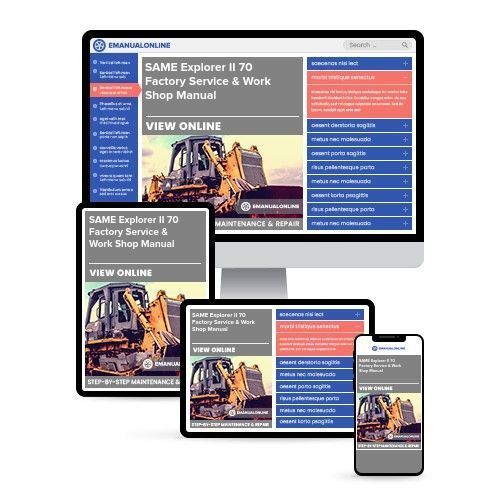
SAME Explorer II 70 Factory Service & Work Shop Manual
Upon purchasing this manual, you will receive a .PDF file containing an email contact. After contacting us, you will receive a reply with a link to access the manual for your SAME Explorer II 70.
This comprehensive manual covers every aspect of your machine, providing detailed guidance for tasks ranging from an oil change to a transmission swap. With hundreds of pages, it includes numerous illustrations and easy-to-understand text to assist you. The manual also features a search function, allowing you to navigate and print necessary pages.
The Factory Service Repair Manual is designed to walk you through the fundamentals of maintenance and repair, empowering you with the knowledge that factory-trained technicians possess. By utilizing the information in this manual, both professional mechanics and DIY enthusiasts can confidently make informed decisions regarding the maintenance and repair of their machine.
Our commitment extends beyond providing a high-quality service manual; we also ensure excellent customer service, guaranteeing your satisfaction.
Reviews
Q&A
Recently Viewed
5,521,897Happy Clients
2,594,462eManuals
1,120,453Trusted Sellers
15Years in Business
Price:
Actual Price:
SAME Explorer II 70 Factory Service & Work Shop Manual












 Lifetime Access