






00-1
INTRODUCTION
The purpose of this workshop manual is to provide instruction for repair technicians and
a practical guide to improving the quality of repairs.
This manual enables repair technicians to acquire a thorough knowledge of the ma-
chine, indicating the correct methods for fault diagnosis, for working in safety and for
accurate dimensional checks and visual inspections. The instructions also indicate the
products to use, the tightening torques and the adjustment data.
The technical material contained in this manual is reserved for Authorised Dealers and
Service Centres who will be duly informed of any technical changes to the machines in
question through the issue of documents regarding modifications, updates and sup-
plements for optional equipment.
All technicians and their colleagues are expressly forbidden from reproducing any part
of this manual in any form or from communicating the contents to third parties without
the express written permission of the Manufacturer, who remains the sole owner of this
document with all rights reserved in accordance with applicable laws.
INTRODUCTION


00-3
GENERAL SAFETY RULES
SAFETY NOTES
To ensure that machines entrusted to Authorised Service Centres for repair or overhaul continue
to function correctly, it is very important that all repair work is carried out in the prescribed manner.
The procedures for checks and repairs indicated in this manual are safe and effective.
Some of the operations described require the use of special tools and equipment; these tools
have been specifically designed for the intended purpose and may be ordered directly from the
Manufacturers.
DO NOT USE MAKESHIFT TOOLS; not only is there a risk of personal injury, but such tools are
rarely suited to the purpose for which they are used.
To prevent injury to operators, the symbols and are used in this manual to indicate the
safety precautions required. The warnings accompanying these symbols must always be ad-
hered to carefully.
In potentially hazardous situations, always give priority to personal safety and take the necessary
actions to eliminate the danger.
GENERAL SAFETY RULES
1 - Even if you have a thorough knowledge of the machine as regards its com-
ponents, operation and controls, always take particular care when carrying
out manoeuvres; Remember that the machine you are working on is in
need of repair or overhaul and consequently may not always behave as ex-
pected.
2 - Before starting work, clean the machine thoroughly to remove all mud,
dust and road dirt. Also clean the cab to remove all traces of oil, snow and
ice from the access steps and grab rails.
3 - When climbing up to or down from the cab, always ensure you maintain
three points of contact at a time (foot or handholds) in order to keep your
balance and prevent accidental falls.
4 - Always take special care when carrying out fault diagnosis operations;
these operations often require two persons, who must never stand in front
of the wheels when the engine is running.
5 - When carrying out checks and repairs, wear close-fitting clothing, safety
goggles and protective gloves that are suitable for the task (cleaning,
draining fluids, repairs).
When working near moving parts, long hair should be gathered up and se-
cured safely under a cap to prevent the risk of entanglement and severe in-
jury.
6 - Do not allow anyone who is not directly involved in the work to come near
the machine; ensure that they remain at a safe distance.
7 - Keep well clear of moving parts; when the engine is running, some moving
parts are not easily visible and therefore present a risk of entanglement,
even if protected by safety guards.
8 - Ensure that the area is well ventilated before starting the engine in order to
avoid the formation of dangerous concentrations of toxic gases; always
connect suitable fume extraction equipment to the exhaust pipe.

00-4
9 - Do not start the engine with the safety guards removed under any circum-
stances; all repair and adjustment operations must be carried out with the
engine stopped.
10 - Do not top up fuel, oil or coolant levels when the engine is running.
11 - Never smoke and ensure there are no naked flames nearby when topping
up fuel or oil. Always remove the battery from the machine before recharg-
ing.
12 - Before checking or removing the battery, stop the engine and remove the
key from the starter switch.
13 - Remove the battery and recharge in a well-ventilated area where the tem-
perature exceeds 0°C.
14 - When checking or recharging the battery, do not smoke or allow naked
flames in the vicinity as the hydrogen gas given off by the battery is highly
explosive.
15 - The liquid (electrolyte) contained in the battery is very harmful if it comes
into contact with the skin and the eyes; for this reason, always wear gloves
and safety goggles with side shields when checking or topping up the bat-
tery.
Should any electrolyte accidentally come into contact with your skin, wash
the affected parts immediately with plenty of water; if electrolyte comes
into contact with your clothing, remove clothing as soon as possible.
In case of accidental ingestion of electrolyte, drink plenty of water, milk or
vegetable oil and take antacids such as magnesium, bicarbonate, etc. and
seek medical attention immediately.
16 - Before working on the electrical systems, always disconnect the battery
terminals.
IMPORTANT!
Always disconnect the negative terminal (--) first and then the positive ter-
minal (+); when re-connecting the battery on completion of the work, first
connect the positive terminal (+) and then the negative (-).
17 - Before carrying out any arc welding (permitted only on implements at-
tached to the machine) always disconnect the battery terminals and un-
plug all the connectors of the electronic control units and the alternator.
18 - When topping up lubricants, always wear suitable protective gloves.
19 - Do not wear clothing contaminated by engine or hydraulic oil; prolonged
contact with the skin can be harmful and may cause allergic reactions.
20 - Used engine oil and hydraulic oil must be disposed of in a proper manner;
recover used lubricants and dispose of them in accordance with the ap-
plicable regulations.
21 - Before carrying out any work on the hydraulic or pneumatic systems, dis-
charge all residual pressure from the circuits.
22 - Before carrying out any work on the hydraulic system or engine, allow the
oil and engine coolant to cool down.
GENERAL SAFETY RULES

00-5
23 - When removing and refitting certain assemblies, it will be necessary to
support the machine; use stands, jacks or blocks capable of supporting
the weight and arrange them in a triangular pattern to prevent the machine
from overturning.
24 - To lift heavy components, use a hoist or crane. Check that
wire ropes, chains or fibre slings are not worn and that hooks are not dam-
aged.
25 - Always use lifting equipment of suitable capacity for the weight of the com-
ponents to be removed. Ensure lifting equipment is attached correctly.
26 - When lifting or supporting an assembly or component, manoeuvre the
parts slowly and carefully to avoid swinging or collision with other com-
ponents.
27 - Never work on components suspended from a hoist or crane.
28 - When removing the retaining screws of a component that could fall, always
leave two opposing bolts in place for safety; before removing these last two
bolts, attach the component to suitable lifting equipment or position sup-
port blocks.
29 - Any oil or fuel spilled during removal or dismantling operations should be
cleaned up as soon as possible to prevent the risk of slipping and fire.
30 - When refitting electrical wiring looms and wires, ensure that they are prop-
erly secured with their original retaining straps or brackets to prevent the
possibility of damage caused by vibration.
31 - Never insert your fingers or hands to check the alignment between fixing
holes in components; always use a suitable dowel of soft material.
32 - When refitting assemblies or components, always use the tightening tor-
ques specified in the tables; the tightening torques indicated in the par-
agraphs regarding assembly/refitting operations have been determined
through experimentation and must be scrupulously adhered to.
33 - When refitting parts that are subject to vibration or that rotate at high
speed, take particular care when carrying out final installation checks.
GENERAL SAFETY RULES

00-6
SAFETY PRECAUTIONS FOR REMOVAL AND REFITTING OPERATIONS
★ When removing or refitting parts, always take the following safety precau-
tions.
1. PRECAUTIONS FOR REMOVAL OPERATIONS
• Unless otherwise indicated, lower the implement until it rests on the
ground.
• After disconnecting hydraulic and fuel system pipes, always fit plugs to the
open ends of the pipes to prevent ingress of dirt.
• Before removing a cylinder, fully retract the piston and secure it in this po-
sition using a retaining strap.
• Use containers of sufficient capacity when draining oil, coolant or fuel.
• Before removing a part from the machine, check for alignment markings in-
dicating the correct assembly position. If necessary, make new markings
to ensure correct assembly.
• When unplugging electrical connectors, always grip the connectors firmly
to avoid pulling on the wires.
• Where necessary, label wires and pipes before removal to avoid confusion
when reconnecting.
• Check the number and thickness of any shims removed and keep them to-
gether in a safe place.
• To lift the machine or any of its main components, use lifting equipment of
suitable capacity.
• When using eyebolts for lifting components, first check that they are not
bent or damaged; screw them fully home and then turn the screw so that
the eye is aligned with the lifting hook.
• Before removing a part, clean the surrounding area and, after removing the
part, cover it to protect it from dirt and dust.
2. PRECAUTIONS FOR REFITTING OPERATIONS
• Tighten nuts and screws to the specified tightening torques.
• When refitting flexible pipes and wires, take care not to twist or tangle
them.
• Always fit new seals, O-rings, split pins and safety stop rings; make sure
that the ends of the split pins are separated and bent back so that the pin
cannot be withdrawn from the hole.
• Ensure that circlips are correctly installed in their seatings.
• When applying threadlocking compound, first clean the part removing all
oil and grease, then cover the thread evenly applying a few drops of the
compound.
SAFETY PRECAUTIONS FOR REMOVAL AND REFITTING OPERATIONS

00-7
• When applying sealant, first clean the surface removing all traces of oil and
grease and check for dirt or indentations, then apply the sealant evenly
making sure that it forms a continuous film around any fixing holes.
• Clean all parts, removing dirt, oxidation, carbon deposits, burrs and in-
dentations.
• Coat all moving parts with a thin film of engine oil.
• When reconnecting electrical connectors, first remove all traces of oil, dust
and water from the inside of the connector and then push the two halves to-
gether firmly; connectors with locking tabs should be pushed together until
the tab engages the keeper.
• Bolt down flanged fittings evenly, tightening the screws gradually in a
crosswise pattern.
3. PRECAUTIONS TO BE TAKEN ON COMPLETION OF
REMOVAL/REFITTING OPERATIONS
• If coolant has been drained from the engine, refit the drain plug and add
new coolant to the correct level. Start the engine to circulate the coolant
and then check the level again and top up.
• After removing hydraulic components, top up the hydraulic oil to the spec-
ified level. Start the engine to circulate the oil in the hydraulic circuits and
then recheck the level and top up as necessary.
• After having removed a variable displacement pump, connect the drain
pipe and fill the pump casing with oil through the filler hole provided.
• Grease stub axle housings, cylinder pivot mountings and drive shafts thor-
oughly after assembly.
SAFETY PRECAUTIONS FOR REMOVAL AND REFITTING OPERATIONS
00-8
LIFTING INSTRUCTIONS
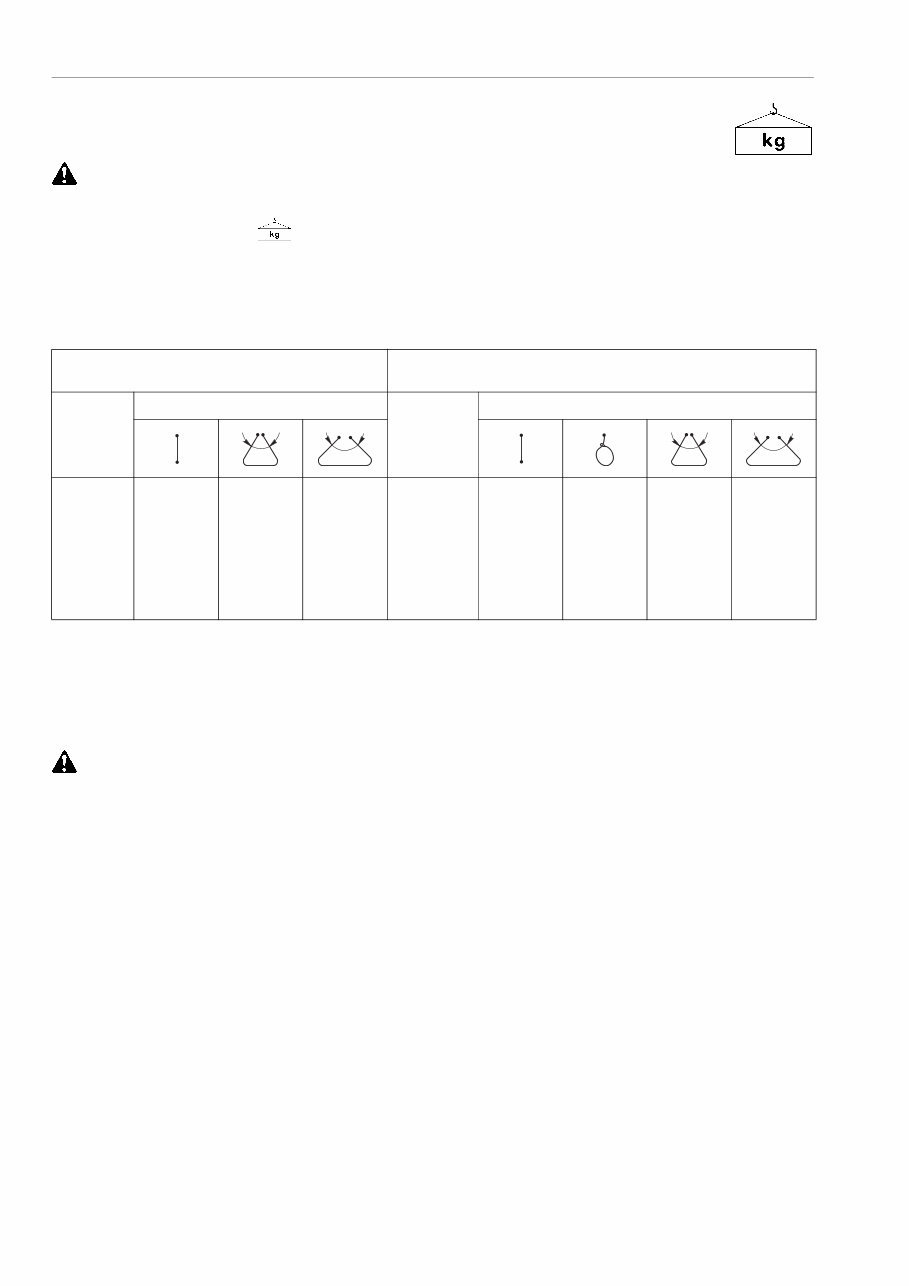
Components weighing over 25 kg or of significant size must be supported and removed using suitable lifting equip-
ment with wire rope or polyester slings.
In the paragraphs regarding removal and refitting operations, the weight of the component or assembly to be lifted is
indicated with the symbol
WIRE ROPES - SLINGS
• Use wire ropes or polyester slings of suitable capacity for the parts to be lifted, referring to the following tables:
NOTE. Lifting capacities are calculated with a safety coefficient.
• The lifting hook should be attached to the central part of the rope or sling; if the hook is attached near the ends of the
rope/sling, this could cause the load to slip during lifting.
• Never lift a heavy load using a single rope; always use two or more symmetrically arranged ropes.
Suspension of a load from a single rope could cause the load to start rotating and consequently cause the rope
strands to untwist or the load to slip; this could lead to serious injury.
• Never lift a heavy load when the two legs of the ropes form a wide angle.
The permitted load (kg) decreases in inverse proportion to the angle of suspension; the table below indicates how the
permitted load varies according to the angle of suspension for two Ø 10 mm ropes each with a load capacity of
1000 kg.
WIRE ROPES
(standard twisted «S» or «Z» type)
POLYESTER SLINGS
(eye-and-eye - simple loop)
Ø rope
mm
Capacity (kg)
Width
(mm)
Capacity (kg)
8
10
12
14
16
18
650
1000
1450
2000
2600
3300
620
1740
2500
3460
4500
5710
500
1420
2050
2820
3670
4660
25
50
62
75
100
150
500
1000
1250
1400
2000
2500
400
800
1000
1120
1600
2000
860
1730
2160
2420
3460
4330
700
1410
1760
1980
2820
3530
60° 90° 60° 90°
You're Reading a Preview
What's Included?
 Lifetime Access
Fast Download Speeds
Online & Offline Access
Access PDF Contents & Bookmarks
Full Search Facility
Print one or all pages of your manual
$39.99
Same Dorado 66 76 86 Power Shuttle Tractor Full Service & Repair Manual
Viewed 18 Times Today

What's Included?
Lifetime Access
Fast Download Speeds
Online & Offline Access
Access PDF Contents & Bookmarks
Full Search Facility
Print one or all pages of your manual
$39.99

Secure transaction
What's Included?
Lifetime Access
Fast Download Speeds
Online & Offline Access
Access PDF Contents & Bookmarks
Full Search Facility
Print one or all pages of your manual
Description
- Complete Factory Service Repair Workshop Manual.
- This Professional Manual covers all repairs, servicing, and troubleshooting procedures.
- Contains step-by-step instructions, highly detailed exploded diagrams, and pictures.
- Can be printed out, either a single page or the entire manual.
- Can be used on multiple computers without limitations or trial periods.
- No expiration or renewal fees; can be used for life.
- Fully compatible with all Windows & MAC Computers.
This manual is available for instant access on your computer, tablet, or smartphone. It is very detailed and contains hundreds of pages with detailed photos & diagrams. Used by professional Mechanics and Technicians, it provides instructions to complete every job correctly.
For more information, please click on the button.


