



WORKSHOP MANUAL
AGROTRON 106 MK3
AGROTRON 110 MK3
AGROTRON 115 MK3
AGROTRON 120 MK3
AGROTRON 135 MK3
AGROTRON 150 MK3
AGROTRON 165 MK3
SAME DEUTZ-FAHR DEUTSCHLAND GmbH
Tractor Manuals Scotland
Tractor Manuals Scotland - Please Do Not Copy

Tractor Manuals Scotland
Tractor Manuals Scotland - Please Do Not Copy

00-1
INTRODUCTION
The purpose of this workshop manual is to provide instruction for repair technicians and
a practical guide to improving the quality of repairs.
This manual enables repair technicians to acquire a thorough knowledge of the ma-
chine, indicating the correct methods for fault diagnosis, for working in safety and for
accurate dimensional checks and visual inspections. The instructions also indicate the
products to use, the tightening torques and the adjustment data.
The technical material contained in this manual is reserved to Authorised Dealers and
Service Centres who will be duly informed of any technical changes to the machines in
question through the issue of documents regarding modifications, updates and sup-
plements for optional equipment.
All technicians and their colleagues are expressly forbidden from reproducing any part
of this manual in any form or from communicating the contents to third parties without
the express written permission of the Manufacturer, who remains the sole owner of this
document with all rights reserved in accordance with applicable laws.
INTRODUCTION
Tractor Manuals Scotland
Tractor Manuals Scotland - Please Do Not Copy

Tractor Manuals Scotland
Tractor Manuals Scotland - Please Do Not Copy

00-3
SAFETY NOTES
To ensure that machines entrusted to Authorised Service Centres for repair or overhaul continue to function cor-
rectly, it is very important that all repair work is carried out in the prescribed manner.
The procedures for checks and repairs indicated in this manual are safe and effective.
Some of the operations described require the use of special tools and equipment: these tools have been designed for
a specific purpose and may ordered directly from the Manufacturers.
DO NOT USE MAKESHIFT TOOLS; not only is there is risk of personal injury, but such tools are rarely suited to the
purpose for which they are used.
To prevent injury to operators, the symbols and are used in this manual to indicate the safety precautions re-
quired. The warnings accompanying these symbols must always be adhered to carefully.
In potentially hazardous situations, always give priority to personal safety and take the necessary actions to eliminate
the danger.
GENERAL SAFETY RULES
1 - Even if you have a thorough knowledge of the ma-
chine as regards its components, operation and
controls, always take particular care when carrying
out the following operations. Remember that the ma-
chine you are working on is in need of repair or over-
haul and consequently may not always behave as
expected.
2 - Before starting work, clean the machine thoroughly
to remove all mud, dust and road dirt.
Also clean the cab to remove all traces of oil, snow
and ice from the access steps and grab rails.
3 - When climbing up to or down from the cab, always
ensure you maintain three points of contact at a time
(foot or handholds) in order to keep your balance and
prevent accidental falls.
4 - Always take special care when carrying out fault di-
agnosis operations; these operations often require
two persons, who must never stand in front of the
wheels when the engine is running.
5 - When carrying out checks and repairs, wear close-
fitting clothing, safety goggles and protective gloves
that are suitable for the task (cleaning, draining flu-
ids, repairs).
When working near moving parts, long hair should
be gathered up and secured safely under a cap to
prevent the risk of entanglement and sever injury.
6 - Do not allow anyone who is not directly involved in
the work to come near the machine; ensure that they
remain at a safe distance.
7 - Keep well clear of moving parts; when the engine is
running, some moving parts are not easily visible and
therefore present a risk of entanglement, even if pro-
tected by safety guards.
8 - Ensure that the area is well ventilated before starting
the engine in order to avoid the formation of danger-
ous concentrations of toxic gases; always connect
suitable fume extraction equipment to the exhaust
pipe.
9 - Under no circumstances start the engine with the
safety guards removed; all repair and adjustment
operations must be carried out with the engine
stopped.
10 - Do not top up fuel, oil or coolant levels when the en-
gine is running.
11 - Never smoke and ensure there are no naked flames
nearby when topping up fuel or oil.
Always remove the battery from the machine before
recharging.
12 - Before checking or removing the battery, stop the
engine and remove the key from the starter switch.
13 - Remove the battery and recharge in a well-ventilated
area where the temperature exceeds 0°C.
14 - When checking or recharging the battery, do not
smoke or allow naked flames in the vicinity as the hy-
drogen gas given off by the battery is highly explo-
sive.
15 - The liquid (electrolyte) contained in the battery is very
harmful if it comes into contact with the skin and the
eyes; for this reason, always wear gloves and safety
goggles with side shields when checking or topping
up the battery.
Should any electrolyte accidentally come into con-
tact with your skin, wash the affected parts imme-
diately with copious amounts of water. If electrolyte
comes into contact with your clothing, this should be
removed as soon as possible.
GENERAL SAFETY RULES
Tractor Manuals Scotland
Tractor Manuals Scotland - Please Do Not Copy

00-4
In case of accidental ingestion of electrolyte, drink
copious amounts of water, milk or vegetable oil and
take antacids such as magnesium, bicarbonate,
etc.. and seek medical attention immediately.
16 - Before working on the electrical systems, always
disconnect the battery terminals.
IMPORTANT!
Always disconnect the negative terminal (--) first and
then the positive terminal (+); when re-connecting
the battery on completion of the work, first connect
the positive terminal (+) and then the negative (--).
17 - Before carrying out any arc welding, on the tractor,
always disconnect the battery terminals and unplug
all the connectors of the electronic control units and
the alternator.
18 - When topping up lubricants, always wear suitable
protective gloves.
19 - Do not wear clothing contaminated by engine or hy-
draulic oil; prolonged contact with the skin can be
harmful and may cause allergic reactions.
20 - Used engine oil and hydraulic oil must be disposed
of in a proper manner; recover used lubricants and
dispose of them in accordance with the applicable
regulations.
21 - Before carrying out any work on the hydraulic or
pneumatic systems, discharge all residual pressure
from the circuits.
22 - Before carrying out any work on the hydraulic system
or engine, allow the oil and engine coolant to cool
down.
23 - When removing and refitting certain assemblies, it
will be necessary to support the machine; use
stands, jacks or blocks capable of supporting the
weight and arrange them in a triangular pattern to
prevent the machine from overturning.
24 - To lift heavy components, use a hoist or crane.
Check that wire ropes, chains or fibre slings are not
worn and that hooks are not damaged.
25 - Always use lifting equipment of suitable capacity for
the weight of the components to be removed. Ensure
lifting equipment is attached correctly.
26 - When lifting or supporting an assembly or compo-
nent, manoeuvre the parts slowly and carefully to
avoid oscillation or collision with other components.
27 - Never work on components suspended from a hoist
or crane.
28 - When removing the retaining bolts of a component
that could fall, always leave two opposing bolts in
place for safety; before removing these last two bol-
ts, attach the component to suitable lifting equip-
ment or position support blocks.
29 - Any oil or fuel spilled during removal or dismantling
operations should be cleaned up as soon as possible
to prevent the risk of slipping and fire.
30 - When refitting electrical cables and wires, ensure
that they are secured with their original retaining
straps or brackets to prevent the possibility of dam-
age caused by vibration.
31 - Never insert your fingers or hands to check the align-
ment between fixing holes in components; always
use a suitable dowel of soft material.
32 - When refitting assemblies or components, always
use the specified tightening torques; the tightening
torques indicated in the paragraphs regarding as-
sembly/refitting operations have been determined
through experimentation and must be scrupulously
adhered to.
33 - When refitting parts that are subject to vibration or
that rotate at high speed, take particular care when
carrying final installation checks.
GENERAL SAFETY RULES
Tractor Manuals Scotland
Tractor Manuals Scotland - Please Do Not Copy

00-5
HOW THE MANUAL IS STRUCTURED
Section 00 Contains the general safety rules, information on how to use and update
the manual, the symbols used, the products required, the standard tight-
ening torques and a conversion table for units of measurement.
Section 10 Contains technical descriptions and information regarding the mechan-
ical and hydraulic operation of machine components, the designations of
the various components, hydraulic diagrams and general technical data.
Section 20 Contains a guide to the use of the necessary software for machine and en-
gine configuration and for diagnostic.
Section 30 Contains the methods, checks and adjustments regarding the external
components; the operations dealt with in this section do not require re-
moval of the various assemblies that form the tractor frame and cab.
Section 40 Contains information and diagrams regarding the machine's electrical
and electronic systems.
ATTENTION!
This manual does not contain the engine and transmision sections.
For these sections refer to the follow manuals:
Engine DEUTZ 1012 - 1013 0297 9771
Italian
English
French
German
Transmission ZF 7100L
0298 6837 German
0298 6838 English
0298 6839 French
0298 6840 Spanish
Transmission ZF 7100S
0298 6871 German
0298 6872 English
0298 6873 French
0298 6874 Spanish
Rear axle 7100
0298 6877 German
0298 6878 English
0298 9879 French
0298 9880 Spanish
Trasmission/rear axle 7200 L-S-H
0298 6831 German
0298 6832 English
0298 6833 French
0298 6834 Spanish
Front axle ZF 2025-2035-2045 AS
0298 6803 German
0298 6856 English
0298 6857 French
0298 6858 Spanish
HOW THE MANUAL IS STRUCTURED
Tractor Manuals Scotland
Tractor Manuals Scotland - Please Do Not Copy

00-6
HOW TO CONSULT THE MANUAL
1. Removal and refitting of assembled units
(1) For the removal or refitting of assembled units, the sequence of operations and the methods to be applied are de-
scribed in the removal procedure; if the refitting sequence of operations is the exact reverse of the removal pro-
cedure, it is not described.
(2) All special techniques that apply only to the refitting procedure are indicated by the symbol ; this same
symbol appears at the end of each major step in the removal procedure to indicate the parts for which special
techniques are to be applied during refitting.
E.g.: REMOVAL OF UNIT : ................................................ Operation heading
: ............................................................................. Safety rules to be observed when carrying out the pro-
cedure described
1 - Remove part (1): ...................................................... Step of the procedure
★: ................................................................................. Technique or important information regarding the re-
moval operation.
2 - Disconnect (2) ......... : ................................... Indicates the existence of special information regar-
ding refitting of the component in question.
.......... : .............................................................. Recover oil, liquid or fuel and the quantity to be recov-
ered
E.g.: REFITTING UNIT: ...................................................... Operation heading
• Refitting is the reverse of removal
: ....................................................................... Technique to be applied during refitting
★: ................................................................................. Technique or important information regarding the refit-
ting operation
• .......... : ........................................................... Filling with oil or liquid with quantity
2. During removal and refitting operations, in addition to the general safety rules, you must also apply the specific
«SAFETY PRECAUTIONS FOR REMOVAL AND REFITTING OPERATIONS».
Always adhere to these precautions.
3. List of special tools
(1) For details regarding the type, code numbers and quantity of all the tools (T1, T2, etc.) specified in the operating
procedures, see the heading «SPECIAL TOOLS».
4. Tightening torques
1 - In the operating procedures, the symbol denotes a specific tightening torque that has been determined ex-
perimentally and that must be adhered to.
2 - If the symbol does not appear, the torque values to be used are those indicated in the table in Section 00 of this
manual.
1
1
1
HOW TO CONSULT THE MANUAL
Tractor Manuals Scotland
Tractor Manuals Scotland - Please Do Not Copy
00-7
HOW TO USE AND UPDATE THE MANUAL
1. UPDATING THE MANUAL
All additions, corrections or amendments to the manual will be sent to the Authorised Service Centres.
Before starting any repair or overhaul operations, check that you have the most recent updates as these may contain
supplementary data not present in previous issues.
2. INSERTING UPDATES
1- Check the number of the page and insert it in the appropriate section of the manual following the consecutive or-
der of the page numbers. Example:
2 - Supplementary pages: indicated with a hyphen (-) and consecutive number after the page number. Example:
NOTE. The contents of supplementary pages are structured so that there is no overlap with existing pages.
3 - Updated pages: indicated by a consecutive number in a circle; this symbol appears below the page number.
Example:
NOTE. All supplementary and updated pages are indicated in the manual page list; a revised page list is
sent with each update and supersedes the previous list.
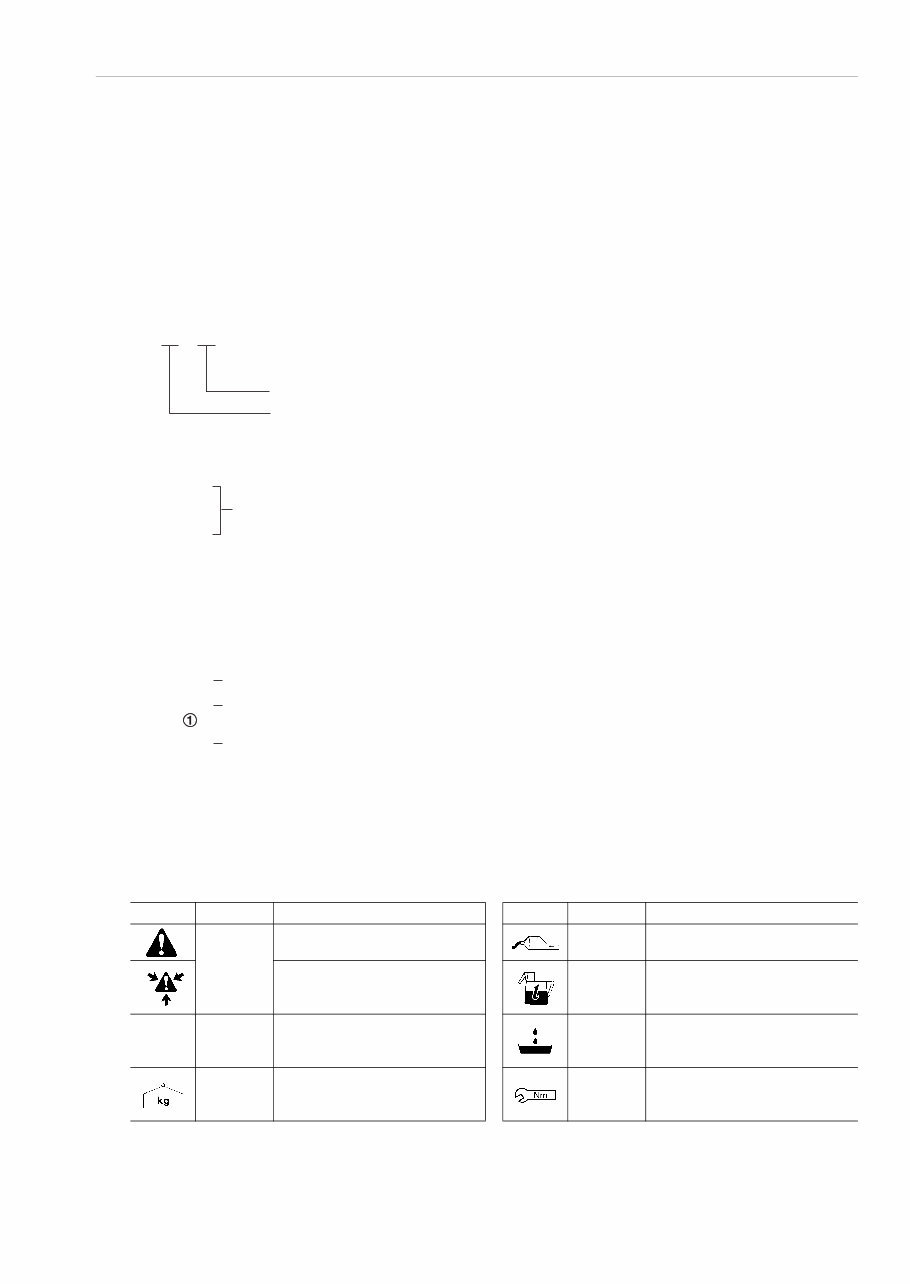
3. SYMBOLS USED IN THE MANUAL
For greater clarity, important information pertaining to operator safety and to critical stages in the working proce-
dures is highlighted by the symbols shown in the following table.
Symbol Meaning Notes Symbol Meaning Notes
Safety
Safety rules to be applied during
operation.
Coating
Parts must be coated with adhesive,
lubricant, etc.
Operation requiring special safety
measures due to internal pressure.
Oil, water
Points at which oil, water or fuel
must be added and quantity requi-
red.
★
Warning
Operations requiring special techni-
cal or other precautionsto ensure
compliance with standard values.
Drain
Points from which oil, water or fuel
must be drained with quantity.
Weight
Weight of main assemblies.
Choose lifting ropes/slings careful-
ly; supports required, etc.
Tightening
torques
Parts requiring special tightening
torque during refitting or assembly.
20 5
Section number
Consecutive page number
20-5
20-5-1
20-5-2
20-6
Supplementary page
20-5
20-5-1
20-5-1
20-5-2
Existing page
Update page
Existing page
HOW TO UPDATE THE MANUAL
Tractor Manuals Scotland
Tractor Manuals Scotland - Please Do Not Copy

00-8
SAFETY PRECAUTIONS FOR REMOVAL AND REFITTING OPERATIONS
★ When removing or refitting parts, always take the following safety precautions.
1. Precautions for removal operations
• Unless otherwise indicated, lower the working equipment until it rests on the ground.
• After disconnecting hydraulic and fuel system pipes, always fit plugs to the open ends of the pipes to prevent in-
gress of impurities.
• Before removing a cylinder, fully retract the piston and secure it in this position using a retaining strap.
• Use containers of sufficient capacity when draining oil, coolant or fuel.
• Before removing a part from the machine, check for alignment markings indicating the correct assembly po-
sition. If necessary, make new markings to ensure correct assembly.
• When unplugging electrical connectors, always grip the connectors firmly to avoid pulling on the wires.
• Where necessary, label wires and pipes before removal to avoid confusion when reconnecting.
• Check the number and thickness of any shims removed and keep them together in a safe place.
• To lift the machine or any of its main components, use lifting equipment of suitable capacity.
• When using bolts or eye bolts to remove parts, ensure they are screwed home fully.
• Before removing a part, clean the surrounding area and, after removing the part, cover it to prevent the ingress of
dirt and dust.
2. Precautions for refitting operations
• Tighten nuts and bolts to the specified tightening torques.
• When refitting flexible pipes and wires, take care not to twist or tangle them.
• Always fit new seals, O-rings, cotter pins and safety stop rings; ensure that cotter pins are bent over so that they
cannot work loose.
• Ensure that circlips are correctly installed in their seatings.
• When applying threadlocking compound, first clean the part removing all oil and grease, then cover the thread
evenly applying a few drops of the compound.
• When applying sealant, first clean the surface removing all traces of oil and grease and check for dirt or inden-
tations, then apply the sealant evenly making sure that it forms a continuous film around any fixing holes.
• Clean all parts, removing dirt, oxidisation, carbon deposits, burrs and indentations.
• Coat all moving parts with a thin film of engine oil.
• When reconnecting electrical connectors, first remove all traces of oil, dust and water from the inside of the con-
nector and then connect the two halves together firmly.
• When using eyebolts for lifting, check that they are not deformed, screw them fully home and align the eye with
the lifting hook.
• Bolt down flanged fittings evenly, tightening the bolts gradually in a crosswise pattern.
3. Precautions to be taken on completion of removal/refitting operations
• If coolant has been drained from the engine, refit the drain plug and add new coolant to the correct level. Start the
engine to circulate the coolant and then check the level again and top up.
• After removing hydraulic components, top up the hydraulic oil to the specified level. Start the engine to circulate
the oil in the hydraulic circuits and then recheck the level and top up as necessary.
• After having removed the variable displacement pump, before connecting the discharge pipe, fill the pump cas-
ing with oil.
• Grease stub axle housings, cylinder pivot mountings and drive shafts thoroughly after assembly.
SAFETY PRECAUTIONS FOR REMOVAL AND REFITTING OPERATIONS
Tractor Manuals Scotland
Tractor Manuals Scotland - Please Do Not Copy
You're Reading a Preview
What's Included?
 Lifetime Access
Fast Download Speeds
Online & Offline Access
Access PDF Contents & Bookmarks
Full Search Facility
Print one or all pages of your manual
$52.99
DEUTZ FAHR AGROTRON 106 110 115 120 135 150 165 MK3 Manual
Viewed 96 Times Today

What's Included?
Lifetime Access
Fast Download Speeds
Online & Offline Access
Access PDF Contents & Bookmarks
Full Search Facility
Print one or all pages of your manual
$52.99

Secure transaction
What's Included?
Lifetime Access
Fast Download Speeds
Online & Offline Access
Access PDF Contents & Bookmarks
Full Search Facility
Print one or all pages of your manual
Description
If you own or work on a DEUTZ FAHR AGROTRON 106, 110, 115, 120, 135, 150, or 165 MK3 tractor, this workshop service repair manual is essential for you. It provides valuable technical information for both professional mechanics and DIY enthusiasts. Please note that this manual does not cover the engine, gearbox, or front and rear axle. For information on these components, please view other items.


