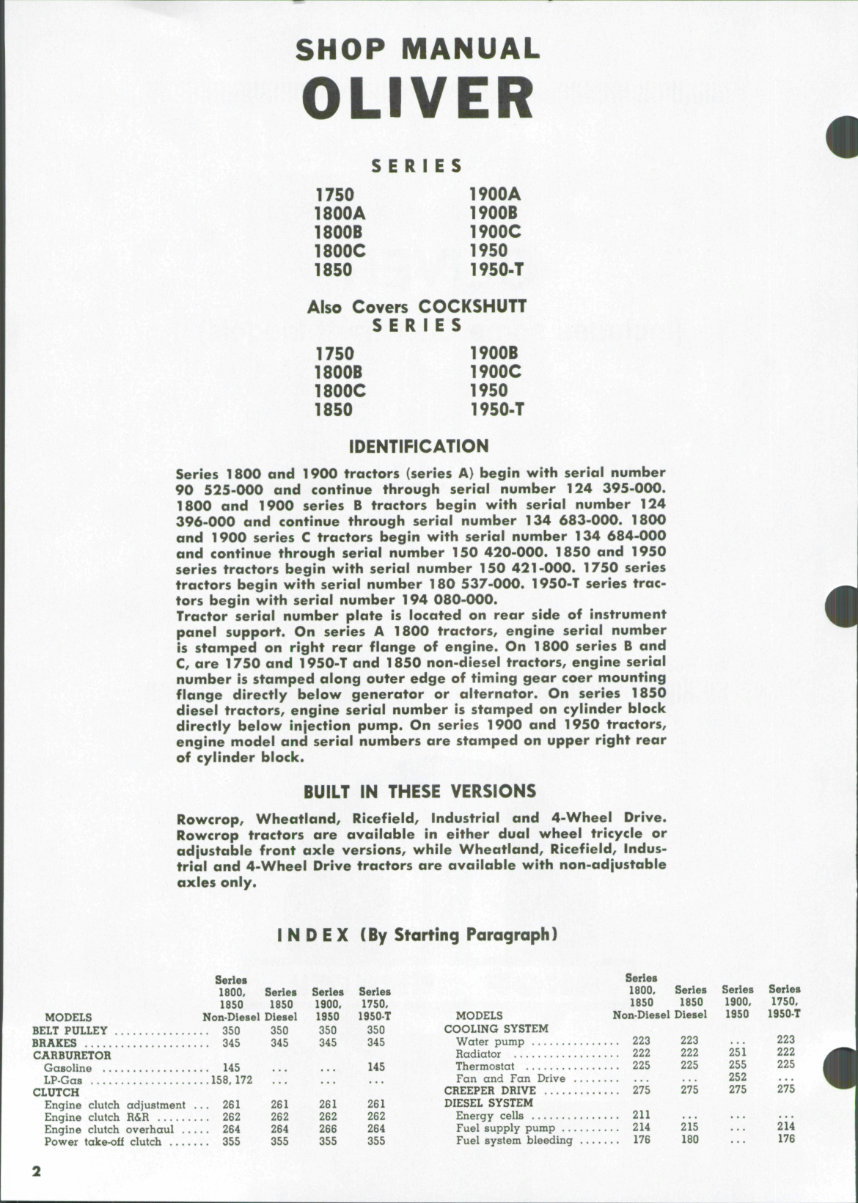
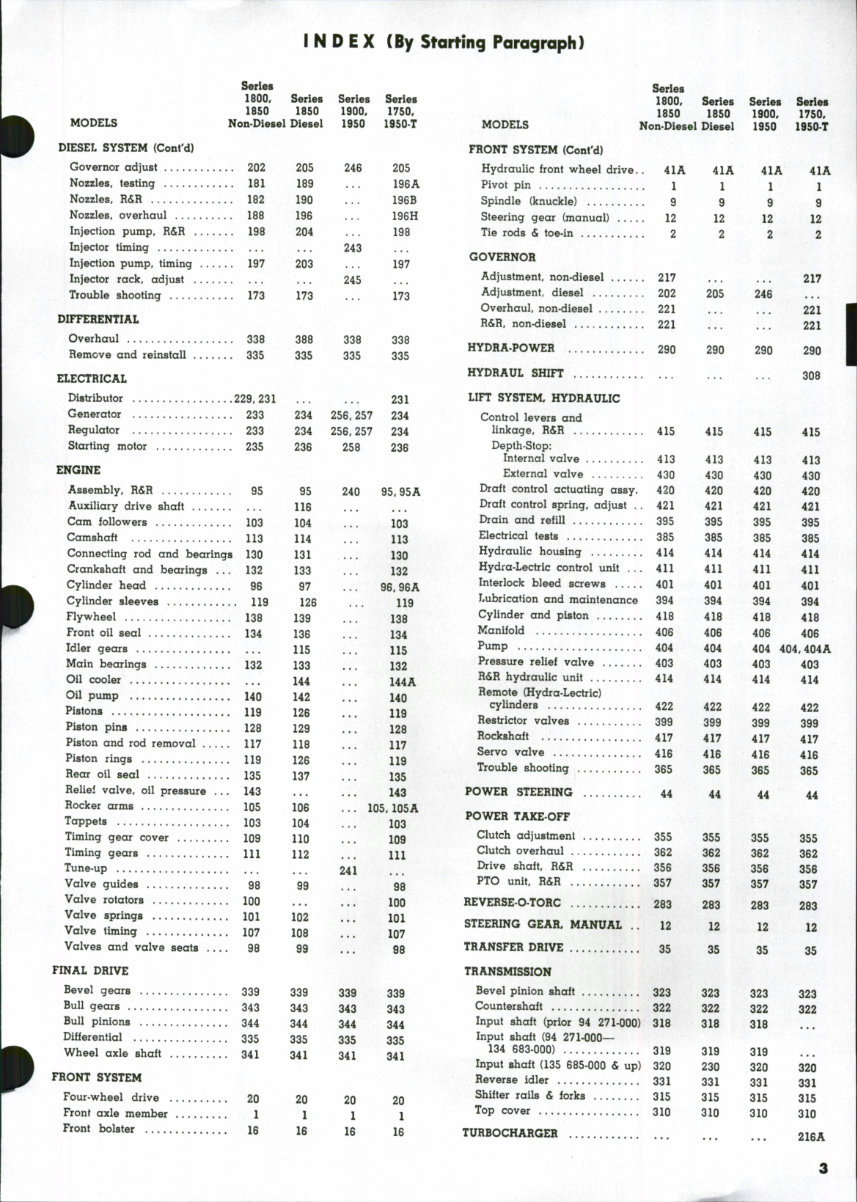
SHOP MANUAL OLIVER SERIES 1750 1800A 1800B 1800C 1850 Uso Covers SER 1750 1800B 1800C 1850 1900A 1900B 1900C 1950 1950-T COCKSHUTT 1 ES 1900B 1900C 1950 1950.T IDENTIFICATION Series 1800 and 1900 tractors (series A) begin with serial number 90 525-000 and continue through serial number 124 395-000. 1800 and 1900 series B tractors begin with serial number 124 396-000 and continue through serial number 134 683-000. 1800 and 1900 series C tractors begin with serial number 134 684-000 and continue through serial number 150 420-000. 1850 and 1950 series tractors begin with serial number 150 421-000. 1750 series tractors begin with serial number 180 537-000. 1950-T series trac- tors begin with serial number 194 080-000. Tractor serial number plate is located on rear side of instrument panel support. On series A 1800 tractors, engine serial number is stamped on right rear flange of engine. On 1800 series B and C/ are 1750 and 1950-T and 1850 non-diesel tractors, engine serial number is stamped along outer edge of timing gear coer mounting flange directly below generator or alternator. On series 1850 diesel tractors, engine serial number is stamped on c/linder block directly below injection pump. On series 1900 and 1950 tractors, engine model and serial numbers are stamped on upper right rear of cylinder block. BUILT IN THESE VERSIONS Rowcrop, Wheatland, Ricefield, Industrial and 4-Wheel Drive. Rowcrop tractors are available in either dual wheel tricycle or adjustable front axle versions, while Wheatland, Ricefield, Indus- trial and 4-Wheel Drive tractors are available with non-adjustable axles only. INDEX (By Starting Paragraph) Series Series 1800, Series Series Series 1800, Series Series Series 1850 1850 1900, 1750, 1850 1850 1900, 1750, MODELS Non-Diesel Diesel 1950 1950.T MODELS Non-Diesel Diesel 1950 1950-T BELT PULLEY 350 350 350 350 COOLING SYSTEM BRAKES 345 345 345 345 Water pump 223 223 ... 223 CARBURETOR Radiator 222 222 251 222 Gasoline 145 145 Thermostat 225 225 255 225 LP-Gaa 158, 172 ... ... ... Fan and Fan Drive ... 252 CLUTCH CREEPER DRIVE 275 275 275 275 Engine clutch adjustment ... 261 261 261 261 DIESEL SYSTEM Engine clutch R&R 262 262 262 262 Energy cells 211 Engine clutch overhaul 264 264 266 264 Fuel supply pump 214 215 ... 214 Power take-off clutch 355 355 355 355 Fuel system bleeding 176 180 ... 176
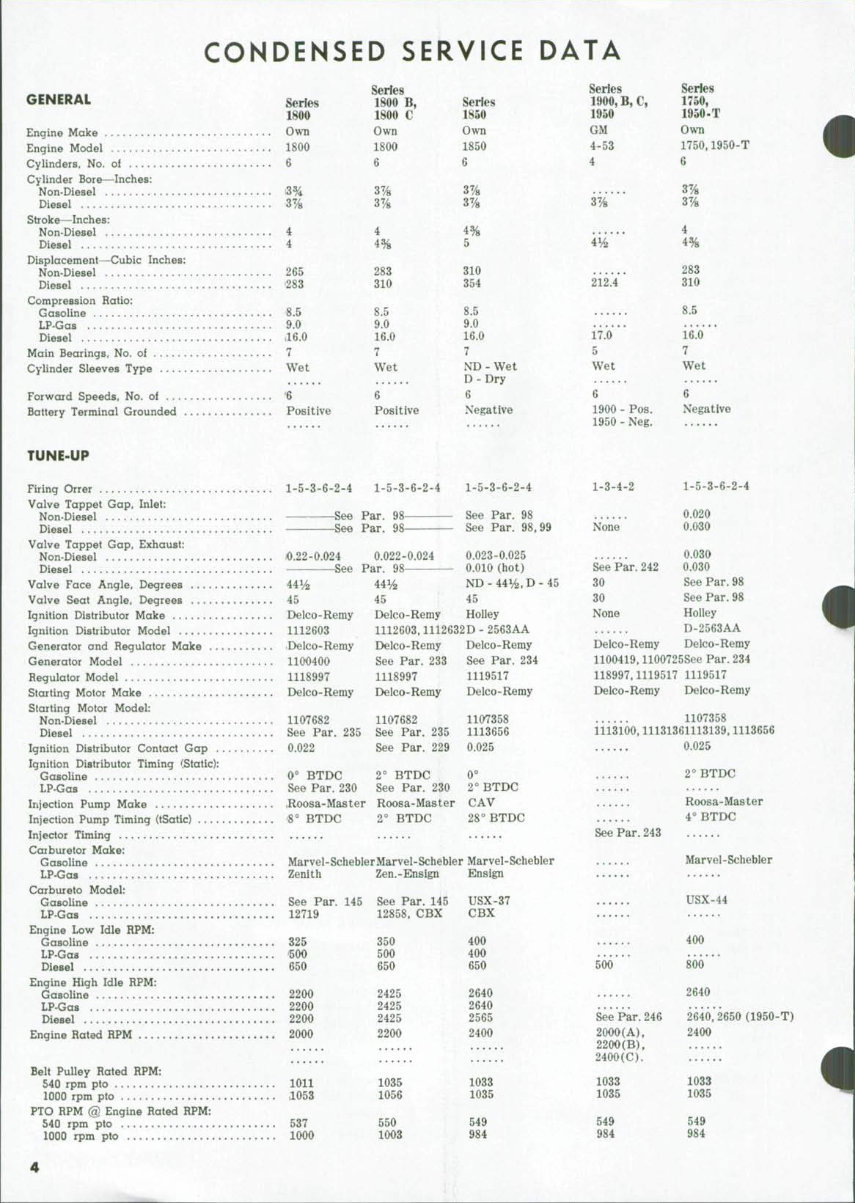
CONDENSED SERVICE DATA GENERAL Series 1800 Engine Make Own Engine Model 1800 Cylinders, No. of 6 Cylinder Bore—Inches: Non-Diesel i3% Diesel 37/8 Stroke—Inches: Non-Diesel 4 Diesel 4 Displacement—Cubic Inches: Non-Diesel 265 Diesel 283 Compression Ratio: Gasoline 8.5 LP-Gas 9.0 Diesel 1I6.O Main Bearings, No. of 7 Cylinder Sleeves Type . Wet Forward Speeds, No. of '6 Battery Terminal Grounded Positive Series 1800 B, 1800 C Own 1800 6 3% 3% 4 4% 283 310 8.5 9.0 16.0 7 Wet 6 Positive Series 1850 Own 1850 6 3% 3y8 4% 5 310 354 8.5 9.0 16.0 7 ND - Wet D - Dry 6 Negative Series 1900, B, C, 1950 GM 4-53 4 3% 4^ 212.4* * 17.0 5 Wet 6 1900 - Pos. 1950 - Neg. Series 1750, 1950-T Own 1750,1950-T 6 3% 3% 4 4% 283 310 8.5 16.0 7 Wet 6 Negative TUNE-UP Firing Orrer 1-5-3-6-2-4 1-5-3-6-2-4 1-5-3-6-2-4 Valve Tappet Gap, Inlet: Non-Diesel See Par. 98 See Par. 98 Diesel See Par. 98 See Par. 98,99 Valve Tappet Gap, Exhaust: Non-Diesel /0.22-0.024 0.022-0.024 0.023-0.025 Diesel See Par. 98 0.010 (hot) Valve Face Angle, Degrees 441/2 44y2 ND - 44V2, D - 45 Valve Seat Angle, Degrees 45 45 45 Ignition Distributor Make Delco-Remy Delco-Remy Holley Ignition Distributor Model 1112603 1112603,1112632D - 2563AA Generator and Regulator Make .Delco-Remy Delco-Remy Delco-Remy Generator Model 1100400 See Par. 233 See Par. 234 Regulator Model 1118997 1118997 1119517 Starting Motor Make Delco-Remy Delco-Remy Delco-Remy Starting Motor Model: Non-Diesel 1107682 1107682 1107358 Diesel See Par. 235 See Par. 235 1113656 Ignition Distributor Contact Gap 0.022 See Par. 229 0.025 Ignition Distributor Timing (Static): Gasoline 0° BTDC 2° BTDC 0° LP-Gas See Par. 230 See Par. 230 2° BTDC Injection Pump Make Roosa-Master Roosa-Master CAV Injection Pump Timing (tSatic) 8° BTDC 2° BTDC 28" BTDC Injector Timing Caiburetor Make: Gasoline Marvel-ScheblerMarvel-Schebler Marvel-Schebler LP-Gas Zenith Zen.-Ensign Ensign Carbureto Model: Gasoline See Par. 145 See Par. 145 USX-37 LP-Gas 12719 12858, CBX CBX Engine Low Idle RPM: Gasoline 325 350 400 LP-Gas 500 500 400 Diesel 650 650 650 Engine High Idle RPM: Gasoline 2200 2425 2640 LP-Gas 2200 2425 2640 Diesel 2200 2425 2565 Engine Rated RPM 20O0 220O 2400 Belt Pulley Rated RPM: 540 rpm pto 1011 1035 1033 1000 rpm pto ,1053 1056 1035 PTO RPM @ Engine Hated RPM: 540 rpm pto 537 550 549 1000 rpm pto 1000 1003 984 1-3-4-2 None 1-5-3-6-2-4 0.020 0.030 0.030 See Par. 242 0.030 30 See Par. 98 30 See Par. 98 None Holley D-2563AA Delco-Remy Delco-Remy 1100419,1100725See Par. 234 118997,1119517 1119517 Delco-Remy Delco-Remy 1107358 1113100,11131361113139,1113656 0.025 See Par. 243 500 See Par. 246 20OO(A), 2200{B), 2400(C). 1033 1035 549 984 2° BTDC Roosa-Master 4° BTDC Marvel-Schebler USX-44 400 800 2640 2640,2650 (1950-T) 2400 1033 1035 549 984 4
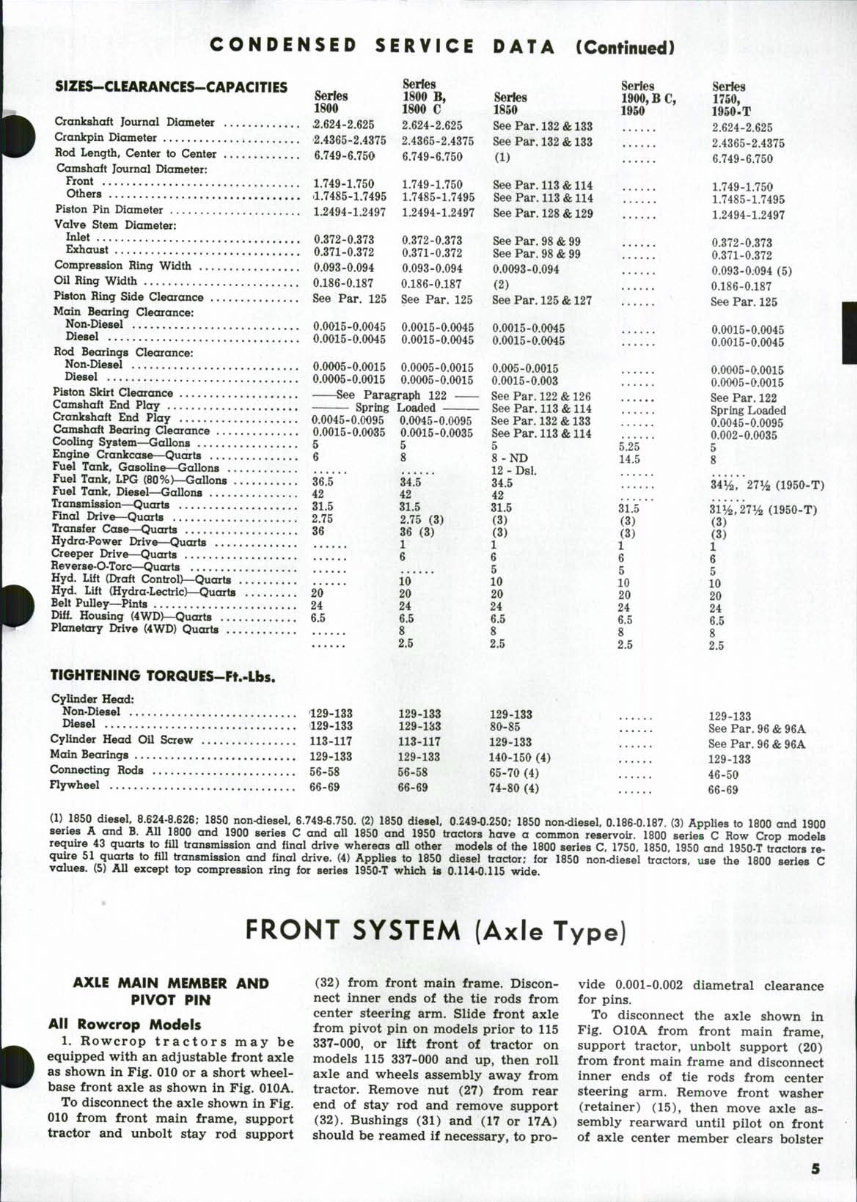
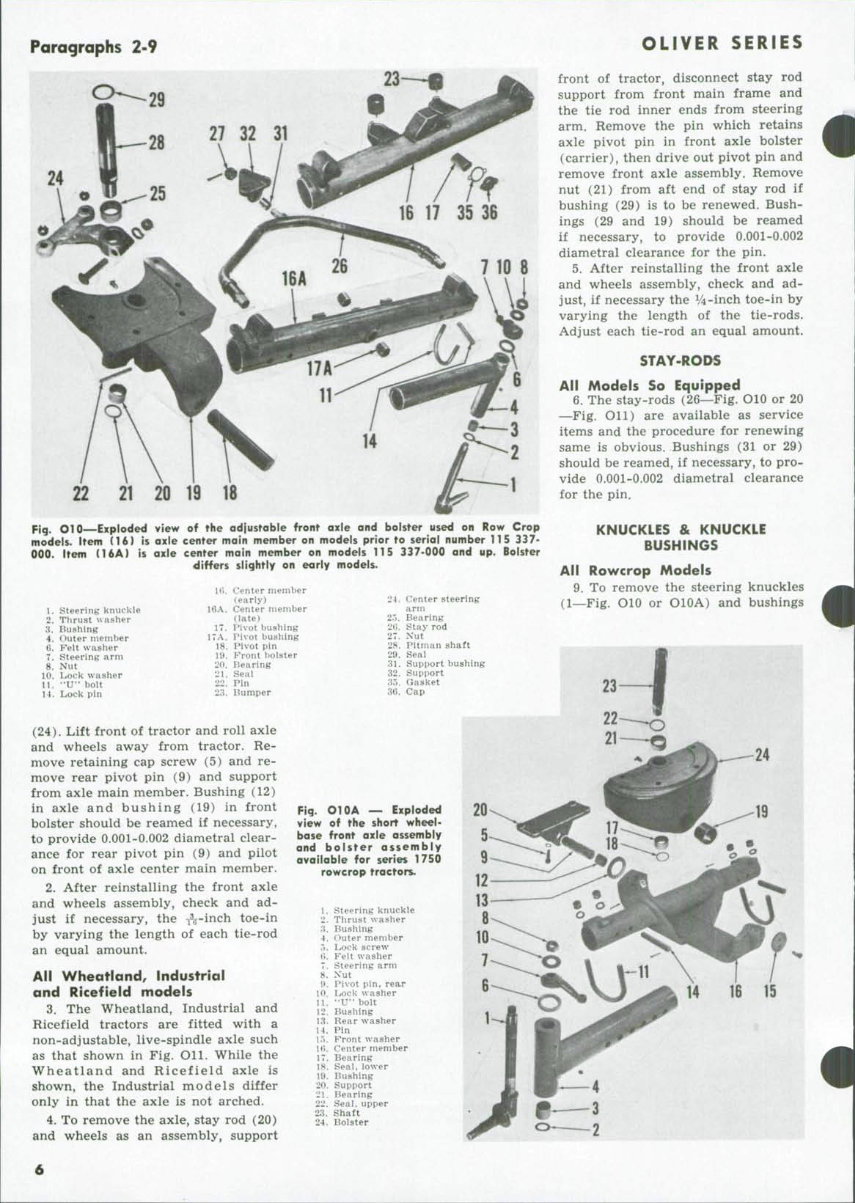
CONDENSED SERVICE DATA (Continued) SIZES-CLEARANCES-CAPACITIES ^^ ferjes 1800 1800 C Crankshaft Journal Diameter 2.624-2.625 2.624-2.625 Crankpin Diameter 2.4365-2.4375 2.4365-2.4375 Rod Length, Center to Center 6.749-6.750 6.749-6.750 Camshaft Journal Diameter: front 1.749-1.750 1.749-1.750 O*ers 1.7485-1.7495 1.7485-1.7495 Piston Pin Diameter 1.2494-1.2497 1.2494-1.2497 Valve Stem Diameter: Inlet 0.372-0.373 0.372-0.373 Exhaust 0.371-0.372 0.371-0.372 Compression Ring Width 0.093-0.094 0.093-0.094 Oil Ring Width 0.186-0.187 0.186-0.187 Piston Ring Side Clearance See Par. 125 See Par. 125 Main Bearing Clearance: Non-Diesel 0.0015-0.0045 0.0015-0.0045 I^iesel O.0O15-0.0O45 0.0015-0.0045 Rod Bearings Clearance: Non-Diesel 0.0005-0.0015 0.00O5-0.0O15 I^iesel 0.0005-0.0015 0.00O5-0.O015 Piston Skirt Clearance — See Paragraph 122 Camshaft End Play Spring Loaded Crankshaft End Play O.0045-0.0O95 0.0O45-0.0O95 Camshaft Bearing Clearance 0.0015-0.0O35 0.0015-0.0035 Cooling System—Gallons 5 g Engine Crankcase—Quarts 6 ^f Fuel Tank, Gasoline—Gallons Fuel Tank, LPG (80%)—GaUons 36.5*' * 34.*5' Fuel Tank, Diesel—GaUons 42 42 Transmission—Quarts 31.5 31.5 Final Drive—Quarts 2.75 2.75 (3) Transfer Case—Quarts 36 36 (3) Hydra-Power Drive—Quarts 1 Creeper Drive—Quarts 6 Reverse-O-Torc—Quarts ,'.' Hyd. Lift (Draft Control)—Quarts !!!!!! 10 Hyd. Lift (Hydra-Lectric)—Quarts 20 20 Belt Pulley—Pints 24 24 Diff. Housing (4WD)—Quarts 6.5 6.5 Planetary Drive (4WD) Quarts 8 2.5 TIGHTENING TORQUES-Ft.-Lbs. Cylinder Head: Non-Diesel 129-133 129-133 Diesel 129-133 129-133 Cylinder Head Oil Screw 113-117 113-117 Main Bearings 129-133 129-133 Connecting Rods 56-58 56-58 Flywheel 66-69 66-69 Series Series 1900, B C , 1850 1950 See Par. 132 & 133 See Par. 132 & 133 (1) See Par. 113 & 114 See Par. 113 & 114 See Par. 128 & 129 See Par. 98 & 99 See Par. 98 & 99 0.0093-0.094 (2) See Par. 125 & 127 ...... 0.0015-0.0045 0.0015-0.0045 0.0O5-0.0015 0.0015-0.003 See Par. 122 & 126 See Par. 113 & 114 See Par. 132 & 133 See Par. 113 & 114 5 5.25 8 - ND 14,5 12 - Dsl. 34.5 42 31.5 31.5 (3) (3) (3) (3) 1 1 6 6 5 5 10 10 20 20 24 24 6.5 6.5 8 8 2.5 2.5 129-133 80-85 129-133 140-150 (4) 65-70 (4) 74-80 (4) Series 1750, 1950-T 2.624-2.625 2.4365-2.4375 6.749-6.750 1.749-1.750 1.7485-1.7495 1.2494-1.2497 0.372-0.373 0.371-0.372 0.093-0;094 (5) 0.186-0.187 See Par. 125 0.0015-0.0045 0.0015-0.0045 0.0005-0.0015 0.0005-0.0015 See Par. 122 Spring Loaded 0.0045-0.0095 0.002-0.0035 5 8 34%, 27% (1950-T) , 27% (1950-T) (3) (3) 1 6 5 10 20 24 6.5 8 129-133 See Par. 96 & 96A SeePar.96&96A 129-133 46-50 66-69 (1) 1850 diesel. 8.624-8.626; 1850 non^iiesel 6.749-8.750. (2) 1850 diesel 0.249-0.250; 1850 non-diesel 0.188-0.187. (3) Applies to 1800 and 1900 series A and B. All 1800 and 1900 series C and all 1850 and 1950 tractors have a common reservoir. 1800 series C Row Crop models require 43 quarts to fill transmission and final drive whereas all other models of the 1800 series C. 1750, 1850, 1950 and 1950-T tractors re- quire 51 quarts to fill transmission and final drive. (4) Applies to 1850 diesel tractor; for 1850 non-diesel tractors, use the 1800 series C values. (5) All except top compression ring for series 1950-T which is 0.U4-0.115 wide. FRONT SYSTEM (Axle Type) AXLE MAIN MEMBER AND PIVOT PIN All Rowcrop Models 1. Rowcrop tractors may be equipped with an adjustable front axle as shown in Fig. 010 or a short wheel- base front axle as shown in Fig. 010A. To disconnect the axle shown in Fig. 010 from front main frame, support tractor and unbolt stay rod support (32) from front main frame. Discon- nect inner ends of the tie rods from center steering arm. Slide front axle from pivot pin on models prior to 115 337-000, or lift front of tractor on models 115 337-000 and up, then roll axle and wheels assembly away from tractor. Remove nut (27) from rear end of stay rod and remove support (32). Bushings (31) and (17 or 17A) should be reamed if necessary, to pro- vide 0.001-0.002 diametral clearance for pins. To disconnect the axle shown in Fig. OlOA from front main frame, support tractor, unbolt support (20) from front main frame and disconnect inner ends of tie rods from center steering arm. Remove front washer (retainer) (15), then move axle as- sembly rearward until pilot on front of axle center member clears bolster
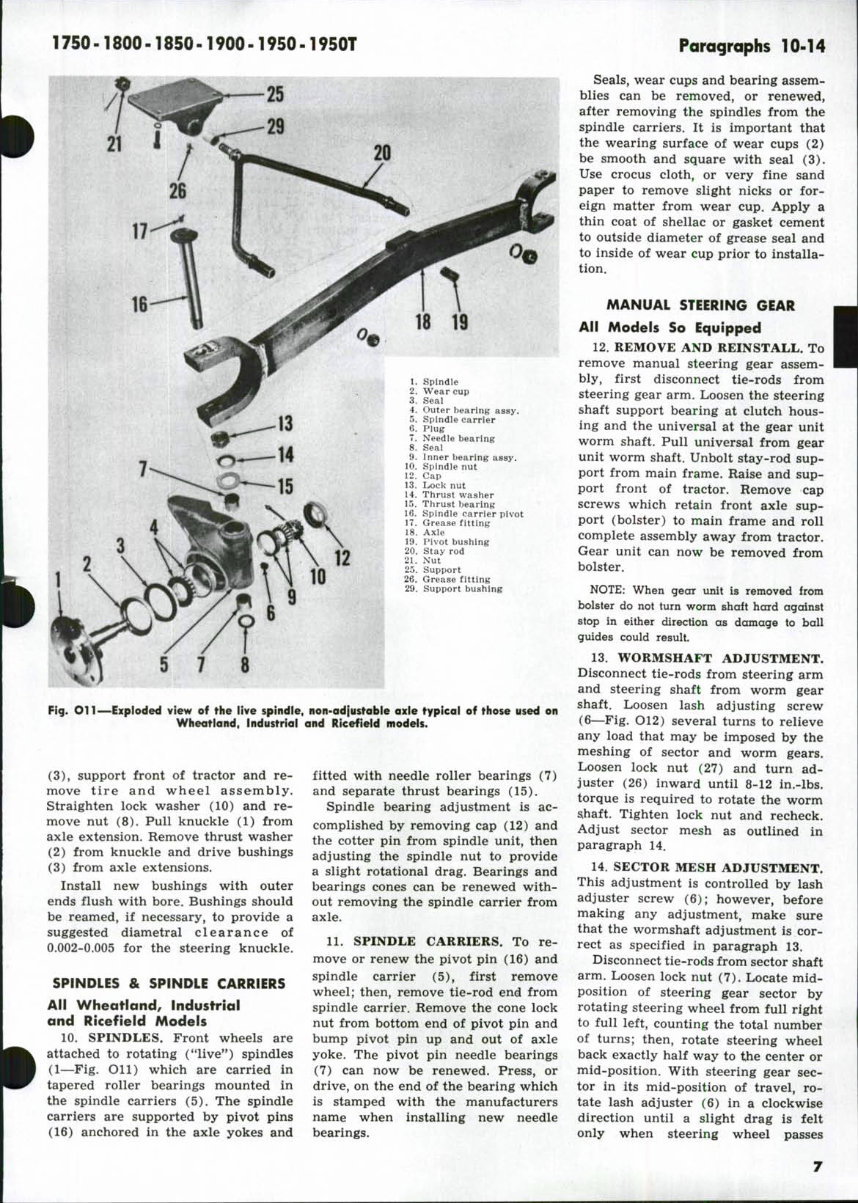
22 21 20 19 18 Fig. O10 Exploded view of the adjustable front axle and bolster used on Row Crop models. Item (16) is axle center main member on models prior to serial number 115 337- 000. Item (16A) is axle center main member on models 115 337-000 and up. Bolster differs slightly on early models. 1, steering knuckle •2. Tlirust washer 'A. lUishing 4. Outer member ti. Felt washer 7. Steering arm 8. Nut 10. Lock washer 11. "U" bolt 14. Lock pin Hi. Center member (early) 16A. Center member (late) 17. IMvot bushing 17A. Pivot bushing 18. Pivot pin lt». ?"'ront boister 20. Bearing 21. Seal 22. Pin 23. liumper 24. Center steering arm 2."». Bearing 2t;. Stay rod 27. Xut 28. Pitman shaft 29. Seal 31. Support bushing 32. Supi)ort 35. Gasket 36. Cap (24). Lift front of tractor and roll axle and wheels away from tractor. Re- move retaining cap screw (5) and re- move rear pivot pin (9) and support from axle main member. Bushing (12) in axle and bushing (19) in front bolster should be reamed if necessary, to provide 0.001-0.002 diametral clear- ance for rear pivot pin (9) and pilot on front of axle center main member. 2. After reinstalling the front axle and wheels assembly, check and ad- just if necessary, the ^-inch toe-in by varying the length of each tie-rod an equal amount. All Wheatland, Industrial and Ricefield models 3. The Wheatland, Industrial and Ricefield tractors are fitted with a non-adjustable, live-spindle axle such as that shown in Fig. Oil. While the Wheatland and Ricefield axle is shown, the Industrial models differ only in that the axle is not arched. 4. To remove the axle, stay rod (20) and wheels as an assembly, support OLIVER SERIES front of tractor, disconnect stay rod support from front main frame and the tie rod inner ends from steering arm. Remove the pin which retains axle pivot pin in front axle bolster (carrier), then drive out pivot pin and remove front axle assembly. Remove nut (21) from aft end of stay rod if bushing (29) is to be renewed. Bush- ings (29 and 19) should be reamed if necessary, to provide 0.001-0.002 diametral clearance for the pin. 5. After reinstalling the front axle and wheels assembly, check and ad- just, if necessary the V4-inch toe-in by varying the length of the tie-rods. Adjust each tie-rod an equal amount. STAY-ROI>S All Models So Equipped 6. The stay-rods (26—Fig. OlO or 20 —Fig. OU) are available as service items and the procedure for renewing same is obvious. Bushings (31 or 29) should be reamed, if necessary, to pro- vide 0.001-0.002 diametral clearance for the pin. KNUCKLES & KNUCKLE BUSHINGS All Rowcrop Models 9. To remove the steering knuckles (l_Fig. OlO or OlOA) and bushings 23 24 4 Fig. OlOA — Exploded view of the short wheel- base front axle assembly and bolster assembly available for series 1750 rowcrop tractors. 1. Steering knuckle 2. Thrust washer •A. Bushing 4. Outer member ,". Lock screw *>. Feit washer 7. Steering arm 8. Xut 1>. Pi\ot pin, rear 10. Lock washer U. "U" bolt 12. Bushing 13. Rear washer 14. Pin 1.". Front washer KK Center member 17. Bearing 18. Seal, lower 19. Bushing 20. Support 21. Bearing 22. Seal, upper 23. Shaft 24. Bolster •
1750-1800-1850-1900-1950-1950T Paragraphs 10-14 b 12 Spindle Wear cup Seal Outer bearing assy. Spindle carrier Plug Needle bearing Seal Inner bearing assy. Spindle nut Cap Lrock nut Thrust washer Thrust bearing Spindle carrier pivot Grease fitting Axle IMvot bushing Stay rod Nut Support Grease fitting Support bushing 7 8 Fig. Oil—Exploded view of the live spindle, non-adjustable axle typical of those used on Wheatland, Industrial and Ricefield models. (3), support front of tractor and re- move tire and wheel ass em b 1 y. Straighten lock washer (10) and re- move nut (8). Pull knuckle (1) from axle extension. Remove thrust washer (2) from knuckle and drive bushings (3) from axle extensions. Install new bushings with outer ends flush with bore. Bushings should be reamed, if necessary, to provide a suggested diametral clearance of 0.002-0.005 for the steering knuckle. SPINDLES & SPINDLE CARRIERS All Wheatland, Industrial and Ricefield Models 10. SPINDLES. Front wheels are attached to rotating ("live") spindles (1—Fig. Oil) which are carried in tapered roller bearings mounted in the spindle carriers (5). The spindle carriers are supported by pivot pins (16) anchored in the axle yokes and fitted with needle roller bearings (7) and separate thrust bearings (15). Spindle bearing adjustment is ac- complished by removing cap (12) and the cotter pin from spindle unit, then adjusting the spindle nut to provide a slight rotational drag. Bearings and bearings cones can be renewed with- out removing the spindle carrier from axle. 11. SPINDLE CARRIERS. To re- move or renew the pivot pin (16) and spindle carrier (5), first remove wheel; then, remove tie-rod end from spindle carrier. Remove the cone lock nut from bottom end of pivot pin and bump pivot pin up and out of axle yoke. The pivot pin needle bearings (7) can now be renewed. Press, or drive, on the end of the bearing which is stamped with the manufacturers name when installing new needle bearings. Seals, wear cups and bearing assem- blies can be removed, or renewed, after removing the spindles from the spindle carriers. It is important that the wearing surface of wear cups (2) be smooth and square with seal (3). Use crocus cloth, or very fine sand paper to remove slight nicks or for- eign matter from wear cup. Apply a thin coat of shellac or gasket cement to outside diameter of grease seal and to inside of wear cup prior to installa- tion. MANUAL STEERING GEAR All Models So Equipped 12. REMOVE AND REINSTALL. To remove manual steering gear assem- bly, first disconnect tie-rods from steering gear arm. Loosen the steering shaft support bearing at clutch hous- ing and the universal at the gear unit worm shaft. Pull universal from gear unit worm shaft. Unbolt stay-rod sup- port from main frame. Raise and sup- port front of tractor. Remove cap screws which retain front axle sup- port (bolster) to main frame and roll complete assembly away from tractor. Gear unit can now be removed from bolster. NOTE; When gear unit is removed from bolster do not turn worm shaft hard against stop in either direction as damage to ball guides could result. 13. WORMSHAFT ADJUSTMENT. Disconnect tie-rods from steering arm and steering shaft from worm gear shaft. Loosen lash adjusting screw (6—Fig. O12) several turns to relieve any load that may be imposed by the meshing of sector and worm gears. Loosen lock nut (27) and turn ad- juster (26) inward until 8-12 in.-lbs. torque is required to rotate the worm sihaft. Tighten lock nut and recheck. Adjust sector mesh as outlined in paragraph 14. 14. SECTOR MESH ADJUSTMENT. This adjustment is controlled by lash adjuster screw (6); however, before making any adjustment, make sure that the wormshaft adjustment is cor- rect as specified in paragraph 13. Disconnect tie-rods from sector shaft arm. Loosen lock nut (7). Locate mid- position of steering gear sector by rotating steering wheel from full right to full left, counting the total number of turns; then, rotate steering wheel back exactly half way to the center or mid-position. With steering gear sec- tor in its mid-position of travel, ro- tate lash adjuster (6) in a clockwise direction until a slight drag is felt only when steering wheel passes
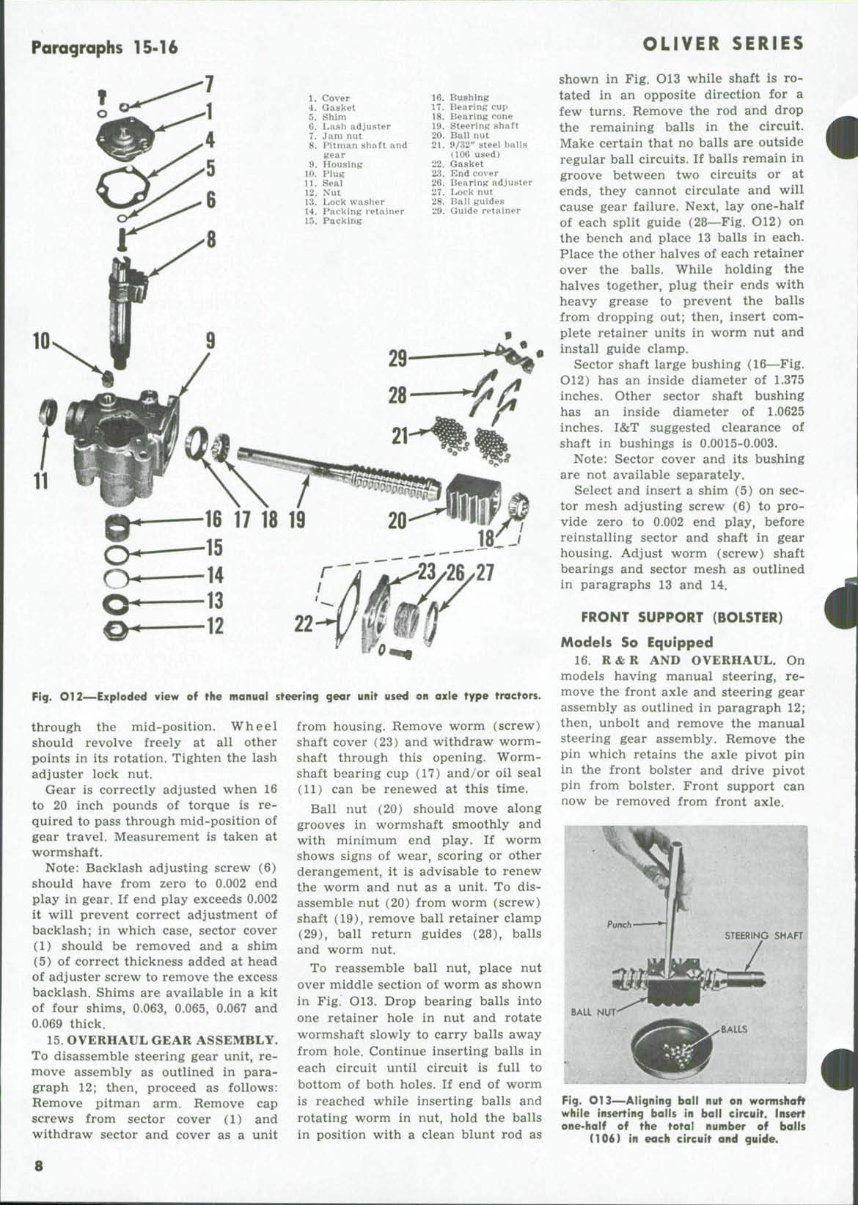
Paragraphs 15-16 OLIVER SERIES 1. 4. 5. 6. 7. 8. 9. 10. 11. 12. 13. 14. I'). Cover Gasket Shim Lash adju.ster Jam nut Pitman shaft and K'ear Housing mug Seal Xut Lock washer Packing retainer Packing 16. 17. 18. 19. 20. 21. 22. 23. 26. 27 28! 29. Bushmg Bearing cui) Bearing rone Steering shaft Ball nut 9/;i2" steel balls (106 used) Gasket End cover Bearing adjuster Lock nut Ball guides Guide retainer Fig. O12—Exploded view of fhe manual steering gear unif used on axle type tractors. through the mid-position. Wheel should revolve freely at all other points in its rotation. Tighten the lash adjuster lock nut. Gear is correctly adjusted when 16 to 20 inch pounds of torque is re- quired to pass through mid-position of gear travel. Measurement is taken at wormshaft. Note: Backlash adjusting screw (6) should have from zero to 0.002 end play in gear. If end play exceeds 0.002 it will prevent correct adjustment of backlash; in which case, sector cover (1) should be removed and a shim (5) of correct thickness added at head of adjuster screw to remove the excess backlash. Shims are available in a kit of four shims, 0.063, 0.065, 0.067 and 0.069 thick. 15. OVERHAUL GEAR ASSEMBLY. To disassemble steering gear unit, re- move assembly as outlined in para- graph 12; then, proceed as follows: Remove pitman arm. Remove cap screws from sector cover (1) and withdraw sector and cover as a unit from housing. Remove worm (screw) shaft cover (23) and withdraw worm- shaft through this opening. Worm- shaft bearing cup (17) and/or oil seal (11) can be renewed at this time. Ball nut (20) should move along grooves in wormshaft smoothly and with minimum end play. If worm shows signs of wear, scoring or other derangement, it is advisable to renew the worni and nut as a unit. To dis- assemble nut (20) from worm (screw) shaft (19), remove ball retainer clamp (29), ball return guides (28), balls and worm nut. To reassemble ball nut, place nut over middle section of worm as shown in Fig. O13. Drop bearing balls into one retainer hole in nut and rotate wormshaft slowly to carry balls away from hole. Continue inserting balls in each circuit until circuit is full to bottom of both holes. If end of worm is reached while inserting balls and rotating worm in nut, hold the balls in position with a clean blunt rod as shown in Fig. O13 while shaft is ro- tated in an opposite direction for a few turns. Remove the rod and drop the remaining balls in the circuit. Make certain that no balls are outside regular ball circuits. If balls remain in groove between two circuits or at ends, they cannot circulate and will cause gear failure. Next, lay one-half of each split guide (28—Fig. O12) on the bench and place 13 balls in each. Place the other halves of each retainer over the balls. While holding the halves together, plug their ends with heavy grease to prevent the balls from dropping out; then, insert com- plete retainer units in worm nut and install guide clamp. Sector shaft large bushing (16—Fig. O12) has an inside diameter of 1.375 inches. Other sector shaft bushing has an inside diameter of 1.0625 inches. I&T suggested clearance of shaft in bushings is 0.0015-0.003. Note: Sector cover and its bushing are not available separately. Select and insert a shim (5) on sec- tor mesh adjusting screw (6) to pro- vide zero to 0.002 end play, before reinstalling sector and shaft in gear housing. Adjust worm (screw) shaft bearings and sector mesh as outlined in paragraphs 13 and 14. FRONT SUPPORT (BOLSTER) Models So Equipped 16. R&R AND OVERHAUL. On models having manual steering, re- move the front axle and steering gear assembly as outlined in paragraph 12; then, unbolt and remove the manual steering gear assembly. Remove the pin which retains the axle pivot pin in the front bolster and drive pivot pin from bolster. Front support can now be removed from front axle. BAIL NUT Fig. on—Aligning ball nut an warmshaft while inserting balls in ball circuit. Insert one-half af the total number af balls C106) in each circuit and guide. 8
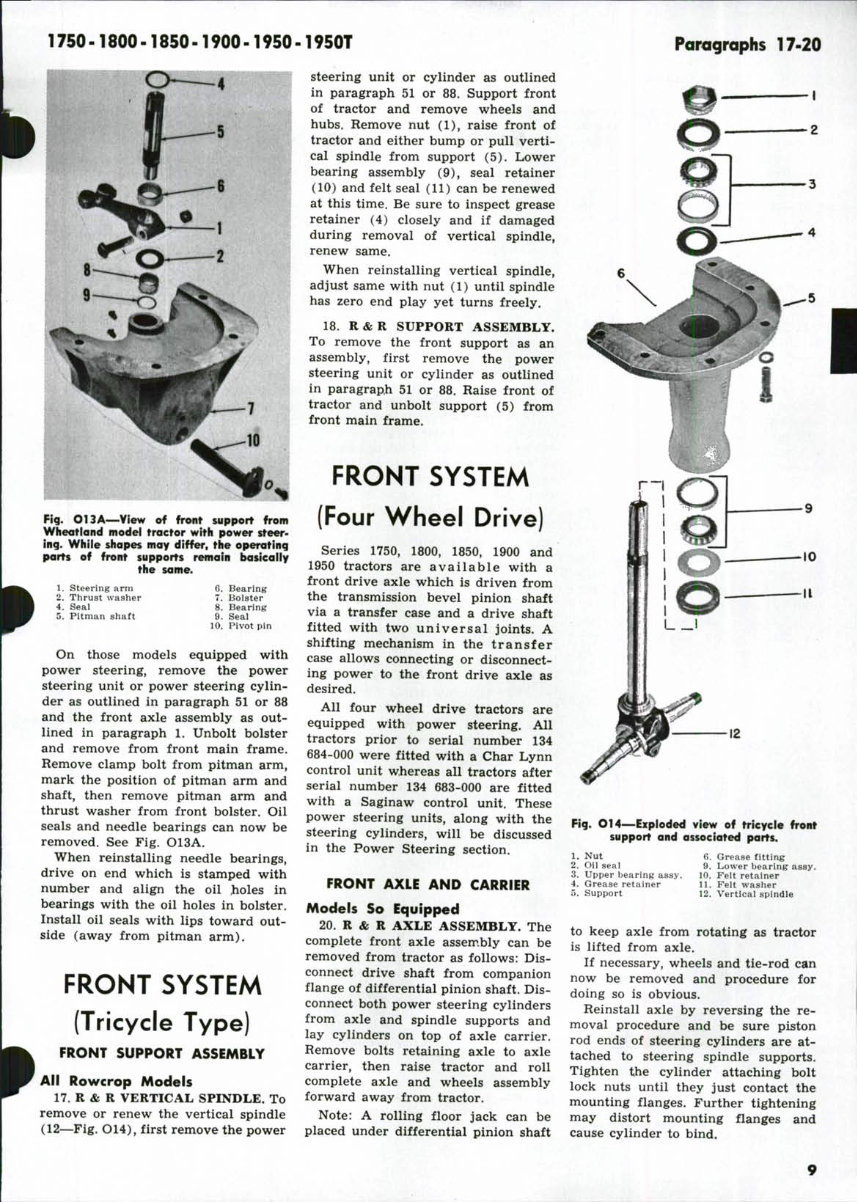
1750-1800-1850-1900-1950-1950T Paragraphs 17-20 Fig. O13A—View of front support from Wheatland model tracror with power steer- ing. While shapes may differ, the operating parts of front supports remain basically the same. 1. 2. 4. 5. Steering arm Thrust washer Seal Pitman shaft 6. 7. 8*. 9. 10. Bearing: Bolster Bearing Seal Pivot pin On those models equipped with power steering, remove the power steering unit or power steering cylin- der as outlined in paragraph 51 or 88 and the front axle assembly as out- lined in paragraph 1. Unbolt bolster and remove from front main frame. Remove clamp bolt from pitman arm, mark the position of pitman arm and shaft, then remove pitman arm and thrust washer from front bolster. Oil seals and needle bearings can now be removed. See Fig. O13A. When reinstalling needle bearings, drive on end which is stamped with number and align the oil .holes in bearings with the oil holes in bolster. Install oil seals with lips toward out- side (away from pitman arm). FRONT SYSTEM (Tricycle Type) FRONT SUPPORT ASSEMBLY All Rowcrop Models 17. R & R VERTICAL SPINDLE. To remove or renew the vertical spindle (12—Fig. O14), first remove the power steering unit or cylinder as outlined in paragraph 51 or 88. Support front of tractor and remove wheels and hubs. Remove nut (1), raise front of tractor and either bump or pull verti- cal spindle from support (5). Lower bearing assembly (9), seal retainer (10) and felt seal (11) can be renewed at this time. Be sure to inspect grease retainer (4) closely and if damaged during removal of vertical spindle, renew same. When reinstalling vertical spindle, adjust same with nut (1) until spindle has zero end play yet turns freely. 18. R&R SUPPORT ASSEMBLY. To remove the front support as an assembly, first remove the power steering unit or cylinder as outlined in paragraph 51 or 88. Raise front of tractor and unbolt support (5) from front main frame. FRONT SYSTEM (Four Wheel Drive) Series 1750, 1800, 1850, 1900 and 1950 tractors are available with a front drive axle which is driven from the transmission bevel pinion shaft via a transfer case and a drive shaft fitted with two universal joints. A shifting mechanism in the transfer case allows connecting or disconnect- ing power to the front drive axle as desired. All four wheel drive tractors are equipped with power steering. All tractors prior to serial number 134 684-000 were fitted with a Char Lynn control unit whereas all tractors after serial number 134 683-000 are fitted with a Saginaw control unit. These power steering units, along with the steering cylinders, will be discussed in the Power Steering section. FRONT AXLE AND CARRIER Models So Equipped 20. R & R AXLE ASSEMBLY. The complete front axle assembly can be removed from tractor as follows: Dis- connect drive shaft from companion flange of differential pinion shaft. Dis- connect both power steering cylinders from axle and spindle supports and lay cylinders on top of axle carrier. Remove bolts retaining axle to axle carrier, then raise tractor and roll complete axle and wheels assembly forward away from tractor. Note: A rolling floor jack can be placed under differential pinion shaft Fig. O14—Exploded view of tricycle front support and associared parts. 1. Nut 2. Oil seal 3. Upper bearing assy. 4. Grease retainer 5. Support 6. Grease fitting 9. Lower bearing assy. 10. Felt retainer 11. Felt washer 12. Vertical spindle to keep axle from rotating as tractor is lifted from axle. If necessary, wheels and tie-rod can now be removed and procedure for doing so is obvious. Reinstall axle by reversing the re- moval procedure and be sure piston rod ends of steering cylinders are at- tached to steering spindle supports. Tighten the cylinder attaching bolt lock nuts until they just contact the mounting flanges. Further tightening may distort mounting flanges and cause cylinder to bind.
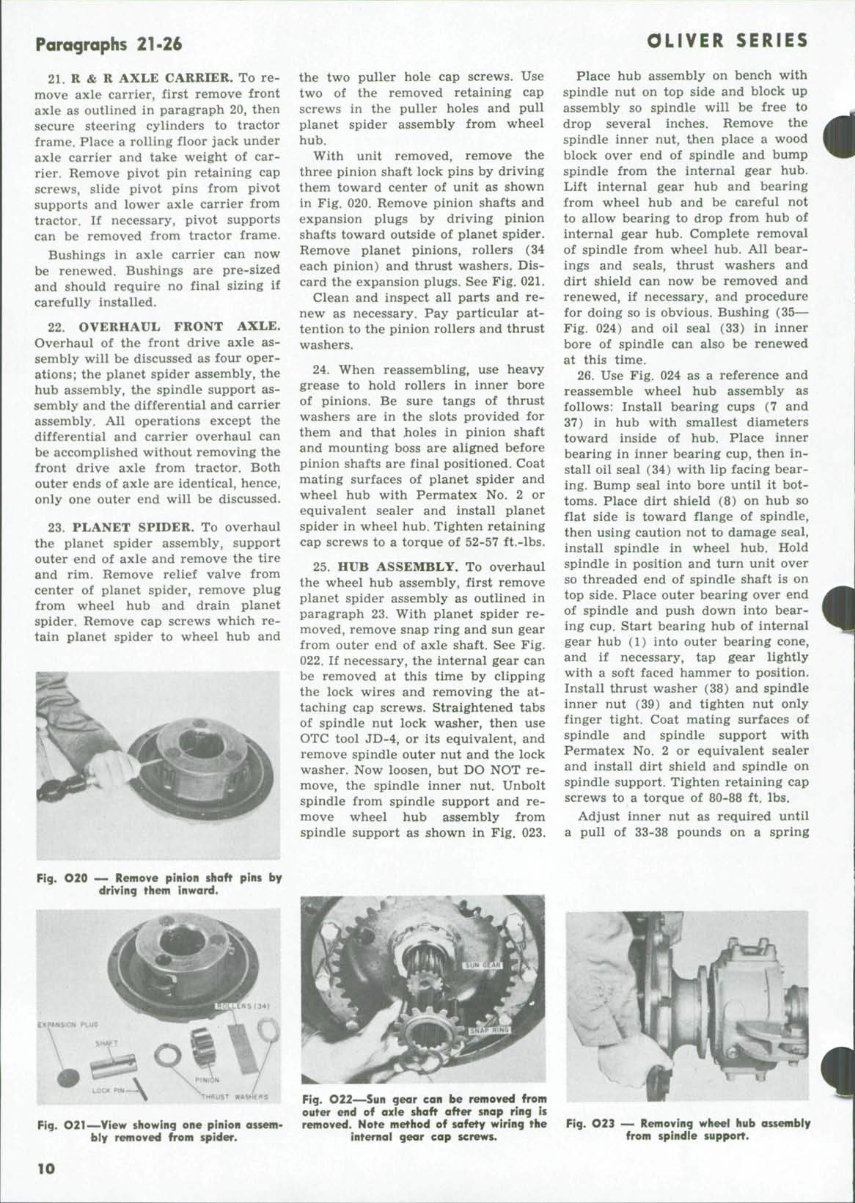
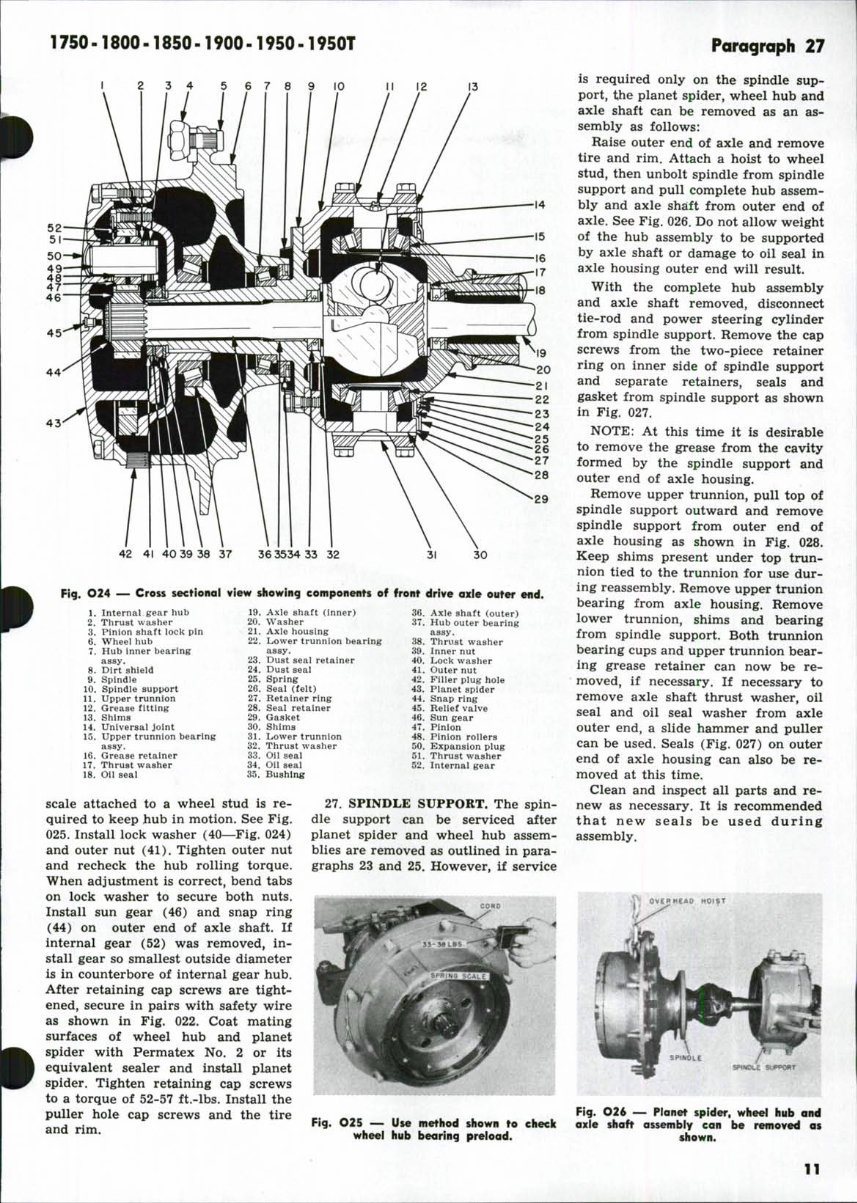
Paragraphs 21-26 OLIVER SERIES 21. R & R AXLE CARRIER. To re- move axle carrier, first remove front axle as outlined in paragraph 20, then secure steering cylinders to tractor frame. Place a rolling floor jack under axle carrier and take weight of car- rier. Remove pivot pin retaining cap screws, slide pivot pins from pivot supports and lower axle carrier from tractor. If necessary, pivot supports can be removed from tractor frame. Bushings in axle carrier can now be renewed. Bushings are pre-sized and should require no final sizing if carefully installed. 22. OVERHAUL FRONT AXLE. Overhaul of the front drive axle as- sembly will be discussed as four oper- ations; the planet spider assembly, the hub assembly, the spindle support as- sembly and the differential and carrier assembly. All operations except the differential and carrier overhaul can be accomplished without removing the front drive axle from tractor. Both outer ends of axle are identical, hence, only one outer end will be discussed. 23. PLANET SPIDER. To overhaul the planet spider assembly, support outer end of axle and remove the tire and rim. Remove relief valve from center of planet spider, remove plug from wheel hub and drain planet spider. Remove cap screws which re- tain planet spider to wheel hub and the two puller hole cap screws. Use two of the removed retaining cap screws in the puller holes and pull planet spider assembly from wheel hub. With unit removed, remove the three pinion shaft lock pins by driving them toward center of unit as shown in Fig. 020. Remove pinion shafts and expansion plugs by driving pinion shafts toward outside of planet spider. Remove planet pinions, rollers (34 each pinion) and thrust washers. Dis- card the expansion plugs. See Fig. 021. Clean and inspect all parts and re- new as necessary. Pay particular at- tention to the pinion rollers and thrust washers. 24. When reassembling, use heavy grease to hold rollers in inner bore of pinions. Be sure tangs of thrust washers are in the slots provided for them and that holes in pinion shaft and mounting boss are aligned before pinion shafts are final positioned. Coat mating surfaces of planet spider and wheel hub with Permatex No. 2 or equivalent sealer and install planet spider in wheel hub. Tighten retaining cap screws to a torque of 52-57 ft.-lbs. 25. HUB ASSEMBLY. To overhaul the wheel hub assembly, first remove planet spider assembly as outlined in paragraph 23. With planet spider re- moved, remove snap ring and sun gear from outer end of axle shaft. See Fig. 022. If necessary, the internal gear can be removed at this time by clipping the lock wires and removing the at- taching cap screws. Straightened tabs of spindle nut lock washer, then use OTC tool JD-4, or its equivalent, and remove spindle outer nut and the lock washer. Now loosen, but DO NOT re- move, the spindle inner nut. Unbolt spindle from spindle support and re- move wheel hub assembly from spindle support as shown in Fig. 023. Place hub assembly on bench with spindle nut on top side and block up assembly so spindle will be free to drop several inches. Remove the spindle inner nut, then place a wood block over end of spindle and bump spindle from the internal gear hub. Lift internal gear hub and bearing from wheel hub and be careful not to allow bearing to drop from hub of internal gear hub. Complete removal of spindle from wheel hub. All bear- ings and seals, thrust washers and dirt shield can now be removed and renewed, if necessary, and procedure for doing so is obvious. Bushing (35— Fig. 024) and oil seal (33) in inner bore of spindle can also be renewed at this time. 26. Use Fig. 024 as a reference and reassemble wheel hub assembly as follows: Install bearing cups (7 and 37) in hub with smallest diameters toward inside of hub. Place inner bearing in inner bearing cup, then in- stall oil seal (34) with lip facing bear- ing. Bump seal into bore until it bot- toms. Place dirt shield (8) on hub so flat side is toward flange of spindle, then using caution not to damage seal, install spindle in wheel hub. Hold spindle in position and turn unit over so threaded end of spindle shaft is on top side. Place outer bearing over end of spindle and push down into bear- ing cup. Start bearing hub of internal gear hub (1) into outer bearing cone, and if necessary, tap gear lightly with a soft faced hammer to position. Install thrust washer (38) and spindle inner nut (39) and tighten nut only finger tight. Coat mating surfaces of spindle and spindle support with Permatex No. 2 or equivalent sealer and install dirt shield and spindle on spindle support. Tighten retaining cap screws to a torque of 80-88 ft. lbs. Adjust inner nut as required until a pull of 33-38 pounds on a spring Fig. O20 — Remove pinion shaft pins by driving them inward. Ftg. O21—View showing one pinion assem- bly removed from spider. Fig. O22—Sun gear can be removed from outer end of axle shaft after snop ring is removed. Note method of safety wiring the internal gear cap screws. Fig. O23 — Removing wheel hub assembly from spindle support. 10
1750-1800-1850-1900-1950-1950T I 2 3 4 5 6 7 8 9 10 Ii 12 14 44 43 42 41 40 39 38 37 36 3534 33 32 30 Fig. O24 — Cross secfionol view showing componenrs of fronr drive axle outer end. 1. Internal gear hub 19. 2. Thrust washer 20. 3. Pinion shaft lock pin 21. 6. Wheel hub 22. 7. Hub inner bearing assy. 23. 8. Dirt shield 24. 9. Spindle 25. 10. Spindle support 26. 11. Upper trunnion 27. 12. Grease fitting 28. 13. Shims 29. 14. Universal joint 30. 15. Upper trunnion bearing 31. assy. 32. 16. Grease retainer 33. 17. Thrust washer 34. 18. Oil seal 35. Axle shaft (inner) 36. Washer 37. Axie housing Lower trunnion bearing 38. assy. 39. Dust seal retainer 40. Dust seal 41. Spring 42. Seal (felt) 43. Retainer ring 44. Seal retainer 45. Gasket 46. Shims 47. Lower trunnion 48. Thrust washer 50. Oil seal 51. Oil seal 52. Bushing Axle shaft (outer) Hub outer bearing assy. Thrust washer Inner nut Lock washer Outer nut Filler plug hole Planet spider Snap ring Relief valve Sun gear Pinion Pinion rollers Expansion plug Thrust washer Internal gear scale attached to a wheel stud is re- quired to keep hub in motion. See Fig. 025. Install lock washer (40—Fig. 024) and outer nut (41). Tighten outer nut and recheck the hub rolling torque. When adjustment is correct, bend tabs on lock washer to secure both nuts. Install sun gear (46) and snap ring (44) on outer end of axle shaft. If internal gear (52) was removed, in- stall gear so smallest outside diameter is in counterbore of internal gear hub. After retaining cap screws are tight- ened, secure in pairs with safety wire as shown in Fig. 022. Coat mating surfaces of wheel hub and planet spider with Permatex No. 2 or its equivalent sealer and install planet spider. Tighten retaining cap screws to a torque of 52-57 ft,-lbs. Install the puller hole cap screws and the tire and rim. 27. SPINDLE SUPPORT. The spin- dle support can be serviced after planet spider and wheel hub assem- blies are removed as outlined in para- graphs 23 and 25. However, if service Paragraph 27 is required only on the spindle sup- port, the planet spider, wheel hub and axle shaft can be removed as an as- sembly as follows: Raise outer end of axle and remove tire and rim. Attach a hoist to wheel stud, then unbolt spindle from spindle support and pull complete hub assem- bly and axle shaft from outer end of axle. See Fig. 026. Do not allow weight of the hub assembly to be supported by axle shaft or damage to oil seal in axle housing outer end will result. With the complete hub assembly and axle shaft removed, disconnect tie-rod and power steering cylinder from spindle support. Remove the cap screws from the two-piece retainer ring on inner side of spindle support and separate retainers, seals and gasket from spindle support as shown in Fig. 027. NOTE: At this time it is desirable to remove the grease from the cavity formed by the spindle support and outer end of axle housing. Remove upper trunnion, pull top of spindle support outward and remove spindle support from outer end of axle housing as shown in Fig. 028. Keep shims present under top trun- nion tied to the trunnion for use dur- ing reassembly. Remove upper trunion bearing from axle housing. Remove lower trunnion, shims and bearing from spindle support. Both trunnion bearing cups and upper trunnion bear- ing grease retainer can now be re- moved, if necessary. If necessary to remove axle shaft thrust washer, oil seal and oil seal washer from axle outer end, a slide hammer and puller can be used. Seals (Fig. 027) on outer end of axle housing can also be re- moved at this time. Clean and inspect all parts and re- new as necessary. It is recommended that new seals be used during assembly. OVE^ Fig. O25 — Use method shown ro eheck wheel hub bearing preload. Fig. O26 — Planet spider, wheel hub and axle shaft assembly can be removed as shown. 11
You're Reading a Preview
What's Included?
Lifetime Access
Fast Download Speeds
Online & Offline Access
Access PDF Contents & Bookmarks
Full Search Facility
Print one or all pages of your manual
$41.99
1750-1950 Oliver & Cockshutt Service & Repair Manual
This manual covers service and repair of Oliver Series 1750, 1800A, 1800B, 1800C, 1850, 1900A, 1900B, 1900C, 1950, and 1950-T Tractors, as well as Cockshutt Series 1750, 1800A, 1800B, 1800C, 1850, 1900A, 1900B, 1900C, 1950, and 1950-T Tractors.
It is suitable for both first-time owners/amateurs and professional technicians. The manual is designed in an easy-to-read format and provides all the necessary information to perform procedures correctly.
Manual Covers:
BELT PULLEY
BRAKES
CARBURETOR
CLUTCH
COOLING SYSTEM
CREEPER DRIVE
DIESEL SYSTEM
DIFFERENTIAL
ELECTRICAL SYSTEM
ENGINE
FINAL DRIVE
FRONT SYSTEM
GOVERNOR
HYDRAULIC POWER
HYDRAULIC SHIFT
LIFT SYSTEM, HYDRAULIC
POWER STEERING
POWER TAKE-OFF
REVERSE-O-TORC
STEERING GEAR, MANUAL
TRANSFER DRIVE
TRANSMISSION
TURBOCHARGER
SERVICE DATA
It is recommended to keep this service manual handy and refer to it regularly. Performing routine preventive maintenance can save time and money by helping to prevent premature failure and unnecessary repairs.
File Format: PDF
Compatibility: All Versions of Windows & Mac
Language: English
Requirements: Adobe Reader
Reviews
Q&A
Recently Viewed
5,521,897Happy Clients
2,594,462eManuals
1,120,453Trusted Sellers
15Years in Business
Price:
Actual Price:
1750-1950 Oliver & Cockshutt Service & Repair Manual



 Lifetime Access




