Part number 47851907 2 nd edition English March 2015 Replaces part number 87010385 SERVICE MANUAL 12HS / 14HS / 16HS / 18HS Sickle Header
Contents INTRODUCTION Hydraulic systems....................................................................... 35 [35.000] Hydraulic systems .................................................................. 35.1 [35.910] Head and header hydraulic drive .................................................. 35.2 Electrical systems ....................................................................... 55 [55.000] Electrical system ................................................................... 55.1 [55.100] Harnesses and connectors ......................................................... 55.2 [55.404] External lighting .................................................................... 55.3 [55.820] Chopping and cutting control systems ............................................. 55.4 Attachments/Headers .................................................................. 58 [58.105] Attachment/Header reel control system ............................................ 58.1 [58.101] Attachment/Header reel ............................................................ 58.2 [58.120] Attachment/Header feed auger .................................................... 58.3 [58.110] Attachment/Header cutting mechanism ............................................ 58.4 Product feeding .......................................................................... 60 [60.220] Pickup .............................................................................. 60.1 [60.620] Roll conditioning.................................................................... 60.2 47851907 11/03/2015
INTRODUCTION 47851907 11/03/2015 1
Contents INTRODUCTION Foreword - Important notice regarding equipment servicing .................................... 3 Safety rules ..................................................................................... 4 Safety rules - Personal safety .................................................................. 5 Safety rules - Ecology and the environment .................................................... 6 Torque – Minimum tightening torques for normal assembly .................................... 7 Torque – Standard torque data for hydraulics ................................................ 12 Basic instructions - Shop and assembly ...................................................... 14 General specification ......................................................................... 16 Consumables ................................................................................. 18 Product identification .......................................................................... 19 Product identification - Machine orientation .................................................. 20 47851907 11/03/2015 2
INTRODUCTION Foreword - Important notice regarding equipment servicing All repair and maintenance work listed in this manual must be carried out only by qualified dealership personnel, strictly complying with the instructions given, and using, whenever possible, the special tools. Anyone who performs repair and maintenance operations without complying with the procedures provided herein shall be responsible for any subsequent damages. The manufacturer and all the organizations of its distribution chain, including - without limitation - national, regional, or local dealers, reject any responsibility for damages caused by parts and/or components not approved by the manu- facturer, including those used for the servicing or repair of the product manufactured or marketed by the manufacturer. In any case, no warranty is given or attributed on the product manufactured or marketed by the manufacturer in case of damages caused by parts and/or components not approved by the manufacturer. The manufacturer reserves the right to make improvements in design and changes in specifications at any time without notice and without incurring any obligation to install them on units previously sold. Specifications, descriptions, and illustrative material herein are as accurate as known at time of publication but are subject to change without notice. In case of questions, refer to your NEW HOLLAND Sales and Service Networks. 47851907 11/03/2015 3
INTRODUCTION Safety rules Personal safety This is the safety alert symbol. It is used to alert you to potential personal injury hazards. Obey all safety messages that follow this symbol to avoid possible death or injury. Throughout this manual you will find the signal words DANGER, WARNING, and CAUTION followed by special in- structions. These precautions are intended for the personal safety of you and those working with you. Read and understand all the safety messages in this manual before you operate or service the machine. DANGER indicates a hazardous situation that, if not avoided, will result in death or serious injury. WARNING indicates a hazardous situation that, if not avoided, could result in death or serious injury. CAUTION indicates a hazardous situation that, if not avoided, could result in minor or moderate injury. FAILURE TO FOLLOW DANGER, WARNING, AND CAUTION MESSAGES COULD RESULT IN DEATH OR SERIOUS INJURY. Machine safety NOTICE: Notice indicates a situation that, if not avoided, could result in machine or property damage. Throughout this manual you will find the signal word Notice followed by special instructions to prevent machine or property damage. The word Notice is used to address practices not related to personal safety. Information NOTE: Note indicates additional information that clarifies steps, procedures, or other information in this manual. Throughout this manual you will find the word Note followed by additional information about a step, procedure, or other information in the manual. The word Note is not intended to address personal safety or property damage. 47851907 11/03/2015 4
INTRODUCTION Safety rules - Personal safety Precautionary statements A careful operator is the best operator. Most accidents can be avoided by observing certain precautions. To help prevent accidents, read the following precautions before operating this equipment. Equipment should be operated only by those who are responsible and instructed to do so. Carefully review the procedures given in this manual with all operators. It is important that all operators be familiar with and follow safety precautions. 1. Always disengage the drive, lock the tractor brakes, and shut off the tractor engine before: • Leaving the seat. • Lubricating. • Cleaning or unplugging any part of the machine. • Adjusting the machine. 2. Always lower the header to the ground or engage the transport stops when parking. 3. Always use the header transport stops and spring-loaded tongue safety lock when transporting the machine. 4. Never work under a raised header unless it is securely locked with the header transport stops 5. Always block the wheels before working on or under the machine. 6. Do not start the machine until you know that everyone is clear of the machine and have made sure no tools are lying on it. 7. Keep all shields in place. Never work around the machine in loose clothing that could catch in a moving part. 8. Do not modify any shields or operate the machine with any shields removed. 9. Always use adequate lights and safety warning devices when transporting the machine on public roads or after dark. Check with your local law enforcement agencies for specific requirements. 10. Long exposure to loud noise can damage your hearing. Wear a suitable hearing protection device such as ear- muffs or ear plugs if you are exposed to uncomfortable noise levels. 11. Be sure no one is standing near or touching the machine before raising or lowering the header. 47851907 11/03/2015 5
INTRODUCTION Safety rules - Ecology and the environment Soil, air, and water quality is important for all industries and life in general. When legislation does not yet rule the treatment of some of the substances that advanced technology requires, sound judgment should govern the use and disposal of products of a chemical and petrochemical nature. Familiarize yourself with the relative legislation applicable to your country, and make sure that you understand this legislation. Where no legislation exists, obtain information from suppliers of oils, filters, batteries, fuels, anti-freeze, cleaning agents, etc., with regard to the effect of these substances on man and nature and how to safely store, use, and dispose of these substances. Helpful hints • Avoid the use of cans or other inappropriate pressurized fuel delivery systems to fill tanks. Such delivery systems may cause considerable spillage. • In general, avoid skin contact with all fuels, oils, acids, solvents, etc. Most of these products contain substances that may be harmful to your health. • Modern oils contain additives. Do not burn contaminated fuels and or waste oils in ordinary heating systems. • Avoid spillage when you drain fluids such as used engine coolant mixtures, engine oil, hydraulic fluid, brake fluid, etc. Do not mix drained brake fluids or fuels with lubricants. Store all drained fluids safely until you can dispose of the fluids in a proper way that complies with all local legislation and available resources. • Do not allow coolant mixtures to get into the soil. Collect and dispose of coolant mixtures properly. • The air-conditioning system contains gases that should not be released into the atmosphere. Consult an air-condi- tioning specialist or use a special extractor to recharge the system properly. • Repair any leaks or defects in the engine cooling system or hydraulic system immediately. • Do not increase the pressure in a pressurized circuit as this may lead to a component failure. • Protect hoses during welding. Penetrating weld splatter may burn a hole or weaken hoses, allowing the loss of oils, coolant, etc. Battery recycling Batteries and electric accumulators contain several substances that can have a harmful effect on the environment if the batteries are not properly recycled after use. Improper disposal of batteries can contaminate the soil, groundwater, and waterways. NEW HOLLAND strongly recommends that you return all used batteries to a NEW HOLLAND dealer, who will dispose of the used batteries or recycle the used batteries properly. In some countries, this is a legal requirement. Mandatory battery recycling NOTE: The following requirements are mandatory in Brazil. Batteries are made of lead plates and a sulfuric acid solution. Because batteries contain heavy metals such as lead, CONAMA Resolution 401/2008 requires you to return all used batteries to the battery dealer when you replace any batteries. Do not dispose of batteries in your household garbage. Points of sale are obliged to: • Accept the return of your used batteries • Store the returned batteries in a suitable location • Send the returned batteries to the battery manufacturer for recycling 47851907 11/03/2015 6
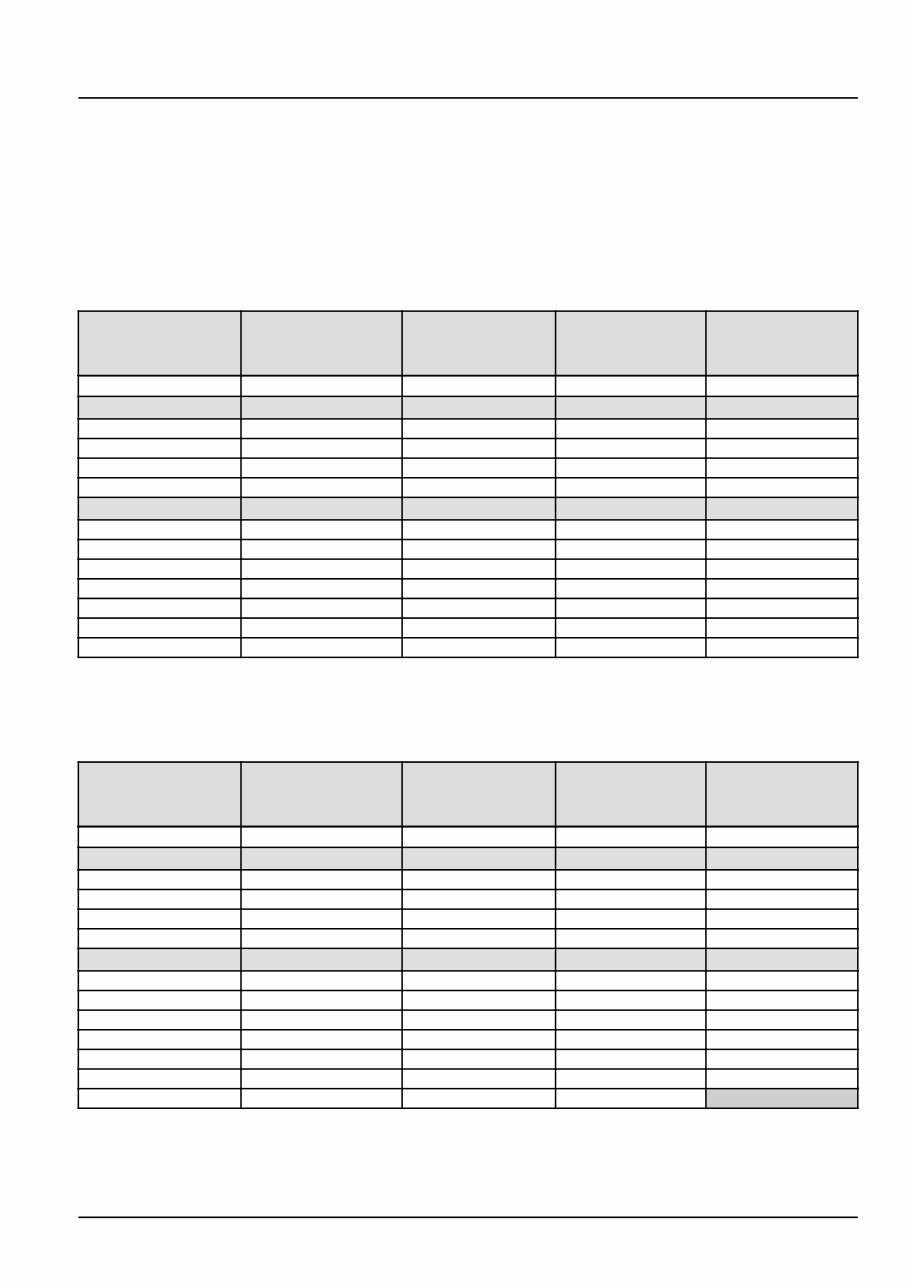
INTRODUCTION Torque – Minimum tightening torques for normal assembly NOTE: In the metric tables, nominal sizes M4 through M8 hardware torque specifications are shown as a Newton meters (pound-inches) numerical value. Nominal sizes M10 through M24 hardware torque specifications are shown as a Newton meters (pound-feet) numer- ical value. Metric non-flanged hardware Plain (PLN) an unplated hardware finish with residual manufacturing oils Zinc-dichromate (ZND) – a yellow colored chemical plating formula yellow applied to the hardware Nominal size Class (CL) 8.8 bolt and Class (CL) 8 nut Class (CL) 10.9 bolt and Class (CL) 10 nut Locknut CL 8 w/CL 8.8 bolt Locknut CL 10 w/CL 10.9 bolt PLN and ZND PLN and ZND ZND ZND N·m (lb in) N·m (lb in) N·m (lb in) N·m (lb in) M4 2.9 (26) 4.2 (37) 2 (18) 2.9 (26) M5 5.9 (52) 8.5 (75) 4 (36) 5.8 (51) M6 10.1 (89) 14.5 (128) 6.8 (60) 10 (89) M8 24.5 (217) 35.1 (311) 17 (151) 24 (212) N·m (lb ft) N·m (lb ft) N·m (lb ft) N·m (lb ft) M10 48.7 (36) 69.5 (90) 33 (25) 48 (35) M12 85 (63) 121 (67) 58 (43) 83 (61) M14 135 (100) 193 (142) 92 (68) 132 (97) M16 210 (155) 301 (222) 143 (106) 205 (151) M18 299 (221) 414 (305) 203 (150) 281 (207) M20 425 (313) 587 (433) 290 (214) 400 (295) M24 735 (542) 1016 (749) 501 (370) 693 (510) Metric flanged hardware Plain (PLN) – an unplated hardware finish with residual manufacturing oils Zinc-dichromate (ZND) – a yellow colored chemical plating formula yellow applied to the hardware Nominal size Class (CL) 8.8 bolt and Class (CL) 8 nut Class (CL) 10.9 bolt and Class (CL) 10 nut Locknut CL 8 w/CL 8.8 bolt Locknut CL 10 w/CL 10.9 bolt PLN and ZND PLN and ZND ZND ZND N·m (lb ft) N·m (lb ft) N·m (lb ft) N·m (lb ft) M4 3.2 (28) 4.6 (41) 2.2 (19) 3.1 (27) M5 6.5 (58) 9.4 (83) 4.4 (39) 6.4 (57) M6 11.1 (98) 15.9 (141) 7.5 (66) 11 (96) M8 27 (239) 39 (345) 18 (163) 27 (240) N·m (lb ft) N·m (lb ft) N·m (lb ft) N·m (lb ft) M10 53.6 (40) 76.5 (56) 37 (27) 53 (39) M12 93 (69) 134 (98) 63 (47) 91 (67) M14 148 (109) 213 (157) 101 (75) 145 (107) M16 231 (171) 331 (244) 158 116) 226 (167) M18 329 (243) 455 (336) 223 (165) 309 (228) M20 467 (345) 645 (476) 318 (235) 440 (325) M24 809 (597) 1118 (824) 552 (407) 47851907 11/03/2015 7
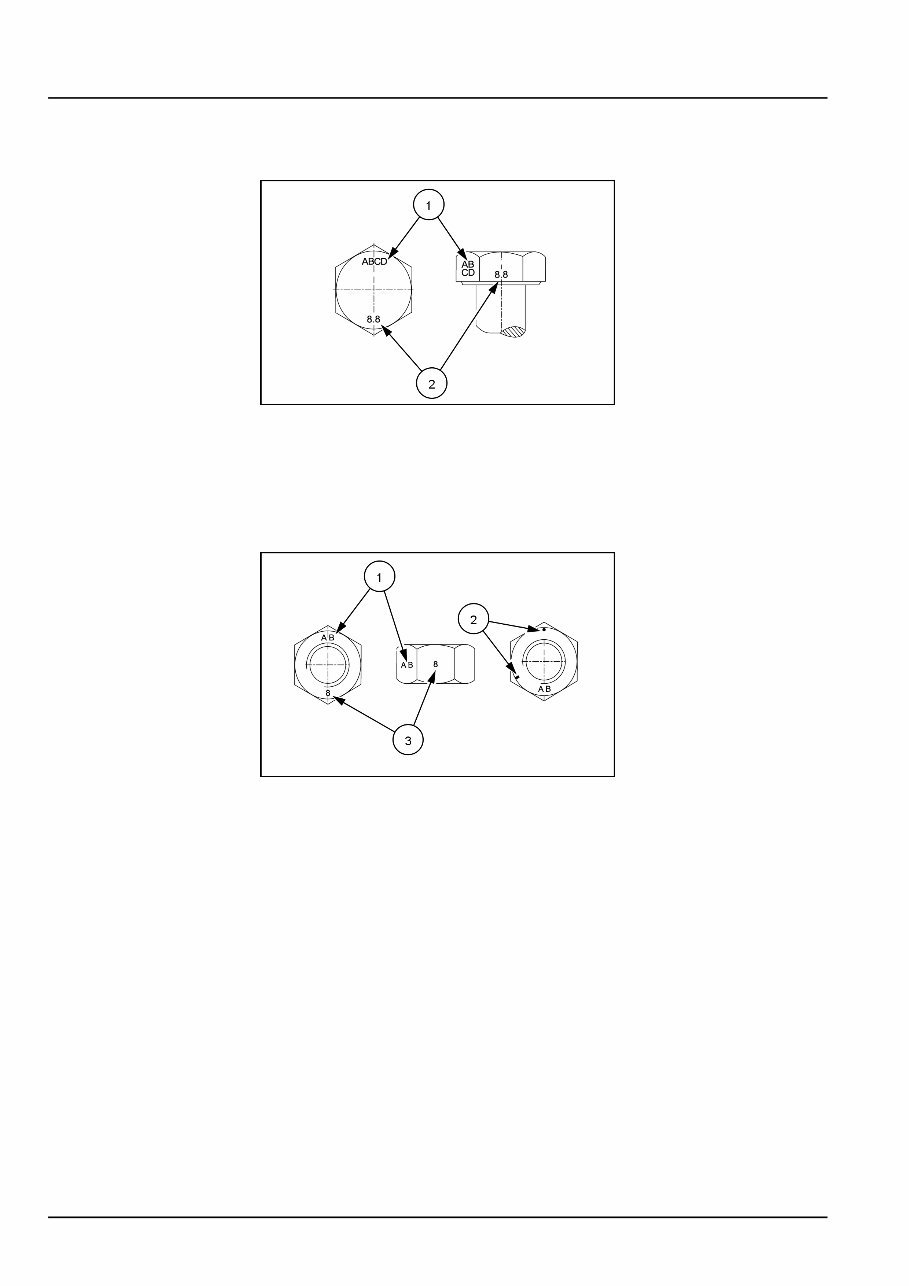
INTRODUCTION Identification markings Metric hex head, flange hex head and carriage bolts, Classes (CL) 5.6 and upward NHIL14RB00662AA 1 Metric bolt identification markings 1. Manufacturer's identification 2. Property class Metric hex nuts and locknuts, Classes (CL) 05 and upward NHIL14RB00663AA 2 Metric hex nut identification markings • (1) – Manufacturer's identification • (3) – Property class • (2) – Clockwise type markings indicate property class and may include manufacturer identification (if applied), Example: property marks 240 ° apart (shown) at the eight o’clock position indicate a Class 8 property, and marks 300 ° apart at the ten o’clock position indicate a Class 10 property. 47851907 11/03/2015 8
The New Holland 12HS, 14HS, 16HS, 18HS Headers Repair Manual is a comprehensive guide designed to assist both professional mechanics and DIY enthusiasts in maintaining their headers. This manual provides detailed step-by-step instructions for the removal, installation, disassembly, and assembly of the 12HS, 14HS, 16HS, and 18HS models, eliminating guesswork and simplifying maintenance.
In addition to the mechanical procedures, the manual includes an electrical wiring diagram and hydraulic schematic, equipping users with the necessary information to address electrical or hydraulic issues effectively.
Furthermore, the manual offers diagnostic tips, specifications, and torque values, empowering users to troubleshoot problems accurately and perform repairs to the manufacturer's standards.
Whether you own a New Holland 12HS, 14HS, 16HS, or 18HS model, this repair manual is an invaluable resource for ensuring the smooth and efficient operation of your headers.











 Lifetime Access




