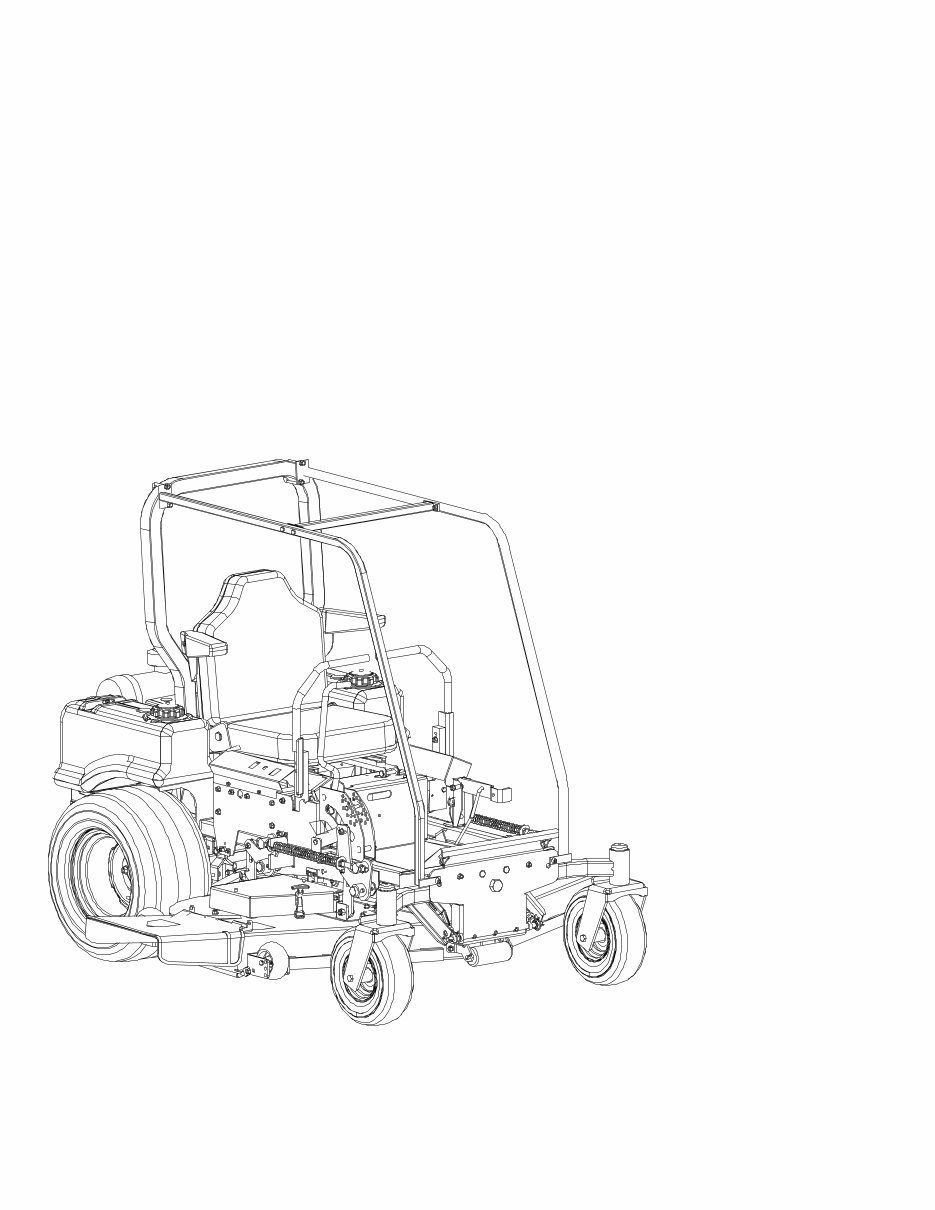
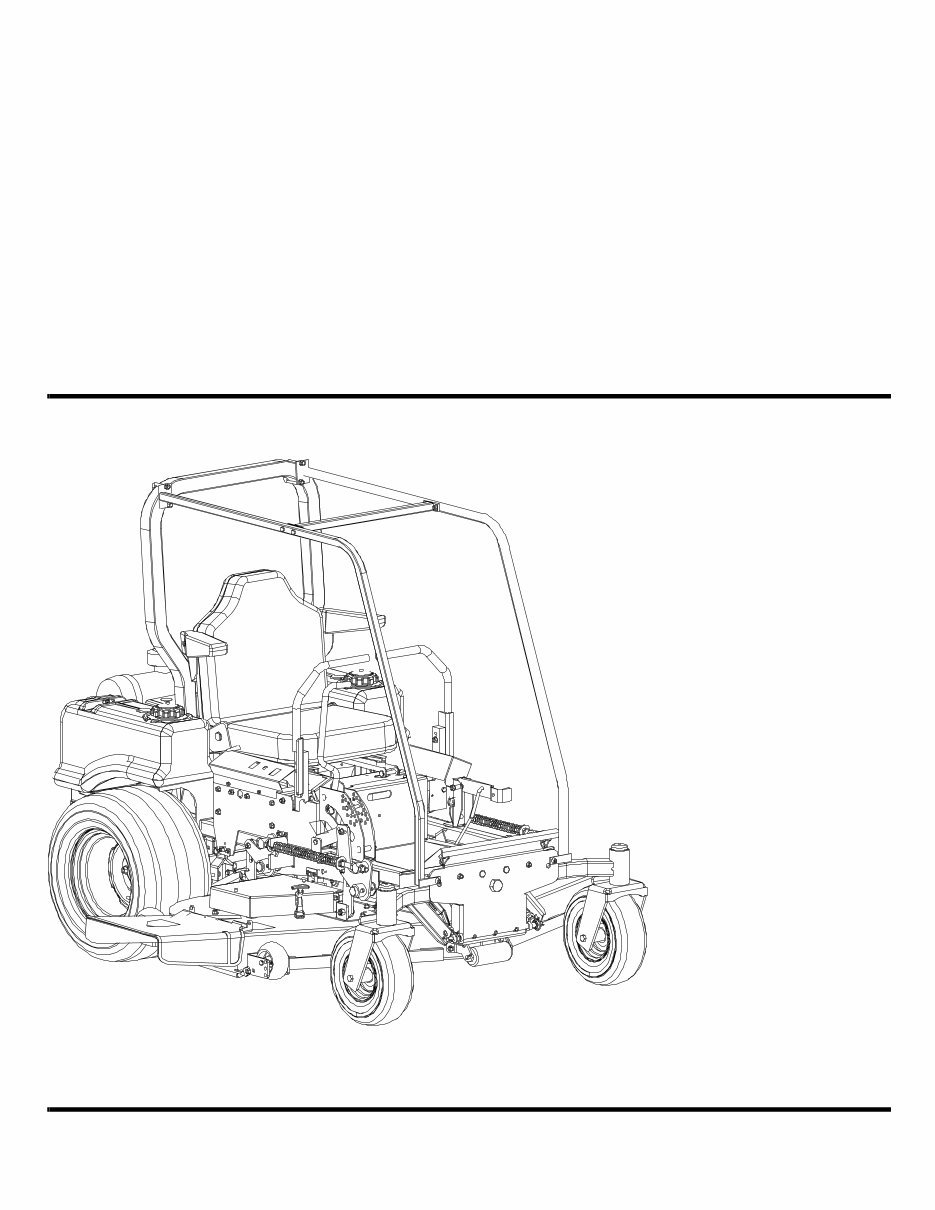
3 FORWARD The Tank Hydrostatic Zero-Turn Commercial Riding Mower provides superb maneuverability, mid-mount cutting capability for professional landscapers, commercial lawn service compa- nies, professional turf managers and golf course superintendents. The machine incorporates many safety features that should be studied by all operators and maintenance personnel before use. The list of safety precautions should receive particular attention. This manual presents all of the operating and maintenance instructions necessary to keep your mower at peak efficiency. If operated and maintained properly, your mower will give dependable service. CAUTION: Only thoroughly trained persons should operate and maintain this mower. This machine can cause serious injury to anyone who mis- uses it and does not understand its operation. For their personal safety, all operators and maintenance personnel are required to read this entire manual before operating the mower. Hazard control and accident prevention are partially dependent upon the design and configuration of the equipment. Notwithstand- ing, these factors are also dependent upon the awareness, concern, prudence and proper training of the personnel involved in the oper- ation, transport, maintenance and storage of the equipment. NOTE: The engine manufacturer is responsible for all engine-related issues with regards to performance, power-rating, specifications, warranty and service. Please refer to the engine manufacturer’s owner’s/operator’s manual, packed seperately with your unit, for more information. WARNING • The engine exhaust, some of its constituents, and certain vehicle components contain or emit chemicals known to the State of California to cause cancer, birth defects or other reproductive harm. • This unit is equipped with an internal combustion engine and should not be used on or near any unim- proved forest-covered, brush-covered, or grass-covered land unless the engine’s exhaust system is equipped with a spark arrester meeting applicable local or state laws (if any). If a spark arrester is used, it should be maintained in effective working order by the operator. • In the State of California, the above is required by law (Section 4442 of the California Public Resources Code). Other States may have similar laws. Federal laws apply to federal lands. A spark arrester muffler may be available. MODELS LISTED IN THIS MANUAL 25HP Tank, 27HP Tank, 53CH5D8X750 53AH5BDX750
4 GENERAL SAFETY OPERATIONS A. DANGER 1. Do not operate machine in confined areas where exhaust gases can accumulate. 2. Do not operate machine without mower chute deflector in place and operational. 3. Do not carry passengers. B. WARNING 1. Do not operate machines under the influence of alcohol or drugs. 2. Do not operate machines without all guards and safety devices in place and functional. 3. Do not start machines if there are fuel or oil leaks or spillage — clean it up. 4. Do not operate machines near spilled or leak- ing fuels. 5. Do not stop or park machine over dry leaves, grass, debris, etc. that could be combustible. 6. Use extreme care when backing up. 7. Do not operate machine on slopes greater than 15 degrees (27%). 8. Do not operate machines on slopes when traction is reduced (wet grass, ice, soft ground, loose ground, leaves, pine needles, debris, etc.). 9. Avoid turning downhill if possible, go slowly and use extra care when turning downhill. 10. Do not operate machines during reduce visi- bility (low light, fog, rain, etc.). 11. Do not operate machines with non-approved attachments. 12. Do not operate machines that are dam- aged.....have machine repaired. 13. Do not operate machines that have not been properly maintained. 14. Use only replacement parts that are the same or equivalent to the original equipment. 15. Do not modify machines or any of their com- ponents, especially the engine governor! 16. Do not operate machine for more than 2 hours without hearing protection. C. CAUTION 1. Use proper protective equipment when oper- ating machine (gloves, boots, and hearing protection are recommended). 2. Read entire machine Operator’s Manual. 3. Make sure operators are fully trained in the safe use of the machine. 4. Follow all safety instructions when using the machine. 5. Keep all safety signs legible and properly installed. 6. Do not check for hydraulic leaks with any part of the body. 7. Do not add fuel to a machine when the engine is running and/or the exhaust system is hot. 8. Keep machine clean and free of debris, grass, leaves, oil, grease, etc. 9. Place lap bars in neutral/start position, set park brake, disengage P.T.O., turn engine off, and remove ignition key before you dismount from machine. 10. Use machines laterally or diagonally across slopes, avoid going downhill when possible. 11. Go slowly and use extra care when descend- ing slopes. 12. Disengage P.T.O. when crossing surfaces such as asphalt, concrete, loose ground, sand, gravel, etc. 13. Use extra care when loading and unloading machines from trucks or trailers. SAFETY PRECAUTIONS A. General 1. Read this Operator’s Manual before starting the mower. Study the controls and learn the proper sequence of operation. 2. Do not allow anyone to operate or maintain this machine who has not read this manual. Never permit children to operate this machine. 3. Never carry passengers. 4. Do not remove any shields, guards or safety devices. If a shield, guard or safety device is damaged or does not function, repair or replace it before operating the mower. 5. Always wear safety glasses and safety shoes when operating or maintaining this mower. Do not wear loose-fitting clothing. 6. Disconnect the spark plug wires and remove the key from the ignition to prevent the engine from accidentally starting before performing any maintenance on this mower. 7. Never run the engine indoors without ade- quate ventilation. Exhaust fumes are deadly. 8. To avoid serious burns, do not touch the engine, exhaust pipe or muffler while the engine is running or until it has cooled after it has been shut off. 9. The liquid in the battery is dilute sulfuric acid. Always wear safety glasses and rubber gloves when working on the battery. Do not overfill the battery. 10. Lead-acid batteries generate hydrogen and oxygen gases which form an explosive mix- ture. Keep sparks and flames away at all times.
5 11. When looking for oil leaks, never run your hand over hydraulic hoses, lines or fittings. Never tighten or adjust hydraulic hoses, lines or fittings while the system is under pressure. If high-pressure oil penetrates the skin, the oil must be removed within a few hours by a doc- tor familiar with this form of injury or serious complications may result. B. Related to Fuel 1. Fuel is highly flammable and its vapors can explode if ignited. Please respect it. 2. Do not smoke or permit others to smoke while handling fuel. 3. Always use approved containers for fuel and fill slowly to decrease the chance of static electricity buildup and spillage. 4. Store fuel in well ventilated and unoccupied buildings away from sparks and flames. 5. When dispensing gasoline into approved con- tainers, place the container on the ground when refueling to avoid a possible static elec- tricity ignition of fuel vapors. 6. Do not fill containers while it is inside a vehi- cle, trunk, the bed of a pickup or floor of a trailer. 7. Always shut off the engine and permit it to cool before removing the fuel tank cap. 8. Always fill the fuel tank outdoors. 9. If the fuel container spout will not fit inside the fuel tank opening, use a funnel. 10. When filling the fuel tank, stop when the fuel reaches one inch from the top. This space is necessary for tank expansion. Do not overfill. 11. Wipe up any spilled fuel. C. Related to Batteries Batteries are stored electrical energy devices that may be serviceable with removable caps (the electro- lyte levels can be checked), or may be non-service- able (no attempt should be made to open the vents). Batteries may contain lead (Pb) and sulfuric acid, and they must be re-cycled and not disposed of nor abandoned. Sulfuric acid can cause severe burns, and in the event of contact, the areas should be flushed with water and a physician contacted. Bat- tery cases should not be punctured. Lead is poison- ous and is contained within the positive and negative terminals as well as within the battery’s internal grid- work of plates and active materials. Explosive gases are generated when batteries are re-charged, so sparks, flames and heat sources should be avoided. Loose connections at the battery terminals can produce sprks and heat...connections to the terminals must be kept tight, and the terminals and battery surfaces kept clean of acids and corro- sion. If batteries are re-charged or “jumped” from external sources, make sure that the connections are made properly and in the correct sequence...connect to the positive terminal of the good battery first, then connect that to the positive terminal of the weak bat- tery. The third connection should be to the negative terminal of the good battery, followed by the negative terminal of the weak battery. If sparks are observed or heating of the wiring or connectors is detected, disconnect in reverse order (I.E., the negative termi- nal of the weak battery first). Batteries should be re- charged at a constant voltage...generally 14.5 +/- 0.5 volts DC for a nominal 12 volt DC battery. D. When Mowing 1. Keep adults, children and pets away from the area to be mowed. 2. When operating this mower in the forward direction, DO NOT allow the steering levers to return to the neutral position on their own. Always maintain a firm grip on the levers, operate them smoothly and avoid any sudden movements of the levers when starting or stopping. 3. If the mower is equipped for side discharge, never use the mower without the discharge chute installed and placed in the down position. 4. Always remove debris and other objects from the area to be mowed.(Note: debris and loose grass will reduce traction.) 5. Mow only in daylight. 6. Watch for holes, sprinkler heads and other hidden hazards. 7. Avoid driving too close to trees, creeks, ditches, sand traps and other obstacles. 8. Before backing up, check behind you and watch where you’re going. 9. Always reduce speed when making a turn, and when grass is wet. 10. Always mow across slopes, never up and down the slope. Do not operate on steep slopes and slow down before turning. 11. Be careful when crossing gravel paths or roadways. Always turn off the blade clutch switch and wait until the blades stop rotating and raise the cutting deck to the transport position. Always allow other vehicles to have the right-of-way. 12. If you hit a solid object while mowing, turn off the blade clutch switch, place the left and right steering levers in the neutral, opened-out position, move the throttle to slow, set the parking brake, shut off the engine and take the key from the ignition switch. Inspect for damage. Repair any damage. Make sure the blades are in good condition and that the
6 blade bolts are tight before restarting the engine. 13. Never leave the mower unattended without: turning off the blade clutch switch; placing the left and right steering levers in the neutral opened-out position; moving the throttle to slow; setting the parking brake; shutting off the engine and taking the key from the ignition switch. 14. Never walk or stand on the discharge side of a mower with the engine running. Turn off the blade clutch switch if another person approaches while you are operating the mower. 15. Never attempt to operate the traction unit without the mowing deck attached. 16. Keep the mower and especially the engine and hydraulic components clean and free of grease, grass and leaves to reduce the chance of fire and to permit proper cooling. E. Operator Protection System 1. This machine is equipped with a Roll Over Protective Structure (ROPS) and seat belt. 2. The ROPS and seat belt are integral parts of this machine and should not be tampered with, modified in any manner, or removed. 3. The seat belt must be fastened securely at all times when an operator is on the machine. 4. The ROPS extends above and behind the operator position, and therefore the operator must be aware of potential contact of the ROPS with items such as trees, buildings, doorways, clothes lines, utility wires, etc., that could cause the machine to upset or roll- over ....use caution in (or avoid) areas where the ROPS could come in contact with any structures, trees, etc. 5. The ROPS and seat belt add additional mass that elevates the machine’s Center of Gravity (C.G.) which negatively affects the machine’s stability and traction....use extra caution when operating on slopes. 6. Inspect the ROPS and seat belt assemblies on a regular basis for damage and improper operation....replace all components that are damaged or are not functioning properly with authorized replacement parts. 7. Failure to use the seatbelt properly could result in serious injury or death if an acciden- tal overturn occurs. In order for the ROPS to be effective, the seat belt must be securely fastened around the operator at all times when the operator is on the machine. Contact with the ROPS during an overturn could cause serious injury or death. 8. The ROPS will not prevent the machine from upsets or roll overs. 9. Only approved attachments should be used on this machine.
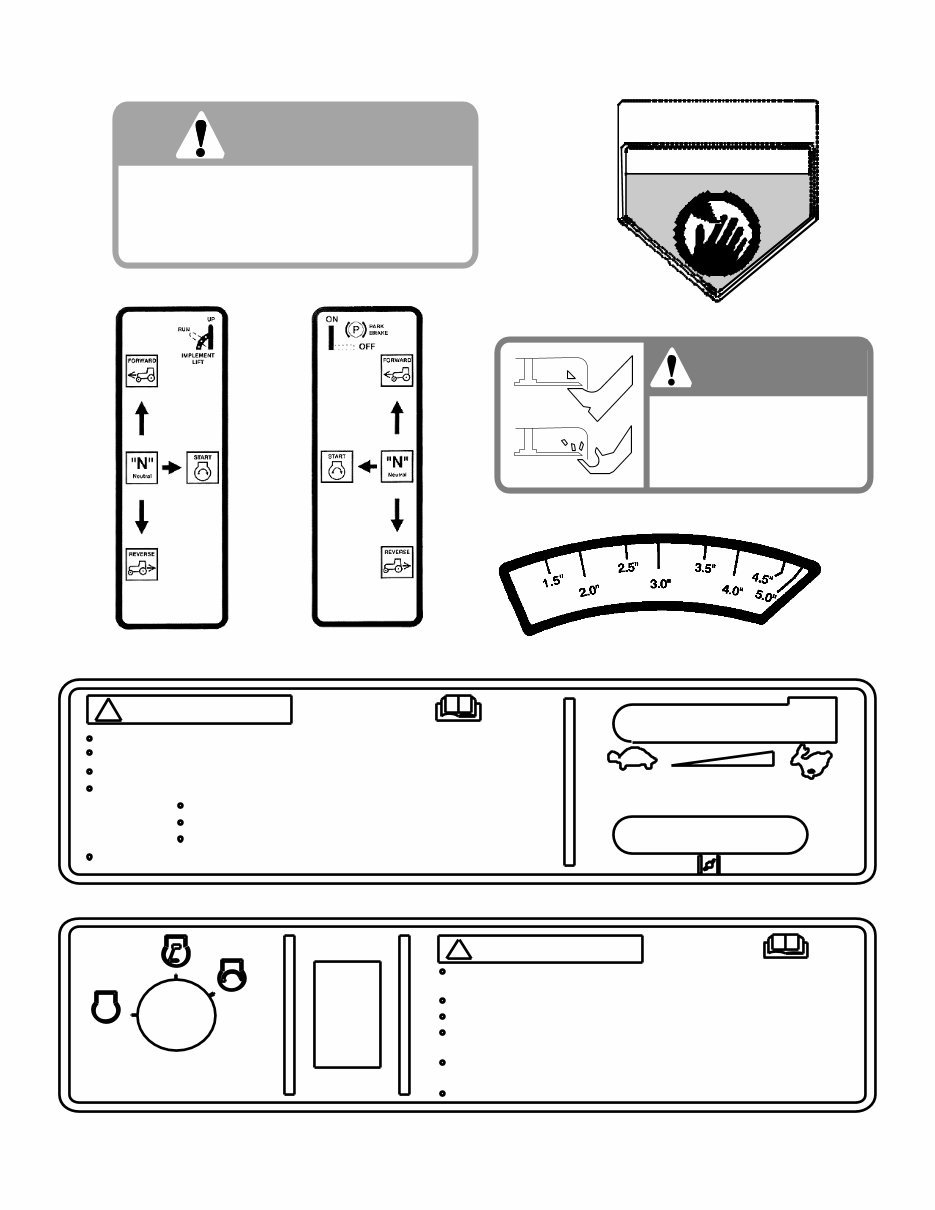
7 SAFETY DECALS AND LABELS KEEP HANDS and FEET AWAY DANGER TO REDUCE THE RISK OF INJURY, DO NOT OPERATE MOWER UNLESS DISCHARGECHUTECOVERORGRASS CATCHER IS IN ITS PROPER PLACE. WARNING SHIELD MISSING DO NOT OPERATE Do not put hands or feet under or into mower when engine is running. ROTATING BLADE DANGER ! WARNING Engage parking brake when leaving the machine. Do not add fuel while the engine is hot or running. Stop engine, disconnect spark plug before adjusting or servicing. Before leaving operator's position: Disengage implement drive. Place speed controls in neutral and set park brake. Wait for all movement to stop. Do not allow operation by untrained personnel. OFF ON ! WARNING Serious bodily injury may result from failure to follow safe operating procedures. Read the Operator's Manual before operating this machine. Clear area of debris and other objects before mowing. Do not operate the machine when children and others are around. Do not operate machine without guards, shields and safety devices in place and working. Slow down and use caution on slopes. Part Number: 00030635 Part Number: 00030633 Part Number: 01003859 Part Number: 01003452 Part Number: 01003451 Part Number: 02000162 Part Number: 02000163 Part Number: 01002166
8 SPECIFICATIONS GENERAL INFO. Controls: Engine ignition and start switch; throttle; choke; left and right steering levers; electric blade clutch switch; parking brake; mower deck lift Parking Brake: Mechanical linkage brake handle to internal drum brakes Seat: Adjustable seat and armrests. 5" Adjustment (fore-aft) Frame: 2" Steel structural tube and plate, all welded construction Instrumentation: Hour meter, Tachometer, Maintenance-minder Front Caster Wheels: 13 x 6.50 x 6 Drive Wheels: 24x12 - 12 Tire Pressure: 8-10 psi Rear, 20-25 psi front caster Fuel Tank: Two 6.5 gallon w/individual shutoff valves Ground Speed: 0-12 + MPH forward. 0-5 MPH reverse Net Weight: 1090 lbs. w/60" deck ENGINE INFO. Engine: 25HP Kawasaki, & 27HP Kohler Type: Vertical crankshaft air cooled V-Twin Air Cleaner: Dual Paper Element with rain cap Lube System: Pressurized with oil filter Hydraulic System: In tank filter, 3 quart capacity Starter: 12-volt electric Blade Brake Clutch: Electric TRACTION DRIVE INFO. Traction Drive: Engine to two variable-output hydraulic pumps each connected to individual wheel motors CUTTER DECK INFO. Cutter Deck;Drive: 60" Belt Driven Deck Lift: Hand lever w/pin lock for height adjustment Cutting Height: 1-1/2" to 5" in 1/4” increments No. of Blades 3, belt-driven, power take-off from engine
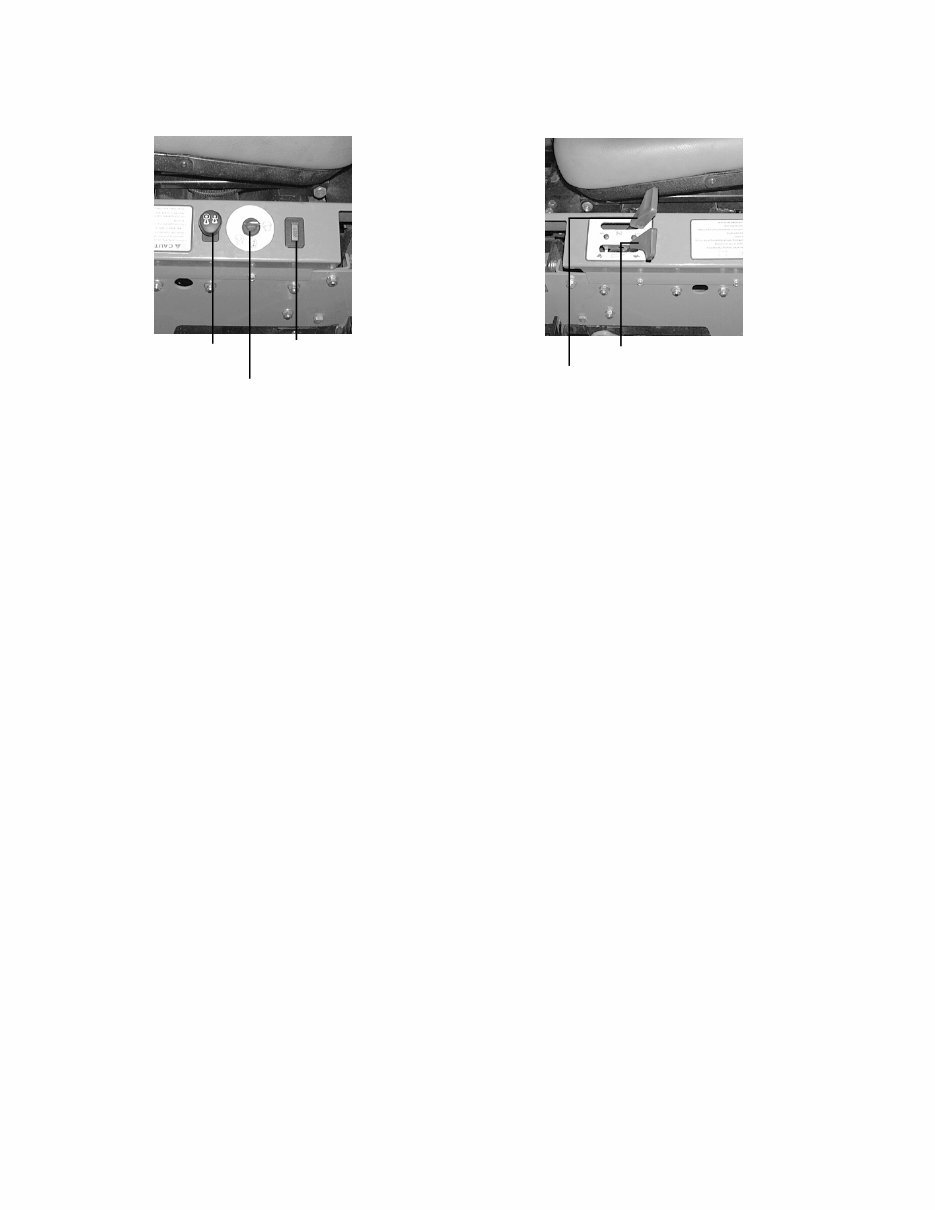
9 OPERATING INSTRUCTIONS A.General 1. When Mowing: a. Keep adults, children, and pets away from the area to be mowed. b. When operating this mower, in the forward direction, do not allow the steering levers to return to Neutral on their own. Always maintain a firm grip on the levers, operate them smoothly and avoid any sudden movements of the levers when starting and stopping. c. If the mower is equipped for side dis- charge, never use the mower without the discharge chute installed and placed in the down position. d. Always remove debris and other objects from the area to be mowed (Note: debris and loose grass will reduce traction). e. Mow only in daylight. f. Watch for holes, sprinkler heads, and other hidden hazards. g. Avoid driving too close to trees, creeks, ditches, sand traps, and other obstacles. h. Before backing up, check behind and watch where you are going. i. Always reduce speed when making a turn, and when grass is wet. j. Always mow across slopes, never up and down the slope. Do not operate on steep slopes and slow down before turning. Avoid turning downhill if possible, start at the bottom and work up to the top. Use extra care and go slowly when turning downhill. Control the speed and direction of the zero turn machine “primarily” with the speed/directional control (lap bar) of the downhill side of the machine...I.E., maintain the uphill side lap bar “essen- tially” in a fixed position. k. Be careful when crossing gravel paths or roadways. Always turn off the blade clutch switch and wait until the blades stop rotat- ing and raise the cutting deck to the trans- port position. Always allow other vehicles to have the right of way. l. If you hit a solid object while mowing, turn off the blade clutch switch, place the steer- ing levers in the neutral, opened-out posi- tion, move the throttle to slow, set the parking brake, shut off the engine, and take the key from the ignition switch. Inspect for damage. Repair the damage. Make sure the blades are in good condition and that the blade bolts are tight before restarting the engine. m. Never leave the mower unattended without observing the following: turn off the blade clutch switch, placing the steering levers in the neutral open-out position, moving the throttle to slow, setting the parking brake, shutting off the engine and taking the key from the ignition switch. n. Never walk or stand on the discharge side of the mower when the engine is running. Turn off the blade clutch switch if another person approaches while you are operat- ing the mower. o. Never attempt to operate the traction unit without having the mowing deck attached. p. Keep the mower and especially the engine and hydraulic components clean and free of grease, grass, and leaves to reduce the chance of fire and permit proper cooling. 2. Safety Awareness when Mowing a. Do not operate on steep slopes, those above 15 degrees (27% slope). Figure. 1 Figure. 2 Ignition Switch Electric Blade Clutch Switch Tach and Hour Meter Engine throttle Choke Lever
Cub Cadet 25HP (53CH5D8X750) and 27HP (53AH5BDX750) Zero Turn Lawnmower are reliable machines suitable for maintenance and repair at home. These lawnmowers are ideal for both professional mechanics and DIY enthusiasts due to their simple construction and ease of repair.
Regular lawnmower maintenance is essential for prolonged and reliable use. This includes changing the oil, inspecting the muffler, springs, and linkages, replacing spark plugs, and fuel and air filters. A quality service manual specific to your lawnmower is invaluable for identifying parts and assisting with routine maintenance.
Performing routine maintenance at home offers several benefits, including cost-effectiveness, prolonged lawnmower life, and a better understanding of the motor's components. Even with diligent maintenance, periodic repairs may be necessary. Having access to service manuals and parts catalogues makes lawnmower repair easier, especially if you have been conducting your own routine maintenance.
The included manual, available in .PDF format, consists of 30 pages, allowing you to print only the necessary sections. It covers safety precautions, specifications, operating instructions, maintenance and servicing, maintenance schedule, performance adjustments, and a wiring diagram.









 Lifetime Access




