Freightliner Business Class Trucks FL50, FL60, FL70, FL80, FL106, FL112, MB50, MB60, MB70, MB80 Complete Workshop Service Repair
What's Included?
Lifetime Access
Fast Download Speeds
Online & Offline Access
Access PDF Contents & Bookmarks
Full Search Facility
Print one or all pages of your manual
BUSINESS CLASS TRUCKS SERVICE MANUAL Models: FL50 FL60 FL70 FL80 FL106 FL112 MB50 MB60 MB70 MB80 STI-267, S34 (1/08P) Published by Daimler Trucks North America LLC 4747 N. Channel Ave. Portland, OR 97217 Printed in U.S.A.
Daimler Trucks North America LLC distributes the following major service publications. Workshop/Service Manual Workshop/service manuals contain service and repair information for all vehicle systems and components, except for major components such as engines, trans- missions, and rear axles. Each workshop/service manual section is divided into subjects that can include general information, principles of operation, removal, disassembly, assembly, installation, specifications, and troubleshooting. Maintenance Manual Maintenance manuals contain routine maintenance procedures and intervals for vehicle components and systems. They have information such as lubrication procedures and tables, fluid replacement procedures, fluid capacities, specifica- tions, procedures for adjustments and for checking the tightness of fasteners. Maintenance manuals do not contain detailed repair or service information. Driver’s/Operator’s Manual Driver’s/operator’s manuals contain information needed to enhance the driver’s understanding of how to operate and care for the vehicle and its components. Each manual contains a chapter that covers pretrip inspection and daily mainte- nance of vehicle components. Driver’s/operator’s manuals do not contain de- tailed repair or service information. Parts Technical Manual Daimler Trucks North America LLC publishes this manual to aid in the identifica- tion of serviceable replacement vehicle parts. This manual is used in conjunc- tion with the parts book and the service parts catalog microfiche. Service Bulletins Service bulletins provide the latest service tips, field repairs, product improve- ments, and related information. Some service bulletins are updates to informa- tion in the workshop/service manual. These bulletins take precedence over workshop/service manual information, until the latter is updated; at that time, the bulletin is usually canceled. The service bulletins manual is available only to dealers. When doing service work on a vehicle system or part, check for a valid service bulletin for the latest information on the subject. IMPORTANT: Before using a particular service bulletin, check the current service bulletin validity list to be sure the bulletin is valid. Recall Bulletins These bulletins pertain to special situations that involve service work or replace- ment of parts in connection with a recall notice. Recall bulletins pertain to mat- ters of vehicle safety. All bulletins are distributed to dealers; customers receive notices that apply to their vehicles. Field Service Modifications This publication is concerned with non-safety-related service work or replace- ment of parts. All field service modifications are distributed to dealers; custom- ers receive notices that apply to their vehicles. Introduction Descriptions of Service Publications Business Class Trucks Service Manual, Supplement 35, September 2008 I–1
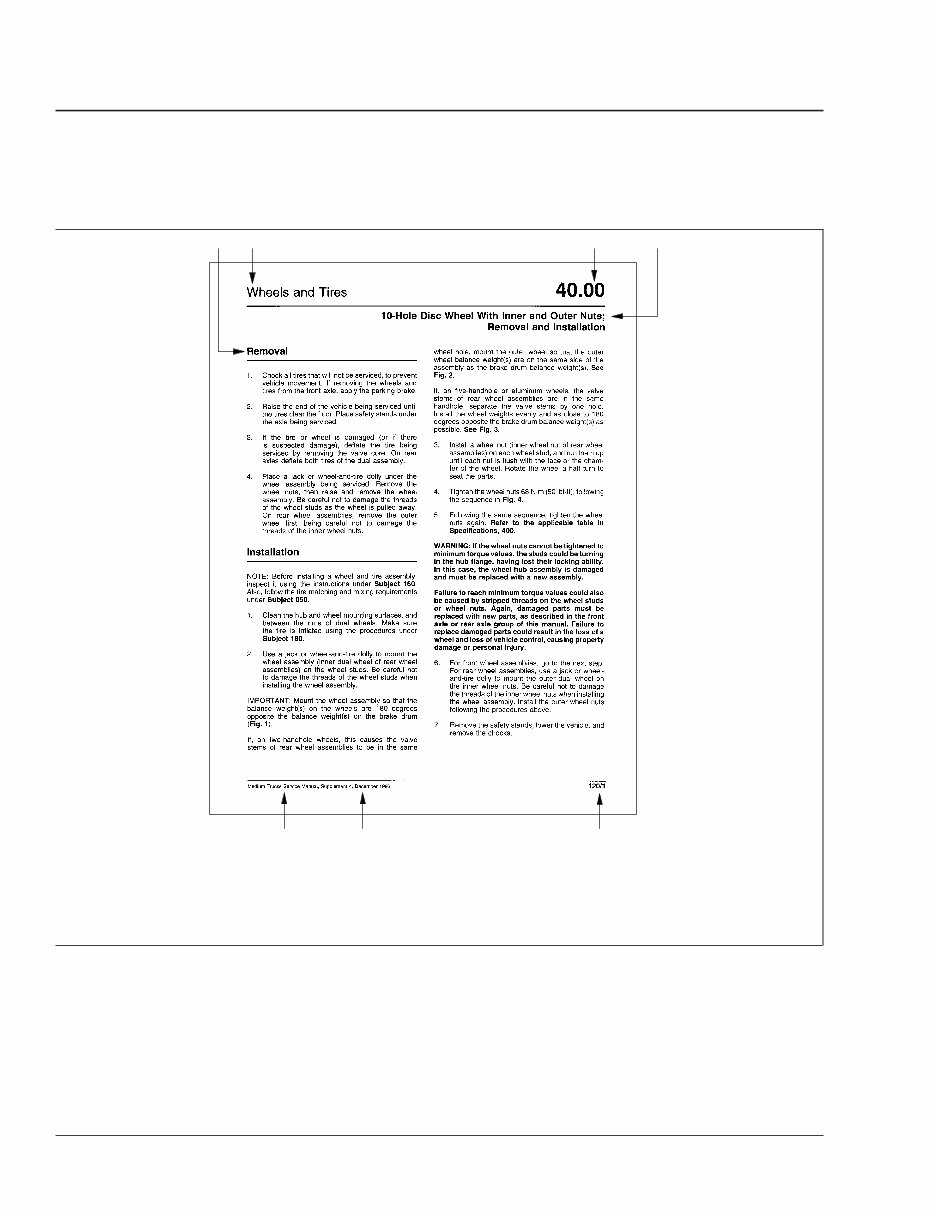
For a page example of the printed manual, see Fig. 1. A B C F G D E f020023 06/13/94 A. Subject Topic B. Section Title C. Section Number; made up of the Group Number (first two digits) followed by a sequence number (last two digits) D. Subject Title E. Manual Title F. Supplement Number and Release (Supplement) Date G. Subject Number/Subject Page Number Fig. 1, Page Example of the Printed Manual Introduction Page Description I–2 Business Class Trucks Service Manual, Supplement 35, September 2008
Group No. Group Title 00 ...................... General Information 01 ................................ Engine 09 .............................. Air Intake 13 ......................... Air Compressor 15 ................... Alternators and Starters 20 ................... Engine Cooling/Radiator 25 ................................ Clutch 26 ........................... Transmission 30 ......................... Throttle Control 31 ............. Frame and Frame Components 32 ............................ Suspension 33 ............................. Front Axle 35 ............................. Rear Axle 40 ........................ Wheels and Tires 41 .............................. Driveline 42 ................................ Brakes 46 ............................... Steering 47 ................................. Fuel 49 ............................... Exhaust 54 .......... Electrical, Instruments, and Controls 60 .................................. Cab 72 ................................ Doors 82 ............. Windshield Wipers and Washer 83 ................. Heater and Air Conditioner 88 .............. Hood, Grille, and Cab Fenders 90 ................. Fire Suppression Systems 91 ............... Seats and Restraint Systems 98 ................................. Paint Introduction Service Manual Contents Business Class Trucks Service Manual, Supplement 35, September 2008 I–3
Vehicle Receipt Prior to signing for vehicle delivery from a transporter company, the dealer is responsible for checking for transporter-related shortages or damages, and noting these discrepancies on the transporter’s delivery re- ceipt. The dealer is also responsible for ensuring that the vehicle was built according to the Truck Sales Order/ Invoice. Refer to Section 3 of the Freightliner LLC Warranty Manual for details. Vehicle Storage There may be times when a vehicle is stored for long periods before customer delivery. To protect all ve- hicles from deterioration and weather, they must be properly maintained. Adequate protection and stor- age of new vehicles is the responsibility of the dealer. Claims arising from loss and damage to improp- erly stored vehicles will not be reimbursed. See Section 3 of the Freightliner LLC Warranty Manual for instructions on storage of new vehicles. Pre-Delivery Information All pre-delivery inspections and services must be performed at an authorized Freightliner LLC facility, assigned to fully qualified service personnel and re- corded on the "New Vehicle Pre-Delivery Inspection" form. Refer to Section 3 of the Freightliner LLC Warranty Manual for details. It is recommended the pre-delivery inspection be per- formed within 30 days of vehicle receipt. Vehicle Receipt, Storage, and Pre-Delivery Information 00.01 General Information Business Class Trucks Service Manual, Supplement 29, October 2002 050/1
Cooling System 1. Cooling system hoses must clear all moving parts by a minimum of 1/4 inch (6 mm). 2. The 1-inch (25-mm) hose from the surge tank to the engine must be free of sumps and have al- lowance for engine torque. 3. Cooling system hoses should not be twisted or kinked. 4. Cooling system hoses must be routed at least six inches (152 mm) from a heat source if the heat source does not have a heat shield. If a heat shield is provided, the hose must be routed at least three inches (76 mm) from the heat source. HVAC System 1. Cushion clamps are required to support all A/C lines. Butterfly or figure-8 clamps (two cushion clamps) may be used to prevent rubbing or chaf- ing. 2. Tie straps may only be used to fasten together A/C lines that are parallel to each other. 3. Heater hoses that are protected with convoluted tubing may be fastened with tie straps. Other- wise, only cushion clamps or butterfly clamps may be used for heater hoses. 4. A/C lines cannot be secured to air lines, fuel lines, or electrical wires. 5. HVAC hoses should be protected from damage by routing them away from hazards of heat, wheel splash (water, gravel, ice), human traffic, and moving parts of the vehicle. 6. HVAC hoses should be routed away from sharp points and edges (such as nuts, bolts, brackets, and frame rail edges), moveable parts, and sources of abrasion, cutting, pinching, or crush- ing. NOTE: If hoses are covered with convoluted tubing, they may touch any of the above. 7. Hoses that are protected with convoluted tubing may come in contact with the bends on frame rails and filters. 8. HVAC hoses must be routed at least six inches (152 mm) from a heat source if the heat source does not have a heat shield. If a heat shield is provided, the hose must be routed at least three inches (76 mm) from the heat source. 9. HVAC hoses should be clamped every 12 to 18 inches (305 to 457 mm). 10. All HVAC hoses must be routed so that regularly serviced components, such as fuel filters, fuel/ water separators, oil filters, air filters, belts, and fill and drain plugs, are readily accessible for ad- justment or replacement without the need to relo- cate or remove the hoses. Engine Plumbing The engine oil pressure line should not rub or chafe against the Teflon ® discharge line. Electrical Wiring 1. Wires that are bundled together should be fas- tened at 8- to 12-inch (203- to 305-mm) intervals. If anchor clamps are more than 12 inches (305 mm) apart, a tie strap must be used between the anchor clamps. 2. Bundles of wires that are located in an exposed area, such as under the cab or outside the frame rail, need to be fastened with heavy-duty cable ties. 3. Any wiring that will be exposed to water or heat must be covered with either loom or convoluted tubing. Loom or convoluted tubing need not butt up against Weather Pack ® connectors. 4. Any wiring routed across the vehicle, on the en- gine crossmember, or across the rear of the en- gine, must be secured with a clamp or tie strap, and covered with either convoluted tubing or a loom. 5. Any wiring that may come into contact with sharp points and edges (such as nuts, bolts, brackets, and frame rail edges), moveable parts, and sources of abrasion, cutting, pinching, or crush- ing, must be protected by either a loom or con- voluted tubing. 6. Unprotected breakouts (individual wires) of up to eight inches (203 mm) are acceptable as long as these wires are routed safely away from sharp Vehicle Receipt, Storage, and Pre-Delivery Information 00.01 Hoses and Electrical Wiring Routing Standards Business Class Trucks Service Manual, Supplement 29, October 2002 100/1
points and edges, moveable parts, and sources of abrasion, cutting, pinching, or crushing. 7. Gray, flame-retardant convoluted tubing may be used to protect wiring in the cab or the chassis. Black nylon convoluted tubing may only be used in the chassis. 8. All wiring must be routed so that regularly ser- viced components, such as fuel filters, fuel/water separators, oil filters, air filters, belts, and fill and drain plugs, are readily accessible for adjustment or replacement without the need to relocate or remove any wiring. 9. In exposed locations, such as the road light har- ness near the headlights, loose loops of wire must be secured with tie straps. 10. All wiring should be routed a minimum of four inches (102 mm) from the exhaust. In situations where the wiring is less than four inches (102 mm) from the exhaust, a heat shield must be placed between the wiring and the exhaust. Battery Cables 1. Battery cables must be routed along an unob- structed path from the starter to the battery box. The cables must not rub or chafe on brackets, tanks, air lines or fuel lines. 2. Battery cables and electrical wiring cannot be tied or secured to fuel lines, discharge lines, or air lines. 3. Battery cables must have support brackets no more than 30 inches (762 mm) apart. Tie straps must be within six inches (152 mm) of both sides of the support brackets, and every 12 inches (305 mm) between the brackets. 4. Battery cables must have convoluted tubing from the frame bracket to the batteries, and from the frame bracket to the starter. Fuel Lines 1. Fuel lines must not be clamped to A/C lines, bat- tery cables, jumper cables, or any other electrical wiring. 2. Stand-off brackets or clamps may be used to prevent fuel lines from rubbing against the frame. 3. Fuel lines must be routed at least six inches (152 mm) from a heat source. If a heat shield is pro- vided, the fuel line must be at least three inches (76 mm) from the heat source. 4. Fuel lines that are parallel may be fastened to- gether. Fuel lines that cross or that rub on metal, plastic, or electrical parts, need to be separated with butterfly clamps. Chassis Air Lines and Brake Hoses 1. Hoses may come in contact with each other if they are parallel, or if they are bundled together. 2. If the hoses lie on the curve or flat surface of a bracket or crossmember, they do not need con- voluted tubing. 3. Brake hoses may be clamped at the top of the axle housing, and touch or lie against the axle housing in its path to the brake chamber as this assembly moves together. 4. Brake hoses must have slack between the last clamping point on the rail and brake chamber to allow for full range of suspension travel. 5. Brake hoses should have butterfly clamps at breakout points. 6. Air lines and brake hoses that are bundled to- gether should be fastened at 8- to 12-inch (203- to 305-mm) intervals. If anchor clamps are more than 12 inches (305 mm) apart, a tie strap must be used between the anchor clamps. Tie straps may be closer than 12 inches (305 mm) apart. 7. Hoses or lines that may come into contact with the sharp edge of a bracket or frame rail are to be protected by convoluted tubing. 8. Air lines and brake hoses that are parallel may be fastened together. Air lines and brake hoses that cross or that rub on metal, plastic, or electri- cal parts need to be separated with butterfly clamps. 9. Nylon or STX (wire braid) chassis air lines may be fastened together to prevent rubbing, as long as the lines are stationary. Vehicle Receipt, Storage, and Pre-Delivery Information 00.01 Hoses and Electrical Wiring Routing Standards Business Class Trucks Service Manual, Supplement 29, October 2002 100/2
Refer to tables in this subject for conversion factors. U.S. Customary to Metric Metric to U.S. Customary When You Know Multiply By To Get When You Know Multiply By To Get Length inches (in) 25.4 millimeters (mm) 0.03937 inches (in) inches (in) 2.54 centimeters (cm) 0.3937 inches (in) feet (ft) 0.3048 meters (m) 3.281 feet (ft) yards (yd) 0.9144 meters (m) 1.094 yards (yd) miles (mi) 1.609 kilometers (km) 0.6215 miles (mi) Area square inches (in 2 ) 645.16 square millimeters (mm 2 ) 0.00155 square inches (in 2 ) square inches (in 2 ) 6.452 square centimeters (cm 2 ) 0.15 square inches (in 2 ) square feet (ft 2 ) 0.0929 square meters (m 2 ) 10.764 square feet (ft 2 ) Volume cubic inches (in 3 ) 16387.0 cubic millimeters (mm 3 ) 0.000061 cubic inches (in 3 ) cubic inches (in 3 ) 16.387 cubic centimeters (cm 3 ) 0.06102 cubic inches (in 3 ) cubic inches (in 3 ) 0.01639 liters (L) 61.024 cubic inches (in 3 ) fluid ounces (fl oz) 29.54 milliliters (mL) 0.03381 fluid ounces (fl oz) pints (pt) 0.47318 liters (L) 2.1134 pints (pt) quarts (qt) 0.94635 liters (L) 1.0567 quarts (qt) gallons (gal) 3.7854 liters (L) 0.2642 gallons (gal) cubic feet (ft 3 ) 28.317 liters (L) 0.03531 cubic feet (ft 3 ) cubic feet (ft 3 ) 0.02832 cubic meters (m 3 ) 35.315 cubic feet (ft 3 ) Weight/Force ounces (av) (oz) 28.35 grams (g) 0.03527 ounces (av) (oz) pounds (av) (lb) 0.454 kilograms (kg) 2.205 pounds (av) (lb) U.S. tons (t) 907.18 kilograms (kg) 0.001102 U.S. tons (t) U.S. tons (t) 0.90718 metric tons (t) 1.1023 U.S. tons (t) Torque/Work Force inch-pounds (lbf·in) 11.298 Newton-centimeters (N·cm) 0.08851 inch-pounds (lbf·in) foot-pounds (lbf·ft) 1.3558 Newton-meters (N·m) 0.7376 foot-pounds (lbf·ft) Pressure/Vacuum inches of mercury (inHg) 3.37685 kilo Pascals (kPa) 0.29613 inches of mercury (inHg) pounds per square inch (psi) 6.895 kilo Pascals (kPa) 0.14503 pounds per square inch (psi) Metric/U.S. Customary Conversion Chart 00.02 General Information Business Class Trucks Service Manual, Supplement 0, June 1991 050/1
Freightliner Business Class Trucks FL50, FL60, FL70, FL80, FL106, FL112, MB50, MB60, MB70, MB80 Complete Workshop Service Repair Manual
Thanks for taking the time to look at this Complete Service Repair Workshop Manual.
This Manual covers every Service & Repair Procedure you will need.
DESCRIPTION:
You can now save yourself BIG money by doing your own repairs! This manual makes any service or repair job easy to do with very easy to follow step-by-step instructions & pictures on all areas of servicing & repairs. Once you have this manual it is yours to keep forever. You can print out one page, chapter or the whole thing. You can also add it to your tablet or smart phone if required.
MODELS COVERED:
All Models/Engines/Trim/Transmissions Types Are Covered.
CONTENTS:
This high quality Service Repair Workshop Manual covers all repair procedures A-Z. Every repair and service procedure is covered.
COMPUTER REQUIREMENTS:
This Manual will work on All PC & MAC Computers, tablets, mobile phones Etc. The only software needed is Adobe acrobat reader or any equivalent, which in most cases is already loaded onto your computer, if not you can install it for free.
INSTANT DELIVERY:
This manual will be instantly emailed to the email address you used when checking out after receiving your payment by Visa, MasterCard or PayPal.
Customer Satisfaction Guaranteed.
Recently Viewed
5,521,897Happy Clients
2,594,462eManuals
1,120,453Trusted Sellers
15Years in Business
Price:
Actual Price:
Freightliner Business Class Trucks FL50, FL60, FL70, FL80, FL106, FL112, MB50, MB60, MB70, MB80 Complete Workshop Service Repair



 Lifetime Access