TABLE OF CONTENTS Click on the Red Text to go. Forward Section 1. General Information 2. Engine 3. Engine-Related Items 4. Fuel Systems 5. Engine Electrical Systems 6. Chassis Electrical Systems 7. Steering and Body 8. Drive Train and Brake Systems 9. Track/Rear Suspension
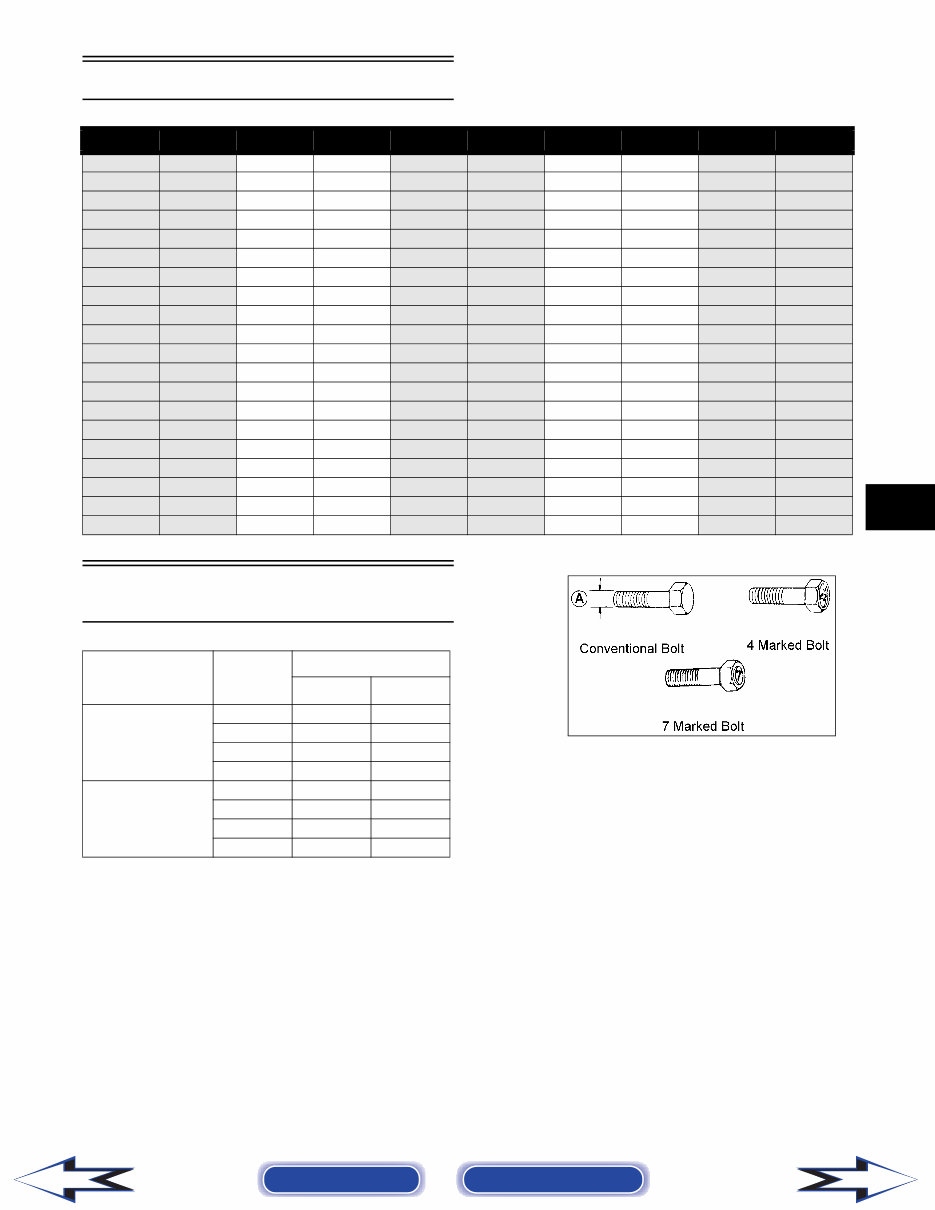
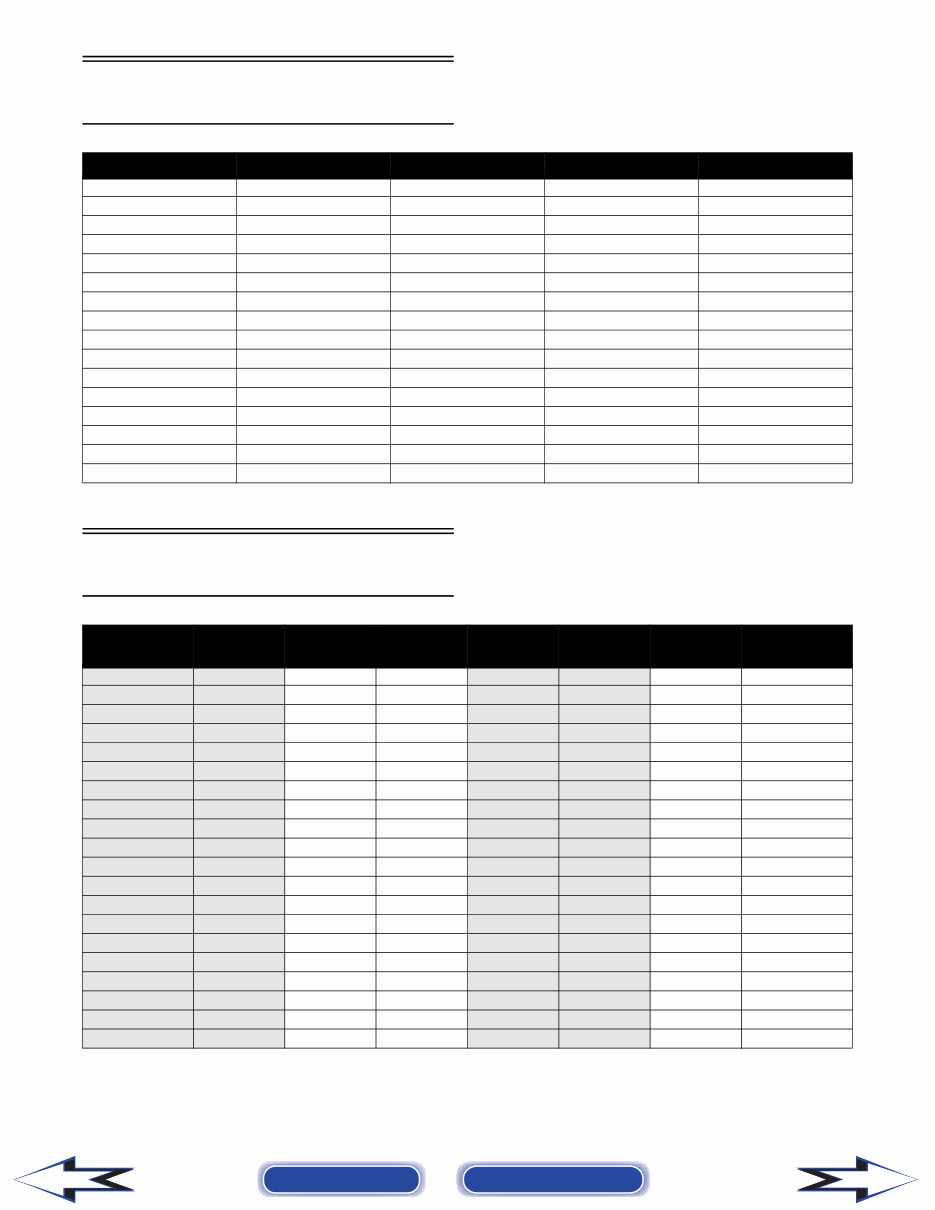
1-1 1 SECTION 1 — GENERAL INFORMATION TABLE OF CONTENTS Snowmobile Identification ....................................... 1-2 Recommended Gasoline and Oil ........................... 1-2 Break-In Procedure ................................................ 1-2 Genuine Parts ........................................................ 1-3 High Altitude Operation .......................................... 1-3 Preparation For Storage ......................................... 1-3 Preparation After Storage ...................................... 1-5 After Break-In Checkup (100 Miles) ....................... 1-5 After Break-In Checkup Checklist .......................... 1-6 Torque Conversions ............................................... 1-7 Tightening Torque (General Bolts) ........................ 1-7 Fraction/Decimal Conversion Chart ....................... 1-8 Drill Bit Sizes (Number) Chart ................................ 1-8 MM/In. Conversion Chart ....................................... 1-9 Servicing Symbols ............................................... 1-10 Back to TOC
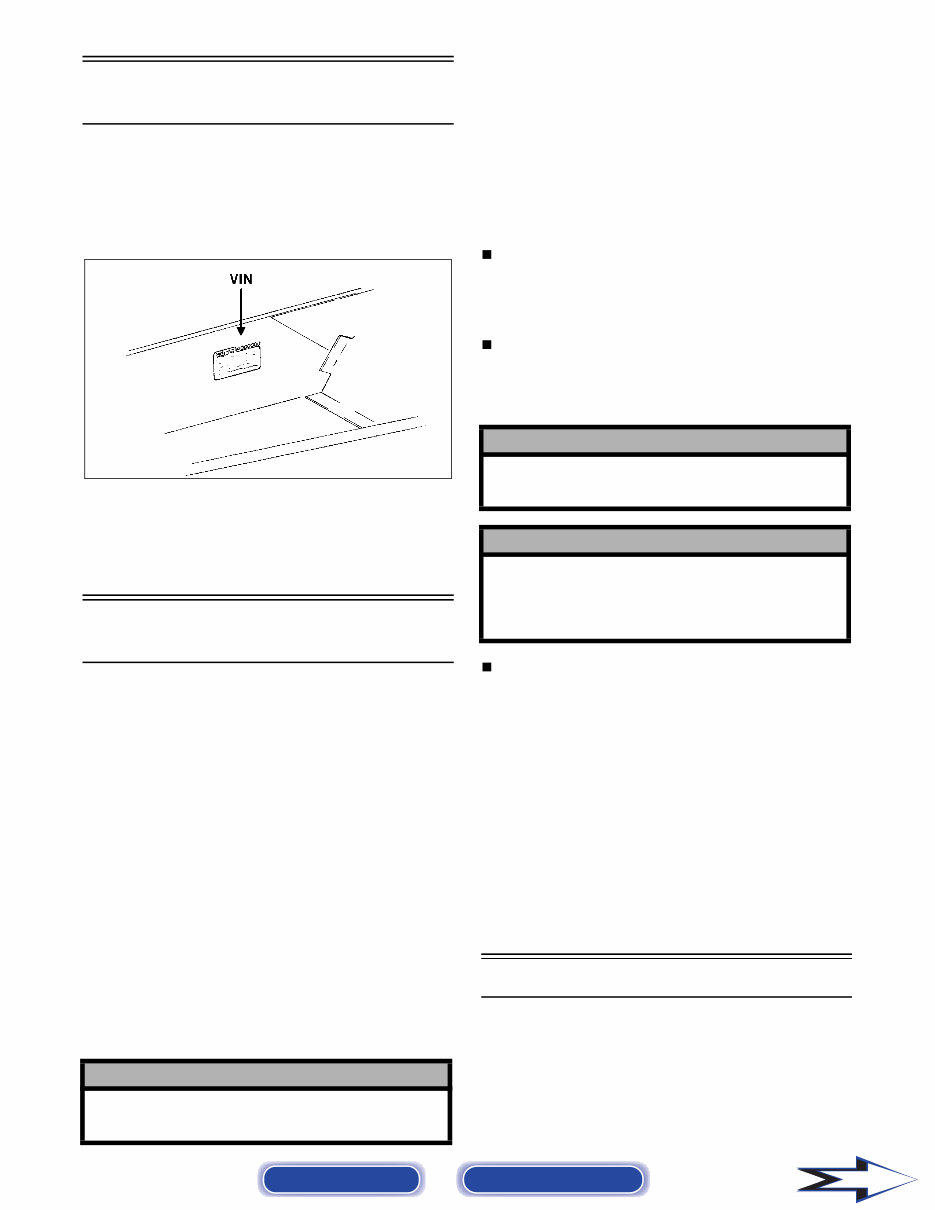
1-2 Snowmobile Identification The Arctic Cat Snowmobile has two important iden- tification numbers. The Vehicle Identification Num- ber (VIN) is stamped into the tunnel near the right- side footrest. The Engine Serial Number (ESN) is stamped into the crankcase of the engine. 0726-383 These numbers are required to complete warranty claims properly. No warranty will be allowed by Arctic Cat Inc. if the engine serial number or VIN is removed or mutilated in any way. Recommended Gasoline and Oil RECOMMENDED GASOLINE (Carbureted Models) The recommended gasoline to use in these snowmo- biles is 87 minimum octane regular unleaded. In many areas, oxygenates (either ethanol or MTBE) are added to the gasoline. Oxygenated gasolines con- taining up to 10% ethanol or up to 15% MTBE are acceptable gasolines; however, whenever using oxy- genated gasolines, the carburetor main jet must be one size larger than the main jet required for regular unleaded gasoline. For example, if a 400 main jet is recommended for regular unleaded gasoline, a 410 main jet must be installed if using an oxygenated gasoline. When using ethanol blended gasoline, it is not neces- sary to add a gasoline antifreeze since ethanol will prevent the accumulation of moisture in the fuel sys- tem. RECOMMENDED GASOLINE (EFI Models) The recommended gasoline to use in these snowmo- biles is 87 minimum octane regular unleaded. In many areas, oxygenates (either ethanol or MTBE) are added to the gasoline. Oxygenated gasolines con- taining up to 10% ethanol or up to 15% MTBE are acceptable gasolines. Do not use gasolines contain- ing methanol. NOTE: On the 700 cc and 900 cc engines when using the recommended gasoline, the Fuel Desig- nation Connector (the gray wire at the ECU) must be connected. NOTE: On the 700 cc and 900 cc engines when using oxygenated gasolines, the Fuel Designation Connector (the gray wire at the ECU) must be dis- connected. NOTE: On the 700 cc and 900 cc engines in order for the ECU to change modes, the engine must be OFF when connecting or disconnecting the Fuel Designation Connector. RECOMMENDED OIL The recommended oil to use in the oil-injection sys- tem is Arctic Cat 50:1 Injection Oil (for standard models) or Arctic Cat Synthetic APV 2-Cycle Oil (for APV models). The oil is specially formulated to be used either as an injection oil or as a pre-mix oil (for carbureted model break-in) and meets all of the lubrication requirements of the Arctic Cat snowmo- bile engine. Break-In Procedure The Arctic Cat 2-stroke engine (when new or rebuilt) requires a short break-in period before the engine is subjected to heavy load conditions. Arctic Cat requires that the first tankful of fuel be premixed at a 100:1 ratio in all oil-injection models. ! CAUTION Do not use white gas or gasolines containing meth- anol. Only Arctic Cat approved gasoline additives should be used. ! CAUTION Do not use white gas or gasoline containing metha- nol. Only Arctic Cat approved gasoline additives should be used. ! CAUTION On the 700 cc and 900 cc engines if oxygenated gasoline is to be used, it is extremely important that the Fuel Designation Connector at the ECU is dis- connected. If not, severe engine damage may occur. Back to TOC Back to Section TOC Next
1-3 1 During the break-in period, a maximum of 1/2 throt- tle is recommended; however, brief full-throttle accelerations and variations in driving speeds con- tribute to good engine break-in. Genuine Parts When replacement of parts is necessary, use only genuine Arctic Cat parts. They are precision-made to ensure high quality and correct fit. High Altitude Operation Operating a snowmobile at varying altitudes requires changes in performance components. These changes affect drive train components (on all models) and carburetion components (on carbureted models). High altitude information decal(s) are located beneath the hood of the snowmobile. King Cat and M-Series snowmobiles are initially set up at the factory for operation between 6000-9000 feet. Consult the appropriate specifications for this information. Preparation For Storage Prior to storing the snowmobile, it must be properly serviced to prevent corrosion and component deteri- oration. An authorized Arctic Cat Snowmobile dealer should perform this service; however, the owner/operator can perform this service if desired. To prepare the snowmobile for storage, Arctic Cat recommends the following procedure: 1. Clean the seat cushion with a damp cloth and Arctic Cat Vinyl Protectant (p/n 0638-313). 2. Clean the snowmobile thoroughly by hosing dirt, oil, grass, and other foreign matter from the skid frame, tunnel, hood, and belly pan. Allow the snowmobile to dry thoroughly. DO NOT get water into any part of the engine. 3. Place the rear of the snowmobile up on a shielded safety stand. NOTE: On 500/600/700 cc models, the air silencer boot can be pried forward to access the intake bores. Pry the boot forward; then proceed to step 7. NOTE: On some standard models, the air-intake silencer is a one-piece unit, and the silencer boot(s) can be removed to access the intake bore(s). Remove the boots; then proceed to step 7. NOTE: On some standard models, the air-intake silencer includes a cover/tool tray assembly and a baffle/resonator, and the silencer boot cannot be removed to access the intake bores. Proceed to step 4. 4. Open the air-intake silencer cover; then remove the three screws securing the cover/tool tray assembly to the silencer. 5. Close the cover; then tip the cover/tool tray assembly forward and out of its slots and remove the assembly. 6. Using a large flat-blade screwdriver, remove the baffle/resonator tabs from the air-intake silencer slots and remove the baffle/resonator to access the intake bores. NOTE: The baffle/resonator can be removed more easily by removing the back tabs first. 7. Start the engine and allow to idle. With the engine idling, spray Arctic Cat Engine Storage Preserver (p/n 0636-177) into the intake(s) until the engine exhaust starts to smoke heavily or until the engine starts to drop in RPM. Turn engine off. NOTE: On 500/600/700 cc models, secure the air silencer boots onto the intake bores. NOTE: On some standard models, install the air- intake silencer boot(s); on some standard models, install the baffle/resonator and the cover/tool tray assembly. 8. Plug the exhaust system outlet with a clean cloth. 9. With the ignition switch in the OFF position: ! CAUTION DO NOT exceed the one (1) tankful limitation of a 100:1 gas/oil break-in mixture. Continuous use of a gas/oil mixture, unless consistently operating in extremely cold conditions (-26°C/-15°F or colder), could cause spark plug fouling and excessive car- bon buildup. A 100:1 gas/oil mixture must be used in conjunction with the oil-injection system to ensure adequate engine lubrication in extremely cold conditions. ! CAUTION On carbureted models, carefully follow the Main Jet Chart recommendations for proper main jet selec- tion for altitude, temperature, and gasoline being used. Back to TOC Back to Section TOC Next Back
1-4 A. Disconnect the high tension lead(s) from the spark plug(s); then remove the plug(s), con- nect it/them to the lead(s), and ground it/them on the cylinder head(s). B. Pour 29.5 ml (1 fl oz) of SAE #30 petroleum- based oil into each spark plug hole and pull the recoil starter handle slowly about 10 times. C. Install the spark plug(s) and connect the high tension lead(s). 10. On carbureted models, drain the gas from each carburetor float chamber. 11. Fill the gas tank to its rated capacity; then add Arctic Cat Fuel Stabilizer (p/n 0638-165) to the gas tank following directions on the container for the stabilizer/gasoline ratio. Tighten the gas tank cap securely. 12. On models with a chain case, drain the lubricant by removing the chain-case drain plug located on the backside of the chain-case assembly. Remove the chain-case cover and inspect chain, sprockets, chain tensioner, and rollers for wear and the chain for proper tension. Install the drain plug, chain-case cover, and seal; then pour Arc- tic Cat Transmission Lube (p/n 0636-817) into the filler hole - 236 ml (8 fl oz) for standard transmission or 354 ml (12 fl oz) for reverse transmission. 13. On models with a gear case, drain the fluid from the gear case. Install the drain plug; then pour Arctic Cat Synthetic ACT Drive Fluid (p/n 4639-025) into the gear case - 89 ml (3 fl oz). 14. Clean and inspect the drive clutch and driven pulley. 15. Remove the drive belt from the drive clutch/ driven pulley. Lay the belt on a flat surface or slide it into a cardboard sleeve to prevent warp- ing or distortion during storage; then clean and inspect the drive clutch and driven pulley. 16. Apply light oil to the upper steering post bush- ing, ski spindles and bolts, front and rear pivot bushings of the skid frame, and plungers of the shock absorbers. 17. Lubricate all grease fittings (front and rear sus- pension, spindles, speedometer drive adapter, and the driven shaft support bearing) with a low- temperature grease. 18. Tighten all nuts, bolts, and cap screws making sure all calibrated nuts, bolts, and cap screws are tightened to specifications. Make sure all rivets holding the components together are tight. Replace all loose rivets. 19. Clean and polish the hood, console, and chassis with Arctic Cat Hood and Windshield Cleaner/ Polish (p/n 0636-174). DO NOT USE SOL- VENTS OR SPRAY CLEANERS. THE PRO- PELLENT WILL DAMAGE THE FINISH. 20. On electric start models, disconnect the battery cables making sure to disconnect the negative cable first; then clean the battery posts and cables. 21. If possible, store the snowmobile indoors. Raise the track off the floor by blocking up the back end making sure the snowmobile is secure. Loosen the track adjusting bolts to reduce track tension. Cover the snowmobile with a machine cover or a heavy tarpaulin to protect it from dirt and dust. 22. If the snowmobile must be stored outdoors, posi- tion the snowmobile out of direct sunlight; then block the entire snowmobile off the ground mak- ing sure the snowmobile is secure. Loosen the track adjusting bolts to reduce track tension. Cover with a machine cover or a heavy tarpaulin to protect it from dirt, dust, and rain. ! CAUTION Never crank the engine over without grounding the spark plug(s). Damage to coils and/or CDI unit may result. ! CAUTION On models with remote start, make sure to leave the battery cables disconnected. Failure to dis- connect the battery cables when storing the snowmobile for a prolonged period of time (six weeks or more) will result in a discharged or damaged battery. ! CAUTION Avoid storing in direct sunlight and using a plastic cover as moisture may collect on the snowmobile causing corrosion. Back to TOC Back to Section TOC Next Back
1-5 1 Preparation After Storage Taking the snowmobile out of storage and correctly preparing it for another season will assure many miles and hours of trouble-free snowmobiling. Arc- tic Cat recommends the following procedure: 1. Clean the snowmobile thoroughly. Polish the exterior of the snowmobile. 2. Clean the engine. Remove the cloth from the exhaust system. Check exhaust system and air- intake silencer/air filter for obstructions. 3. Inspect all control wires and cables for signs of wear or fraying. Replace if necessary. Use cable ties or tape to route wires and cables away from hot or rotating parts. 4. Inspect the drive belt for cracks and tears. Check belt specifications. Replace if damaged or worn. Install the drive belt. NOTE: If the old belt is worn but in reasonable condition, retain it with the snowmobile as a spare in case of emergency. 5. On carbureted models, inspect the in-line fuel filter and replace if necessary. 6. Inspect all fuel hoses and oil hoses for deteriora- tion or cracks; replace if necessary. Make sure all connections are tight; then fill the oil-injection reservoir with the recommended injection oil. NOTE: After prolonged storage, Arctic Cat rec- ommends one tankful of 100:1 gas/oil mixture be used in conjunction with the oil-injection system to ensure proper lubrication. 7. Inspect the entire brake system, all controls, headlight, taillight, brakelight, ski wear bars, and headlight aim; adjust or replace as necessary. 8. Inspect each spark plug. Replace, gap, or clean as necessary. 9. Adjust the track to the proper tension and align- ment. Lock the jam nuts. 10. Adjust the carburetor(s) and choke cable on car- bureted models and throttle cable on all models. 11. Tighten all nuts, bolts, and cap screws making sure all calibrated nuts, bolts, and cap screws are tightened to specifications. 12. Lubricate all grease fittings (rear suspension, spindles, speedometer drive adapter, and the driven shaft support bearing) with a low-temper- ature grease. 13. On liquid cooled models, check the coolant level and all coolant hoses and connections for deteri- oration or cracks. Add properly mixed coolant as necessary. 14. On fan cooled models, clean the engine cooling fins and all vents. 15. On electric start models, charge the battery; then connect the battery cables making sure to con- nect the positive cable first. Test the electric start system. After Break-In Checkup (100 Miles) The 100 mile checkup offered by some dealerships reduces problems and warranty costs. A program of this kind should be offered by all dealerships. Many dealerships have added the price of the checkup into the selling price of the snowmobile, and others offer it as a bonus to the customers who purchase snow- mobiles from their dealership. There are three areas that require adjustment after the break-in period in order to obtain peak perfor- mance. These areas are the following. A. Carburetor jetting B. Drive belt deflection/Break-In C. Track tension and alignment CARBURETOR JETTING (Carbureted Mod- els)— Altitude, temperature, and the use of oxygen- ated gasoline affect the carburetion needed for optimum engine performance. The carburetor main jets must be changed in conjunction with changes in operating altitude, oxygenated gasoline usage, and temperature. ! CAUTION On carbureted models if the gas in each carburetor float chamber was not drained prior to storage, the carburetor(s) must be cleaned before starting the engine. ! WARNING On VM-style carburetors, be sure to tighten the swivel adapter jam nuts securely. If a jam nut isn’t tightened, the adjuster can rotate out of the carburetor cap caus- ing the piston valve not to return to the full-closed position. Back to TOC Back to Section TOC Next Back
1-6 DRIVE BELT DEFLECTION — Drive belt deflection is very important to the snowmobile. Even if it is checked and is correct when the snowmobile is set up, it does change (more so during the break-in period). This is because the rubber engine mounts and the rubber snubber on the torque link will all take a “set” during the first 100 miles, which allows the distance between the drive clutch and driven pul- ley to shorten. When this happens, the snowmobile will appear to have a too long drive belt. To add to this, the drive belt itself wears and stretches some- what. This all leads to a low-end performance prob- lem and, if not corrected, causes premature drive belt wear. After the break-in period, drive belt deflection should be checked according to the instructions given in this manual. To correct for too much deflec- tion, washer(s) from between the driven pulley sheaves can be removed to “tighten the drive belt” and allow the belt to return to the proper ratio for drive clutch engagement. DRIVE BELT BREAK-IN — It is critical for maxi- mum drive belt life to allow the belt to break in before subjecting it to hard use such as wide-open- throttle operation or hill climbing. The first 20 miles on the drive belt should be at 1/2 throttle or lower. This will allow the belt to gain its optimum flexibility and will extend belt life. Do not exceed 50 MPH during the first 20 miles. If this procedure isn’t followed, it is possible to destroy a new drive belt in less than 50 miles. This should be explained to customers at the time of drive belt sales. To increase the life of a drive belt, it is very impor- tant that the belt be warmed up before subjecting it to any type of use. In cold temperature (0° or below), the engine should be allowed to idle for a period of 8 to 10 minutes. This will allow heat from the engine compartment to soften the drive belt. Not only will this procedure increase belt life but will also help prevent engine damage from cold seizure. Each operator should be instructed to drive the snowmobile for several minutes at a low throttle set- ting to warm the belt up before using wide-open- throttle. This practice should be followed on all models for maximum belt life. In addition to instructing each operator about these drive belt break-in procedures, Arctic Cat also rec- ommends that the operators be informed that a drive belt (like brake pads, wear strips, etc.) is considered a normal wear item and is listed as an exclusion on the Arctic Cat Limited Warranty. TRACK TENSION AND ALIGNMENT — There is a certain amount of stretch on all tracks during the first 500 miles. The track must be adjusted after the first 50 to 100 miles to the specifications given in the Setup and Pre-delivery Manual and periodically thereafter. If these adjustments aren’t performed, the track may “derail” which leads to track and slide rail damage. Along with these three major areas, there are also other areas that should be checked and adjusted dur- ing the “After Break-In Checkup.” A checklist to assist you with this service follows. Not only will the customer be happier, but it also gets the customer back into your dealership, which in many cases will mean additional sales in accessories, belts, oil, etc. After Break-In Checkup Checklist Below is a recommended list of items to check after the break-in period. By performing this inspection, warranty cost can be reduced and customer satisfac- tion can be increased. The recommended mileage for this inspection is between 100 and 300 miles. Please encourage the customers to have this important checkup done. ❏ Jet carburetor(s) according to average tempera- ture, type of gasoline being used, and altitude ❏ Adjust drive belt deflection ❏ Adjust track tension and alignment ❏ Check throttle cable tension ❏ Check oil-injection pump adjustment ❏ Check engine idle ❏ Check coolant level ❏ Check chain case lubricant level ❏ Check lights (high/low beam, brakelight) ❏ Check safety switch operation ❏ Check driveshaft area for any rubbing compo- nents ❏ Check steering hardware for tightness ❏ Check skid frame and A-arm mounting hard- ware for tightness ❏ Check brake lever travel and adjustment ❏ Grease all lubrication points Back to TOC Back to Section TOC Next Back
Upon purchasing this manual, you will receive a .PDF file containing an email contact. After contacting us, you will receive a reply with a link to access the manual for your 2006 Arctic Cat M7 EFI.
This comprehensive manual covers every aspect of your machine, providing detailed guidance for tasks ranging from simple maintenance, such as an oil change, to more complex procedures like a transmission swap. With hundreds of pages, it includes numerous illustrations to assist you and easy-to-understand text throughout.
The manual features a search function, allowing you to easily navigate and print the necessary pages. It serves as a Factory Service Repair Manual, offering step-by-step instructions for maintenance and repair, equipping you with the knowledge typically possessed by factory-trained technicians.
By utilizing the insights provided in this service repair manual, both professional mechanics and DIY enthusiasts can confidently make informed decisions regarding the maintenance and repair of their machine.
Rest assured, in addition to the high-quality service manual, we are committed to delivering excellent customer service, ensuring your satisfaction with your purchase.
Recently Viewed
5,521,897Happy Clients
2,594,462eManuals
1,120,453Trusted Sellers
15Years in Business
Price:
Actual Price:
2006 Arctic Cat M7 EFI Factory Service & Work Shop Manual




 Lifetime Access