TYPE CODE Throughout this manual, the following abbreviations are used to identify individual model. CODE AREA TYPE E U.K. (Ireland) F France ED EUROPEAN DIRECT SALES (Austria, Switzerland, Belgium, Germany, Portugal, Italy, Spain, Israel) U Australia II G Germany II CM Canada
A Few Words About Safety Service Information The service and repair information contained in this manual is intended for use by qualified, professional technicians. Attempting service or repairs without the proper training, tools, and equipment could cause injury to you or others. It could also damage the vehicle or create an unsafe condition. This manual describes the proper methods and procedures for performing service, maintenance, and repairs. Some procedures require the use of specially designed tools and dedicated equipment. Any person who intends to use a replacement part, service procedure or a tool that is not recommended by Honda, must determine the risks to their personal safety and the safe operation of the vehicle. If you need to replace a part, use genuine Honda parts with the correct part number or an equivalent part. We strongly recommend that you do not use replacement parts of inferior quality. For Your Customer’s Safety Proper service and maintenance are essential to the customer’s safety and the reliability of the vehicle. Any error or oversight while servicing a vehicle can result in faulty operation, damage to the vehicle, or injury to others. For Your Safety Because this manual is intended for the professional service technician, we do not provide warnings about many basic shop safety practices (e.g., Hot parts–wear gloves). If you have not received shop safety training or do not feel confident about your knowledge of safe servicing practice, we recommended that you do not attempt to perform the procedures described in this manual. Some of the most important general service safety precautions are given below. However, we cannot warn you of every conceivable hazard that can arise in performing service and repair procedures. Only you can decide whether or not you should perform a given task. Important Safety Precautions Make sure you have a clear understanding of all basic shop safety practices and that you are wearing appropriate clothing and using safety equipment. When performing any service task, be especially careful of the following: • Read all of the instructions before you begin, and make sure you have the tools, the replacement or repair parts, and the skills required to perform the tasks safely and completely. • Protect your eyes by using proper safety glasses, goggles or face shields any time you hammer, drill, grind, pry or work around pressurized air or liquids, and springs or other stored-energy components. If there is any doubt, put on eye protection. • Use other protective wear when necessary, for example gloves or safety shoes. Handling hot or sharp parts can cause severe burns or cuts. Before you grab something that looks like it can hurt you, stop and put on gloves. • Protect yourself and others whenever you have the vehicle up in the air. Any time you lift the vehicle, either with a hoist or a jack, make sure that it is always securely supported. Use jack stands. Make sure the engine is off before you begin any servicing procedures, unless the instruction tells you to do otherwise. This will help eliminate several potential hazards: • Carbon monoxide poisoning from engine exhaust. Be sure there is adequate ventilation whenever you run the engine. • Injury from moving parts. If the instruction tells you to run the engine, be sure your hands, fingers and clothing are out of the way. Gasoline vapors and hydrogen gases from batteries are explosive. To reduce the possibility of a fire or explosion, be careful when working around gasoline or batteries. • Never drain or store gasoline in an open container. • Keep all cigarettes, sparks and flames away from the battery and all fuel-related parts. Improper service or repairs can create an unsafe condition that can cause your customer or others to be seriously hurt or killed. Follow the procedures and precautions in this manual and other service materials carefully. Failure to properly follow instructions and precautions can cause you to be seriously hurt or killed. Follow the procedures and precautions in this manual carefully. • Use only a non-flammable solvent, not gasoline, to clean parts. • Burns from hot parts or coolant. Let the engine and exhaust system cool before working in those areas.
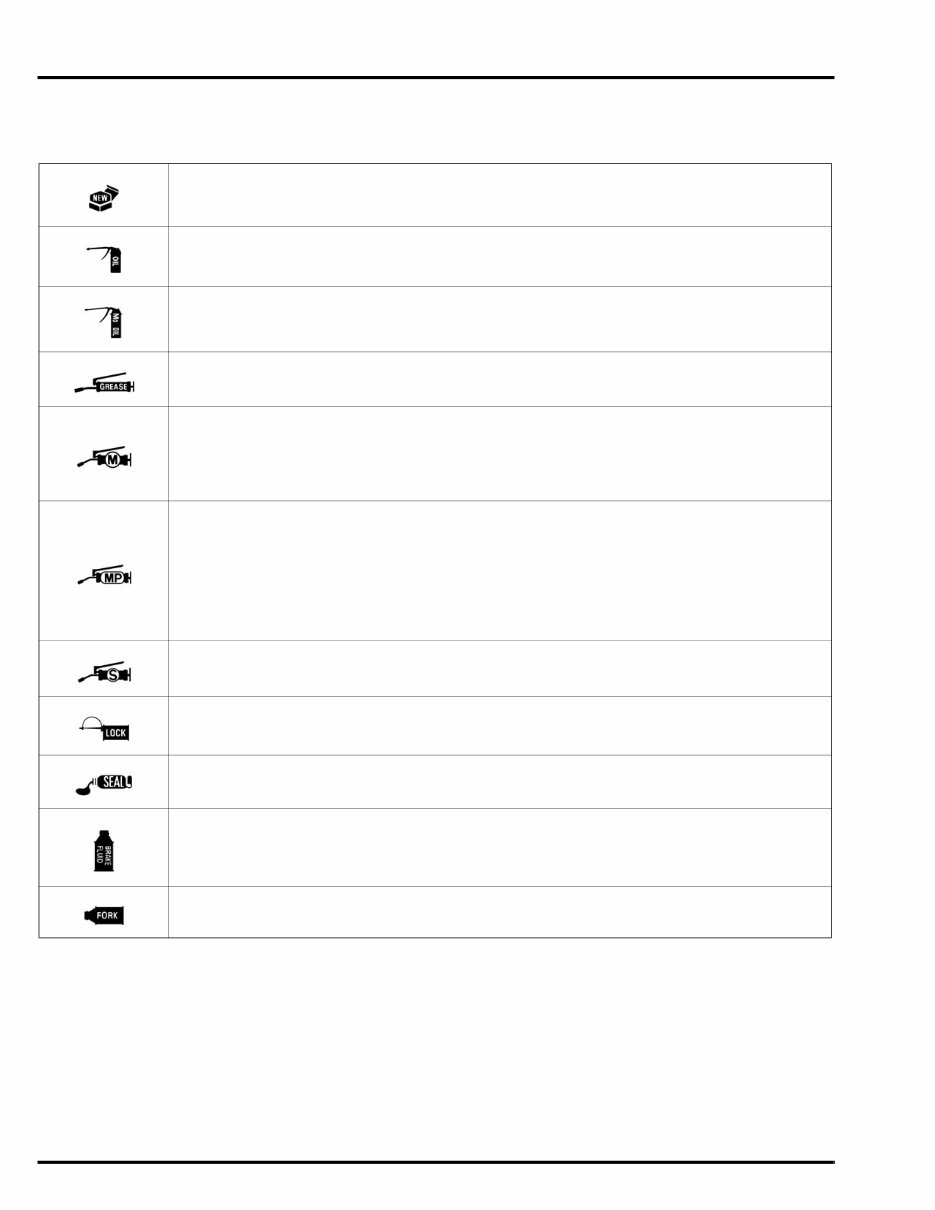
SYMBOLS The symbols used throughout this manual show specific service procedures. If supplementary information is required pertaining to these symbols, it would be explained specifically in the text without the use of the symbols. Replace the part (s) with new one (s) before assembly. Use the recommended engine oil, unless otherwise specified. Use molybdenum oil solution (mixture of the engine oil and molybdenum grease in a ratio of 1:1). Use multi-purpose grease (lithium based multi-purpose grease NLGI #2 or equivalent). Use molybdenum disulfide grease (containing more than 3% molybdenum disulfide, NLGI #2 or equivalent). Example: Molykote ® BR-2 plus manufactured by Dow Corning U.S.A. Multi-purpose M-2 manufactured by Mitsubishi Oil, Japan Use molybdenum disulfide paste (containing more than 40% molybdenum disulfide, NLGI #2 or equivalent). Example: Molykote ® G-n Paste manufactured by Dow Corning U.S.A. Honda Moly 60 (U.S.A. only) Rocol ASP manufactured by Rocol Limited, U.K. Rocol Paste manufactured by Sumico Lubricant, Japan Use silicone grease. Apply locking agent. Use a medium strength locking agent unless otherwise specified. Apply sealant. Use DOT 4 brake fluid. Use the recommended brake fluid unless otherwise specified. Use fork or suspension fluid.
1-1 1 1. GENERAL INFORMATION SERVICE RULES ········································· 1-2 MODEL IDENTIFICATION··························· 1-2 GENERAL SPECIFICATIONS······················ 1-5 LUBRICATION SYSTEM SPECIFICATIONS········································ 1-7 FUEL SYSTEM (PGM-FI) SPECIFICATIONS········································ 1-7 COOLING SYSTEM SPECIFICATIONS ······ 1-7 CYLINDER HEAD/VALVES SPECIFICATIONS········································ 1-8 CYLINDER/PISTON SPECIFICATIONS ······ 1-8 CLUTCH/GEARSHIFT LINKAGE SPECIFICATIONS········································ 1-8 ALTERNATOR/STARTER CLUTCH SPECIFICATIONS········································ 1-9 CRANKSHAFT/BALANCER/TRANSMISSION SPECIFICATIONS········································ 1-9 FRONT WHEEL/SUSPENSION/STEERING SPECIFICATIONS······································ 1-10 REAR WHEEL/SUSPENSION SPECIFICATIONS ····································· 1-10 HYDRAULIC BRAKE SPECIFICATIONS··· 1-10 BATTERY/CHARGING SYSTEM SPECIFICATIONS ····································· 1-11 IGNITION SYSTEM SPECIFICATIONS ···· 1-11 ELECTRIC STARTER SPECIFICATION····· 1-11 LIGHTS/METERS/SWITCHES SPECIFICATIONS ····································· 1-11 STANDARD TORQUE VALUES··············· 1-12 ENGINE & FRAME TORQUE VALUES ···· 1-12 LUBRICATION & SEAL POINTS ·············· 1-16 CABLE & HARNESS ROUTING ··············· 1-18 EMISSION CONTROL SYSTEMS (Except CM type) ····································· 1-30 EMISSION CONTROL SYSTEMS (CM type only)·········································· 1-32
Discover the Workshop Service Repair Manual for the HONDA CBR 125 & CBR 125R, spanning the years 2004 to 2006. This resource, available in English, is a go-to for professional technicians and DIY enthusiasts alike.
Covering all repair and maintenance facets, it offers detailed instructions and step-by-step diagrams for every workshop procedure, from plug changes to engine rebuilds.
Containing a wealth of information, it includes sections on:
General information
Body panels/exhaust system
Maintenance
Lubrication system
Fuel system (PGM-FI)
Cooling system
Engine removal/installation
Cylinder head/valves
Cylinder/piston
Clutch/gearshift linkage
Alternator/starter clutch
Crankshaft/balancer/transmission
Front wheel/suspension/steering
Rear wheel/suspension
Hydraulic brake
Battery/charging system
Ignition system
Electric starter
Lights/meters/switches
Wiring diagrams
Troubleshooting
Moreover, this manual provides electrical diagrams, torque settings, fluid capacities, and more. It is compatible with all operating systems, including Windows, Mac, and Tablet.
Whether you're a professional mechanic or a DIY enthusiast, this Workshop Service Repair Manual is an indispensable resource for maintaining and repairing your HONDA CBR 125 & CBR 125R.



 Lifetime Access