


Bosch Fuel Injection RQV - RQUV - EP - RSV Equipment
What's Included?
 Lifetime Access
Fast Download Speeds
Online & Offline Access
Access PDF Contents & Bookmarks
Full Search Facility
Print one or all pages of your manual
Fuel Injection Equipment
for Diesel Engines
Governors
for In-Line Pumps
© 1975 Robert Bosch GmbH
Postfach 50, D-7000 Stuttgart 1
Automotive Equipment Division
Department for Technical Publications KH/VDT
Editor in chief: Ulrich Adler
Editor: Erich Kaufmann
Translation 1977): John T. Warner, Michael J. Scott
Composition, graphics, layout: Dept. KH/VDT
In consultation with the technical departments of our
organisation. Reproduction, duplication and translation of
this publication, even in abridged form, is only to ensue
with our previous written consent and with particulars of
source. Illustrations, descriptions, diagrams and other
particulars only serve for elucidation and presentation of
the text. They are not binding as regards details of
construction, installation or delivery.
We undertake no liability for conformity of the text with
national or local regulations.
Subject to revision.
Printed in the Federal Republic of Germany.
Imprime en Republique Féderale d'Allemagne.
1st edition
30th September 1975
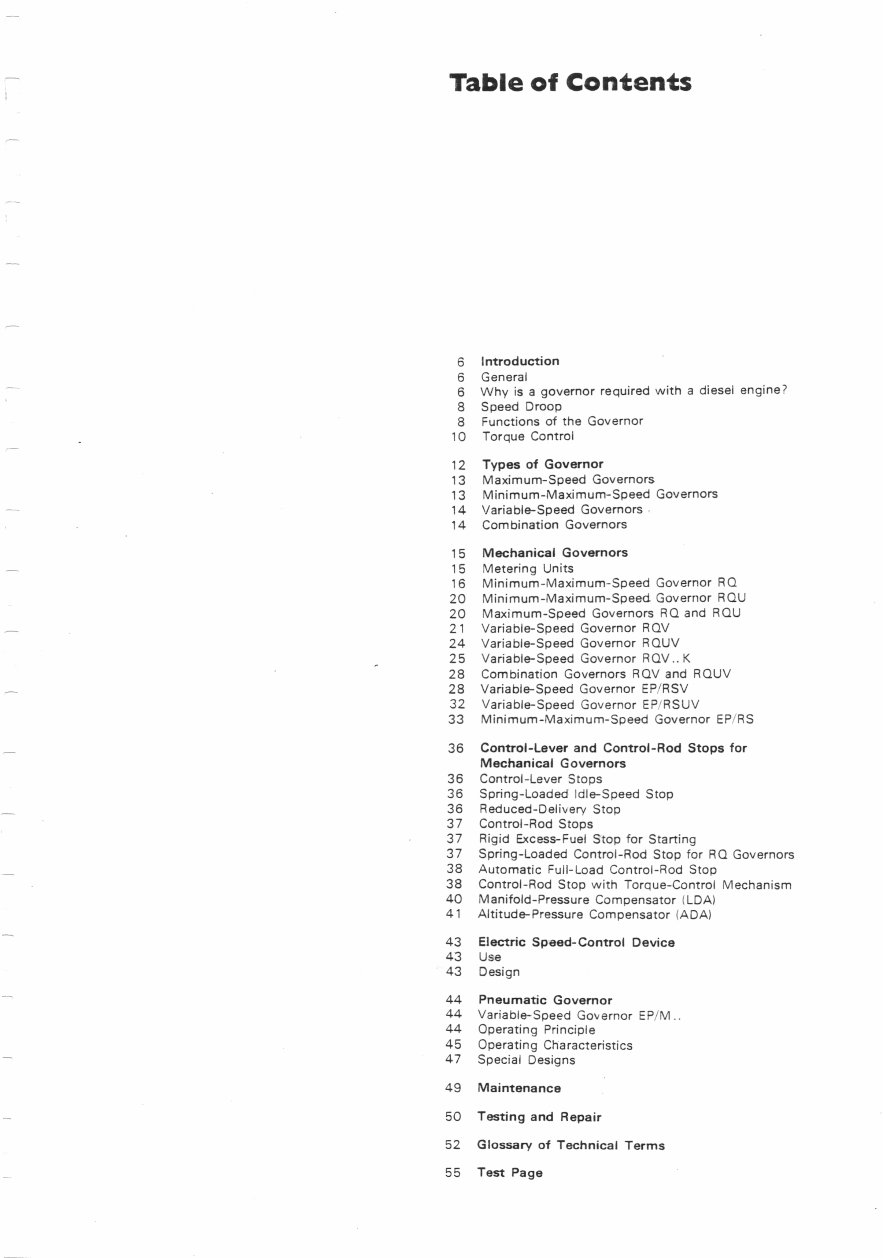
Table of Contents
6 Introduction
6 General
6 Why is a governor required with a diesel engine?
8 Speed Droop
8 Functions of the Governor
10 Torque Control
12 Types of Governor
13 Maximum-Speed Governors
13 Minimum-Maximum-Speed Governors
14 Variable-Speed Governors
14 Combination Governors
15 Mechanical Governors
15 Metering Units
16 Minimum-Maximum-Speed Governor RQ
20 Minimum-Maximum-Speed Governor RQU
20 Maximum-Speed Governors RQ and RQU
21 Variable-Speed Governor RQV
24 Variable-Speed Governor RQUV
25 Variable-Speed Governor ROy.. K
28 Combination Governors ROy and RQUV
28 Variable-Speed Governor EP/RSV
32 Variable-Speed Governor EPRSUV
33 Minimum-Maximum-Speed Governor EP RS
36 Control-Lever and Control-Rod Stops for
Mechanical Governors
36 Control-Lever Stops
36 Spring-Loaded Idle-Speed Stop
36 Reduced-Delivery Stop
37 Control-Rod Stops
37 Rigid Excess-Fuel Stop for Starting
37 Spring-Loaded Control-Rod Stop for RQ Governors
38 Automatic Full-Load Control-Rod Stop
38 Control-Rod Stop with Torque-Control Mechanism
40 Manifold-Pressure Compensator (LOA)
41 Altitude- Pressure Compensator (ADA)
43 Electric Speed-Control Device
43 Use
43 Design
44 Pneumatic Governor
44 Variable-Speed Governor EP/M..
44 Operating Principle
45 Operating Characteristics
47 Special Designs
49 Maintenance
50 Testing and Repair
52 Glossary of Technical Terms
55 Test Page
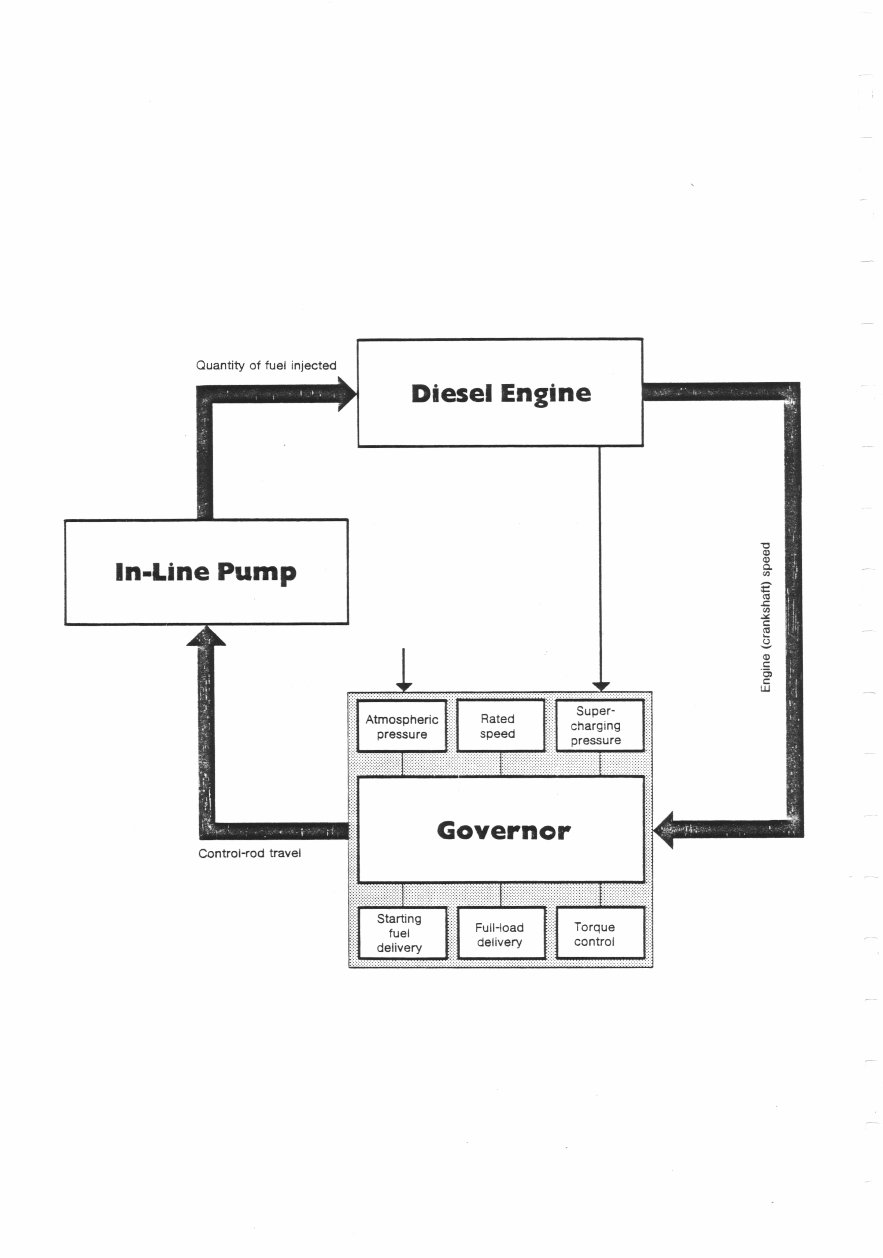
Quantity of fuel injected
Diesel Engine
In-Line Pump
CL
(I)
C
Q
C
C
LU
Governor
Control-rod travel
Starting j;
fuel
Full-load Torque
delivery
delivery control
We provided information on in-
line pumps for you in the booklet
in this series entitled "Diesel
Fuel-Injection Pumps Types
PE and PF". The in-line pump,
however, is only one part of the
fuel injection system. Equally
important is the governor. This
device is responsible for
ensuring that the engine
maintains a certain speed under
various load conditions, that the
engine speed does not exceed a
certain level as protection
• against self-destruction, and
that the engine does not stop
during pauses in loaded
operation, i.e. during idling. The
governor accomplishes all this
by controlling the amount of fuel
injected into the engine. How
the governor performs these as
well as a number of other
functions is described in this
booklet.
Introduction
General
The diesel engine draws only air in during the suction
stroke. During the compression stroke this air is heated to
such a high temperature that the diesel fuel injected into
the engine toward the end of the compression stroke
ignites of its own accord. The fuel is metered by the fuel
injection pump and is injected under high pressure through
the injection nozzle into the combustion chamber.
Fuel injection must take place:
• in an accurately metered quantity corresponding to the
engine load.
• at the correct instant in time.
• for a precisely determined period of time, and
• in a manner suited to the particular combustion process
concerned.
Maintenance of these conditions is the function of the
fuel injection pump and the governor. The quantity of fuel
injected into the engine during each plunger lift is approxi-
mately proportional to the torque of the engine. This fuel
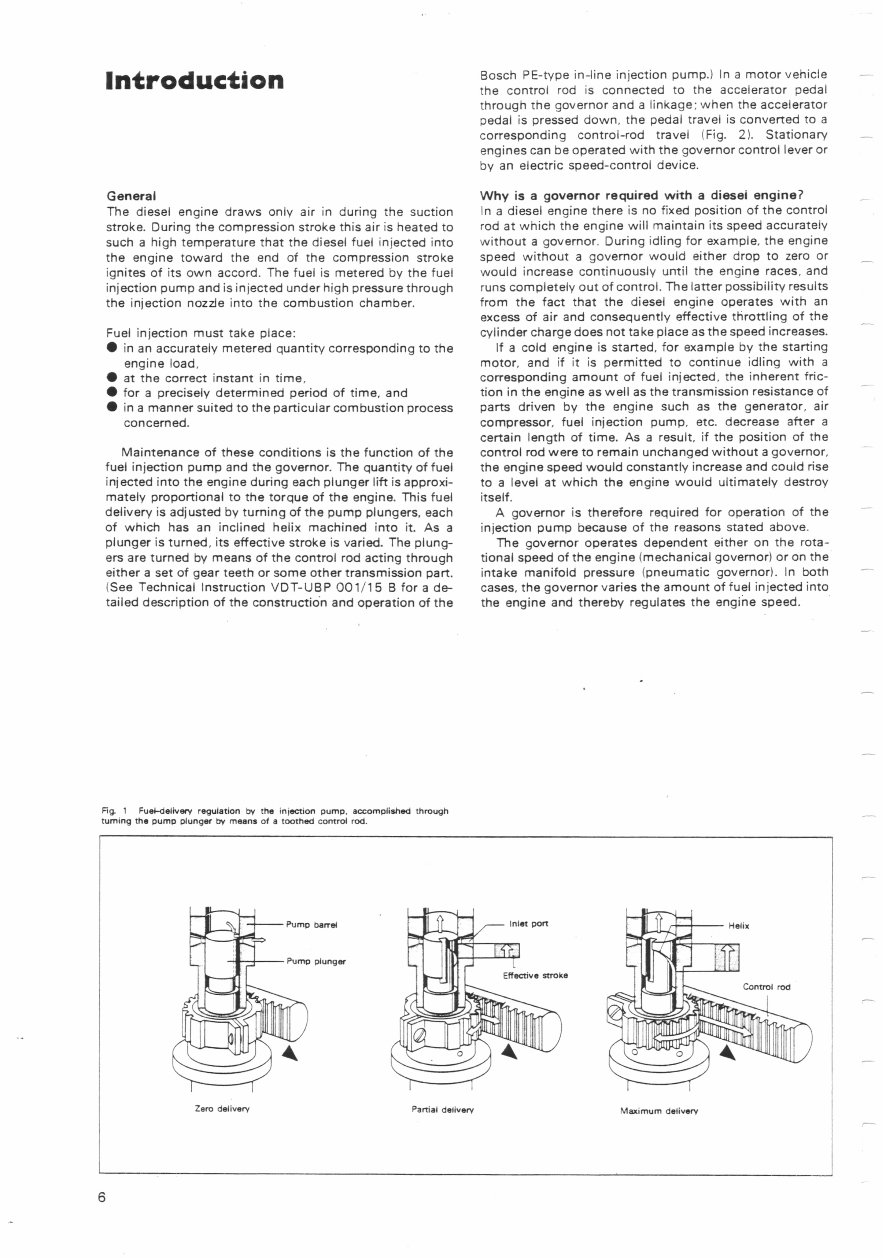
delivery is adjusted by turning of the pump plungers, each
of which has an inclined helix machined into it. As a
plunger is turned, its effective stroke is varied. The plung-
ers are turned by means of the control rod acting through
either a Set of gear teeth or some other transmission part.
(See Technical Instruction VDT-UBP 001/15 B for a de-
tailed description of the construction and operation of the
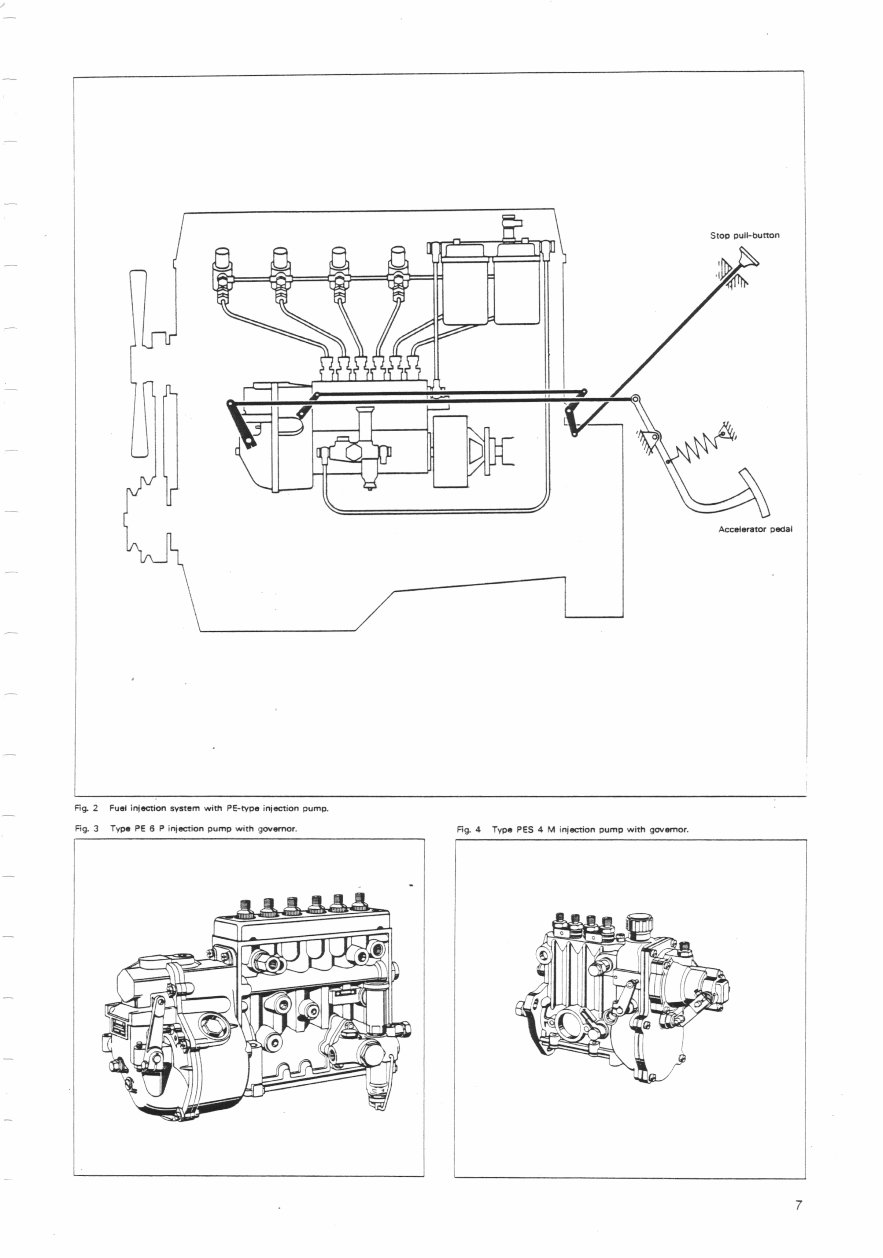
Bosch PE-type in-line injection pump.) In a motor vehicle
the control rod is connected to the accelerator pedal
through the governor and a linkage: when the accelerator
pedal is pressed down, the pedal travel is converted to a
corresponding control-rod travel (Fig. 2). Stationary
engines can be operated with the governor control lever or
by an electric speed-control device.
Why is a governor required with a diesel engine?
In a diesel engine there is no fixed position of the control
rod at which the engine will maintain its speed accurately
without a governor. During idling for example, the engine
speed without a governor would either drop to zero or
would increase continuously until the engine races, and
runs completely out of control. The latter possibility results
from the fact that the diesel engine operates with an
excess of air and consequently effective throttling of the
cylinder charge does not take place as the speed increases.
If a cold engine is started, for example by the starting
motor, and if it is permitted to continue idling with a
corresponding amount of fuel injected, the inherent fric-
tion in the engine as well as the transmission resistance of
parts driven by the engine such as the generator, air
compressor, fuel injection pump, etc. decrease after a
certain length of time. As a result, if the position of the
control rod were to remain unchanged without a governor,
the engine speed would constantly increase and could rise
to a level at which the engine would ultimately destroy
itself.
A governor is therefore required for operation of the
injection pump because of the reasons stated above.
The governor operates dependent either on the rota-
tional speed of the engine (mechanical governor) or on the
intake manifold pressure (pneumatic governor). In both
cases, the governor varies the amount of fuel injected into
the engine and thereby regulates the engine speed.
Fig. 1 Fuel-delivery regulation by the injection pump. accomplished through
turning the pump plunger by means of a toothed control rod.
Pump Helix
4 COnV-01 rrod
ve5e
p
Zero delivery Partial delivery Maximum delivery
I
.rcl__ i I::Ittr
\
Stop MI-button
fL
,
Acceiwaor -
Fig. 2 Fuel injection system with PE-type injection pump.
Fig. 3 Type PE S P injection pomp with governor. Fig. 4 Type PES 4 M injection Dump with governor.
7
Speed Droop
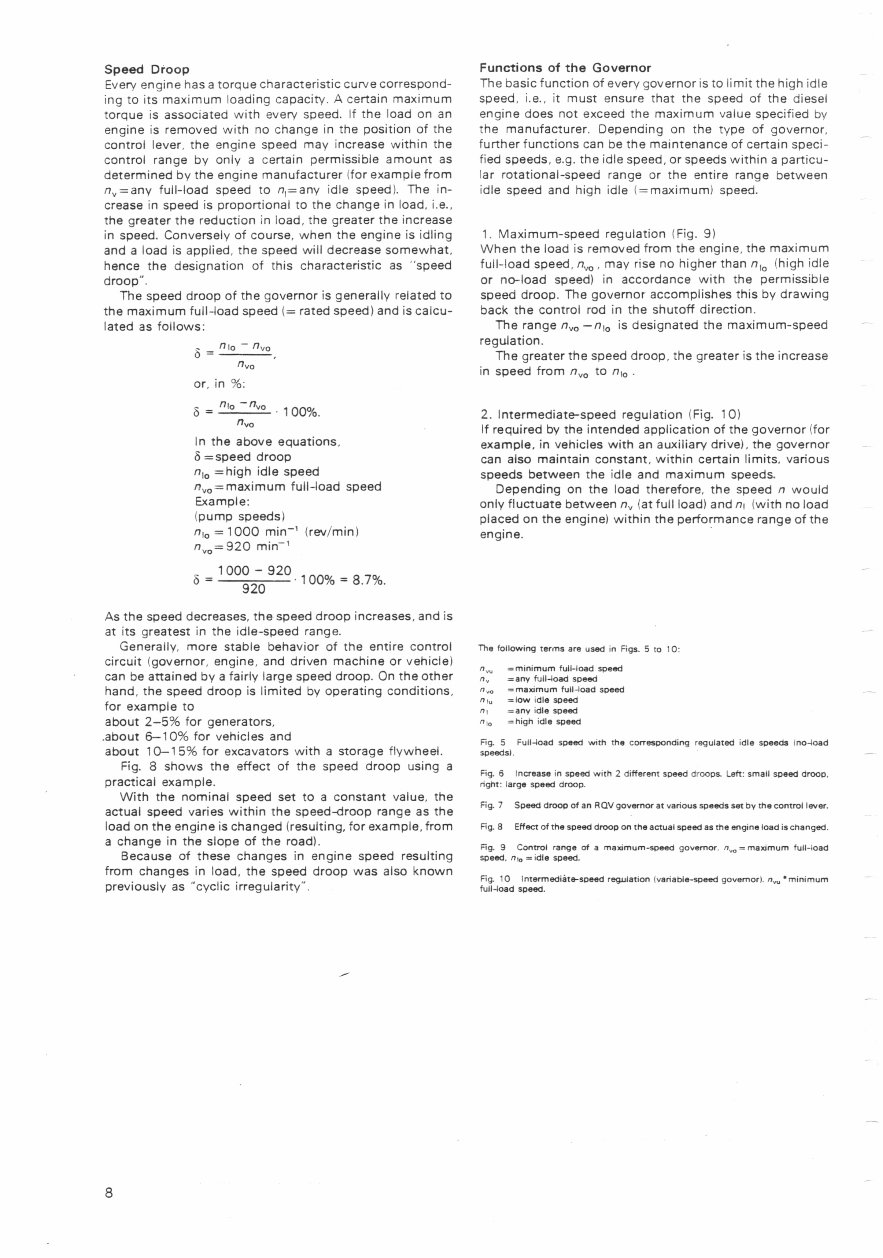
Every engine has a torque characteristic curve correspond-
ing to its maximum loading capacity. A certain maximum
torque is associated with every speed. If the load on an
engine is removed with no change in the position of the
control lever, the engine speed may increase within the
control range by only a certain permissible amount as
determined by the engine manufacturer (for example from
n=any full-load speed to 1 1 =any idle speed). The in-
crease in speed is proportional to the change in load, i.e.,
the greater the reduction in load, the greater the increase
in speed. Conversely of course, when the engine is idling
and a load is applied, the speed will decrease somewhat,
hence the designation of this characteristic as "speed
droop".
The speed droop of the governor is generally related to
the maximum full-load speed 1= rated speed) and is calcu-
lated as follows:
= f7io -
n', 0
or, in %:
= nio
-nvo , 100%,
"Va
In the above equations,
=speed droop
n jo =high idle speed
n ' , 0 =maximum full-load speed
Example:
(pump speeds)
= 1000 min (rev/min)
n. 0 =920 min- '
= 100% = 8.7%.
As the speed decreases, the speed droop increases, and is
at its greatest in the idle-speed range.
Generally, more stable behavior of the entire control
circuit (governor, engine, and driven machine or vehicle)
can be attained by a fairly large speed droop. On the other
hand, the speed droop is limited by operating conditions,
for example to
about 2-5% for generators,
about 6-10% for vehicles and
about 10-15% for excavators with a storage flywheel.
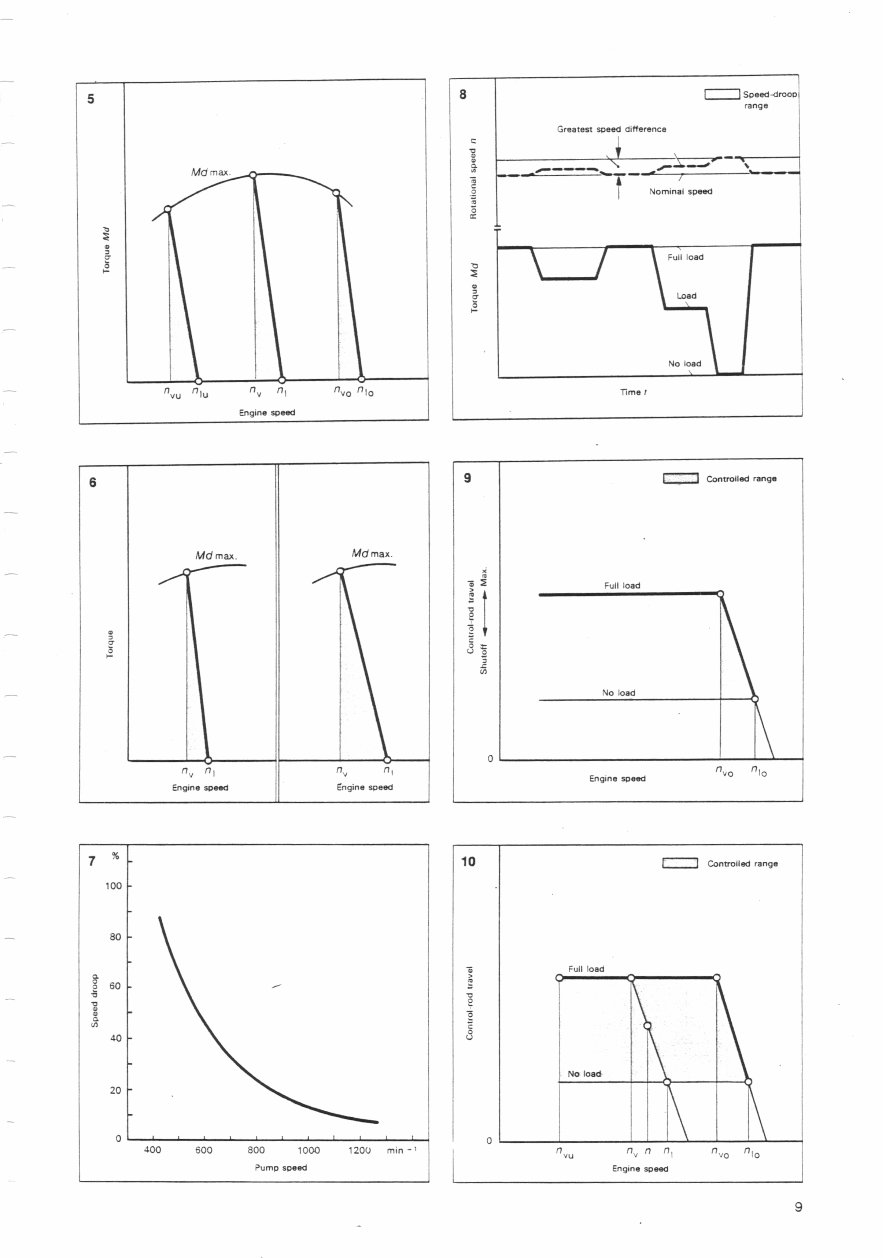
Fig. 8 shows the effect of the speed droop using a
practical example.
With the nominal speed set to a constant value, the
actual speed varies within the speed-droop range as the
load on the engine is changed (resulting, for example, from
a change in the slope of the road).
Because of these changes in engine speed resulting
from changes in load, the speed droop was also known
previously as "cyclic irregularity".
Functions of the Governor
The basic function of every governor is to limit the high idle
speed, i.e., it must ensure that the speed of the diesel
engine does not exceed the maximum value specified by
the manufacturer. Depending on the type of governor,
further functions can be the maintenance of certain speci-
fied speeds, e.g. the idle speed, or speeds within a particu-
lar rotational-speed range or the entire range between
idle speed and high idle (=maximum) speed.
1. Maximum-speed regulation (Fig. 9)
When the load is removed from the engine, the maximum
full-load speed, n' ,, may rise no higher than
n'
(high idle
or no-load speed) in accordance with the permissible
speed droop. The governor accomplishes this by drawing
back the control rod in the shutoff direction.
The range n ' , 0 -n 10 is designated the maximum-speed
regulation.
The greater the speed droop, the greater is the increase
in speed from
r'
to ri 0 .
2. Intermediate-speed regulation (Fig. 10)
If required by the intended application of the governor (for
example, in vehicles with an auxiliary drive), the governor
can also maintain constant, within certain limits, various
speeds between the idle and maximum speeds.
Depending on the load therefore, the speed ii would
only fluctuate between ri ' , (at full load) and ni (with no load
placed on the engine) within the performance range of the
engine.
The following terms are used in Figs. 5 to 10:
=minimum full-load speed
,7 =any full-load speed
,, =maomum full-load speed
n,, =low idle soeed
ti =any idle speed
0 10 =high idle speed
Fig. 5 Full-load speed with the corresponding regulated idle speeds tno4oad
speeds).
Fig. 6 Increase in speed with 2 different speed droops. Left: small speed droop.
right: large speed droop.
Fig. 7 Speed droop of an Ray governor at various speeds set by the control lever.
Fig, 8 Effect of the speed droop on the actual speed as the engine load is changed.
Fig. 9 Control range of a rna,amurn-speed governor. 'r,,, = maximum full-load
speed, n, =idle speed.
Fig. 10 Intermediéte-speed regulation variable-speed governor). n,,. minimum
full-load speed.
M rna.
3
Ii _
[I
vu 0 1u fl y 0vo
0l
Engine speed
5
8 r1
range
Greatest speed difference
.,- -'-
S
T f
-
Nominal speed
cc
\Fulo.d
Load !
a
\ I
No.d\I
Time I
8
Mdmax.
Mdmax.
S
a
8
I-
fl y ('V
I
Engine spied Engine speed
9 1 Controlled range
Full load
I I
a
No load
0
Engine speed
('VO ('10
7 % .
100
so
so
i
400 600 800 1000 1200 mm-'
Pump speed
10 Controlled range
S Full load
a
0
0
C
No load
0
"
('i vo 'lo
Engine speed
9
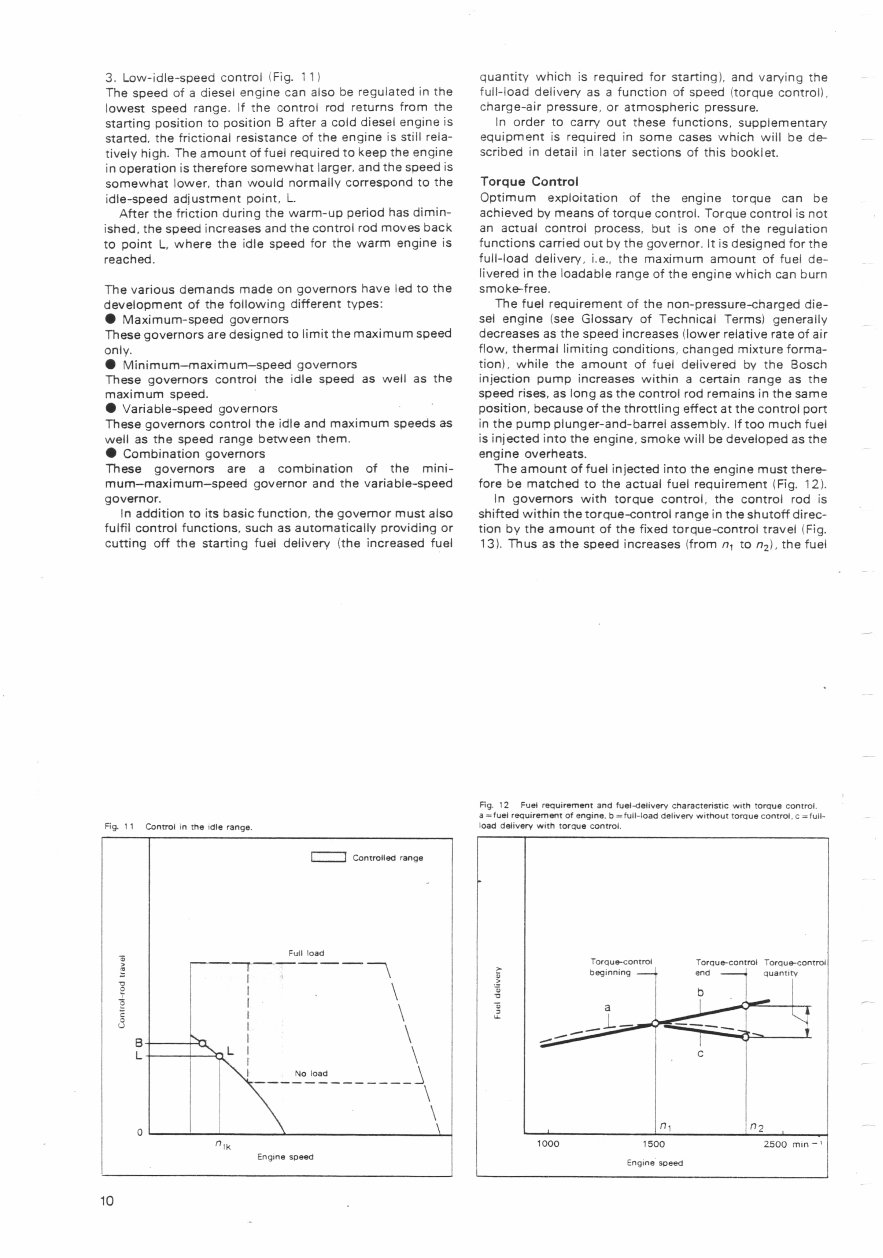
3. Low-idle-speed control Fig. 11)
The speed of a diesel engine can also be regulated in the
lowest speed range. If the control rod returns from the
starting position to position B after a cold diesel engine is
started, the frictional resistance of the engine is still rela-
tively high. The amount of fuel required to keep the engine
in operation is therefore somewhat larger, and the speed is
somewhat lower, than would normally correspond to the
idle-speed adjustment point, L
After the friction during the warm-up period has dimin-
ished, the speed increases and the control rod moves back
to point L, where the idle speed for the warm engine is
reached.
The various demands made on governors have led to the
development of the following different types:
• Maximum-speed governors
These governors are designed to limit the maximum speed
only.
• Minimum—maximum--speed governors
These governors control the idle speed as well as the
maximum speed.
• Variable-speed governors
These governors control the idle and maximum speeds as
well as the speed range between them.
• Combination governors
These governors are a combination of the mini-
mum—maximum—speed governor and the variable-speed
governor.
In addition to its basic function, the governor must also
fulfil control functions, such as automatically providing or
cutting off the starting fuel delivery (the increased fuel
quantity which is required for starting), and varying the
full-load delivery as a function of speed (torque control),
charge-air pressure, or atmospheric pressure.
In order to carry out these functions, supplementary
equipment is required in some cases which will be de-
scribed in detail in later sections of this booklet.
Torque Control
Optimum exploitation of the engine torque can be
achieved by means of torque control. Torque control is not
an actual control process, but is one of the regulation
functions carried out by the governor. It is designed for the
full-load delivery, i.e., the maximum amount of fuel de-
livered in the loadable range of the engine which can burn
smoke-free.
The fuel requirement of the non-pressure-charged die-
sel engine (See Glossary of Technical Terms) generally
decreases as the speed increases (lower relative rate of air
flow, thermal limiting conditions, changed mixture forma-
tion), while the amount of fuel delivered by the Bosch
injection pump increases within a certain range as the
speed rises, as long as the control rod remains in the same
position, because of the throttling effect at the control port
in the pump plunger-and-barrel assembly. If too much fuel
is injected into the engine, smoke will be developed as the
engine overheats.
The amount of fuel injected into the engine must there-
fore be matched to the actual fuel requirement (Fig. 12).
In governors with torque control, the control rod is
shifted within the torque-control range in the shutoff direc-
tion by the amount of the fixed torque-control travel (Fig.
13). Thus as the speed increases (from n 1 to n 2 ), the fuel
Fig. 12 Fuel requirement and fuel-delivery characteristic with torque control.
a =fuel requirement of engine. b = full-load delivery without torque control. c =full-
Fig. ii Control in the idle range. load delivery with torque control.
Controlled range
lk
Full load
\
I
\
\
No load
Engine speed
Torque-control Torque-control Torque-control
beginning end
a
2
.5
a
quantity
1000 1500 2500 min'
Engine speed
0
0
B
L
10
You're Reading a Preview
What's Included?
Lifetime Access
Fast Download Speeds
Online & Offline Access
Access PDF Contents & Bookmarks
Full Search Facility
Print one or all pages of your manual
$31.99
Viewed 44 Times Today


Secure transaction
What's Included?
Lifetime Access
Fast Download Speeds
Online & Offline Access
Access PDF Contents & Bookmarks
Full Search Facility
Print one or all pages of your manual
$31.99
Bosch Fuel Injection RQV - RQUV - EP - RSV Equipment
- Introduction
- General
- Why is a governor required with a diesel engine?
- Speed Droop
- Functions of the Governor
- Torque Control
- Types of Governor
- Maximum-Speed Governors
- Minimum-Maximum-Speed Governors
- Variable-Speed Governors
- Combination Governors
- Mechanical Governors
- Metering Units
- Minimum-Maximum-Speed Governor RQ
- Minimum-Maximum-Speed Governor RQU
- Maximum-Speed Governors RQ and RQU
- Variable-Speed Governor RQV
- Variable-Speed Governor RQUV
- Variable-Speed Governor ROy.. K
- Combination Governors ROy and RQUV
- Variable-Speed Governor EP/RSV
- Variable-Speed Governor EPRSUV
- Minimum-Maximum-Speed Governor EP RS
- Control-Lever and Control-Rod Stops for Mechanical Governors
- Control-Lever Stops
- Spring-Loaded Idle-Speed Stop
- Reduced-Delivery Stop
- Control-Rod Stops
- Rigid Excess-Fuel Stop for Starting
- Spring-Loaded Control-Rod Stop for RQ Governors
- Automatic Full-Load Control-Rod Stop
- Control-Rod Stop with Torque-Control Mechanism
- Manifold-Pressure Compensator (LOA)
- Altitude- Pressure Compensator (ADA)
- Electric Speed-Control Device
- Use
- Design
- Pneumatic Governor
- Variable-Speed Governor EP/M..
- Operating Principle
- Operating Characteristics
- Special Designs
- Maintenance
- Testing and Repair
- Glossary of Technical


