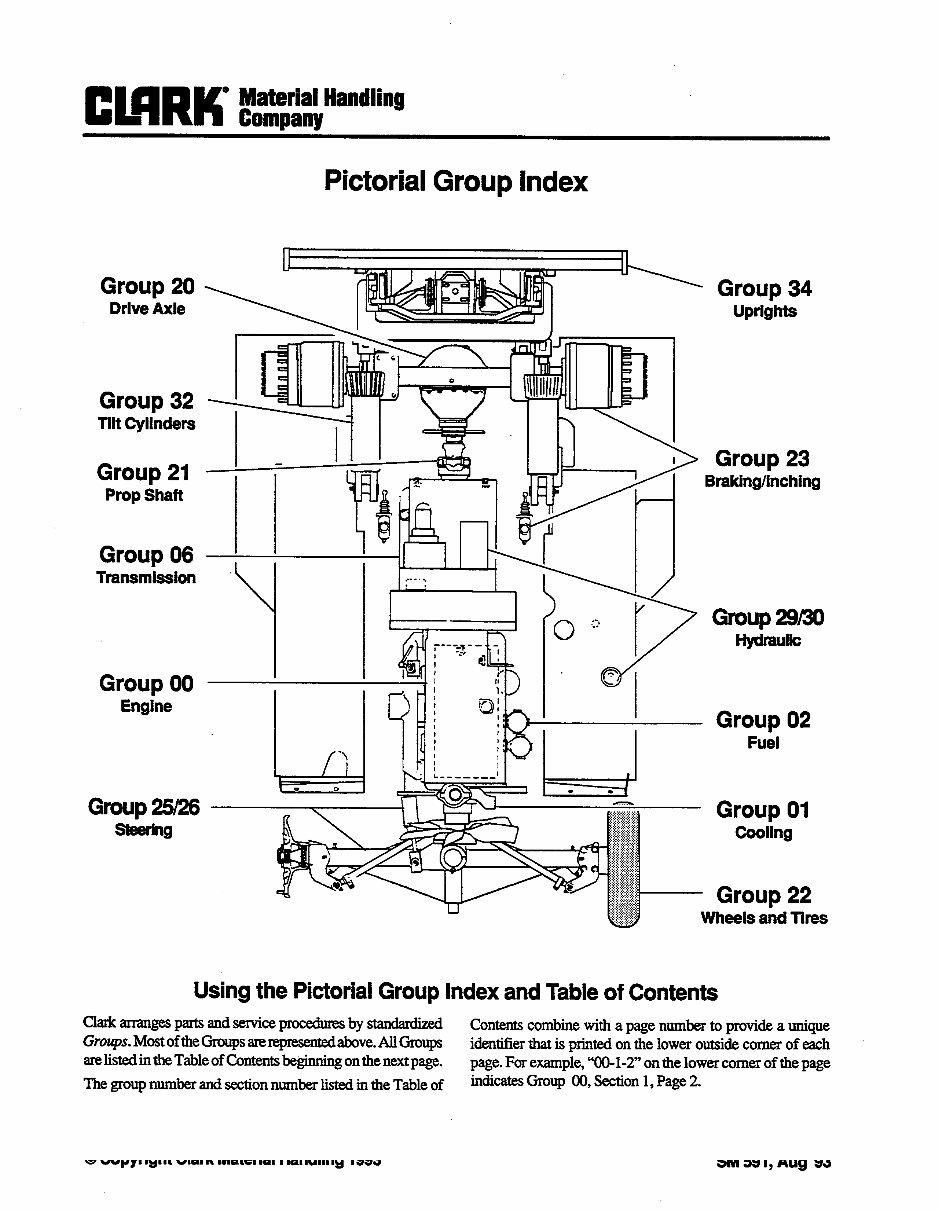
Group 20 Drive Axle Group 32 lilt Cylinders Group 21 Prop Shaft Group 06 Transmlsslon Group 00 Group26/26 -!I Pictorial Group Index a_ Group 34 uprights Group 23 Braklng/lnchlng Group 29/30 Hydraulic Group 02 Fuel - Group 01 Cooling - Group 22 Wheels and Tires Using the PictorialGroup Index and Table of Contents Clakinangespartsandserviceproceduresby~~ Contents combine with a page number to provide a unique Gro~~~s.MostoftheGroupsarereprewWabove.AllGmups identifierthat is printed on the lower outside comer of each are listedin the Table of Contentsbeginningon the nextpage. page. For example,“00-1-2” on the lower comer of the page The group number and section number listed in the Table of indicatesGroup 00, Section 1, Page 2. 0 CopyrightClark Materlal Handling1993 SM 591, Aug ‘93
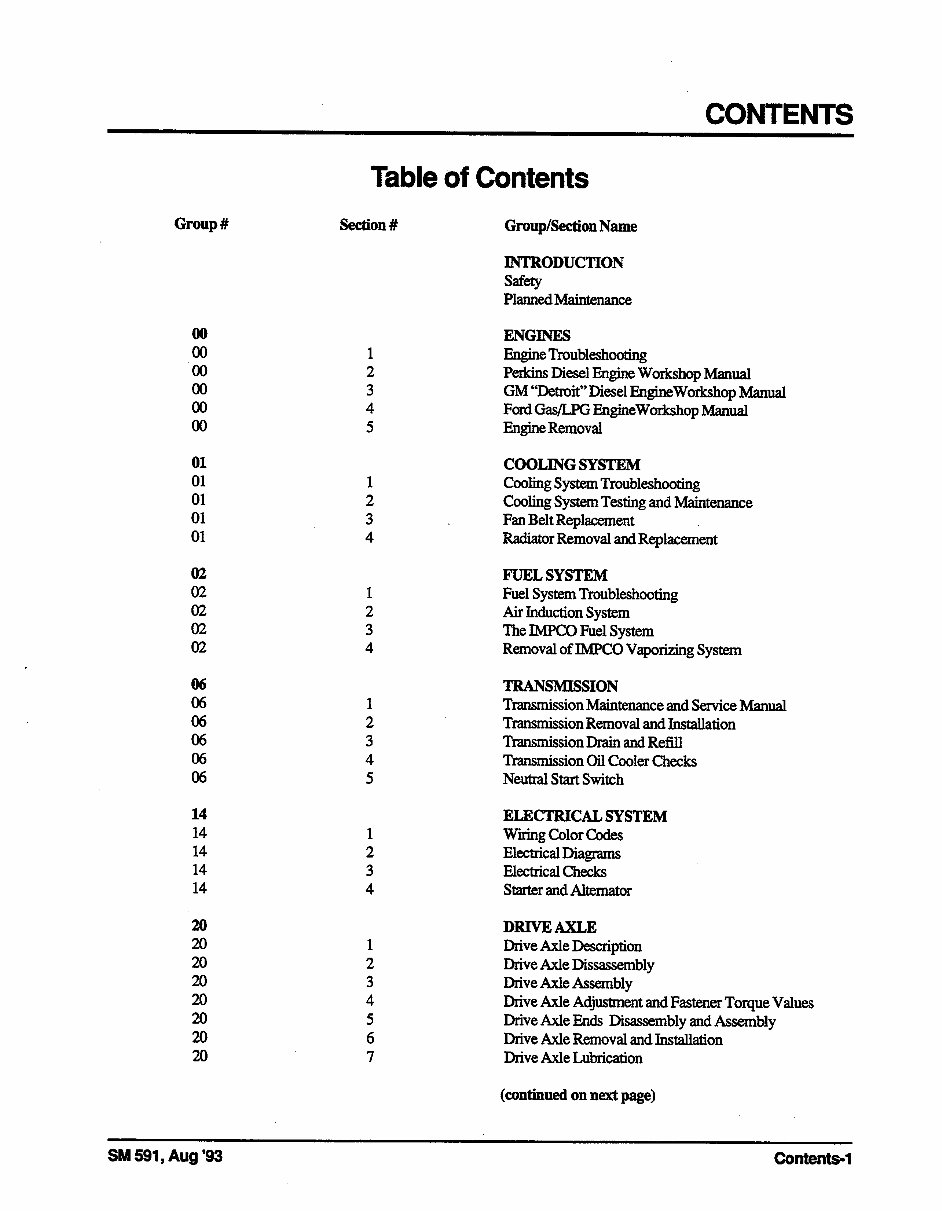
CONTENTS Group# 00 00 al 00 00 00 01 01 01 01 01 02 02 02 02 02 06 06 06 06 06 06 14 14 14 14 14 20 20 20 20 20 20 20 20 Table of Contents Section# Group/Section Name INTRODUCTION Safety PlannedMaintenance ENGINES Engine Troubleshooting Perkins Diesel Engine Workshop Manual GM “Detroit” Diesel EngineWorkshop Manual Ford Gas/LPG BngineWorkshop Manu Engine Removal COOLING SYSTEM Cooling System Troubleshooting Cooling System Testing and Maintenance Fan Belt Replacement Radiator Removal and Replacement FUEL SYSTEM Fuel System Troubleshooting Air Induction System The IMPCO Fuel System Removal of IMPCO Vaporizing System TRANSMISSION Transmission Maintenance and Service Manual Transmission Removal and Installation Transmission Drain and Refill Transmission Oil Cooler Checks Neutral Start Switch ELECTRICAL SYSTEM wiring C&r C5de.s ElectricalDiagrzns BlectlicalChecks StarterandAltemator DRIVEAXLE Drive Axle Description Drive Axle Dissassembly Drive Axle Assembly Drive Axle Adjustment and Fastener Torque Values Drive Axle Ends Disassembly and Assembly Drive Axle Removal and Installation Drive Axle Lubrication (continued on next page) SM 591, Aug ‘93 COIlbltS-1
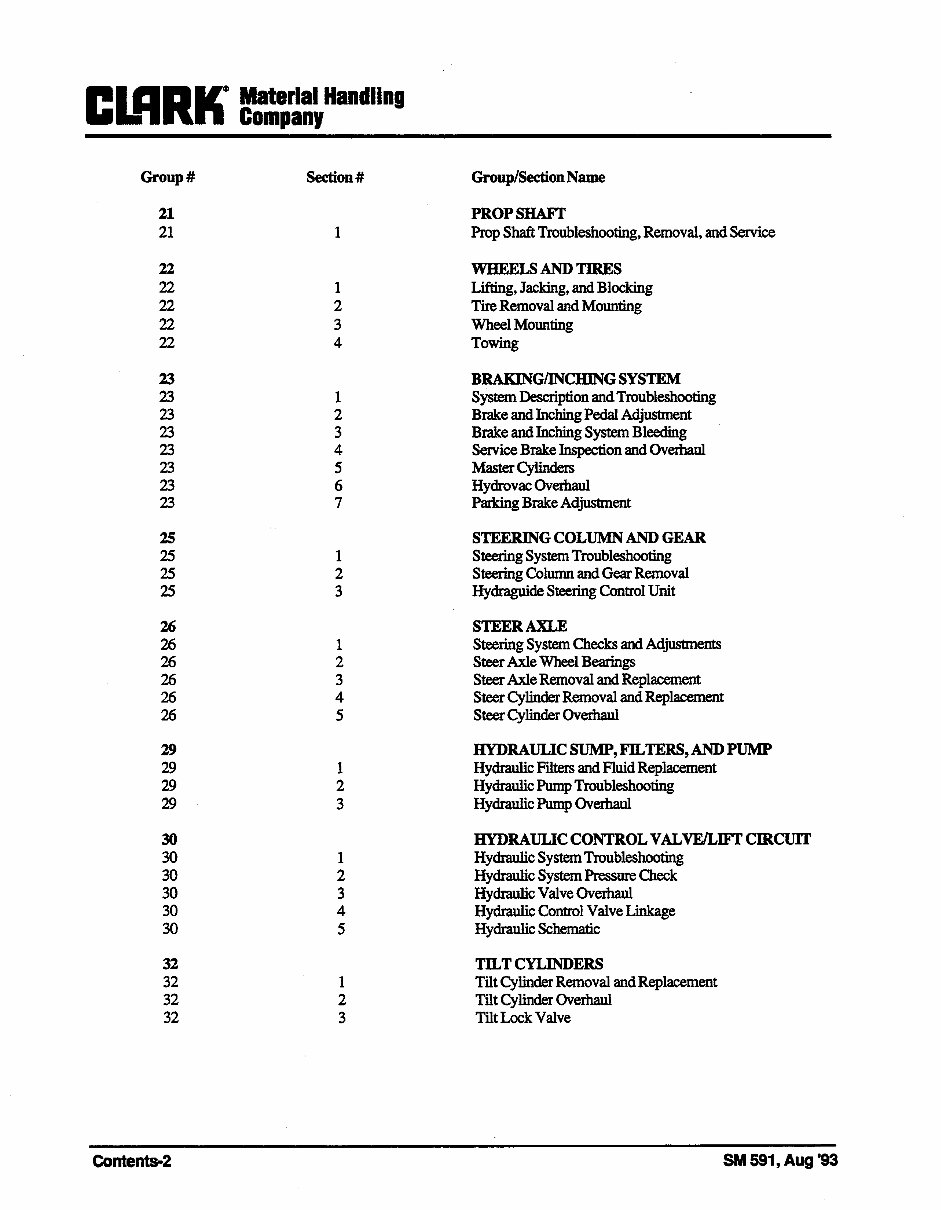
Group# 21 21 22 22 22 22 22 23 23 23 23 23 23 23 23 25 25 25 25 26 26 26 26 26 26 29 29 29 29 30 30 30 30 30 30 32 32 32 32 section# Group/Section Name 1 Prop Shaf& Troubleshooting, Removal, and Service 1 2 3 1 2 3 1 2 3 PROP !sHAFr WHEELSANDTIRES Lifting, Jacking, and Blocking Tire Removal and Mounting Wheel Mounting Towing BRAKING/lNCHINGSYSTEM System Description and Troubleshooting Brake and Inching Pedal Adjustment Brake and Inching System Bleeding ServiceBrakeInqxctionandOverhaul MasterCylin~ Hydrovac Overhaul Parking Brake Adjustment STEERING COLUMN AND GEAR Steering SystemTroubleshooting Steering Column and Gear Removal Hydraguide Steering Control Unit STEER AXLE Steering System Checks and Adjustments SteerAxle WheelBearings Steer Axle Removal and Replacement Steer Cylinder Removal and Replacement SteerCylinder Overhaul HYDRAuLIcsuMP,FJLTERs,ANDPuMP Hydraulic Filters and Fluid Replacement Hydraulic Pump Troubleshooting HydraulicPumpOverhaul HYDRAuLIccoNTRoLvALvE/LlFTcIRcurr Hydraulic System Troubleshooting Hydraulic SystemPressureQxck Hydraulic Valve Owrhanl Hydraulic Control Valve Linkage Hydraulic Schematic TILT CYLINDERS Tilt Cylinder Removal and Replacement Tilt Cylinder Overhaul Tilt Lock Valve Contents-2 SM 591, Aug ‘93
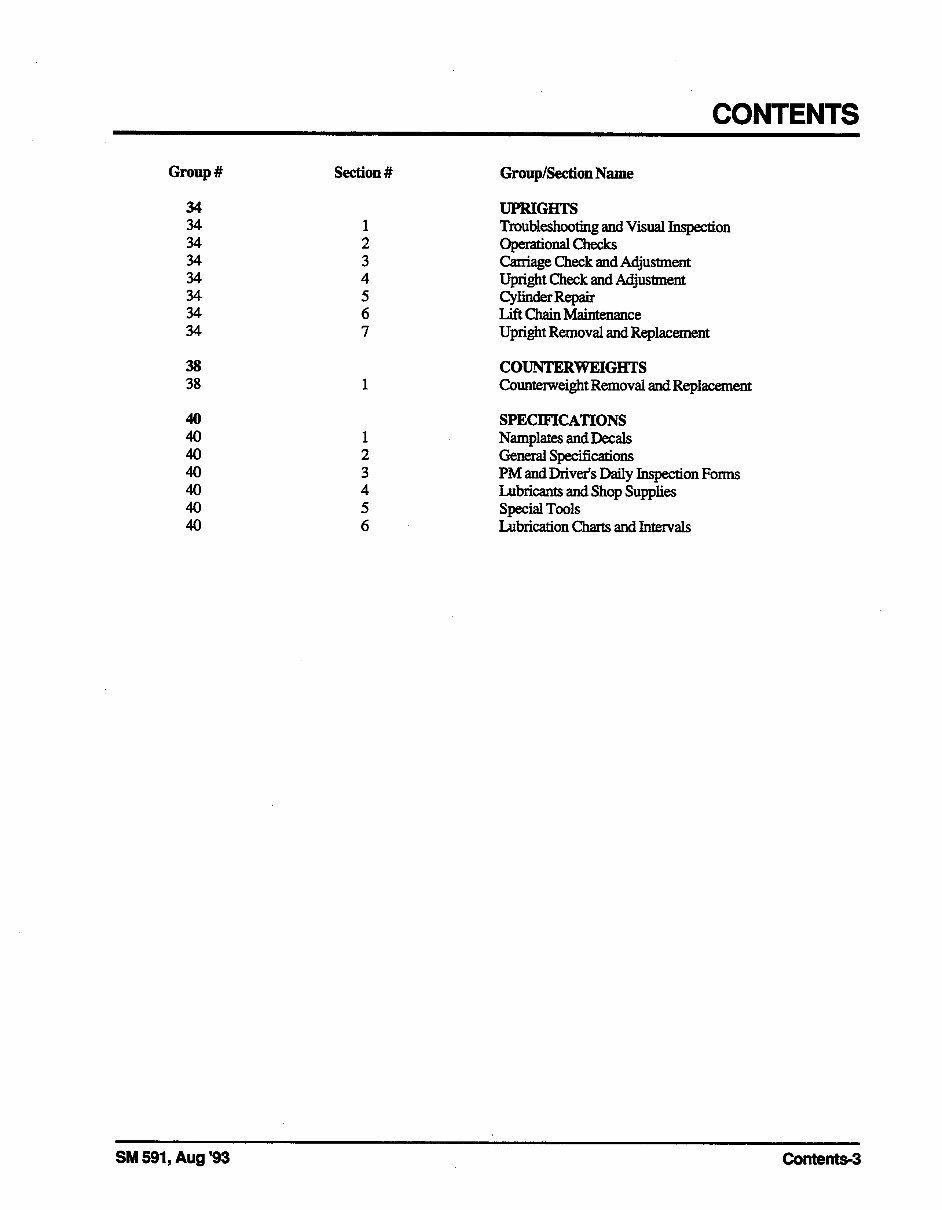
CONTENTS Group # Section# Group/Section Name 34 34 34 34 34 34 34 34 38 38 40 40 40 40 40 40 40 1 1 2 3 4 5 6 UPRIGHTS Troubleshooting and Visual Iqection OpltiOIldChtXkS Carriage Check and Adjustment Upright Check and Adjustment Cylinder Repair Lift ChainMaintenance Upright Removal and Replacement COUNTERWEIGHTS Counterweight Removal and Replacement SPEClFICATIONS Namplates andDecals GxxEralspecifications PM and Driver’s Daily Inqection Forms Lubricants and Shop Supplies Special Tools Lubrication charts and Intervals SM 591, Aug ‘93 C43ntents-3
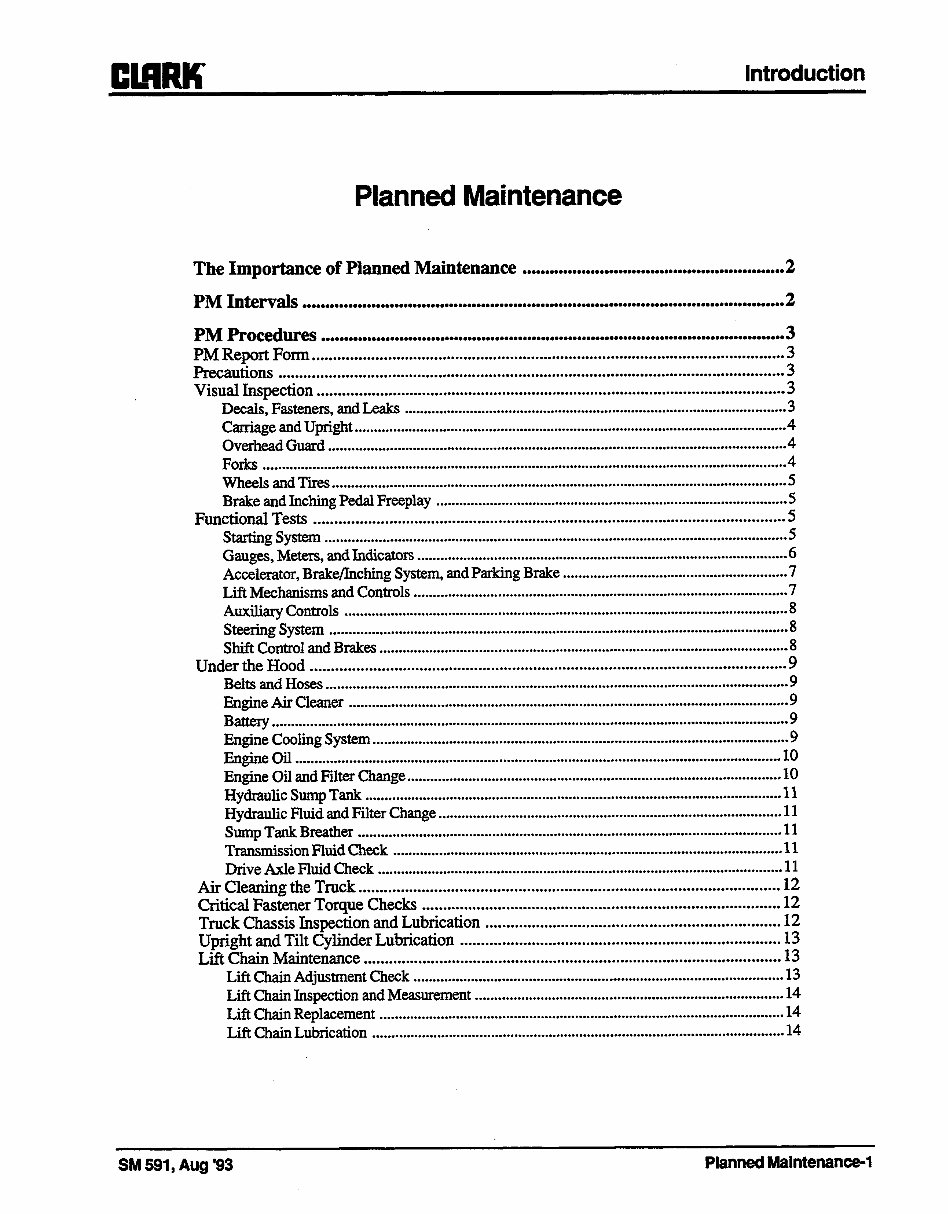
Emw Introduction Planned Maintenance The Importance of Planned Maintenance ......................................................... 2 PM Intervals ......................................................................................................... 2 PM Procedures ..................................................................................................... 3 PM Report Form ................................................................................................................ Precautions ........................................................................................................................ ; Visual Inspection ............................................................................................................... 3 Decals, Fasteners, and Leaks ................................................................................................... 3 Carriage and Upright ................................................................................................................ 4 Overhead Guard ....................................................................................................................... 4 Forks ........................................................................................................................................ 4 Wheels and Tires ...................................................................................................................... 5 Brake and Inching Pedal Freeplay ........................................................................................... Functional Tests ................................................................................................................ : Starting System ........................................................................................................................ 5 Gauges, Meters, and Indicators ................................................................................................ 6 Accelerator, Brake/Inching System, and Parking Brake .......................................................... 7 Lift Mechanisms and Controls ................................................................................................. 7 Auxiliary Controls ................................................................................................................... 8 Steering System ....................................................................................................................... 8 Shift Control and Brakes .......................................................................................................... Under the Hood ................................................................................................................. ; Belts and Hoses ........................................................................................................................ 9 Engine Air Cleaner .................................................................................................................. 9 Battery ...................................................................................................................................... 9 Engine Cooling System ............................................................................................................ 9 Engine Gil .............................................................................................................................. 10 Engine Oil and Filter Change ................................................................................................. 10 Hydraulic Sump Tank ............................................................................................................ 11 Hydraulic Fluid and Filter Change ......................................................................................... 11 SumpTankBreather .............................................................................................................. 11 Transmission Fluid Check ..................................................................................................... 11 Drive Axle Fluid Check ......................................................................................................... 11 Air Cleaning the Truck .................................................................................................... 12 Critical Fastener Torque Checks ..................................................................................... 12 Truck Chassis Inspection and Lubrication ...................................................................... 12 Upright and Tilt Cylinder Lubrication ............................................................................ 13 Lift Chain Maintenance ................................................................................................... 13 Lift Chain Adjustment Check ................................................................................................ 13 Lift Chain Inspection and Measurement ................................................................................ 14 Lift Chain Replacement ......................................................................................................... 14 Lift Chain Lubrication ........................................................................................................... 14 SM 591, Aug ‘93 PlannedMaintenance-1
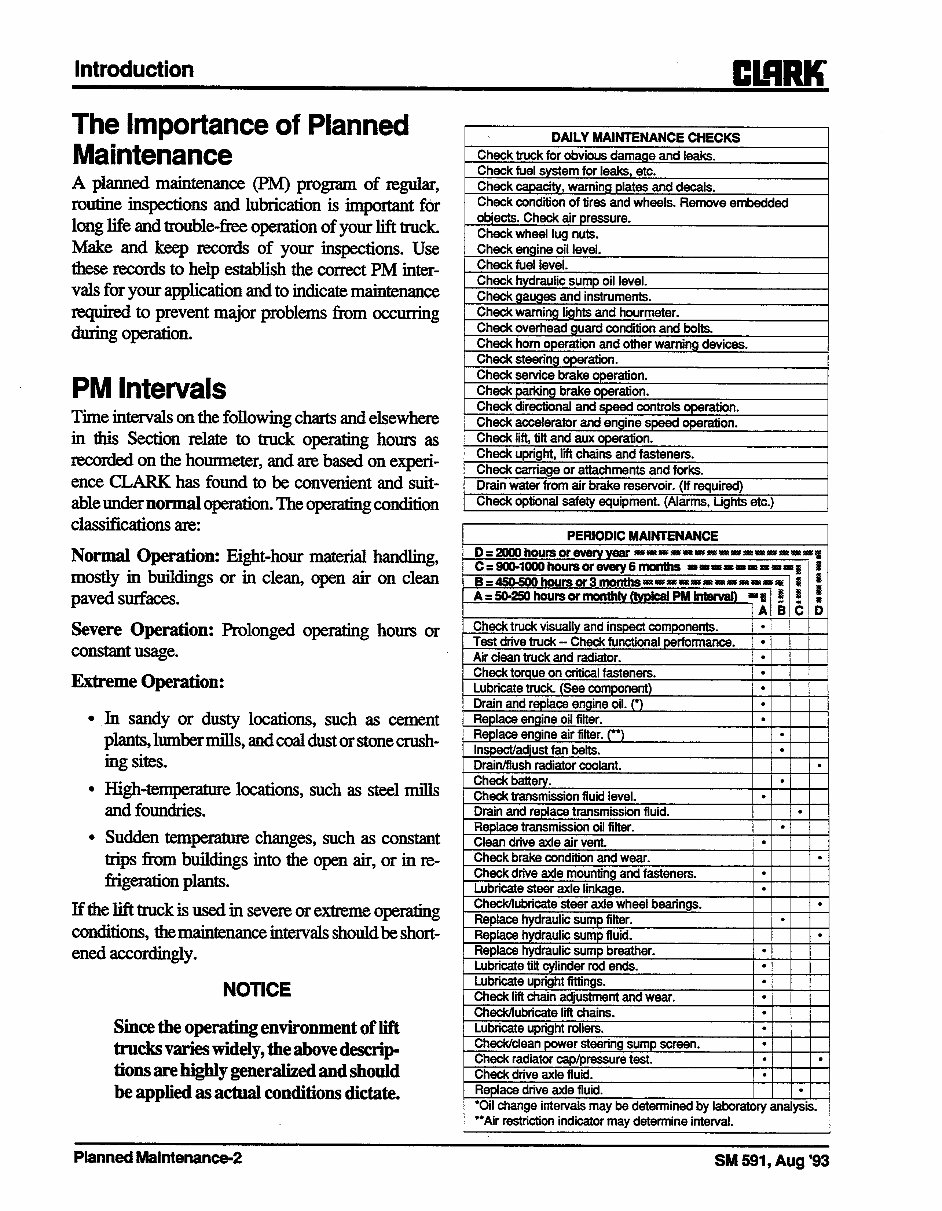
Introduction cl!!mK The Importance of Planned Maintenance A planned maintenance (PM) program of regular, routine inspections and lubrication is important for long life and trouble-free operation of your lift truck. Make and keep records of your inspections. Use these records to help establish the correct PM inter- vals for your application and to indicate maintenance required to prevent major problems from occurring during operation. PM Intervals Time intervals on the following charts and elsewhere in this Section relate to truck operating hours as recorded on the hometer, and ate based on experi- ence CLARK has found to be convenient and suit- able under normal operation. The operating condition classifications are: Normal Operation: Eight-hour material handling, mostly in buikiings or in clean, open air on clean paved surfaces. Severe Operation: Prolonged operating hours or constantusage. Extreme Operation: Jn sandy or dusty locations, such as cement plants,lumbermills,andcoaldustorstonecrush- ing sites. H&h-temperature locations, such as steel mills and foundries. Sudden temperature changes, such as constant trips from buildings into the open air, or in re- frigeration plants. If the lift truck is used in severe or extreme operating conditions, the maintenance intervals shouldbe short- ened accordingly. NOTICE Siucethe operating environment of lift trucksvarieswidely,theabovedescrip- tions are highly generalized and should be applied as actual conditions dictate. “*Air restriction indicator may determine interval. PlannedMaintenance-2 SM 591, Aug ‘93
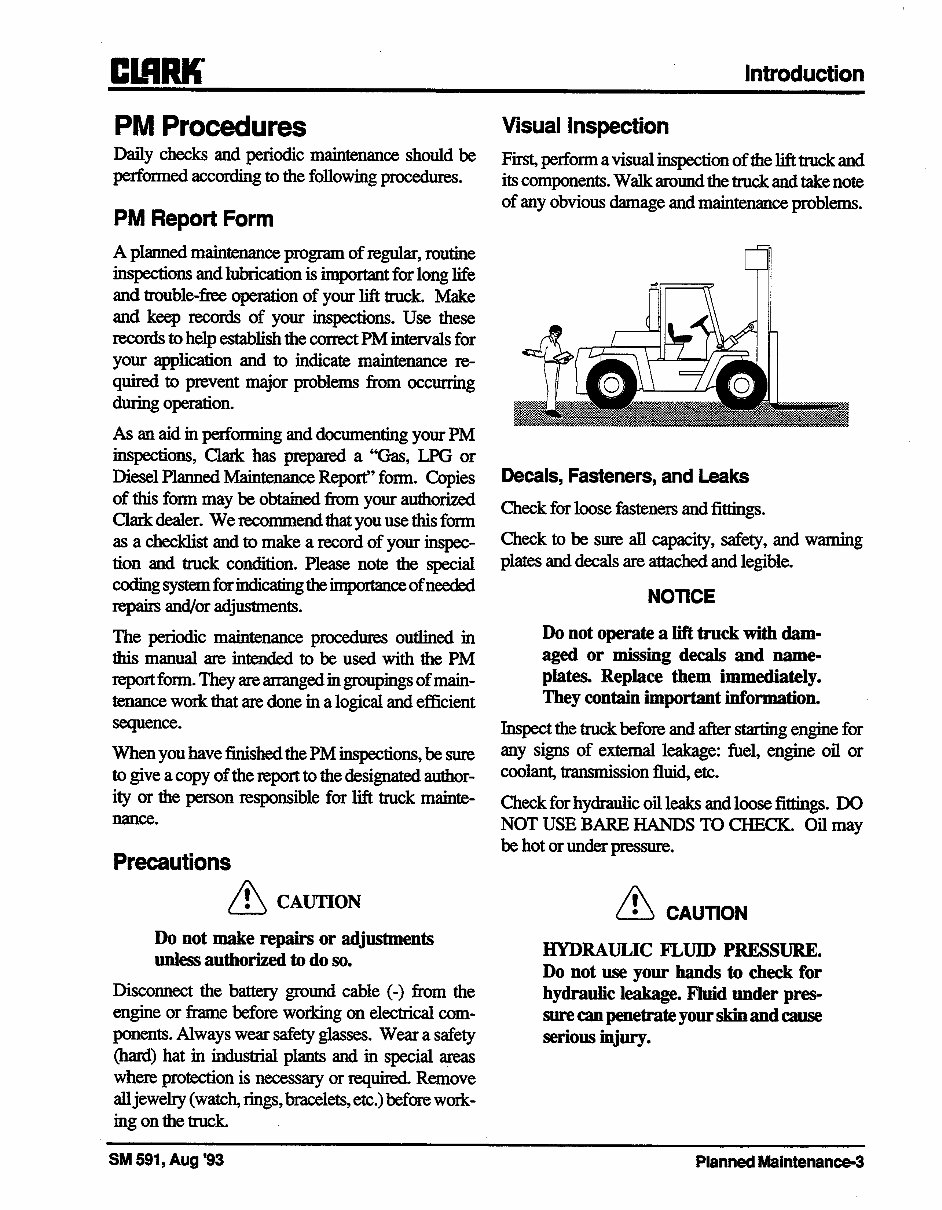
Introduction PM Procedures Visual Inspection Daily checks and periodic maintenance should be performed according to the following procedures. PM Report Form First, perform a visual inspection of the lift truck and its components. Walk around the truck and take note of any obvious damage andmaintenance problems. A planned maintenance program of regular, routine inspections and lubrication is important for long life and trouble-free operation of your lift truck. Make and keep records of your inspections. Use these records to help establish the correct PM intervals for your application and to indicate maintenance re- quired to prevent major problems from occuning during operation. As an aid in performing and documenting your PM inspections, Clark has prepared a “Gas, LPG or Diesel Planned Maintenance Report” form. Copies of this form may be obtained from your authorized Clark dealer. We recommend that you use this form as a checklist and to make a record of your inspec- tion and truck condition. Please note the special codingsystemforindicatingtheimportanceofneeded repairs and/or adjustments. The periodic maintenance procedures outlined in thismanualateintendedtobeusedwiththePM report form. They are arranged in groupings of main- tenance work that are done in a logical and efficient sequence. Decals, Fasteners, and Leaks Check for loose fasteners and fittings. Check to be sure all capacity, safety, and warning plates and decals are attached and legible. NOTICE Do not operate a lift truck with dam- aged or missing decals and name- plates. Replace them immediately. They contain important iuformatio~~ When you have finished the PM inspections, be sure to give a copy of the report to the designated author- ity or the person responsible for lift truck mainte- nance. Inspect the truck before and after starting engine for any signs of extemal leakage: fuel, engine oil or coolant, transmission fluid, etc. Precautions /\ ! CAUTION Do not make repairs or adjustments unless authorized to do so. Check for hydraulic oil leaks and loose fittings. DO NOT USE BARE HANDS TO CHECK. Oil may be hot or under pressure. A ! CAUTION Disconnect the battery ground cable (-) from the engine or frame before working on electrical com- ponents. Always wear safety glasses. Wear a safety (hard) hat in industrial plants and in special areas where protection is necessary or required Remove all jewehy (watch rings, bracelets, etc.) before work- ing on the truck HYDRAULIC FLUID PREssuRE. Do not use your hands to check for hydraulic leakage. Fluid under pres- surecaupenetrateyourskinandcause serious injury. SM 591, Aug ‘93 PlannedMaintenance-3
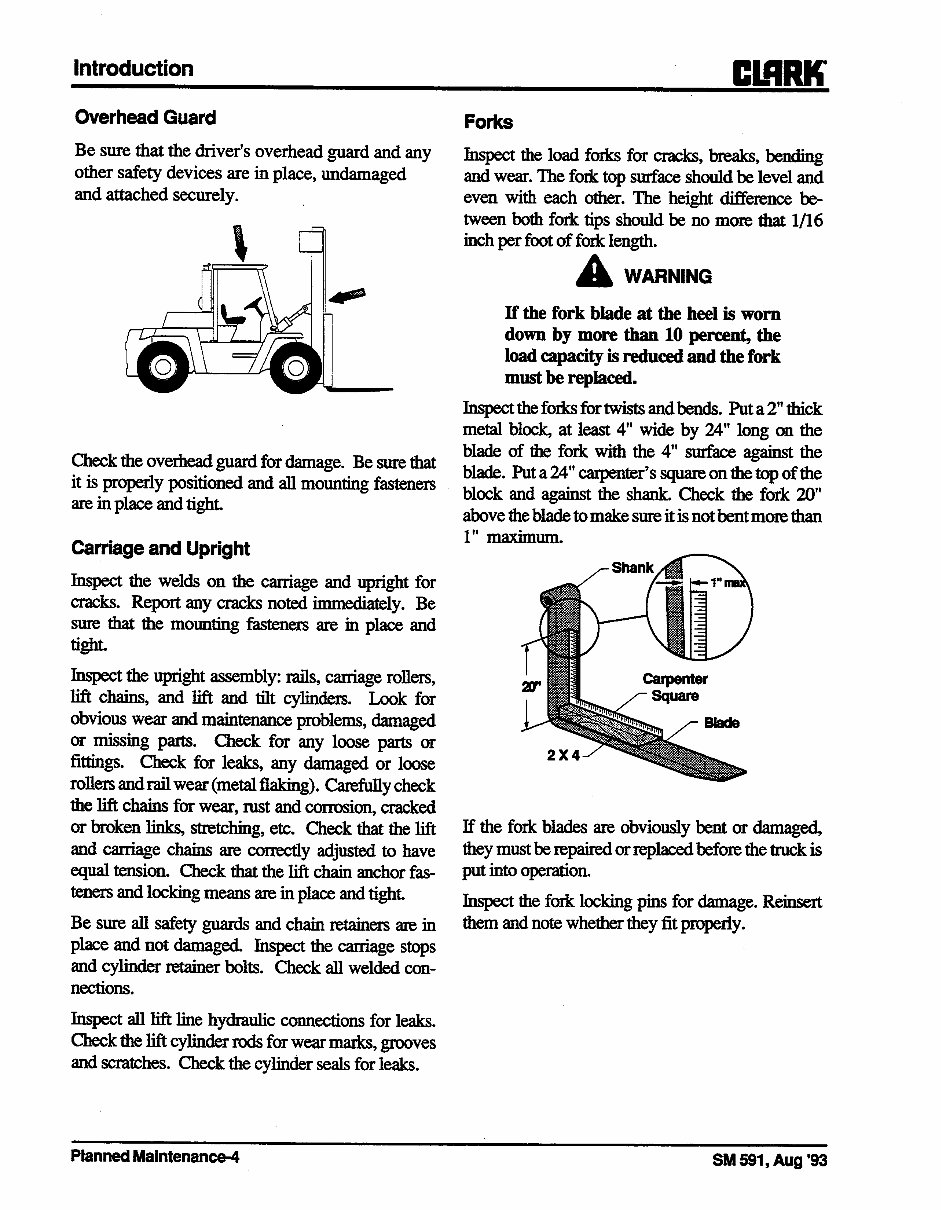
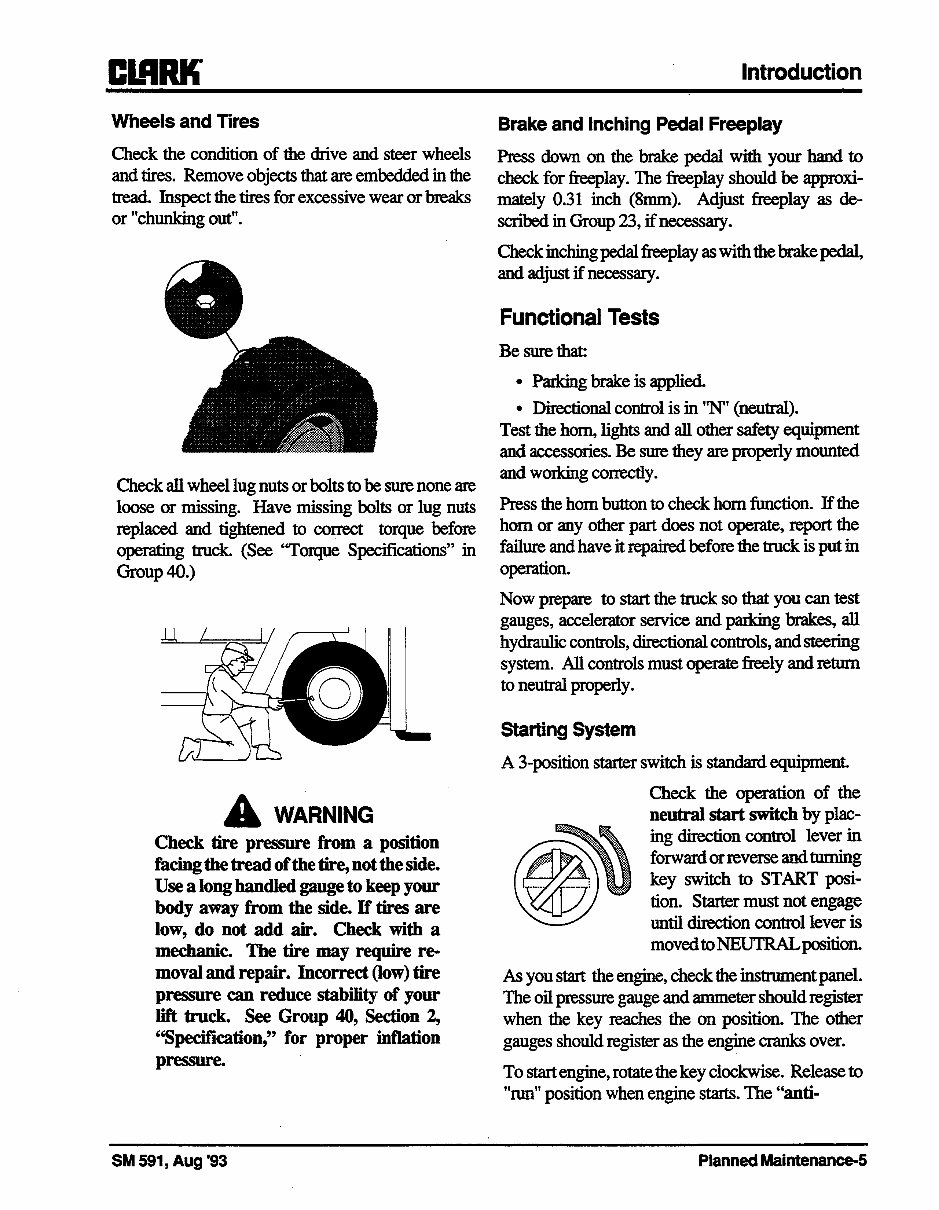
Introduction el!!mK OverheadGuard Forks Be sure that the driver’s overhead guard and any other safety devices are in place, undamaged and attached securely. Inspectthe load forks for cracks, breaks, bending and wear. The fork top surface should be level and even with each other. The height difference be- tween both fork tips should be no more that l/16 inch per foot of fork length. Check the overhead guard for damage. Be sure that it is properly positioned and all mounting fasteners are in place and tight. Carriageand Upright Inspect the welds on the carriage and upright for cracks. Report any cracks noted immediately. Be sum that the mounting fasteners are in place and tight. Inspect the upright assembly: rails, carriage rollers, lift chains, and lift and tilt cylinders. Look for obvious wear and maintenance problems, damaged or missing parts. Check for any loose parts or fittings. Check for leaks, any damaged or loose rollers and rail wear (metal flaking). Carefully check the lift chains for wear, rust and corrosion, cracked or broken links, stretching, etc. Check that the hft and carriage chains are cornxtly adjusted to have equal tension. Check that the lift chain anchor fas- teners and locking means are in place and tight Besureallsafetyguardsandchainretainersamin place and not damaged. Jnspect the carriage stops and cylinder retainer bolts. Check all welded con- nections. Jnspect all lift line hydraulic connections for leaks. Check the lift cylinder rods for wear marks, grooves and scratches. Check the cylinder seals for leaks. A WARNING If the fork blade at the heel is worn down by more than 10 percent, the load capacity is reduced and the fork must be replaced. Inspecttheforksfortwistsandbends. Puta2”thick metal block, at least 4” wide by 24” long on the blade of the fork with the 4” surface against the blade. Put a 24” carpenter’s square on the top of the block and against the shank. Check the fork 20” above the blade to make sure it is not bent more than 1” maximum. If the fork blades ate obviously bent or damaged, they mustbetepairedorreplacedbefore the track is put into operation. Inspect the fork locking pins for damage. Reinsert them and note whether they fit properly. PlannedMaintenance-rl SM 591, Aug ‘93
Introduction Wheels and Tires Check the condition of the drive and steer wheels and tires. Remove objects that ate embedded in the tread. Inspect the tires for excessive wear or breaks or “chunking out”. Check all wheel lug nuts or bolts to be sure none are loose or missing. Have missing bolts or lug nuts replaced and tightened to correct torque before opemting truck (See ‘Torque Specifications” in Group 40.) A WARNING Check tire pressure from a position facing the tread of the tire, not the side. Use a long handled gauge to keep your body away from the side. If tires are low, do not add air. Check with a mechanic. The tire may require re- moval and repair. Incorrect (low) tire pressure can reduce stability of your lift truck. See Group 40, Section 2, T@ecification,” for proper inflation Pm Brake and Inching Pedal Freeplay Pxessdownonthebrakepedalwithyourhandto check for &play. The freeplay should be approxi- mately 0.31 inch (8mm). Adjust fieeplay as de- scribed in Group 23, if necessary. checkinchingpedalfreeplayaswiththebrakepedal, and adjust if necessary. Functional Tests Besurethat: l Parking brake is applied. l Directional control is in ‘W’ (neutral). Test the horn, lights and all other safety equipment and accessories. Be sure they are properly mounted and working correctly. Press the horn button to check horn function. If the horn or any other part does not operate, report the faihu-e and have it repaired before the truck is put in operation. Now prepare to start the truck so that you can test gauges, accelerator service and parking brakes, all hydraulic controls, directional controls, and steering system. All controls must operate freely and return to neutral properly. Starting System A 3position starter switch is standard equipment. Check the operation of the neutral start switch by plac- ing direction control lever in forwardorreverseandturning key switch to START posi- tion. Starter must not engage until dim&ion control lever is movedtoNEUTRALposition. As you start the engine, check the instrument panel. The oil pressure gauge and ammeter should register when the key reaches the on position. The other gauges should register as the engine cranks over. To start engine, rotate the key clockwise. Release to “run” position when engine starts. The “anti- SM 591, Aug ‘93 PlannedMaintenance-5
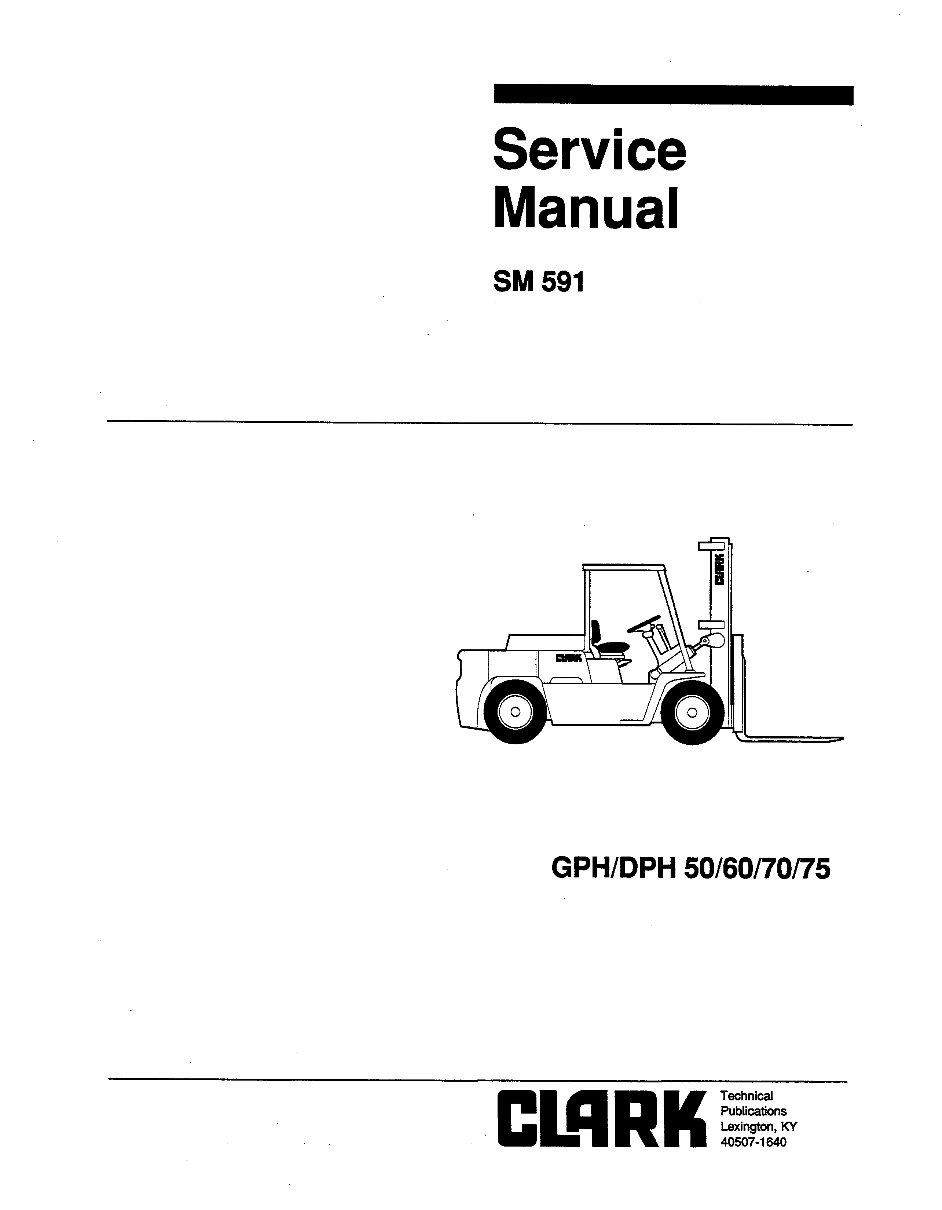
This is a comprehensive Service Repair Manual for the Clark GPH 50, GPH 60, GPH 70, GPH 75, DPH 50, DPH 60, DPH 70, DPH 75 Forklift. It contains detailed information about maintenance, assembly, disassembly, and servicing of your Clark Forklift.
Models Covered:
CLARK GPH 50 FORKLIFT
CLARK GPH 60 FORKLIFT
CLARK GPH 70 FORKLIFT
CLARK GPH 75 FORKLIFT
CLARK DPH 50 FORKLIFT
CLARK DPH 60 FORKLIFT
CLARK DPH 70 FORKLIFT
CLARK DPH 75 FORKLIFT
Table of Contents:
Planned Maintenance
Engines
Cooling System
Fuel System
Transmission
Electrical System
Drive Axle
Prop Shaft
Wheels and Tires
Braking/Inching
Steering Column and Gear
Steer Axle
Hydraulic Sump, Filters, and Pump
Hydraulic Valve
Tilt Cylinders
Uprights
Specifications
Model Specification: Clark GPH 50, GPH 60, GPH 70, GPH 75, DPH 50, DPH 60, DPH 70, DPH 75 Forklift
Language: English
Total Pages: 794
File Format: .PDF
Requirements: Adobe Reader
Zoom In/Out: Yes
Printable: Yes
Compatible: All Versions of Windows & Mac
This manual contains information, data, specs, diagrams, actual real photo illustrations, and schemes. It is a valuable resource for diagnosing, repairing, and maintaining Clark machinery.
All manuals are compatible with Windows 7, Vista 32 and 64, XP, ME, 98, NT, 2000, and Mac.
Upon receipt of your payment, you can find, print, use, and dispose of it. The manual includes numerous pictures and diagrams for easy reference. All pages are printable, allowing you to take the necessary information with you into the garage or workshop. By following the step-by-step instructions, these manuals make it easy for any skill level to save money by doing their own repairs.



 Lifetime Access