Contents General information GEN INFO 0 Specification SPEC 1 Technical features and description TECH FEA 2 Rigging information RIG GING 3 Troubleshooting TRBL SHTG 4 Electrical system ELEC 5 Fuel system FUEL 6 Power unit POWR 7 Lower unit LOWR 8 Bracket unit BRKT 9 Maintenance MNT 10 Index Appendix A
GEN INFO 0 1 2 3 4 5 6 7 8 9 10 A General information 0 Safety while working .................................................... 0-1 Rotating part .............................................................................. 0-1 Hot part ...................................................................................... 0-1 Electric shock ............................................................................ 0-1 Propeller .................................................................................... 0-1 Handling of gasoline .................................................................. 0-1 Ventilation .................................................................................. 0-1 Self-protection ........................................................................... 0-2 Working with crane .................................................................... 0-2 Handling of gas torch ................................................................ 0-2 Part, lubricant, and sealant ........................................................ 0-2 Handling of sealant .................................................................... 0-3 Special service tool ................................................................... 0-3 Tightening torque ...................................................................... 0-3 Non-reusable part ...................................................................... 0-3 Disassembly and assembly ....................................................... 0-3 How to use this manual .................................................... 0-4 Manual format ........................................................................... 0-4 Abbreviation .............................................................................. 0-5 Lubricant, sealant, and thread locking agent ................. 0-6 Symbol ...................................................................................... 0-6 Special service tool ........................................................... 0-8
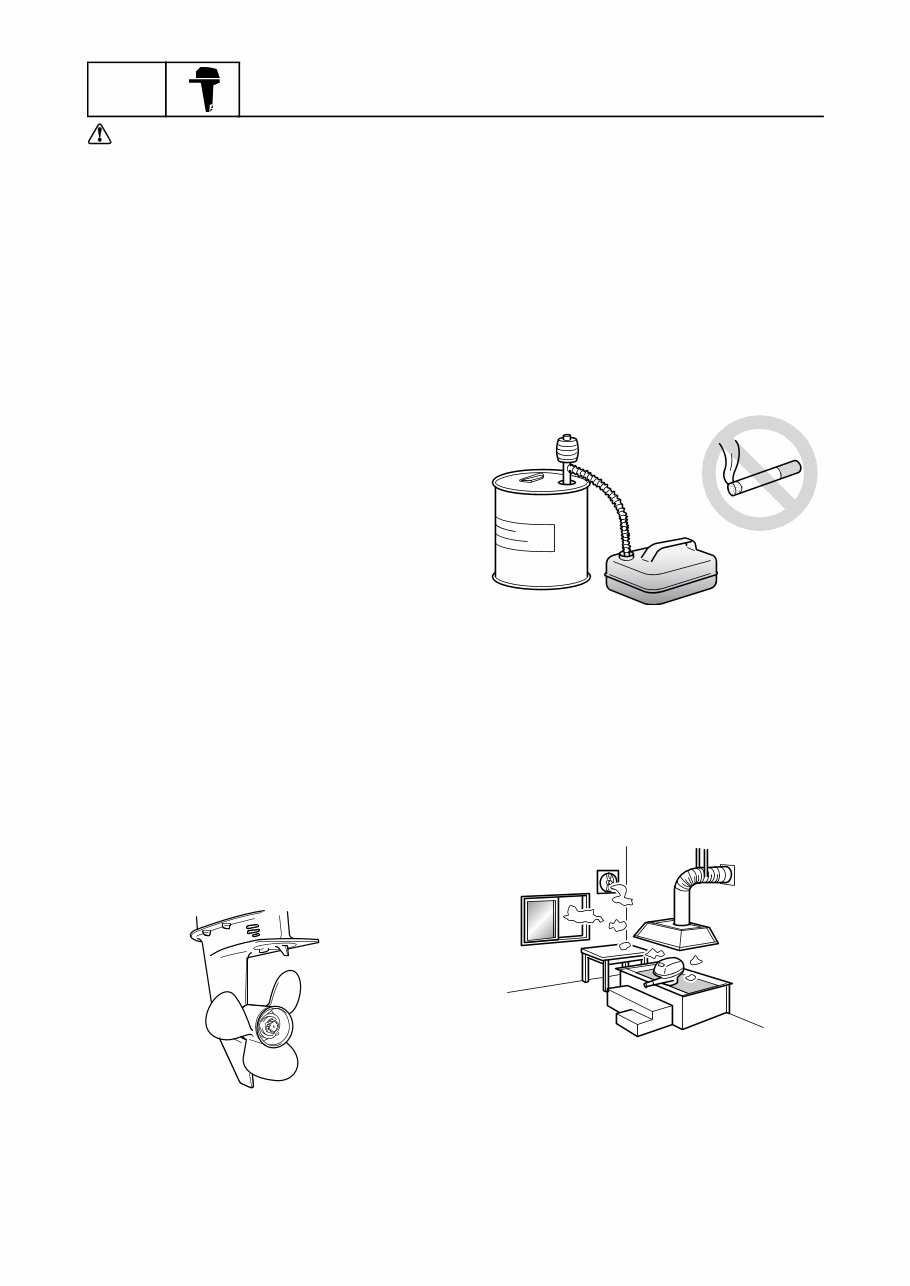
0-1 GEN INFO General information Safety while working To prevent an accident or injury and to pro- vide quality service, observe the following safety procedures. Rotating part • Hands, feet, hair, jewelry, clothing, personal flotation device straps, and so on, can become entangled with internal rotating parts of the engine, resulting in serious injury or death. • Keep the top cowling installed whenever possible. Do not remove or install the top cowling when the engine is running. • Only operate the engine with the top cowl- ing removed according to the specific instructions in the manual. Keep hands, feet, hair, jewelry, clothing, personal flota- tion device straps, and so on, away from any exposed moving parts. Hot part During and after operation, engine parts are hot enough to cause burns. Do not touch any parts under the top cowling until the engine has cooled. Electric shock Do not touch any electrical parts while start- ing or operating the engine. Otherwise, shock or electrocution could result. Propeller Do not hold the propeller with your hands when loosening or tightening the propeller nut. Handling of gasoline • Gasoline is highly flammable. Keep gaso- line and all flammable products away from heat, sparks, and open flames. • Gasoline is poisonous and can cause injury or death. Handle gasoline with care. Never siphon gasoline by mouth. If you swallow some gasoline, inhale a lot of gasoline vapor, or get some gasoline in your eyes, see your doctor immediately. If gasoline spills on your skin, wash with soap and water. If gasoline spills on your clothing, change your clothes. Ventilation • Gasoline vapor and exhaust gas are heavier than air and extremely poisonous. If gasoline vapor or exhaust gas is inhaled in large quantities, it may cause loss of con- sciousness and death within a short time. • When test running an engine indoors (for example, in a water tank) make sure to do so where adequate ventilation can be main- tained.
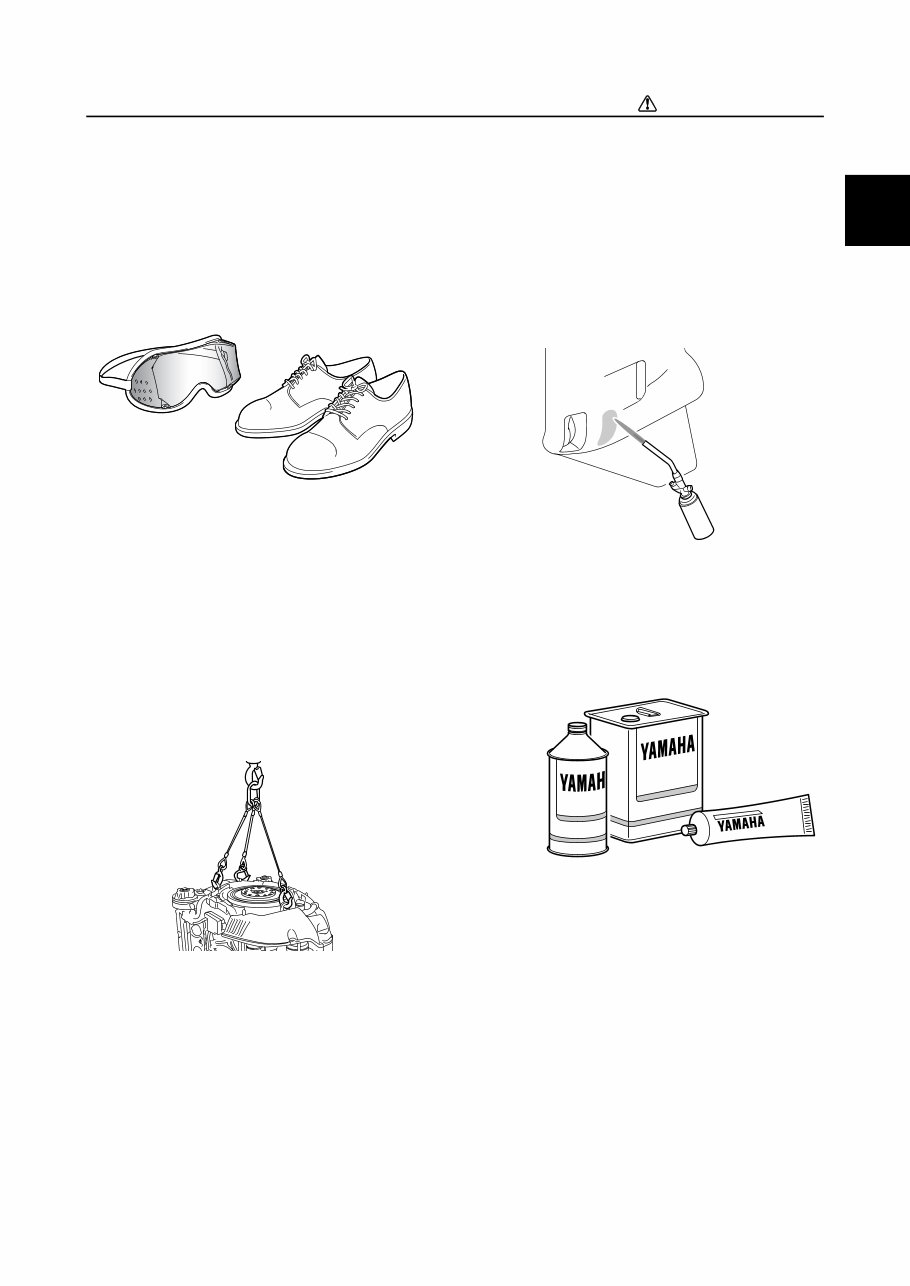
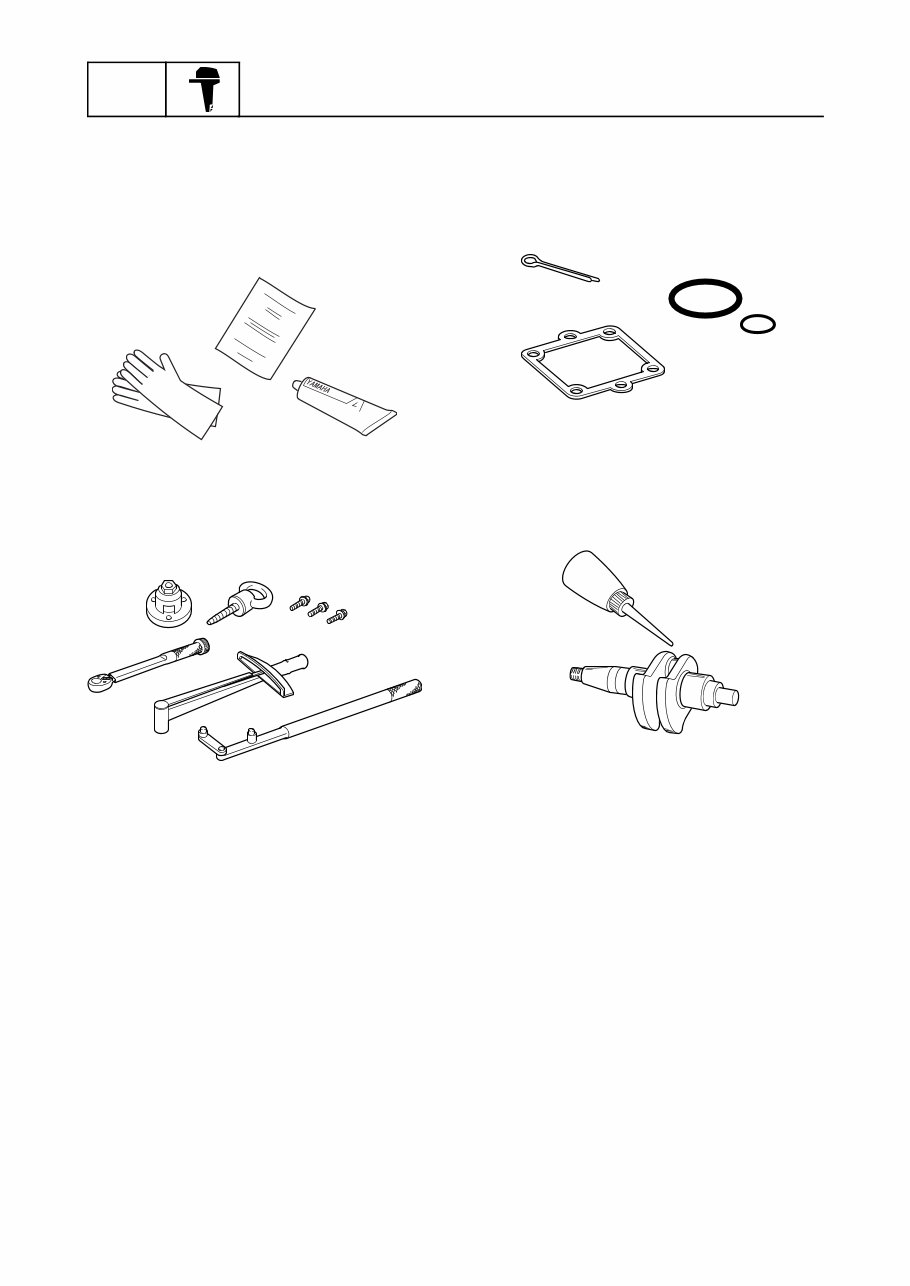
0-2 Safety while working 0 1 2 3 4 5 6 7 8 9 10 A Self-protection • Protect your eyes by wearing safety glasses or safety goggles during all opera- tions involving drilling and grinding, or when using an air compressor. • Protect your hands and feet by wearing pro- tective gloves and safety shoes when nec- essary. Working with crane • Outboard motors weighing 18.0 kg (39.7 lb) and over must be carried by a crane. • Use the wire ropes of adequate strength, and lift up the outboard motor using the three-point suspension. • If the outboard motor does not have three or more points to be suspended, support it using additional ropes, or the like, so that the outboard motor can be lifted and carried in a stable manner. Handling of gas torch • Improper handling of a gas torch may result in burns. For information on the proper han- dling of the gas torch, see the operation manual issued by the manufacturer. • When using a gas torch, keep it away from the gasoline and oil, to prevent a fire. • Components become hot enough to cause burns. Do not touch any hot components directly. Part, lubricant, and sealant Use only genuine Yamaha parts, lubricants, and sealants, or those recommended by Yamaha, when servicing or repairing the out- board motor.
0-3 GEN INFO General information Handling of sealant • Wear protective gloves to protect your skin, when using the sealants. • See the material safety data sheet issued by the manufacturer. Some of the sealants may be harmful to human health. Special service tool Use the recommended special service tools to work safely, and to protect parts from dam- age. Tightening torque When tightening nuts, bolts, and screws, fol- low the tightening instructions provided throughout the manual. If the tightening order is not specified, tighten the large sizes first, and then tighten the small sizes, starting from the center and moving outward. Non-reusable part Always use new gaskets, seals, O-rings, cot- ter pins, and so on, when installing or assem- bling parts. Disassembly and assembly • Use compressed air to remove dust and dirt during disassembly. • Apply engine oil to the contact surfaces of moving parts before assembly. • Install bearings so that the bearing identifi- cation mark is facing in the direction indi- cated in the installation procedure. In addition, make sure to lubricate the bear- ings liberally. • Apply a thin coat of water resistant grease to the lip and periphery of an oil seal before installation. • Check that moving parts operate normally after assembly.
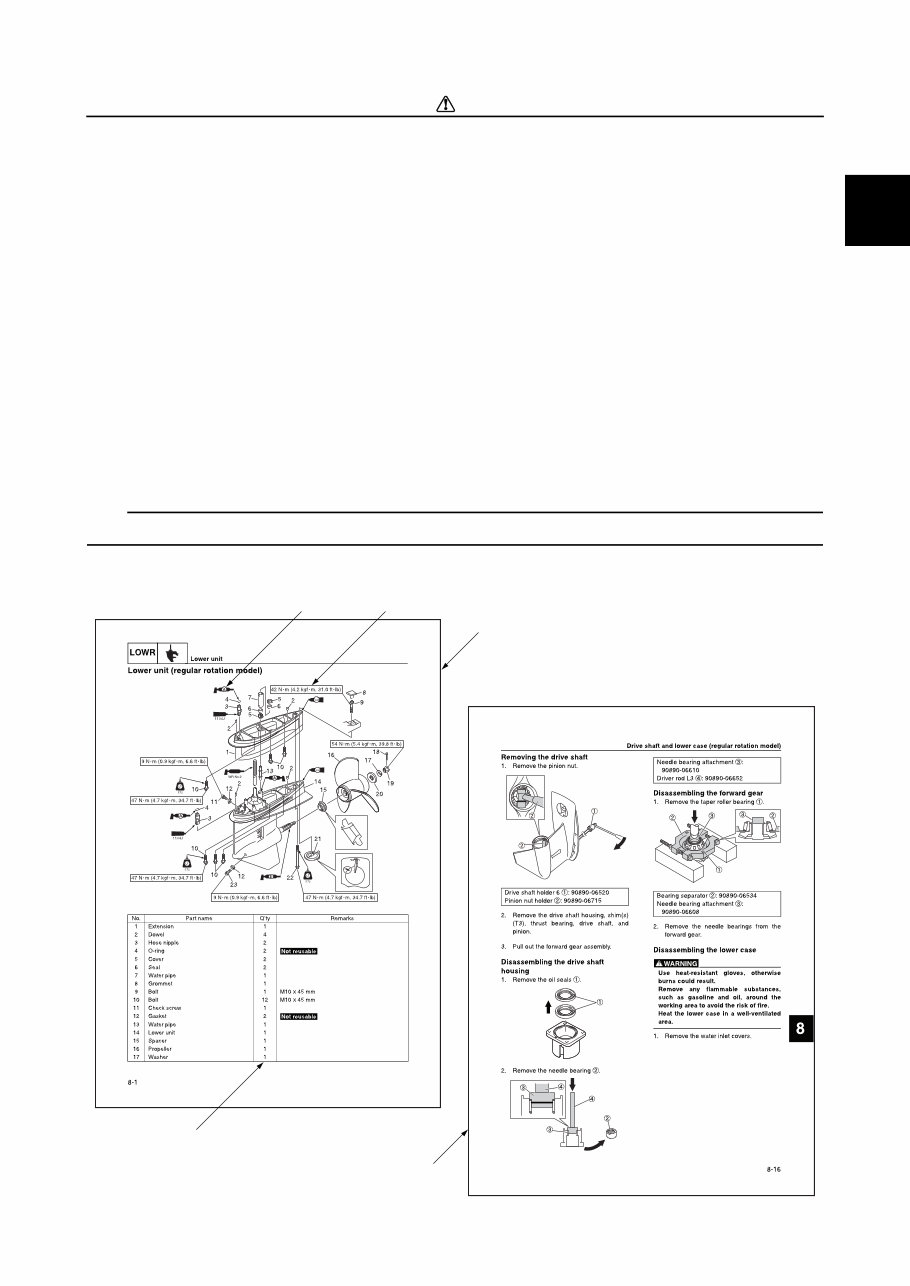
0-4 0 1 2 3 4 5 6 7 8 9 10 A How to use this manual Manual format The format of this manual has been designed to make service procedures clear and easy to under- stand. Use the following information as a guide for effective and quality service. • Parts are shown and detailed in an exploded diagram and are listed in the component list (see a in the following figure for an example page). • The component list consists of part names and quantities, as well as bolt and screw dimensions (see b in the following figure). • Symbols are used to indicate important aspects of a procedure, such as the grade of lubricant and the lubrication points (see c in the following figure). • Tightening torque specifications are provided in the exploded diagrams (see d in the following fig- ure), and in the related detailed instructions. Some torque specifications are listed in stages as torque figures or angles in degrees. • Separate procedures and illustrations are used to explain the details of removal, checking, and installation where necessary (see e in the following figure for an example page). TIP: For troubleshooting procedures, see Chapter 4, “Troubleshooting.” e b c d a Safety while working / How to use this manual
0-5 GEN INFO General information Abbreviation The following abbreviations are used in this service manual. Abbreviation Description ABYC American Boat and Yacht Council API American Petroleum Institute ATF Automatic Transmission Fluid BTDC Before Top Dead Center CARB California Air Resources Board CCA Cold Cranking Ampere C/E Check Engine DN Down side ECM Electronic Control Module EPA Environmental Protection Agency EX Exhaust F Forward ID Identification IN Intake ISO International Organization for Standardization ISC Idle Speed Control MCA Marine Cranking Ampere N Neutral PON Pump Octane Number PORT Port side PTT Power Trim and Tilt R Reverse RC Reserve Capacity SAE Society of Automotive Engineers SOHC Single Overhead Camshaft STBD Starboard side TCI Transistor-Controlled Ignition TDC Top Dead Center TPS Throttle Position Sensor UP Up side W/F Water in Fuel Y-COP Yamaha Customer Outboard Protection YDIS Yamaha Diagnostic System
Get your hands on the 2010-2014 Yamaha 70HP 4-Stroke Outboard (F70) OEM Service & Repair Manual, manual number LIT-18616-03-25. This comprehensive 406-page manual is recommended by Yamaha tech pubs for all F70 4-stroke models produced between 2010 and 2014.
General Information
Periodic Inspection and Adjustments
Fuel System
Power Unit
Lower Unit
Electrical System
Bracket Unit
Specification
Troubleshooting
Many subsections of the above sections
This manual provides detailed wiring and circuit diagrams, illustrations, photos, exploded views, and step-by-step instructions. It covers diagnostic procedures and includes technical information essential for service and repair. Designed for professional mechanics and DIY enthusiasts alike, this English language PDF file is compatible with all versions of Windows and Mac, enabling you to print pages as needed without delay. Simplify your maintenance tasks and save on dealer labor costs with this indispensable guide for your Yamaha 70HP outboard engine.




 Lifetime Access