



1956-1970 1,5-40hp Outboard Repair Manual
What's Included?
 Lifetime Access
Fast Download Speeds
Online & Offline Access
Access PDF Contents & Bookmarks
Full Search Facility
Print one or all pages of your manual

TABLE OF CONTENTS
1 SAFETY TOP SEAL 3-12
Removal 3-12
INTRODUCTION 1-1 BOTTOM SEAL
3-13
CLEANING, WAXING, Inspection 3-14-
AND POLISHING 1-1 CENTERING PINS
3-15
CONTROLLING CORROSION 1-2
PROPELLERS 1-2
MAIN BEARING BOLTS
FUEL SYSTEM 1-7
AND CRANKCASE SIDE BOLTS 3-15
LOADING 1-9
CRANKCASE COVER 3-16
HORSEPOWER 1-10
Removal 3-16
FLOTATION 1-10
Cleaning and Inspecting 3-16
EMERGENCY EQUIPMENT 1-12
CONNECTING RODS
COMPASS 1-15
AND PISTONS 3-16
STEERING 1-17
Removal 3-17
ANCHORS 1-17
Disassembly 3-18
MISCELLANEOUS EQUIP MENT 1-18
Rod Inspection
BOATING ACCIDENT REPORTS 1-19
and Service 3-21
NAVIGATION 1-19
Piston and Ring Inspection
and Service 3-22
2 TUNING
Assembling
3-24-
CRANKSHAFT 3-27
INTRODUCTION 2-1
Removal 3-27
TUNE-UP SEQUENCE 2-2
Cleaning and Inspection 3-27
COMPRESSION CHECK 2-3
Assembling 3-28
SPARK PLUG INSPECTION 2-4-
IGNITION SYSTEM 2-4- CYLINDER BLOCK SERVICE 3-28
SYNCHRONIZING 2-5 Honing Procedures 3-29
BATTERY SERVICE 2-5 Assembling 3-30
CARBURETOR ADJUSTMENTS 2-7 Piston and Rod Assembly
FUEL PUMPS 2-9 Installation 3-30
ST AR TER AND SOLENOID 2-10 Crankshaft Installation
INTERNAL WIRING HARNESS 2-11 Large Horsepower Engines
WATER PUMP CHECK 2-12
15 hp to 4-0hp 3-33
PROPELLER 2-13 Crankshaft Installation
LOWER UNIT 2-14- Small Horsepower Engines
BOAT TESTING 2-15 1.5 hp, 5.0 hp, 5.5 hp,
6.0 hp, 9.5 hp 3-35
3 POWERHEAD Crankshaft Installation
Small Horsepower Engines
INTRODUCTION
3-1
3.0 hp, 4-.0 hp, 7.5 hp 3-37
Theory of Operation 3-1 Crankcase Cover Installation 3-38
CHAPTER ORGANIZATION 3-4- Main Bearing Bolt and Crankcase
POWERHEAD DISASSEMBLING 3-5 Side Bolt Installation 3-39
HEAD SERVICE
3-5 Bottom Seal Installation
REED SERVICE
3-6
15 hp to 4-0hp Engines 3-39
Description 3-6
Exhaust Cover and Bypass
Reed Valve Adjustment 3-8 Cover Installation 3-4-0
Cleaning and Service 3-9 Reed Box Installation
3-4-0
BYPASS COVERS 3-10
Head Installation 3-4-1
EXHAUST COVER 3-11 BREAK-IN PROCEDURES
3-4-1
Cleaning 3-11 EXPLODED DRAWINGS 3-4-2- 3-50

".
FUEL SYNCHRONIZA TION FUEL AND
IGNITION SYSTEMS 5-26
INTRODUCTION 4--1 Primary Pickup Adjustments
GENERAL CARBURETION and Locations 5-26
INFORMATION 4--1
FUEL SYSTEM
4--4-
6 ELECTRICAL
TROUBLESHOOTING
4--4-
Fuel Pump Tests 4--6 INTRODUCTION 6-1
Fuel Line Test 4--7 BATTERIES 6-1
Testing with Pressure Tank 4--8 Mar ine Batteries 6-1
Rough Engine Idle 4--10
Battery Construction 6-2
Excessive Fuel Consumption 4--11 Battery Location 6-2
CARBURETORS 4--12 Battery Service 6-2
TYPE I CARBURETOR 4--13 Jumper Cables 6-5
Removal and Disassembling 4--13 Dual Battery Installation 6-5
Cleaning and Inspecting 4--15 GAUGES AND HORNS 6-7
Assembling 4--16 Constant-Voltage System 6-7
CHOKE SYSTEM SERVICE 4--23 SERVICE PROCEDURES 6-7
Heat/Electric Choke 4--23 Temperature Gauges 6-7
All Electric Choke 4--25 Warning Lights
Water Choke 4--26 Thermomelt Sticks 6-8
TYPE II CARBURETOR 4--28 FUEL SYSTEM 6-8
Disassembling 4--28 Fuel Gauge 6-8
Cleaning and Inspecting 4--31 Fuel Gauge Hookup 6-8
Assembling 4--33 Troubleshooting 6-9
ASSEMBLING CHOKES TO TACHOMETER 6-10
TYPE II CARBURETORS 4--38 HORNS 6-10
Adjustments 4--42
ELECTRICAL SYSTEM GENERAL
TYPE III CARBURETORS 4--43
INFORMA TION 6-11
Removal
4--4-3
CHARGING CIRCUIT SERVICE 6-12
Cleaning and Inspecting 4--45
Troubleshooting 6-12
Assembling 4--47
Generator Service 6-16
Adjustments 4--50
Armature Testing 6-17
FUEL PUMP SERVICE 4--51
Cleaning and Inspecting 6-18
Troubleshooting 4--52
Assembling 6-20
Removal and Repair 4--52
CHOKE CIRCUIT SERVICE 6-22
Cleaning and Inspecting 4-54-
STARTER MOTOR CIRCUIT
Assembling and Installation
4--54-
SERVICE 6-22
FUEL TANK AND LINE SERVICE 4--57
Circuit Description 6-22
Disassembling 4--58
Starter Motor Description 6-22
Cleaning and Inspecting 4--61
Troubleshooting 6-24
Assembling 4--61
Testing
6-25
LATE MODEL FUEL TANK
STARTER DRIVE GEAR SERVICE 6-26
SERVICE 4--67
Starter Removal 6-26
5 IGNITION
Drive Gear Disassembling 6-27
Cleaning and Inspecting 6-27
INTRODUCTION 5-1
Assembling Type I Drive 6-28
SPARK PLUG EVALUATION 5-2
Disassembling Type II 6-28
POLARITY CHECK 5-3
Cleaning and Inspecting 6-28
WIRING HARNESS 5-4-
Assembling Type II Drive 6-28
FLYWHEEL MAGNETO IGNITION 5-5
DELCO-REMY SERVICE 6-29
TROUBLESHOOTING 5-6
Removal
6-29
SERVICING FLYWHEEL MAGNETO
Disassembling
IGNITION SYSTEM 5-13
6-29
Removal 5-13
Armature Testing 6-30
Cleaning and Inspecting 5-19
Cleaning and Inspecting 6-31
Assembling
5-20
Assembling 6-32

6 ELECTRICAL (CONT)
AUTOLITE STARTER MOTOR
SERVICE 6-34
Removal 6-34
Disassembling 6-35
Armature Testing 6-35
Cleaning and Inspecting 6-37
Assembling 6-37
PRESTOLITE STARTER MOTOR
SERVICE 6-39
Removal 6':'39
Disassembling 6-40
Armature Testing 6-40
Cleaning and Inspecting 6-42
Assembling 6-43
STARTER MOTOR TESTING 6-44
STARTER MOTOR
INSTALLATION 6-44
7 ACCESSORIES
INTRODUCTION
SHIFT BOXES
Description
OLD-STYLE DOUBLE LEVER
Troubleshooting
Disassembling
Cleaning and Inspection
Assembling
NEW-STYLE SHIFT LEVER
Troubleshooting
Removal
Disassembling
Cleaning and Inspecting
Assembling
ELECTRIC GEAR BOXES AND
SINGLE LEVER CONTROL 7-12
Troubleshooting 7-12
Disassembling 7-14
Cleaning and Inspecting 7-15
Assembling 7-16
PUSH BUTTON SHIFT BOX SERVICE
EVINRUDE UNITS ONLY 7-18
Troubleshooting 7-19
Disassembling 7-21
Cleaning and Inspecting 7-22
Assembling 7-22
CABLE END FITTING INSTALLA-
TION AT THE ENGINE END 7-24
8· LOWER UNIT
7-1
7-1
7-1
7-3
7-3
7-4
7-5
7-5
7-6
7-6
7-8
7-8
7-9
7-10
DESCRIPTION
Chapter Coverage
Illustrations
TROUBLESHOOTING
MANUAL SHIFT
PROPELLER REMOVAL
8-1
8-1
8-2
8-2
8-7
DRAINING LOWER UNIT
LOWER UNIT SERVICE
1.5 hp to 4.0 hp -- NO SHIFT
Lower Unit Removal
Water Pump Removal
Disassembling
Cleaning and Inspecting
Assembling
Water Pump Installation
Lower Unit Installation
Filling the Lower Unit
Propeller Installation
LOWER UNIT SERVICE
MANUAL SHIFT -- 5 HP
TO 25 HP
Removal
Water Pump Removal
Disassembling
Cleaning and Inspecting
Assembling
Water Pump Installation
Lower Unit Installation
LOWER UNIT SERVICE
MANUAL SHIFT -- 28 HP
TO 40 HP
Removal
Water Pump Removal
Disassem bling
Cleaning and Inspecting
Assembling
Lower Unit Installation
ELECTROMA TIC LOWER UNIT
Description
Troubleshooting
Removal
Disassembling
Cleaning and Inspecting
Assembling
Water Pump Installation
Lower Unit Installation
9 HAND STARTERS
INTRODUCTION
Operation
TYPE I STAR TER
CYLINDER WITH PINION GEAR
5 HP and 6 HP ENGINES
Starter Rope Replacement
Removal
Installation
Starter Removal
Disassembling
Cleaning and Inspecting
Assembling
8-8
8-8
8-9
8-9
8-10
8-11
8-13
8-14
8-15
8-16
8-16
8-17
8-19
8-19
8-20
8-22
8-28
8-31
8-33
8-36
8-37
8-38
8-38
8-41
8-46
8-50
8-53
8-53
8-53
8-56
8-57
8-65
8-66
8-72
8-74
9-1
9-2
9-3
9-4
9-4
9-4
9-5
9-7
9-7
9-7

9 HAND STARTERS (CONT)
- TYPE I STARTER
CYLINDER WITH PINION GEAR
ALL 9.5 HP ENGINES 9-11
Starter Rope Replacement 9-11
Removal 9-11
Installation 9-12
Starter Removal 9-12
Cleaning and Inspecting 9-14
Assembling 9-14
Installation 9-15
TYPE II STARTER
COIL SPRING WITH SWING ARM
DRIVE GEAR
3HP1968
4 HP 1969-70
Removal
Disassembling
Cleaning and Inspecting
Assembling
TYPE III STARTER
MOUNTED ATOP FL YWHEEL
MODEL WITH RETURN SPRINGS
28 HP 1962-63
30 HP1956
35 HP 1957-59
40 HP 1960-63
Removal
Cleaning and Inspecting
Assembling
Rope Installation
Starter Installation
TYPE III STARTER
MOUNTED ATOP FLYWHEEL
MODEL WITH NO RETURN SPRINGS
28HP1964
33 HP 1965-70
40 HP 1964-70
Removal
Cleaning and Inspecting
Assembling
Rope Installation
Starter Installation
TYPE III STARTER
MOUNTED ATOP FLYWHEEL
MODEL WITH ONE NYLON PAWL
3 HP 1956-68
5.5 HP 1956-64
7.5 HP 1956-58
10 HP 1956-63
15 HP 1956
18 HP 1956-70
20 HP 1966-70
25 HP 1969-70
9-17
9-17
9-17
9-20
9-20
9-23
9-24
9-26
9-27
9-29
9-30
9-31
9-32
9-34
9-34
9-37
9-39
9-39
Removal 9-40
Disassembling 9-40
Cleaning and Inspecting 9-42
Assembling 9-43
Rope Installation 9-43
Starter Installation 9-46
10 MAINTENANCE
INTRODUCTION
ENGINE SERIAL NUMBERS
FIBERGLASS HULLS
ALUMINUM HULLS
BELOW WATERLINE SERVICE
SUBMERGED ENGINE SERVICE
WINTER STORAGE
LOWER UNIT SERVICE
Propeller
BATTERY STORAGE
PRESEASON PREPARATION
10-1
10-2
10-3
10-3
10-4
10-5
10-7
10-9
10-9
10-13
10-13
APPENDIX
METRIC CONVERSION CHART
DRILL SIZE CONVERSION CHART
TORQUE SPECIFICATIONS
POWERHEAD SPECS
TUNE-UP SPECS
GEAR OIL CAPACITIES
STARTER MOTOR SPECS
REGULA TOR SPECS
GENERATOR SPECS
CONDENSER SPECS
STAR TER ROPE SPECS
A-I
A-2
A-3
A-4 & A-5
A-6 to AI0
A-ll
A-12
A-12
A-12
A-13
A-14
WIRE INDENTIFICATION ORA WINGS
20 hp and 25 hp -- 1971-72 A-15
33 hp with Generator -- 1965-67 A-16
33 hp with Generator -- 1968 A-17
33 hp with Generator -- 1969-70 A-18
35hp--1957-59 A-19
40 hp Standard Shift
with Generator -- 1960-66 A-20
40 hp Standard Shift
with Generator -- 1967-68 A-21
40 hp Standard Shift
with Generator -- 1969-70 A-22
40 hp Electric Shift
with Generator -- 1961-66 A-23
40 hp Electric Shift
with Generator -- 1967-68 A-24
40 hp Electric Shift
with Generator -- 1969-70 A-25

1
SAFETY
1-1 INTRODUCTION
Your boat probably represents a sizeable
investment for you. In order to protect this
investment and to receive the maximum
amount of enjoyment from your boat it must
be cared for properly while being used and
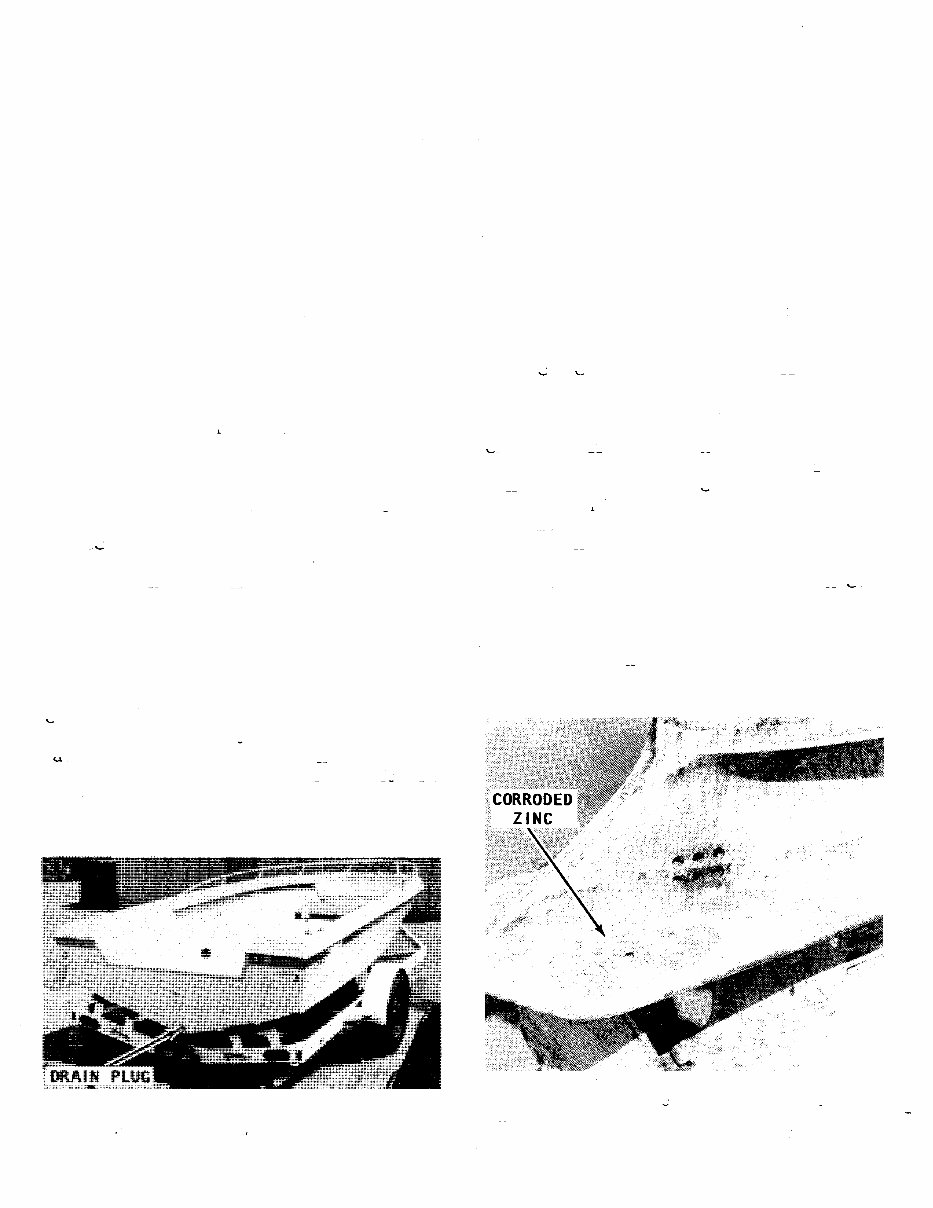
when it is out of the water. Always store
your boat with the bow higher than the stern
and be sure to remove the transom drain
plug and the inner hull drain plugs. If you
use any type of cover to protect your boat,
plastic, canvas, whatever, be sure to allow
for some movement of air through the hull.
Proper ventilation will assure evaporation of
any condensation that may form due to
changes in temperature and humidity.
1-2 CLEANING, \VAXING, AND POLISHING
An outboard boat should be washed with
clear water after each use to remove sur-
face dirt and any salt deposits from use in
sal t water. Regular rinsing will extend the
time between waxing and polishing. It will
also give you "pride of ownership", by
having a sharp looking piece of equipment.
Elbow grease, a mild detergent, and a brush
Whenever the boat is stored, for long or short
periods, the bow should be slightly higher than the stern
and the drain plug in the transom removed to ensure
proper drainage of rain water.
will be required to remove stubborn dirt, oil,
and other unsightly deposits.
Stay away from harsh abrasives or strong
chemical cleaners. A white buffing com-
pound can be used to restore the original
gloss to a scratched, dull, or faded area.
The finish of your boat should be thoroughly
cleaned, buffed, and polished at least once
each season. Take care when buffing or
polishing with a marine cleaner not to over-
heat the surface you are working, because
you will burn it.
A small outboard engine mounted on an
aluminum boat should be removed from the
boat and stored separately. Under all cir-
cumstances, any outboard engine must AL-
WA YS be stored with the power head higher
than the lower unit and exhaust system.
This position will prevent water trapped in
the lower unit from draining back through
the exhaust ports into the power head.
Lower unit badly corroded because the zinc was not
replaced. Once the zinc is destroyed, more costly parts
will be damaged. Attention to the zinc condition is
extremely important during boat operation in salt
water.
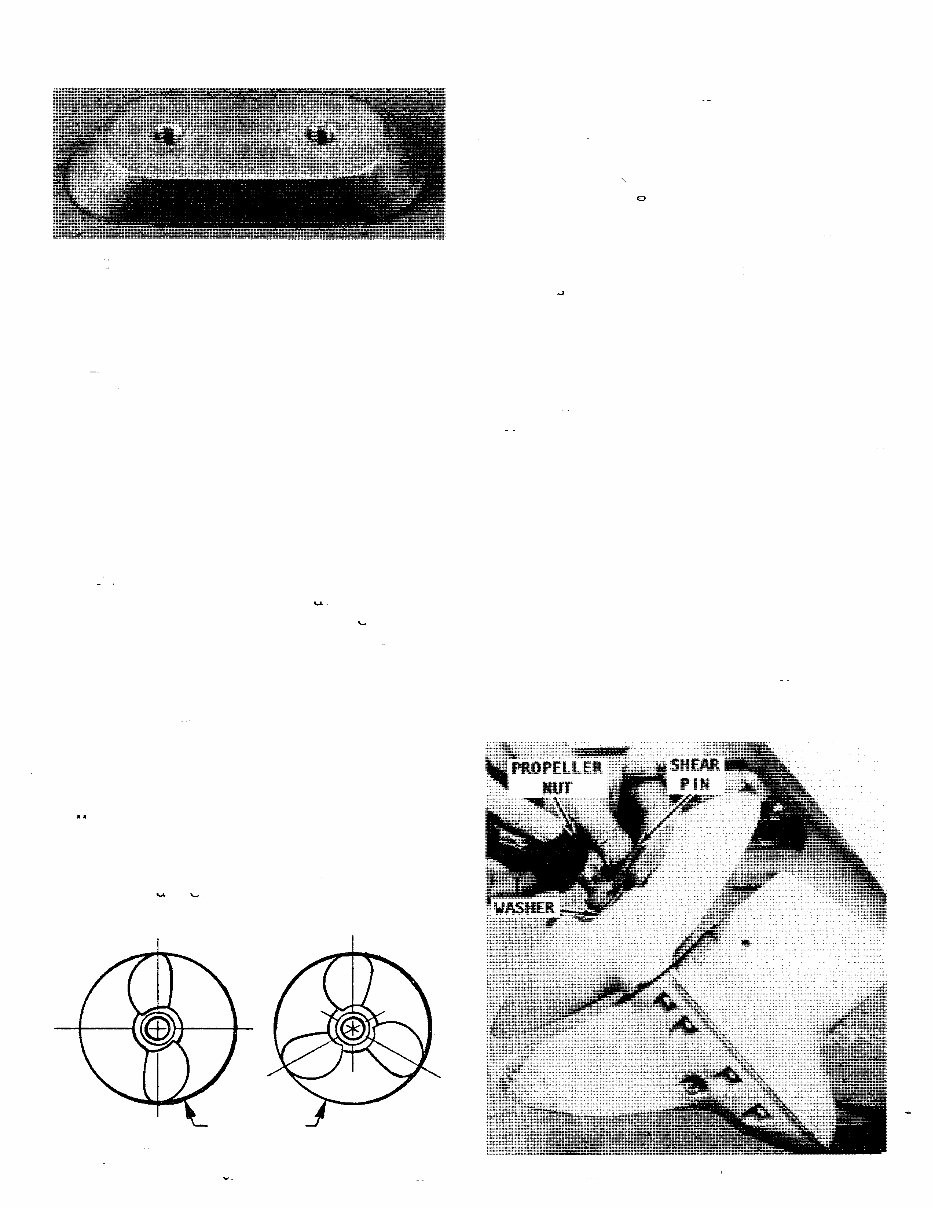
1-2 SAFETY
A new zinc prior to installation. This inexpensive
item will save corrosion on more valuable parts.
Most outboard engines have a flat area
on the back side of the powerhead. When
the engine is placed with the flat area on
the power head and the lower unit resting on
the floor, the engine will be in the proper
altitude with the power head higher than the
lower unit.
1-3 CONTROLLING CORROSION
Since man first started out on the water,
corrosion on his craft has been his enemy.
The first form was merely rot in the wood
and then it was rust, followed by other
forms of destructive corrosion in the more
modern materials. One defense against cor-
rosion is to use similar metals throughout
the boat. Even though this is difficult to do
in designing a new boat, particularily the
undersides, similar metals should be used
whenever and wherever possible.
A second defense against corrosion is to
insulate dissimilar metals. This can be done
by using an exter ior coating of Sea Skin or
by insulating them with plastic or rubber
gaskets.
Using Zinc
The proper amount of zinc attached to a
boat is extremely important. The use of too
much zinc can cause wood burning by plac-
ing the metals close together and they be-
come "hot". On the other hand, using too
DIAMETER
Diameter and pitch are the two basic dimensions of
a propeller. The diameter is measured across the
circumference of a circle scribed by the propeller
blades, as shown.
small a zinc plate will cause more rapid
deterioration of the metal you- are trying to
protect. If in doubt, consider the fact that
is is far better to replace the zincs than to
replace planking or other expensive metal
parts from having an excess of zinc.
When installing zinc plates, there are
two routes available. One is to install many
different zincs on all metal parts and thus
run the risk of wood burning. Another
route, is to use one large zinc on the tran-
som of the boat and then connect this zinc
to every underwater metal part through
internal bonding. Of the two choices, the
one zinc on the transom is the better way to
go.
Small outboard engines have a zinc plate
attached to the cavitation plate. Therefore,
the zinc remains with the engine at all
times.
1-4 PROPELLERS
As you know, the propeller is actually
what moves the boat through the water.
This is how it is done. The propeller oper-
ates in water in much the manner as a wood
screw does in wood. The propeller "bites"
into the water as it rotates. Water passes
between the blades and out to the rear in
the shape of a cone. The propeller "biting"
through the water in much the same manner
as a wood auger is what propels the boat.
Propeller and associated parts in order, washer,
shear-pin, and nut, ready for installation.
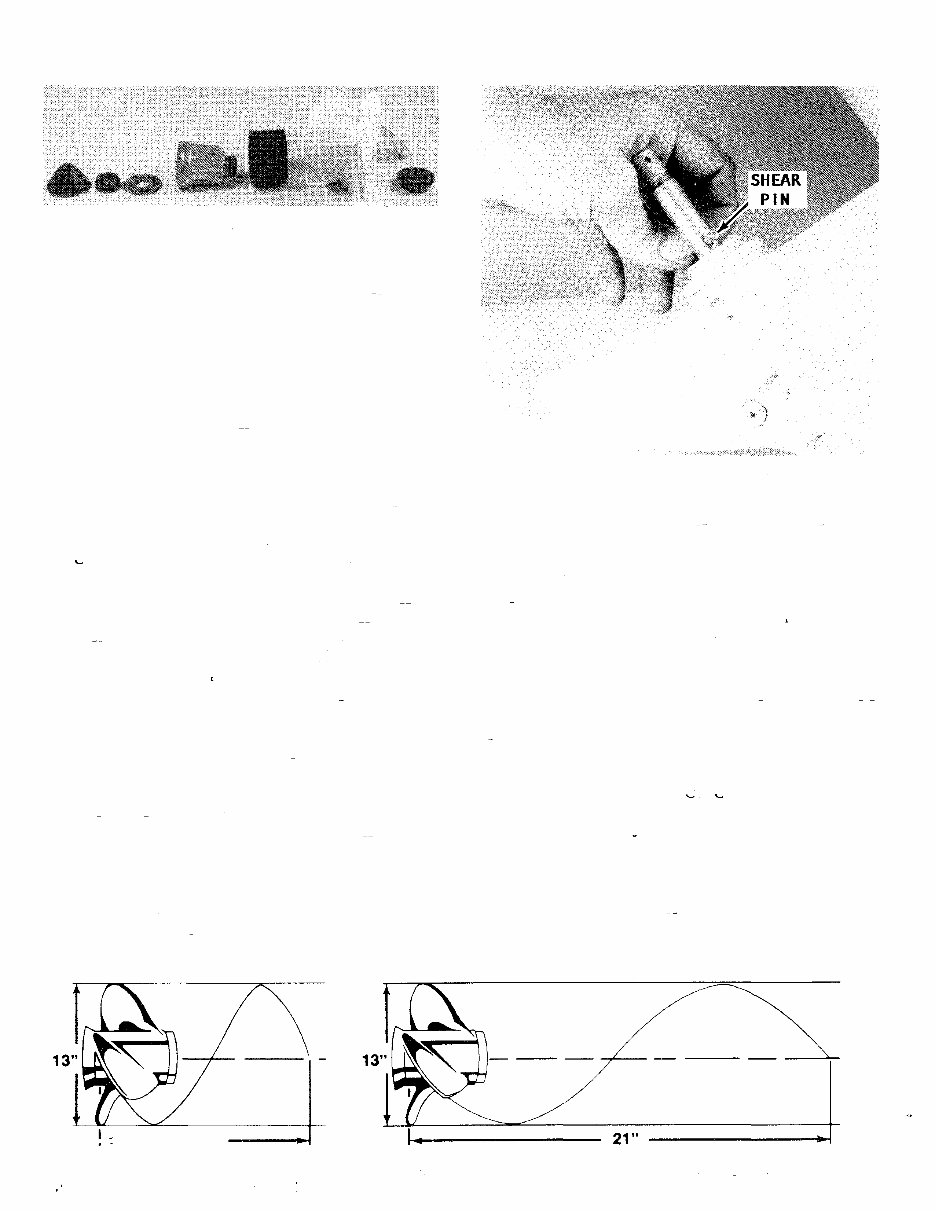
Arrangement of propeller and associated parts, in
order, for a small horsepower engine.
Diameter and Pitch
Only two dimensions of the propeller are
of real interest to the boat owner: the
diameter and the pitch. These two dimen-
sions are stamped on the propeller hub and
always appear in the same order: the diam-
eter first and then the pitch. For instance,
the number 15-19 stamped on the hub,
would mean the propeller had a diameter of
15 inches with a pitch of 19.
The diameter is the measured distance
from the tip of one blade to the tip of the
other as shown in the accompanying illus-
tration.
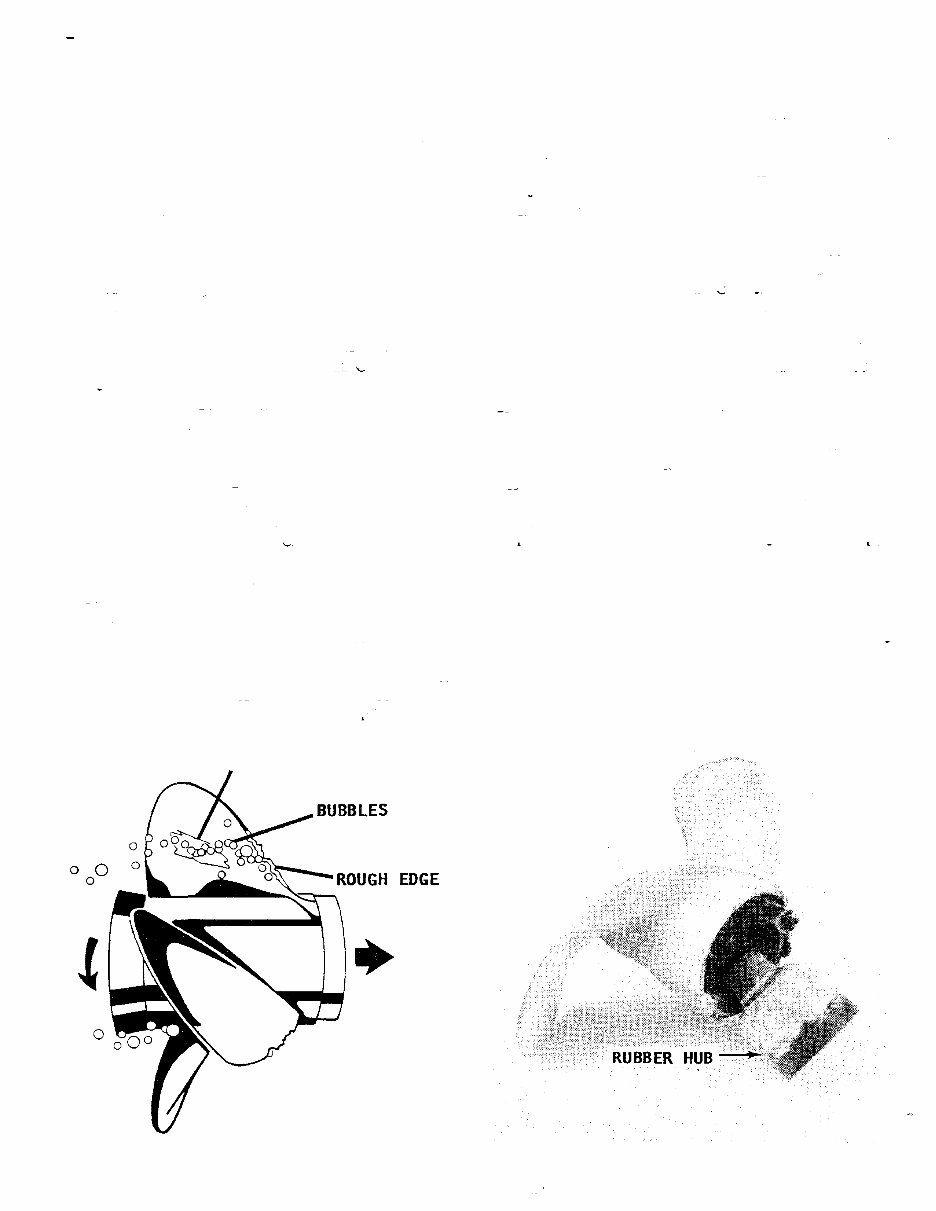
The pitch of a propeller is the angle at
which the blades are attached to the hub.
This figure is expressed in inches of water
travel for each revolution of the propeller.
In our example of a 15-19 propeller, the
propeller should travel 19 inches through the
water each time it revolves. If the propel-
ler action was perfect and there was no
slippage, then the pitch multiplied by the
propeller rpms would be the boat speed.
Most outboard manufacturers equip their
units with a standard propeller with a diam-
eter and pitch they consider to be best
suited to the engine and the boat. Such a
propeller allows the engine to run as near to
the rated rpm and horsepower (at full throt-
tle) as possible for the boat design.
The blade area of the propeller deter-
mines its load-carrying capacity. A two-
blade propeller is used for high-speed run-
ning under very light loads.
PROPELLERS 1-3
Shear-pin installed behind the propeller instead of in
front of the propeller.
A four-blade propeller is installed in
boats intended to operate at low speeds
under very heavy loads such as tugs, barges,
or large houseboats. The three-blade pro-
peller is the happy medium covering the
wide range between the high performahce
units and the load carrying workhorses.
Propeller Selection
There is no standard propeller that will
do the proper job in very many cases. The
list of sizes and weights of boats is almost
endless. This fact coupled with the many
boat-engine combinations makes the propel-
ler selection for a specific purpose a diffi-
cult job. In fact, in many cases the propel-
ler is changed after a few test runs. Proper
selection is aided through the use of charts
set up for various engines and boats. These
charts should be studied and understood
when buying a propeller. However, bear in
mind, the charts are based on average boats
-----10 ..
Diagram to explain the pitch dimension of a propeller. The pitch is the theoretical distance a propeller would travel
through the water if there was no slippage.
1-4 SAFETY
with average loads, therefore, it may be
necessary to make a change in size or pitch,
in order to obtain the desired results for the
hull design or load condition.
A wide range of pitch is available for
each of the larger horsepower engines. The
choice available for the smaller engines, up
to about 25 hp, is restricted to one or two
sizes. Remember, a low pitch takes a
smaller bite of the water than the high pitch
propeller. This means the low pitch propel-
ler will travel less distance through the
water per revolution. The low pitch will
require less horsepower and will allow the
engine to run faster and more efficiently.
It stands to reason, and it's true, that the
high pitch propeller will require more horse-
power, but will give faster boat speed if the
engine is allowed to tu rn to its rated rpm.
If a higher-pitched propeller is installed
on a boat, in an effort to get more speed,
extra horsepower will be required. If the
extra power is not available, the rpms will
be reduced to a less efficient level and the
actual boat speed will be less than if the
lower-pitched propeller had been left in-
stalled.
All engine manufacturers design their
units to operate with full throttle at, or
slightly above, the rated rpm. If you run
your engine at the rated rpm, you will
increase spark plug life, receive better fuel
economy, and obtain the best performance
CAVITATION BURN
o
Cavitation (air bubbles) formed at the propeller.
Manufacturers are constantly fighting this problem, as
explained in the text.
from your boat and engine. Therefore, take
time to make the proper propeller selection
for the rated rpm of your engine at full
throttle with what you consider to be an
average load. Your boat will then be cor-
rectly balanced between engine and pro-
peller throughout the entire speed range.
A reliable tachom eter must be used to
measure engine speed at full throttle to
ensure the engine will achieve full horse-
power and operate efficiently and safely.
To test for the correct propeller, make your
run in a body of smooth water with the
lower unit in forward gear at full throttle.
Observe the tachometer at full throttle.
NEVER run the engine at a high rpm when a
flush attachment is installed. If the reading
is above the manufacturer's recommended
operating range, you must try propellers of
greater pitch, until you find the one that
allows the engine to operate continually
within the recommended full throttle range.
If the engine is unable to deliver top
performance and you feel it is properly
tuned, then the propeller may not be to
blame. Operating conditions have a marked
effect on performance. For instance, an
engine will lose rpm when run in very cold
water. It will also lose rpm when run in salt
water as compared with fresh water. A hot,
low-barometer day will also cause your en-
gine to lose power.
Example of a damaged propeller. This unit should
have been replaced long before this amount of damage
was sustained.
Ventilation
Ventilation is the forming of voids in the
water just ahead of the propeller blades.
Marine propulsion designers are constantly
fighting the battle against the formation of
these voids due to excessive blade tip speed
and engine wear. The voids may be filled
with air or water vapor, or they may actual-
ly be a partial vacuum. Ventilation may be
caused by installing a piece of equipment
too close to the lower unit, such as the knot
indicator pickup, depth sounder, or bait tank
pickup.
Vibration
Your propeller should be checked reg-
ularly to be sure all blades are in good
condition. If any of the blades become bent
or nicked, this condition will set up vibra-
tions in the drive unit and the motor. If the
vibration becomes very serious it will cause
a loss of power, efficiency, and boat perfor-
mance. If the vibration is allowed to con-
tinue over a period of time it can have a
damaging effect on many of the operating
parts.
Vibration in boats can never be com-
pletely eliminated, but it can be reduced by
keeping all parts in good working condition
and through proper maintenance and lubr i-
cation. Vibration can also be reduced in
some cases by increasing the number of
blades. For this reason, many racers use
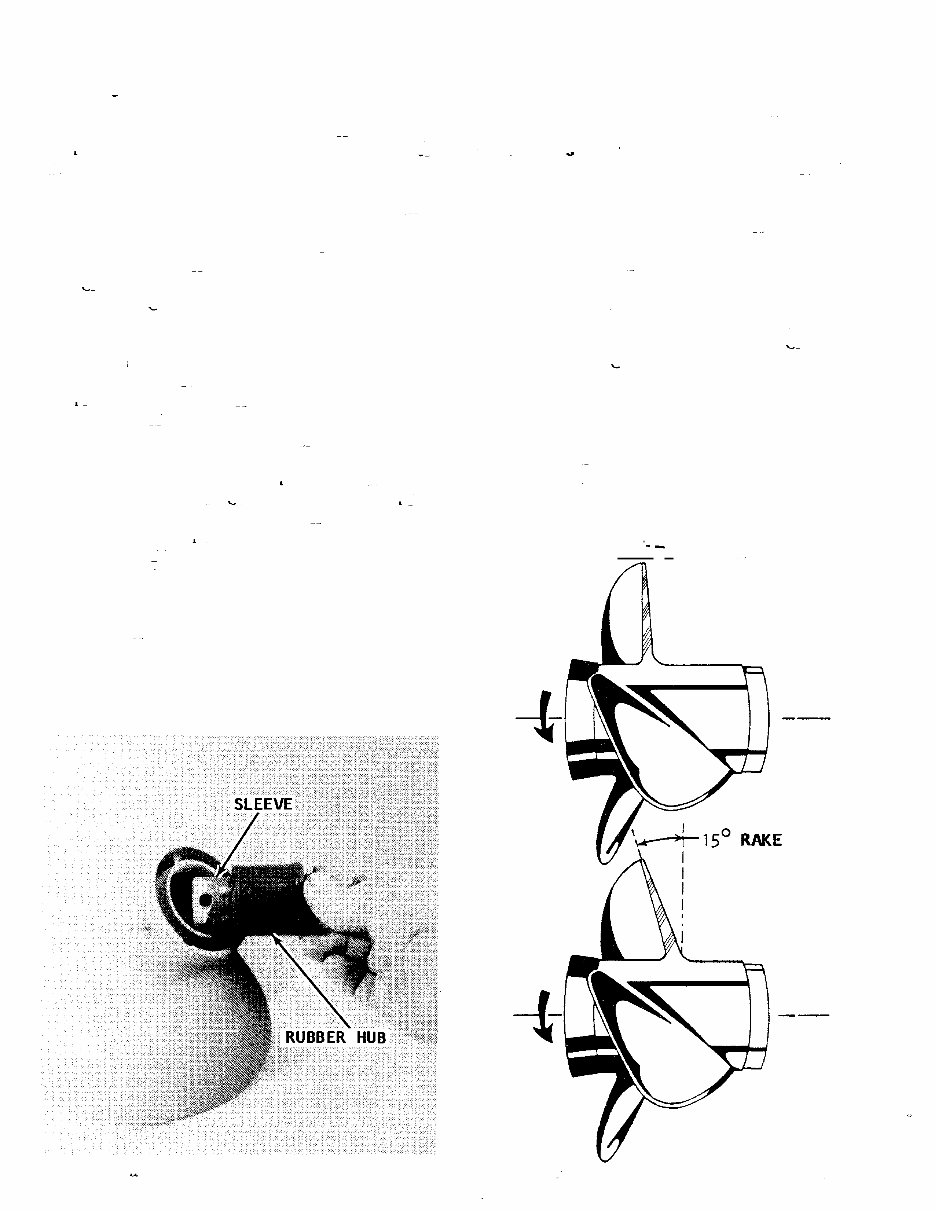
Rubber hub removed from a propeller. This hub was
removed because the hub was slipping in the propeller.
PROPELLERS 1-5
two-blade props and luxury cruisers have
four- and five-blade props installed.
Shock Absorbers
The shock absorber in the propeller plays
a very important role in protecting the
shafting, gears, and engine against the shock
of a blow, should the propeller strike an
underwater object. The shock absorber al-
lows the propeller to stop rotating at the
instant of impact while the power train
continues turning.
How much impact the propeller is able
to withstand before causing the clutch hub
to slip is calculated to be more than the
force needed to propel the boat, but less
than the amount that could damage any part
of the power train. Under normal propulsion
loads of moving the boat through the water,
the hub will not slip. However, it will slip if
the propeller strikes an object with a force
that would be great enough to stop any part
of the power train.
I
~~ - 00 RAKE
illustration depicting the rake of a propeller, as
explained in the text.
You're Reading a Preview
What's Included?
Lifetime Access
Fast Download Speeds
Online & Offline Access
Access PDF Contents & Bookmarks
Full Search Facility
Print one or all pages of your manual
$37.99
Viewed 95 Times Today


Secure transaction
What's Included?
Lifetime Access
Fast Download Speeds
Online & Offline Access
Access PDF Contents & Bookmarks
Full Search Facility
Print one or all pages of your manual
$37.99
This digital manual covers Johnson Evinrude outboard engines from 1956 to 1970, including models with varying horsepower such as 1.5 Hp, 3.0 Hp, 4.0 Hp, 5.0 Hp, 5.5 Hp, 6.0 Hp, 7.5 Hp, 9.5 Hp, 10 Hp, 15 Hp, 18 Hp, 20 Hp, 25 Hp, 28 Hp, 30 Hp, 33 Hp, 35 Hp, and 40 Hp. It is suitable for both professional mechanics and DIY enthusiasts.
- 1 2 cylinder
- 2 stroke
The manual includes the following content:
- Quick Reference Data
- General Information
- Tools & Techniques
- Troubleshooting
- Lubrication, Maintenance & Tune Up
- Engine Synchronization & Linkage Adjustments
- Dygimanual
- Fuel System
- Ignition & Electrical Systems
- Power Head
- Gearcase
- Lower Unit
- Hand Starter
- Wiring Diagrams
If you have any questions, feel free to contact us for assistance.
instant shop workshop


