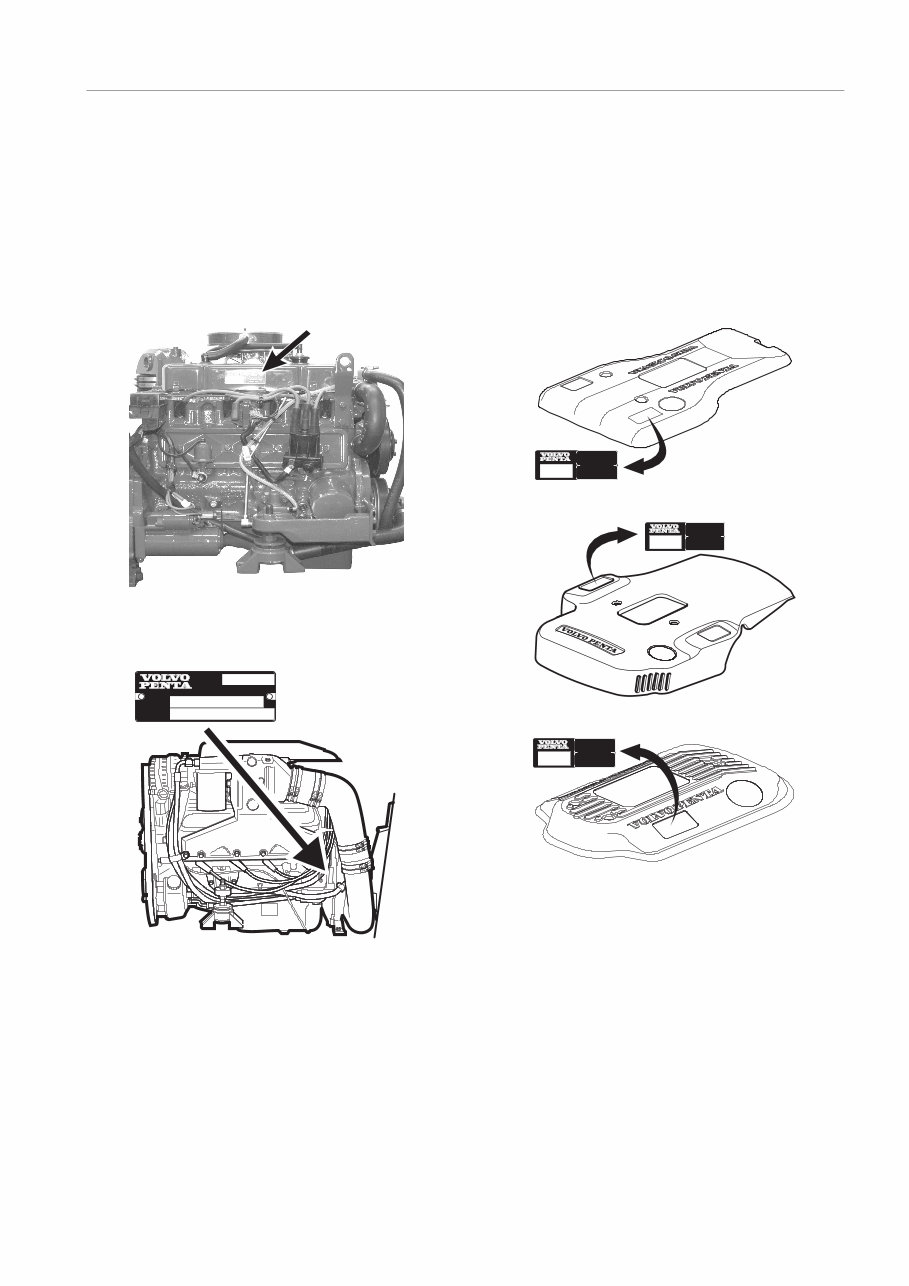
VPA 7748089 English 09-2007 1 Model Identification Model Identification This workshop manual applies to the products listed in Service Bulletin 04-2-67 version 1 dated 08-2007. The unit that you are servicing may be identified from the product model identification plates and/or decals that are placed in various locations to identify Volvo Penta engines, transmissions, transom shields, and drives. All sterndrive system components must be matched for either single or dual engine installations. Failure to properly match engine, transmission, transom shield, and drive unit will result in poor boat performance, and risk damage to engine and drive because of incorrect drive gear ratio. On 3.0L engines, the model identification plate is lo- cated on the side of the valve cover. 4.3, 5.0, and 5.7 Gi, GXi, OSi, OSXi models 8.1 Gi, GXi, OSi models All GL models For all other engines, the model identification plate or decal is located either on the port side of the engine cover and/or next to the flywheel housing. 23737-1 PROD. NO. SER. NO. TYPE A B C TRANSOM ASSEMBLY REVERSE GEAR DRIVE UNIT ENGINE XXXXXXXXXX (B) XXXXXXXXXX (A) XXX XXX (C) TRANSOM ASSEMBLY REVERSE GEAR DRIVE UNIT ENGINE XXXXXXXXXX (B) XXXXXXXXXX (A) XXX XXX (C) TRANSOM ASSEMBLY REVERSE GEAR DRIVE UNIT ENGINE XXXXXXXXXX (B) XXXXXXXXXX (A) XXX XXX (C)
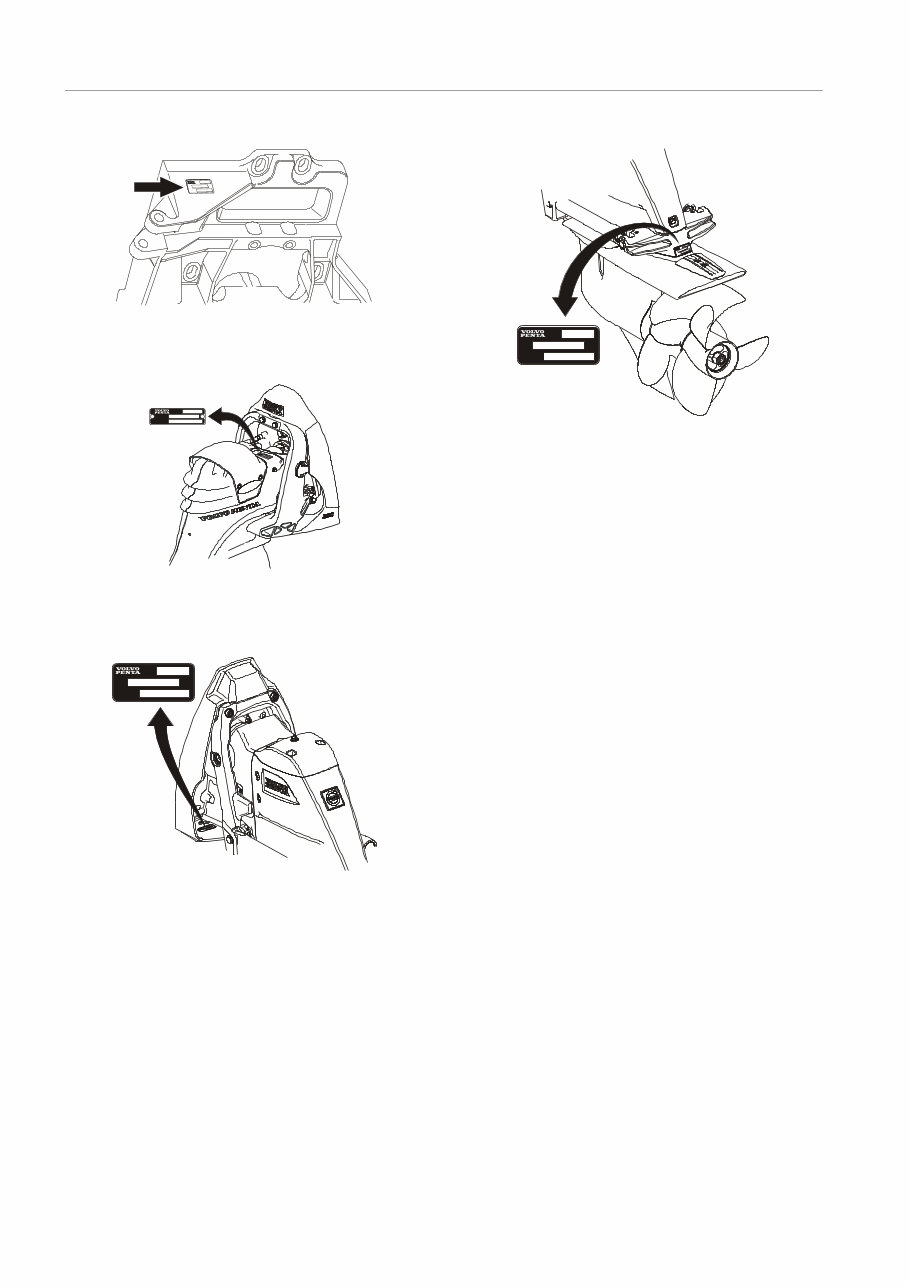
Model Identification 2 VPA 7748089 English 09-2007 The XP transom shield identification plate is located on the inner transom plate, above the steering ram. The XDP sterndrive model identification plate is locat- ed on top of the drive, in front of the upper gear hous- ing cover . The SX-A transom identification plate is located on the lower left of the outer transom plate. The identification plate for the SX-A/DPS-A stern- drives is located on the rear of the upper gear, just above the parting line between the upper and lower gear housing. 50328 PROD. NO. TYPE SER. NO. 50327 50478 50315
VPA 7748089 English 09-2007 3 General Information General Information Tuning the Engine . . . . . . . . . . . . . . . . . . . . . . . . . . . . . . . . . . . 5 Intake Manifold Vacuum Testing . . . . . . . . . . . . . . . . . . . . . . . . 7 Gasoline Requirements . . . . . . . . . . . . . . . . . . . . . . . . . . . . . . . 9 Gasoline Containing Alcohol . . . . . . . . . . . . . . . . . . . . . . . . . . 10 Crankcase Oil . . . . . . . . . . . . . . . . . . . . . . . . . . . . . . . . . . . . . . 10 Oil Filter . . . . . . . . . . . . . . . . . . . . . . . . . . . . . . . . . . . . . . . . . . . 12 Power Steering . . . . . . . . . . . . . . . . . . . . . . . . . . . . . . . . . . . . . 13 Power Trim/Tilt Fluid Level . . . . . . . . . . . . . . . . . . . . . . . . . . . 13 Off-Season Storage . . . . . . . . . . . . . . . . . . . . . . . . . . . . . . . . . 13 Preparation for Boating After Storage . . . . . . . . . . . . . . . . . . 15 Engine Break-in . . . . . . . . . . . . . . . . . . . . . . . . . . . . . . . . . . . . 16 Submerged Engine or Water Ingestion in Cylinders . . . . . . . 18 20-Hour Check . . . . . . . . . . . . . . . . . . . . . . . . . . . . . . . . . . . . . 18 Positive Closed Ventilation System . . . . . . . . . . . . . . . . . . . . 19 Troubleshooting - System Isolation . . . . . . . . . . . . . . . . . . . . 20 Engine Troubleshooting Guides . . . . . . . . . . . . . . . . . . . . . . . 21 This service manual is divided into sections concerning various sys- tems and assemblies. Refer to the Contents to locate the section covering the system or assembly requiring service. Each section title page has an additional listing that will describe the sections contents in more detail. Be sure to read the Safety Section at the end of this manual, and pay special attention to all safety warnings as they ap- pear throughout the text. Since models are subject to change at any time, some photos may not depict actual product. Good Service Practice Service required for stern drives is generally one of three kinds: • Normal care and maintenance - which includes putting a new stern drive into operation, storing engines, lubrication, and care under special operating conditions such as salt water and cold weather. • Operating malfunctions - due to improper engine or drive mounting, propeller condition or size, boat condition, or the malfunction of some part of the engine. This includes engine servicing procedures to keep the engine in prime operating condition. • Complete disassembly and overhaul - such as major ser- vice or rebuilding a unit. It is important to determine before disassembly just what the trouble is and how to correct it quickly, with minimum expense to the owner. When repairing an assembly, the most reliable way to ensure a good job is to do a complete overhaul on that assembly, rather than just to replace the bad part. Wear not readily apparent on other parts could cause malfunction soon after the repair job. Repair kits and seal kits
General Information 4 VPA 7748089 English 09-2007 contain all the parts needed to ensure a complete repair, to eliminate guesswork, and to save time. Repair time can also be minimized by the use of special tools. Volvo Penta special tools are designed to perform service procedures unique to the product that cannot be completed using tools from oth- er sources. They also speed repair work to help achieve service flat rate times. In some cases, the use of substitute tools can damage the part. Preparation for Service Proper preparation is extremely helpful for efficient service work. A clean work area at the start of each job will minimize tools and parts becoming misplaced. Clean an engine that is excessively dirty be- fore work starts. Cleaning will occasionally uncover trouble sources. Obtain tools, instruments and parts needed for the job before work is started. Interrupting a job to locate special tools or repair kits is a needless delay. CAUTION! Use proper lifting and handling equipment. Working on engines or stern drives without proper equipment can cause damage and personal injury. Always use clean fresh fuel when testing engines. Troubles can of- ten be traced to the use of old or dirty fuel. Service Policy It is a Volvo Penta policy to provide dealers with service knowledge so they can give professional service demanded by today’s consum- er. The Volvo Penta Training Centers, frequent mailing of Service Bulletins, Letters and Promotions, Special Tools and this Service Manual represent the latest effort to assist dealers in giving consum- ers the best and most prompt service possible. If a service question does not appear to be answered in this manual, you are invited to write to the Volvo Penta Service Department for additional help. Al- ways be sure to give complete information, including engine model number and serial number. Replacement Parts WARNING! When replacement parts are required, always use genu- ine Volvo Penta parts, or parts with equivalent charac- teristics, including type, strength, and material. Failure to do so may result in product damage and possible injury to the operator and/or passengers. Parts Catalogs Parts Catalogs contain exploded views showing the correct assem- bly of all parts, as well as a complete listing of the parts for replace- ment. These catalogs are helpful as a reference during disassembly and reassembly, and are available from Volvo Penta Parts.
VPA 7748089 English 09-2007 5 General Information Special Service Tools Volvo Penta has specially designed tools to simplify some of the dis- assembly and assembly operations. These tools are illustrated in this Service Manual, in many cases in actual use. All special tools can be ordered from Volvo Penta Parts. Individual purchasers of Service Manuals must order Special Tools through an authorized dealer. Product References, Illustrations & Specifications Volvo Penta reserves the right to make changes at anytime, without notice, in specifications and models and also to discontinue models. The right is also reserved to change any specifications or parts at any time without incurring any obligation to equip same on models manufactured prior to date of such change. All information, illustra- tions and specifications contained in this manual are based on the latest product information available at the time of printing. The right is reserved to make changes at anytime without notice. All photographs and illustrations used in this manual may not depict actual models or equipment, but are intended as representative views for reference only. The continuing accuracy of this manual cannot be guaranteed. The purpose of an engine tune-up is to restore power and perfor- mance that has been lost through wear, corrosion or deterioration of one or more parts or components. In the normal operation of an en- gine, these changes can take place gradually at a number of points, so that it is seldom advisable to attempt an improvement in perfor- mance by correction of one or two items only. Time will be saved and more lasting results will be obtained by following a definite and thor- ough procedure of analysis and correction of all items affecting pow- er and performance. Economical, trouble-free operation can better be ensured if a com- plete tune-up is performed once every year, preferably in the spring. Components that affect power and performance can be divided into three groups: • Components affecting compression • Components affecting ignition • Components affecting fuel system Tuning the Engine Tune-up procedures should cover these groups in the order given. While the items affecting compression and ignition may be handled according to personal preference, correction of items in the fuel sys- tem group should not be attempted until all items affecting compres- sion and ignition have been satisfactorily corrected. Most of the procedures for performing a complete engine tune-up will be cov- ered in greater detail in this manual. This section will deal mainly with the order of procedures involved in tuning the engine. Engine Compression Testing During all work done around the engine, while the engine is running or being cranked, use extreme care to avoid getting fingers or cloth- ing caught in any belts, pulleys, or other moving parts.
General Information 6 VPA 7748089 English 09-2007 1. Visually inspect stern drive unit for leaks, missing parts or other obvious defects. Replace deteriorated parts. 2. Compression check: Proper compression is essential for good engine performance. An engine with low or uneven compres- sion cannot be properly tuned. • Operate engine to normal operating temperature. NOTICE! Engine must not be started and run without water for cooling. • Remove any foreign matter from around spark plugs by blowing out with compressed air. • Remove and inspect all spark plugs. Install thread-type com- pression gauge in spark plug hole. To Prevent Sparking WARNING! Failure to disable the ignition system during compres- sion testing may cause fire or explosion by igniting gasoline fumes present during cranking and cause per- sonal injury or death. —Remove (grey) 2-wire connector, with purple and grey wires, at ignition coil. —With choke and/or throttle plates wide open, crank engine through at least four compression strokes. Test Conclusion The indicated compression pressures are considered normal if the lowest reading cylinder is within 75% of the highest. Example: If the highest pressure reading was 140 PSI, 75% of 140 is 105. Therefore, any cylinder reading less than 105 PSI indicates an im- properly seated valve, worn valve guides, piston, cylinder, or worn or broken piston rings. Any cylinder reading 105 PSI or greater is within specifications, and compression is considered normal. If one or more cylinders read low, squirt approximately one table- spoon of engine oil on top of the pistons in the low reading cylinders. Repeat compression pressure check on the cylinders. 1. If compression improves considerably, the piston rings are at fault. 2. If compression does not improve, valves are sticking or seating poorly, or valve guides are worn. 3. If two adjacent cylinders indicate low compression pressures and squirting oil on the pistons does not increase the compres- sion, the cause may be a cylinder head gasket leak between the cylinders. This problem could allow engine oil and/or cool- ant to enter the cylinders. It is recommended the following quick reference chart be used when checking cylinder compression
The Volvo Penta 5.0 & 5.7 GL, Gi, GXi, OSi, OSXi Engine Service & Repair Manual is the authoritative guide for maintaining and repairing Volvo Penta's 5.0-liter and 5.7-liter marine gasoline engines across the GL, Gi, GXi, OSi, and OSXi variants. Designed for marine technicians and experienced boat owners, this manual offers detailed instructions and technical data directly from Volvo Penta, ensuring that all service procedures meet factory standards for performance and reliability.
Contents Overview:
Model Identification: Guidelines for locating and interpreting engine labels and component identification plates to accurately determine engine models and configurations.
General Information: Recommendations on fuel and oil types, break-in procedures, crankcase capacities, service best practices, and safety precautions.
Engine Service: Procedures for tuning, compression testing, intake manifold vacuum diagnostics, and inspections of ignition and fuel system components.
Troubleshooting Guides: Diagnostic trees addressing issues such as no-start conditions, rough idle, overheating, lubrication faults, and electrical problems.
Maintenance Procedures: Instructions for oil and filter changes, coolant system maintenance, off-season storage, and recommissioning after storage.
Specifications: Detailed information on compression values, torque specifications, oil types, and acceptable tolerances.
This official service and repair manual is an essential resource for maintaining and repairing Volvo Penta’s 5.0L and 5.7L marine V8 engines, providing a structured approach to diagnostics, preventive maintenance, and major mechanical work in accordance with factory-approved standards.
Printable: Yes Language: English Compatibility: Pretty much any electronic device, incl. PC & Mac computers, Android and Apple smartphones & tablet, etc. Requirements: Adobe Reader (free)


![Volvo Penta 5.0-5.7 GL/ Gi/ GXi/ OSXi engines Workshop Manual [en]](https://cdm.emanualonline.com/media/catalog/product/cache/3fba745dcec88e97bfe808bedc471260/4/9/490732-1.jpg "Volvo Penta 5.0-5.7 GL/ Gi/ GXi/ OSXi engines Workshop Manual [en]")








 Lifetime Access