


Beta 10 BZ482 Beta 16 BD722 and Beta 25 Marine Engine Complete Workshop Service Repair Manual
What's Included?
 Lifetime Access
Fast Download Speeds
Online & Offline Access
Access PDF Contents & Bookmarks
Full Search Facility
Print one or all pages of your manual
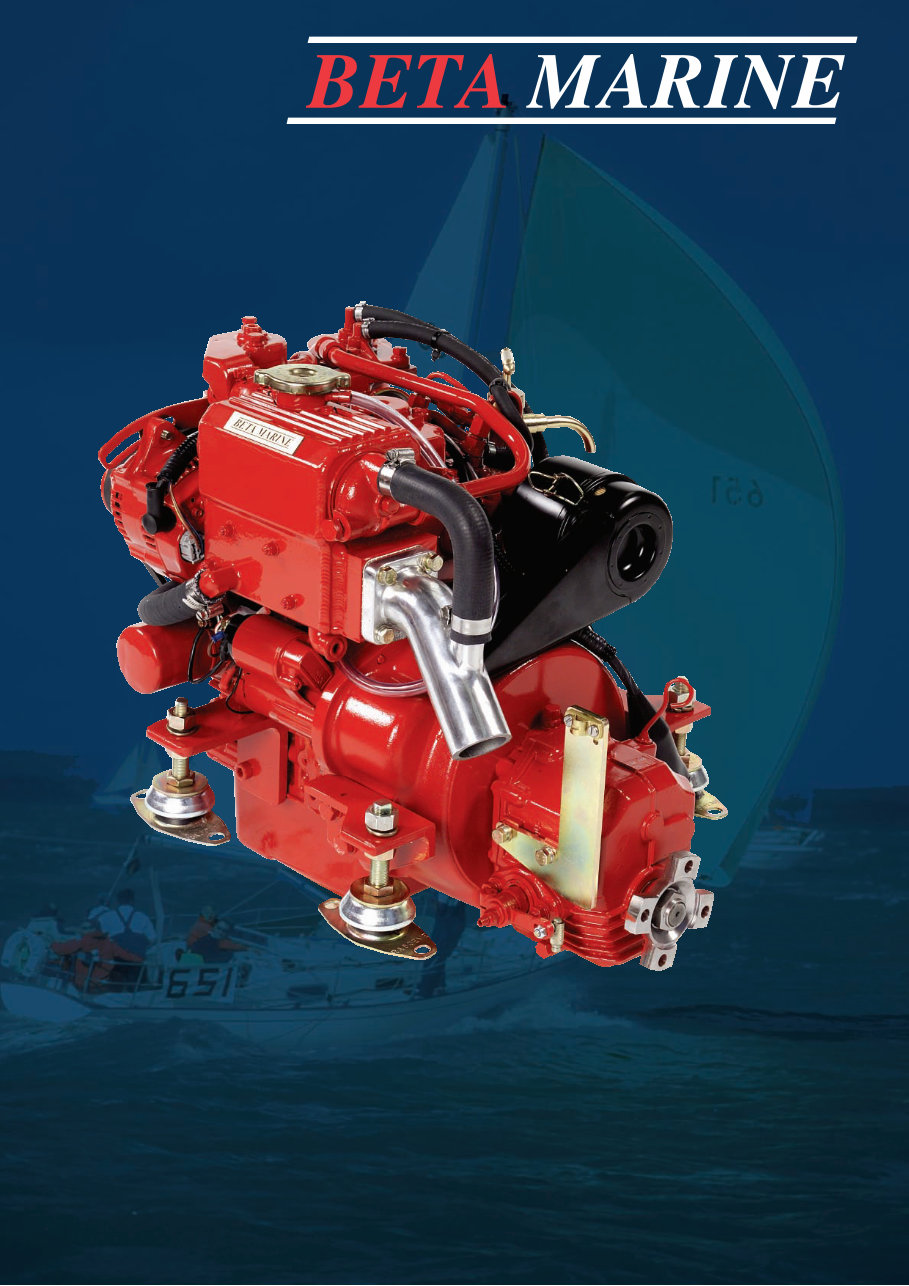
Operator’s
Maintenance
Manual
CALIFORNIA – Proposition 65 Warning: Diesel engine exhaust and some of its constituents are known to
the state of California to cause cancer, birth defects and other reproductive harm.
Heat
Exchanger
and Keel Cooled
Small Diesel Engine Range: Beta 10,
BZ482, Beta 16, BD722 & Beta 25

Engine Details
Engine Type: Power: bhp Speed: rpm
BETA WOC NO: K
Gearbox Type:
Purchased from:
Invoice No:
Date Commissioned:
Specification / Special Details
IMPORTANT – Please fill in details at moment of purchase – it really will
help you! (and it will really help us specify the correct spare parts for you).

1
INTRODUCTION 2
Engine Identification 2
Initial Receipt of the engine 2
Engine Storage 2
SAFETY PRECAUTIONS 3
TECHNICAL SPECIFICATIONS 4
SECTION 1: GUIDELINES FOR OPERATION OF ENGINE
Important checks prior to initial use 5
Initial Start-up and Bleeding The Fuel System 5
Starting/Stopping 6
SECTION 2: MAINTENANCE AND SERVICE GUIDELINES
Maintenance Schedule: 7
Lubrication – Checking and changing oil 8
Fuel System - Pumps, Filter, fuel/water separator 9
Cooling - Fresh water system, Keel Cooling, Heat Exchanger 10
Sea Water Pump, Heat Exchanger 12
Belt Tensioning 13
Air Filter 13
Electrical 14
Laying up - Winterising 14
Troubleshooting 15
Torque Settings 26
SECTION 3: INSTALLATION GUIDELINES
Engine Mounting 27
Alignment - Drives, Flanges, Flexible Drives 27
Exhausts & Bends 28
Mounting Exhausts 28
Fuel Supply 29
Cooling 30
Calorifier System 31
Electrical installations 32
Appendices –wiring diagrams and general arrangements 32
Component identification at rear of manual. 63
Maintenance Record 65
Contents
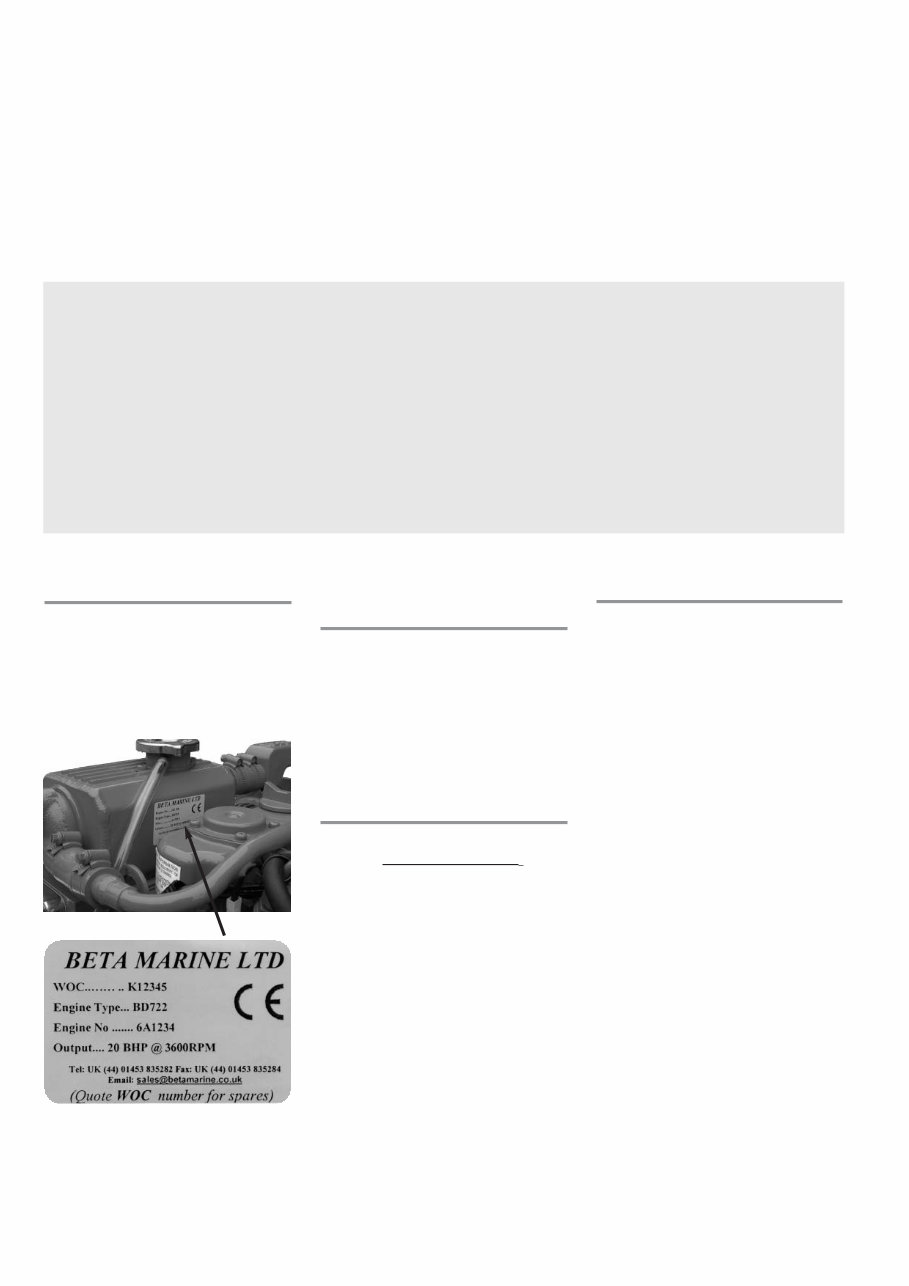
ENGINE IDENTIFICATION
NOTE: In all communications with
the distributor or Beta Marine, the
engine number, type, and W.O.C.
number must be quoted.
BETA 10, BZ482, BETA 16,
BD722 & BETA 25
The engine serial number is stamped
above the fuel lift pump on the
starboard side of the engine, and is
shown on the rocker cover label.
INITIAL RECEIPT
OF THE ENGINE
A full inspection of the engine must
be made immediately on delivery to
confirm that there is no damage. If
there is any damage then write this
clearly on the delivery note and
inform your dealer or Beta Marine
within 24 hours.
ENGINE STORAGE
The engine must be stored in a dry,
frost free area and this is best done in
its packing case. If storage is to be
more than six months then the
engine must be inhibited (contact
your dealer or Beta Marine). Failure
to inhibit the engine may result in the
formation of rust in the injection
system and the engine bores, this
could invalidate the warranty.
OPERATION AND MAINTENANCE MANUAL FOR THE FOLLOWING
BETA MARINE ENGINES BASED ON KUBOTA MINI SERIES
Beta 10, BZ482, Beta 16 (BZ602),
BD722 & Beta 25 (BD902)
2
This manual has been compiled to
provide the user with important
information and recommendations
to ensure a trouble free and
economical operation of the
engine.
For further advice or technical
assistance, application should be
made to BETA MARINE LIMITED
or its distributors.
All information and
recommendations given in this
publication are based on the latest
information available at the time of
publication, and are subject to
alteration at any time. The
information given is subject to the
company’s current conditions of
Tender and Sale, is for the
assistance of users, and is based
upon results obtained from tests
carried out at the place of
manufacture and in vessels used
for development purposes. We do
not guarantee the same results will
be obtained elsewhere under
different conditions.
SAMPLE
3
A Keep the engine, gearbox
and surrounding area clean,
including the area immediately
below the engine
B DRIVES - Power Take Off
Areas
i) Gearbox Output Flange
The purpose of a marine diesel
propulsion engine is to provide
motive power to propel a vessel.
Accordingly the gearbox output
shaft rotates at between 300 and
2400 rev/min. This flange is
designed to be coupled to a
propeller shaft by the installer and
steps must be taken to ensure
adequate guarding.
ii) Forward End Drive
Engines are supplied with
unguarded vee belt drives to
power the fresh water pump and
battery charging alternator. The
installer must ensure that it is not
possible for injury to occur by
allowing accessibility to this area
of the engine. The three pulleys
run at high speed and can cause
injury if personnel or clothing
come in contact with the belts or
pulleys, when the engine is
running.
iii) Power Take Off Shaft
(Engine Mounted Option)
Shaft extensions are available as
an option and rotate at between
850 and 3600 rev/min. If
contact is made with this shaft
when the engine is running, injury
can occur.
C EXHAUST OUTLET
Diesel marine propulsion engines
emit exhaust gases at very high
temperatures - around 400-
500°C. Engines are supplied with
either wet exhaust outlet (water
injection bend) or dry outlet (dry
exhaust stub) - see option list. At
the outlet next to the heat
exchanger/header tank, the
exhaust outlet can become very
hot and if touched, can injure.
This must be lagged or avoided by
ensuring adequate guarding. It is
the responsibility of the installer to
lag the exhaust system if a dry
system is used. Exhaust gases
are harmful if ingested, the
installer must therefore ensure that
exhaust lines are lead overboard
and that leakage in the vessel
does not occur.
D FUEL
i) Fuel Lines
Diesel engines are equipped with
high pressure fuel injection
pumps, if leakages occur, or if
pipes fracture, fuel at a high
pressure can harm personnel.
Skin must be thoroughly cleaned
in the event of contact with diesel
fuel.
ii) Fuel Supply Connections
Engines are supplied with 8 mm
compression fittings. The installer
must ensure that when
connections are made, they are
clean and free of leaks.
E OIL
The Beta propulsion is supplied
with 2 dipsticks, one for the
engine and one for the gearbox.
Ensure dipsticks are returned and
secure after checking, if not oil
leaks can cause infection when
touched. All oil must be removed
from the skin to prevent infection.
F SCALDING
An engine running under load will
have a closed circuit fresh water
temperature of 85° to 95°C. The
pressure cap on the top of the
heat exchanger must not be
removed when the engine is
running. It can only be removed
when the engine is stopped and
has cooled down.
G TRANSPORTATION/LIFTING
Engines are supplied on
transportable pallets. Lifting eyes
on engines are used for lifting
engine and gearbox assembly
only, not the pallet and
associated kit.
GENERAL DECLARATION
This machinery is not intended to
be put into
service until it has been
incorporated into or with other
machinery. It is the responsibility of
the purchaser/installer/owner, to
ensure that the machinery is
properly guarded and that all
necessary health and safety
requirements, in accordance with
the laws of the relevant country, are
met before it is put into service.
Signed:
J A Growcoot, C.E.O,
Beta Marine Limited
NOTE: Recreational Craft
Where applicable, the
purchaser/installer/owner and operator
must be responsible for making sure
that the Recreational Craft Directive
94/25/EC is complied with.
SAFETY PRECAUTIONS!

TECHNICAL SPECIFICATIONS
MINI SERIES – STANDARD ENGINES
Maximum Angle of Installation: Trim 15°, Roll 30° (intermittent)
Rotation: ANTI CLOCK ON FLYWHEEL, CLOCKWISE ON OUTPUT GEARBOX FLANGE FOR USE WITH RIGHT HAND PROP IN AHEAD
Diesel fuel must conform to BS2869-1970 class A1 or A2. The fuel must be a distillate, and not a residual oil or blend.
Lubricant: Engine - Engine oil must meet MIL-L-2104C (see section 2 for details)
Gearbox - see operator’s manual for the gearbox oil type and capacity
Oil pressure – minimum (tickover) 0.5 bar
Power outputs: These comply with BS EN ISO 8665:1996 crankshaft power
Note: Declared Powers to ISO8665:1995
1. The declared powers are at the same engine speed as the ISO 3046 figures. This speed is the speed related to the outputs / powers shown.
2. Declared powers are at the gearbox coupling (coupling to the propeller shaft) as per clause 3.2.1 with standard specifications as per our current price lists.
Additional accessories or alternative gearboxes may affect the declared powers.
3. Operation at parameters outside the test parameters may affect the outputs / powers which in any case are subject to the ISO tolerance bands.
4
BETA 10 BZ482 Beta 16 BD722 Beta 25
Cylinder 2 2 2 3 3
Bore (mm) 67 67 72 67 72
Stroke (mm) 68 68 73.6 68 73.6
Displacement (cc) 479 479 599 719 898
Combustion 3 Vortex E-TVCS
Cooling Water
Starter voltage (V) 12
Starter output (kW) 0.8
Starter alternator output (Amps) 40 (standard)
Glow plug resistance (each) 1Ω
Engine speed (RPM) 3,000 3,600
Power output to ISO3046 (BHP) 10.0 13.3 16.7 20.0 24.8
Declared power ISO8665 (kW) 7.4 8.7 11.0 13.1 16.3
Fuel timing BTDC 21°
Capacity of standard sump approx (litres) 2.0 - 2.5 2.4 - 2.9 3.1 - 3.8 3.7 – 4.5
Capacity of shallow sump approx (litres) 2.2 2.6 3.4 3.8
Nett dry weight with gearbox (kg) 87.2 94.1 101.7 110.6
Fuel Diesel oil class A1 / A2
Coolant 33%-50% maximum antifreeze / water
Coolant capacity approx (H/E litres) 2.25 3.00 3.25
Min. recommended battery capacity 12V, 40Ah 12V, 75Ah
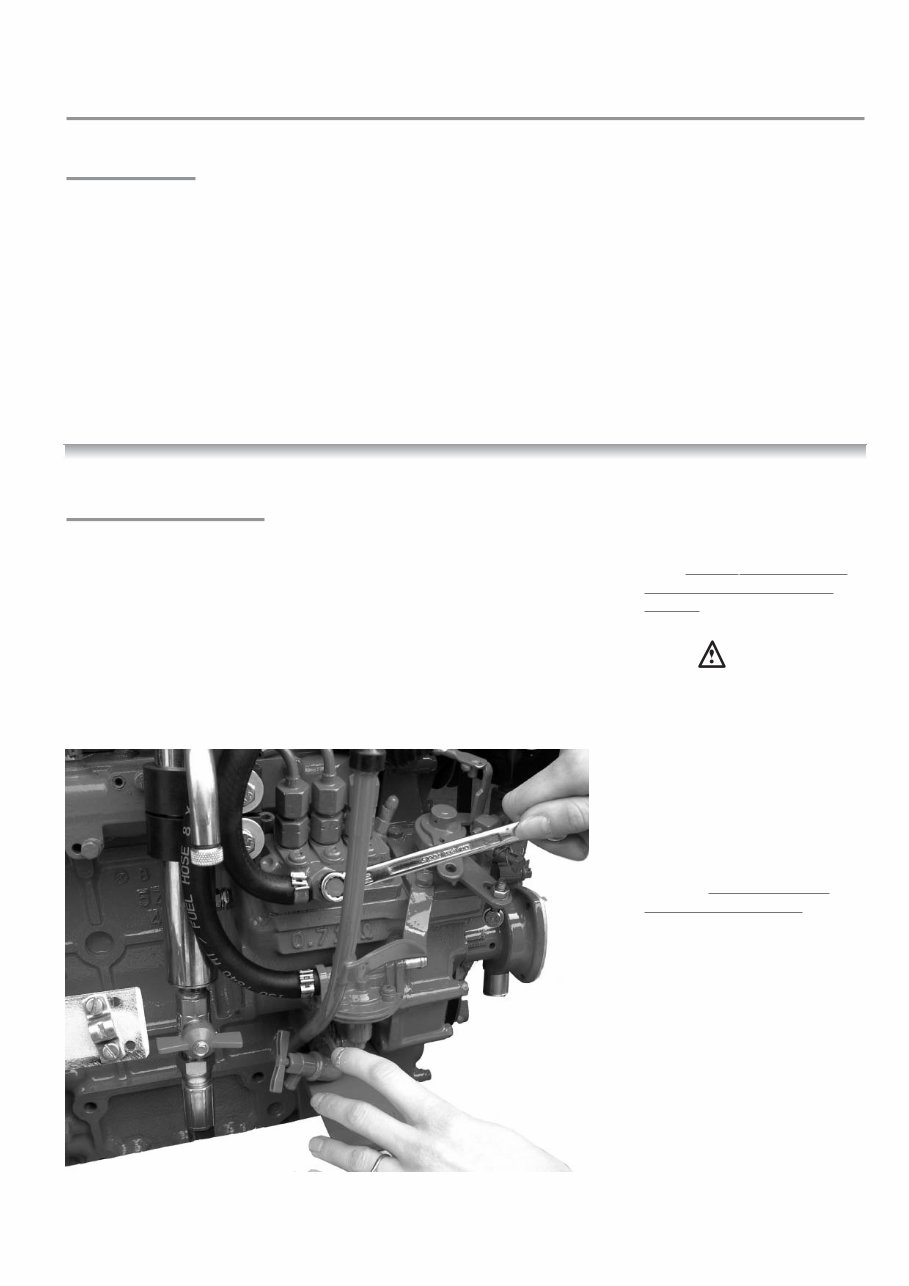
INITIAL STARTUP AND
BLEEDING THE SYSTEM
(a) Open fuel bleed screw on
injection pump by 1
1
/2 turns. See
diagram 1a.
(b) Move hand priming lever on fuel
lift pump up and down until fuel
with no bubbles comes out of the
bleed screw.
(c) Shut/tighten the bleed screw.
Clean area thoroughly with tissue
paper.
(d) Continue to hand prime for 30
seconds to push fuel through the
fuel pump.
(e) Start engine (see normal starting).
Note the engine may have to be
turned over with the starter for a
few seconds before it fires. Do
not run the starter for more than
20 seconds. If the engine has not
started after 20 seconds then
disengage the starter and
continue to hand prime for a
further 30 seconds, then repeat.
(f) If engine does not start after 3
attempts then allow 5 minutes for
the starter to cool down before
repeating (a) to (e).
Note: The star ter windings can
be burnt out with continuous
cranking
CAUTION
To avoid personal injury:
• Do not bleed a hot engine as this
could cause fuel to spill onto a hot
exhaust manifold creating a danger
of fire.
• Do not mix gasoline or alcohol
with diesel fuel. This mixture can
cause an explosion.
• Do not get diesel on the flexible
mounts – they will deteriorate
rapidly if soaked in diesel .
• All fuel must be removed from skin
to prevent infection.
5
Diagram 1a
SECTION 1
GUIDELINES FOR OPERATION OF ENGINE
IMPORTANT CHECKS PRIOR
TO INITIAL USE
1. Generally, a new engine has the
oil and anti-freeze removed after
the works test. Fill the engine
with the correct oil and anti-
freeze (see sections on ENGINE
OIL and COOLING). Check
gearbox oil level - see separate
operator’s hand book.
2. Ensure the engine is free to turn
without obstructions.
3. Ensure battery is fully charged
and connected (the isolator is in
the ‘ON’ position).
4. Ensure Morse speed and gearbox
cables are fitted correctly and that
cable travel lengths are correct.
Gear selection lever –all
mechanical gearboxes: care must
be taken to ensure that the
remote control cable is adjusted
so that the selector lever on the
gearbox moves FULL travel and
brought “hard up” against its end
stop in both directions. Failure to
achieve the correct adjustment
will reduce efficiency of the
clutch and may cause slippage at
low revs. Warranty will not be
accepted on gearboxes returned
in the warranty period for failure
due to incorrect adjustment.
5. Ensure engine is out of gear with
1/3 throttle - see single lever
control instruction manual.
6. Open the fuel stopcock and bleed
the fuel water separator of air as
shown in manufacturers
literature.
7. Fuel should now be at the fuel lift
pump, see diagram 1a.
8. Open the sea cock.
6
STOPPING
Every propulsion engine is fitted with a
stop solenoid which is energised to
stop. To stop engine simply press stop
push button, hold in until engine
stops, then turn key from ‘RUN’ to
‘OFF’ position.
When leaving the boat for an extended
period,
• Turn off sea-cock (heat exchanger
cooled engines).
• Turn off battery isolator.
Do not turn the key to the off
position when the engine is running.
This will not allow the alternator to
charge.
*WARNING
Do not leave the key in ‘HEAT’ position
for more than 15 seconds - this will
damage the heater plugs and eventually
lead to poor starting.
Do not depress stop button for more
than 10 seconds as this will lead to
overheating and failure of the solenoid.
NOTES FOR ALL PANEL TYPES:
Do not depress the stop button for
more than ten seconds as this will
lead to overheating and failure of the
solenoid.
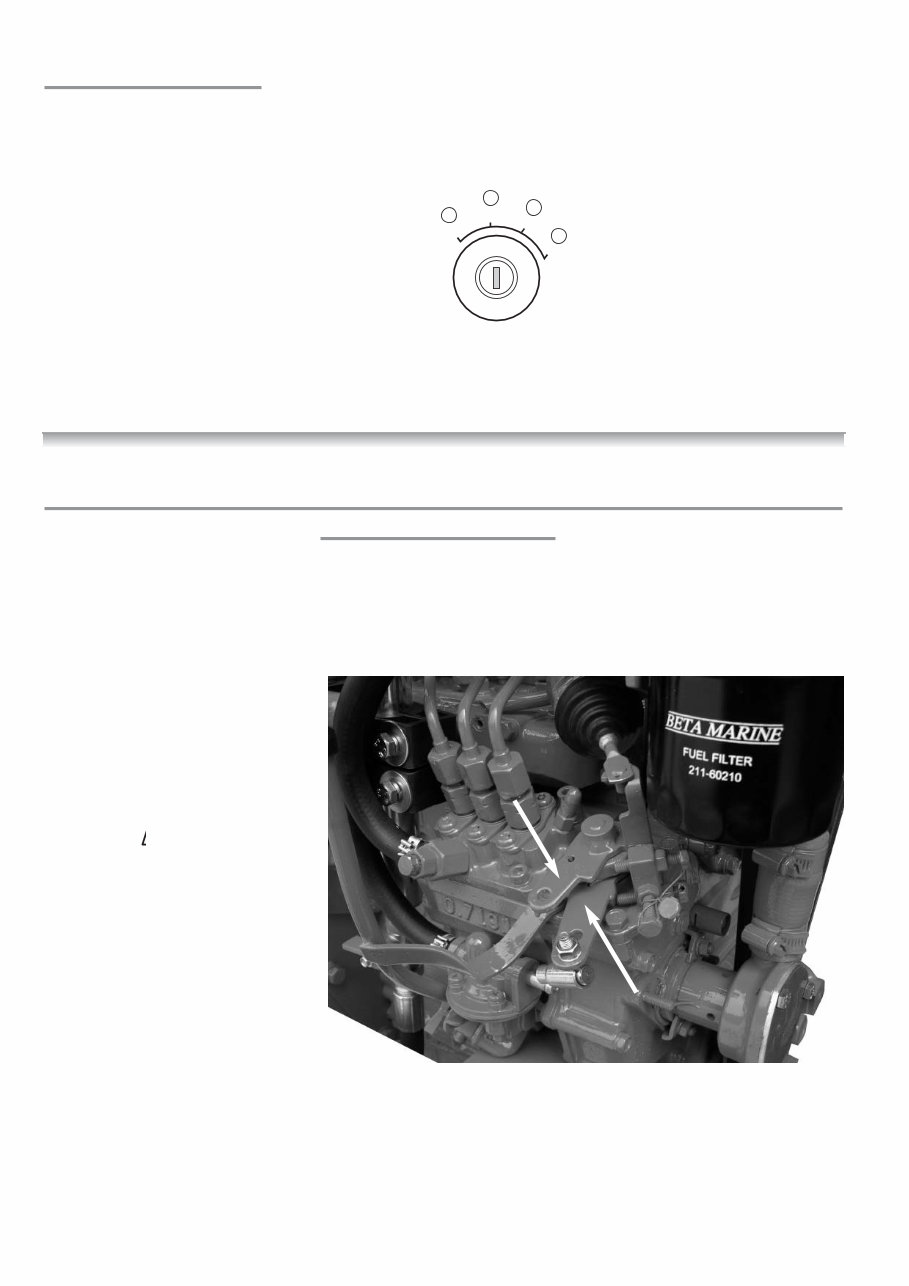
The Mini range of engines are
equipped with a mechanical stop lever
in the event of electrical system failure.
This lever is located on the starboard
side of the engine above the speed
control lever. See illustration below:
Stop lever Stop lever
Speed lever Speed lever
NORMAL STARTING (ALL BETA
PANELS WITH SILVER KEYSWITCH)
With the engine out of gear, set speed
control lever to 1/3 throttle. Turn key
anti-clockwise to HEAT* (A) position
and hold for ten seconds, turn key
clockwise to RUN (C) position. At this
stage the instrument panel should
illuminate, an alarm buzzer will sound
and two (or three*) red warning lights
will illuminate:
STARTER BATTERY CHARGE
DOMESTIC BATTERY CHARGE* (D
in battery symbol - AB & C PANELS
ONLY)
*(Note: this will only illuminate if 2nd
alternator is fitted)
OIL PRESSURE and green POWER
ON / RUN LIGHT (this will stay on)
Turn to START
(D) position and
engine will
motor, hold in
position until
engine fires (see
initial start-up
section for maximum time starter can
be used).
Release key (when engine has started)
to RUN position. Ensure alarm buzzer
is not sounding and that warning
lights are extinguished. If one or both
of the alternator warning lights are still
on, then increase engine speed to
excite the alternator - then return to
idle. The battery charge lights should
then go out. The run light will remain
on (green LED).
Note: for panels without keyswitches
see seperate instruction sheet
(page 24).
RUN
C
START
D
OFF
B
HEAT
A

7
SECTION 2
MAINTENANCE SCHEDULE
DAILY OR EVERY 8 HOURS
RUNNING
• Check engine oil level.
• Check gearbox oil level.
• Check coolant level.
• Check battery fluid.
• Check drive belt tension
• Ensure raw water inlet strainer is
clear.
• Check stern gland lubrication.
• Drain off any water in fuel water
separator.
AFTER THE FIRST 25 HOURS
RUNNING
• Change gearbox lubricant (See
separate gearbox manual).
• Check that all external nuts, bolts
and fastenings are tight. See table
for torque values. Special attention
should be paid to the flexible
mount lock nuts, these should be
checked for tightness, starting
with lower nut first in each case.
If the lower nuts are found to be
very loose, then the alignment of
the shaft to the gearbox half
coupling should be re-checked.
Poor alignment due to loose
flexible mount nuts will cause
excessive vibration and knocking.
• Check the belt tension on any
second alternators fitted and
adjust –see page 11
• Check ball joint nyloc nuts for
tightness on both gearbox and
speed control levers. Grease both
fittings all over.
AFTER FIRST 50 HOURS
• Change engine lubricating oil.
• Change oil filter.
• Check for leaks on header tank
tubestack. Tighten end cap bolt if
required.
• Drain off any water in fuel/water
separator.
EVERY 150 HOURS
• If shallow sump (option) is fitted,
change engine lubricating oil and
filter.
EVERY YEAR -OR EVERY 250
HOURS IF SOONER
• Change engine lubricating oil
(standard sump)
• Change lubricating oil filter
• Check air cleaner element
• Check sea water pump impeller
and change if worn.
• Check wasting anode condition,
replace when necessary. In some
environments this may be 6
montly or less.
• Remove heat exchanger tube
stack, by undoing the bolt each
end of the tube stack. Remove
end cover, pull out tube stack and
clean. Replace rubber ‘O’ rings
and re-assemble. Immediately
engine is started check for leaks.
• Spray the key switch with WD40
or equivalent to lubricate the
barrel.
• Check that all external nuts, bolts
and fastenings are tight. See table
for torque values.
• Check ball joint nyloc nuts for
tightness on both gearbox and
speed control levers. Grease both
fittings all over.
EVERY 750 HOURS
• As every 250 hours plus the
following:-
• Change air cleaner element.
• Change fuel filter.
• Change antifreeze.
• Change gearbox oil.
• Check electrical equipment,
condition of hoses and belts,
replace as necessary.
8
Engine oil: Engine oil should be MIL-
L-2104C or have properties of API
classification CC/CD/CE grades. The
following table gives grades of oil
required for various ambient
temperatures.
Note: A good quality 15W/40
mineral or multigrade oil as used in
most diesel car engines will meet
these requirements. Do not use
‘Turbo Diesel Oil’ or additives.
CHECKING ENGINE OIL
LEVEL
For quantities of oil required see
section marked ‘Technical
Specification’, Page 4
When checking the engine oil level,
do so before starting, or more than
five minutes after stopping.
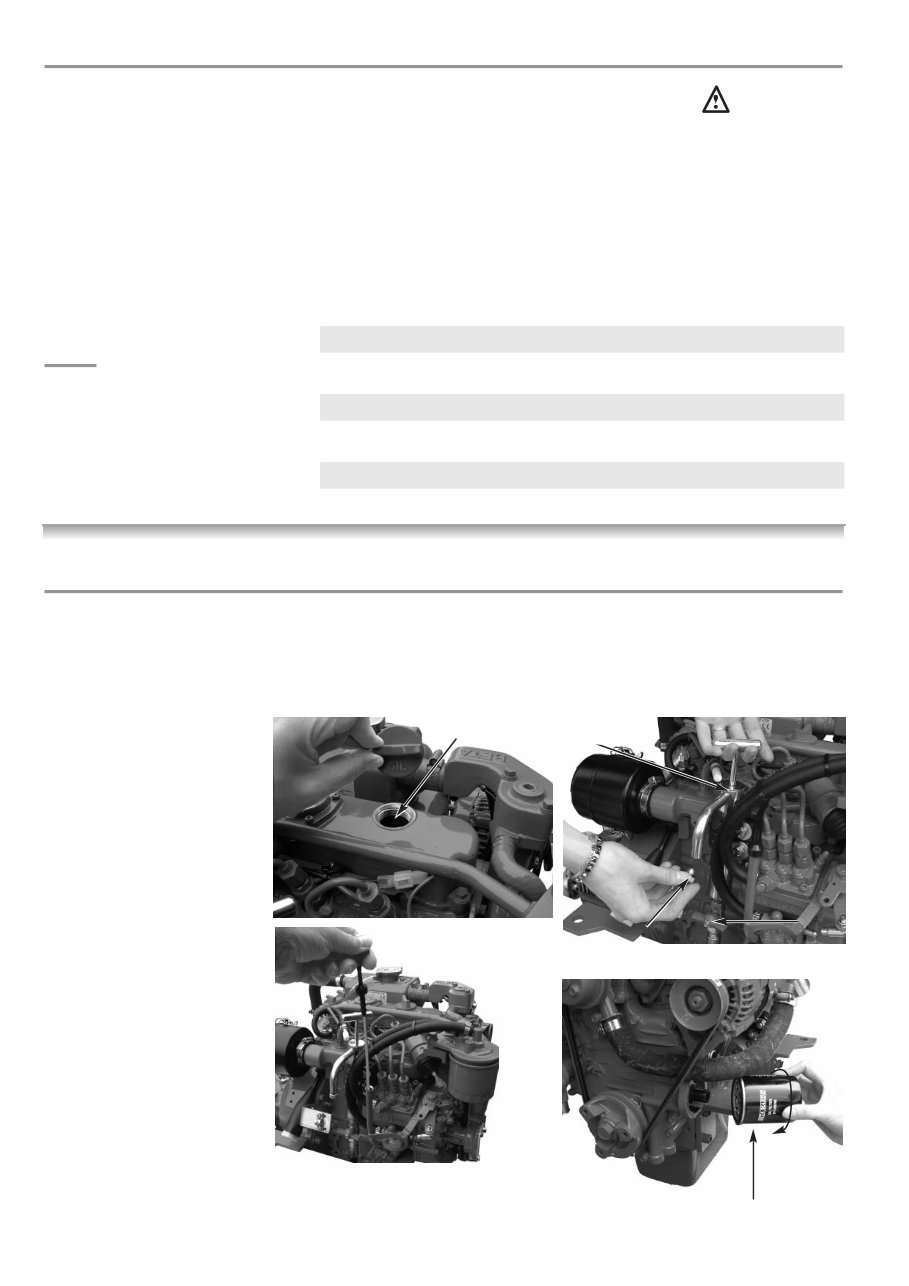
1. To check the oil level, draw out
the dipstick, wipe it clean, re-
insert it, and draw it out again.
Check to see that the oil level lies
between the two notches.
2. If the level is too low, add new oil
to the specified level - Do not
overfill,
IMPORTANT
When using an oil of different make
or viscosity from the previous one,
drain old oil. Never mix two different
types of oil. Engine oil should be
changed after first 50 hours running
time and then every year or every
250 hours if sooner. Oil filter is a
cartridge type mounted on the port
side of the engine.
(1) Run the engine for 10 minutes to
warm up the oil.
(2) Your engine is provided with a
sump drain pump (option on
Beta Ten, see note below).
Unscrew the end cap on the
end of the pump (if fitted),
turn the tap to ‘on’. Use the
hand pump as shown to
pump out the oil into a
bucket. Turn the tap to off
position and replace end
cap. See diagram 2c.
(3) Unscrew the oil filter and
replace with a new one. See
diagram 2d.
Note: It is best to have a
plastic bag wrapped round
the filter to catch any oil left
in the system. (Always keep
your bilges clean!) Before
screwing in the new filter
spread a thin film of oil
round the rubber gasket to
ensure a good seal and
screw in – hand tight.
Note: On the Beta Ten not fitted with
a sump drain pump the engine oil
must be drained off by unscrewing
the sump drain plug (see diagram
100-00030 at rear of book). This is
best done with the oil filler cap
removed. Replace the plug and
tighten firmly.
(4) Fill the engine with new oil as
described above.
LUBRICATION
AMBIENT TEMP SINGLE GRADE MULTI GRADE
-30°C TO 0°C SAE 10W S AE 10W/30
-15°C TO +15°C SAE 20W SAE 15W/40
0°C TO +30°C SAE 30 SAE 15W/40
25°C AND ABOVE SAE 30 SAE 15W/40
CHANGING ENGINE OIL
Fig. 2b. Dip stick
Fig. 2a
Oil goes in here
Sump pump
Tap
Oil filter
End Cap
Fig. 2c
Fig. 2d
You're Reading a Preview
What's Included?
Lifetime Access
Fast Download Speeds
Online & Offline Access
Access PDF Contents & Bookmarks
Full Search Facility
Print one or all pages of your manual
$41.99
$54.99
Viewed 85 Times Today


Secure transaction
What's Included?
Lifetime Access
Fast Download Speeds
Online & Offline Access
Access PDF Contents & Bookmarks
Full Search Facility
Print one or all pages of your manual
$41.99
$54.99
Beta 10 BZ482 Beta 16 BD722 and Beta 25 Marine Engine Complete Workshop Service Repair Manual
Thanks for taking the time to look at this Complete Service Repair Workshop Manual.
This manual covers every Service & Repair Procedure you will need.
Description:
- You can now save yourself BIG money by doing your own repairs! This manual makes any service or repair job easy to do with very easy to follow step-by-step instructions & pictures on all areas of servicing & repairs.
- Once you have this manual it is yours to keep forever. You can print out one page, chapter or the whole thing. You can also save it to your tablet or smart phone if required.
Models Covered:
- All Models/Engines/Trim/Transmissions Types Are Covered.
Contents:
- This high quality Service Repair Workshop Manual covers all repair procedures A-Z.
- Every repair and service procedure is covered.
Computer Requirements:
- This downloadable Manual will work on All PC & MAC Computers, tablets, mobile phones Etc. The only software needed is adobe reader which in most cases is already loaded onto your computer, if not can be downloaded for free.
Instant Delivery:
- This manual will be instantly emailed to the email address you used when checking out after receiving your payment by Visa, MasterCard or PayPal.
Customer Satisfaction Guaranteed.


