Pressure Washer Familiarization & Troubleshooting Guide Electronic Version #B3277 Rev. 1 4/03 Please click the “Bookmarks” tab at left to enable the search and navigational features of this document. ®
1 1 • Operation 5 2 • Pressure Washer Components 7 Power Source 7 Pressure washer pumps 7 Inlet and Outlet Check Valves 8 Unloader - Pressure Regulator 8 Thermal Bypass System 9 Chemical Injection 9 Easy Start Valve 10 High Pressure Hose 11 Spray Guns 11 Spray Wands and Nozzles 12 3 • General Information 13 Part 1 - General Maintenance 13 Chemical Injection System 13 Inlet Water Supply Connector 13 Inlet Supply Filter/Strainer 13 Hose, Spray Gun and Wand Systems 13 Spray Nozzle Servicing 14 Part 2 - Lubrication 15 Check Pump Oil Level 15 Change Pump Oil 15 Part 3 - Storage 16 Pump Storage 16 Protection Against Freezing 16 Purging Air From the System 16 4 • Small Frame Electric Pump 17 Part 1 - Specifications and Views 17 Performance Specifications 17 Cross-Sectional View 18 Exploded View 20 Part 2 - Disassembly 22 General Information & Special Tools 22 Pump Head 22 Piston Housing Removal 23 Piston Housing Disassembly 24 Chemical Injection System 24 Auto Start Switch Assembly 25 Axial Cam 26 Part 3 - Inspection 27 Seals, O-Rings, and Gaskets 27 Piston & Spring Assemblies 27 Pump Head and Piston Housing 27 Axial Cam Drive Components 28 Part 4 - Reassembly 29 Pump Head Assembly 29 Auto Start Switch Assembly 29 Chemical Inject Assembly 30 Piston Housing Assembly 31 Pilot Spacer Installation 31 Pump Head Bolts 32 Assemble Axial Cam 32 Oil Fill 32 Main Component Assembly 32 Final Assembly and Test 33 Part 5 - Troubleshooting 34 TABLE OF CONTENTS Table of Contents Portable Pressure Washer Familiarization and Troubleshooting Guide
Small Frame Gas Pump 35 Part 1 - Specifications and Views 35 Performance Specifications 35 Cross-Sectional view 36 Exploded View 38 Part 2 - Disassembly 40 General Information & Special Tools 40 Pump Head 40 Piston & Unloader Housing Removal 40 Piston & Unloader Housing Disassembly 41 Chemical Injection System 42 Unloader 42 Engine Adapter 43 Part 3 - Inspection 43 Seals, O-Rings, and Gaskets 43 Piston & Spring Assemblies 43 Engine Adapter, Pump Head and Piston/Unloader Housing 44 Axial Cam Drive Components 44 Part 4 - Reassembly 45 Engine Adapter 45 Unloader Assembly 45 Chemical Injection Assembly 45 Piston & Unloader Housing Assembly 46 Pump Head Assembly 46 Main Component Assembly 47 Pilot Spacer Installation 48 Pump Head Bolts 49 Oil Fill 49 Part 5 - Troubleshooting 50 5 • Medium Frame Pump 51 Part 1 - Specifications and Views 51 Performance Specifications 51 Cross-Sectional View 52 Exploded View 55 Part 2 - Disassembly 56 General Information & Special Tools 56 Pump Head 56 Axial Cam Drive Components 57 Pistons and Piston Springs 57 Pump Head 58 Spacer Plate 58 Inlet Check Valves 59 Outlet Check Valves 59 Unloader Spindle Assembly 59 Chemical Injection System 60 Thermal Bypass Actuator Removal 60 Part 3 - Inspection 61 Seals, O-Rings, and Gaskets 61 Seals 61 Check Valves 61 Head Gasket 61 Engine Adapter O-Rings 62 Engine Adapter, Pump Crankcase and Spacer Plate/Head 62 Axial Cam Drive Components 62 Piston & Spring Assemblies 62 High Pressure Outlet/Chemical Injection Assembly 63 Part 4 - Reassembly 64 Engine Adapter 64 Piston Oil Seals and Pistons 65 Spacer Plate 67 High Pressure Seal Assembly 67 Check Valve Assembly 68 High Pressure Outlet and Chemical Injection Assembly 69 Unloader Spindle Assembly 69 Pump Head Installation 70 Main Component Assembly 71 Oil Fill 72 Part 5 - Troubleshooting 73 2 Table of Contents Portable Pressure Washer Familiarization and Troubleshooting Guide TABLE OF CONTENTS
3 6 • Large Frame Pump 75 Part 1 - Specifications and Views 75 Performance Specifications 75 Cross-Sectional View 76 Exploded View 78 Part 2 - Disassembly 80 General Information & Special Tools 80 Pump Head 80 Axial Cam Drive Components (Tapered Engine Shaft) 81 Axial Cam Drive Component (Straight Engine Shaft) 82 Pistons and Piston Springs 82 Regulator/Unloader Valve 82 Cylinder Head 84 Thermal Bypass Actuator Removal 85 Spacer Plate 86 Part 3 - Inspection 87 Seals, O-Rings, and Gaskets 87 Oil Seals 87 Inlet Check Valve Seals 87 Outlet Check Valve Seals 87 Head Gasket 88 Engine Adapter Gasket 88 Engine Adapter, Pump Crankcase, Spacer Plate and Head 88 Axial Cam Drive Components 88 Piston & Spring Assemblies 89 Unloader-Pressure Regulator Valve 90 Part 4 - Reassembly 91 Engine Adapter 91 Piston Oil Seals and Pistons 94 Spacer Plate 96 Pump Head Assembly 96 Pump Head Installation 98 Unloader-Pressure Regulator Valve 99 Main Component Assembly 99 Oil Fill 101 Part 5 - Troubleshooting 102 Glossary 105 TABLE OF CONTENTS Table of Contents Portable Pressure Washer Familiarization and Troubleshooting Guide
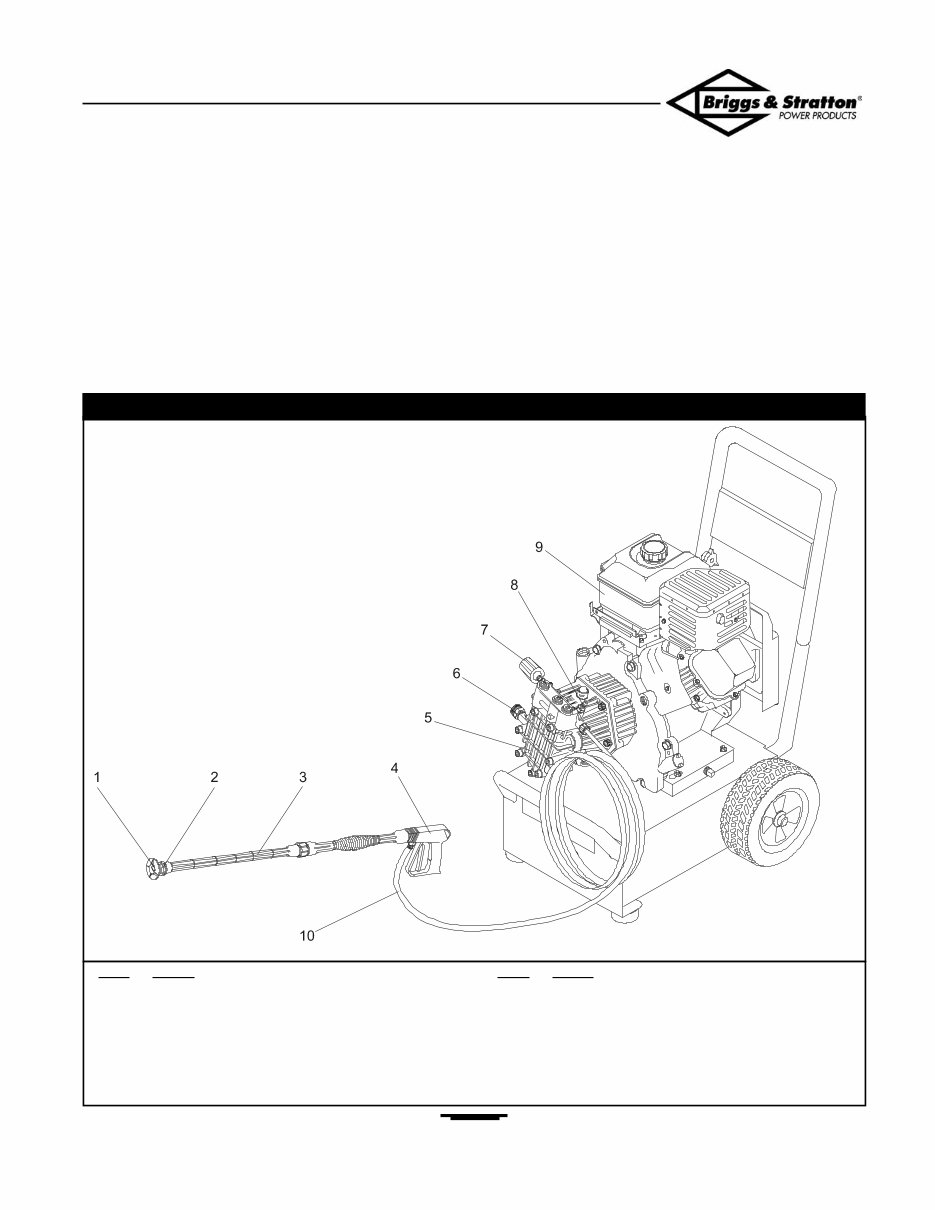
5 Operation of a pressure washer system may be briefly described as follows. Please refer to Figure 1.1 for visual component identification: 1. An inlet hose delivers water to the motor-driven, piston- type pump. An inlet strainer (item 6) protects the pump (item 5) against damage from solid impurities. The motor driving the pump (item 9) may be gas or electric. 2. Rotary motion of the motor crankshaft is converted to reciprocating motion of the pump’s pistons using an axial cam. On a piston’s ‘suction’ stroke, an inlet valve opens and water is drawn into the piston chamber. On the piston’s ‘pressure’ stroke, that piston’s inlet check valve closes and its outlet check valve is forced open so pressurized water can leave the chamber. There is one inlet check valve and one outlet check valve for each piston. PRESSURE WASHER OPERATION Section 1 • Operation Pressure Washer Familiarization and Troubleshooting Guide Item Name 1 Spray nozzle 2 Hi-Lo nozzle collar 3 Spray gun extension wand 4 Spray gun with locking trigger 5 Pump, including optional thermal relief and/or easy start valve Item Name 6 Inlet strainer 7 Unloader/pressure regulator valve 8 Chemical inject fitting (optional) 9 Engine on cart 10 High pressure hose Figure 1.1 — Example Pressure Washer System
6 3. The linear movement of the pistons pump a fixed volume of water through the pressure washer system. The volume of water flow depends on a. piston diameter b. length of piston stroke c. number of pistons d. number of piston strokes per minute. 4. The pressure that builds up in the system then depends on the size of the spray nozzle orifice (item 1). 5. The fixed volume of water flows past an unloader/pressure regulator valve (item 7), an optional chemical injection assembly (item 8), through a high- pressure hose (item 10), and to a spray gun (item 4). 6. The spray gun permits the operator to turn the flow of water on or off. 7. If the water flow is turned off, water pressure within the pump will increase until the unloader/regulator valve (item 7) is moved off its seat. Flow is then bypassed back to the pump inlet through an internal bypass channel. Fluid bypass continues as long as the spray is turned off. 8. Recirculating bypass water can become hot enough to damage seals and other pump parts. Some pressure washer systems may be equipped with an internal thermal relief valve which automatically replaces hot water with cool water. 9. The optional chemical injection assembly (item 8) permits detergents or other chemicals to be drawn into the water stream and (along with the water) discharged from the nozzle. 10. The nozzle collar (item 2), a part of the spray gun nozzle, permits easy selection of high or low velocity spray or a fan or stream spray pattern. 11. An optional easy start valve relieves pump outlet pressure during cranking for quicker and easier starts. 12. As a nozzle is used, it often becomes clogged with various types of matter. A clogged nozzle obstructs the water flow causing a reduction in outlet pressure. It also may cause the water stream to pulsate while the gun is triggered. Therefore, the nozzle should be checked and cleaned before every use, using the cleaning kit provided with every Generac Portable Products® pressure washer system. 13. The flow of water through the nozzle will gradually wear away the nozzle orifice, causing the orifice to become larger. This enlargement will eventually cause a reduction in system pressure. For this reason, the nozzle should be replaced periodically and always replaced with the correct nozzle. Section 1 • Operation Portable Pressure Washer Familiarization and Troubleshooting Guide
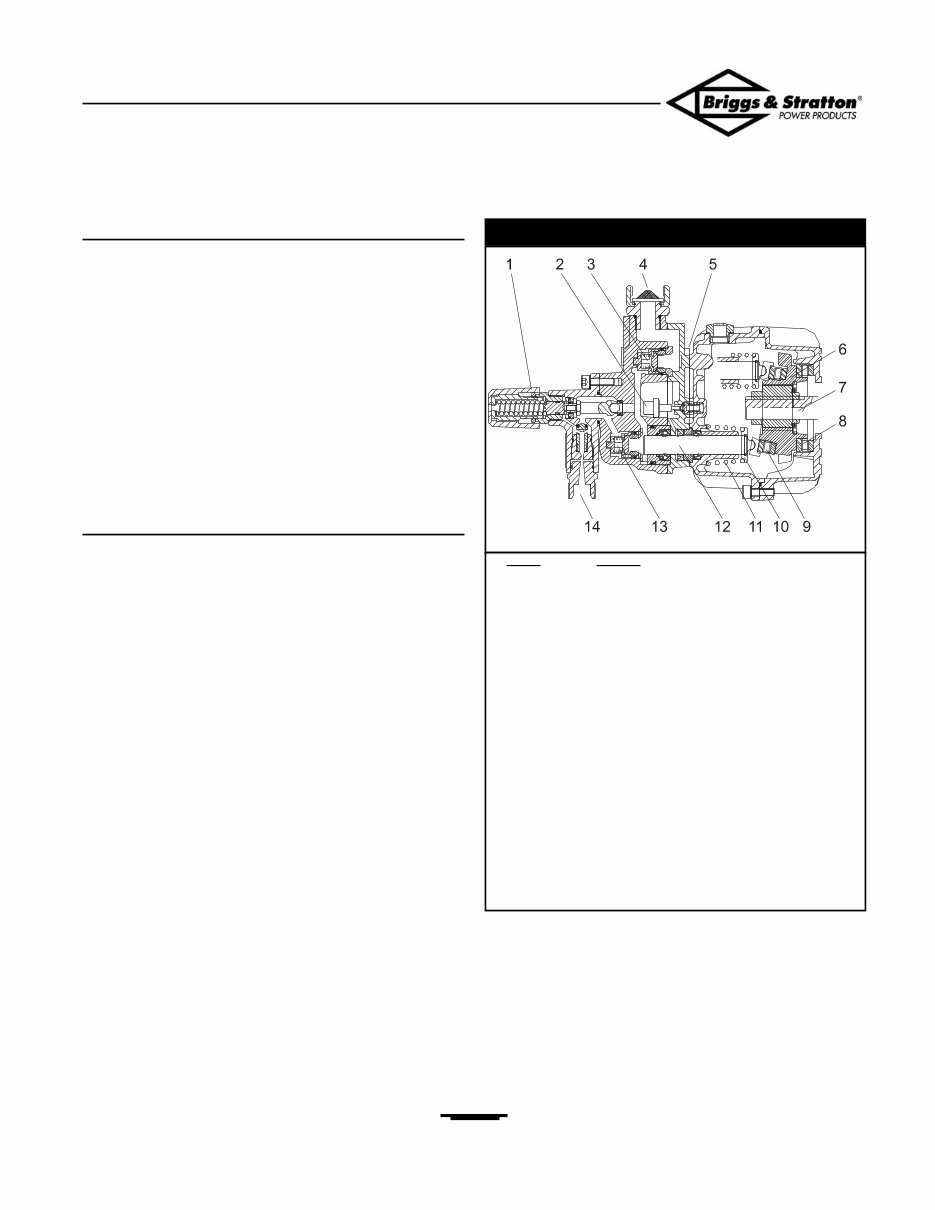
7 Power Source Generac Portable Products® uses several engine manufacturers and different pump types on its pressure washers. Generac Portable Products® also uses an electric motor on some models. The motor horsepower rating is designed into the overall rating of the pressure washer. Pressure pumps require a specified amount of horsepower for the pressure rating of the pump. It is important to remember that engine performance may be miss-diagnosed as a failed pump, and a failed pump may also be miss-diagnosed as a faulty engine. This manual does not cover service and repair of the engine. Refer to the engine manufacturers’ service manual for engine repair specifications. Pressure washer pumps Generac Portable Products® pressure washer pumps are positive displacement, piston type pumps. They use an axial cam to impart a reciprocating motion to its three (3) pistons. The volume of water moved by the pump depends on: 1. The axial distance each piston moves on its pressure stroke 2. The diameter of each piston bore 3. The rotating speed of the axial cam (RPM of the engine or electric motor) 4. The number of pistons Theoretically, a pump will always move the same volume of water, regardless of flow restrictions. The pump’s axial cam is coupled to the engine crankshaft, so that it revolves at the same speed as the engine. Figure 2.1 depicts a simplified cross-sectional diagram of a typical pressure washer pump mechanism. If the pump simply discharges water to atmosphere, no pressure will be created. A pressure buildup in the system occurs when flow is restricted downstream from the pump. By adding a nozzle to the system, pressure will increase to force the same volume of water through the nozzle orifice. The smaller the nozzle orifice, the greater the pressure needed to force the pumped volume through the nozzle. PRESSURE WASHER COMPONENTS Section 2 • Pressure Washer Components Portable Pressure Washer Familiarization and Troubleshooting Guide Figure 2.1 — Pressure Washer Pump Item Name 1 Pressure adjust knob 2 Thermal bypass actuator 3 Inlet check valve 4 Garden hose connector/strainer 5 Thermal bypass outlet 6 Axial cam 7 Engine drive shaft 8 Engine adapter bearing assembly 9 Piston shoe bearing assembly 10 Piston spring retainer 11 Piston return spring 12 Piston 13 Outlet check valve 14 High pressure discharge port
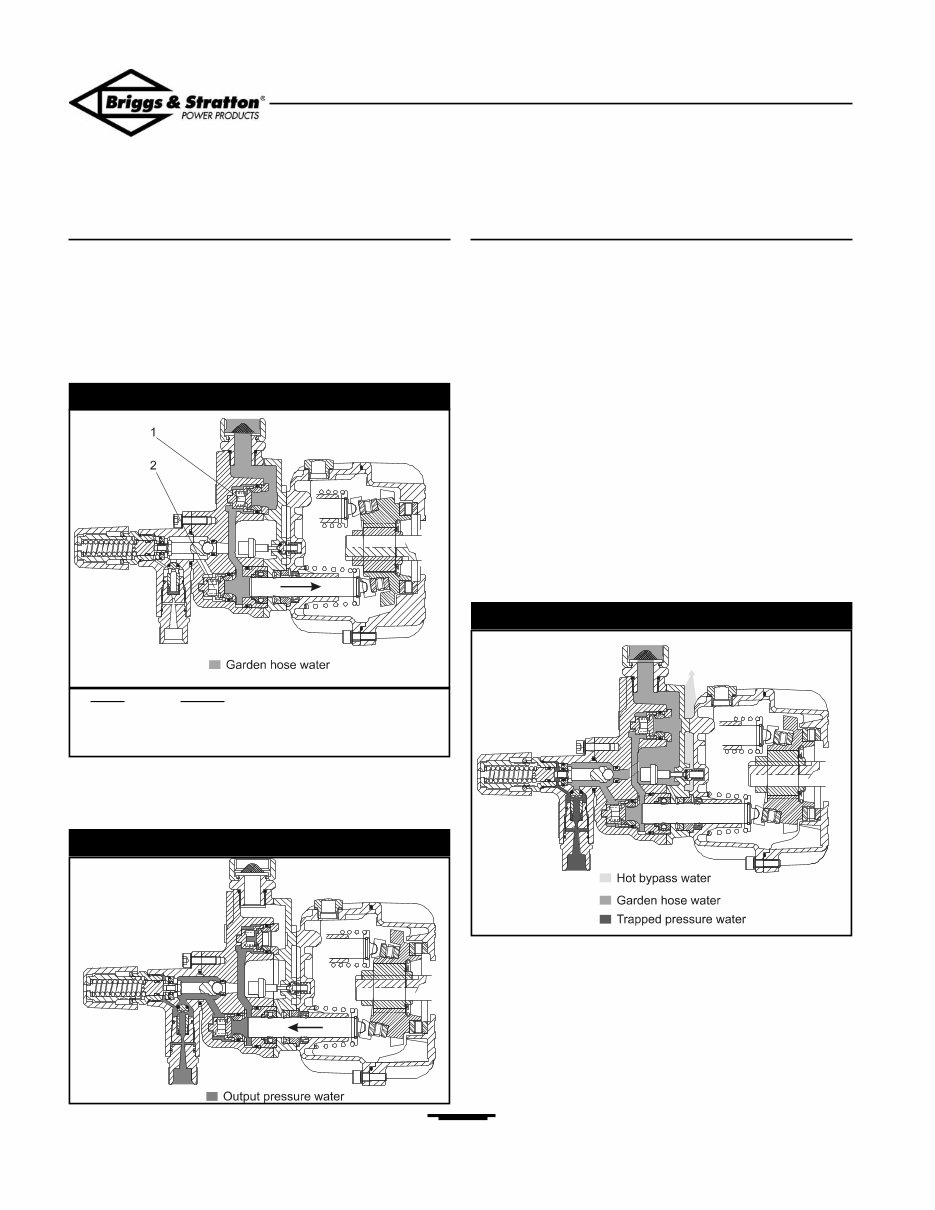
8 Inlet and Outlet Check Valves A set of six (6) inlet and outlet check valves work in conjunction with the pump pistons to create volume flow. As a piston is moved toward the axial cam by its return spring during its suction stroke, that piston’s inlet check valve opens and allows water to enter the pumping chamber. During the suction stroke, that piston’s outlet check valve is forced closed, as depicted in Figure 2.2. When the piston is pressed forward by the axial cam on its pressure stroke, its inlet check valve is forced closed and its outlet check valve is forced open, as seen in Figure 2.3. Unloader - Pressure Regulator Output water pressure can be adjusted using the pressure adjust knob on the Unloader-Pressure Regulator assembly. Turn the knob clockwise to increase pressure (up to the rated maximum pump pressure), counterclockwise to decrease pressure. The pressure washer is provided with an unloader - pressure regulator valve to protect the pump and hose system whenever water flow is blocked upstream. Blockage is caused when the spray gun trigger is normally closed or by a kinked pressure hose or a clogged nozzle. Without an unloader system, water pressure could increase until the engine stalls or part of the system ruptures to relieve the pressure. As shown in Figure 2.4, the unloader valve will open at a preset maximum pressure to divert all or part of the flow back to the pump inlet. During such shutdown conditions, the water will circulate from the pumping chambers to the pump inlet and then back to the pumping chambers. Section 2 • Pressure Washer Components Portable Pressure Washer Familiarization and Troubleshooting Guide Figure 2.4 — Typical Unloader - Pressure Regulator System Figure 2.2 — Inlet Check Valve - Suction Stroke Figure 2.3 — Outlet Check Valve - Pressure Stroke Item Name 1 Inlet check valve 2 Outlet check valve
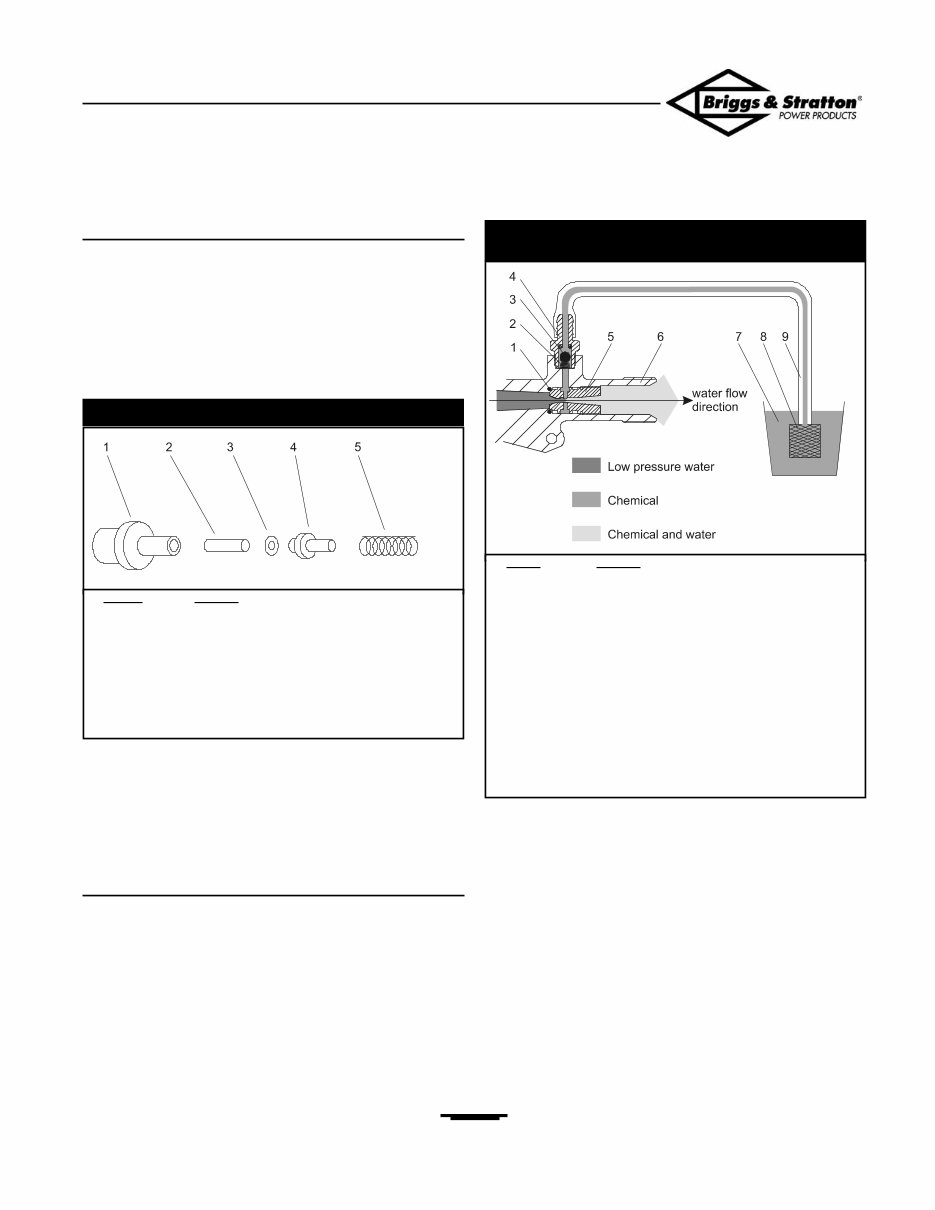
9 Thermal Bypass System When the trigger on the gun is not squeezed, the water in the pump is recirculating and under pressure. This condition causes the water in the pump to become hot. Excessively hot water may cause damage to the pressure washer pump elements. To resolve this problem, some Generac Portable Products® pressure washers are equipped with a thermal bypass system. Figure 2.5 depicts components of such a system. At a water temperature of approximately 140°F, the thermal actuator stem will push the thermal piston off its seat. Heated water will then bleed out of the pump to the ground. As cool water enters the pump, the thermal actuator stem retracts and the thermal piston closes against its seat, halting the water bleed-off. Chemical Injection Generac Portable Products® pressure washers commonly incorporate a means of adding wax or cleaning/sanitizing chemicals into the low-pressure water stream. As depicted in Figure 2.6, the chemical injection assembly includes a venturi, a spring-loaded ball and seat, a chemical siphon tube, and a strainer. As low-pressure water flows through the injector venturi throat, its velocity increases and its pressure decreases. The suction created by the low pressure at the venturi throat draws the liquid chemical through a strainer into the siphon tube, around and past the spring-loaded ball, through small orifices in the venturi, and into the water stream. Chemical injection only operates at the low pressure setting because detergents and chemicals require some soak or residence time on the surface to be cleaned. Low pressure also avoids splashing, over-spraying, and waste. Section 2 • Pressure Washer Components Portable Pressure Washer Familiarization and Troubleshooting Guide Figure 2.5 — Thermal Bypass System Item Name 1 Thermal bypass actuator 2 Thermal bypass actuator stem 3 O-ring 4 Thermal bypass piston 5 Thermal bypass spring Item Name 1 Venturi o-ring 2 Spring 3 Check ball moved OFF valve seat 4 Chemical injection fitting 5 Chemical injection venturi 6 Discharge port 7 Chemical solution reservoir 8 Siphon tube strainer 9 Chemical siphon tube Figure 2.6 — Low Pressure Suctionof Chemical Injection System
This manual covers all versions of the following machines:
BRIGGS AND STRATTON PORTABLE PRESSURE WASHERS
Our informative repair manual, owners manuals, and parts catalogs contain all the information you need to perform repairs, look up parts, or do routine maintenance on your machine. You will have access to information regarding the following topics:
General Information
Routine Maintenance
Engine Removal and Installation
Fuel System
Lubrication and Cooling System
Engine Specifications
Transmission, Drive Chain & Sprockets
Steering System
Shocks
Body Work
Intake & Exhaust
Electrical System
Advanced Troubleshooting
And much more! ......
With our repair manuals, find the page pertaining to your job, print it off, and get working on your machine. No more ruining your expensive paper shop manual with grease and dirt.
Broke down on the trail or site and have a smartphone? What a cool way to find your problem and repair it on the trail, no downtime on the job site. With our repair manuals, you instantly have access to the material needed to get you running again. Kind of tough to do that with a paper manual.
And did we mention the fact that you're saving the trees... All our repair manuals come with a Lifetime Protection Policy. If lost or damaged, simply contact us and we'll replace it free of charge for life.
We provide various repair service manuals, workshop manuals, repair manuals, owners manuals, parts catalogs, and other various manuals all in an electronic format.
UTVs, Motorcycles, ATVs, Quads, Snowmobiles, Seadoo, Equipment, Small Engines, Inboards, Outboards, and more.
INSTANT DOWNLOAD
NO SHIPPING COST WITH DOWNLOAD
GET A DOWNLOAD SO NO WAITING, REPAIR IT NOW ......



 Lifetime Access