



Stihl MS241 Chainsaw Workshop Manual
What's Included?
 Lifetime Access
Fast Download Speeds
Online & Offline Access
Access PDF Contents & Bookmarks
Full Search Facility
Print one or all pages of your manual

STIH)
STIHL MS 241 C
2010-11

1 MS 241 C
q
© ANDREAS STIHL AG & Co. KG, 2011
RA_741_00_01_01
1. Introduction and
safety precautions 3
1.1 Introduction 3
1.2 Safety precautions 4
2. Specifications 5
2.1 Engine 5
2.2 Fuel system 5
2.3 Ignition system 5
2.4 Chain lubrication 5
2.5 Tightening torques 6
3. Troubleshooting 8
3.1 Clutch 8
3.2 Chain Drive,
Chain Brake,
Chain Tensioner 9
3.3 Chain lubrication 11
3.4 Starter 12
3.5 Ignition system 14
3.6 Carburetor 15
3.7 Engine 18
4. Clutch 19
4.1 Clutch drum 19
4.2 Clutch 19
5. Chain brake 20
5.1 Checking operation of
chain brake 20
5.2 Brake band 20
5.3 Brake lever 21
5.4 QuickStop Super
brake lever 23
5.4.1 Adjusting brake cable 25
5.4.2 Brake cable
Removal and
installation 27
5.5 Cam lever 28
5.6 Pins 29
5.7 Chain tensioner 31
5.7.1 Quick chain
tensioner 31
5.7.2 Chain catcher 32
5.8 Bar mounting stud 32
5.9 Collar nut for chain
sprocket cover 32
6. Engine 34
6.1 Muffler 34
6.2 Leak testing 35
6.2.1 Preparations 35
6.2.2 Vacuum test 36
6.2.3 Pressure test 36
6.3 Oil seals 37
6.3.1 Ignition side 37
6.3.2 Clutch side 37
6.4 Shroud 38
6.5 Cylinder 39
6.6 Crankshaft 41
6.6.1 Ball bearing /
crankcase 46
6.7 Piston 47
6.8 Piston rings 49
6.9 Decompression valve 50
7. Ignition system 51
7.1 Ignition timing 51
7.2 Pre-separator 51
7.3 Control unit 51
7.4 Spark test check
control unit 54
7.5 Spark plug boot 55
7.5.1 Ignition lead 56
7.6 Flywheel 56
7.7 Short circuit wire 57
7.7.1 Contact test 57
7.7.2 Removal and
installation 57
7.7.3 Ground wire 64
7.7.4 Contact spring 64
7.8 Troubleshooting,
ignition system 66
8. M-Tronic 69
8.1 Calibrating the
control unit 69
8.2 Testing 70
8.2.1 Test preparations 70
8.2.2 Connect the test lead 70
8.2.3 Check screwed and
plug connections
as well as switch 70
8.2.4 Checking the
solenoid valve 72
8.2.5 Checking the start
detection function 73
8.2.6 Checking the wiring
harness 74
8.3 Wiring harness 76
8.4 Switchgear 76
8.5 Troubleshooting,
M-Tronic 80
8.5.1 Engine does not start 80
8.5.2 Engine does not start
in position } 81
8.5.3 Engine speed drops
under load
– low power 82
8.5.4 Ignition –
no ignition spark 83
8.5.5 Engine stops
suddenly 84
8.5.6 Cut-off speed
not reached 85
9. Rewind starter 86
9.1 General 86
9.2 Fan housing 86
9.3 Pawls 87
9.4 ErgoStart 88
9.5 Rope rotor 89
9.6 Starter rope /
starter grip 89
9.7 Tensioning the rewind
spring 90
9.8 Replacing the rewind
Spring 91
Contents

2 MS 241 C
Contents
10. Maintaining the
antivibration
elements 94
10.1 Antivibration element
on oil tank 94
10.2 Antivibration element
on fuel tank 94
10.3 Antivibration element
on front handle 96
10.3.1 Antivibration element
on handlebar, version
with heating 97
10.3.2 Stop buffer 98
10.3.3 Filter base buffers 98
10.4 Front handle 99
10.4.1 Handlebar with
heating 100
11. Actuating levers 105
11.1 Master Control lever 105
11.1.1 Removal and
installation 105
11.2 Throttle trigger / throttle
trigger interlock 106
11.3 Throttle trigger /
throttle trigger interlock /
QuickStop Super 107
11.3.1 Trigger switch
QuickStop Super 108
11.3.2 Trigger interlock
QuickStop Super 109
11.4 Choke rod 110
11.5 Throttle rod 110
12. Chain lubrication 112
12.1 Pickup body 112
12.2 Oil suction hose 112
12.3 Oil pump 112
12.4 Valve 114
13. Fuel system 115
13.1 Air filter 115
13.2 Baffle 115
13.3 Filter base 115
13.4 Air guide shroud 117
13.4.1 Air guide shroud,
versions with manual
fuel pump 120
13.4.2 Air guide shroud
version with heating 123
13.5 Carburetor 129
13.5.1 Leakage test 133
13.6 Repairing the
carburetor 133
13.6.1 Metering diaphragm 134
13.6.2 Inlet needle 135
13.6.3 Pump diaphragm 135
13.6.4 Lead retainer 137
13.6.5 Lever of the
throttle shaft 137
13.6.6 Lever of the
choke shaft 138
13.7 Carburetor
adjustment 138
13.8 Carburetor bracket 138
13.9 Intake elbow 140
13.10 Tank vent 141
13.10.1 Testing 141
13.10.2 Removal and
installation 142
13.11 Fuel intake 143
13.11.1 Pickup body 143
13.11.2 Fuel hose 143
13.11.3 Fuel hoses manual
fuel pump 146
13.11.4 Manual fuel pump 148
13.11.5 Tank housing 149
14. Heating 152
14.1 Carburetor heating 152
14.1.1 Check overall system 152
14.1.2 Check heating
element 152
14.1.3 Thermostatic switch 153
14.2 Troubleshooting,
carburetor heating 154
14.3 Handle heating
systems 155
14.3.1 Troubleshooting 155
14.4 Heating switch 156
14.5 Heating element
in handle 158
14.6 Heating element in
front handle 159
14.7 Generator 160
14.7.1 Troubleshooting chart,
handle heating systems
and generator 162
14.7.2 Summary of test
connections and test
values 164
14.8 Wiring harness 166
14.9 Connecting leads
heating elements 167
15. Special tools 170
16. Service
accessories 172
3 MS 241 C
1. Introduction and safety precautions
1.1 Introduction
This Service Manual contains
detailed descriptions of all the
typical repair and servicing
procedures for this machine.
Refer to the illustrated spare parts
lists during all repair work. These
lists show the installation position
and order in which the individual
parts and modules should be
assembled.
Refer to the latest edition of the
relevant spare parts list to check the
part numbers of any spare parts
required.
A fault on the machine may be due
to several causes. To help locate
the fault, consult the chapter on
"Troubleshooting" and the
"STIHL Service Training System"
for all functional groups.
Refer to the "Technical Information"
bulletins for engineering changes
which have been introduced since
publication of this Service Manual.
Technical information bulletins also
supplement the spare parts list and
Service Manual until an updated
edition is issued.
The special tools mentioned in the
descriptions are listed in the chapter
"Special Servicing Tools" of this
manual. The tools can be identified
according to part number in the
"STIHL Special Tools" manual. The
manual lists all tools supplied by
STIHL.
Symbols are included in the text and
pictures for greater clarity.
The meanings are as follows:
In the text:
N Action to be taken as shown in
the illustration above the text
– Action to be taken that is not
shown in the illustration above
the text
In the illustrations:
A Item pointer (short)
a Direction of
movement (long arrow)
@ 4.2 Reference to another
chapter, in this case to
Chapter 4.2
Service Manuals and technical
information bulletins are intended
exclusively for the use of properly
equipped repair shops. They must
not be passed on to third parties.
Servicing and repairs are made
considerably easier if the machine
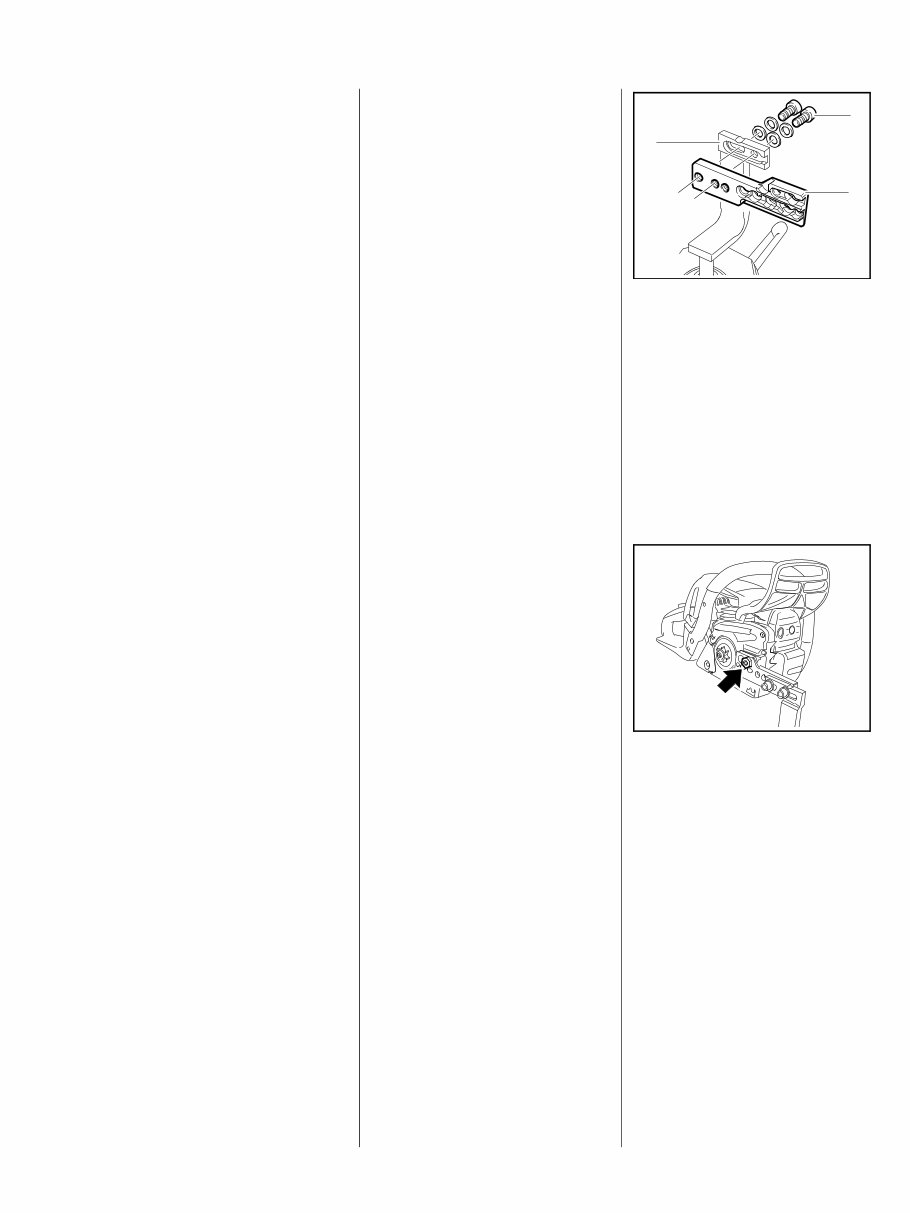
is mounted on assembly stand (3)
5910 890 3101. For this purpose,
secure the clamp (2)
5910 850 1650 to the assembly
stand with two screws (1).
The screws must not protrude, as
they may damage the housings
when clamping the machine,
depending on the machine.
The machine is guided with the
collar screw through the upper hole
of the clamping rail and fastened
using nut M 8 (arrow).
The machine is fastened to the
mount on the clamping rail by the
screw head on the crankcase.
2710RA320 TG
2
3
1
2410RA000 TG
4 MS 241 C
Preparing to make repairs
Before repair tasks or clamping on
the assembly stand, always remove
the chain sprocket cover, saw chain
and guide bar.
Always use original STIHL
replacement parts.
They can be identified by the STIHL
part number
the logo {
and the
STIHL parts symbol K
The symbol may appear alone on
small parts.
Storage or disposal of oil and fuel
Collect fuel or lubricating oil in
a clean container and dispose of it
in accordance with environmental
regulations.
Plug connections on electrical
leads
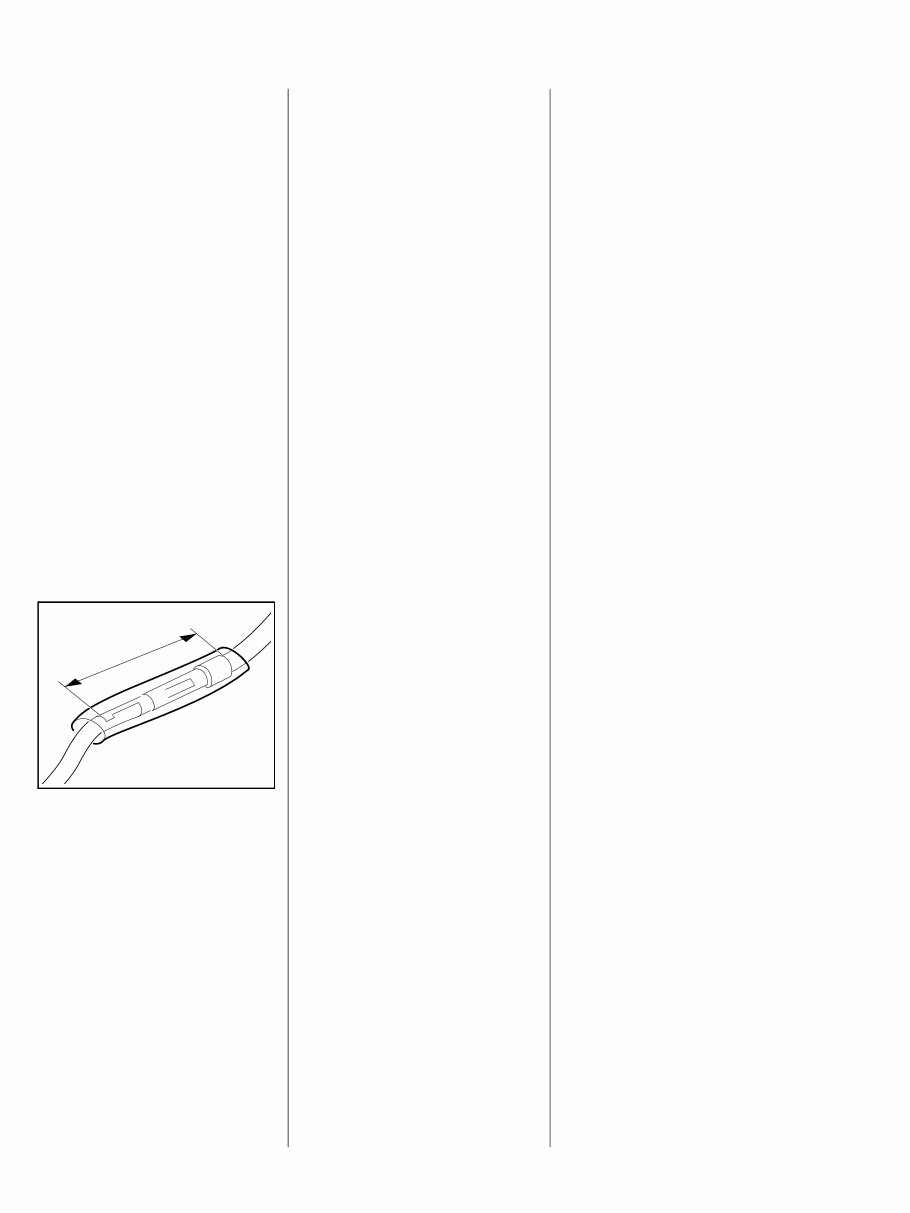
The insulating tube must be
oriented so that it is centered over
the plug connection and completely
enclose the plug connection
– danger of short-circuiting.
The plug connection is completely
plugged together when it has a total
length of a = max. 30 mm.
5902RA299 TG
a
1.2 Safety precautions
Specific national safety regulations
and the safety instructions in the
instruction manual must be
observed if the machine has to be
started up during maintenance or
repair work.
Gasoline is highly inflammable and
can also be explosive under certain
conditions.
Do not bring any fire, flame, spark or
other source of heat near the fuel.
All work with fuel must be performed
outdoors only. Spilled fuel must be
wiped away immediately.
Test for leakage after all work on the
fuel system and engine.
Exercise extreme caution while
carrying out maintenance and repair
work on the ignition system. The
high voltages which occur can
cause serious or fatal accidents.
Suitable gloves must be worn
without fail if parts are heated for
assembly/disassembly purposes.
Improper handling may result in
burns and other serious injuries.
Always replace damaged parts.
Check dismantled parts for wear
and damage before installation,
replace if necessary.
Only use the machine with the
shroud mounted – otherwise the
rotating fan wheel poses a risk of
injury and there is a risk of engine
damage due to overheating.
The chapter "Tightening Torques"
lists all components of this machine
that must be tightened with the
specified tightening torques or
coated with thread-locking
adhesive. These specifications
must be observed throughout the
Service Manual when tightening
screws and nuts as well as other
fasteners.
Fuel system – barbed connectors
Pull or push the fuel hoses, by hand
whenever possible, in the direction
of the connector in order to ensure
leakproofness of the fuel system.
Avoid damaging the barbed
connectors
– sharp-edged pliers, screwdrivers,
etc., may not be used.
Also, do not cut open fuel hoses
with a knife or similar aids.
Do not reuse fuel hoses after
disassembly, but instead always
replace them with new hoses
– fuel hoses can be overstretched
when being detached.
Mount new fuel hoses dry or using
STIHL press fluid, b 16.
Other press fluids are not permitted
and may lead to fuel hose damage.
When using STIHL press fluid,
apply press fluid to the ends of the
hose and the connectors and press
the new hoses onto the barbed
connectors, b 16.

5 MS 241 C
2. Specifications
2.1 Engine
MS 241 C
Displacement: 42.6 cm
3
Bore: 42.5 mm
Stroke: 30.0 mm
Engine power to ISO 7293: 2.2 kW (3.0 HP)
at 10000 rpm
Max. permissible engine speed
(with bar and chain): 14000 rpm
Idle speed: 2800 rpm
Clutch: Centrifugal clutch without
linings
Clutch engages at: 3500 rpm
Crankcase leakage test
at gauge pressure: p
ü
= 0.5 bar
under vacuum p
u
= 0.5 bar
2.2 Fuel system
Carburetor leakage test at
gauge pressure: p
ü
= 0.8 bar
Operation of tank vent at
gauge pressure: p
ü
= 0.5 bar
Fuel: as specified in instruction
manual
2.3 Ignition system
Air gap between control unit
and fanwheel: 0.30 (+ 0.05/- 0.10) mm
Spark plug (suppressed): NGK CMR 6 H
Electrode gap: 0.5 mm
2.4 Chain lubrication
Speed-controlled oil pump with reciprocating piston and
manual oil flow control
Oil flow settings:
min:
max:
4.0 (+/- 2.0) cm
3
/min
at 7000 rpm
8.0 (+/- 3.0) cm
3
/min
at 7000 rpm

6 MS 241 C
2.5 Tightening torques
DG and P screws are fitted in plastic and light alloy metal parts. These screws form a permanent thread when
they are installed for the first time. The material is permanently deformed. Screws can be removed and installed
as often as necessary without impairing the strength of the screwed assembly, provided that the specified
tightening torque is observed.
For this reason it is essential to use a torque wrench.
Fastener Thread size For component Tightening
torque
Nm
Comment
Screw P 4x12 Cover plate / fan housing 2.0
Screw P 4x10 Cover / tank housing 1.0
Screw D 4x12 Cover / chain tensioner / crankcase 2.5 2), 4)
Screw M 5x16 Antivibration element / crankcase 8.0 2), 4)
Screw P 5x34 Antivibration element / tank housing 4.0
Screw D 4x12 Brake band / crankcase 3.0 2), 4)
Screw P 4x10 Brake cable support / tank housing 1.0 Q
Stud M 5x18 Stud 7.0 2), 3)
Stud M 8 Bar mounting stud 23.0 1)
Stud M 8 Bar mounting stud 23.0 1), B
Stud D 8x18 Bar mounting stud (repair solution) 16.0
Screw D 4x12 Cover, chain brake / crankcase 3.0 2), 4)
M 10x1 Decompression valve 14.0
Nut M 5 Filter base / baffle / carburetor 3.5
Screw M 4x12 Generator / crankcase 3.0 3), VW
Screw P 6x25 Handlebar / locking screw 8.0 VW
Screw P 6x26.5 Handlebar / tank housing right 6.0
Screw P 6x30 Handlebar / tank housing right 6.0 2), 4), VW
Screw M 5x16 Handlebar / tank housing bottom 5.0 2), 3)
Screw M 5x12 Handlebar / tank housing bottom 8.0 3), VW
Screw M 5x16 Handlebar / plugs antivibration springs 10.0 2), 3), VW
Screw M 5x20 Hand guard / fan housing / crankcase 6.0 3)
Screw P 6x30 Chain catcher / crankcase / bearing plugs 6.0
Nut M 5 Spiked bumper / crankcase / upper lock nut 8.0
Screw M 5x10 Spiked bumper / top of crankcase 8.0 2), 3)
Screw M 5x16 Spiked bumper / bottom of crankcase 8.0 2), 3)
Screw D 4x12 Manifold / cylinder 4.0 2), 4)
Screw M 5x20 Crankcase drive side / fan side 10.0 2), 4)
Screw M 5x16 Bearing plugs / cylinder 10.0 2), 3)
Screw M 5x16 Fan housing / crankcase 6.0 2), 4)
Screw D 4x12 Air guide shroud / crankcase 4.0 2), 4)

7 MS 241 C
Fastener Thread size For component Tightening
torque
Nm
Comment
Carrier M 12x1 L Crankshaft carrier 50.0
Screw D 4x12 Oil pump / crankcase 4.0 2), 4)
Screw M 5x16 Muffler / crankcase 10.0 2), 3)
Screw M 5x16 Muffler / cylinder 10.0 2), 3)
Nut M 8x1 Flywheel / crankshaft 28.0 5)
Nut M 12x0.75 Switch 2.0
Screw P 4x10 Support 1.0
Screw D 4x12 Pre-separator / crankcase 4.0 2), 4)
M 10x1 Spark plug / cylinder 12.0
Screw D 4x20 Control unit / cylinder 4.5 2), 4)
Screw M 5x20 Cylinder / crankcase 1st stage 4.0 2), 4)
Screw M 5x20 Cylinder / crankcase 2nd stage 10.0 2), 4)
Remarks:
1) Loctite 242 or 243 medium strength
2) Screws with locking serration
3) Microencapsulated screws
4) Screws with easy-slide coating
5) Connection between crankshaft and flywheel must be degreased and oil-free
Q) QuickStop Super
B) Quick chain tensioner
VW) Heating
When inserting DG and P screws into an existing screw thread:
Insert the DG or P screw in the hole and turn counterclockwise until it gently drops into the hole in axial direction.
Tighten the screw clockwise to the specified torque.
This procedure ensures that the screw engages properly in the existing thread and does not form a new thread
and weaken the assembly.
Coat micro-encapsulated screws with Loctite 242 or 243 medium strength before refitting them.
Screwdriver speed when used in plastic material: max. 500 rpm for DG and P-type screws.
Do not use an impact wrench to release or tighten screw connections.
Screws with and without locking serration must not be confused.

8 MS 241 C
3. Troubleshooting
3.1 Clutch
Problem Cause Remedy
Saw chain becomes stuck under
full load
Clutch shoes badly worn Install new clutch
Clutch drum badly worn Install new clutch drum
Saw chain rotates at idle speed Idle speed too high Check M-Tronic
Tension springs of the clutch shoes
are stretched
Replace tension springs, replace
clutch if necessary
Tension springs of the clutch shoes
are broken
Replace tension springs
Loud noises Tension springs stretched Replace all tension springs
Needle cage damaged Replace needle cage
Clutch shoe retainer broken Examine retainer, replace if
necessary
Clutch shoes and carrier worn Install new clutch

9 MS 241 C
3.2 Chain Drive, Chain Brake, Chain Tensioner
Problem Cause Remedy
Chain sprocket wears rapidly Chain not properly tensioned Tension chain as specified
Wrong chain pitch Fit chain of correct pitch
Insufficient chain lubrication Check chain lubrication
Saw chain becomes stuck under
full load
Clutch shoes badly worn Install new clutch
Clutch drum badly worn Install new clutch drum
Brake band stuck Check freedom of movement and
function of brake band
Saw chain rotates at idle speed Idle speed too high Check M-Tronic
Tension springs of the clutch shoes
are stretched
Replace tension springs, replace
clutch if necessary
Tension springs of the clutch shoes
are broken
Replace tension springs
Saw chain does not stop
immediately when brake is
activated
Brake spring stretched or broken Fit new brake spring
Brake band stretched, worn or
broken
Fit new brake band
Clutch drum worn Install new clutch drum
You're Reading a Preview
What's Included?
Lifetime Access
Fast Download Speeds
Online & Offline Access
Access PDF Contents & Bookmarks
Full Search Facility
Print one or all pages of your manual
$30.99
Viewed 92 Times Today


Secure transaction
What's Included?
Lifetime Access
Fast Download Speeds
Online & Offline Access
Access PDF Contents & Bookmarks
Full Search Facility
Print one or all pages of your manual
$30.99
The Stihl MS241 Chainsaw Workshop / Shop Manual provides comprehensive information for repairing and maintaining your chainsaw. Whether you are a professional mechanic or a DIY enthusiast, this manual covers all the essential details you need to effectively service your chainsaw.


