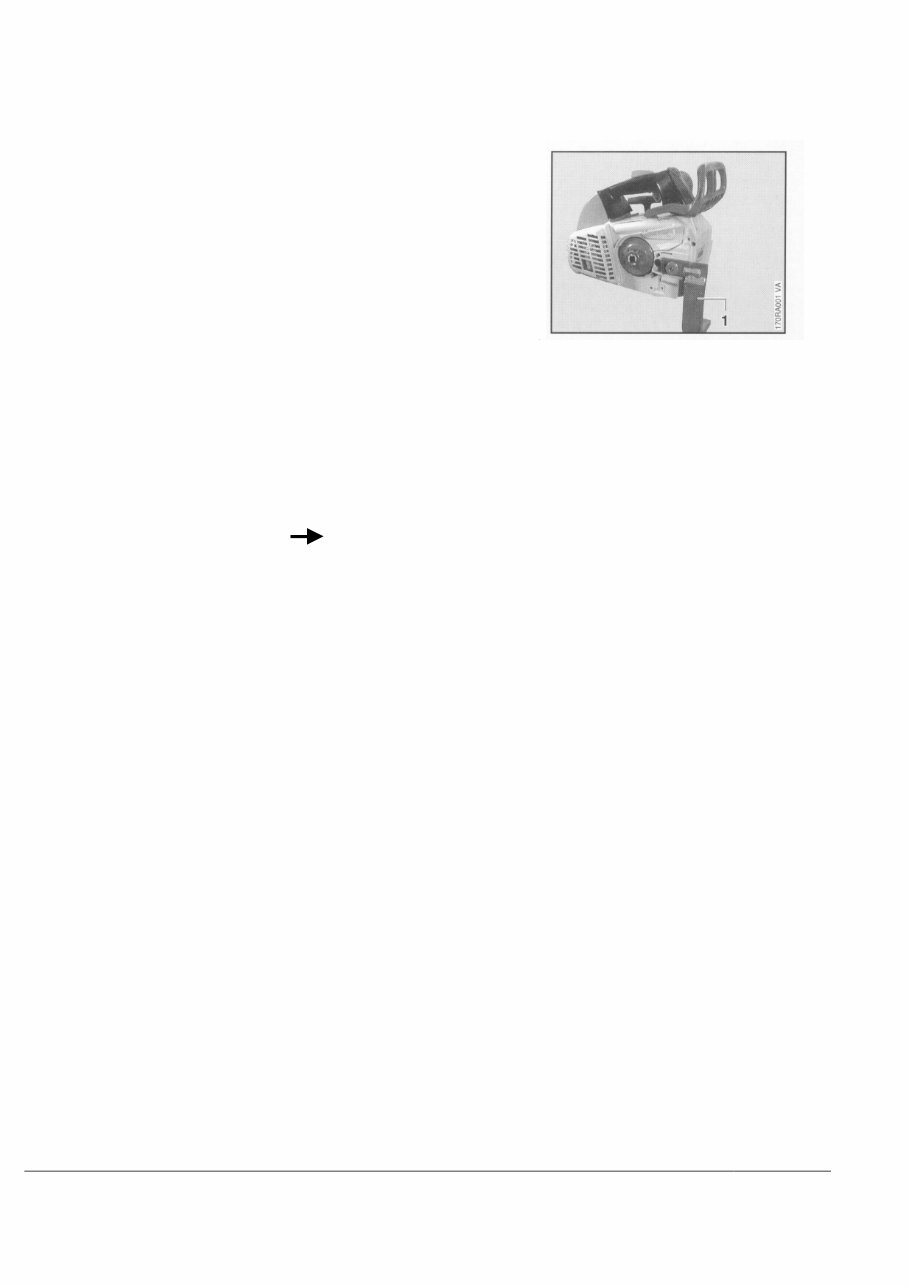
STIHL 019 T 2 1. INTRODUCTION This service manual contains detailed descriptions of all the repair and servicing procedures specific to this series of chainsaws There are separate handbooks for servicing procedures on standardized parts and assemblies that are installed in several STIHL power tool models. Reference is made to these handbooks in the appropriate chapters of this manual. You should make use of the illustrated parts lists while carrying out repair work. They show the installed positions of the individual components and assemblies. Always use the latest edition of the parts list to determine the part numbers of any replacement parts required. Microfilmed parts list are always more up to date than printed lists. A fault on the machine may have several causes. Consult the troubleshooting charts for all assemblies in the "Standard Repairs, Troubleshooting" handbook. Refer to the "Technical Information" bulletins for engineering changes which have been introduced since publication of this service manual. Technical information bulletins also supplement the parts list until a revised edition is issued. Special servicing tools mentioned in the descriptions are listed in the last chapter of this manual. Use the part numbers to identify the tools in the "STIHL Special Tools" manual. The manual lists all special servicing tools currently available from STIHL. Symbols are included in the text and pictures for greater clarity. The meanings are as follows: In the descriptions: • = Action to be taken as shown in the illustration (above the text) - = Action to be taken that is not shown in the illustration (above the text) In the illustrations: P = Pointer = Direction of movement Service manuals and all technical information bulletins describing engineering changes are intended exclusively for the use of STIHL servicing dealers. They must not be passed to third parties. Servicing and repairs are made considerably easier if the powerhead is mounted to the assembly stand (1) 5910 890 3100. This enables the powerhead to be swivelled to the best position for the ongoing repair and leaves both hands free. It is secured with the bar mounting stud after removing the chain sprocket cover and tensioner. Always use original STIHL replacement parts. They can be identified by the STIHL part number, the STIHL STIHL STIHL STIHL logo and the STIHL parts symbol (The symbol may appear alone on small parts.
STIHL 019 T 3 2. SPECIFICATIONS 2.1 Engine STIHL single cylinder two-stroke engine with special impregnated cylinder bore Displacement: Bore: Stroke: Engine power to ISO 8893: Max. engine speed with bar and chain: Idle speed: Bearings: Piston pin diameter: Connecting rod length: Rewind starter: Reserve pull on rope rotor: Starter rope: Clutch: Diameter: Clutch engages at: Crankcase leakage test at gauge pressure: under vacuum: 35.2 cm 3 (2.15 cu.in) 40 mm (1.57 in) 28 mm (1.10 in) 1.2 kW (1.6 bhp) 12,000 rpm 2,800 rpm Crankshaft supported in heavy- duty ball bearings, needle cages on small and big ends 8 mm (0.3 in) 51 mm (2 in) Single pawl system min. 1/2 turn 3.0 mm (0.12 in) dia., 800 mm (31.5 in) long Centrifugal clutch without linings 64 mm (2.52 in) 3,700 rpm 0.5 bar (7.25 psi) 0.4 bar (5.8 psi) Carburetor: Standard setting High speed screw H: Low speed screw L: Carburetor leakage test at gauge pressure: Fuel tank capacity: Octane number: Fuel mixture: Mix ratio: Air filter: Diaphragm carburetor Open approx. 1 turn Open approx. 1 turn 0.4 bar (4.8 psi) 0.29 1 (0.61 US pt) min. 90 RON (US/CAN: pump octane min. 87 unleaded) Regular brand-name gasoline and two-stroke engine oil 1:50 with STIHL 50:1 two-stroke engine oil 25:1 with other brand-name two-stroke, air-cooled engine oils Felt element 2.2 Fuel System
STIHL 019 T 4 STIHL repair kit 6-tooth 3/8" P spur sprocket 8-tooth 1/4" spur sprocket ElastoStart Carburetor parts kit 1132 900 5000 1123 640 2005 1123 640 2010 0000 190 3400 1132 007 1060 2.5 Special Accessories 2.5.1 For User 2.5.2 For Service 2.3 Ignition System 2.4 Cutting Attachment Electronic magneto ignition (breakerless) with integral trigger unit 0.25 mm (0.010 in) 1.6 - 2.3 mm (0.063-0.091 in) B.T.D.C. at 8,000 rpm NGK BPMR 7 A or CHAMPION RCJ6Y 0.5 mm (0.02 in) M14x1.25 9.5 mm (0.37 in) 9.32 mm (3/8") Picco-Micro-Mini 7-tooth 3/8" P spur sprocket 21.7 m/s (71.2 ft/sec) at 10,000 rpm Speed-controlled reciprocating oil pump. No oil feed at idle speed Adjustable 5 - 9 cm 3 /min (0.17 - 0.30 fl.oz/min) 0.16 l (0.34 US pt) Type: Air gap: Ignition timing: Spark plug (suppressed): Electrode gap: Spark plug thread: Length of thread: Oilomatic chain: Chain sprocket: Chain speed: Chain lubrication: Oil delivery rate: Oil tank capacity:
STIHL 019 T 5 2.6 Tightening Torques Plastoform screws are used for polymer components and "DG" screws for lightmetal components. These screws form a permanent thread when they are installed for the first time. They can be removed and installed as often as necessary without detrimentally affecting the strength of the screwed assembly, providing the specified tightening torque is observed. For this reason it is essential to use a torque wrench. Fastener Spline screw Spline screw Spline screw Spline screw Spline screw Spline screw Spline screw Spline screw Collar screw Spline screw Collar nut Plastoform screw Screw Thread size IS-DG 4x20 IS-DG 5x24 IS-DG 5x24 IS-DG 5x24 IS-DG 5x24 IS-DG 5x24 IS-DG 5x24 IS-DG 5x24 IS-DG 8x18 IS-M5x52 M8x1 M12x1 L M14x1.25 IS-P4x12 IS-DG 3.5x12 For component Ignition module/cylinder Handle molding/front handle Fan housing/engine housing Engine pan/cylinder Handle molding/handle Muffler/cylinder Spacer flange/cylinder Engine housing/cylinder Bar mounting/engine housing Intake casing/carburetor/flange Flywheel Clutch Spark plug Hand guard, left/fan housing Support plate /diaphragm/ spacer flange Torque Nm Ibf.ft 4.5 3.3 3.5 2.6 4.0 3.0 8.0 5.9 4.0 3.0 7.0 5.2 8.0 5.9 8.0 5.9 16.0 11.8 5.0 3.7 28.0 21.0 50.0 37.0 25.0 18.5 1.7 1.3 2.0 1.5 Remarks Use the following procedure when refitting a P or DG screw in an existing thread: - Place the screw in the hole and rotate it counterclockwise until it drops down slightly. - Tighten the screw clockwise to the specified torque. This procedure ensures that the screw engages properly in the existing thread and does not form a new thread and weaken the joint. Note: Power screwdriver speed for use in polymer: Plastoform screws max. 600 rpm, DG screws max. 500 rpm. Use only screws specified in parts list. Do not use screws with underhead locking teeth on polymer components.
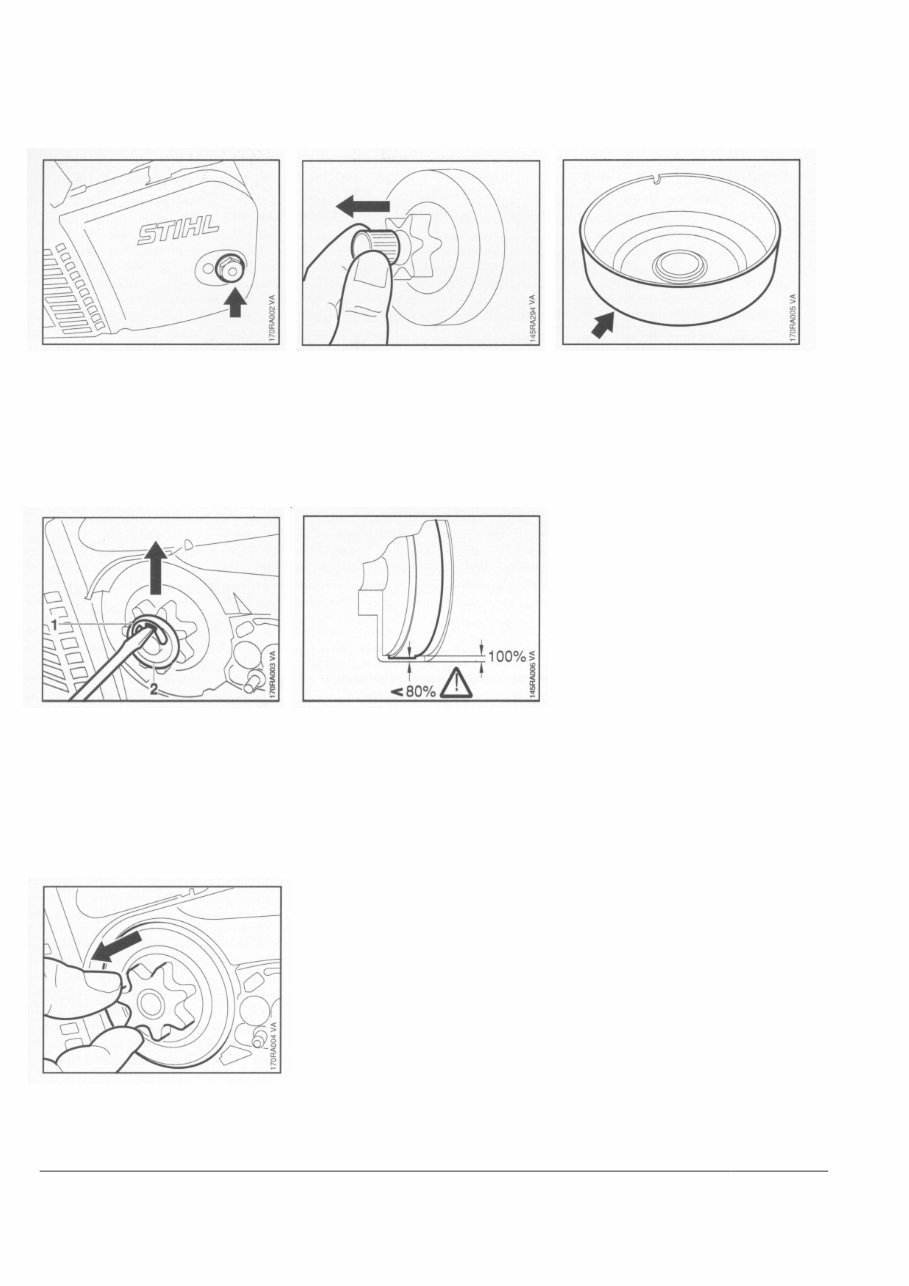
STIHL 019 T 6 • Remove the E-clip (1). • Remove the washer (2). • Pull off the chain sprocket. • If the clutch drum is still serviceable, use No. 120 emery paper or emery cloth (grain size approx. 120μm) to clean and roughen its friction surface. Reassemble in the reverse sequence. - Clean stub of crankshaft. Wash needle cage in clean white spirit and lubricate with grease - see 11.2. - Replace damaged needle cage. - Rotate chain sprocket and apply slight pressure at the same same until oil pump drive spring engages properly. • Take the needle cage out of the sprocket. - Clean and inspect the chain sprocket. • Unscrew the nut. - Pull off the chain sprocket cover. - Disengage the chain brake by pulling the hand guard toward the front handle. 3. CLUTCH, CHAIN DRIVE, CHAIN BRAKE AND CHAIN TENSIONER 3.1 Chain Sprocket Important: If there are noticeable wear marks on the inside diameter of the clutch drum, check its wall thickness. If it is less than 80% of the original wall thickness, fit a new sprocket. Note: If the clutch drum has to be replaced, also check the brake band - see 3.3.2.
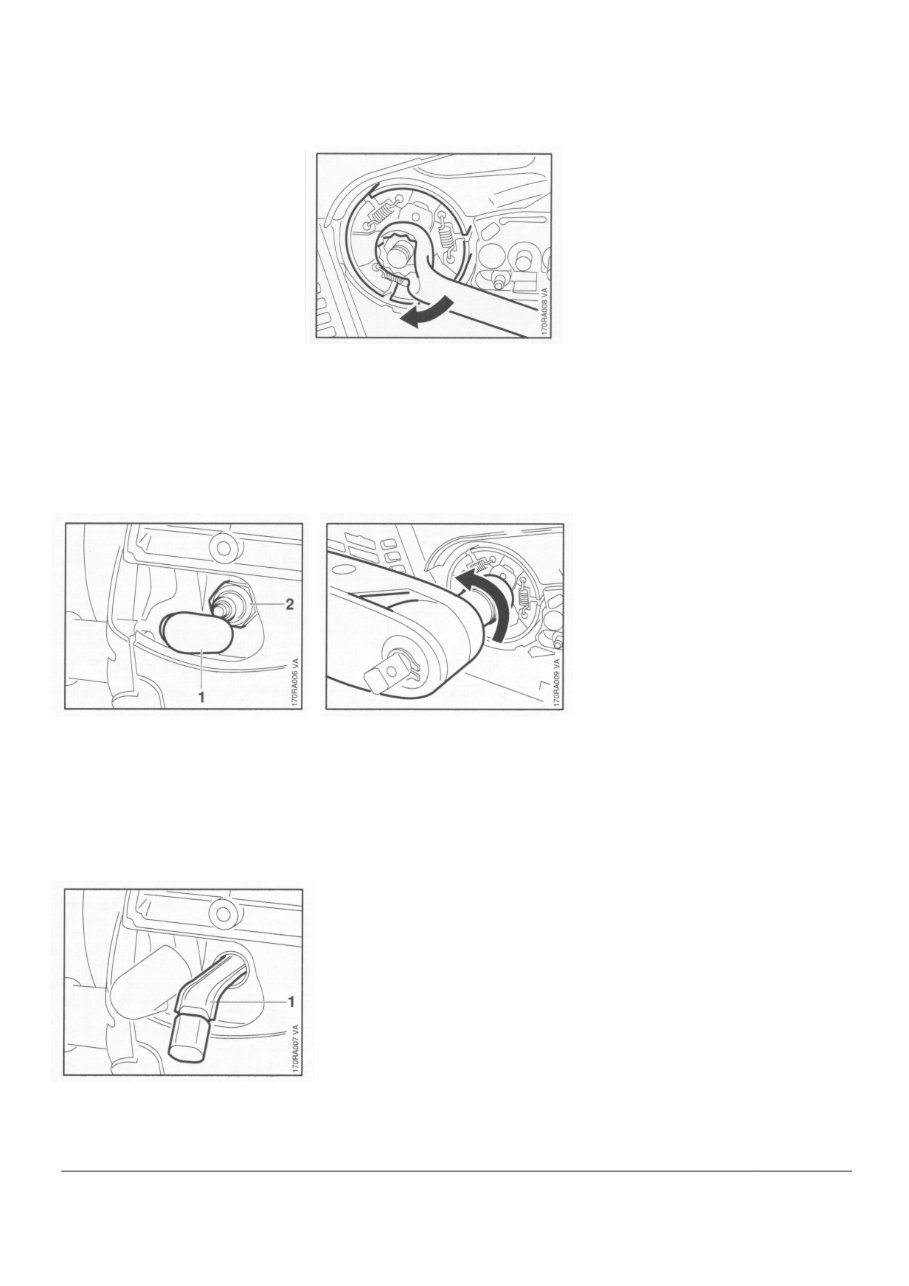
STIHL 019 T 7 3.2 Clutch Troubleshooting chart - see "Standard Repairs, Troubleshooting" handbook. - Remove chain sprocket - see 3.1. 3.3 Chain Brake 3.3.1 Checking Function The chain brake is one of the most important safety devices on the chainsaw. Its efficiency is measured in terms of braking time, i.e. the time that elapses between activating the brake and the saw chain coming to a standstill. The shorter the braking time, the better the efficiency and protection offered against being injured by the rotating chain. Contamination (with chain oil, chips, fine particles of abrasion, etc.) and smoothing of the friction surfaces of the brake band and clutch drum impair the coefficient of friction. This, in turn, reduces the frictional forces and thus prolongs the braking time. A fatigued or stretched brake spring has the same negative effect. - Start the engine. - With the chain brake activated (locked), open throttle wide for brief period (max. 3 seconds) the chain must not rotate. - With the chain brake released, open throttle wide and activate the brake manually - the chain must come to an abrupt stop. Note: The braking time is in order if deceleration of the saw chain is imperceptible to the eye. • Pull boot (1) off the spark plug. - Unscrew the spark plug (2). • Push the locking strip (1) 0000 893 5903 into the cylinder. • Unscrew the clutch from the crankshaft in the direction of the arrow (left-hand thread). - Disassemble and reassemble the clutch - see "Standard Repairs, Troubleshooting" handbook. • Screw clutch onto crankshaft and torque down to 50 Nm (37 Ibf.ft). - Remove locking strip from cylinder. - Install spark plug and torque down to 25 Nm (18.5 Ibf.ft). Important: If spark plug has a separate terminal nut, make sure that it is properly tightened down. - Fit spark plug boot. - Install the chain sprocket - see 3.1.
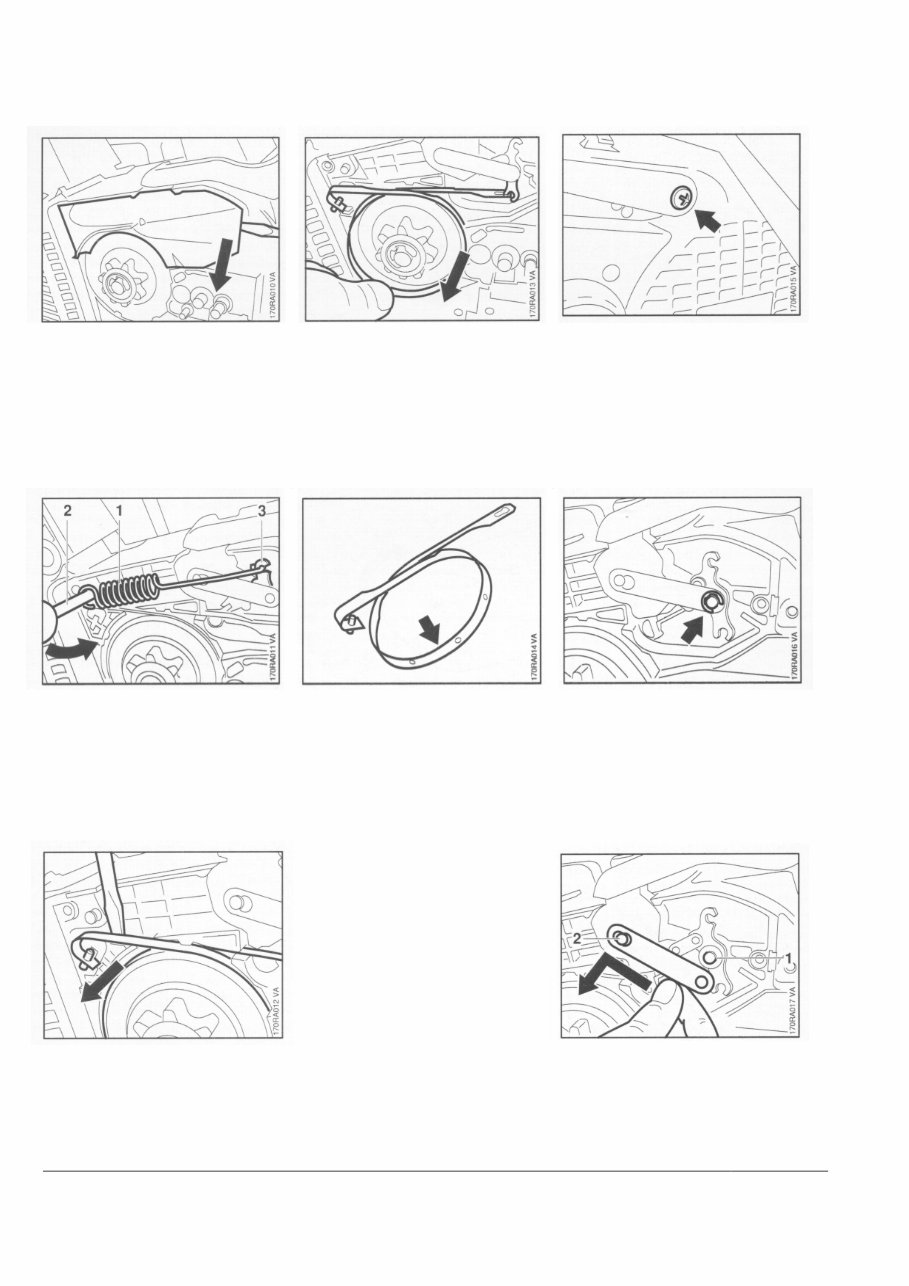
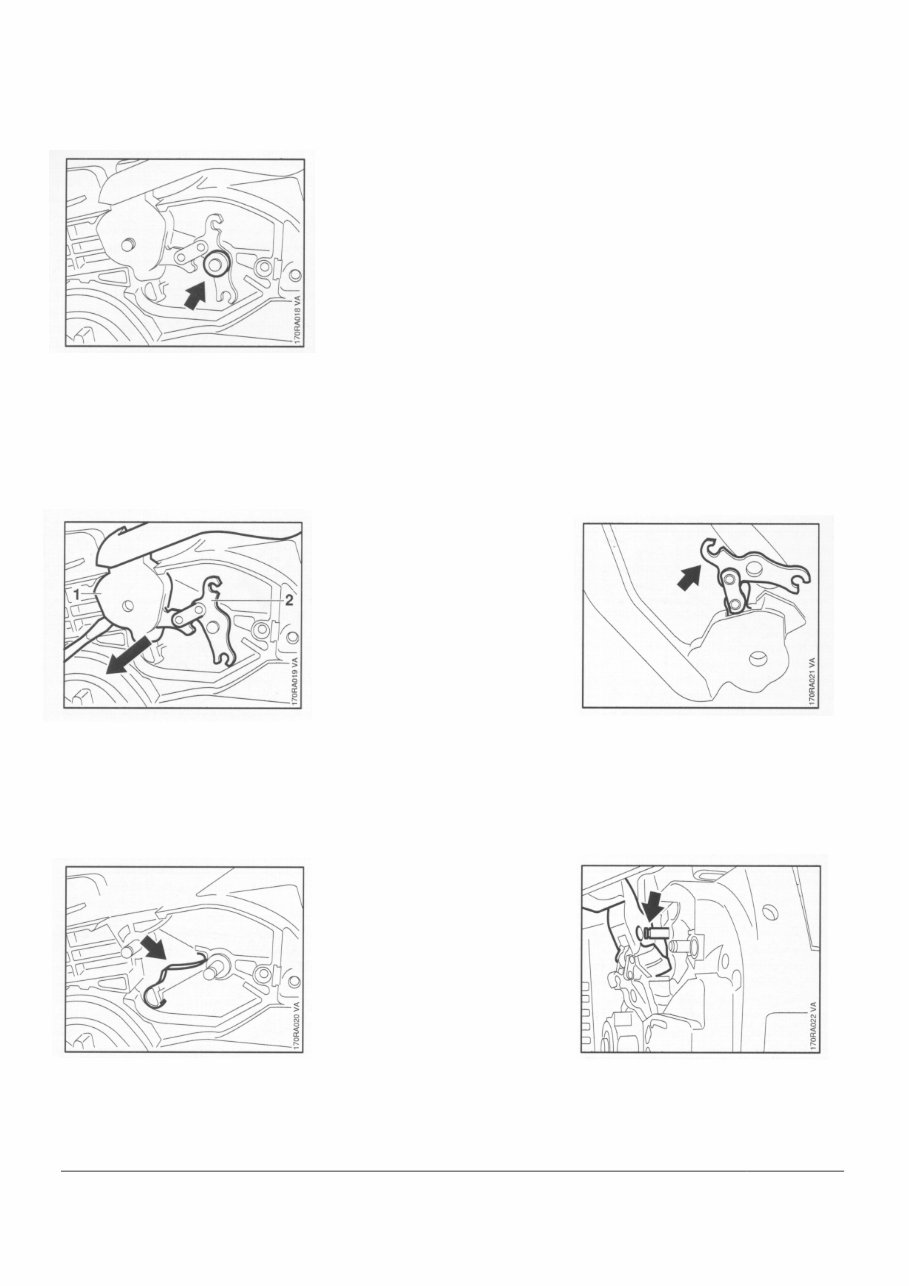
STIHL 019 T 8 • Lever the brake band out of the engine housing. • Slip the strap off the bell crank pivot pin (1). • Push the strap to one side and remove it from the hand guard pivot pin (2). Replace the brake band if: - there are noticeable signs of wear (large areas on inside diameter and/or parts of outside diameter) and - its remaining thickness is less than 0.6 mm (0.024"). Important! Thickness of brake band must not be less at any point. • If the brake band is still serviceable, use No. 120 emery paper or emery cloth (grain size approx. 120μm) to clean and roughen its entire friction surface (inside diameter). • Take out the screw. - Remove the hand guard from its seat on the fan housing. • Remove brake band from the chain sprocket and detach it from the bell crank. - Release tension of brake spring by pushing the hand guard forwards. - Remove chain sprocket cover. • Ease the cover out of its retainers. 3.3.2 Disassembly • Use assembly tool (2) 1117 890 0900 to carefully disconnect the brake spring (1). • Unhook the brake spring from the bell crank (3). • Remove the E-clip,
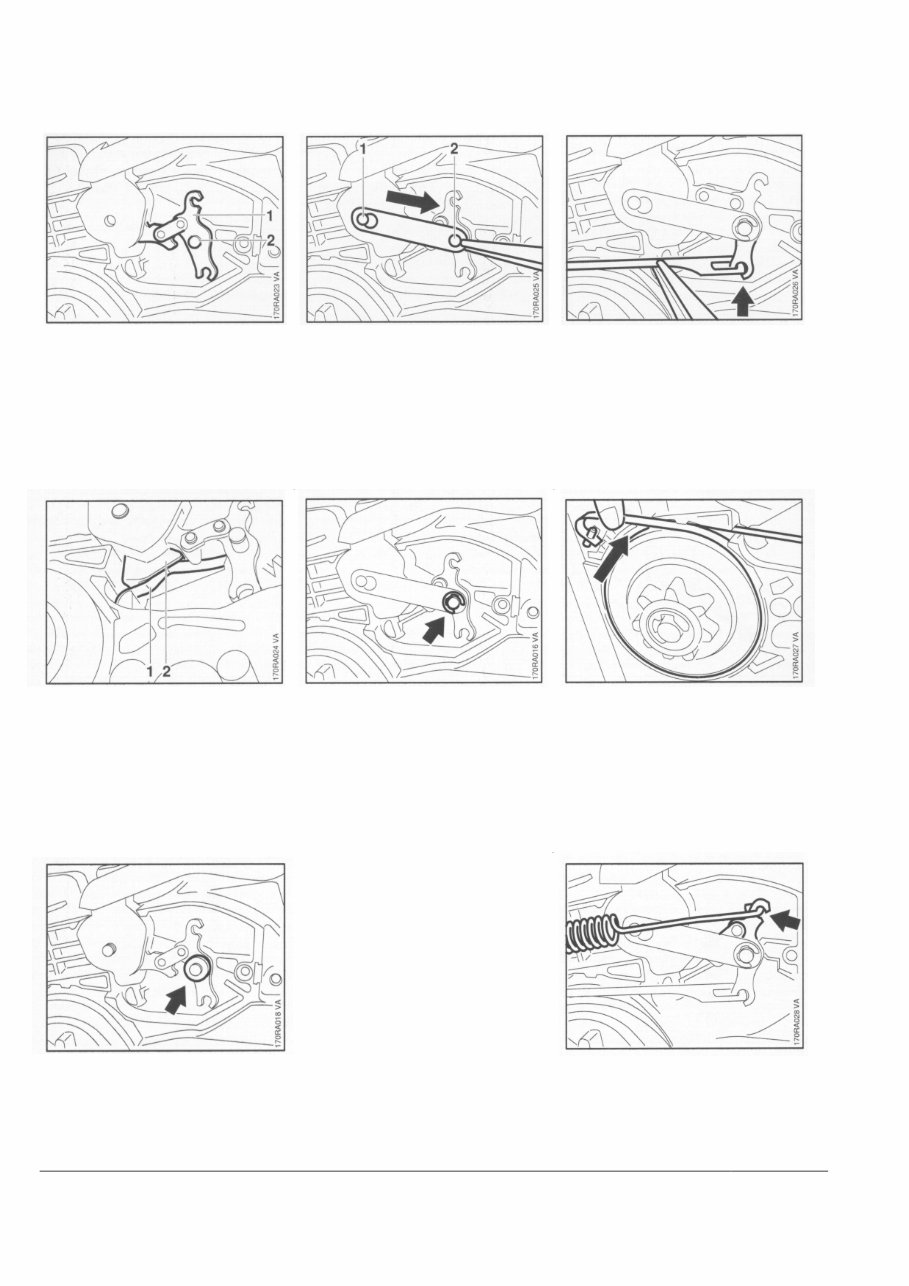
STIHL 019 T 9 - Clean chain brake seat in housing. - If the groove of the brake spring anchor pin is worn, replace the housing. 3.3.3 Assembly - Lubricate sliding and bearing points of chain brake with STIHL multipurpose grease or, preferably, Molykote grease - see 11.2. - Fit flat spring in position. • Remove the washer. • Carefully ease the hand guard (1) and bell crank (2) off the pivot pins and lift them away together. - Pull the bell crank out of the hand guard. • Take out the flat spring. - Inspect parts. Replace any worn or damaged parts. • Locate bearing boss of hand guard (1) on pivot pin. - Fit other end over the housing. • Slide bell crank into end of hand guard. The short arm of the bell crank must point to top of hand guard.
STIHL 019 T 10 • Fit the washer. • Hook the brake spring onto the bell crank. • Fit the brake band and press it into the engine housing. • Secure strap with E-clip. - Coat brake band with chain oil (STIHL Bioplus), see 11.2, to protect it from corrosion an cushion "snatching" during the first few brake applications. • Check that flat spring (1) is properly located on face (2) of bearing boss. • Attach brake band to the bell crank. • Place strap on pivot pin (1) and pull it in direction of arrow until it engages the groove. • Then push it over the pivot pin (2). • Position bell crank (1) against pivot pin (2). - Push hand guard and bell crank fully onto the pivot pins.
You are purchasing a Service & Shop manual for a Stihl MS 192 T. This comprehensive manual contains hundreds of pages that cover every aspect of your vehicle, from body and exterior to powertrain and chassis. It is designed to assist both professional mechanics and DIY enthusiasts in identifying and resolving a wide range of issues, from basic maintenance to complex repairs such as transmission swaps.
The manual includes numerous illustrations to guide you through the process, along with easy-to-understand text. It also features a search function that allows for easy navigation and the option to print specific pages as needed. The topics covered in this manual include but are not limited to:
Body and exterior
Electrical and electronic systems
Audio/Video devices
Charging system
Electrical supply system
Gauges and meters
Ignition system
Lighting and signaling systems
Sensors
Starting system
Switches
Wiring harnesses
Miscellaneous systems
Powertrain and chassis
Engine components and parts
Engine cooling system
Engine oil system
Exhaust system
Fuel supply system
Suspension and steering systems
Transmission system
Wheels and tire parts
When you purchase a service manual from us, you can be confident in its excellent quality and rely on our commitment to providing great customer service. This manual is an invaluable resource for maintaining and repairing your Stihl MS 192 T.




 Lifetime Access