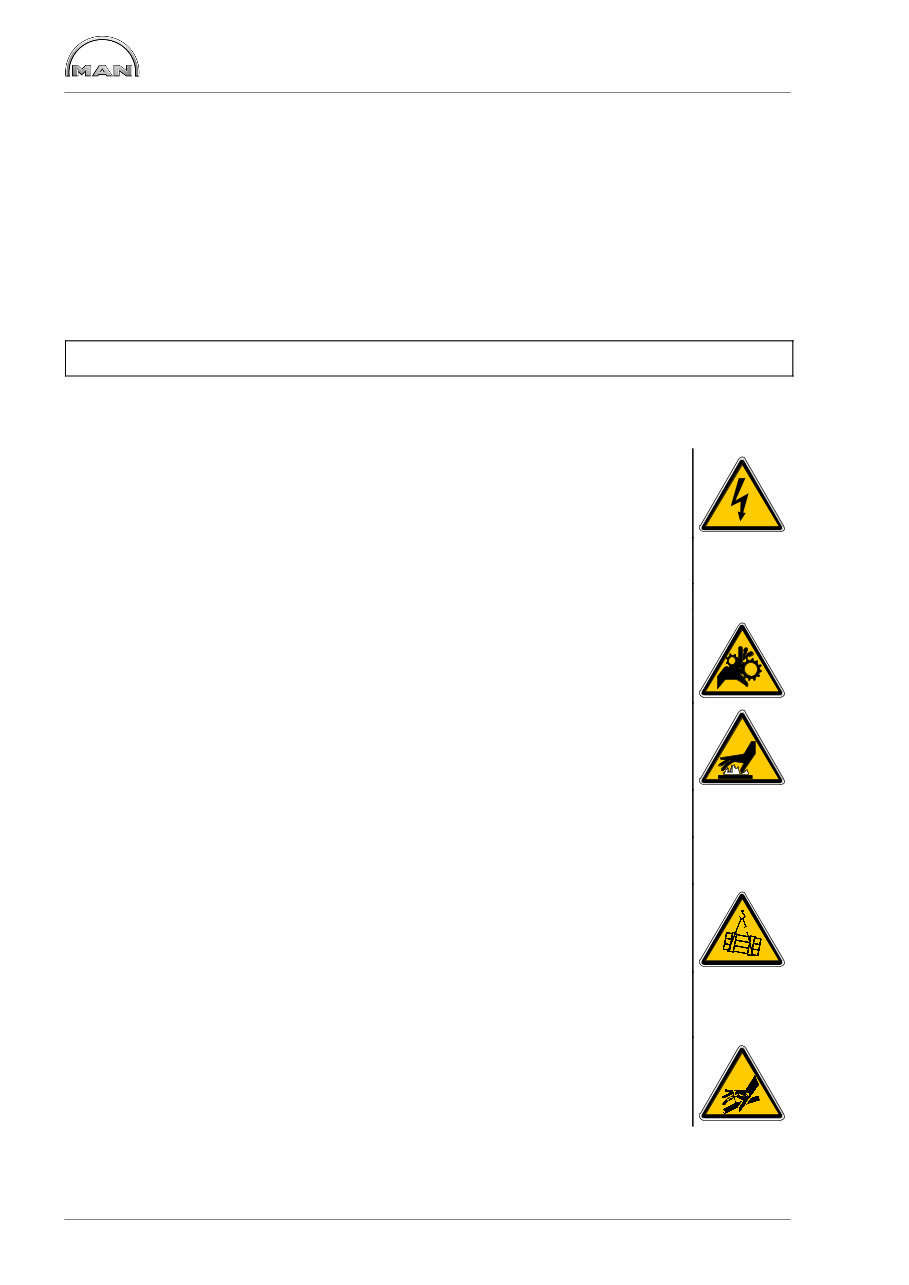
Instructions 2 Important instructions which concern technical safety and protection of persons are emphasised as shown below. Danger: This refers to working and operating procedures which must be complied with in order to rule out the risk to persons. Caution: This refers to working and operating procedures which must be complied with in order to prevent damage to or destruction of material. Note: Explanatory descriptions which help in understanding the relevant work or operating procedure to be carried out. Assembly of pipes Danger: No pipes may be bent. Risk of breakage! Fitting flat seals / gaskets Flat seals / gaskets are often inserted with sealing agents or adhesives to make fitting them easier or to achieve better sealing. Flat seals may slip in operation due to the “sewing -machine” effect, in particular if they are used between parts with different rates of linear expansion under heat (e.g. aluminium and cast iron), and leaks may then occur. Example: The cap of the front crankshaft seal. If a sealing agent or an adhesive is used here the flat seal will move inwards in the course of time as a result of the different expansion rates of the materials. Oil will be lost, for which the shaft seal may be thought to be responsible. Flat seals / gaskets can be fitted properly only if the following points are observed: D Use only genuine MAN seals / gaskets D The sealing faces must be undamaged and clean D Do not use any sealing agent or adhesive − as an aid to fitting the seals a little grease can be used if necessary so that the seal will stick to the part to be fitted D Tighten bolts evenly to the specified torque Fitting round sealing rings D Use only genuine MAN round sealing rings D The sealing faces must be undamaged and clean D Always wet round sealing rings with engine oil before fitting them
Engine type classification 5 All the engines dealt with here are related in terms of their design and make up a family. The type classification, which is made up of a series of letters and numbers, reveals some of the features of the engine in question provided the reader is familiar with the underlying nomenclature. The system is explained below using the model type D 2876 LE 423 as an example: D The “D” at the start of the type classification stands for “Diesel” 28 The numbers “28” indicates that the power plant in question has a bore of 128 mm 7 The “7” means 166 mm stroke 6 The “6” indicates the number of cylinders 6 L This letter stands for “charge-air cooling” (German: Ladeluftkühlung) E The “E” stands for “fitted engine” (German: Einbaumotor) and is intended to distinguish MAN vehicle engines 423 This is a factory-internal development number
Safety regulations 6 General notes Important safety regulations are summarized in this quick-reference overview and arranged by topic to ef- fectively convey the knowledge necessary to avoid accidents causing injury, damage or environmental haz- ard. Additional information can be found in the operating instructions of the engine. Important: Should an accident occur despite all precautionary measures, particularly one involving contact with corros- ive acid, penetration of fuel under the skin, scalding by hot oil, antifreeze splashing into the eyes etc. you must seek medical assistance immediately. 1. Regulations for the prevention of accidents with personal injury Inspection, adjustment and repair work may only be performed by authorised and skilled person- nel. D During installation work, switch off the battery master switch. D When carrying out maintenance and repair work, ensure that the engine cannot be accidentally started from the bridge by unauthorised persons. D The engine may only be started and operated by authorised personnel. D When the engine is running, do not get too close to the rotating parts. Wear close-fitting working clothes. D Do not touch hot engine with bare hands: Risk of burns. D Keep area surrounding engine, ladders and stairways free of oil and grease. Accidents caused by slipping can have serious consequences. D Only work with tools which are in good condition. Worn spanners / wrenches slip: Danger of injury. D Persons must not stand under an engine suspended on a crane hook. Keep lifting gear in order. D Open the coolant circuit only when the engine has cooled down. If opening the coolant circuit while the engine is hot is unavoidable, observe the instructions in the chapter “Maintenance and care” in the Operator’s Manual. D Do not tighten or undo pipes and hoses under pressure (lubricating oil circuit, coolant circuit and any downstream hydraulic oil circuits). The fluids which flow out can cause injury.
Safety regulations 7 D When working on the electrical system, first disconnect the earth cable of the battery and reconnect this last to prevent short circuits. D Follow the manufacturer’s instructions for handling batteries. Caution: Accumulator acid is toxic and caustic. Battery gases are explosive. D When performing welding work, observe the “Notes for welders”. 2. Regulations designed to prevent damage to engine and premature wear D Prior to repairing the engine, clean it thoroughly. Ensure that dirt, sand or foreign matter will not get into the engine during repair work. D If engine operation is disrupted, immediately determine the cause and have it remedied to prevent addi- tional damage. D Always use genuine MAN parts only. Installation of “equally” good parts from other suppliers may cause severe damage for which the workshop carrying out the work is responsible. D Never allow the engine to run dry, i.e. without lubricant or coolant. Appropriate notices must be attached to engines that are not ready for operation. D Today modern components of diesel injection consist of high-precision parts which are exposed to ex- treme stresses. The high-precision technology requires the utmost cleanliness during all work on the fuel system. Even a particle of dirt over 0.2 mm can lead to the failure of components. D Use only MAN-approved service products (fuel, engine oil, anti-freeze and anti-corrosion agent). Pay attention to cleanliness. Diesel fuel must be free of water. D Do not fill engine oil beyond the max. notch on the dipstick. Do not exceed the maximum per- missible tilt of the engine. Serious damage to the engine may result if these instructions are not adhered to. D Control and monitoring devices (charge control, oil pressure, coolant temperature) must be in perfect working order. D Observe the instructions for operating the alternator; see chapter “Maintenance and care” in the Oper- ator’s Manual.
Safety regulations 8 3. Regulations for the prevention of environmental damage Engine oil and filter elements / cartridges, fuel / fuel filter D Old oil must be passed on for recycling. D Take strict precautions to ensure that no oil or Diesel fuel gets into the drains or the ground. Caution: Risk of contamination of potable water. D Filter elements are classed as dangerous waste and must be treated as such. Coolant D Treat undiluted corrosion protection agents and / or antifreeze as hazardous waste. D When disposing of used coolant, the regulations issued by the relevant local authorities must be ob- served. 4. Notes on safety in handling used engine oil * Prolonged or repeated contact between the skin and any kind of engine oil decreases the skin. Drying, ir- ritation or inflammation of the skin may therefore occur. Used engine oil also contains hazardous sub- stances that have caused skin cancer in tests on animals. If the basic principles of work safety and hygiene are observed, handling used engine oil does not represent a health hazard. Precautionary measures to protect your health: D Avoid prolonged or repeated skin contact with used engine oil. D Protect your skin by means of suitable agents (creams etc.) or wear protective gloves. D Clean skin which has been in contact with engine oil. − Wash thoroughly with soap and water. A nail brush provides effective assistance here. − Special hand cleaning agents make it easier to clean dirty hands. − Do not use petrol (gasoline), diesel fuel, gas oil or solvents as washing agents. D After washing apply a fatty skin cream to the skin. D Change clothing and shoes that are soaked in oil. D Do no put oily cloths in you pockets. Ensure that used engine oil is disposed of in the appropriate manner. − Engine oil is a substance that endangers the water supply − For this reason do not let engine oil get into the ground, waterways, the drains or the sewers. Violations are punishable. Carefully collect and dispose of used engine oil. Information on collection points can be obtained from sales personnel, the supplier or the local authorities. ∗ Based on “Information sheet for handling used engine oil”.
The MAN Industrial Diesel Engine D2876 LE201, D2876 LE202, D2876 LE203 Service Repair Manual is a comprehensive guide suitable for both professional mechanics and DIY enthusiasts. It contains easy-to-understand text sections accompanied by high-quality diagrams and instructions, making it an invaluable resource for anyone undertaking engine repairs.
The manual covers the following models:
MAN Industrial Diesel Engine D 2876 LE 201
MAN Industrial Diesel Engine D 2876 LE 202
MAN Industrial Diesel Engine D 2876 LE 203
Service Repair Manual Contents:
Foreword
Instruction
Safety regulations
Fault table
General notes on engine overhaul
Commissioning after engine overhaul
Pressurisation
Engine lubrication schedule
Engine views D 2876 LE 201
Cooling system diagram
Fuel system schedule
Fuel system
Cooling system
Lubrication system
Flywheel / Crankshaft seals
Intake- and exhaust system
Cylinder head
Valve timing
Crankgear, pistons
Attachments
Service Data
Special tools
Circuit diagram
Index
File Format: PDF
Compatibility: All Versions of Windows & Mac
Language: English
Requirements: Adobe Reader
This manual is an essential investment for anyone working with the MAN Industrial Diesel Engine D2876 LE201, D2876 LE202, D2876 LE203. It is designed to save time and money, providing in-depth knowledge about the engines and enabling efficient, accurate repairs. Additionally, all pages are printable, offering convenience and ease of use.
Recently Viewed
5,521,897Happy Clients
2,594,462eManuals
1,120,453Trusted Sellers
15Years in Business
Price:
Actual Price:
MAN Industrial Diesel Engine D2876 LE201, D2876 LE202, D2876 LE203 Service Repair Workshop Manual




 Lifetime Access