



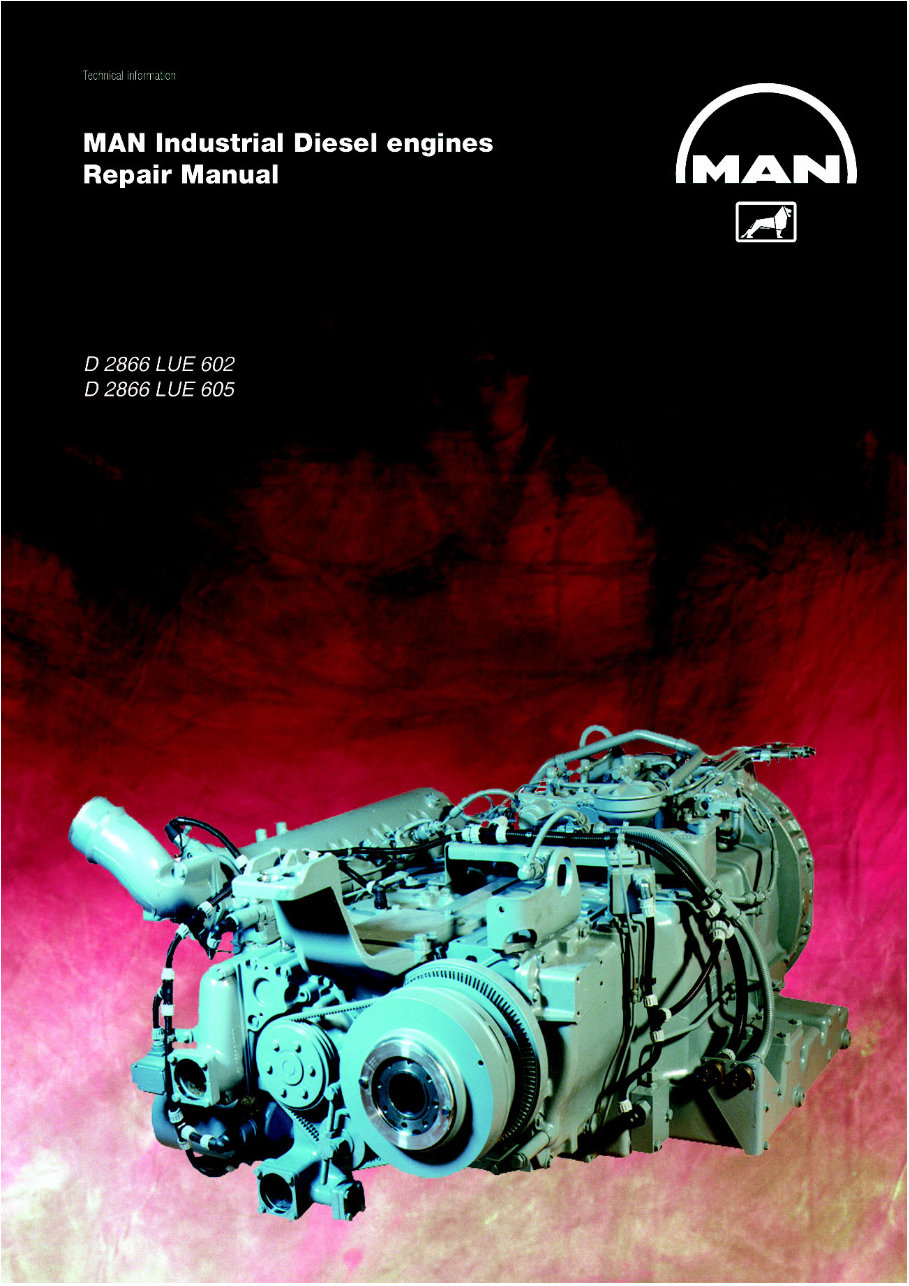
MAN Industrial Diesel Engine D 2866 D2866 * Factory Service / Repair/ Workshop Manual !(D 2866 LUE 602,D 2866 LU
What's Included?
 Lifetime Access
Fast Download Speeds
Online & Offline Access
Access PDF Contents & Bookmarks
Full Search Facility
Print one or all pages of your manual


Preface
1
This Repair Manual is designed to facilitate competent repair of the engines listed herein.
The pictures and relevant descriptions show typical work that may not always be applicable to the engine in
hand, which nevertheless does not mean that they are not correct.
In such cases the repair work is to be planned and carried out in a similar way.
Please note that all jobs described in this Repair Manual were carried out on an engine which was not in-
stalled.
The expert knowledge necessary for handling Diesel engines was taken for granted when this publication
was compiled.
Any repair of components such as injection pump, alternator etc. ought to be left to our or the manufac-
turer’s service department.
Yours faithfully,
MAN Nutzfahrzeuge Aktiengesellschaft
Nuremberg Works
We reserve the right to make technical modifications in the course of further development.
2003 MAN Nutzfahrzeuge Aktiengesellschaft
Reprinting, copying or translation, even in the form of excerpts, is forbidden without the written permission
of MAN. MAN expressly reserves all rights in accordance with the law on copyright.
MTDA Technical status: 06.2003 51.99598-8103
Instructions
2
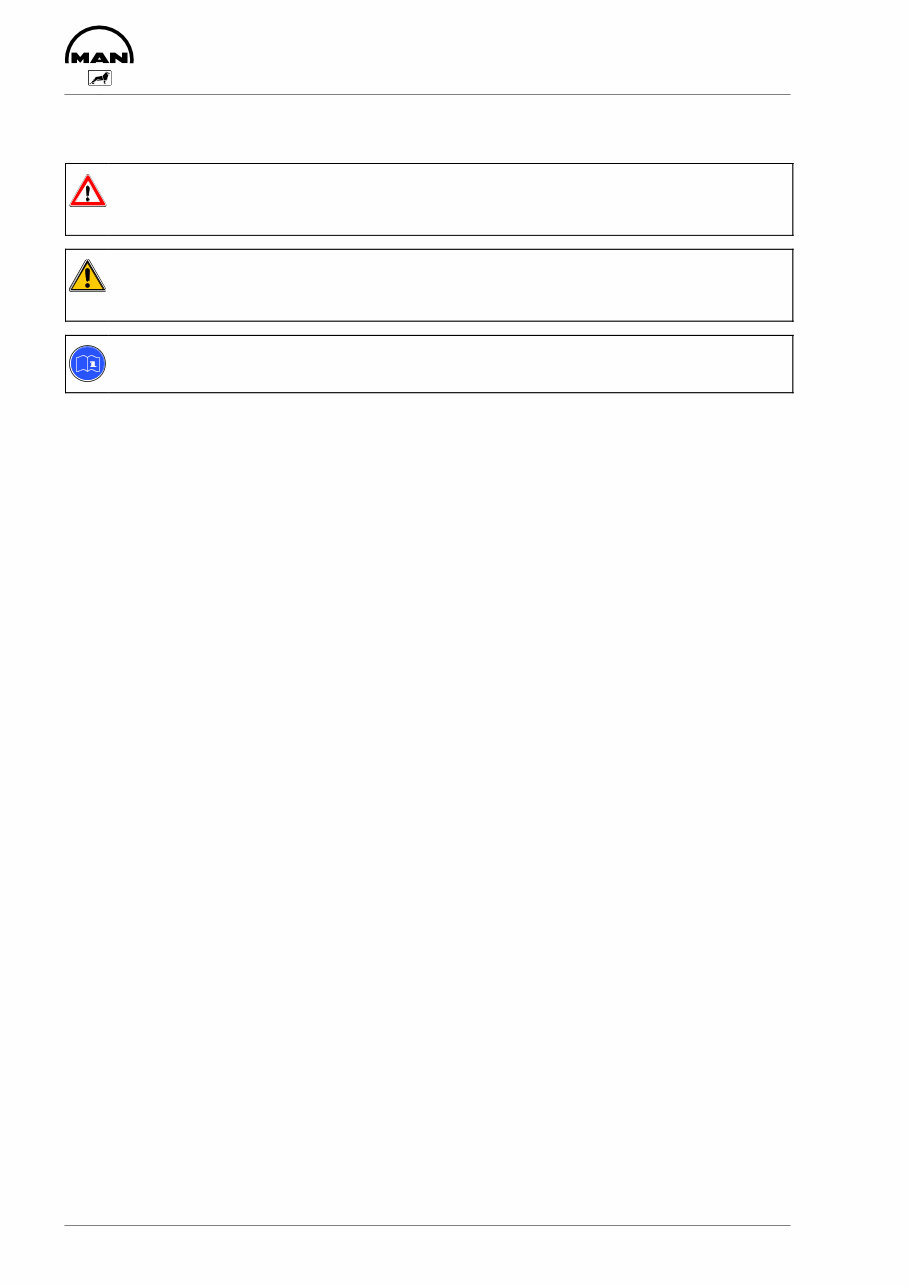
Important instructions which concern technical safety and protection of persons are emphasised as shown
below.
Danger:
This refers to working and operating procedures which must be complied with in order to rule out
the risk to persons.
Caution:
This refers to working and operating procedures which must be complied with in order to prevent
damage to or destruction of material.
Note:
Explanations useful for understanding the working or operating procedure to be performed.
Fitting flat seals / gaskets
Flat seals/gaskets are often inserted with sealing agents or adhesives to make fitting them easier or to
achieve better sealing. Flat seals may slip in operation due to the “sewing-machine” effect, in particular if
they are used between parts with different rates of linear expansion under heat (e.g. aluminium and cast
iron), and leaks may then occur.
Example:
the cap of the front crankshaft seal. If a sealing agent or an adhesive is used here the flat seal will move
inwards in the course of time as a result of the different expansion rates of the materials. Oil will be lost, for
which the shaft seal may be thought to be responsible.
Flat seals / gaskets can be fitted properly only if the following points are observed:
D Use only genuine MAN seals/gaskets.
D The sealing faces must be undamaged and clean.
D Do not use any sealing agent or adhesive - as an aid to fitting the seals a little grease can be used if
necessary so that the seal will stick to the part to be fitted.
D Tighten bolts evenly to the specified torque.
Fitting toric seals
D Use only genuine MAN toric seals.
D The sealing faces must be undamaged and clean.
D Always wet toric seals with engine oil before fitting them

Contents
3
Instructions 2 . . . . . . . . . . . . . . . . . . . . . . . . . . . . . . . . . . . . . . . . . . . . . . . . . . . . . . . . . . . . . . . . . . . . . . . . . . .
Preface 1 . . . . . . . . . . . . . . . . . . . . . . . . . . . . . . . . . . . . . . . . . . . . . . . . . . . . . . . . . . . . . . . . . . . . . . . . . . . . . .
Engine type classification 5 . . . . . . . . . . . . . . . . . . . . . . . . . . . . . . . . . . . . . . . . . . . . . . . . . . . . . . . . . . . . . . .
Safety instructions 7 . . . . . . . . . . . . . . . . . . . . . . . . . . . . . . . . . . . . . . . . . . . . . . . . . . . . . . . . . . . . . . . . . . . . .
General notes on engine overhaul 9 . . . . . . . . . . . . . . . . . . . . . . . . . . . . . . . . . . . . . . . . . . . . . . . . . . . . . . .
Commissioning after engine overhaul 10 . . . . . . . . . . . . . . . . . . . . . . . . . . . . . . . . . . . . . . . . . . . . . . . . . . . .
Fault table 13 . . . . . . . . . . . . . . . . . . . . . . . . . . . . . . . . . . . . . . . . . . . . . . . . . . . . . . . . . . . . . . . . . . . . . . . . . . . .
Troubleshooting chart 14 . . . . . . . . . . . . . . . . . . . . . . . . . . . . . . . . . . . . . . . . . . . . . . . . . . . . . . . . . . . . . . . . . .
Engine views 18 . . . . . . . . . . . . . . . . . . . . . . . . . . . . . . . . . . . . . . . . . . . . . . . . . . . . . . . . . . . . . . . . . . . . . . . . . .
Engine lubrication diagram 20 . . . . . . . . . . . . . . . . . . . . . . . . . . . . . . . . . . . . . . . . . . . . . . . . . . . . . . . . . . . . . .
Fuel system diagram 21 . . . . . . . . . . . . . . . . . . . . . . . . . . . . . . . . . . . . . . . . . . . . . . . . . . . . . . . . . . . . . . . . . . .
Cooling System diagram 23 . . . . . . . . . . . . . . . . . . . . . . . . . . . . . . . . . . . . . . . . . . . . . . . . . . . . . . . . . . . . . . . .
Engine management diagram 24 . . . . . . . . . . . . . . . . . . . . . . . . . . . . . . . . . . . . . . . . . . . . . . . . . . . . . . . . . . .
Fuel system
Checking and adjusting start of fuel delivery 25 . . . . . . . . . . . . . . . . . . . . . . . . . . . . . . . . . . . . . . . . . . . . . . .
Removing and Installing Injection Pump 29 . . . . . . . . . . . . . . . . . . . . . . . . . . . . . . . . . . . . . . . . . . . . . . . . . .
Removing and Installing Injection Nozzles 31 . . . . . . . . . . . . . . . . . . . . . . . . . . . . . . . . . . . . . . . . . . . . . . . .
Checking and repairing fuel injectors 33 . . . . . . . . . . . . . . . . . . . . . . . . . . . . . . . . . . . . . . . . . . . . . . . . . . . . .
Fuel Prefilter 36 . . . . . . . . . . . . . . . . . . . . . . . . . . . . . . . . . . . . . . . . . . . . . . . . . . . . . . . . . . . . . . . . . . . . . . . . . .
Removing and attaching fuel filter, exchanging filter cartridge 37 . . . . . . . . . . . . . . . . . . . . . . . . . . . . . . . .
Flame starter sheathed-element glow plug,removing and installing 38 . . . . . . . . . . . . . . . . . . . . . . . . . . .
Cooling system
Draining and filling coolant 39 . . . . . . . . . . . . . . . . . . . . . . . . . . . . . . . . . . . . . . . . . . . . . . . . . . . . . . . . . . . . . .
Removing and installing thermostats 40 . . . . . . . . . . . . . . . . . . . . . . . . . . . . . . . . . . . . . . . . . . . . . . . . . . . . .
Removing and installing engine water pump 41 . . . . . . . . . . . . . . . . . . . . . . . . . . . . . . . . . . . . . . . . . . . . . . .
Repairing engine water pump D 2866 LUE 602 43 . . . . . . . . . . . . . . . . . . . . . . . . . . . . . . . . . . . . . . . . . . . .
Repairing coolant pump with high-temperature and low-temperature parts D 2866 LUE 605 48 . . . . . .
Cleaning cooling system 55 . . . . . . . . . . . . . . . . . . . . . . . . . . . . . . . . . . . . . . . . . . . . . . . . . . . . . . . . . . . . . . . .
Lubrication
Changing the oil filter 57 . . . . . . . . . . . . . . . . . . . . . . . . . . . . . . . . . . . . . . . . . . . . . . . . . . . . . . . . . . . . . . . . . . .
Removing and installing the oil cooler 58 . . . . . . . . . . . . . . . . . . . . . . . . . . . . . . . . . . . . . . . . . . . . . . . . . . . .
Removing and installing the oil pan 60 . . . . . . . . . . . . . . . . . . . . . . . . . . . . . . . . . . . . . . . . . . . . . . . . . . . . . .
Removing and installing / Repairing Oil Pump 62 . . . . . . . . . . . . . . . . . . . . . . . . . . . . . . . . . . . . . . . . . . . . .
Removing and Installing Oil Spray Nozzle 65 . . . . . . . . . . . . . . . . . . . . . . . . . . . . . . . . . . . . . . . . . . . . . . . . .
Flywheel / Crankshaft seal
Removing and fitting vibration damper, replacing front crankshaft gasket 67 . . . . . . . . . . . . . . . . . . . . . .
Removing and installing flywheel, replacing starter gear ring 72 . . . . . . . . . . . . . . . . . . . . . . . . . . . . . . . . .
Removing and installing crankshaft seal (flywheel end) 74 . . . . . . . . . . . . . . . . . . . . . . . . . . . . . . . . . . . . .
Exchanging bearing race 75 . . . . . . . . . . . . . . . . . . . . . . . . . . . . . . . . . . . . . . . . . . . . . . . . . . . . . . . . . . . . . . .
Crankshaft seals 76 . . . . . . . . . . . . . . . . . . . . . . . . . . . . . . . . . . . . . . . . . . . . . . . . . . . . . . . . . . . . . . . . . . . . . .
Intake / exhaust system
Removing and installing intake manifold 77 . . . . . . . . . . . . . . . . . . . . . . . . . . . . . . . . . . . . . . . . . . . . . . . . . .
Removing and installing exhaust manifold 78 . . . . . . . . . . . . . . . . . . . . . . . . . . . . . . . . . . . . . . . . . . . . . . . . .
Turbocharger, troubleshooting 79 . . . . . . . . . . . . . . . . . . . . . . . . . . . . . . . . . . . . . . . . . . . . . . . . . . . . . . . . . . .
Checking charge-air pressure 81 . . . . . . . . . . . . . . . . . . . . . . . . . . . . . . . . . . . . . . . . . . . . . . . . . . . . . . . . . . .
Removing and installing the turbocharger 82 . . . . . . . . . . . . . . . . . . . . . . . . . . . . . . . . . . . . . . . . . . . . . . . . .
Measuring the axial / radial clearance or the turbocharger shaft 84 . . . . . . . . . . . . . . . . . . . . . . . . . . . . . .

Contents
4
Cylinder head
Removing and installing cylinder head 85 . . . . . . . . . . . . . . . . . . . . . . . . . . . . . . . . . . . . . . . . . . . . . . . . . . . .
Setting valve claerance 89 . . . . . . . . . . . . . . . . . . . . . . . . . . . . . . . . . . . . . . . . . . . . . . . . . . . . . . . . . . . . . . . . .
Disassembling and Assembling Rocker Arm Mechanism 90 . . . . . . . . . . . . . . . . . . . . . . . . . . . . . . . . . . . .
Removing and installing valves 91 . . . . . . . . . . . . . . . . . . . . . . . . . . . . . . . . . . . . . . . . . . . . . . . . . . . . . . . . . .
Removing and installing valve guides 94 . . . . . . . . . . . . . . . . . . . . . . . . . . . . . . . . . . . . . . . . . . . . . . . . . . . . .
Replacing valve seat insert 95 . . . . . . . . . . . . . . . . . . . . . . . . . . . . . . . . . . . . . . . . . . . . . . . . . . . . . . . . . . . . .
Reworking valve seat 97 . . . . . . . . . . . . . . . . . . . . . . . . . . . . . . . . . . . . . . . . . . . . . . . . . . . . . . . . . . . . . . . . . .
Refacing valves 100 . . . . . . . . . . . . . . . . . . . . . . . . . . . . . . . . . . . . . . . . . . . . . . . . . . . . . . . . . . . . . . . . . . . . . . .
Checking compression pressure 101 . . . . . . . . . . . . . . . . . . . . . . . . . . . . . . . . . . . . . . . . . . . . . . . . . . . . . . . . .
Valve timing
Removing and installing the gear case 102 . . . . . . . . . . . . . . . . . . . . . . . . . . . . . . . . . . . . . . . . . . . . . . . . . . . .
Removing and installing the camshaft, replacing camshaft bearings 103 . . . . . . . . . . . . . . . . . . . . . . . . . .
Checking the valve timing 105 . . . . . . . . . . . . . . . . . . . . . . . . . . . . . . . . . . . . . . . . . . . . . . . . . . . . . . . . . . . . . . .
Crankgear, pistons
Removing and installing the crankshaft 106 . . . . . . . . . . . . . . . . . . . . . . . . . . . . . . . . . . . . . . . . . . . . . . . . . . .
Removing and installing pistons with conrods 112 . . . . . . . . . . . . . . . . . . . . . . . . . . . . . . . . . . . . . . . . . . . . . .
Removing pistons from conrod and fitting, checking - replacing conrod 115 . . . . . . . . . . . . . . . . . . . . . . .
Removing and installing / replacing piston rings 117 . . . . . . . . . . . . . . . . . . . . . . . . . . . . . . . . . . . . . . . . . . . .
Replacing cylinder liners 119 . . . . . . . . . . . . . . . . . . . . . . . . . . . . . . . . . . . . . . . . . . . . . . . . . . . . . . . . . . . . . . . .
Measuring piston protrusion 123 . . . . . . . . . . . . . . . . . . . . . . . . . . . . . . . . . . . . . . . . . . . . . . . . . . . . . . . . . . . . .
Attachments
Removing and installing the starter motor 124 . . . . . . . . . . . . . . . . . . . . . . . . . . . . . . . . . . . . . . . . . . . . . . . . .
V-belts 125 . . . . . . . . . . . . . . . . . . . . . . . . . . . . . . . . . . . . . . . . . . . . . . . . . . . . . . . . . . . . . . . . . . . . . . . . . . . . . . .
Pilot clutch D 2866 LUE 602 127 . . . . . . . . . . . . . . . . . . . . . . . . . . . . . . . . . . . . . . . . . . . . . . . . . . . . . . . . . . . .
Service Data
Engine 132 . . . . . . . . . . . . . . . . . . . . . . . . . . . . . . . . . . . . . . . . . . . . . . . . . . . . . . . . . . . . . . . . . . . . . . . . . . . . . . .
Crankcase 133 . . . . . . . . . . . . . . . . . . . . . . . . . . . . . . . . . . . . . . . . . . . . . . . . . . . . . . . . . . . . . . . . . . . . . . . . . . . .
Cylinder liner 133 . . . . . . . . . . . . . . . . . . . . . . . . . . . . . . . . . . . . . . . . . . . . . . . . . . . . . . . . . . . . . . . . . . . . . . . . . .
Crankshaft 134 . . . . . . . . . . . . . . . . . . . . . . . . . . . . . . . . . . . . . . . . . . . . . . . . . . . . . . . . . . . . . . . . . . . . . . . . . . . .
Flywheel and starter motor gear ring 136 . . . . . . . . . . . . . . . . . . . . . . . . . . . . . . . . . . . . . . . . . . . . . . . . . . . . .
Conrods 137 . . . . . . . . . . . . . . . . . . . . . . . . . . . . . . . . . . . . . . . . . . . . . . . . . . . . . . . . . . . . . . . . . . . . . . . . . . . . . .
Conrod bearings 137 . . . . . . . . . . . . . . . . . . . . . . . . . . . . . . . . . . . . . . . . . . . . . . . . . . . . . . . . . . . . . . . . . . . . . . .
Conrod bolts 137 . . . . . . . . . . . . . . . . . . . . . . . . . . . . . . . . . . . . . . . . . . . . . . . . . . . . . . . . . . . . . . . . . . . . . . . . . .
Pistons 138 . . . . . . . . . . . . . . . . . . . . . . . . . . . . . . . . . . . . . . . . . . . . . . . . . . . . . . . . . . . . . . . . . . . . . . . . . . . . . . .
Cylinder head 139 . . . . . . . . . . . . . . . . . . . . . . . . . . . . . . . . . . . . . . . . . . . . . . . . . . . . . . . . . . . . . . . . . . . . . . . . .
Valve gear 141 . . . . . . . . . . . . . . . . . . . . . . . . . . . . . . . . . . . . . . . . . . . . . . . . . . . . . . . . . . . . . . . . . . . . . . . . . . . .
Engine lubrication D 2866 LUE 602 143 . . . . . . . . . . . . . . . . . . . . . . . . . . . . . . . . . . . . . . . . . . . . . . . . . . . . . .
Engine lubrication D 2866 LUE 605 144 . . . . . . . . . . . . . . . . . . . . . . . . . . . . . . . . . . . . . . . . . . . . . . . . . . . . . .
Engine coolant pump D 2866 LUE 602 145 . . . . . . . . . . . . . . . . . . . . . . . . . . . . . . . . . . . . . . . . . . . . . . . . . . .
Turbocharger S3A - 91H39GAVM- 1.40CF6 146 . . . . . . . . . . . . . . . . . . . . . . . . . . . . . . . . . . . . . . . . . . . . . . .
Fuel system 147 . . . . . . . . . . . . . . . . . . . . . . . . . . . . . . . . . . . . . . . . . . . . . . . . . . . . . . . . . . . . . . . . . . . . . . . . . .
Cylinder-head bolts 151 . . . . . . . . . . . . . . . . . . . . . . . . . . . . . . . . . . . . . . . . . . . . . . . . . . . . . . . . . . . . . . . . . . . .
Torque guide values 148 . . . . . . . . . . . . . . . . . . . . . . . . . . . . . . . . . . . . . . . . . . . . . . . . . . . . . . . . . . . . . . . . . . .
Special tools 156 . . . . . . . . . . . . . . . . . . . . . . . . . . . . . . . . . . . . . . . . . . . . . . . . . . . . . . . . . . . . . . . . . . . . . . . . . . . .
Index 170 . . . . . . . . . . . . . . . . . . . . . . . . . . . . . . . . . . . . . . . . . . . . . . . . . . . . . . . . . . . . . . . . . . . . . . . . . . . . . . . . . . .

Engine type classification
5
All the engines dealt with here are related in terms of their design and make up a family.
The type classification, which is made up of a series of letters and numbers, reveals some of the features
of the engine in question provided the reader is familiar with the underlying nomenclature.
We will explain the system using model D 2866 LUE 602 / 605:
D The “D” at the start of the type classification stands for “diesel”.
28 The numbers “28” indicates that the power plant in question has a bore of 128 mm.
6 The “6” means 160 mm stroke. This figure is, however, only approximate for this model.
The actual stroke is 155 mm.
6 The “6” indicates the number of cylinders 6
L This letter stands for “charge-air cooling” (German: Ladeluftkühlung)
U The “U” stands for “Underfloor ”
E The “E” stands for “fitted engine” (German: Einbaumotor) and is intended to distinguish MAN
vehicle engines
602/6.. This is a factory-internal development number.
Safety instructions
6
General information
This brief overview summarises important instructions and is structured into areas of main concern in order
to impart the knowledge necessary to prevent accidents involving injury to persons, damage to the engine
or other property and harm to the environment. Additional notes are included in the operator’s manual for
the engine.
Important: If despite all safety precautions an accident occurs as a result of contact with caustic acids,
penetration of fuel into the skin, scalding with hot oil, anti-freeze splashes into the eyes etc, consult a doc-
tor immediately!
1. Instructions for preventing accidents with injury to persons
Checks, setting jobs and repair work must be carried out by authorised skilled personnel only.
D When carrying out maintenance and repair work, ensure that the engine cannot be ac-
cidentally started from the bridge by unauthorised persons.
D The engine must be started and operated by authorised personnel only.
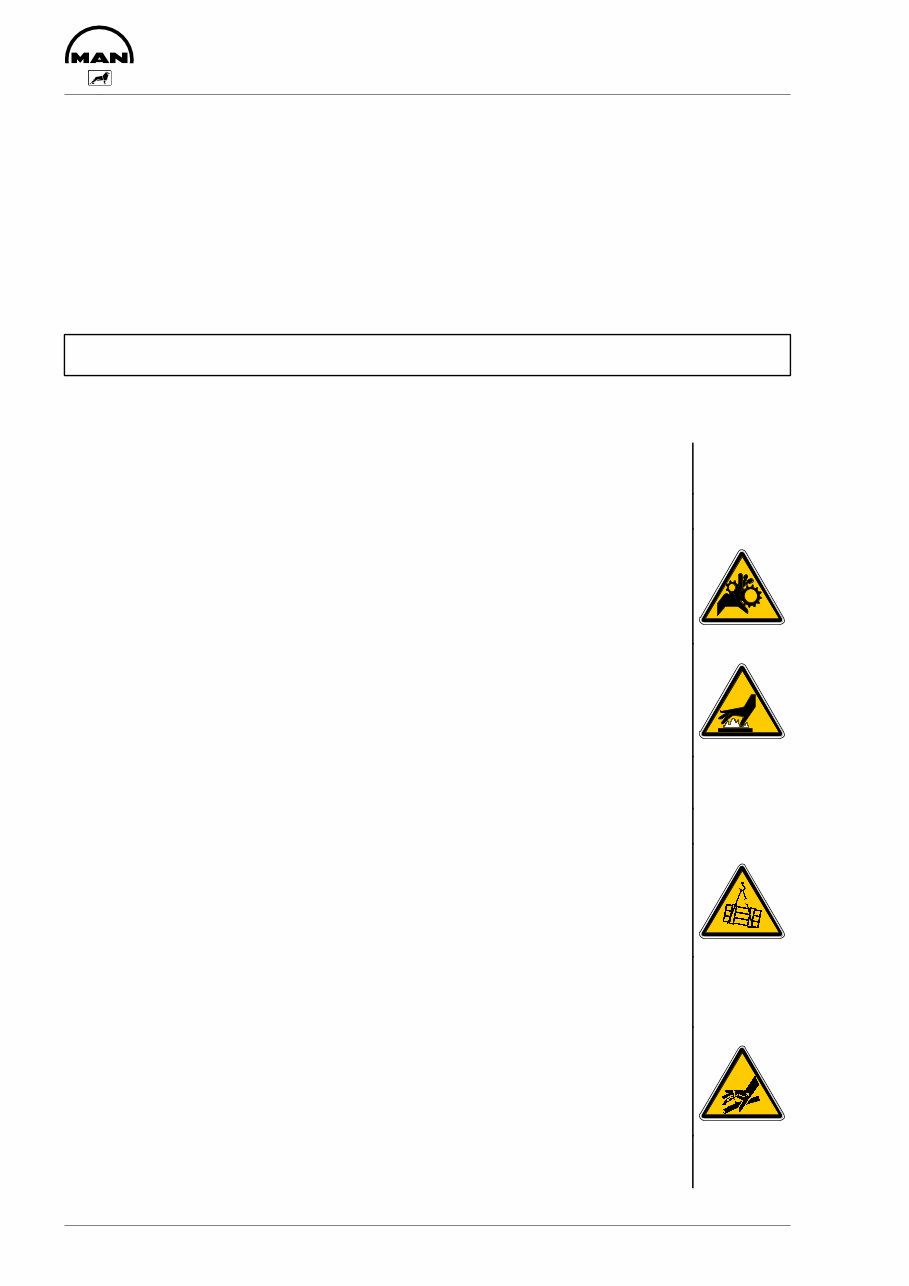
D When the engine is running, do not get too close to revolving components. Wear tight-
fitting working clothes.
D Do not touch hot engine with bare hands: risk of burning yourself.
D Keep engine vicinity, ladder and steps free of oil and grease. Accidents resulting from
slipping may have serious consequences.
D Work only with tools that are in good condition. Worn spanners slip: risk of injuries.
D Persons must not stand under an engine suspended from a crane hook. Keep lifting
gear in good order.
D Open coolant circuit only after the engine has cooled down. If opening the coolant cir-
cuit while the engine is hot is unavoidable, observe the instructions in the chapter
“Maintenance and care” in the Operator’s Manual.
D Neither retighten nor open pressurised pipelines and hoses (lube oil circuit, coolant cir-
cuit and downstream hydraulic oil circuit if fitted): risk of injuries resulting from emerging
fluids.
D When checking the injection nozzles, do not hold your hands in the fuel jet. Do not in-
hale fuel mist.
Safety instructions
7
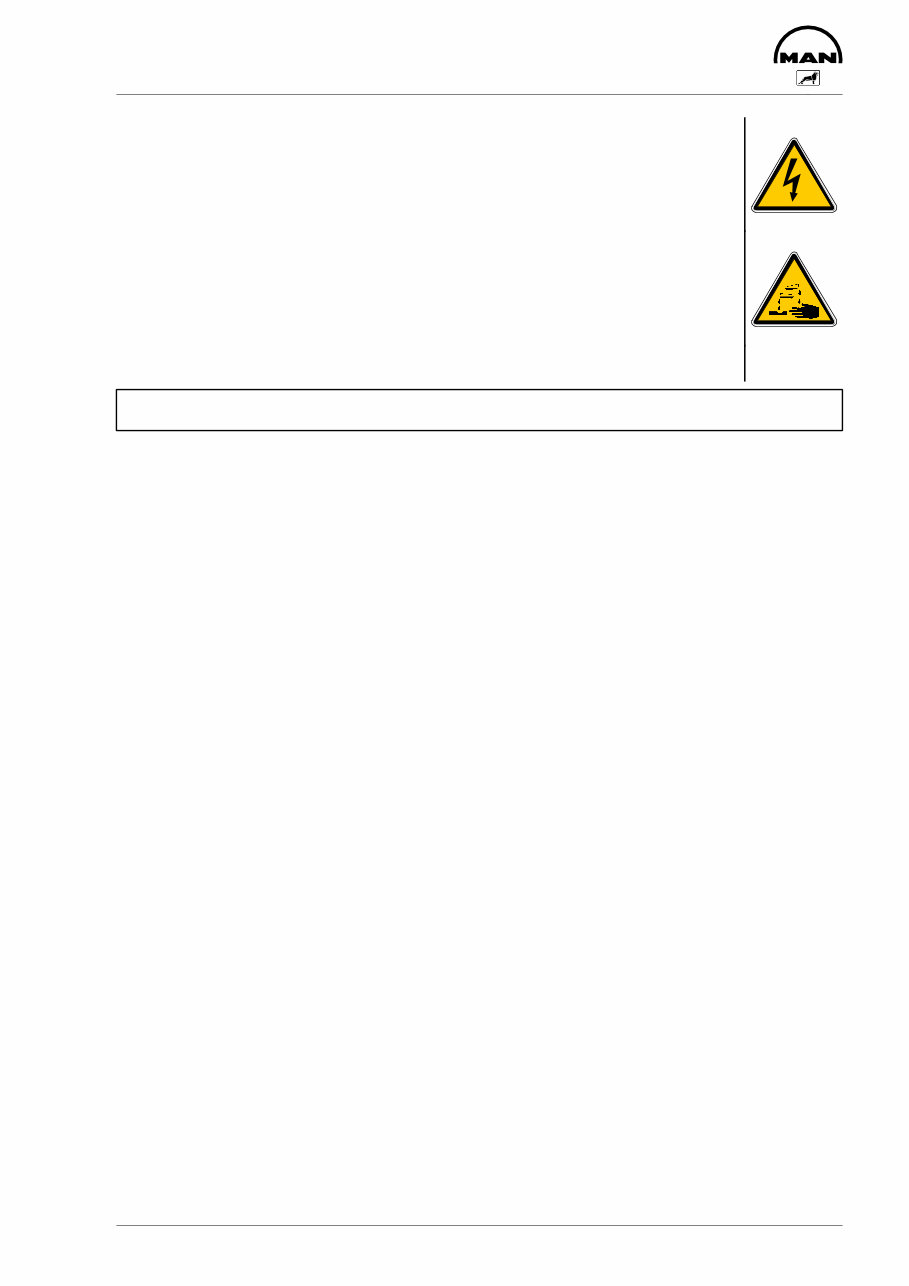
D When working on the electrical system, unplug earth cable from battery first and recon-
nect it last to avoid short-circuits.
D Observe the manufacturer’s instructions for handling batteries.
Caution:
Battery acid is toxic and caustic. Battery gases are explosive.
D When carrying out welding work, observe the “Information sheets for welders”.
2. Instructions for preventing damage to the engine and premature wear
D Prior to repairing the engine, clean it thoroughly. Ensure that dirt, sand or foreign matter will
not get into the engine during repair work.
D In the event of operational faults immediately identy the cause and rectify to prevent more serious dam-
age.
D Always use genuine MAN parts only. Installation of “equally” good parts from other suppliers may cause
severe damage for which the workshop carrying out the work is responsible.
D Never operate the engine while it is dry, i.e. without lubricant or coolant.
Use a suitable label to mark engines not ready for operation.
D Only use operating materials (fuel, engine oil, antifreeze and anticorrosion agents) approved by MAN.
Ensure that everything is kept clean. Diesel fuel must be free of water.
D Do not fill up with engine oil above the max. notch on the dipstick. Do not exceed the engine’s
maximum permissible operating inclination.
Non-compliance with these instructions may cause severe engine damage.
D Control and monitoring devices (charge check, oil pressure, coolant temperature) must work faultlessly.
D Observe the instructions for operating the alternator; see chapter “Commissioning and operation” in the
Operator’s Manual.
Safety instructions
8
3. Instructions for preventing environmental damage
Engine oil and filter cartridges and elements, fuel/fuel filters
D Take old oil to an old oil disposal point only.
D Ensure without fail that oil and Diesel fuel will not get into the sewerage system or the ground.
Caution:
Danger of contaminating potable water!
D Treat filter elements and cartridges as special waste.
Coolant
D Treat undiluted anticorrosion and/or antifreeze agents as special waste.
D The regulations of the relevant local authorities are to be observed for the disposal of spent coolants.
4. Instructions for handling used engine oil *
Prolonged or repeated contact of any kind of engine oil with the skin causes the skin to degrease, which
may result in dryness, irritation or inflammation. Old engine oil also contains hazardous substances which
in animal experiments have caused skin cancer. Handling old engine oil does not pose any health hazard if
the basic safety and hygiene related regulations are observed.
Health and safety regulations:
D Avoid prolonged, excessive or repeated contact of old engine oil with the skin.
D Use a suitable skin protection agent or wear protective gloves.
D Clean the skin that has been in contact with engine oil.
- Wash yourself thoroughly with soap and water. A nailbrush is an effective aid.
- Special hand cleaning agents facilitate cleaning soiled hands.
- Do not use petrol, Diesel fuel, gas oil, fluxes or solvents as cleaning agents.
D After washing apply moisturising handcream to your skin.
D Change oil-soaked clothes and shoes.
D Do not put any oil-soaked cloths into pockets.
Pay meticulous attention to the proper disposal of old engine oil.
- Old oil is a water hazard -
Therefore, do not pour any old oil into the ground, the drains or the sewerage system. Any violation of this
rule is punishable.
Collect and dispose of old engine oil properly. For information concerning collection points, contact seller,
supplier or the local authorities.
∗ Based on the “Information sheed for handling used engine oil”
(Notes on how to handle old engine oil).
You're Reading a Preview
What's Included?
Lifetime Access
Fast Download Speeds
Online & Offline Access
Access PDF Contents & Bookmarks
Full Search Facility
Print one or all pages of your manual
$41.99
Viewed 95 Times Today


Secure transaction
What's Included?
Lifetime Access
Fast Download Speeds
Online & Offline Access
Access PDF Contents & Bookmarks
Full Search Facility
Print one or all pages of your manual
$41.99
This factory service, repair, and workshop manual provides maintenance and repair procedures for the MAN Industrial Diesel Engine D 2866. It includes step-by-step instructions, detailed exploded pictures, and diagrams to facilitate correct and efficient completion of all repair procedures. The manual is beneficial for both professional mechanics and DIY enthusiasts.
Applicable Models:
- MAN Industrial Diesel Engine D 2866 LUE 602
- MAN Industrial Diesel Engine D 2866 LUE 605
Service Repair Manual Covers:
- Instructions
- Preface
- Engine type classification
- Safety instructions
- General notes on engine overhaul
- Commissioning after engine overhaul
- Fault table
- Troubleshooting chart
- Engine views
- Engine lubrication diagram
- Fuel system diagram
- Cooling system diagram
- Engine management diagram
- Fuel system
- Checking and adjusting start of fuel delivery
- Removing and Installing Injection Pump
- Removing and Installing Injection Nozzles
- Checking and repairing fuel injectors
- Fuel Prefilter
- Removing and attaching fuel filter, exchanging filter cartridge
- Flame starter sheathed-element glow plug, removing and installing
- Cooling system
- Draining and filling coolant
- Removing and installing thermostats
- Removing and installing engine water pump
- Repairing engine water pump D 2866 LUE 602
- Repairing coolant pump with high-temperature and low-temperature parts D 2866 LUE 605
- Cleaning cooling system
- Lubrication
- Changing the oil filter
- Removing and installing the oil cooler
- Removing and installing the oil pan
- Removing and installing / Repairing Oil Pump
- Removing and Installing Oil Spray Nozzle
- Flywheel / Crankshaft seal
- Removing and fitting vibration damper, replacing front crankshaft gasket
- Removing and installing flywheel, replacing starter gear ring
- Removing and installing crankshaft seal (flywheel end)
- Exchanging bearing race
- Crankshaft seals
- Intake / exhaust system
- Removing and installing intake manifold
- Removing and installing exhaust manifold
- Turbocharger, troubleshooting
- Checking charge-air pressure
- Removing and installing the turbocharger
- Measuring the axial / radial clearance or the turbocharger shaft
- Cylinder head
- Removing and installing cylinder head
- Setting valve clearance
- Disassembling and Assembling Rocker Arm Mechanism
- Removing and installing valves
- Removing and installing valve guides
- Replacing valve seat insert
- Reworking valve seat
- Refacing valves
- Checking compression pressure
- Valve timing
- Removing and installing the gear case
- Removing and installing the camshaft, replacing camshaft bearings
- Checking the valve timing
- Crankgear, pistons
- Removing and installing the crankshaft
- Removing and installing pistons with conrods
- Removing pistons from conrod and fitting, checking - replacing conrod
- Removing and installing / replacing piston rings
- Replacing cylinder liners
- Measuring piston protrusion
- Attachments
- Removing and installing the starter motor
- V-belts
- Pilot clutch D 2866 LUE 602
- Service Data
- Engine
- Crankcase
- Cylinder liner
- Crankshaft
- Flywheel and starter motor gear ring
- Conrods
- Conrod bearings
- Conrod bolts
- Pistons
- Cylinder head
- Valve gear
- Engine lubrication D 2866 LUE 602
- Engine lubrication D 2866 LUE 605
- Engine coolant pump D 2866 LUE 602
- Turbocharger S3A - 91H39GAVM- 1.40CF6
- Fuel system
- Cylinder-head bolts
- Torque guide values
- Special tools
- Index
Instant access eliminates shipping costs and waiting time for a CD or paper manual. The manual is available for immediate download upon secure payment processing. It is compatible with all versions of Windows and Mac, and can be printed for convenience.
File Format: PDF
Language: English
Requirements: Adobe Reader & Win


