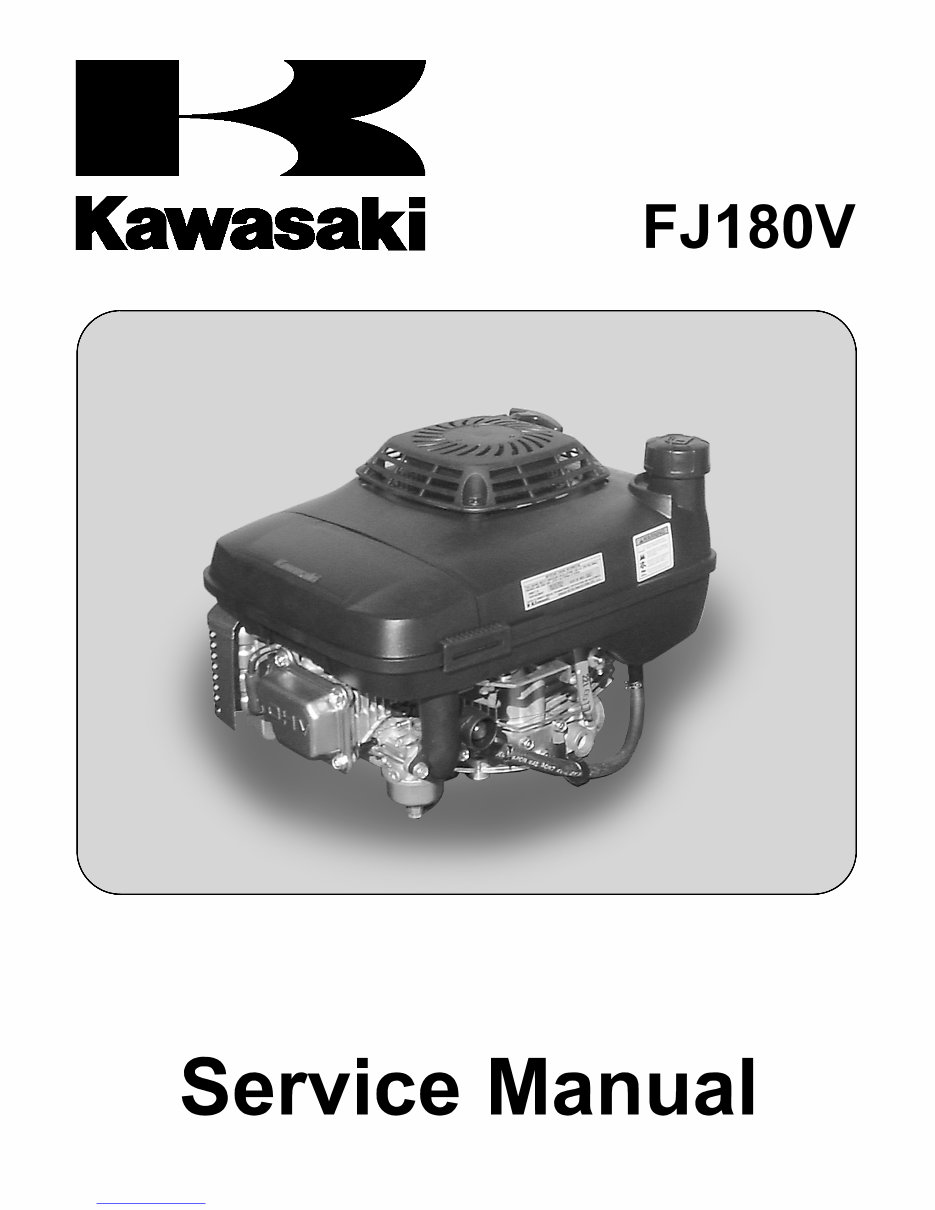
KAWASAKI FJ180V Petrol Engine Workshop Service Repair Manual
What's Included?
Lifetime Access
Fast Download Speeds
Online & Offline Access
Access PDF Contents & Bookmarks
Full Search Facility
Print one or all pages of your manual
4-stroke air-cooled gasoline engine Downloaded from www.Manualslib.com manuals search engine
Downloaded from www.Manualslib.com manuals search engine
Quick Reference Guide General Information 1 Periodic Maintenance 2 Fuel System 3 Cooling System 4 Engine Top End 5 Lubrication System 6 Camshaft/Crankshaft 7 Electrical System 8 Troubleshooting 9 This quick reference guide will assist you in locating a desired topic or pro- cedure. • Bend the pages back to match the black tab of the desired chapter num- ber with the black tab on the edge at each table of contents page. • Refer to the sectional table of con- tents for the exact pages to locate the specific topic required. Downloaded from www.Manualslib.com manuals search engine
Downloaded from www.Manualslib.com manuals search engine
LIST OF ABBREVIATIONS A ampere(s) lb pound(s) ABDC after bottom dead center m meter(s) AC alternating current min minute(s) ATDC after top dead center N newton(s) BBDC before bottom dead center Pa pascal(s) BDC bottom dead center PS horsepower BTDC before top dead center psi pound(s) per square inch C degree(s) Celsius r revolution DC direct current rpm revolution(s) per minute F farad(s) TDC top dead center F degree(s) Fahrenheit TIR total indicator reading ft foot, feet V volt(s) g gram(s) W watt(s) h hour(s) ohm(s) L liter(s) Read OWNER’S MANUAL before operating. Downloaded from www.Manualslib.com manuals search engine
EMISSION CONTROL INFORMATION To protect the environment in which we all live, Kawasaki has incorporated crankcase emission (1) and exhaust emission (2) control systems (EM) in compliance with applicable regulations of the United States Environmental Protection Agency and California Air Resources Board. 1. Crankcase Emission Control System A sealed-type crankcase emission control system is used to eliminate blow-by gases. The blow-by gases are led to the breather chamber through the crankcase. Then, it is led to the air cleaner. Oil is separated from the gases while passing through the inside of the breather chamber from the crankcase, and then returned back to the bottom of crankcase. 2. Exhaust Emission Control System The exhaust emission control system applied to this engine consists of a carburetor and an ignition system having optimum ignition timing characteristics. The carburetor has been calibrated to provide lean air/fuel mixture characteristics and op- timum fuel economy with a suitable air cleaner and exhaust system. TAMPERING WITH EMISSION CONTROL SYSTEM PROHIBITED Federal law and California State law prohibits the following acts or the causing thereof: (1) the removal or rendering inoperative by any person other than for purposes of maintenance, repair, or replacement, of any device or element of design incorporated into any new engine for the purpose of emission control prior to its sale or delivery to the ultimate purchaser or while it is in use, or (2) the use of the engine after such device or element of design has been removed or rendered inoperative by any person. Among those acts presumed to constitute tampering are the acts listed below: Do not tamper with the original emission related part: • Carburetor and internal parts • Spark plug • Magneto or electronic ignition system • Fuel filter element • Air cleaner elements • Crankcase • Cylinder head • Breather chamber and internal parts • Intake pipe and tube Downloaded from www.Manualslib.com manuals search engine
Foreword This manual is designed primarily for use by trained mechanics in a properly equipped shop. However, it contains enough detail and basic in- formation to make it useful to the owner who de- sires to perform his own basic maintenance and repair work. A basic knowledge of mechanics, the proper use of tools, and workshop proce- dures must be understood in order to carry out maintenance and repair satisfactorily. When- ever the owner has insufficient experience or doubts as to his ability to do the work, all ad- justments, maintenance, and repair should be carried out only by qualified mechanics. In order to perform the work efficiently and to avoid costly mistakes, read the text, thor- oughly familiarize yourself with the procedures before starting work, and then do the work care- fully in a clean area. Whenever special tools or equipment are specified, do not use makeshift tools or equipment. Precision measurements can only be made if the proper instruments are used, and the use of substitute tools may ad- versely affect safe operation. To get the longest life out of your engine: • Follow the Periodic Maintenance Chart in the Service Manual. • Be alert for problems and non-scheduled maintenance. • Use proper tools and genuine Kawasaki en- gine parts. Genuine parts provided as spare parts are listed in the Parts Catalog. • Follow the procedures in this manual care- fully. Don’t take shortcuts. • Remember to keep complete records of main- tenance and repair with dates and any new parts installed. How to Use This Manual In this manual, the product is divided into its major systems and these systems make up the manual’s chapters. The Quick Reference Guide shows you all of the product’s system and assists in locating their chapters. Each chapter in turn has its own comprehensive Ta- ble of Contents. For example, if you want ignition coil informa- tion, use the Quick Reference Guide to locate the Electrical System chapter. Then, use the Table of Contents on the first page of the chap- ter to find the Ignition coil section. Whenever you see these WARNING and CAUTION symbols, heed their instructions! Always follow safe operating and maintenance practices. WARNING This warning symbol identifies special instructions or procedures which, if not correctly followed, could result in per- sonal injury, or loss of life. CAUTION This caution symbol identifies special instructions or procedures which, if not strictly observed, could result in dam- age to or destruction of equipment. This manual contains four more symbols (in addition to WARNING and CAUTION) which will help you distinguish different types of informa- tion. NOTE This note symbol indicates points of par- ticular interest for more efficient and con- venient operation. • Indicates a procedural step or work to be done. Indicates a procedural sub-step or how to do the work of the procedural step it follows. It also precedes the text of a WARNING, CAU- TION, or NOTE. Indicates a conditional step or what action to take based on the results of the test or inspec- tion in the procedural step or sub-step it fol- lows. In most chapters an exploded view illustration of the system components follows the Table of Contents. In these illustrations you will find the instructions indicating which parts require spec- ified tightening torque, oil, grease or a locking agent during assembly. Downloaded from www.Manualslib.com manuals search engine
GENERAL INFORMATION 1-1 1 General Information TABLE OF CONTENTS Before Servicing ........................................................................................................................ 1- 2 Model Identification.................................................................................................................... 1- 4 General Specifications............................................................................................................... 1- 5 Torque and Locking Agent ......................................................................................................... 1- 6 Downloaded from www.Manualslib.com manuals search engine
1-2 GENERAL INFORMATION Before Servicing Before starting to service the engine, carefully read the applicable section to eliminate unnecessary work. Photographs, diagrams, notes, cautions, warnings, and detailed descriptions have been in- cluded wherever necessary. Nevertheless, even a detailed account has limitations, a certain amount of basic knowledge is required for successful work. Especially note the following: (1) Dirt Before removal and disassembly, clean the engine. Any dirt entering the engine, carburetor, or other parts, will work as an abrasive and shorten the life of engine. For the same reason, before installing a new part, clean off any dust or metal filings. (2) Tightening Sequence Generally, when installing a part with several bolts, nuts, or screws, start them all in their holes and tighten them to a snug fit. Then tighten them evenly, in a staggered sequence. This is to avoid distortion of the part and/or causing gas or oil leakage. Conversely when loosening the bolts, nuts, or screws, first loosen all of them by about a quarter of a turn and then remove them. Where there is a tightening sequence indication in this Service Manual, the bolts, nuts, or screws must be tightened in the order and method indicated. (3) Torque When torque values are given in this Service Manual, use them. Either too little or too much torque may lead to serious damage. Use a good quality, reliable torque wrench. (4) Force Common sense should dictate how much force is necessary in assembly and disassembly. If a part seems especially difficult to remove or install, stop and examine what may be causing the problem. Whenever tapping is necessary, tap lightly using a wooden or plastic-faced mallet. Use an impact driver for screws (particularly for the removal of screws held by a locking agent) in order to avoid damaging the heads. (5) Edges Watch for sharp edges, especially during major engine disassembly and assembly. Protect your hands with gloves or a piece of thick cloth when lifting the engine or turning it over. (6) High-Flash Point Solvent A high-flash point solvent is recommended to reduce fire danger. A commercial solvent com- monly available in North America is Standard solvent (generic name). Always follow manufacturer and container directions regarding the use of any solvent. (7) Gasket, O-Ring Do not reuse a gasket or O-ring once it has been in service. The mating surfaces around the gasket should be free of foreign matter and perfectly smooth to avoid oil or compression leaks. (8) Press A part installed using a press or driver, such as a journal, should first be coated with oil on its outer or inner circumference so that it will go into place smoothly. (9) Oil Seal and Grease Seal Replace any oil or grease seals that were removed with new ones, as removal generally dam- ages seals. When pressing in a seal which has manufacturer’s marks, press it in with the marks facing out. Seals should be pressed into place using a suitable driver, which contacts evenly with the side of seal, until the face of the seal is even with the end of the hole. (10)Seal Guide A seal guide is required for certain oil or grease seals during installation to avoid damage to the seal lips. Before a shaft passes through a seal, apply a little oil, preferably high temperature grease on the lips to reduce rubber to metal friction. (11)Lubrication Engine wear is generally at its maximum while the engine is warming up and before all the rubbing surfaces have an adequate lubricative film. During assembly, oil or grease (whichever is more suitable) should be applied to any rubbing surface which has lost its lubricative film. Old Downloaded from www.Manualslib.com manuals search engine
This workshop service repair and owners manual is an electronic document available in PDF format. It is compatible with all versions of Windows and Mac operating systems. The file size is 15 MB. To view the manual, Adobe Acrobat Reader is required, which can be downloaded and installed for free from the Adobe Acrobat website.
The manual provides detailed illustrations, step-by-step written instructions, diagrams, and pictures. It is a valuable resource for both do-it-yourself enthusiasts and experienced mechanics. The manual covers a 0.179L forced air-cooled, vertical shaft, OHV, 1-cylinder, 4-stroke petrol engine.
The contents of the manual include general information, periodic maintenance, fuel system, cooling system, engine top end, emission control, lubrication system, camshaft-crankshaft, electrical system, recoil starter, pad brake assembly, muffler system, and troubleshooting.
Recently Viewed
5,521,897Happy Clients
2,594,462eManuals
1,120,453Trusted Sellers
15Years in Business
Price:
Actual Price:
KAWASAKI FJ180V Petrol Engine Workshop Service Repair Manual



 Lifetime Access