


Indmar Starter System Voltage Drop Test Procedure
What's Included?
 Lifetime Access
Fast Download Speeds
Online & Offline Access
Access PDF Contents & Bookmarks
Full Search Facility
Print one or all pages of your manual
~,. J.
~.
\¥:
~'..
>
~~
Indmar
~m/Plwo~mIf/Pl~O[f!]O[f!]@
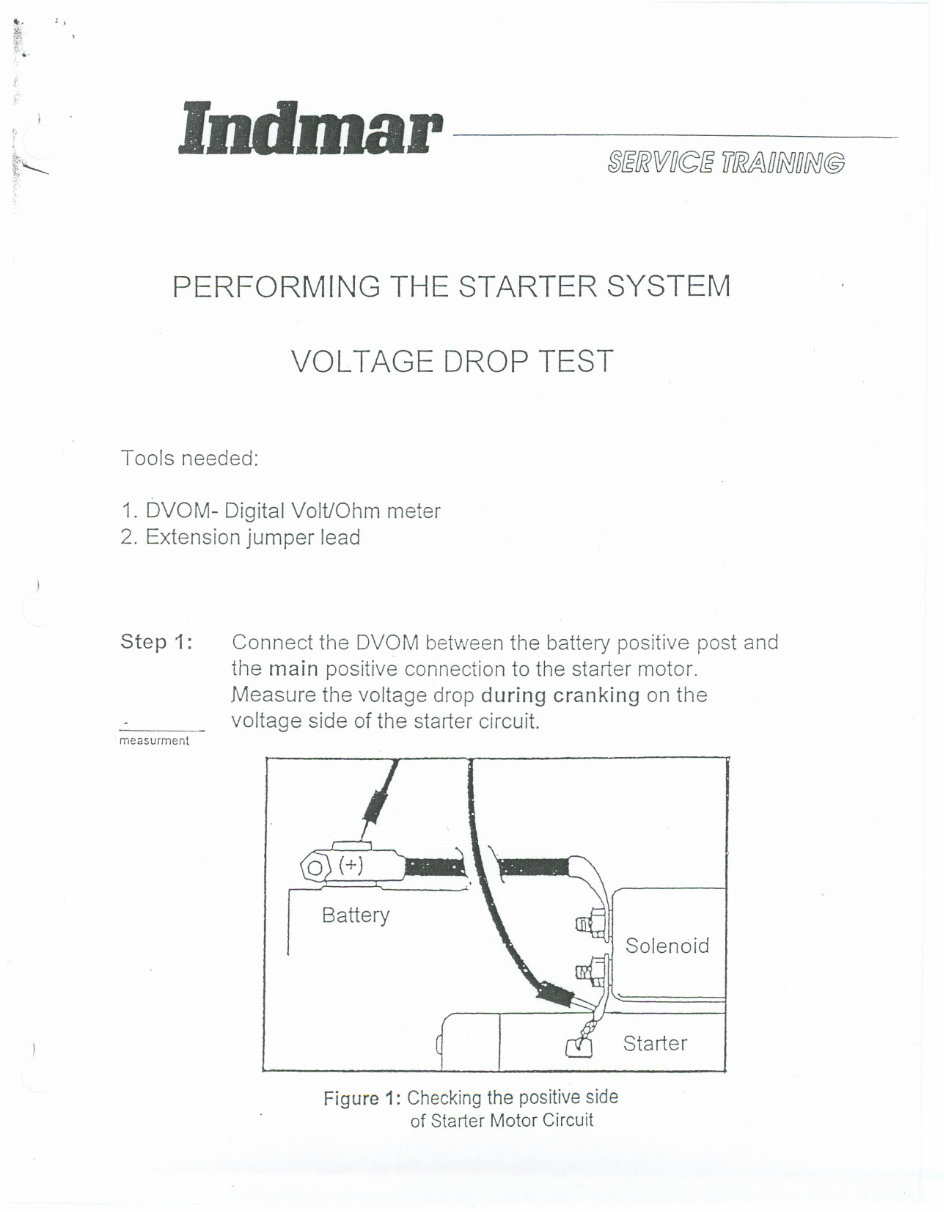
PERFORMING THE STARTER SYSTEM
VOLTAGE DROP TEST
Tools needed:
1. DVOM- Digital Volt/Ohm meter
2. Extension jumper lead
Step 1: Connect the DVOM between the battery positive post and
the main positive connection to the starter motor.
Measure the voltage drop during cranking on the
voltage side of the starter circuit.
measurment
Battery
Solenoid
Starter
Figure 1: Checkingthe positiveside
of StarterMotorCircuit
" - ,
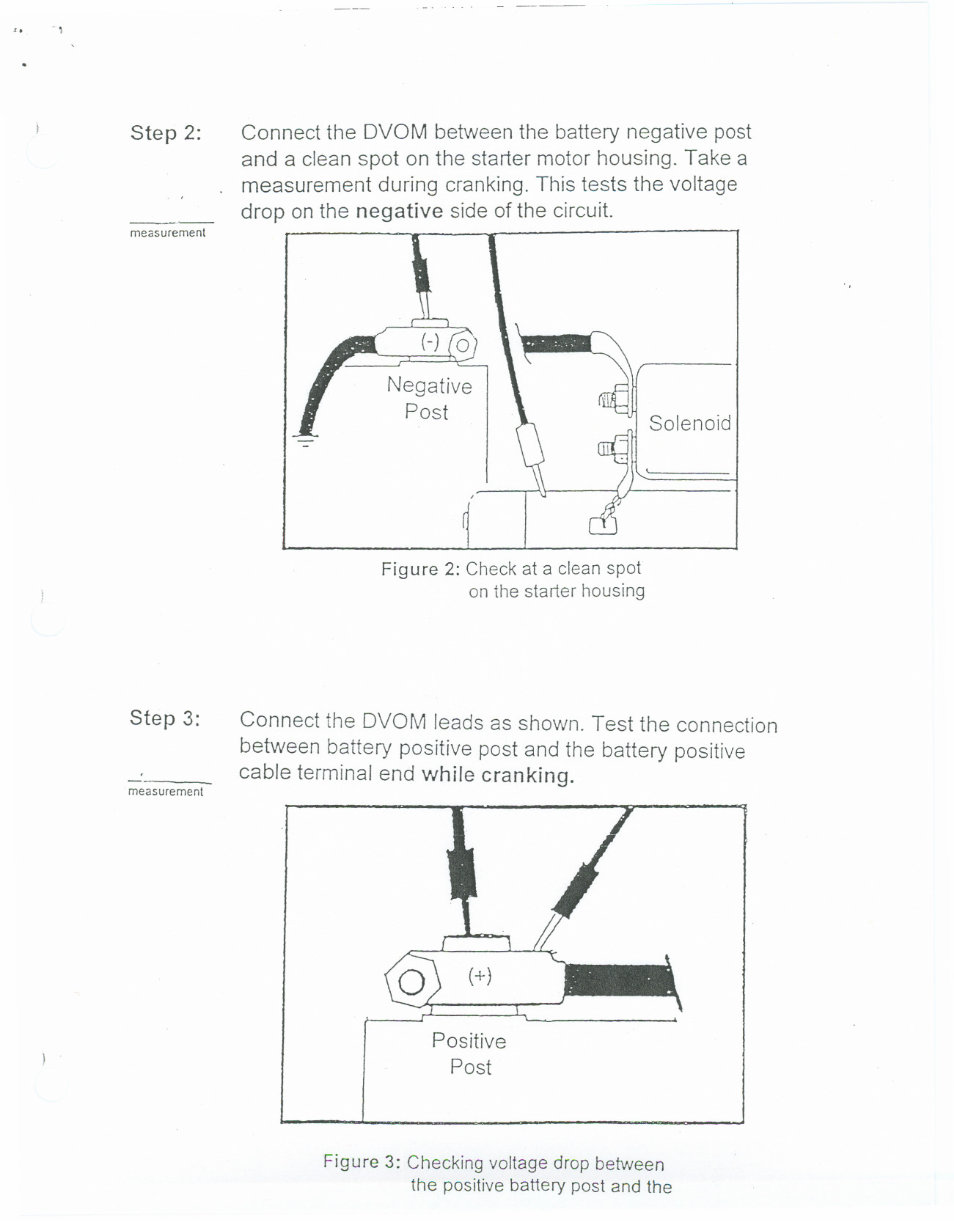
Step 2:
measurement
Step 3:
measurement
Connect the DVOMbetween the battery negative post
and a clean spot on the starter motor housing. Take a
. measurement during cranking. This tests the voltage
drop on the negative side of the circuit.
Negative
Post
Solenoid
-
Figure 2: Check at a clean spot
on the starter housing
Connect the DVOMleads as shown. Test the connection
between battery positive post and the battery positive
cable terminal end while cranking.
Positive
Post
Figure 3: Checking voltage drop between
the positive battery post and the
r.
"
.
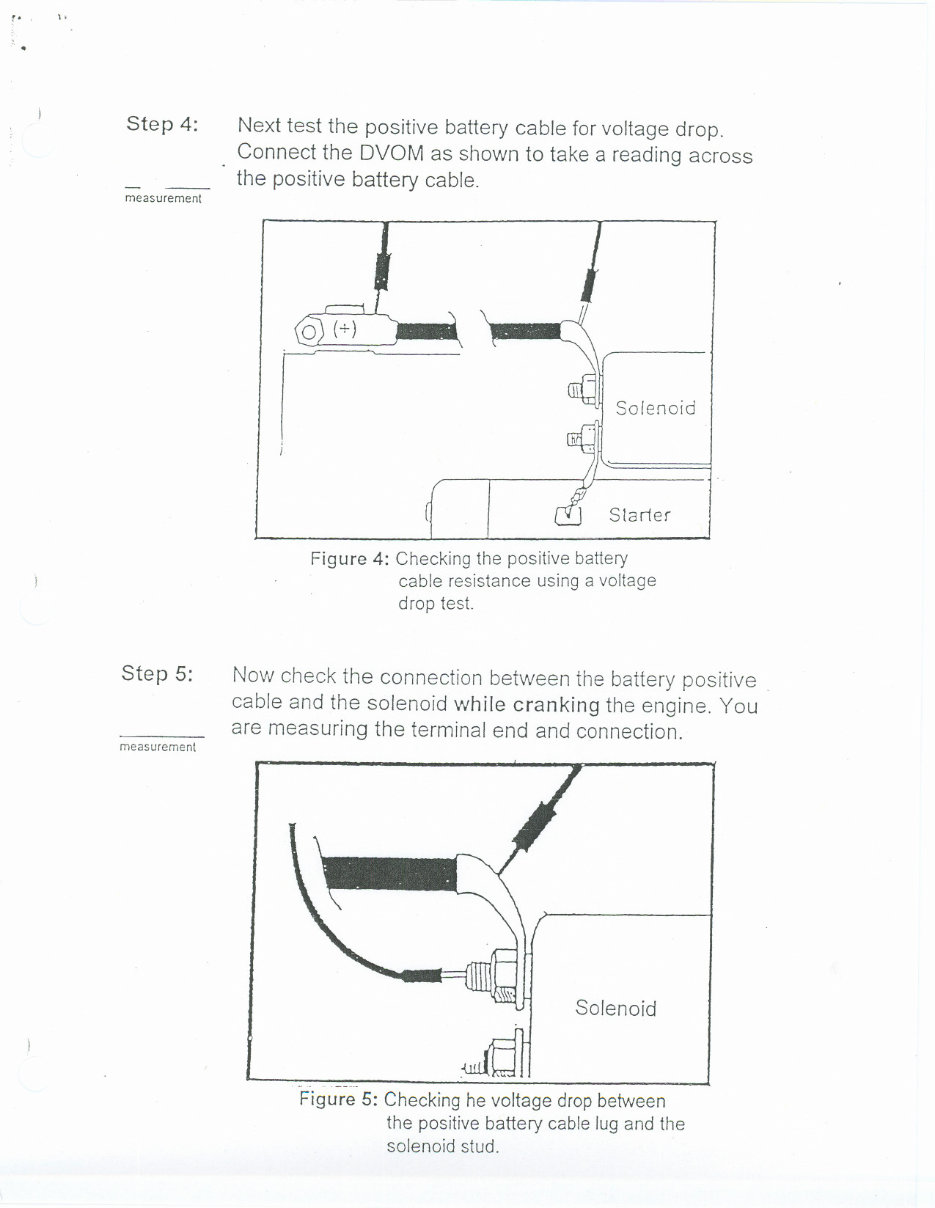
Step 4:
measurement
Step 5:
measurement
Next test the positive battery cable for voltage drop.
Connect the DVOM as shown to take a reading across
the positive battery cable.
Starier
Solenoid
Figure 4: Checking the positive battery
cable resistance using a voltage
drop test.
Now check the connection between the battery positive.
cable and the solenoid while cranking the engine. You
are measuring the terminal end and connection.
Solenoid
Figure 5: Checking he voltage drop between
the positive battery cable lug and the
solenoid stud.
~
, -
-
Step 6:
Clean and suspect terminals and replace any faulty
components. Then, re-check the system by completing
Steps 1 & 2 again.
measurement
REMEMBER:
All tests are made with the engine cranking.
The rule of thumb is that each termination in the circuit should have a
voltage drop of no greater that 0.2 volts.
You're Reading a Preview
What's Included?
Lifetime Access
Fast Download Speeds
Online & Offline Access
Access PDF Contents & Bookmarks
Full Search Facility
Print one or all pages of your manual
$26.99
$35.99
Viewed 45 Times Today


Secure transaction
What's Included?
Lifetime Access
Fast Download Speeds
Online & Offline Access
Access PDF Contents & Bookmarks
Full Search Facility
Print one or all pages of your manual
$26.99
$35.99
The Indmar Starter System Voltage Drop Test Procedure provides comprehensive instructions and images for testing the starter systems of five models (X, Y, Z, V, and W). This manual is valuable for both professional mechanics and DIY enthusiasts, offering step-by-step instructions for collecting accurate voltage samples, automotive grade electrical diagrams, detailed images of test steps, and a complete list of necessary tools and materials. It is essential for technicians involved in the maintenance or repair of any of the listed Indmar models. The manual is easy to follow and understand, making it suitable for both professionals and enthusiasts. It is available for online purchase and instant delivery through a download link.


