CHAPTER ONE GENERAL INFORMATION This detailed and comprehensive manual covers Harley-Davidson FLH and FLT Twin Cam 88 and 103 models from 1999-on. Over a thousand original photos and illustrations based on a complete disas- sembly of the machine, combined with the hands on text, provide the detail necessary to carry out any procedure safely and efficiently. A shop manual is a reference tool and as in all Service manuals, the chapters are thumb tabbed for easy reference. Important items are indexed at the end of the manual. All procedures, tables and fig- ures are designed for the reader who may be work- ing on the motorcycle for the first time. Frequently used specifications and capacities from individual chapters are summarized in the Quick Reference Data at the front of the book. Tables 1-11 are at the end of this chapter. Table 1 lists model designation. Table 2 lists general dimensions. Table 3 lists motorcycle weight. Table 4 lists motorcycle weight ratings. Table 5 lists fuel tank capacity. Table 6 lists decimal and metric equivalents. Table 7 lists general torque specifications. Table 8 lists conversion tables. Table 9 lists technical abbreviations. Table 10 lists American tap and drill sizes. Table 11 lists special tools. MANUAL ORGANIZATION This chapter provides general information on shop safety, tool use, service fundamentals and shop supplies. The tables at the end of the chapter include general motorcycle information. Chapter Two provides methods for quick and ac- curate diagnosis of problems. Troubleshooting pro- cedures present typical symptoms and logical methods to pinpoint and repair the problem.
Chapter Three explains all routine maintenance necessary to keep the motorcycle running well. Chapter Three also includes recommended tune-up procedures, eliminating the need to constantly con- sult other chapters on the various assemblies. Subsequent chapters describe specific systems such as engine, transmission, clutch, drive system, fuel and exhaust systems, suspension and brakes. Each disassembly, repair and assembly procedure is given in step-by-step form. Some of the procedures in this manual specify special tools. In most cases, the tool is illustrated in use. Well-equipped mechanics may be able to sub- stitute similar tools or fabricate a suitable replace- ment. In some cases, specialized equipment or expertise may make it impractical for the home me- chanic to attempt the procedure. Such operations are identified in the text with the recommendation to have a dealership or specialist perform the task. It may be less expensive to have a professional per- form these jobs, especially when considering the cost of the equipment. WARNINGS, CAUTIONS AND NOTES The terms, WARNING, CAUTION and NOTE have specific meanings in this manual. A WARNING emphasizes areas where injury or even death could result from negligence. Mechani- cal damage may also occur. WARNINGS are to be taken seriously . A CAUTION emphasizes areas where equipment damage could occur. Disregarding a CAUTION could cause permanent mechanical damage, though injury is unlikely. A NOTE provides additional information to make a step or procedure easier or clearer. Disregarding a NOTE could cause inconvenience, but would not cause equipment damage or personal injury. SAFETY Professional mechanics can work for years and never sustain a serious injury or mishap. Follow these guidelines and practice common sense to safely service the motorcycle. 1. Do not operate the motorcycle in an enclosed area. The exhaust gasses contain carbon monoxide, an odorless, colorless and tasteless poisonous gas. Carbon monoxide levels build quickly in small en- closed areas and can cause unconsciousness and death in a short time. Make sure the work area is properly ventilated or operate the motorcycle out- side. 2. Never use gasoline or extremely flammable liq- uid to clean parts. Refer to Cleaning Parts and Han- dling Gasoline Safely in this chapter. 3. Never smoke or use a torch in the vicinity of flammable liquids, such as gasoline or cleaning sol- vent. 4. Before welding or brazing on the motorcycle, re- move the fuel tank, carburetor and shocks to a safe distance at least 50 ft. (15 m) away. 5. Use the correct type and size of tools to avoid damaging fasteners. 6. Keep tools clean and in good condition. Replace or repair worn or damaged equipment. 7. When loosening a tight fastener, be guided by what would happen if the tool slips. 8. When replacing fasteners, make sure the new fasteners are the same size and strength as the origi- nal ones. 9. Keep the work area clean and organized. 10. Wear eye protection anytime the safety of the eyes is in question. This includes procedures in- volving drilling, grinding, hammering, compressed air and chemicals. 11. Wear the correct clothing for the job. Tie up or cover long hair so it can not get caught in moving equipment. 12. Do not carry sharp tools in clothing pockets. 13. Always have an approved fire extinguisher available. Make sure it is rated for gasoline (Class B) and electrical (Class C) fires. 14. Do not use compressed air to clean clothes, the motorcycle or the work area. Debris may be blown into the eyes or skin. Never direct compressed air at anyone. Do not allow children to use or play with any compressed air equipment. 15. When using compressed air to dry rotating parts, hold the part so it can not rotate. Do not allow the force of the air to spin the part. The air jet is ca- pable of rotating parts at extreme speed. The part may be damaged or disintegrate and cause serious injury. 16. Do not inhale the dust created by brake pad and clutch wear. These particles may contain asbestos. In addition, some types of insulating materials and 2 CHAPTER ONE
gaskets may contain asbestos. Inhaling asbestos particles is hazardous to health. 17. Never work on the motorcycle while someone is working under it. 18. When placing the motorcycle on a stand, make sure it is secure before walking away. Handling Gasoline Safely Gasoline is a volatile flammable liquid and is one of the most dangerous items in the shop. Because gasoline is used so often, many people forget that it is hazardous. Only use gasoline as fuel for gasoline internal combustion engines. When working on a motorcycle, keep in mind that gasoline is always present in the fuel tank, fuel line and carburetor. To avoid a disastrous accident when working around the fuel system, carefully observe the following precautions: 1. Never use gasoline to clean parts. See Cleaning Parts in this chapter. 2. When working on the fuel system, work outside or in a well-ventilated area. 3. Do not add fuel to the fuel tank or service the fuel system while the motorcycle is near open flames, sparks or where someone is smoking. Gasoline va- por is heavier than air, it collects in low areas and is more easily ignited than liquid gasoline. 4. Allow the engine to cool completely before working on any fuel system component. 5. When draining the carburetor, catch the fuel in a plastic container and pour it into an approved gaso- line storage devise. 6. Do not store gasoline in glass containers. If the glass breaks, a serious explosion or fire may occur. 7. Immediately wipe up spilled gasoline with rags. Store the rags in a metal container with a lid until they can be properly disposed of, or place them out- side in a safe place for the fuel to evaporate. 8. Do not pour water onto a gasoline fire. Water spreads the fire and makes it more difficult to put out. Use a class B, BC or ABC fire extinguisher to extinguish the fire. 9. Always turn off the engine before refueling. Do not spill fuel onto the engine or exhaust system. Do not overfill the fuel tank. Leave an air space at the top of the tank to allow room for the fuel to expand due to temperature fluctuations. Cleaning Parts Cleaning parts is one of the more tedious and dif- ficult service jobs performed in the home garage. There are many types of chemical cleaners and sol- vents available for shop use. Most are poisonous and extremely flammable. To prevent chemical ex- posure, vapor buildup, fire and serious injury, note the following: 1. Read and observe the entire product label before using any chemical. Always know what type of chemical is being used and whether it is poisonous and/or flammable. 2. Do not use more than one type of cleaning sol- vent at a time. When mixing chemicals, measure the proper amounts according to the manufacturer. 3. Work in a well-ventilated area. 4. Wear chemical-resistant gloves. 5. Wear safety glasses. 6. Wear a vapor respirator if the instructions call for it. 7. Wash hands and arms thoroughly after cleaning parts. 8. Keep chemical products away from children and pets. 9. Thoroughly clean all oil, grease and cleaner resi- due from any part that must be heated. 10. Use a nylon brush when cleaning parts. Metal brushes may cause a spark. 11. When using a parts washer, only use the solvent recommended by the manufacturer. Make sure the parts washer is equipped with a metal lid that will lower in case of fire. Warning Labels Most manufacturers attach information and warning labels to the motorcycle. These labels con- tain instructions that are important to personal safety when operating, servicing, transporting and storing the motorcycle. Refer to the owner’s manual for the description and location of labels. Order re- placement labels from the manufacturer if they are missing or damaged. SERIAL NUMBERS Serial numbers are stamped in various locations on the frame, engine, transmission and carburetor. Record these numbers in the Quick Reference Data GENERAL INFORMATION 3 1
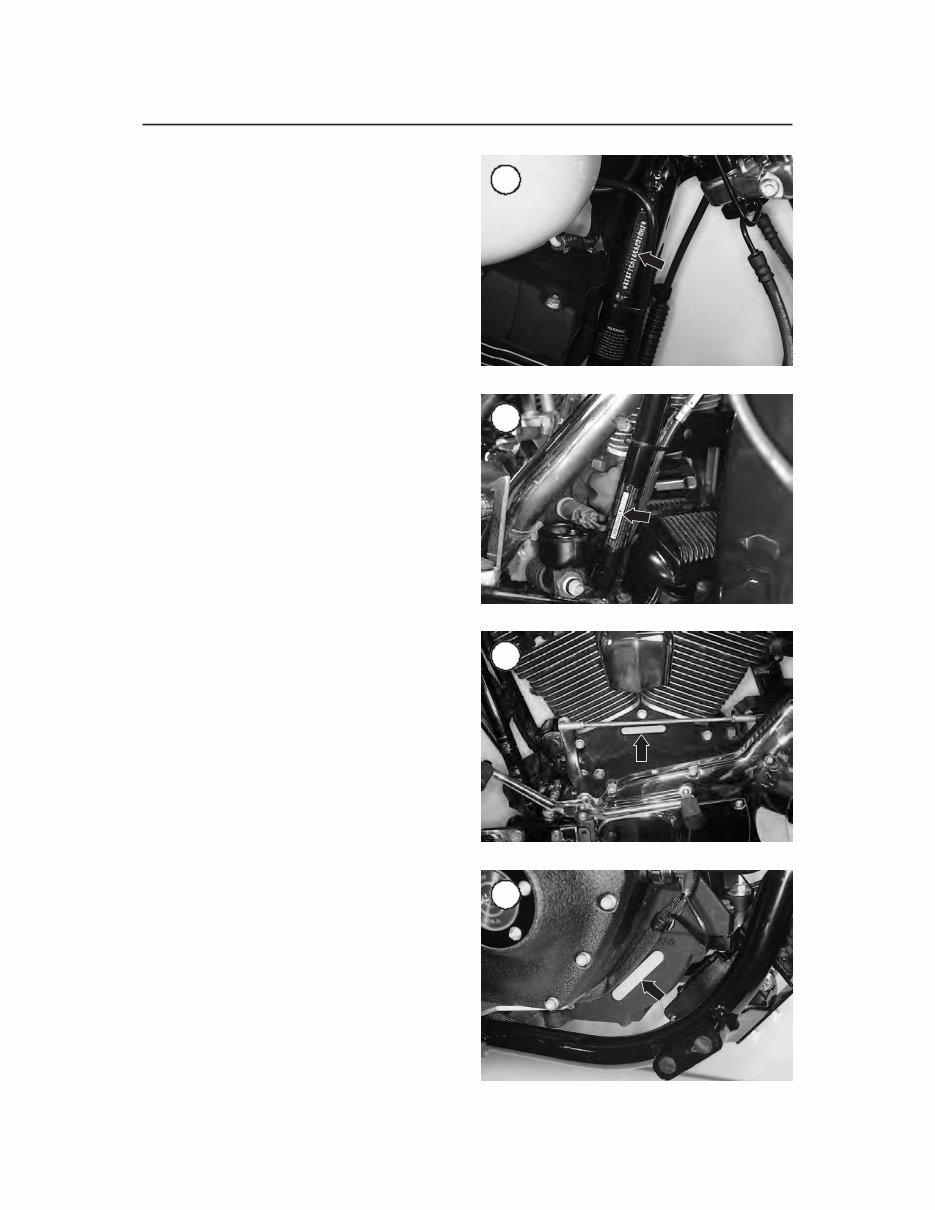
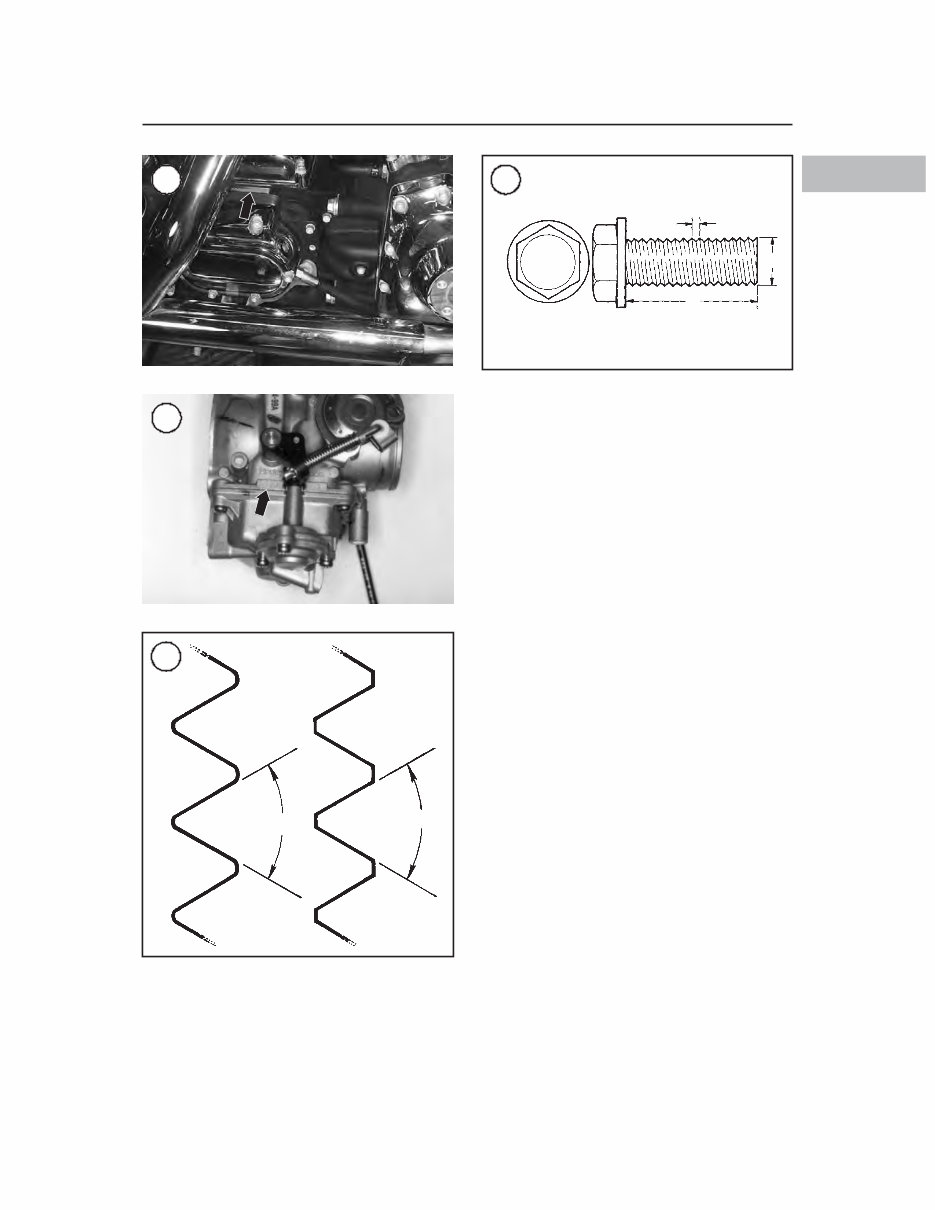
section in the front of the manual. Have these num- bers available when ordering parts. The frame serial number (Figure 1) is stamped on the right side of the frame down tube. The VIN number label (Figure 2) is located just below the frame number on the right side frame down tube. The engine serial number is stamped on a pad on the left side of the crankcase (Figure 3) and the right side of the crankcase (Figure 4). The transmission serial number (Figure 5) is stamped on a pad on the right side of the transmis- sion case next to the side door. The carburetor serial number (Figure 6) is lo- cated on the side of the carburetor body next to the accelerator pump linkage. Table 1 lists model designation. FASTENERS Proper fastener selection and installation is im- portant to ensure the motorcycle operates as de- signed and can be serviced efficiently. The choice of original equipment fasteners is not arrived at by chance. Make sure that replacement fasteners meet all the same requirements as the originals. Threaded Fasteners Threaded fasteners secure most of the compo- nents on the motorcycle. Most are tightened by turning them clockwise (right-hand threads). If the normal rotation of the component being tightened would loosen the fastener, it may have left-hand threads. If a left-hand threaded fastener is used, it is noted in the text. Two dimensions are required to match the threads of the fastener: the number of threads in a given dis- tance and the outside diameter of the threads. Two systems are currently used to specify threaded fastener dimensions: the U.S. Standard system and the metric system (Figure 7). Pay par- ticular attention when working with unidentified fasteners; mismatching thread types can damage threads. CAUTION To ensure the fastener threads are not mismatched or cross-threaded, start all fasteners by hand. If a fastener is 4 CHAPTER ONE 1 2 3 4
hard to start or turn, determine the cause before tightening with a wrench. The length (L, Figure 8), diameter (D) and dis- tance between thread crests (pitch) (T) classify met- ric screws and bolts. A typical bolt may be identi- fied by the numbers, 8–1.25 × 130. This indicates the bolt has diameter of 8 mm, the distance between thread crests is 1.25 mm and the length is 130 mm. Always measure bolt length as shown in Figure 8 to avoid purchasing replacements of the wrong length. The numbers located on the top of the fastener (Figure 8) indicate the strength of metric screws and bolts. The higher the number, the stronger the fastener. Unnumbered fasteners are the weakest. Many screws, bolts and studs are combined with nuts to secure particular components. To indicate the size of a nut, manufacturers specify the internal diameter and the thread pitch. The measurement across two flats on a nut or bolt indicates the wrench size. WARNING Do not install fasteners with a strength classification lower than what was originally installed by the manufacturer. Doing so may cause equipment failure and/or damage. Torque Specifications The materials used in the manufacture of the mo- torcycle may be subjected to uneven stresses if the fasteners of the various subassemblies are not in- stalled and tightened correctly. Fasteners that are improperly installed or work loose can cause exten- sive damage. It is essential to use an accurate torque wrench, described in this chapter, with the torque specifications in this manual. Specifications for torque are provided in New- ton-meters (N•m), foot-pounds (ft.-lb.) and inch-pounds (in.-lb.). Refer to Table 7 for general torque specifications. To use Table 7, first deter- GENERAL INFORMATION 5 1 7 60° Metric American 60° 8 Grade marking L T D -9.8 5 6
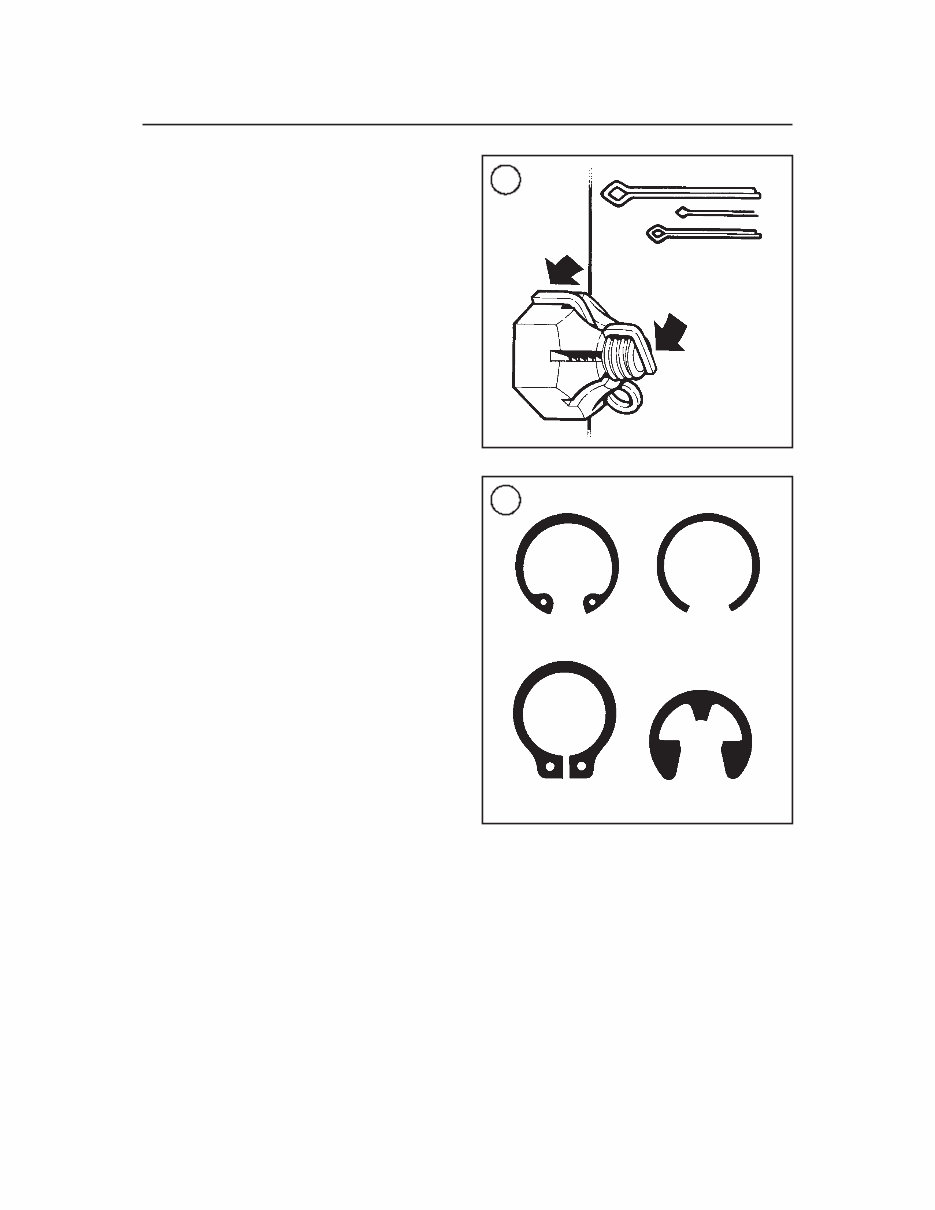
mine the size of the fastener as described in Fas- teners in this chapter. Torque specifications for specific components are at the end of the appropri- ate chapters. Torque wrenches are covered in the Basic Tools section. Self-Locking Fasteners Several types of bolts, screws and nuts incorpo- rate a system that creates interference between the two fasteners. Interference is achieved in various ways. The most common type is the nylon insert nut and a dry adhesive coating on the threads of a bolt. Self-locking fasteners offer greater holding strength than standard fasteners, which improves their resistance to vibration. Most self-locking fas- teners cannot be reused. The materials used to form the lock become distorted after the initial installa- tion and removal. It is a good practice to discard and replace self-locking fasteners after their removal. Do not replace self-locking fasteners with standard fasteners. Washers There are two basic types of washers: flat wash- ers and lockwashers. Flat washers are simple discs with a hole to fit a screw or bolt. Lockwashers are used to prevent a fastener from working loose. Washers can be used as spacers and seals, or to help distribute fastener load and to prevent the fastener from damaging the component. As with fasteners, when replacing washers, make sure the replacement washers are of the same design and quality. Cotter Pins A cotter pin is a split metal pin inserted into a hole or slot to prevent a fastener from loosening. In cer- tain applications, such as the rear axle on an ATV or motorcycle, the fastener must be secured in this way. For these applications, a cotter pin and castel- lated (slotted) nut is used. To use a cotter pin, first make sure the diameter is correct for the hole in the fastener. After correctly tightening the fastener and aligning the holes, insert the cotter pin through the hole and bend the ends over the fastener (Figure 9). Unless instructed to do so, never loosen a torqued fastener to align the holes. If the holes do not align, tighten the fastener just enough to achieve alignment. Cotter pins are available in various diameters and lengths. Measure length from the bottom of the head to the tip of the shortest pin. Snap Rings and E-clips Snap rings (Figure 10) are circular-shaped metal retaining clips. They are required to secure parts and gears in place on parts such as shafts, pins or rods. External type snap rings are used to retain 6 CHAPTER ONE 9 Correct installation of cotter pin 10 Internal snap ring Plain circlip External snap ring E-clip
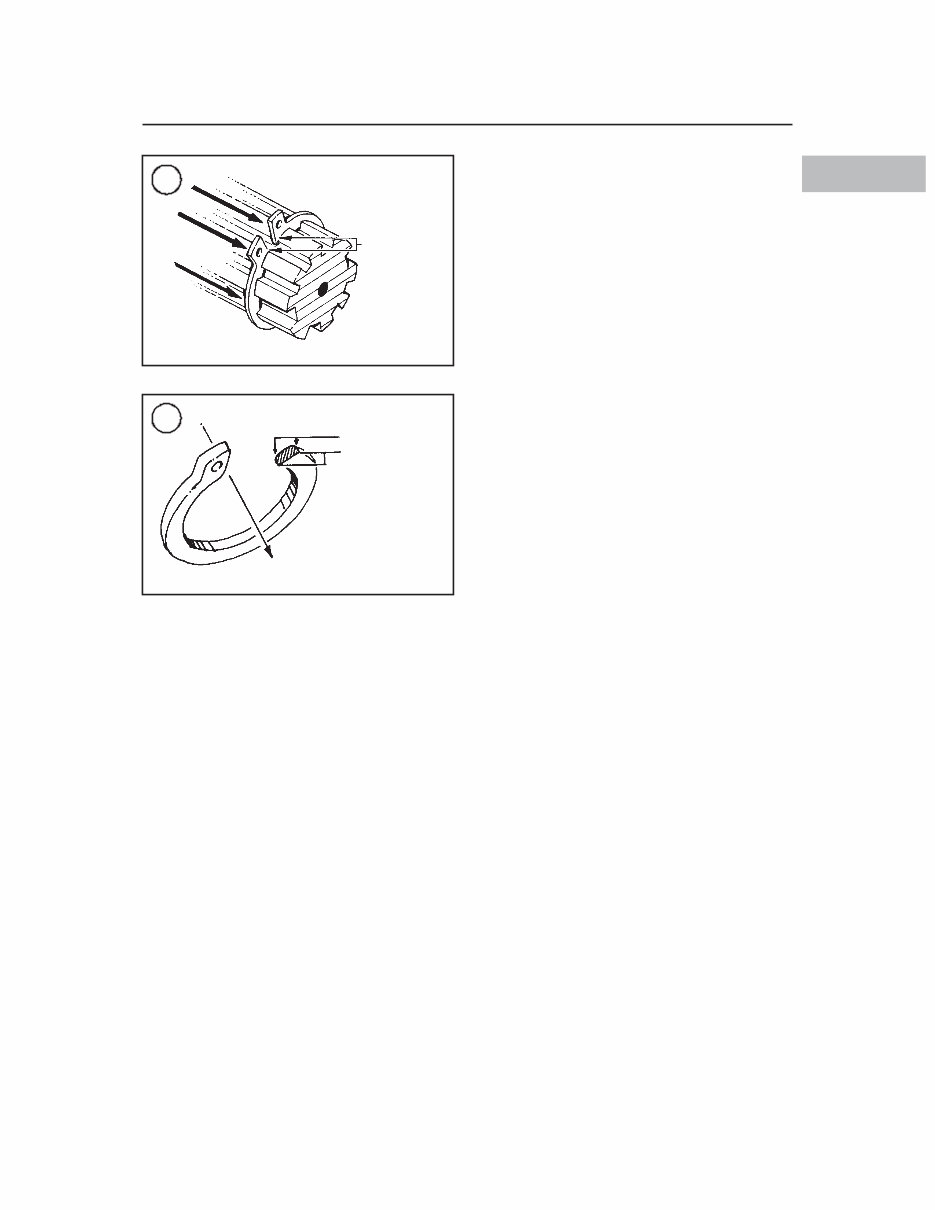
items on shafts. Internal type snap rings secure parts within housing bores. In some applications, in addi- tion to securing the component(s), snap rings of varying thickness also determine endplay. These are usually called selective snap rings. Two basic types of snap rings are used: machined and stamped snap rings. Machined snap rings (Fig- ure 11) can be installed in either direction, since both faces have sharp edges. Stamped snap rings (Figure 12) are manufactured with a sharp edge and a round edge. When installing a stamped snap ring in a thrust application, install the sharp edge facing away from the part producing the thrust. Remove E-clips with a flat blade screwdriver by prying between the shaft and E-clip. To install an E-clip, center it over the shaft groove and push or tap it into place. Observe the following when installing snap rings: 1. Remove and install snap rings with snap ring pli- ers. See Snap Ring Pliers in this chapter. 2. In some applications, it may be necessary to re- place snap rings after removing them. 3. Compress or expand snap rings only enough to install them. If overly expanded, they lose their re- taining ability. 4. After installing a snap ring, make sure it seats completely. 5. Wear eye protection when removing and install- ing snap rings. SHOP SUPPLIES Lubricants and Fluids Periodic lubrication helps ensure a long service life for any type of equipment. Using the correct type of lubricant is as important as performing the lubrication service, although in an emergency the wrong type is better than none. The following sec- tion describes the types of lubricants most often re- quired. Make sure to follow the manufacturer’s recommendations for lubricant types. Engine oils Engine oil is classified by two standards: the American Petroleum Institute (API) service classi- fication and the Society of Automotive Engineers (SAE) viscosity rating. This information is on the oil container label. Two letters indicate the API ser- vice classification. The number or sequence of numbers and letter (10W-40 for example) is the oil’s viscosity rating. The API service classification and the SAE viscosity index are not indications of oil quality. The service classification indicates that the oil meets specific lubrication standards. The first letter in the classification (S) indicates that the oil is for gasoline engines. The second letter indicates the standard the oil satisfies. Always use an oil with a classification recom- mended by the manufacturer. Using an oil with a different classification can cause engine damage. Viscosity is an indication of the oil’s thickness. Thin oils have a lower number while thick oils have a higher number. Engine oils fall into the 5- to 50-weight range for single-grade oils. Most manufacturers recommend multigrade oil. These oils perform efficiently across a wide range of operating conditions. Multigrade oils are identi- fied by a (W) after the first number, which indicates the low-temperature viscosity. Engine oils are most commonly mineral (petro- leum) based; however, synthetic and semi-synthetic types are used more frequently. When selecting en- GENERAL INFORMATION 7 1 11 Full support areas Direction of thrust 12 Rounded edges Sharp edges Direction of thrust
gine oil, follow the manufacturer’s recommenda- tion for type, classification and viscosity. Greases Grease is lubricating oil with thickening agents added to it. The National Lubricating Grease Insti- tute (NLGI) grades grease. Grades range from No. 000 to No. 6, with No. 6 being the thickest. Typical multipurpose grease is NLGI No. 2. For specific ap- plications, manufacturers may recommend wa- ter-resistant type grease or one with an additive such as molybdenum disulfide (MoS 2 ). Brake fluid Brake fluid is the hydraulic fluid used to transmit hydraulic pressure (force) to the wheel brakes. Brake fluid is classified by the Department of Transportation (DOT). Current designations for brake fluid are DOT 3, DOT 4 and DOT 5. This classification appears on the fluid container. Each type of brake fluid has its own definite char- acteristics. Harley-Davidson FLH/FLT models use silicone based DOT 5 brake fluid. Do not intermix DOT 3 or DOT 4 with DOT 5 type brake fluid as this may cause brake system failure since the DOT 5 brake fluid is not compatible with other brake flu- ids. When adding brake fluid, only use the fluid rec- ommended by the manufacturer. Brake fluid will damage any plastic, painted or plated surface it contacts. Use extreme care when working with brake fluid and clean up spills imme- diately with soap and water. Hydraulic brake systems require clean and mois- ture free brake fluid. Never reuse brake fluid. Keep containers and reservoirs properly sealed. WARNING Never put a mineral-based (petro- leum) oil into the brake system. Min- eral oil will cause rubber parts in the system to swell and break apart, re- sulting in complete brake failure. Cleaners, Degreasers and Solvents Many chemicals are available to remove oil, grease and other residue from the motorcycle. Be- fore using cleaning solvents, consider how they will be used and disposed of, particularly if they are not water-soluble. Local ordinances may require spe- cial procedures for the disposal of many types of cleaning chemicals. Refer to Safety and Cleaning Parts in this chapter for more information on their use. Use brake parts cleaner to clean brake system components when contact with petroleum-based products will damage seals. Brake parts cleaner leaves no residue. Use electrical contact cleaner to clean electrical connections and components with- out leaving any residue. Carburetor cleaner is a powerful solvent used to remove fuel deposits and varnish from fuel system components. Use this cleaner carefully, as it may damage finishes. Generally, degreasers are strong cleaners used to remove heavy accumulations of grease from engine and frame components. Most solvents are designed to be used in a parts washing cabinet for individual component cleaning. For safety, use only nonflammable or high flash point solvents. Gasket Sealant Sealants are used with a gasket or seal and are oc- casionally used alone. Follow the manufacturer’s recommendation when using sealants. Use extreme care when choosing a sealant different from the type originally recommended. Choose sealants based on their resistance to heat and various fluids, and their sealing capabilities. One of the most common sealants is RTV, or room temperature vulcanizing sealant. This sealant cures at room temperature over a specific time pe- riod. This allows the repositioning of components without damaging gaskets. Moisture in the air causes the RTV sealant to cure. Always install the tube cap as soon as possible after applying RTV sealant. RTV sealant has a lim- ited shelf life and will not cure properly if the shelf life has expired. Keep partial tubes sealed and dis- card them if they have surpassed the expiration date. Applying RTV sealant Clean all old gasket residue from the mating sur- faces. Remove all gasket material from blind threaded holes; it can cause inaccurate bolt torque. Spray the mating surfaces with aerosol parts cleaner 8 CHAPTER ONE
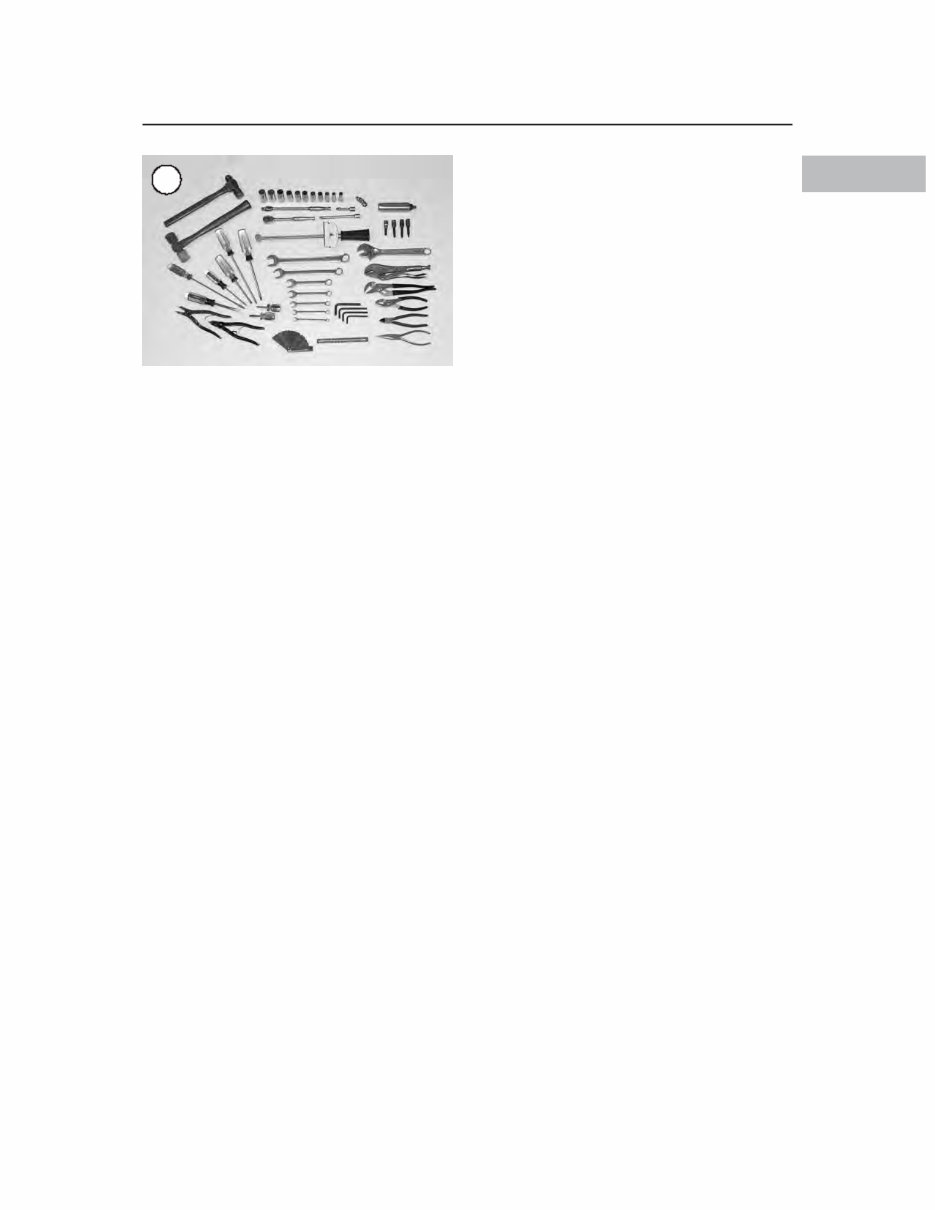
and wipe with a lint-free cloth. The area must be clean for the sealant to adhere. Apply RTV sealant in a continuous bead 2-3 mm (0.08-0.12 in.) thick. Circle all the fastener holes unless otherwise specified. Do not allow any seal- ant to enter these holes. Assemble and tighten the fasteners to the specified torque within the time frame recommended by the RTV sealant manufac- turer. Gasket Remover Aerosol gasket remover can help remove stub- born gaskets. This product can speed up the re- moval process and prevent damage to the mating surface that may be caused by using a scraping tool. Most of these types of products are very caustic. Follow the gasket remover manufacturer’s instruc- tions for use. Threadlocking Compound A threadlocking compound is a fluid applied to the threads of fasteners. After the fastener is tight- ened, the fluid dries and becomes a solid filler be- tween the threads. This makes it difficult for the fastener to work loose from vibration, or heat ex- pansion and contraction. Some threadlocking com- pounds also provide a seal against fluid leakage. Before applying threadlocking compound, re- move any old compound from both thread areas and clean them with aerosol parts cleaner. Use the com- pound sparingly. Excess fluid can run into adjoining parts. Threadlocking compounds are available in differ- ent strengths. Follow the particular manufacturer’s recommendations regarding compound selection. Two manufacturers of threadlocking compound are ThreeBond and Loctite. They both offer a wide range of compounds for various strength, tempera- ture and repair applications. BASIC TOOLS Most of the procedures in this manual can be car- ried out with simple hand tools and test equipment familiar to the home mechanic. Always use the cor- rect tools for the job at hand. Keep tools organized and clean. Store them in a tool chest with related tools organized together. Quality tools are essential. The best are con- structed of high-strength alloy steel. These tools are light, easy to use and resistant to wear. Their work- ing surface is devoid of sharp edges and the tool is carefully polished. They have an easy-to-clean fin- ish and are comfortable to use. Quality tools are a good investment. When purchasing tools to perform the procedures covered in this manual, consider the tool’s potential frequency of use. If a tool kit is just now being started, consider purchasing a basic tool set (Figure 13) from a large tool supplier. These sets are avail- able in many tool combinations and offer substan- tial savings when compared to individually purchased tools. As work experience grows and tasks become more complicated, specialized tools can be added. Screwdrivers Screwdrivers of various lengths and types are mandatory for the simplest tool kit. The two basic types are the slotted tip (flat blade) and the Phillips tip. These are available in sets that often include an assortment of tip sizes and shaft lengths. As with all tools, use a screwdriver designed for the job. Make sure the size of the tip conforms to the size and shape of the fastener. Use them only for driving screws. Never use a screwdriver for prying or chiseling metal. Repair or replace worn or dam- aged screwdrivers. A worn tip may damage the fas- tener, making it difficult to remove. Torx Drivers Many of the components on the Harley-Davidson models covered in this manual are secured with in- GENERAL INFORMATION 9 1 13
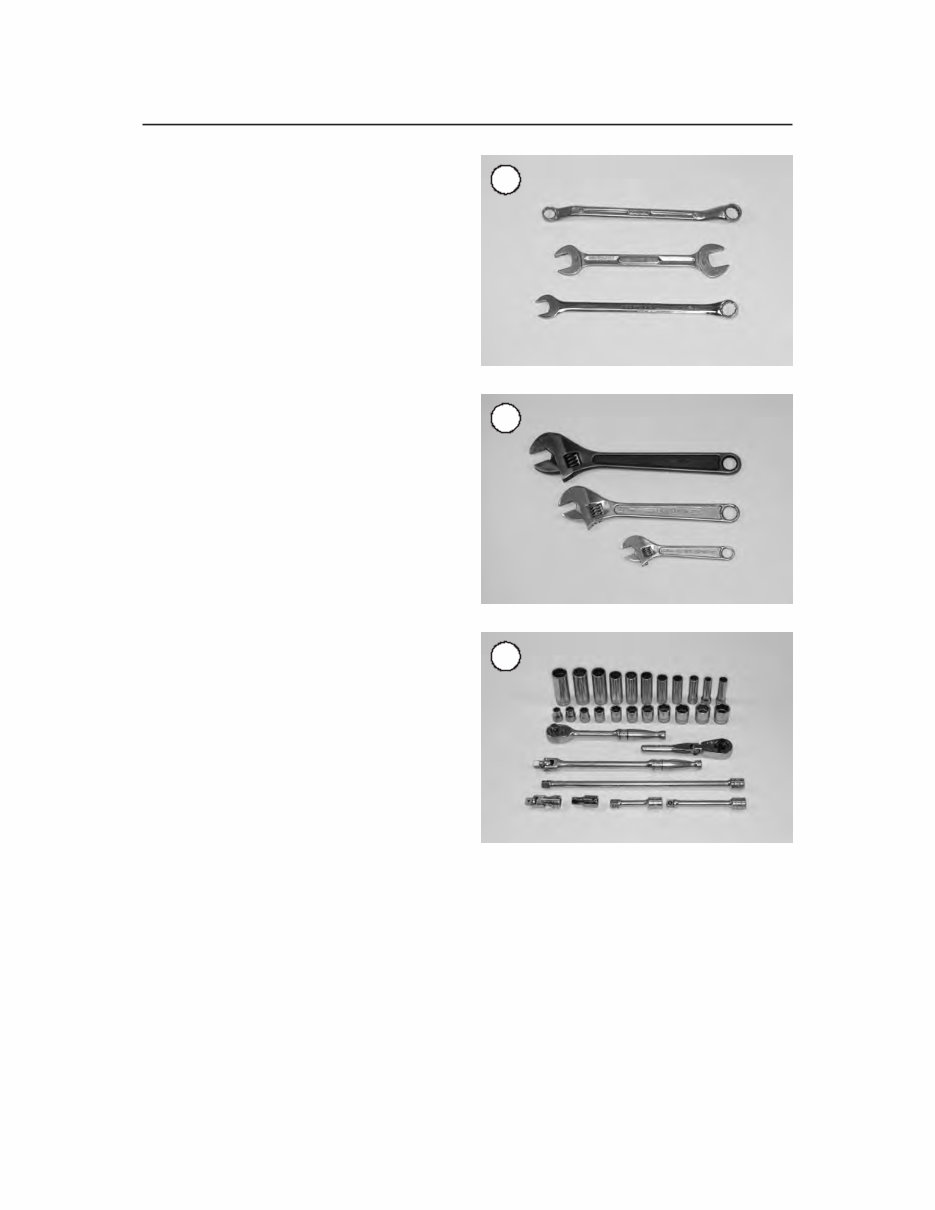
ternal Torx fasteners. These fasteners require spe- cific Torx drivers for removal and installation. These fasteners reduce cam-out and fastener dam- age, and allow high torque transmission due to the complete enclosure of the driver within the fastener. Torx screwdrivers in individual sizes, or screw- drivers that accept various bit sizes are available. However, the most practical application is a Torx bit set that accepts various drive types and sizes. A typ- ical set contains T-10 through T40 bits that accept 1/4 and 3/8 in. drive attachments. Wrenches Open-end, box-end and combination wrenches (Figure 14) are available in a variety of types and sizes. The number stamped on the wrench refers to the distance between the work areas. This size must match the size of the fastener head. The box-end wrench is an excellent tool because it grips the fastener on all sides. This reduces the chance of the tool slipping. The box-end wrench is designed with either a 6- or 12-point opening. For stubborn or damaged fasteners, the 6-point provides superior holding ability by contacting the fastener across a wider area at all six edges. For general use, the 12-point works well. It allows the wrench to be removed and reinstalled without moving the handle over such a wide arc. An open-end wrench is fast and works best in ar- eas with limited overhead access. It contacts the fas- tener at only two points, and is subject to slipping under heavy force, or if the tool or fastener is worn. A box-end wrench is preferred in most instances, especially when breaking a fastener loose and ap- plying the final tightness to a fastener. The combination wrench has a box-end on one end and an open-end on the other. This combination makes it a very convenient tool. Adjustable Wrenches An adjustable wrench or Crescent wrench (Fig- ure 15) can fit nearly any nut or bolt head that has clear access around its entire perimeter. Adjustable wrenches are best used as a backup wrench to keep a large nut or bolt from turning while the other end is being loosened or tightened with a box-end or socket wrench. Adjustable wrenches contact the fastener at only two points, which makes them more subject to slip- ping off the fastener. The fact that one jaw is adjust- able and may loosen only aggravates this shortcoming. Make certain the solid jaw is the one transmitting the force. Socket Wrenches, Ratchets and Handles Sockets that attach to a ratchet handle ( Figure 16) are available with 6-point (A, Figure 17) or 12-point 10 CHAPTER ONE 15 16 14
The 1999-2005 Harley-Davidson Twin Cam 88 & 103 Service & Repair Manual is a comprehensive technical resource for maintaining and repairing these powerful engine models. Sourced directly from Harley-Davidson, it covers critical systems, providing precise service procedures and specifications for the engine, transmission, and electrical systems.
Clear diagrams, accurate torque specifications, and step-by-step instructions streamline the process of diagnosing and addressing issues. From fluid changes and clutch adjustments to comprehensive engine overhauls, this manual guides you through disassembling, inspecting, and reassembling components with precision. Wiring diagrams and troubleshooting charts simplify electrical system maintenance.
This manual is tailored for both professional technicians and DIY enthusiasts, empowering them to manage everything from routine oil changes to intricate diagnostics. With its detailed procedures and technical accuracy, it is essential for keeping your Twin Cam 88 & 103 engines performing optimally and reliably.
Printable: Yes
Language: English
Compatibility: Pretty much any electronic device, incl. PC & Mac computers, Android and Apple smartphones & tablet, etc.




 Lifetime Access