Good operation and a planned maintenance program as outlined in this manual are vital in ob- taining maximum engine performance and long engine life. The instructions on the following pages have been written with this in mind, to give the operator a better understanding of the various problems which may a rise, and the manner in which these problems can best be solved or avoided. The operator is cautioned against the use of any parts, other than genuine Wisconsin Motors, LLC parts, for replacement or repair. These parts have been engineered and tested for their particular job, and the use of any other parts may result in unsatisfactory performance and short enginel ife. Wisconsin Motors, LLC distributors and dealers, because of their close factory relations, can render the best and most efficient service. THE LIFE OF YOUR ENGINE DEPENDS ON THE CARE IT RECEIVES The MODEL, SPECIFICATION and SERIAL NUMBER of your engine must be given when order- ing parts. The MODEL and SPECIFICATION number are on the nameplate. The SERIAL NUMBER is stamped either on the crankcase or the engine’s identification tag. Copy the MODEL, SPECIFICATION and SERIAL NUMBER in the spaces provided below so that it will be available when ordering parts. MODEL SPECIFICATION SERIAL NUMBER To insure prompt and accurate service, the following information must also be given: 1. State EXACTLY the quantity of each part and part number. 2. State definitely whether parts are to be shipped by express, freight or parcel post. 3. State the exact mailing address. FORWARD L...-------II L..-- 1 _----'
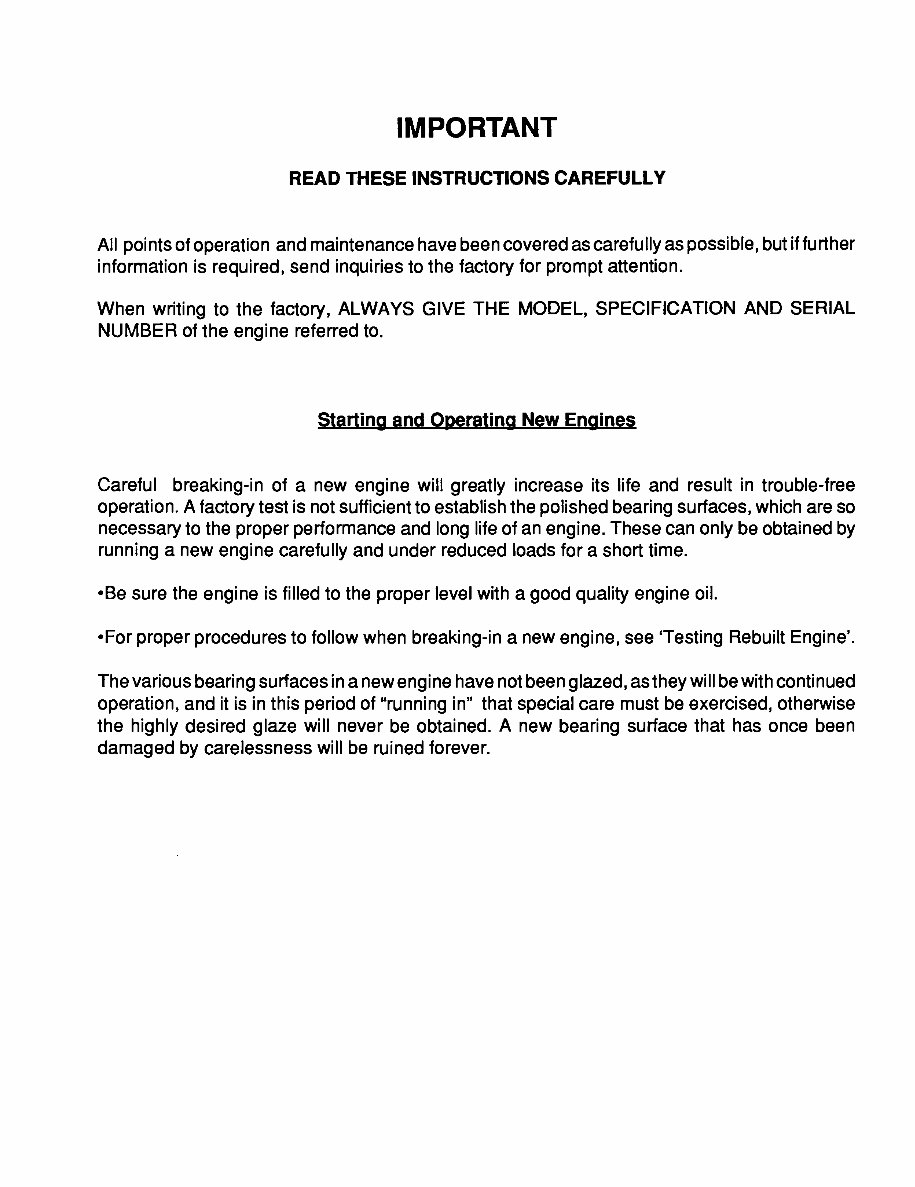
IMPORTANT READ THESE INSTRUCTIONS CAREFULLY All points of operation and maintenance have been covered as carefully as possible, but if further information is required, send inquiries to the factory for prompt attention. When writing to the factory, ALWAYS GIVE THE MODEL, SPECIFICATION AND SERIAL NUMBER of the engine referred to. Starting and Operating New Engines Careful breaking-in of a new engine will greatly increase its life and result in trouble-free operation. A factory test is not sufficient to establish the polished bearing surfaces, which are so necessary to the proper performance and long life of an engine. These can only be obtained by running a new engine carefully and under reduced loads for a short time. -Be sure the engine is filled to the proper level with a good quality engine oil. -For proper procedures to follow when breaking-in a new engine, see 'Testing Rebuilt Engine'. The various bearing surfaces in a new engine have not been glazed, as they will be with continued operation, and it is in this period of "running in" that special care must be exercised, otherwise the highly desired glaze will never be obtained. A new bearing surface that has once been damaged by carelessness will be ruined forever.
Proper repair is important to the safe and reliable operation of an engine. This Service Manual outlines basic recommended procedures, some of which require special tools, devices or work methods. Improper repair procedures can be dangerous and could result in injury or death. READ AND UNDERSTAND ALL SAFETY PRECAUTIONS AND WARNINGS BEFORE PERFORMING REPAIRS ON THIS ENGINE Warning labels have also been put on the engines to provide instructions and identify specific hazards which if not heeded could cause bodily injury or death to you or other persons. These labels identify hazards which may not be apparent to a trained mechanic. There are many potential hazards for an untrained mechanic and there is no way to label the engine against all such hazards. These warnings in the Service Manual and on the engine are identified by this symbol: Operations that may result only in engine damage are identified in the Service Manual by the word CAUTION. Wisconsin Motors, LLC cannot anticipate every possible circumstance that might involve a potential hazard. The warnings in this manual are therefore not all inclusive. If a procedure, tool, device or work method not specifically recommended by Wisconsin Motors, LLC is used, you must satisfy yourself that it is safe for you and others. You should also ensure that the engine will not be damaged or made unsafe by the procedures you choose. IMPORTANT SAFETY NOTICE IMPORTATNT the information, specifications and illustrations in this book are on the basis of information available at the time it was written. The specifications, torques, pressures of operation, measurements adjustments, illustrations and other items can change at any time. These changes can effect the service given to the product. Get the complete and most current information before you start any job. Continental Distributors/Dealers have the most current information which is available. For a list of current Distributors/Dealers, refer to directory LIT1017 or www.wiscosninmotors.com. WARNING ! 1
WARNING ! Most sub-systems used in conjunction with Wisconsin Motors, LLC industrial engines including, but not lim- ited to, radiators, hoses, fans fuel tanks, fuel lines or other fuel systems components, hydraulic pumps and generators, are not supplied by Wisconsin Motors, LLC, but are provided by the manufacturer of the end item in which the eingine is used. Some of the dangers assoicatied with servicing such items are generally mentioned in this manual; however, the appropriate handbooks and safety instructions procided by the manufactureer of the end item should always be consulted prior to undertaking any work on sub-systems attached to the engine, to avoid any hazards inherent to these sub-systems. Read and observe all individual safety warnings as you use this manual to operate, service or repair your engine. Always exercise caution whenever working with an engine or any associated system. Injuries may be caused by lack of care when working with, or near, moving parts, hot parts, pressurized systems, electrical equipment, or fuel systems. Always wear eye and hearing protection when working on or near engines. Improper attire such as loose clothing, ties, rings, soft shoes or bare feet could be hazardous and should be avoided when servicing engines. Use or service of the engine (including the use of modified parts or materials) not in accordance with manufacturer’s specifications could damage your engine or cause personal injury. Starting fluids or aids such as ether or gasoline must not be used in a diesel engine air intake system. The use of these fluids will cause severe internal engine damage and/or bodily injury. Some equipment and materials used in the overhaul or maintenance of an engine such as machine tools, electrical equipment, compressed air, solvents, diesel, gasoline or other fuels may be dangerous and can cause injury. Always observe safety precautions associated with these items. WARNING ! WARNING ! WARNING ! 2
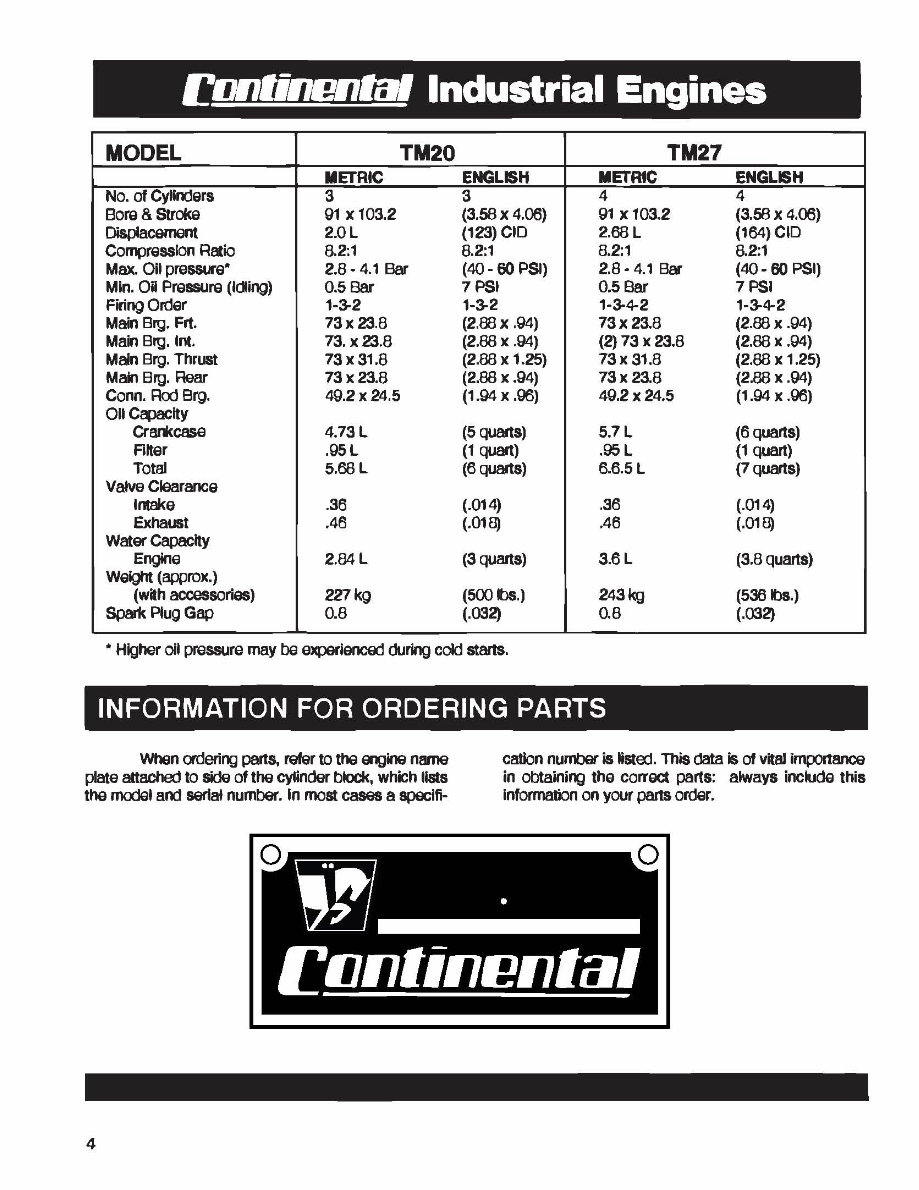
MADE IN USA WISCONSIN MOTORS, LLC MEMPHIS TENNESSEE TME27 08500 1001 r01,jllBl1aI Industrial Engines MODEL TM20 TM27 METRIC ENGLISH METRIC ENGLISH No. of Cylinders 3 3 4 4 Bore & Stroke 91 x 103.2 (3.58 x 4.(6) 91 x 103.2 (3.58 x 4.(6) Displacement 2.0L (123) CID 2.68L (164) CID Compression Ratio 8.2:1 8.2:1 8.2:1 8.2:1 Max. Oil pressure" 2.8·4.1 Bar (40·60 PSI) 2.8·4.1 Bar (40· 60 PSI) Min. Oil Pressure (Idling) 0.5 Bar 7 PSI 0.5 Bar 7 PSI Firing Order 1·3-2 1·3-2 1·3-4-2 1·3-4-2 Main Brg. Frt. 73x23.8 (2.88 x .94) 73x 23.8 (2.88 x .94) Main Brg. Int. 73. x 23.8 (2.88 x .94) (2) 73 x 23.8 (2.88 x .94) Main Brg. Thrust 73 x 31.8 (2.88 x 1.25) 73x 31.8 (2.88 x 1.25) Main Brg. Rear 73 x 23.8 (2.88 x .94) 73x23.8 (2.88 x .94) Conn. Rod Brg. 49.2 x 24.5 (1.94 x .96) 49.2 x 24.5 (1.94 x .96) all Capacity Crankcase 4.73L (5 quarts) 5.7 L (6 quarts) Filter .95L (1 quart) .95L (1 quart) Total 5.68L (6 quarts) 6.6.5L (7 quarts) Valva Clearance Intake .36 (.014) .36 (.014) Exhaust .46 (.018) .46 (.018) Water capacity Engine 2.B4L (3 quarts) 3.6L (3.8 quarts) Weight (approx.) (with accessories) 227 kg (500 Ibs.) 243 kg (536lbs.) Sparl< Plug Gap 0.8 (.032) 0.8 (.032) " Higher oil pressure may be experienced during cold starts. INFORMATION FOR ORDERING PARTS When ordering parts, reler to the angina nama plate attached to side of the cylinclar block, which IISls the modal and serial number. In mcSl casas a spaclfi· 4 cation number is Nsted. This data is of vital importance in obtaining the correct parts: always include this information on your parts order.
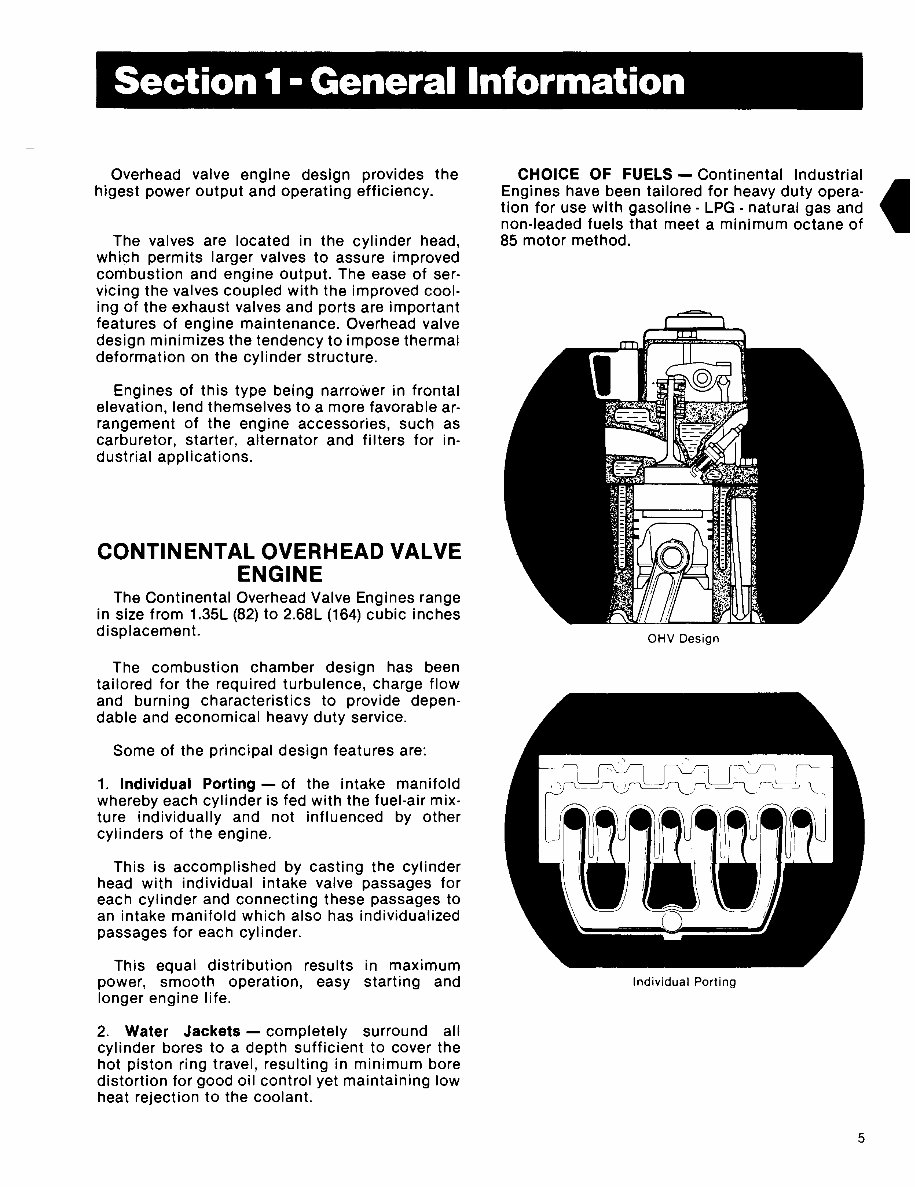
Section 1 • General Information Overhead valve engine design provides the higest power output and operating efficiency. The valves are located in the cylinder head, which permits larger valves to assure improved combustion and engine output. The ease of ser- vicing the valves coupled with the improved cool- ing of the exhaust valves and ports are important features of engine maintenance. Overhead valve design minimizes the tendency to impose thermal deformation on the cylinder structure. Engines of this type being narrower in frontal elevation, lend themselves to a more favorable ar- rangement of the engine accessories, such as carburetor, starter, alternator and filters for in- dustrial applications. CONTINENTAL OVERHEAD VALVE ENGINE The Continental Overhead Valve Engines range in size from 1.35L (82) to 2.68L (164) cubic inches displacement. The combustion chamber design has been tailored for the required turbulence, charge flow and burning characteristics to provide depen- dable and economical heavy duty service. Some of the principal design features are: 1. Individual Porting - of the intake manifold whereby each cylinder is fed with the fuel-air mix- ture individually and not influenced by other cylinders of the engine. This is accomplished by casting the cylinder head with individual intake valve passages for each cylinder and connecting these passages to an intake manifold which also has individualized passages for each cylinder. This equal distribution results in maximum power, smooth operation, easy starting and longer engine life. 2. Water Jackets - completely surround all cylinder bores to a depth sufficient to cover the hot piston ring travel, resulting in minimum bore distortion for good oil control yet maintaining low heat rejection to the coolant. CHOICE OF FUELS - Continental Industrial Engines have been tailored for heavy duty opera- t tion for use with gasoline - LPG - natural gas and non-leaded fuels that meet a minimum octane of 85 motor method. OHV Design Individual Porting 5
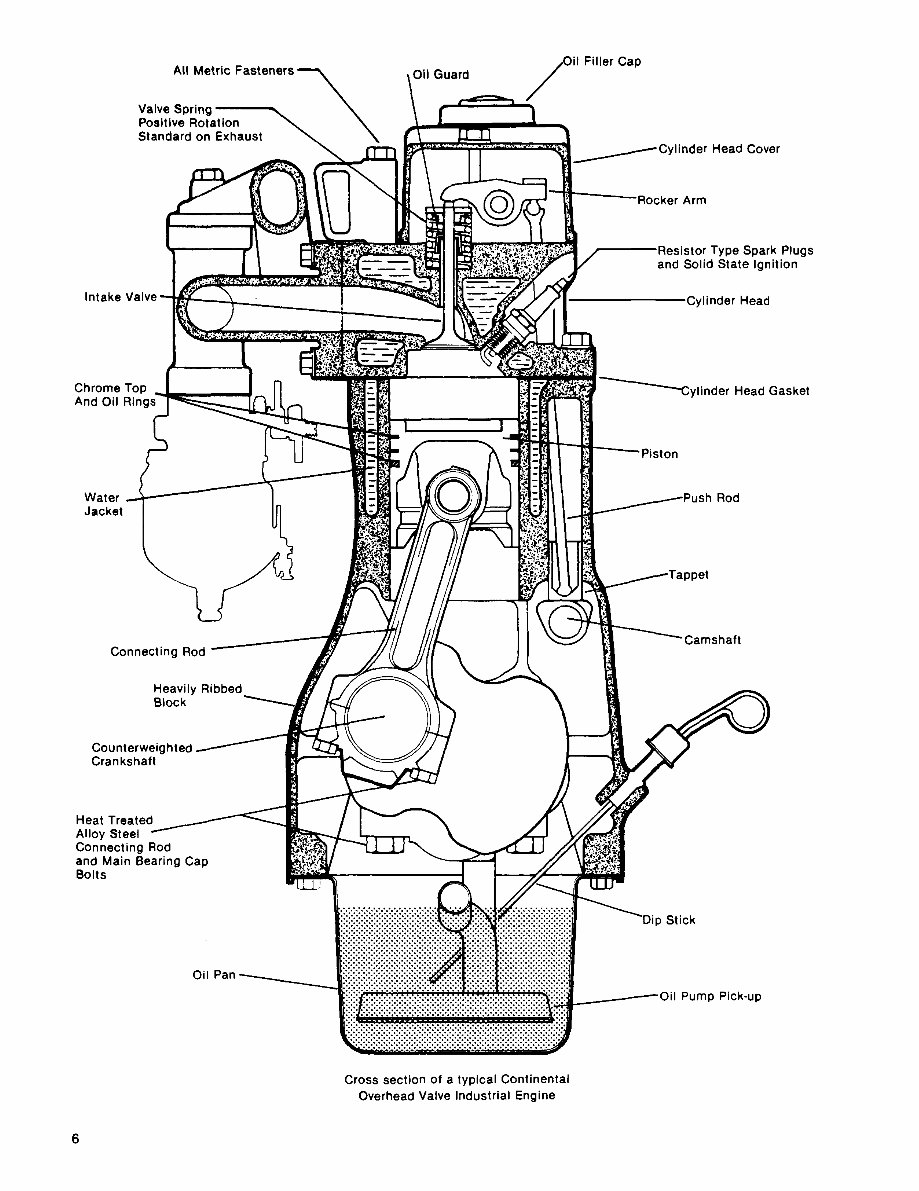
Intake Valve Chrome Top And Oil Rings· ..... ~---..... Water Jacket Connecting Rod Counterweighted Crankshaft Heat Treated Alloy Steel Connecting Rod and Main Bearing Cap Bolts Oil Pan 6 . ____ Cylinder Head Cover Rocker Arm Resistor Type Spark Plugs and Solid State Ignition rl---------------r.,vlinderHead Cross section of a typical Continental Overhead Valve Industrial Engine ~ylinder Head Gasket Piston ~-"""'>II Rod Camshaft P Stick Oil pump Pick-up
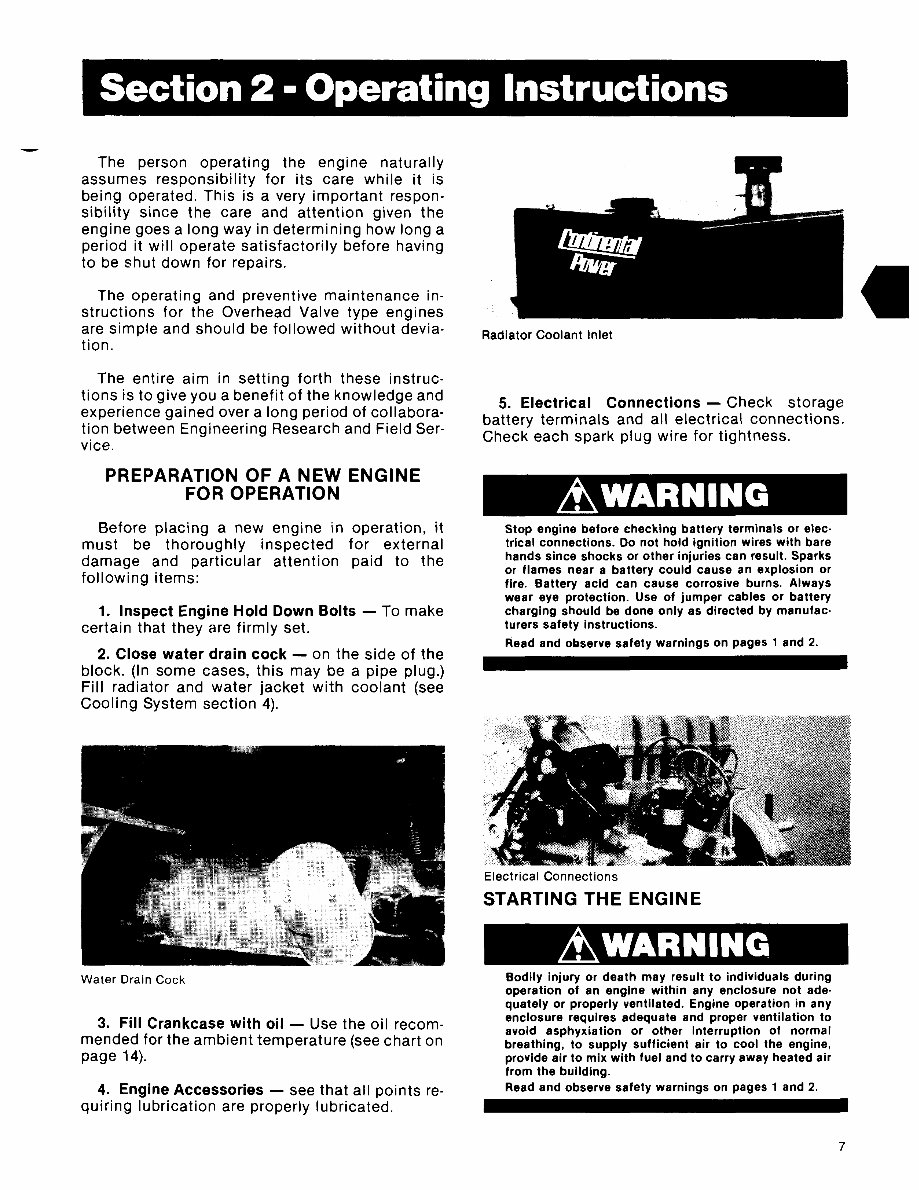
Section 2 • Operating Instructions The person operating the engine naturally assumes responsibility for its care while it is being operated. This is a very important respon- sibility since the care and attention given the engine goes a long way in determining how long a period it will operate satisfactorily before having to be shut down for repairs. The operating and preventive maintenance in- structions for the Overhead Valve type engines are simple and should be followed without devia- tion. The entire aim in setting forth these instruc- tions is to give you a benefit of the knowledge and experience gained over a long period of collabora- tion between Engineering Research and Field Ser- vice. PREPARATION OF A NEW ENGINE FOR OPERATION Before placing a new engine in operation, it must be thoroughly inspected for external damage and particular attention paid to the following items: 1. Inspect Engine Hold Down Bolts - To make certain that they are firmly set. 2. Close water drain cock - on the side of the block. (In some cases, this may be a pipe plug.) Fill radiator and water jacket with coolant (see Cooling System section 4). Water Drain Cock 3. Fill Crankcase with oil - Use the oil recom- mended for the ambient temperature (see chart on page 14). 4. Engine Accessories - see that all points re- quiring lubrication are properly lubricated. Radiator Coolant Inlet 5. Electrical Connections - Check storage battery terminals and all electrical connections. Check each spark plug wire for tightness. Lt.WARNING Stop engine before checking battery terminals or elec· trical connections. Do not hold ignition wires with bare hands since shocks or other injuries can result. Sparks or flames near a battery could cause an explosion or fire. Battery acid can cause corrosive burns. Always wear eye protection. Use of jumper cables or battery charging should be done only as directed by manufac· turers safety instructions. Read and observe safety warnings on pages 1 and 2. Electrical Connections STARTING THE ENGINE Lt.WARNING Bodily injury or death may result to individuals during operation of an engine within any enclosure not ade· quately or properly ventilated. Engine operation in any enclosure requires adequate and proper ventilation to avoid asphyxiation or other interruption of normal breathing, to supply sufficient air to cool the engine, provide air to mix with fuel and to carry away heated air from the building. Read and observe safety warnings on pages 1 and 2. 7
This workshop service repair manual provides in-depth and detailed guidance for working on Continental TM20 and TM27 Gasoline & LPG Engines TM Series. It is a valuable resource for both professional mechanics and DIY enthusiasts, offering step-by-step instructions and exploded pictures for efficient completion of various tasks.
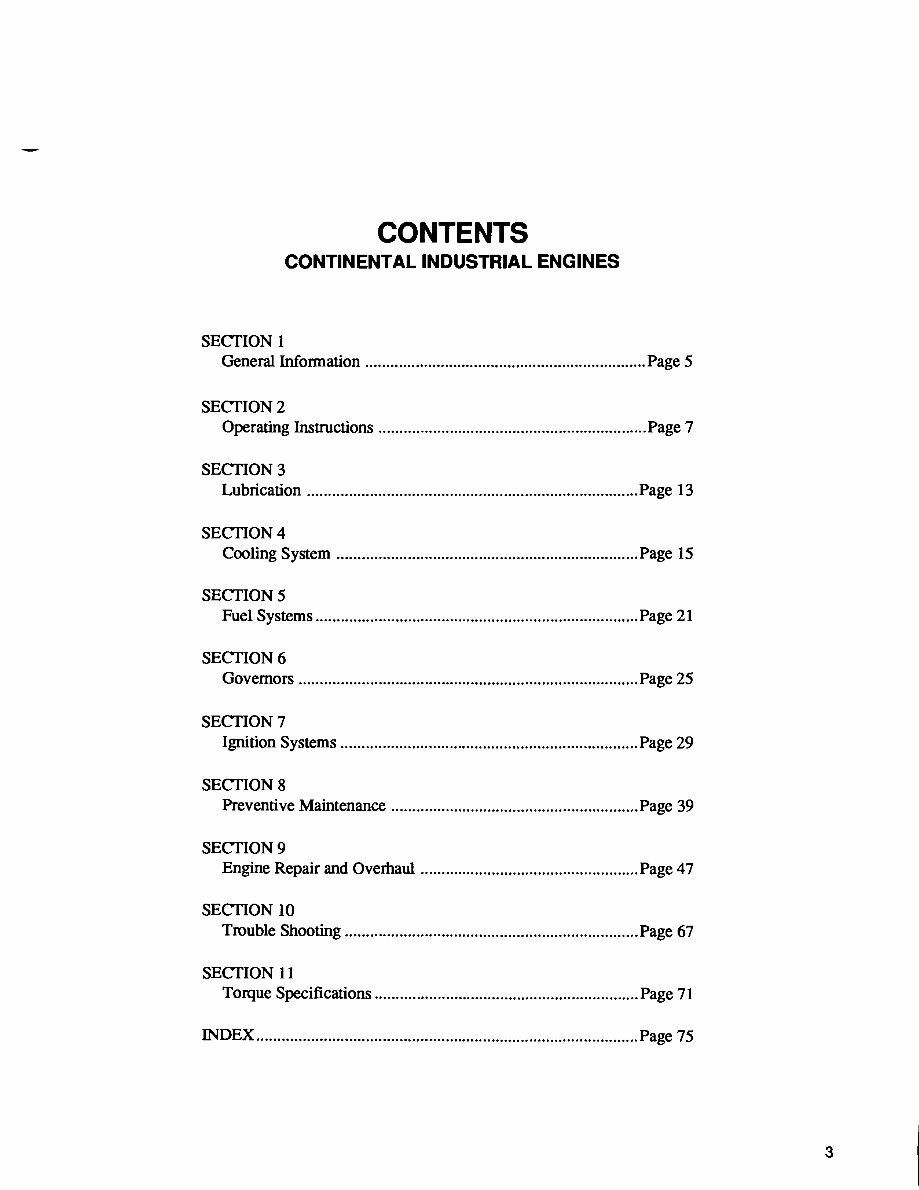
The manual covers a wide range of topics including general information, operation, lubrication, cooling system, fuel system, governors, ignition system, preventive maintenance, engine repair & overhaul, troubleshooting, and technical information & specifications.
Designed for easy access, this manual is available in .PDF format for viewing on Windows PC, Mac, tablet, or smartphone. It can be printed for convenience and reference. With instant delivery, there are no shipping costs or waiting time, making it a smart and fast solution for your repair needs.
If you are unable to find a specific manual, you can reach out to our customer support team for assistance. Thank you for visiting our page and have a nice day!
General Information
Operation
Lubrication
Cooling System
Fuel System
Governors
Ignition System
Preventive Maintenance
Engine Repair & Overhaul
Troubleshooting
Technical Information & Specifications
Recently Viewed
5,521,897Happy Clients
2,594,462eManuals
1,120,453Trusted Sellers
15Years in Business
Price:
Actual Price:
Continental TM20 TM27 Gasoline & LPG Engines TM Series Workshop Service Repair Manual # 1



 Lifetime Access