


Panasonic DMC-FZ200 Service Manual and Repair Guide
What's Included?
 Lifetime Access
Fast Download Speeds
Online & Offline Access
Access PDF Contents & Bookmarks
Full Search Facility
Print one or all pages of your manual
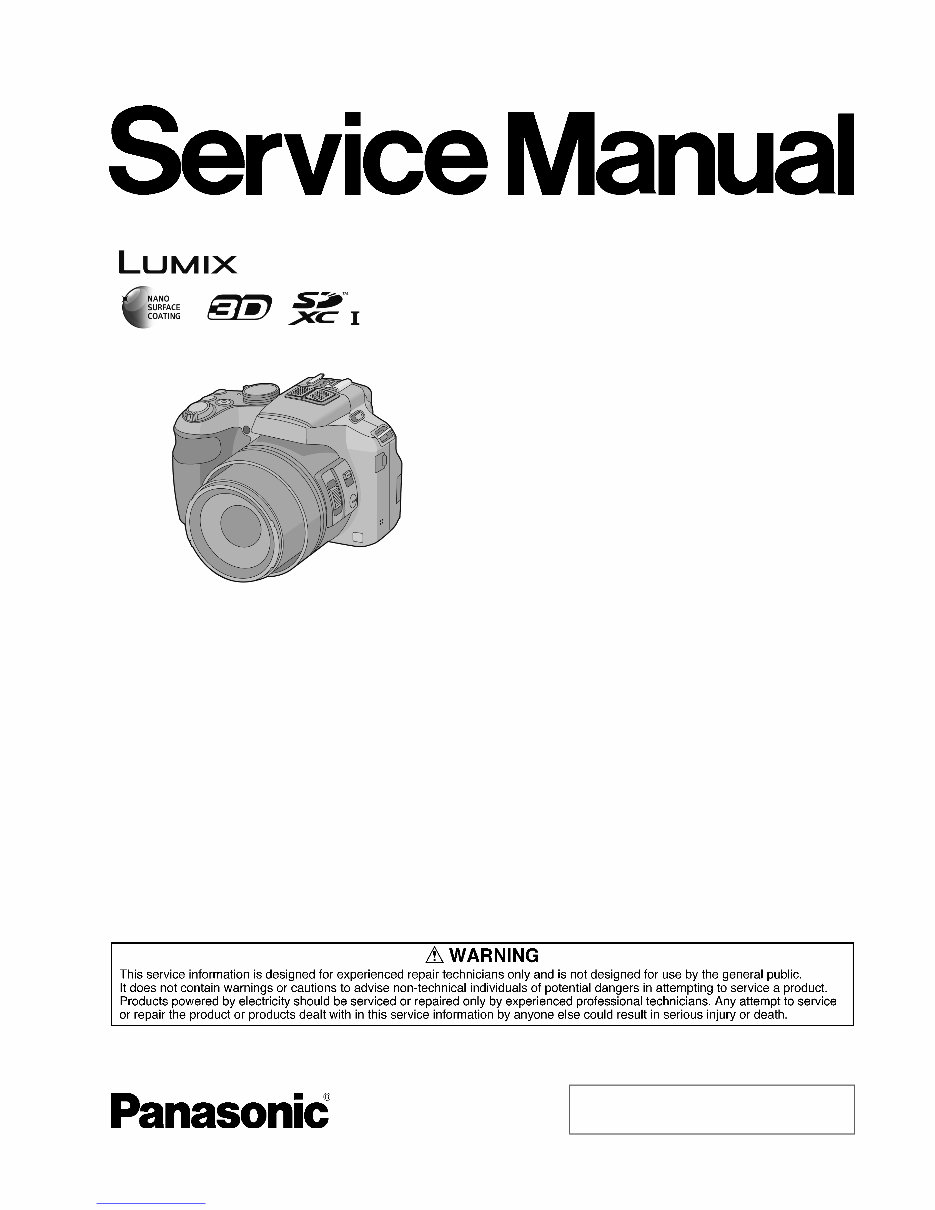
© Panasonic Corporation 2012 Unauthorized copy-
ing and distribution is a violation of law.
ORDER NO. DSC1208028CE
B26
Digital Camera
Model No. DMC-FZ200P
DMC-FZ200PC
DMC-FZ200PU
DMC-FZ200EB
DMC-FZ200EE
DMC-FZ200EF
DMC-FZ200EG
DMC-FZ200EP
DMC-FZ200GC
DMC-FZ200GK
DMC-FZ200GN
DMC-FZ200GT
DMC-FZ200SG
Colour
(K)...........Black Type
Downloaded from www.Manualslib.com manuals search engine

2
TABLE OF CONTENTS
PAGE PAGE
1 Safety Precautions ----------------------------------------------- 3
1.1. General Guidelines ----------------------------------------3
1.2. Leakage Current Cold Check ---------------------------3
1.3. Leakage Current Hot Check (See Figure. 1)--------3
1.4. How to Discharge the E.Capacitor on Flash
P.C.B.----------------------------------------------------------4
2 Warning -------------------------------------------------------------- 5
2.1. Prevention of Electrostatic Discharge (ESD)
to Electrostatically Sensitive (ES) Devices ----------5
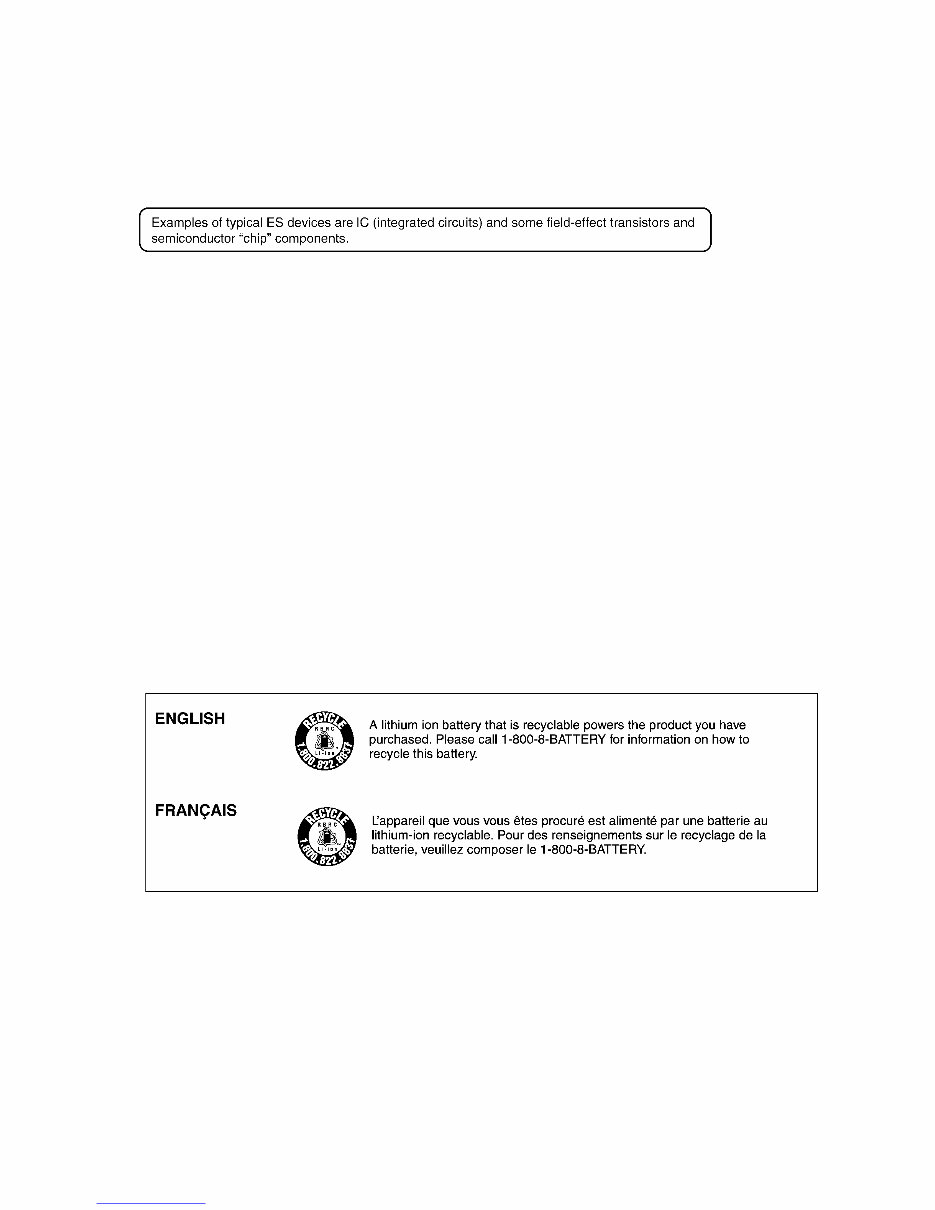
2.2. How to Recycle the Lithium Ion Battery (U.S.
Only)-----------------------------------------------------------5
2.3. Caution for AC Cord(For EB/GC) ----------------------6
2.4. How to Replace the Lithium Battery -------------------7
3 Service Navigation------------------------------------------------ 8
3.1. Introduction --------------------------------------------------8
3.2. Important Notice --------------------------------------------8
3.3. General Description About Lead Free Solder
(PbF) ----------------------------------------------------------9
3.4. How to Define the Model Suffix (NTSC or PAL
model)------------------------------------------------------- 10
4 Specifications ---------------------------------------------------- 14
5 Location of Controls and Components ------------------ 16
6 Service Mode ----------------------------------------------------- 17
6.1. Error Code Memory Function ------------------------- 17
7 Service Fixture & Tools --------------------------------------- 20
7.1. Service Fixture and Tools ------------------------------20
7.2. When Replacing the Main P.C.B. --------------------21
7.3. Service Position ------------------------------------------ 21
8 Disassembly and Assembly Instructions --------------- 22
8.1. Disassembly Flow Chart-------------------------------- 22
8.2. P.C.B. Location -------------------------------------------22
8.3. Disassembly Procedure -------------------------------- 23
8.4. Lens Disassembly Procedure------------------------- 35
8.5. Removal of the MOS Unit------------------------------ 42
9 Measurements and Adjustments -------------------------- 44
9.1. Introduction ------------------------------------------------ 44
9.2. Before Disassembling the unit ------------------------ 44
9.3. Details of Electrical Adjustment----------------------- 46
9.4. After Adjustment------------------------------------------ 50
10 Maintenance ------------------------------------------------------ 51
10.1. Cleaning Lens, Viewfinder and LCD Panel-------- 51
11 Block Diagram --------------------------------------------------- 52
11.1. Overall Block Diagram ---------------------------------- 52
11.2. System Control Block Diagram ----------------------- 53
11.3. Video/Audio Process Block Diagram---------------- 54
11.4. Lens/Flash Block Diagram----------------------------- 55
11.5. Power Block Diagram ----------------------------------- 56
12 Wiring Connection Diagram --------------------------------- 57
12.1. Interconnection Diagram ------------------------------- 57
Downloaded from www.Manualslib.com manuals search engine
3
1 Safety Precautions
1.1. General Guidelines
1. IMPORTANT SAFETY NOTICE
There are special components used in this equipment
which are important for safety. These parts are marked by
in the Schematic Diagrams, Circuit Board Layout,
Exploded Views and Replacement Parts List. It is essen-
tial that these critical parts should be replaced with manu-
facturer’s specified parts to prevent X-RADIATION,
shock, fire, or other hazards. Do not modify the original
design without permission of manufacturer.
2. An Isolation Transformer should always be used during
the servicing of AC Adaptor whose chassis is not isolated
from the AC power line. Use a transformer of adequate
power rating as this protects the technician from acci-
dents resulting in personal injury from electrical shocks. It
will also protect AC Adaptor from being damaged by acci-
dental shorting that may occur during servicing.
3. When servicing, observe the original lead dress. If a short
circuit is found, replace all parts which have been over-
heated or damaged by the short circuit.
4. After servicing, see to it that all the protective devices
such as insulation barriers, insulation papers shields are
properly installed.
5. After servicing, make the following leakage current
checks to prevent the customer from being exposed to
shock hazards.
1.2. Leakage Current Cold Check
1. Unplug the AC cord and connect a jumper between the
two prongs on the plug.
2. Measure the resistance value, with an ohmmeter,
between the jumpered AC plug and each exposed metal-
lic cabinet part on the equipment such as screwheads,
connectors, control shafts, etc. When the exposed metal-
lic part has a return path to the chassis, the reading
should be between 1 MΩ and 5.2 MΩ. When the exposed
metal does not have a return path to the chassis, the
reading must be infinity.
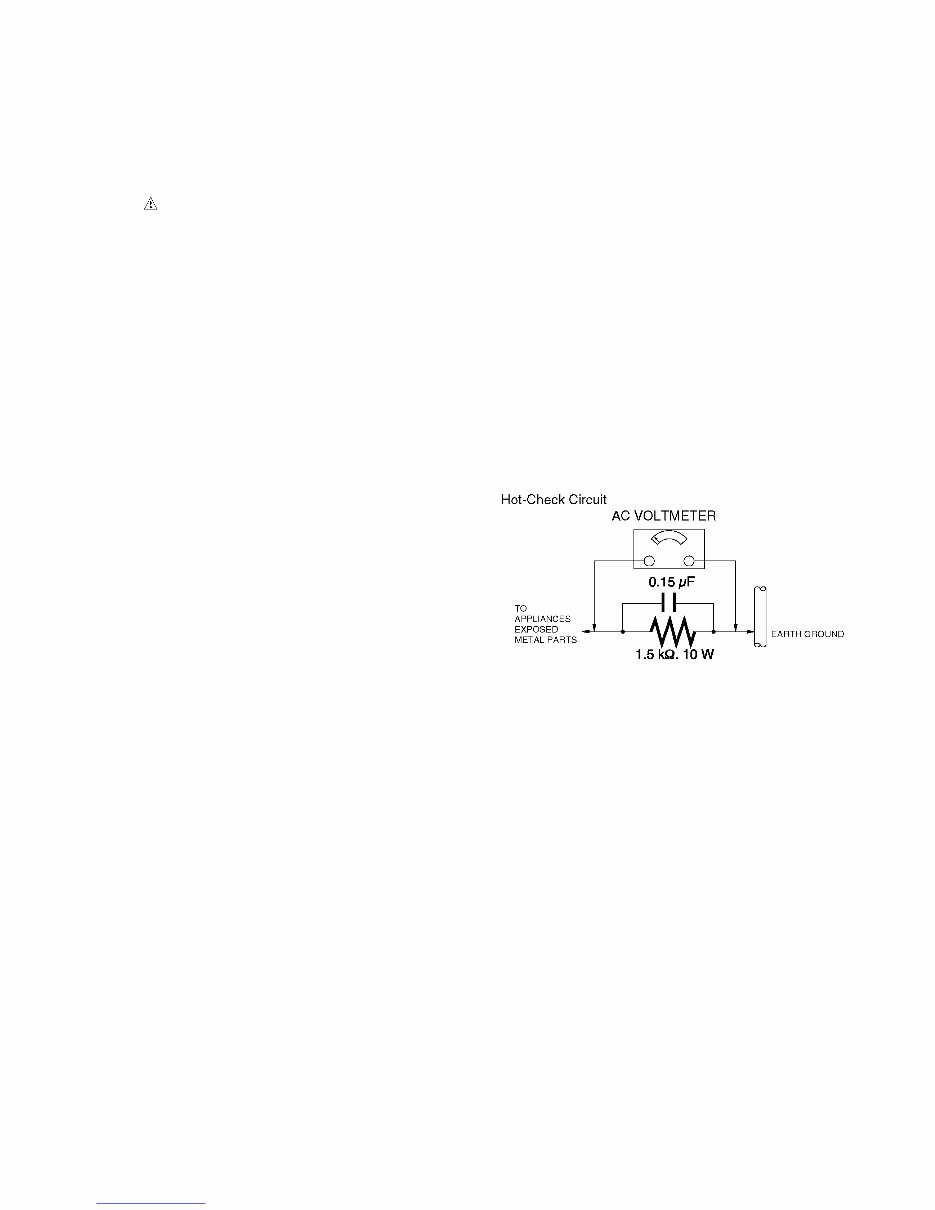
1.3. Leakage Current Hot Check
(See Figure. 1)
1. Plug the AC cord directly into the AC outlet. Do not use
an isolation transformer for this check.
2. Connect a 1.5 kΩ, 10 W resistor, in parallel with a 0.15 μF
capacitor, between each exposed metallic part on the set
and a good earth ground, as shown in Figure. 1.
3. Use an AC voltmeter, with 1 kΩ/V or more sensitivity, to
measure the potential across the resistor.
4. Check each exposed metallic part, and measure the volt-
age at each point.
5. Reverse the AC plug in the AC outlet and repeat each of
the above measurements.
6. The potential at any point should not exceed 0.75 V RMS.
A leakage current tester (Simpson Model 229 or equiva-
lent) may be used to make the hot checks, leakage cur-
rent must not exceed 1/2 mA. In case a measurement is
outside of the limits specified, there is a possibility of a
shock hazard, and the equipment should be repaired and
rechecked before it is returned to the customer.
Figure. 1
Downloaded from www.Manualslib.com manuals search engine
4
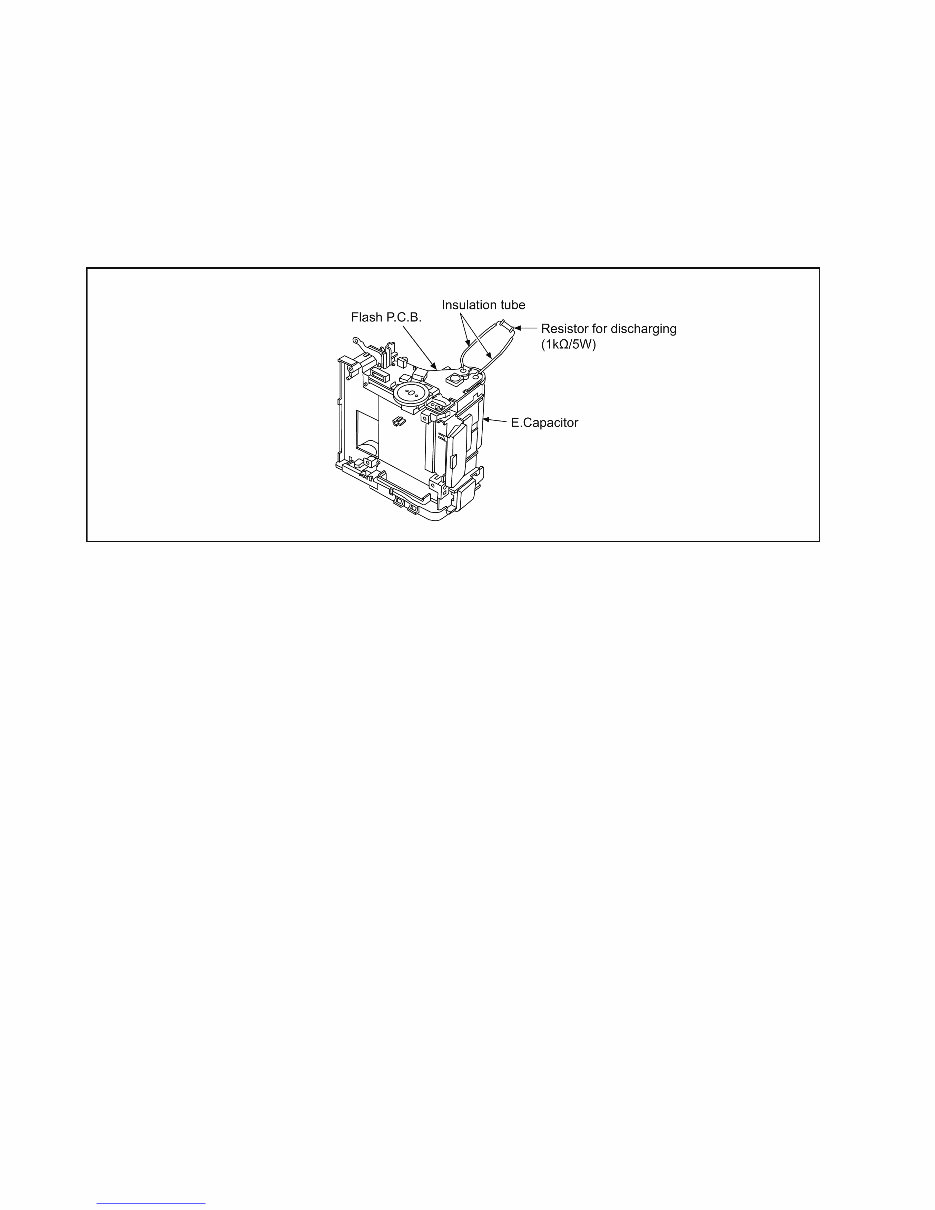
1.4. How to Discharge the E.Capacitor on Flash P.C.B.
CAUTION:
1. Be sure to discharge the E.Capacitor on FLASH P.C.B..
2. Be careful of the high voltage circuit on FLASH P.C.B. when servicing.
[Discharging Procedure]
1. Refer to the disassemble procedure and remove the necessary parts/unit.
2. Install the insulation tube onto the lead part of resistor (ERG5SJ102:1kΩ /5W).
(An equivalent type of resistor may be used.)
3. Place a resistor between both terminals of E.Capacitor on the FLASH P.C.B. for approx. 5 seconds.
4. After discharging, confirm that the E.Capacitor voltage is lower than 10V by using a voltmeter.
Fig. F1
Downloaded from www.Manualslib.com manuals search engine
5
2 Warning
2.1. Prevention of Electrostatic Discharge (ESD) to Electrostatically
Sensitive (ES) Devices
Some semiconductor (solid state) devices can be damaged easily by static electricity. Such components commonly are called Elec-
trostatically Sensitive (ES) Devices.
The following techniques should be used to help reduce the incidence of component damage caused by electrostatic discharge
(ESD).
1. Immediately before handling any semiconductor component or semiconductor-equipped assembly, drain off any ESD on your
body by touching a known earth ground. Alternatively, obtain and wear a commercially available discharging ESD wrist strap,
which should be removed for potential shock reasons prior to applying power to the unit under test.
2. After removing an electrical assembly equipped with ES devices, place the assembly on a conductive surface such as alumi-
num foil, to prevent electrostatic charge buildup or exposure of the assembly.
3. Use only a grounded-tip soldering iron to solder or unsolder ES devices.
4. Use only an antistatic solder removal device. Some solder removal devices not classified as "antistatic (ESD protected)" can
generate electrical charge sufficient to damage ES devices.
5. Do not use freon-propelled chemicals. These can generate electrical charges sufficient to damage ES devices.
6. Do not remove a replacement ES device from its protective package until immediately before you are ready to install it. (Most
replacement ES devices are packaged with leads electrically shorted together by conductive foam, aluminum foil or compara-
ble conductive material).
7. Immediately before removing the protective material from the leads of a replacement ES device, touch the protective material
to the chassis or circuit assembly into which the device will be installed.
CAUTION :
Be sure no power is applied to the chassis or circuit, and observe all other safety precautions.
8. Minimize bodily motions when handling unpackaged replacement ES devices. (Otherwise harmless motion such as the
brushing together of your clothes fabric or the lifting of your foot from a carpeted floor can generate static electricity (ESD) suf-
ficient to damage an ES device).
2.2. How to Recycle the Lithium Ion Battery (U.S. Only)
Downloaded from www.Manualslib.com manuals search engine
6
2.3. Caution for AC Cord
(For EB/GC)
2.3.1. Information for Your Safety
IMPORTANT
Your attention is drawn to the fact that recording of pre-
recorded tapes or discs or other published or broadcast
material may infringe copyright laws.
WARNING
To reduce the risk of fire or shock hazard, do not expose
this equipment to rain or moisture.
CAUTION
To reduce the risk of fire or shock hazard and annoying
interference, use the recommended accessories only.
FOR YOUR SAFETY
DO NOT REMOVE THE OUTER COVER
To prevent electric shock, do not remove the cover. No user
serviceable parts inside. Refer servicing to qualified service
personnel.
2.3.2. Caution for AC Mains Lead
For your safety, please read the following text carefully.
This appliance is supplied with a moulded three-pin mains plug
for your safety and convenience.
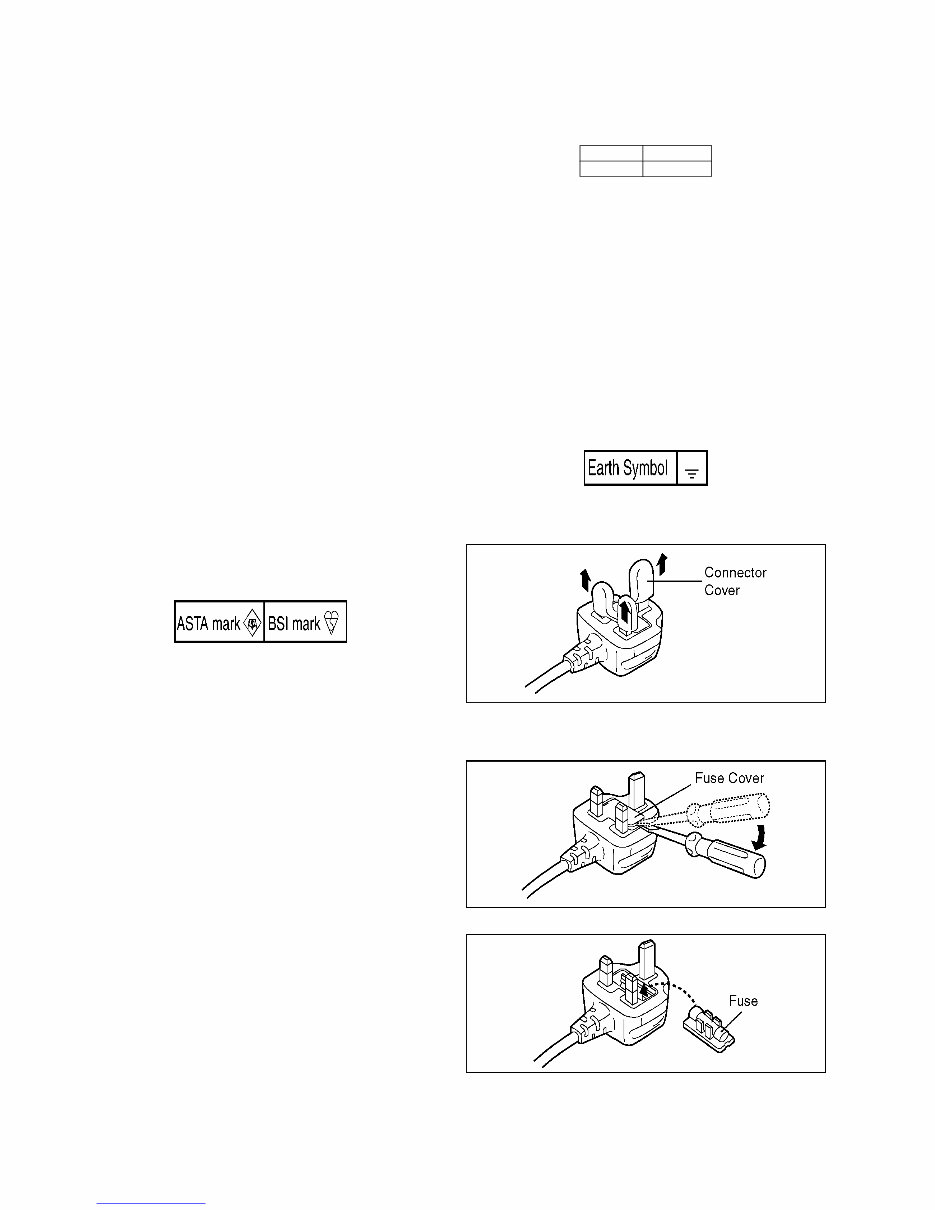
A 5-ampere fuse is fitted in this plug.
Should the fuse need to be replaced please ensure that the
replacement fuse has a rating of 5 amperes and it is approved
by ASTA or BSI to BS1362.
Check for the ASTA mark or the BSI mark on the body of the
fuse.
If the plug contains a removable fuse cover you must ensure
that it is refitted when the fuse is replaced.
If you lose the fuse cover, the plug must not be used until a
replacement cover is obtained.
A replacement fuse cover can be purchased from your local
Panasonic Dealer.
If the fitted moulded plug is unsuitable for the socket outlet in
your home then the fuse should be removed and the plug cut
off and disposed of safety.
There is a danger of severe electrical shock if the cut off plug is
inserted into any 13-ampere socket.
If a new plug is to be fitted please observe the wiring code as
shown below.
If in any doubt, please consult a qualified electrician.
2.3.2.1. Important
The wires in this mains lead are coloured in accordance with
the following code:
As the colours of the wires in the mains lead of this appliance
may not correspond with the coloured markings identifying the
terminals in your plug, proceed as follows:
The wire which is coloured BLUE must be connected to the ter-
minal in the plug which is marked with the letter N or coloured
BLACK.
The wire which is coloured BROWN must be connected to the
terminal in the plug which is marked with the letter L or coloured
RED.
Under no circumstances should either of these wires be con-
nected to the earth terminal of the three pin plug, marked with
the letter E or the Earth Symbol.
2.3.2.2. Before Use
Remove the Connector Cover as follows.
2.3.2.3. How to Replace the Fuse
1. Remove the Fuse Cover with a screwdriver.
2. Replace the fuse and attach the Fuse cover.
Blue Neutral
Brown Live
Downloaded from www.Manualslib.com manuals search engine
7
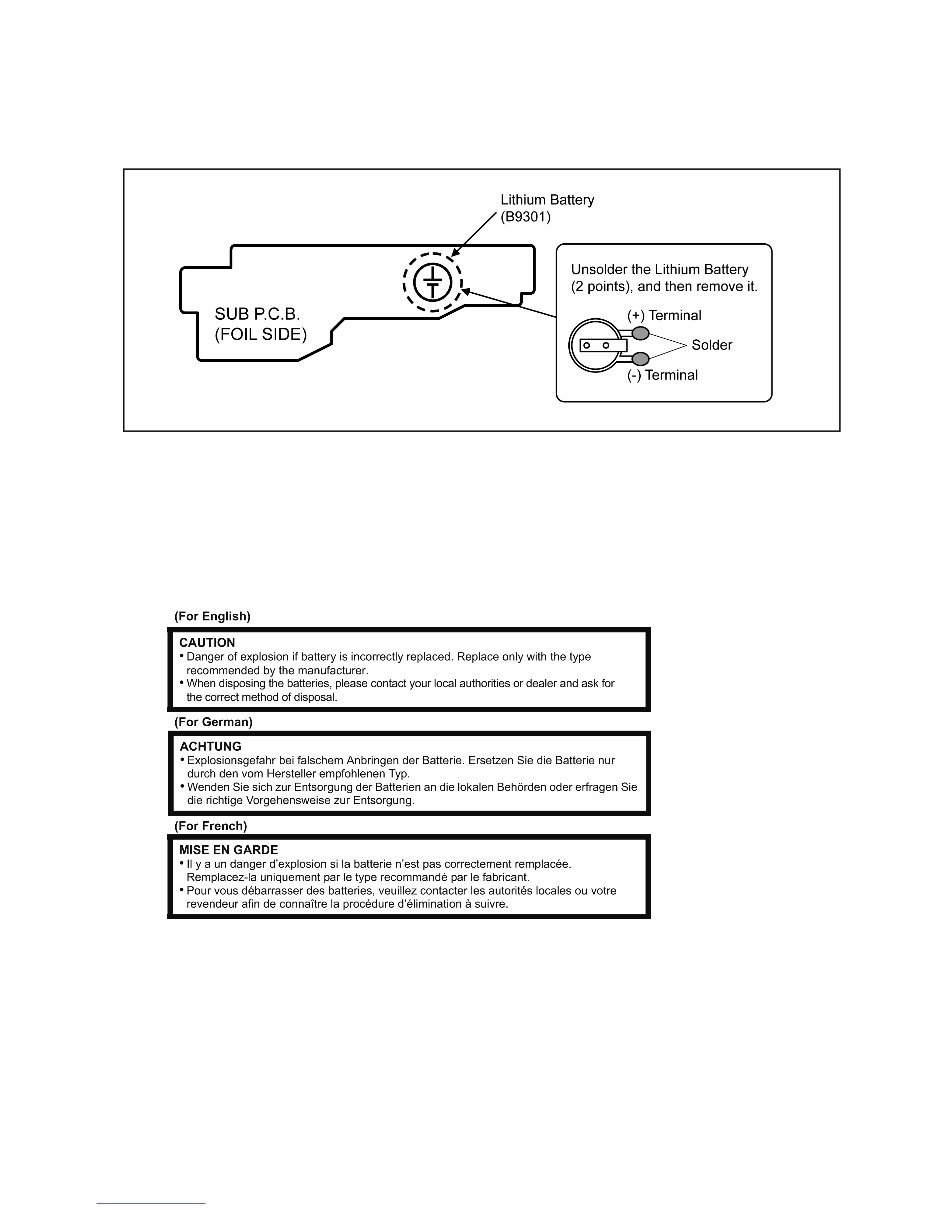
2.4. How to Replace the Lithium Battery
2.4.1. Replacement Procedure
1. Remove the SUB P.C.B.. (Refer to Disassembly Procedures.)
2. Remove the Lithium battery (Ref. No. “B9301” at foil side of SUB P.C.B.) and then replace it into new one.
NOTE:
This Lithium battery is a critical component.
(Type No.: ML614 Manufactured by Energy Company, Panasonic Corporation.)
It must never be subjected to excessive heat or discharge.
It must therefore only be fitted in requirement designed specifically for its use.
Replacement batteries must be of same type and manufacture.
They must be fitted in the same manner and location as the original battery, with the correct polarity contacts observed.
Do not attempt to re-charge the old battery or re-use it for any other purpose.
It should be disposed of in waste products destined for burial rather than incineration.
NOTE:
Above caution is applicable for a battery pack which is for DMC-FZ200 series, as well.
Downloaded from www.Manualslib.com manuals search engine
8
3 Service Navigation
3.1. Introduction
This service manual contains technical information, which allow service personnel’s to understand and service this model.
Please place orders using the parts list and not the drawing reference numbers.
If the circuit is changed or modified, the information will be followed by service manual to be controlled with original service manual.
3.2. Important Notice
3.2.1. About lens block
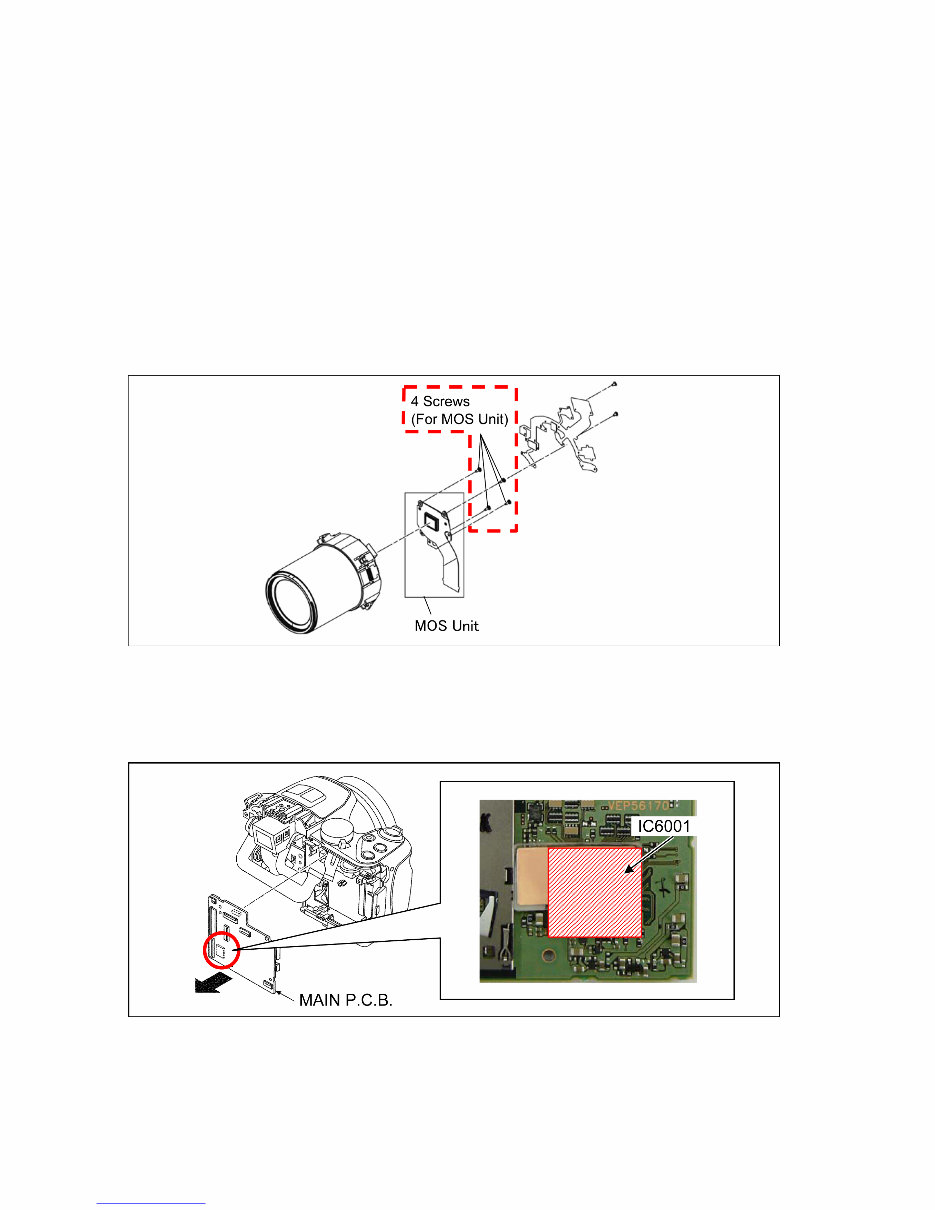
• The image sensor (MOS) unit which are connected to the lens unit with 4 screws. These screws are locked with the screw lock-
ing glue, after performing the Optical tilt adjustment.
During servicing, if one of MOS unit fixing screws are loosened, the Optical tilt adjustment must be performed.
(About the Optical tilt adjustment, refer to the “9.3.2. Adjustment Specifications” for details.)
NOTE:
• It is necessary to use the “DSC_Tilt” software to allow the “Optical tilt adjustment”.
• The Adjustment software “DSC_Tilt” is available at “TSN Website”.
3.2.2. About VENUS ENGINE(IC6001) [Located on the Main P.C.B.]:
• The VENUS ENGINE (IC6001) consists of two IC chips, which are fixed together with solder.
(The so called, “Package On Package” type IC.)
NOTE:
• During servicing, do not press down hard on the surface of IC6001.
3.2.3. About Flexible Cable and Connector
Do not touch carelessly so that the foreign body should not adhere to the terminal part of flexible cable and connector.
Wipe off with a clean cloth and the cotton bud, etc. when the terminal part is dirty.
Downloaded from www.Manualslib.com manuals search engine
9
3.3. General Description About Lead Free Solder (PbF)
The lead free solder has been used in the mounting process of all electrical components on the printed circuit boards used for this
equipment in considering the globally environmental conservation.
The normal solder is the alloy of tin (Sn) and lead (Pb). On the other hand, the lead free solder is the alloy mainly consists of tin
(Sn), silver (Ag) and Copper (Cu), and the melting point of the lead free solder is higher approx.30°C (86°F) more than that of the
normal solder.
Distinction of P.C.B. Lead Free Solder being used
Service caution for repair work using Lead Free Solder (PbF)
• The lead free solder has to be used when repairing the equipment for which the lead free solder is used.
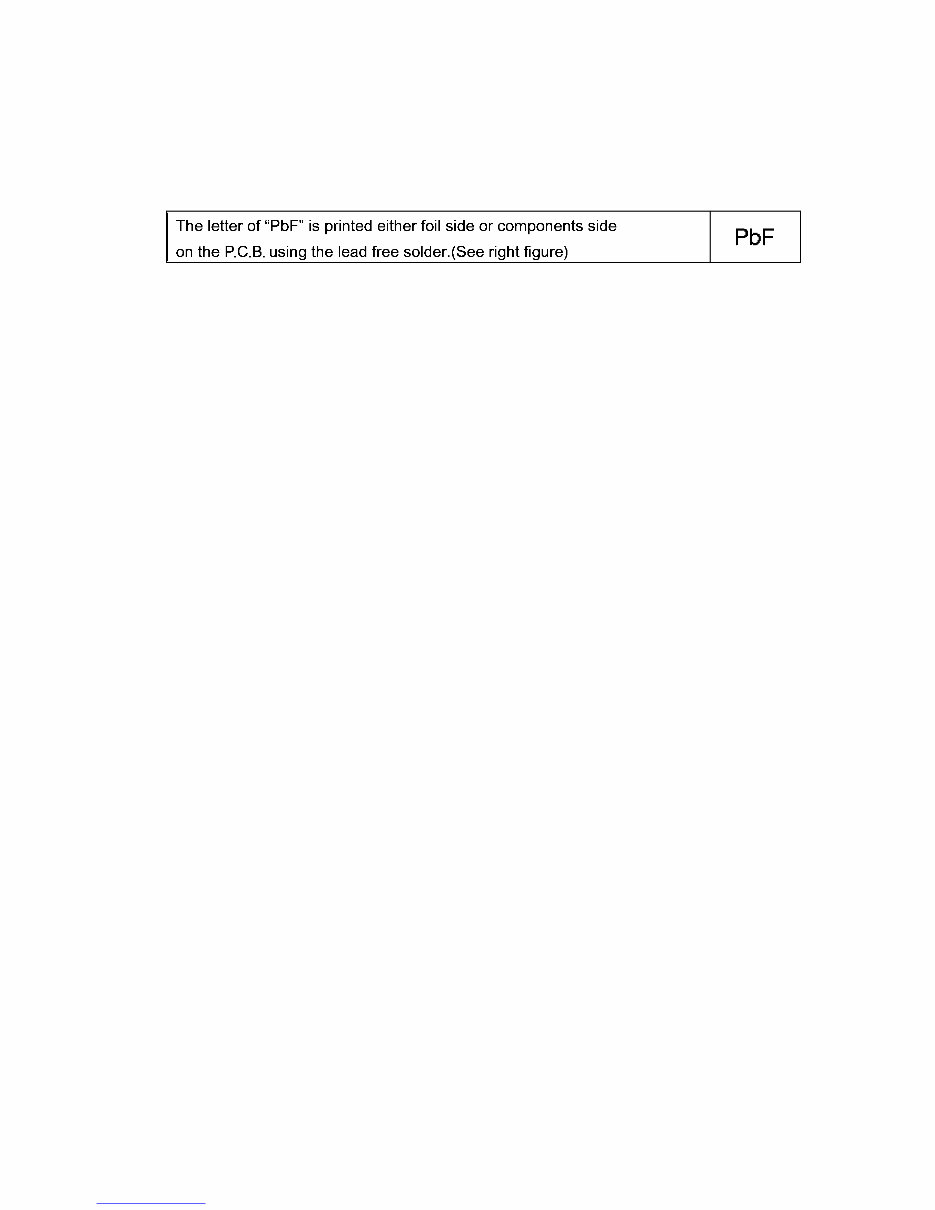
(Definition: The letter of “PbF” is printed on the P.C.B. using the lead free solder.)
• To put lead free solder, it should be well molten and mixed with the original lead free solder.
• Remove the remaining lead free solder on the P.C.B. cleanly for soldering of the new IC.
• Since the melting point of the lead free solder is higher than that of the normal lead solder, it takes the longer time to melt the
lead free solder.
• Use the soldering iron (more than 70W) equipped with the temperature control after setting the temperature at 350±30°C
(662±86°F).
Recommended Lead Free Solder (Service Parts Route.)
• The following 3 types of lead free solder are available through the service parts route.
RFKZ03D01KS-----------(0.3mm 100g Reel)
RFKZ06D01KS-----------(0.6mm 100g Reel)
RFKZ10D01KS-----------(1.0mm 100g Reel)
Note
* Ingredient: tin (Sn) 96.5%, silver (Ag) 3.0%, Copper (Cu) 0.5%, Cobalt (Co) / Germanium (Ge) 0.1 to 0.3%
Downloaded from www.Manualslib.com manuals search engine
10
3.4. How to Define the Model Suffix (NTSC or PAL model)
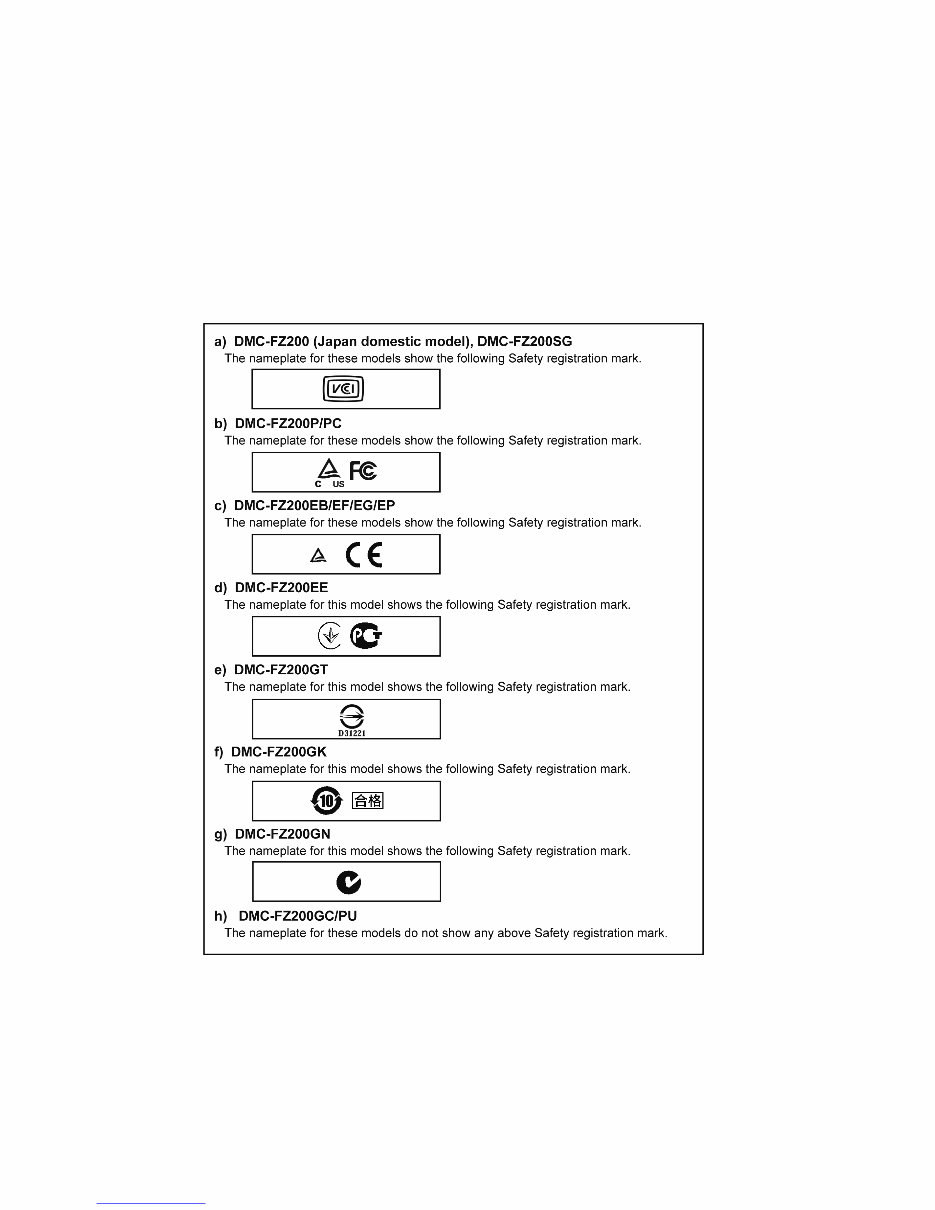
There are eight kinds of DMC-FZ200.
• a) DMC-FZ200 (Japan domestic model), DMC-FZ200SG
• b) DMC-FZ200P/PC
• c) DMC-FZ200EB/EF/EG/EP
• d) DMC-FZ200EE
• e) DMC-FZ200GT
• f) DMC-FZ200GK
• g) DMC-FZ200GN
• h) DMC-FZ200GC/PU
What is the difference is that the “INITIAL SETTINGS” data which is stored in Flash-ROM mounted on MAIN P.C.B..
3.4.1. Defining methods:
To define the model suffix to be serviced, refer to the nameplate which is putted on the bottom side of the Unit.
NOTE:
After replacing the MAIN P.C.B., be sure to achieve adjustment.
The service software is available at “TSN Website”.
Downloaded from www.Manualslib.com manuals search engine
You're Reading a Preview
What's Included?
Lifetime Access
Fast Download Speeds
Online & Offline Access
Access PDF Contents & Bookmarks
Full Search Facility
Print one or all pages of your manual
$35.99
Viewed 72 Times Today


Secure transaction
What's Included?
Lifetime Access
Fast Download Speeds
Online & Offline Access
Access PDF Contents & Bookmarks
Full Search Facility
Print one or all pages of your manual
$35.99
The Panasonic Lumix FZ200 Series Service Manual is a comprehensive resource for car repair enthusiasts and professional mechanics alike. This manual, available in English, consists of 91 pages and is accessible in .PDF format. It provides detailed specifications and technical information essential for servicing and maintaining the Panasonic Lumix FZ200 Series. With instant access upon payment, there are no shipping fees or delays associated with postal delivery, ensuring quick and convenient access to this valuable resource.


