1-1 1. Product Safety Chapter Overview This chapter contains product safety information for the Rubber Track Loader. Read this chapter and understand all safety messages and information messages before attempting to service the machine. Safety Messages Safety messages are provided in this document and on the machine. If these hazard warnings are not heeded, bodily injury or death could occur to you or other persons. Hazards are identified by the Safety Alert Symbols !DANGER! … . !WARNING!….!CAUTION!. The meaning of these safety alerts is as follows: Attention! Become Alert! Your Safety is Involved. The message that appears under a Safety Alert Symbol explains the hazard and can be either writ- ten or pictorially presented. ! DANGER ! This symbol is used to alert service personnel of an imminently hazardous situation that will result in seri- ous injury or death. ! WARNING ! This symbol is used to alert service personnel of a potentially hazardous situation that could result in serious injury or death. ! CAUTION ! This symbol is used to alert service personnel of an unsafe practice that could result in injury. Information Messages Information messages are provided in this document and on the machine. These messages are identified by the labels NOTICE….Note. NOTICE This label is used to alert service personnel to the possibil- ity of damaging the equipment. . Note: This label is used to provide important additional information, comments, explanations or amplification of the accompanying subject matter. The person servicing the Rubber Track Loader may be unfamiliar with many of the systems on the ma- chine. This makes it important to use caution when performing service work. Knowledge of the system and/or components is important before the removal or disassembly of any component. It is not possible to anticipate every circum- stance that might involve a potential hazard. The safety messages in this document and on the product are, therefore, not all inclusive. If you use a tool, procedure, work method or operating technique that is not specifically recommended by the manufacturer, you must satisfy yourself that it is safe for you and for others. You should also ensure that the product will not be damaged or be made unsafe by the operation, lubrication, maintenance or repair procedures that you choose. Basic Precautions ! WARNING ! Improper operation, lubrication, maintenance or repair of this product can be dangerous and could result in injury or death. Do not operate or perform any lubrication, mainte- nance or repair on this product until you have read and understood the operation, lubrication, mainte- nance and repair information. Following is a list of basic precautions that should always be observed. Safety Signs Read and understand all "Safety" signs on the prod- uct before operating, lubricating or repairing this product. Replace any damaged, illegible or missing safety plates, signs or decals.
Rubber Track Loader 1. Product Safety 1-2 Protective Equipment Always wear a hard hat, protective glasses, protec- tive shoes and other protective equipment as re- quired by job conditions when working around this product. In particular, wear protective glasses when pounding on any part of the product or its attach- ment with a hammer or sledge. Use welders gloves, hood/goggles, apron and other protective clothing appropriate to the welding job being performed. Do not wear loose clothing or jewelry that can catch on parts of the product. Mounting and Dismounting Use steps and handholds when mounting or dis- mounting a machine. Clean any mud or debris from steps or work platforms before using them. Always face the machine when using steps and handholds. When it is not possible to use the designed access system, provide ladders, scaffolds, or work platforms to perform safe repair operations. Lifting Use a hoist when lifting components that weigh 23 kg (50 Ib) or more, to avoid back injury. Make sure all chains, hooks, slings, etc., are in good condition and are of the correct capacity. Be sure hooks are positioned correctly and equipped with a spring latch. Lifting eyes are not to be side loaded during a lifting operation. Hot Fluids and Parts To avoid burns, be alert for hot parts on machines that have just been stopped and hot fluids in lines, tubes and compartments. Be careful when removing fill caps, breathers and plugs on the machine. Hold a rag over the cap or plug to prevent being sprayed or splashed by liquids under pressure. The danger is even greater if the machine has just been stopped because fluids can be hot. Corrosion Inhibitor Corrosion inhibitor contains alkali. Avoid contact with eyes. Avoid prolonged or repeated contact with skin. Do not take internally. In case of contact, wash skin immediately with soap and water. For eyes, flush with large amounts of water for at least 15 minutes. Call Physician. Keep out of reach of children. Batteries Do not smoke when inspecting the battery electro- lyte level. Never disconnect any charging unit circuit or battery circuit cable from the battery when the charging unit is operating. A spark can cause an explosion from the flammable vapor mixture of hy- drogen and oxygen that is released from the electro- lyte through the battery outlets. Do not let electrolyte solution make contact with skin or eyes. Electrolyte solution is an acid. In case of contact, immediately wash skin with soap and water. For eyes, flush with large amounts of water for at least 15 minutes. Call Physician. Keep out of reach of children. Pressurized Items 1. Always use a board or a piece of cardboard when you check for a leak. Leaking fluid under pressure can penetrate body tissue. Fluid pene- tration can cause serious injury and possible death. A pin hole leak can cause severe injury. If fluid is injected into your skin, get treatment im- mediately. Seek treatment from a doctor that is familiar with this type of injury. 2. Relieve all pressure in air, oil or water systems before disconnecting or removing any lines, fit- tings or related items. Always make sure all raised components are blocked correctly and be alert for possible pressure when disconnecting any device from a system that utilizes pressure. 3. Lower the bucket, blade, or other attachment to the ground before performing any work on the machine. If this cannot be done, make sure the bucket, blade, or other attachment is blocked correctly to prevent it from dropping unexpect- edly. 4. Loose or damaged fuel, lubricant and hydraulic lines, tubes and hoses can cause fires. Do not bend or strike high-pressure lines or install ones that have been bent or damaged. Check lines, tubes and hoses carefully. Do not use your bare hand to check for leaks. 5. Pressurized air or water can cause personal in- jury. When pressurized air or water is used for cleaning, wear a protective face shield, protec- tive clothing, and protective shoes. The maxi- mum air pressure for cleaning purposes must be below 205 kPa (30 psi). When using a pressure washer, keep in mind that nozzle pressures are very high, generally pressures are well above 13790 kPa (2000 psi). Follow all recommended practices provided by the pressure washer manufacturer.
Rubber Track Loader 1. Product Safety 1-3 Repair ! WARNING ! Accidental machine starting can cause injury or death to personnel working on the machine. To avoid accidental machine starting, disconnect the battery cables from the battery and tape the battery clamps and remove the key. Place a “Do Not Operate” tag prominently on the ma- chine to inform personnel that the machine is being worked on. 1. Disconnect battery and discharge any capacitor before starting to work on the product. Attach a Do Not Operate tag in the Operator's Compart- ment. 2. If possible, make all repairs with the machine parked on a level, hard surface. Block the ma- chine to prevent it from rolling while working on or under the machine. 3. Do not work on any machine that is supported only by lift jacks or a hoist. Always use blocks or jack stands to support the machine before per- forming any service or disassembly. 4. Make sure the work area around the product is made safe and be aware of hazardous condi- tions that may exist. If an engine is started inside an enclosure, make sure that the engine’s ex- haust is properly vented. 5. Be sure all protective devices including guards and shields are properly installed and function- ing correctly before starting a repair. If a guard or shield must be removed to perform the repair work, use extra caution. 6. Always use tools that are in good condition and be sure you understand how to use them before performing any service work. 7. Replace all fasteners with the same part num- ber. Do not use a lesser quality fastener if re- placements are necessary. 8. Be prepared to stop an engine if it has been re- cently overhauled or the fuel system has been recently worked on. If the engine has not been assembled correctly, or if the fuel settings are not correct, the engine can possibly overspeed and cause bodily injury, death or property dam- age. Be prepared to shut off the fuel and air supply to the engine in order to stop the engine. 9. Be careful when removing cover plates. Gradu- ally back off the last two bolts or nuts located at opposite ends of the cover or device. Then, pry the cover loose to relieve any spring or other pressure before removing the last two nuts or bolts completely. 10. Repairs requiring welding should be performed only with the benefit of the appropriate reference information and by personnel adequately trained and knowledgeable in welding procedures. De- termine the type of metal being welded and se- lect the correct welding procedures and electrodes, rods or wire to provide a weld metal equivalent at least to that of the parent weld. 11. Do not damage wiring during removal opera- tions. Reinstall the wiring so it is not damaged during installation or operation by contacting sharp corners or by rubbing against some object or hot surface. 12. Always use lift arm supports to keep lift arms raised. Keep the attachment tilted down and as- sure that all hydraulic pressure has been re- lieved for maintenance or repair work that requires the lift arms to be in the raised position. 13. Tighten connections to the correct torque. Make sure that all heat shields, clamps and guards are installed correctly to avoid excessive heat, vibra- tion or rubbing against other parts during opera- tion. Shields that protect against oil spray onto hot exhaust components in event of a line, tube or seal failure must be installed correctly. 14. Do not operate a machine if any rotating part is damaged or contacts another part during opera- tion. Any high-speed rotating component that has been damaged or altered should be checked for balance before reusing. Make sure all protective devices, including guards and shields, are properly installed and functioning correctly before starting the engine or operating the machine. Attachments Only use attachments that are recommended by the manufacturer of the machine. Make sure that all necessary guarding is in place on the host machine and on the attachment. Wear protective glasses and protective equipment as required by conditions or as recommended in the attachment’s operation manual.
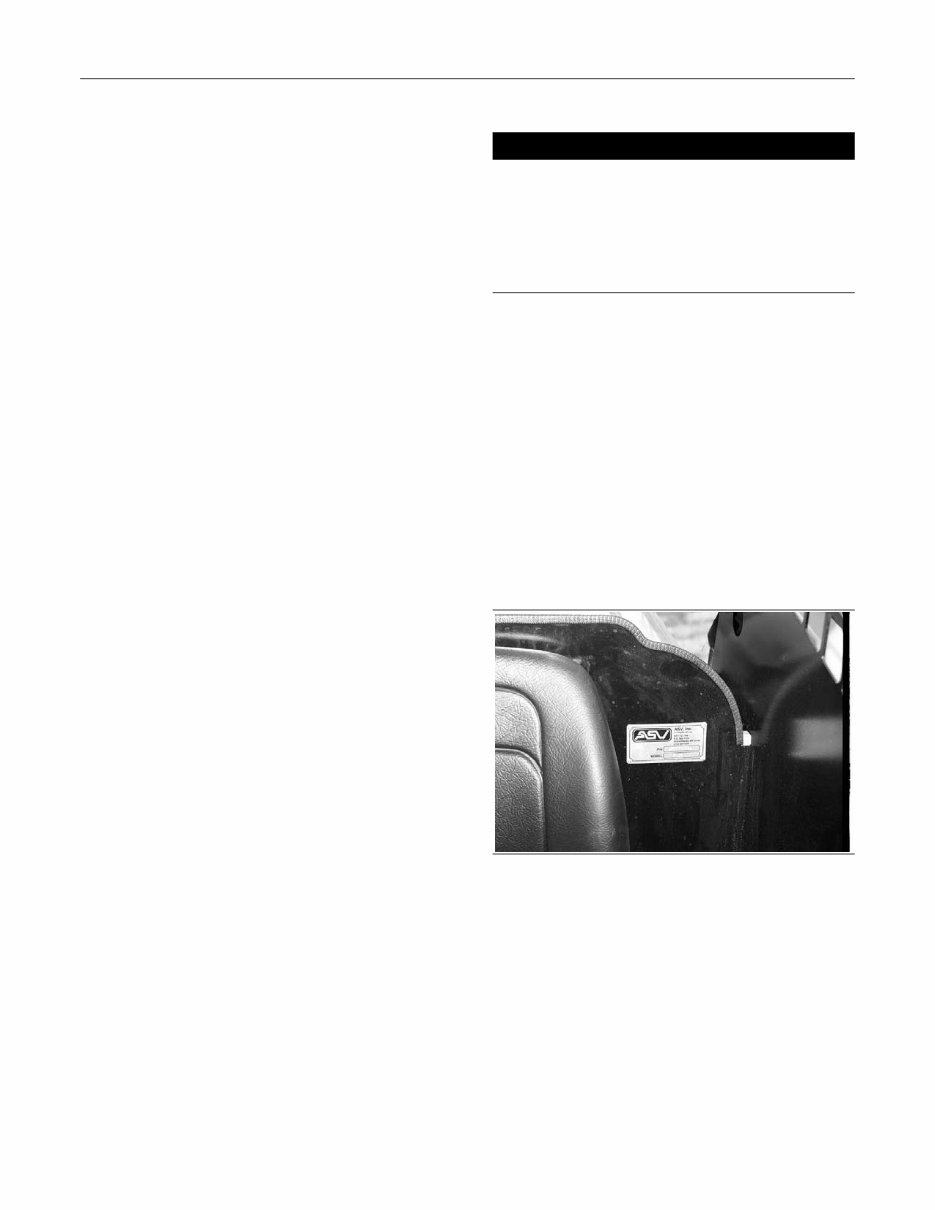
Rubber Track Loader 1. Product Safety 1-4 Ensure that all personnel are far enough away from the work area so they will not be struck by flying ob- jects. Stay clear of the cutting edges, pinching surfaces or crushing surfaces of the attachment while perform- ing any attachment maintenance, testing or adjust- ments. Asbestos Information Equipment and replacement parts shipped from the manufacturer are asbestos free. When replacement parts are required, use only genuine manufacturer’s replacement parts Use caution when handling replacement parts from another supplier if these parts contain asbestos. Avoid inhaling dust that might be generated when handling these components or when handling as- bestos debris. Inhaling this dust can be hazardous to your health. The components that may contain asbestos fibers are lining material, and some gaskets. The asbestos that is used in these components is usually encased in a resin or sealed in some way. Normal handling is not hazardous unless airborne dust containing as- bestos is generated. If dust that may contain asbestos is present, there are several guidelines that should be followed. 1. Never use compressed air for cleaning. Avoid brushing or grinding materials that contain as- bestos. Use a wet method to clean up asbestos debris. A vacuum that is equipped with the high- efficiency particulate air filter (HEPA filter) can also be used. 2. Use exhaust ventilation on permanent machin- ing jobs. 3. Wear an approved respirator if there is no other way to control the dust. 4. Comply with applicable rules and regulations for the work place. In the USA, use Occupational Safety and Health Administration requirements. These OSHA requirements can be found in 29 CFR 1910.1001. 5. Obey environmental regulations for disposal of asbestos. 6. Stay away from areas that might have asbestos particles in the air. ! WARNING ! When replacement parts are required for this product, use only genuine manufacturer’s replacement parts or parts with equivalent specifications including, but not limited to physical dimensions, type, strength and material. Failure to heed this warning can lead to premature failures, product damage, personal injury or death. Machine Labels and Decals Labels and decals placed on the machine provide safety information and operating instructions. Make sure you know the location of these labels and un- derstand their significance. Product ID Number The product ID number (PIN) is located on the left side of the firewall (Figure 1-1). Always provide the PIN when contacting the dealer about parts, service, warranty or accessories. No warranty claims will be processed unless the PIN is provided. Figure 1-1 1-001
The ASV Posi-Track PT-30 Track Loader Service Repair Manual is a comprehensive resource suitable for both professional mechanics and DIY enthusiasts. It contains easy-to-read text sections, high-quality diagrams, and clear instructions, making it an essential tool for anyone working on the ASV Posi-Track PT-30 Track Loader.
This manual covers a wide range of topics, including product safety, technical specifications, circuit system diagrams, machine controls and instrumentation, operator enclosure disassembly and assembly, chassis disassembly and assembly, radiator/oil cooler disassembly and assembly, hydraulic reservoir disassembly and assembly, loader/transmission controls disassembly and assembly, transmission and drive disassembly and assembly, engine components disassembly and assembly, undercarriage disassembly and assembly, loader disassembly and assembly, quick attach disassembly and assembly, troubleshooting, maintenance, and hydraulic pressure check and adjustment.
In addition, this manual simplifies the process of diagnosing and repairing electrical system issues, combining troubleshooting and electrical service procedures with detailed wiring diagrams for ease of use.
The manual is available in PDF format, compatible with all versions of Windows and Mac operating systems. It can be saved to your hard drive and burned to a CD-ROM, offering the convenience of printable pages without the need for shipping or waiting for delivery.
Language: English
Requirements: Adobe Reader & Win
Investing in the ASV Posi-Track PT-30 Track Loader Service Repair Manual will not only save time and money but also provide valuable insights into the maintenance and repair of your ASV Posi-Track PT-30 Track Loader, ensuring optimal performance in the long run.
Recently Viewed
5,521,897Happy Clients
2,594,462eManuals
1,120,453Trusted Sellers
15Years in Business
Price:
Actual Price:
Asv Posi-track Pt-30 Track Loader Workshop Service Repair Manual




 Lifetime Access