



IHI 35N Mini Excavator Parts Catalog
What's Included?
 Lifetime Access
Fast Download Speeds
Online & Offline Access
Access PDF Contents & Bookmarks
Full Search Facility
Print one or all pages of your manual
PARTS CATALOG
MINI ENCAVllTOR
SERIAL No. WMOOOOOI -
IHI
El l I~~#!MR~I;~!L
IHI Construction Machinery Limited
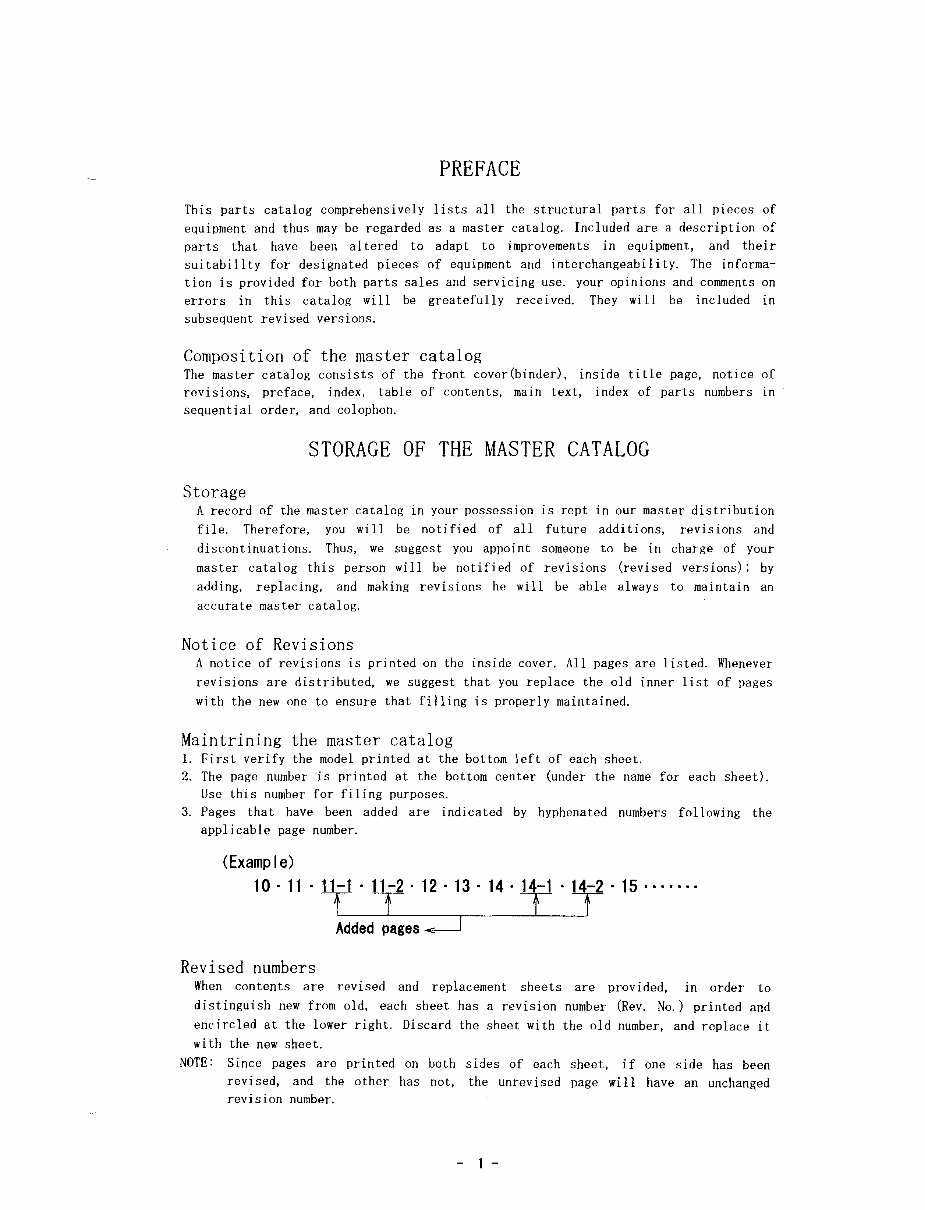
PREFACE
This parts catalog comprehensively lists all the structural parts for all pieces of
equipment and thus may be regarded as a master catalog. Included are a description of
parts that have been altered to adapt to improvements in equipment, and their
suitabillty for designated pieces of equipment and interchangeability. The informa-
tion is provided for both parts sales and servicing use. your opinions and comments on
errors in this catalog will be greatefully received. They will be included in
subsequent revised versions.
Composition of the master catalog
The master catalog consists of the front cover(binder1, inside title page, notice of
revisions, preface, index, table of contents, main text, index of parts numbers in
sequential order, and colophon.
STORAGE OF THE MASTER CATALOG
Storage
A record of the master catalog in your possession is rept in our master distribution
file. Therefore, you will be notified of all future additions, revisions and
discontinuations. Thus, we suggest you appoint someone to be in charge of your
master catalog this person will be notified of revisions (revised versions) ; by
adding, replacing, and making revisions he will be able always to maintain an
accurate master catalog.
Notice of Revisions
A notice of revisions is printed on the inside cover. All pages are listed. Whenever
revisions are distributed, we suggest that you replace the old inner list of pages
with the new one to ensure that filling is properly maintained.
Maintrining the master catalog
1. First verify the model printed at the bottom left of each sheet.
2. The page number is printed at the bottom center (under the name for each sheet).
Use this number for filing purposes.
3. Pages that have been added are indicated by hyphenated numbers following the
applicable page number.
L I I
Added pages
I
Revised numbers
When contents are revised and replacement sheets are provided, in order to
distinguish new from old, each sheet has a revision number (Rev. No.) printed and
encircled at the lower right. Discard the sheet with the old number, and replace it
with the new sheet.
NOTE: Since pages are printed on both sides of each sheet, if one side has been
revised, and the other has not, the unrevised page will have an unchanged
revision number.
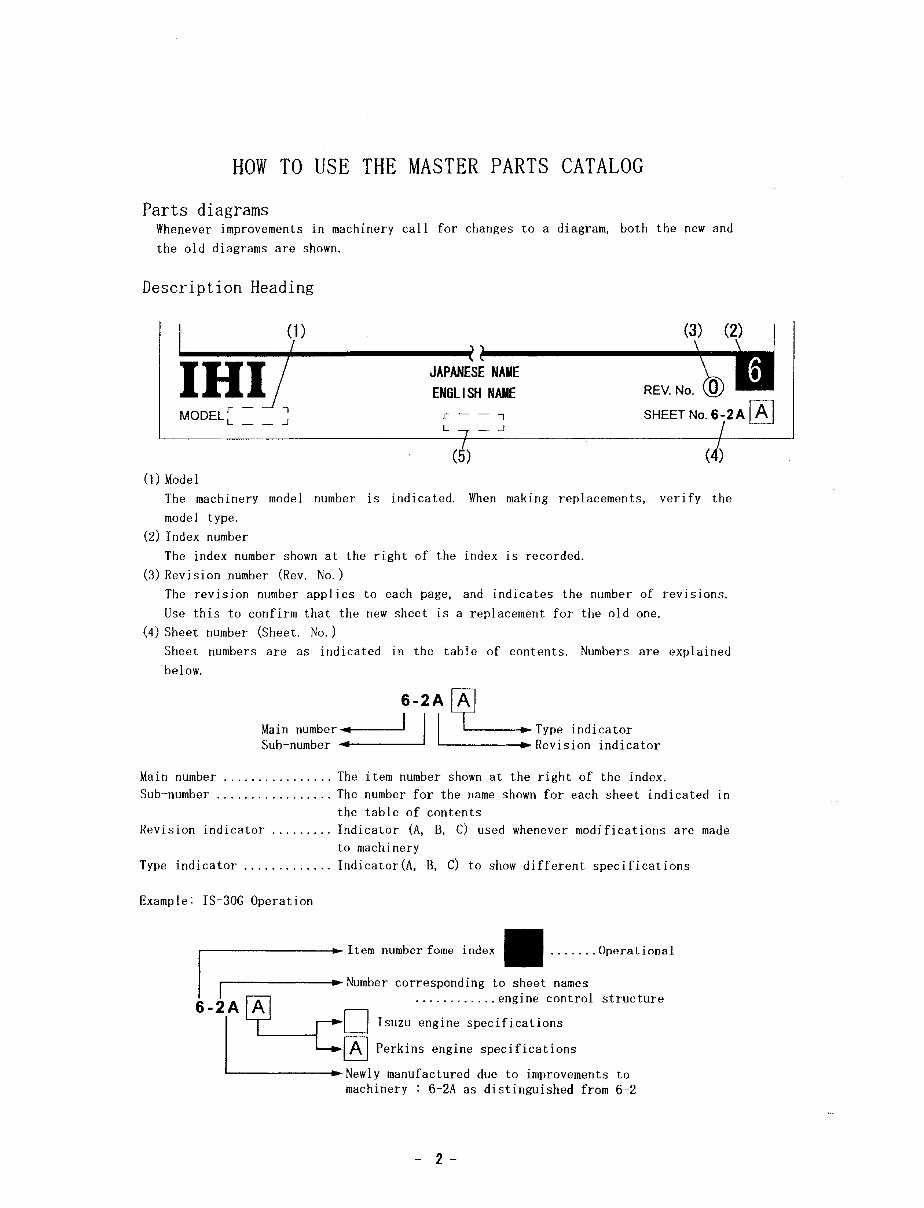
HOW TO USE THE MASTER PARTS CATALOG
Parts diagrams
Whenever improvements in machinery call for changes to a diagram, both the new and
the old diagrams are shown.
Description Heading
JAPANESE NAME
ENGLISH NAME -
SHEET No. 6-2A 1
1
(1) Model
The machinery model number is indicated. When making replacements, verify the
model type.
(2) Index number
The index number shown at the right of the index is recorded.
(3) Revision number (Rev. No. )
The revision number applies to each page, and indicates the number of revisions.
Use this to confirm that the new sheet is a replacement for the old one.
(4) Sheet number (Sheet. No. )
Sheet numbers are as indicated in the table of contents. Numbers are explained
below.
Main number 2 I I I T n e indicator
Sub-number ' ~-"ision indicator
Main number ................ The item number shown at the right of the index.
Sub-number ................. The number for the name shown for each sheet indicated in
the table of contents
Revis ion indicator ......... Indicator (A, B. C) used whenever modifications are made
to machinery
Type indicator ............. Indicator (A, 13, C) to show different specifications
Example: IS-JOG Operation
....... Item number fome index
Operational
I 1-bNumber corresponding to sheet names
engine control structure ............
Isuzu engine specifications
Perkins engine specifications
U ~ e w l y manufactured due to improvements to
machinery : 6-2A as distinguished from 6-2
PREFACE
This parts catalog comprehensively lists all the structural parts for all pieces of
equipment and thus may be regarded as a master catalog. Included are a description of
parts that have been altered to adapt to improvements in equipment, and their
suitabillty for designated pieces of equipment and interchangeability. The informa-
tion is provided for both parts sales and servicing use. your opinions and comments on
errors in this catalog will be greatefully received. They will be included in
subsequent revised versions.
Composition of the master catalog
The master catalog consists of the front cover(binder1, inside title page, notice of
revisions, preface, index, table of contents, main text, index of parts numbers in
sequential order, and colophon.
STORAGE OF THE MASTER CATALOG
Storage
A record of the master catalog in your possession is rept in our master distribution
file. Therefore, you will be notified of all future additions, revisions and
discontinuations. Thus, we suggest you appoint someone to be in charge of your
master catalog this person will be notified of revisions (revised versions) ; by
adding, replacing, and making revisions he will be able always to maintain an
accurate master catalog.
Notice of Revisions
A notice of revisions is printed on the inside cover. All pages are listed. Whenever
revisions are distributed, we suggest that you replace the old inner list of pages
with the new one to ensure that filling is properly maintained.
Maintrining the master catalog
1. First verify the model printed at the bottom left of each sheet.
2. The page number is printed at the bottom center (under the name for each sheet).
Use this number for filing purposes.
3. Pages that have been added are indicated by hyphenated numbers following the
applicable page number.
(Example)
I I
Added pages
Revised numbers
When contents are revised and replacement sheets are provided, in order to
distinguish new from old, each sheet has a revision number (Rev. No.) printed and
encircled at the lower right. Discard the sheet with the old number, and replace it
with the new sheet.
NOTE: Since pages are printed on both sides of each sheet, if one side has been
revised, and the other has not, the unrevised page will have an unchanged
revision number.
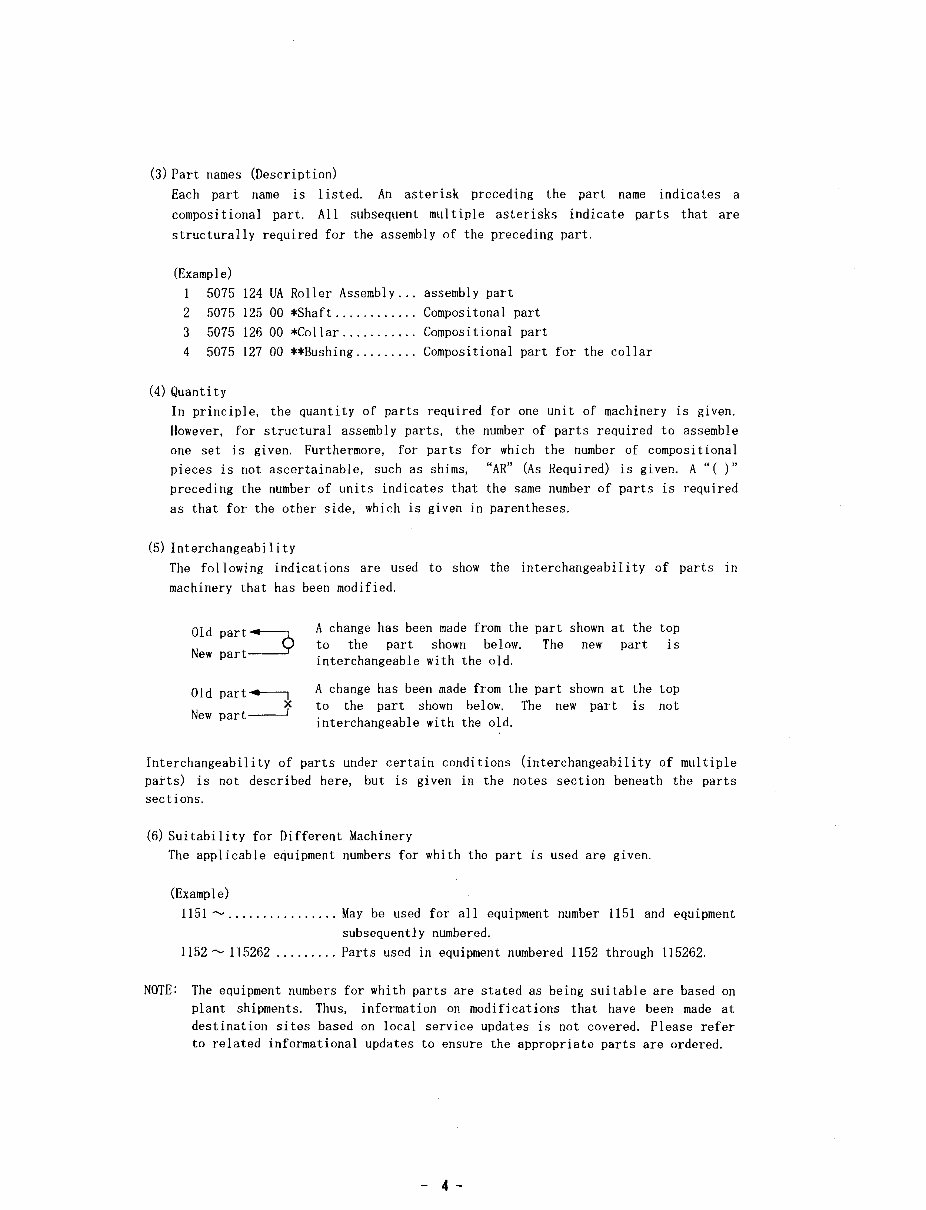
(3) Part names (Description)
Each part name is listed. An asterisk preceding the part name indicates a
compositional part. All subsequent multiple asterisks indicate parts that are
structurally required for the assembly of the preceding part.
(Examp 1 e)
1 5075 124 UA Roller Assembly ... assembly part
2 5075 125 00 *Shaft ............ Compositonal part
3 5075 126 00 *Collar ........... Compositional part
4 5075 127 00 **Bushing ......... Compositional part for the collar
(4)Quantity
In principle, the quantity of parts required for one unit of machinery is given.
However, for structural assembly parts, the number of parts required to assemble
one set is given. Furthermore, for parts for which the number of compositional
pieces is not ascertainable, such as shims, "AR" (As Required) is given. A "( )"
preceding the number of units indicates that the same number of parts is required
as that for the other side, which is given in parentheses.
(5)Interchangeability
The following indications are used to show the interchangeability of parts in
machinery that has been modified.
A change has been made from the part shown at the top
Old to the part shown below. The new part is
New part
interchangeable with the old.
A change has been made from the part shown at the top
Old part7
to the part shown below. The new part is not
New interchangeable with the old.
Interchangeability of parts under certain conditions (interchangeability of multiple
parts) is not described here, but is given in the notes section beneath the parts
sections.
(6)Suitability for Different Machinery
The applicable equipment numbers for whith the part is used are given.
(Example)
1151 - ................ May be used for all equipment number 1151 and equipment
subsequently numbered.
1152 - 115262 ......... Parts used in equipment numbered 1152 through 115262.
NOTE: The equipment numbers for whith parts are stated as being suitable are based on
plant shipments. Thus, information on modifications that have been made at
destination sites based on local service updates is not covered. Please refer
to related informational updates to ensure the appropriate parts are ordered.
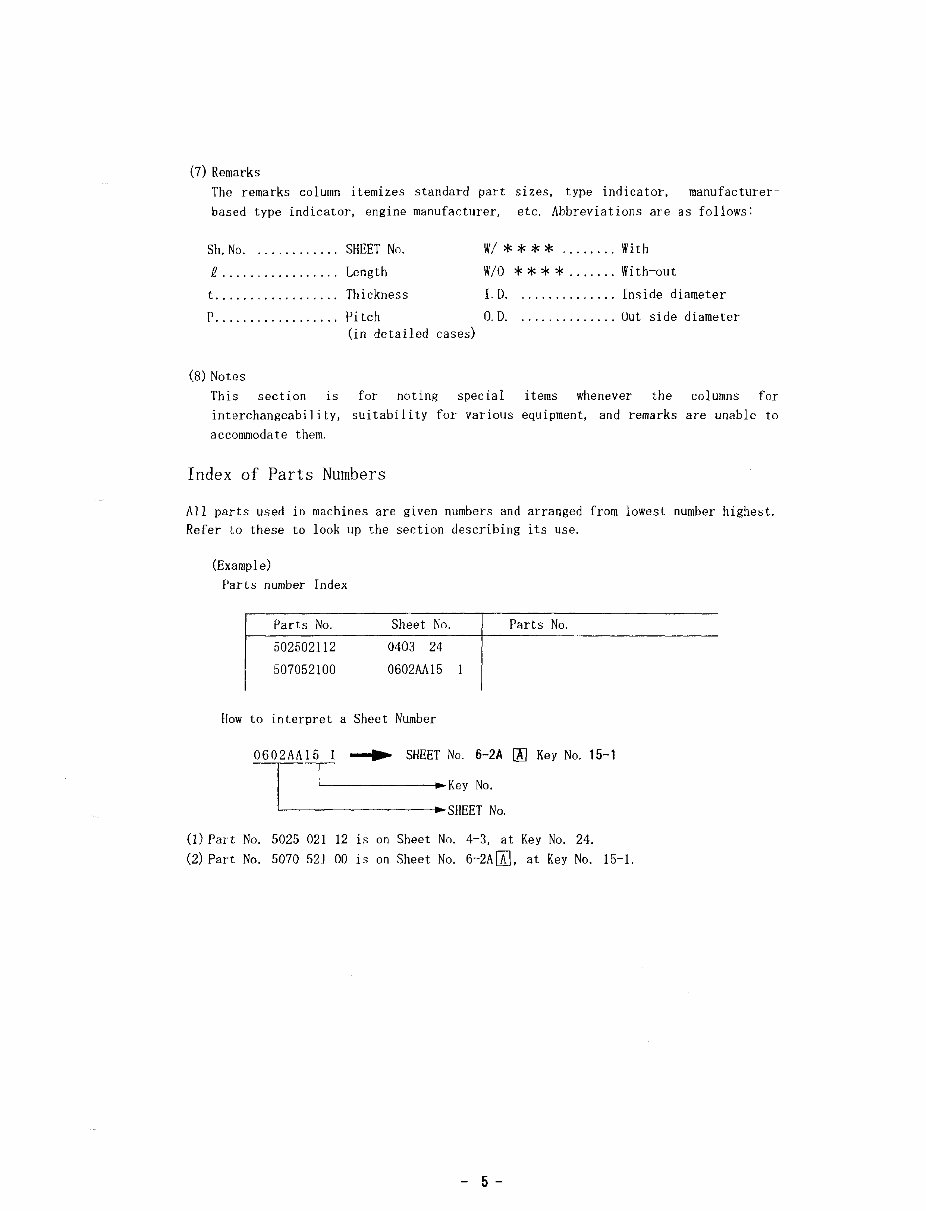
(7) Remarks
The remarks column itemizes standard part sizes, type indicator, manufacturer-
based type indicator, engine manufacturer, etc. Abbreviations are as follows:
........ Sh.No. ............ SHEET No. W/ * * * * With
l. ................ Length W/O * * * * ....... With-out
t.. ................ Thickness I.D. .............. Inside diameter
P.. ................ Pitch O.D. .............. Out side diameter
(in detailed cases)
(8) Notes
This section is for noting special items whenever the columns for
interchangeability, suitability for various equipment, and remarks are unable to
accommodate them.
Index of Parts Numbers
All parts used in machines are given numbers and arranged from lowest number highest.
Refer to these to look up the section describing its use.
(Example)
Parts number Index
( parts NO. Sheet No. I parts NO.
How to interpret a Sheet Number
O6O2AA 15 I II) SHEET No. 6-2A Key No. 15-1
\ K e y No.
SHEET No.
(1) Part No. 5025 021 12 is on Sheet No. 4-3, at Key No. 24.
(2) Part No. 5070 521 00 is on Sheet No. 6 - 2 ~ m , at Key No. 15-1
SECTION 1
LOWER MACHINE
-F%&@
I\
3ia!!4&*S13:*
IHI Construction Machinery Limited
I
I 26
I
I
I For Steel Shoe
I
,
08-35N0-010 100-0
IHI
-F%Btl#&llt
LOWER WHINE ASS' Y REV. No. @ -
MODEL 35N -2- SHEET NO. 1-1
--
I
-
i3
VOTE
7 ; -
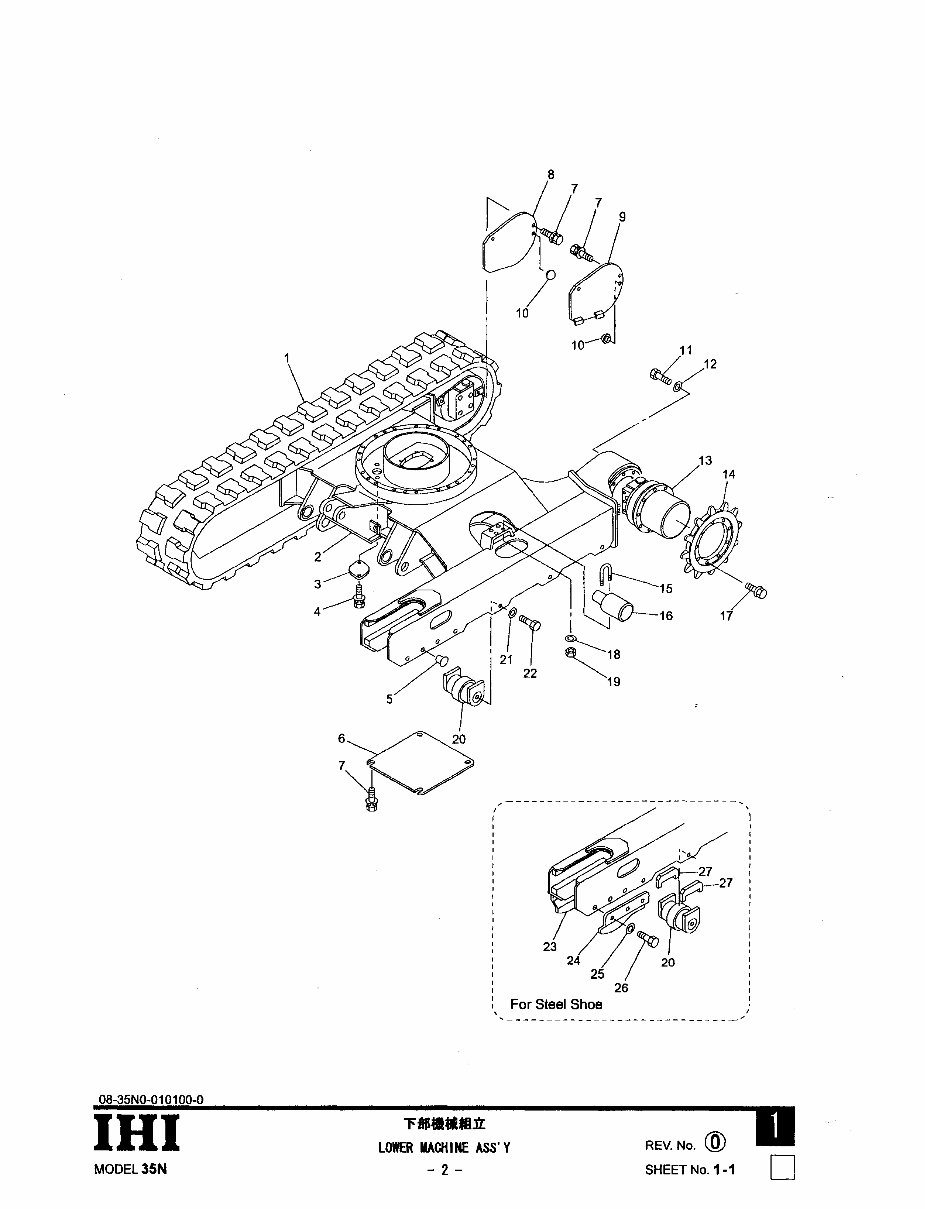
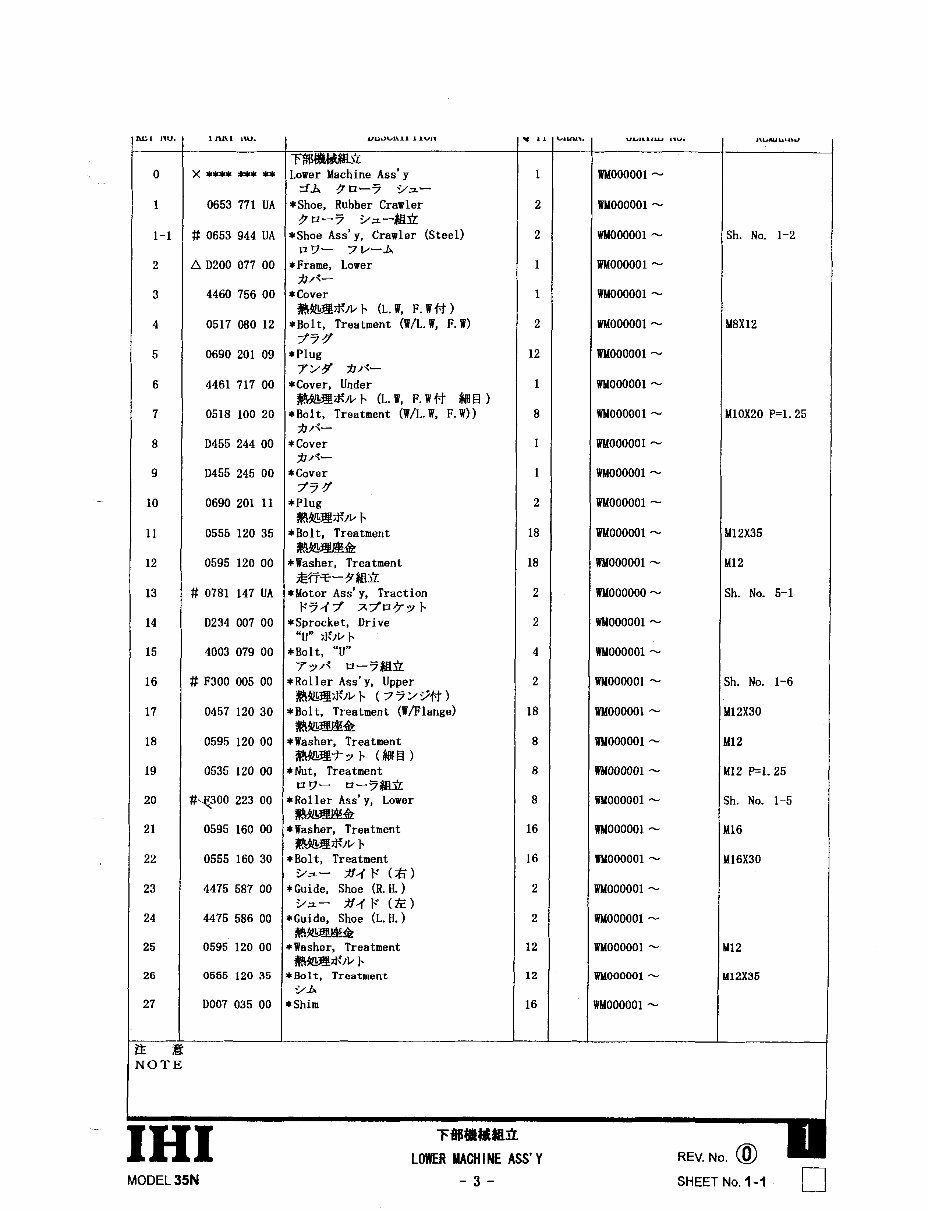
Lower Machine Ass' y
34 pa-7 VZL-
*Shoe, Rubber Crawler
pu-7 Vz-&l?
*Shoe Ass' y, Crawler (Steel)
a7- 7v-4
*Frame, Lower
a/<--
* Cover
~~if\'~k b (L. W, F.W H )
*Bolt, Treatment (W/L.W, F.W)
97 6
*Plug
77Y a/<--
*Cover, Under
%!I#LB!if\'lLb (L.W, F.WM &El)
*Bolt, Treatment (w/L.W. P.w))
*/I-
* Cover
a/<--
*Cover
736
*Plug
%!IMif\'lk b
*Bolt, Treatment
%mi!!?&
*Washer, Treatment
&fi*-!?i%3
*Motor Ass' y, Traction
F741 x-P~'/ub
*Sprocket, Drive
'U" Slk I.
*Bolt, "U"
7yA a--7&&
*Roller Ass' y, Upper
%&Bif\'lk b ( 7 7 79H 1
*Bolt, Treatment (W/Flange)
%as&
*Washer, Treatment
%!WS!JtrF (&El)
r Nut, Treatment
D7- u-7#&Y
@Roller Ass' y, Lower
%-&
clasher, Treatment
%@B!if\'lL I.
@Bolt, Treatment
.)a - 34F (&)
@Guide, Shoe (R.H.)
Vz- #4P (&)
RGuide, Shoe (L.H.)
~~&
c Washer, Treatment
%M&lk b
RBolt, Treatment
1 Shim
Sh. No. 1-2
M8X12
UlOX20 P=1.25
N12X35
612
jh. No. 5-1
ih. No. 1-6
L12X30
112
112 P=1.25
;h. No. 1-5
116
116x30
112
112x35
[HI
-Far#@&
LOWER MACHINE ASS' Y
REV. No. @
MODEL 35N SHEET No. 1-1
08-35N0-0 10200-0
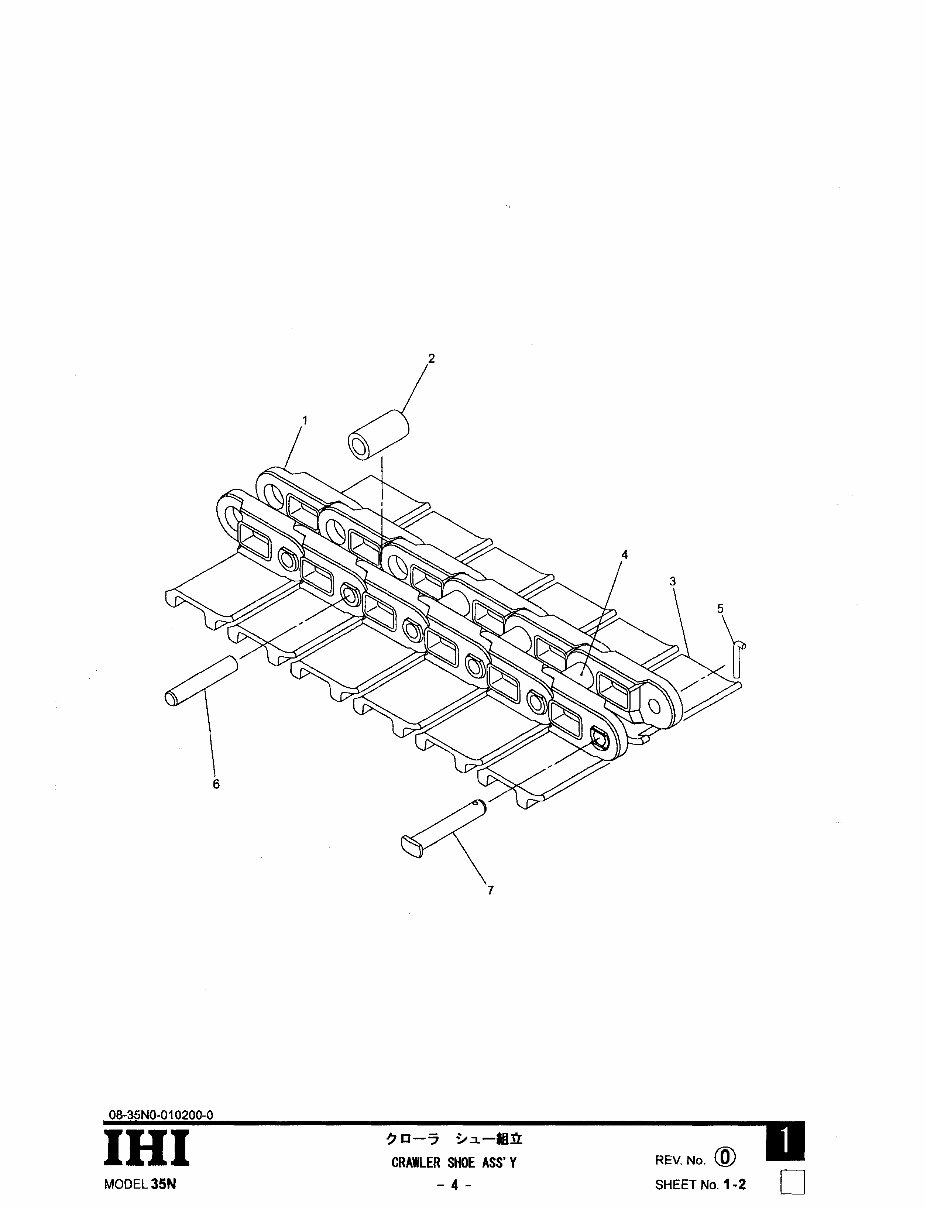
IHI CRAWLER SHOE ASS' Y
MODEL 35N SHEET No 1-2 U
You're Reading a Preview
What's Included?
Lifetime Access
Fast Download Speeds
Online & Offline Access
Access PDF Contents & Bookmarks
Full Search Facility
Print one or all pages of your manual
$36.99
Viewed 14 Times Today


Secure transaction
What's Included?
Lifetime Access
Fast Download Speeds
Online & Offline Access
Access PDF Contents & Bookmarks
Full Search Facility
Print one or all pages of your manual
$36.99
Get your hands on this comprehensive Parts Catalog for the IHI 35N Mini Excavator. Whether you're a professional mechanic or a DIY enthusiast, this catalog equips you with detailed visual and step-by-step instructions for seamless repairs. It provides all the model specifics you need to accurately identify, service, and maintain your IHI 35N Mini Excavator.
It covers a wide range of components including:
- Lower Machine
- Turntable
- Swing Drive Device
- Hydraulic Piping
- Hydraulic Instrument
- Operating Controls
- Power Unit
- Cab & Related Parts
- Electric System
- Tools & Accessories
- Hoe Attachment
- Blade Attachments
- Option Specifications
- Parts Index
And much more, spanning across a total of 297 pages. The catalog is available in English format and is compatible with both Win and Mac systems. This printable resource offers easy-to-follow instructions, complete with diagrams and pictures, ensuring that no technical knowledge or advanced skills are required for your repair needs.


