AIR CONDITIONING SYSTEM – AIR CONDITIONING SYSTEM AC–1
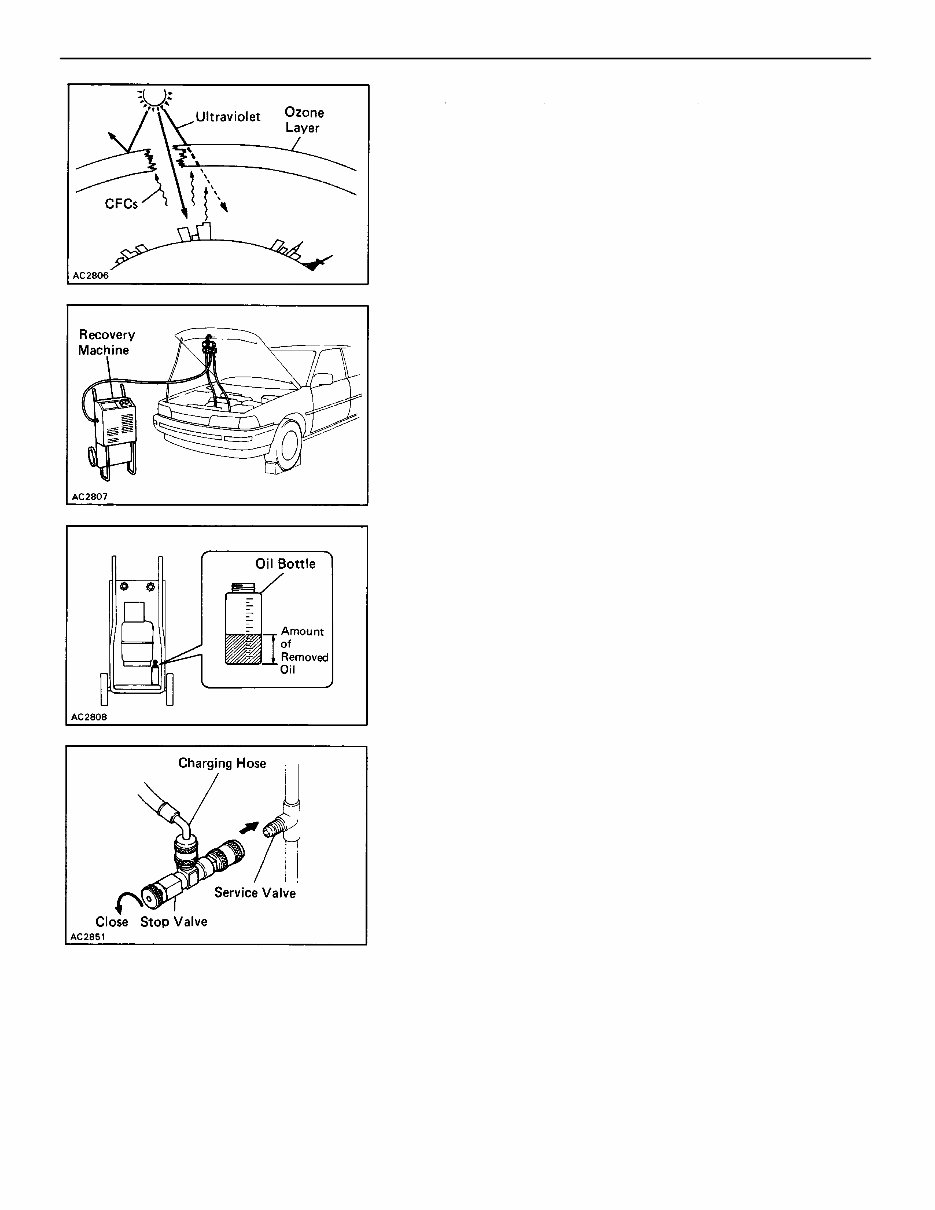
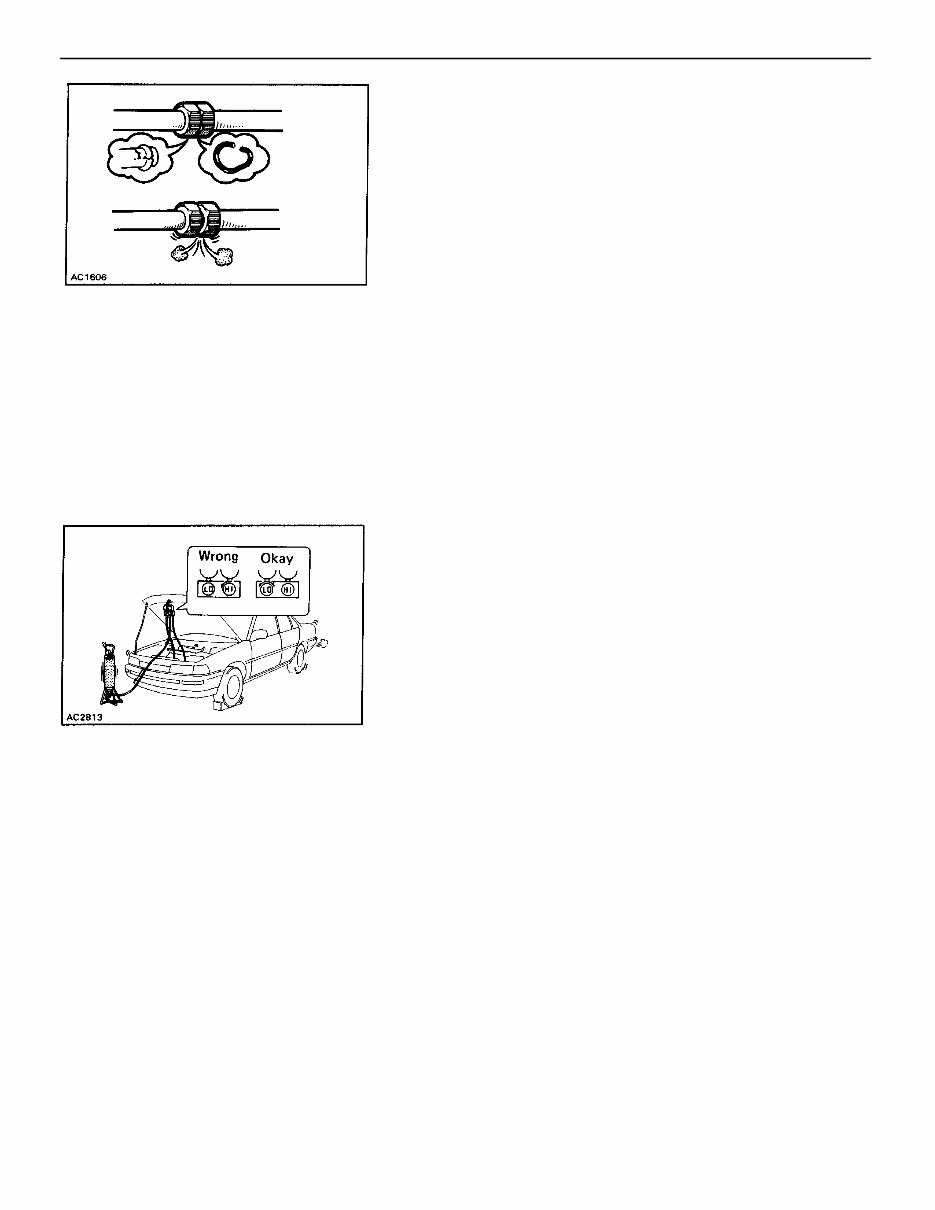
GENERAL INFORMATION REFRIGERATION SYSTEM Prevention of Refrigerant Release and Excessive quantities Refrigerant (CFCs) for automobile air conditionings is be– lieved to cause harm by depleting the ozone layer which helps to protect us from the ultraviolet rays of the sun. Therefore, it is necessary to prevent release of refrigerant to the atmosphere and to use the minimum amount when servicing the air conditioning. 1. USE RECOVERY MACHINE TO RECOVER REFRIGERANT When discharging refrigerant from the system as follows, use a recovery machine to recover the refrigerant. • Before replacing parts on the refrigerant line. • When moisture or air gets in the refrigerant line. • When excess refrigerant is charged. 2. USE CHARGING HOSES WITH STOP VALVE WHEN INSTALLING MANIFOLD GAUGE SET To prevent release of refrigerant, using charging hoses with a stop valve when installing the manifold gauge set to the service valves on the refrigerant line. 3. TIGHTEN CONNECTING PARTS SECURELY Follow the notices about tightening connecting parts in step 6 on page AC–4. 4. PROPERLY EVACUATE AIR FROM REFRIGERANT SYSTEM To prevent release and wasteful use of refrigerant, evac– uate air with care from refrigeration system as follows; • Do not evacuate before recovering refrigerant in system. NOTICE: • When handling the recovery machine, always follow the directions given in the instruction manual. • After recovery, the amount of compressor oil removed must be measured and the same amount added to the system. – AIR CONDITIONING SYSTEM General Information AC–2
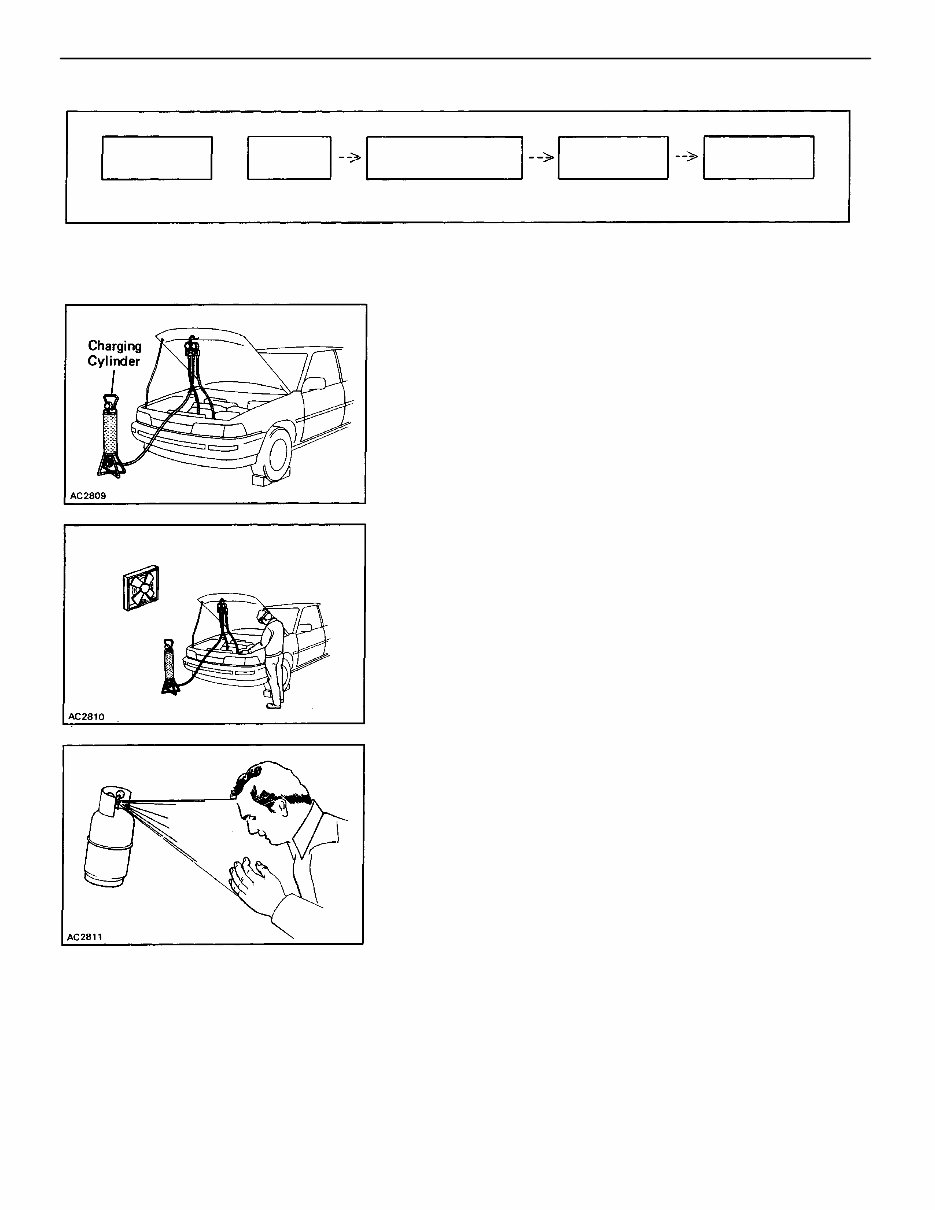
3. BE CAREFUL THAT LIQUID REFRIGERANT DOES NOT GET IN YOUR EYES OR ON YOUR SKIN If liquid refrigerant gets in your eyes or on your skin; (a) Wash the area with lots of cool water. CAUTION: Do not rub your eyes or skin. (b) Apply clean petroleum jelly to the skin. (c) Go immediately to a physician or hospital for profes– sional treatment. CAUTION: Do not attempt to treat yourself. Handling Precautions for Refrigerant Container 1. NEVER HEAT CONTAINER OR EXPOSE IT TO NAKED FLAME 2. BE CAREFUL NOT TO DROP CONTAINER AND NOT TO APPLY PHYSICAL SHOCKS TO IT Handling Precautions for Refrigerant 1. DO NOT HANDLE REFRIGERANT IN AN ENCLOSED AREA OR NEAR AN OPEN FLAME 2. ALWAYS WEAR EYE PROTECTION 6. USE CHARGING CYLINDER TO CHARGE PROPER AMOUNT OF REFRIGERANT To prevent excessive use of refrigerant due to overcharg– ing, use a charging cylinder to charge the proper amount of refrigerant. • Do not perform repeat evacuation of system. Evacuation Process Evacuation Top–Up Charging of Refrigerant Charging Refrigerant Refrigerant Leak Check 10 minutes or more Leave for 5 minutes Airtight Check – AIR CONDITIONING SYSTEM General Information AC–3
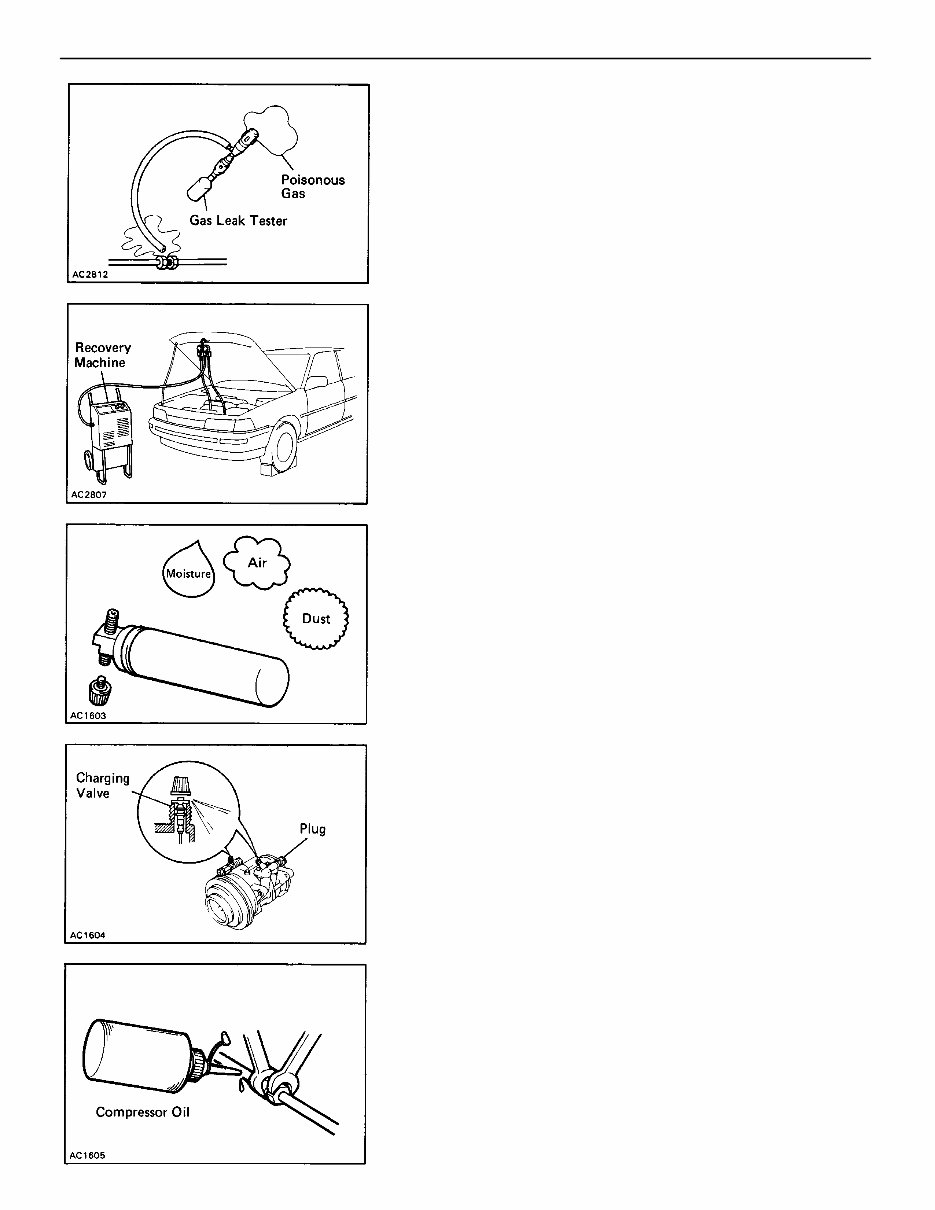
2. INSERT PLUG IMMEDIATELY IN DISCONNECTED PARTS Insert a plug immediately in the disconnected parts to prevent the entry of moisture and dust. 3. DO NOT REMOVE PLUG FROM NEW PARTS UNTIL IM– MEDIATELY BEFORE INSTALLATION 4. DO NOT USE BURNER FOR BENDING OR LENGTHENING OPERATIONS ON TUBE If the tubes are heated with a burner, a layer of oxidation forms inside the tube, causing the same kind of trouble as an accumulation of dust. 5. DISCHARGE GAS IN NEW COMPRESSOR FROM CHARGING VALVE BEFORE INSTALLING IT If the gas in new compressor is not discharged first, com– pressor oil will spray out with gas when the plug is re– moved. Handling Precautions for Gas–Cylinder Type Gas Leak Tester 1. BEFORE USING TESTER MAKE SURE THAT THERE ARE NO FLAMMABLE SUBSTANCES NEARBY 2. BE CAREFUL NOT TO INHALE POISONOUS GAS If refrigerant gas comes in contact with flame, a poison– ous gas is produced. During leak tests, do not inhale any gas. 6. TIGHTEN CONNECTING PARTS SECURELY Securely tighten the connecting parts to prevent leaking of refrigerant gas. • Apply a few drops of compressor oil to 0–ring fittings for easy tightening and to prevent leaking of refriger– ant gas. • Tighten the nuts using two wrenches to avoid twisting the tube. Precautions When Replacing Parts in Refrigerant line 1. RECOVER REFRIGERANT IN SYSTEM BEFORE REMOV– ING PARTS Using a recovery machine, recover refrigerant in system before removing the parts. NOTICE: Do not release refrigerant to atmosphere. – AIR CONDITIONING SYSTEM General Information AC–4
2. DO NOT OPEN HIGH PRESSURE VALVE OF MANIFOLD GAUGE WITH COMPRESSOR OPERATING If the high pressure valve is opened, refrigerant flows in the reverse direction and could cause the charging cylin– der to rupture, so open and close the low pressure valve only. 3. BE CAREFUL NOT TO OVERCHARGE WITH REFRIGER– ANT IN SYSTEM If refrigerant is overcharged, it causes trouble such as in– sufficient cooling, poor fuel economy, engine overheating etc. ELECTRICAL PARTS Before removing and inspecting the electrical parts, set the ignition switch to the LOCK position and disconnect the negative (–) terminal cable from the battery.. Precautions When Charging Refrigerant 1. DO NOT OPERATE COMPRESSOR WITHOUT ENOUGH REFRIGERANT IN REFRIGERANT CYCLE If there is not enough refrigerant in the refrigerant cycle, oil lubrication will be insufficient and compressor burnout may occur, so take care to avoid this. • Tighten the O–ring fittings or the bolted type fittings to the specified torque. – AIR CONDITIONING SYSTEM General Information AC–5
The 1995 Toyota Pickup Service & Repair Manual is a comprehensive guide designed for owners and mechanics of the 1995 Toyota Pickup model. This manual offers detailed instructions and diagrams to facilitate the maintenance and repair of the vehicle.
Whether you are a professional mechanic or a DIY enthusiast, this manual serves as an invaluable resource for servicing the 1995 Toyota Pickup. It covers a wide range of tasks, including routine maintenance such as oil changes, brake inspections, and tire rotations, as well as more complex repairs like engine overhaul and electrical system troubleshooting.
Content overview:
General maintenance procedures
Engine, transmission, and drivetrain repair
Electrical system diagnosis and repair
Body and interior maintenance
Brake and suspension system repair
Fuel system troubleshooting and repair
With the 1995 Toyota Pickup Service & Repair Manual, you can confidently approach any repair knowing that you have accurate and reliable information at your disposal. Say goodbye to guesswork and incomplete online tutorials – this manual provides everything you need to keep your Toyota Pickup in optimal condition.
Printable: Yes Language: English Compatibility: Pretty much any electronic device, incl. PC & Mac computers, Android and Apple smartphones & tablet, etc. Requirements: Adobe Reader (free)




 Lifetime Access




