3510 Vauxhall/Opel Omega Contents LIVING WITH YOUR VAUXHALL OMEGA Introduction Page 0•4 Safety First! Page 0•5 Roadside Repairs Introduction Page 0•6 If your car won’t start Page 0•6 Jump starting Page 0•7 Wheel changing Page 0•8 Identifying leaks Page 0•9 Towing Page 0•9 Weekly Checks Introduction Page 0•10 Underbonnet check points Page 0•10 Engine oil level Page 0•11 Coolant level Page 0•11 Brake (and clutch) fluid level Page 0•12 Power steering fluid level Page 0•12 Battery Page 0•13 Electrical systems Page 0•13 Tyre condition and pressure Page 0•14 Tyre tread wear patterns Page 0•14 Washer fluid level Page 0•15 Wiper blades Page 0•15 Lubricants and fluids Page 0•16 Tyre pressures Page 0•17 MAINTENANCE Routine Maintenance and Servicing Servicing specifications Page 1•2 Maintenance schedule Page 1•3 Maintenance procedures Page 1•6
3510 Vauxhall/Opel Omega Contents REPAIRS & OVERHAUL Engine and Associated Systems 2.0 litre SOHC engine in-car repair procedures Page 2A•1 2.0 litre DOHC engine in-car repair procedures Page 2B•1 2.5 and 3.0 litre engine in-car repair procedures Page 2C•1 General engine overhaul procedures Page 2D•1 Cooling, heating and ventilation systems Page 3•1 Fuel and exhaust systems Page 4A•1 Emission control systems Page 4B•1 Starting and charging systems Page 5A•1 Ignition system Page 5B•1 Transmission Clutch Page 6•1 Manual transmission Page 7A•1 Automatic transmission Page 7B•1 Final drive, driveshafts and propeller shaft Page 8•1 Brakes and Suspension Braking system Page 9•1 Suspension and steering Page 10•1 Body equipment Bodywork and fittings Page 11•1 Body electrical system Page 12•1 Wiring Diagrams Page 12•23 REFERENCE Dimensions and weights Page REF•1 Conversion Factors Page REF•2 Buying Spare Parts and Vehicle Identification Page REF•3 General Repair Procedures Page REF•4 Jacking and vehicle support Page REF•5 Radio/cassette unit anti-theft system precaution Page REF•5 Tools and working facilities Page REF•6 MOT Test Checks Page REF•8 Fault Finding Page REF•12 Glossary of Technical Terms Page REF•20 Index Page REF•24
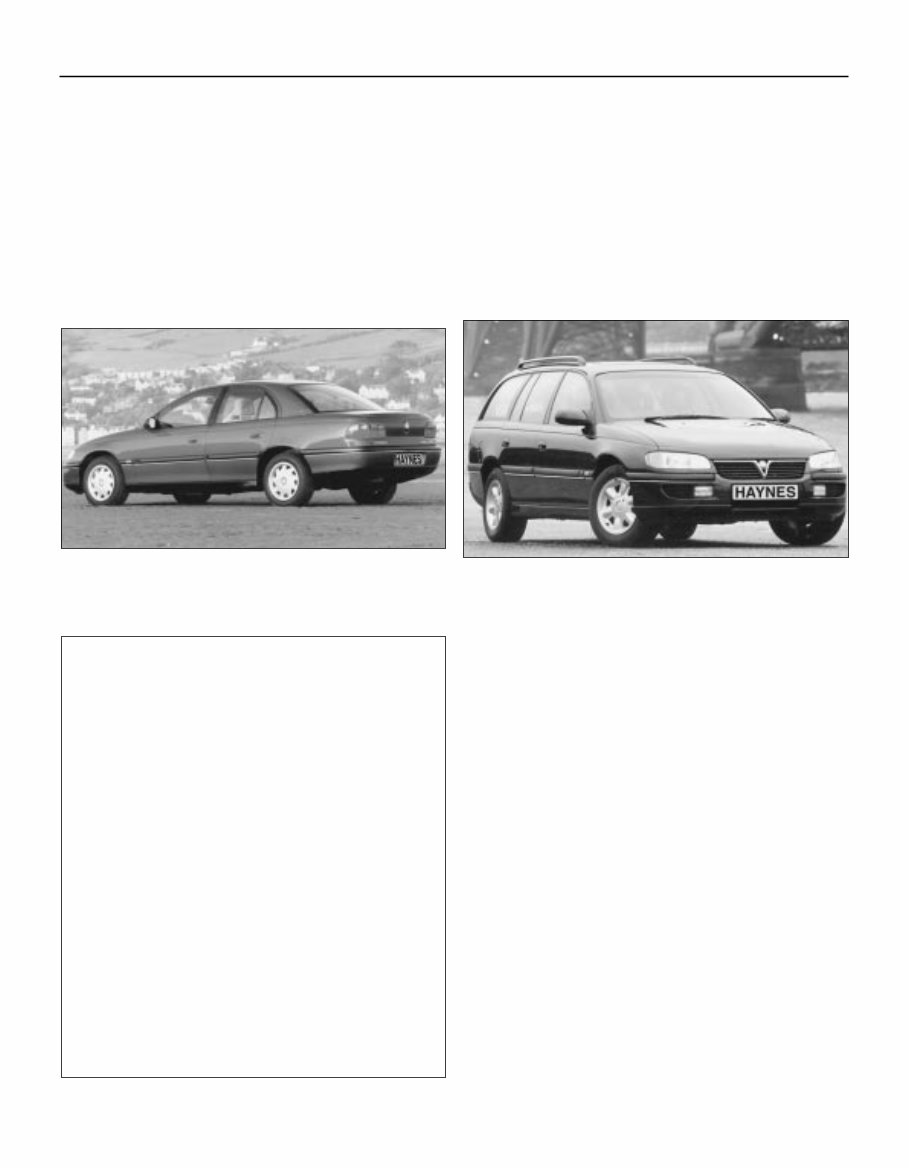
0•4 Introduction 3510 Vauxhall/Opel Omega The Vauxhall Omega was introduced into the UK in April of 1994 as a replacement for the Vauxhall Carlton and Senator. At its launch, the Omega was available in both Saloon and Estate body styles with a choice of either 2.0 litre (1998 cc) or a 2.5 litre (2498 cc) petrol engine both available with either a 5-speed manual transmission unit or a 4- speed automatic transmission unit. Shortly afterwards a 3.0 (2968 cc) litre petrol engine was also introduced. A 2.5 litre Diesel engine (not covered in this manual) was also available. The petrol engines are all well-proven units which are used in many other Vauxhall vehicles; the engine is mounted at the front of vehicle with the transmission mounted on its rear. Two versions of the four-cylinder 2.0 litre engine were used; low specification vehicles were fitted with a single overhead camshaft (SOHC) 8-valve engine were as all other vehicles were fitted with the double overhead camshaft (DOHC) 16-valve engine often referred to as the ECOTEC engine. The 2.5 and 3.0 litre engines are both V6, double overhead camshaft (DOHC) units which are also often referred as ECOTEC engines. All models have fully-independent front and rear suspension and are equipped with front and rear disc brakes. A wide range of standard and optional equipment is available within the range to suit most tastes, including central locking, electric windows and an electric sunroof. An air conditioning system was available as an option on certain models. Provided that regular servicing is carried out in accordance with the manufacturer’s recommendations, the vehicle should prove reliable and very economical. The engine compartment is well-designed, and most of the items requiring frequent attention are easily accessible. Vauxhall Omega 2.0 16V Select Vauxhall Omega Estate CD Your Vauxhall Omega manual The aim of this manual is to help you get the best value from your vehicle. It can do so in several ways. It can help you decide what work must be done (even should you choose to get it done by a garage). It will also provide information on routine maintenance and servicing, and give a logical course of action and diagnosis when random faults occur. However, it is hoped that you will use the manual by tackling the work yourself. On simpler jobs it may even be quicker than booking the car into a garage and going there twice, to leave and collect it. Perhaps most important, a lot of money can be saved by avoiding the costs a garage must charge to cover its labour and overheads. The manual has drawings and descriptions to show the function of the various components so that their layout can be understood. Tasks are described and photographed in a clear step-by-step sequence. References to the ‘left’ and ‘right’ are in the sense of a person in the driver’s seat, facing forwards. Acknowledgements Thanks are due to Champion Spark Plug, who supplied the illustrations showing spark plug conditions. Certain illustrations are the copyright of Vauxhall Motors Limited, and are used with their permission. Thanks are also due to Draper Tools Limited, who provided some of the workshop tools, and to all those people at Sparkford who helped in the production of this manual. We take great pride in the accuracy of information given in this manual, but vehicle manufacturers make alterations and design changes during the production run of a particular vehicle of which they do not inform us. No liability can be accepted by the authors or publishers for loss, damage or injury caused by any errors in, or omissions from, the information given. The Vauxhall Omega Team Haynes manuals are produced by dedicated and enthusiastic people working in close co-operation. The team responsible for the creation of this book included: Authors Marc Coombs Spencer Drayton Sub-editor Ian Barnes Editor & Page Make-up Steve Churchill Workshop manager Paul Buckland Photo Scans Steve Tanswell John Martin Cover illustration & Line Art Roger Healing Wiring diagrams Matthew Marke We hope the book will help you to get the maximum enjoyment from your car. By carrying out routine maintenance as described you will ensure your car’s reliability and preserve its resale value.
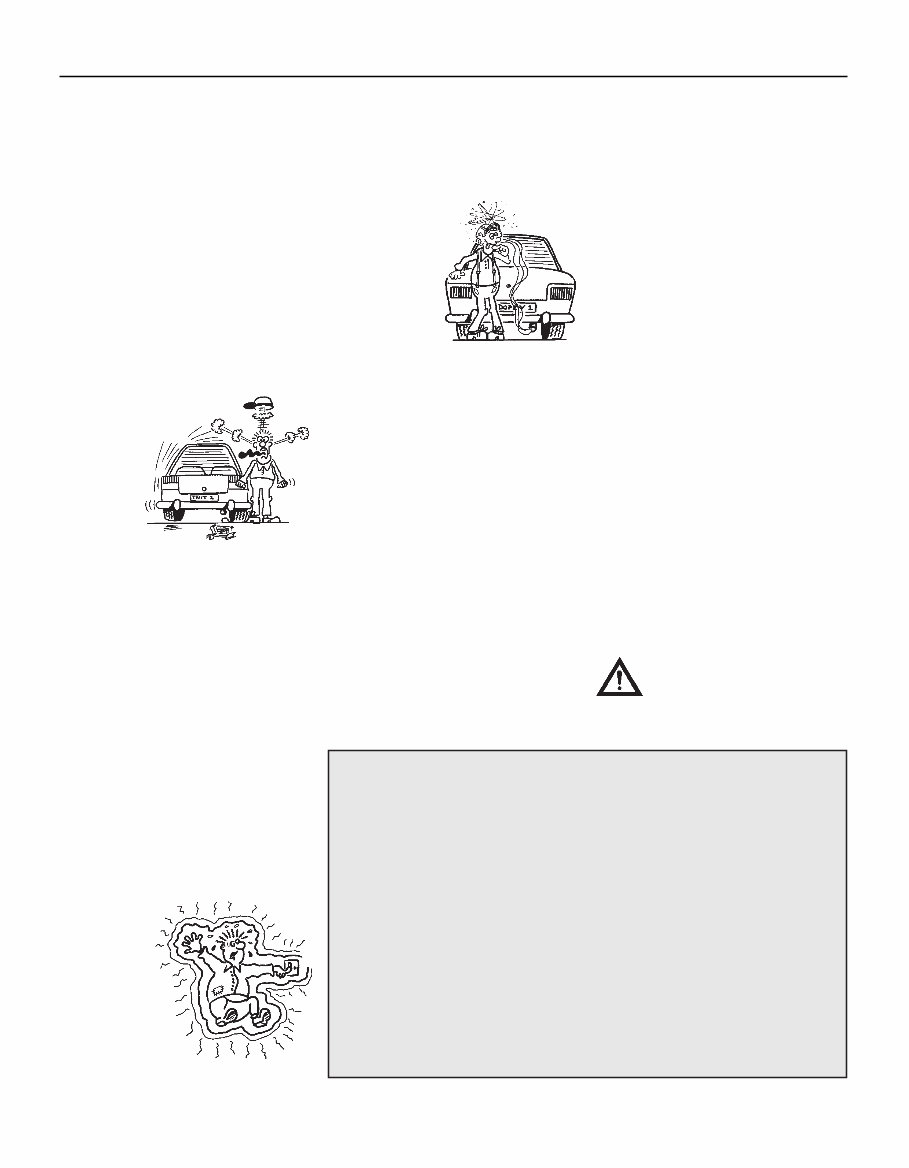
Safety first! 0•5 3510 Vauxhall/Opel Omega Working on your car can be dangerous. This page shows just some of the potential risks and hazards, with the aim of creating a safety-conscious attitude. General hazards Scalding • Don’t remove the radiator or expansion tank cap while the engine is hot. • Engine oil, automatic transmission fluid or power steering fluid may also be dangerously hot if the engine has recently been running. Burning • Beware of burns from the exhaust system and from any part of the engine. Brake discs and drums can also be extremely hot immediately after use. Crushing • When working under or near a raised vehicle, always supplement the jack with axle stands, or use drive-on ramps. Never venture under a car which is only supported by a jack. • Take care if loosening or tightening high- torque nuts when the vehicle is on stands. Initial loosening and final tightening should be done with the wheels on the ground. Fire • Fuel is highly flammable; fuel vapour is explosive. • Don’t let fuel spill onto a hot engine. • Do not smoke or allow naked lights (including pilot lights) anywhere near a vehicle being worked on. Also beware of creating sparks (electrically or by use of tools). • Fuel vapour is heavier than air, so don’t work on the fuel system with the vehicle over an inspection pit. • Another cause of fire is an electrical overload or short-circuit. Take care when repairing or modifying the vehicle wiring. • Keep a fire extinguisher handy, of a type suitable for use on fuel and electrical fires. Electric shock • Ignition HT voltage can be dangerous, especially to people with heart problems or a pacemaker. Don’t work on or near the ignition system with the engine running or the ignition switched on. • Mains voltage is also dangerous. Make sure that any mains-operated equipment is correctly earthed. Mains power points should be protected by a residual current device (RCD) circuit breaker. Fume or gas intoxication • Exhaust fumes are poisonous; they often contain carbon monoxide, which is rapidly fatal if inhaled. Never run the engine in a confined space such as a garage with the doors shut. • Fuel vapour is also poisonous, as are the vapours from some cleaning solvents and paint thinners. Poisonous or irritant substances • Avoid skin contact with battery acid and with any fuel, fluid or lubricant, especially antifreeze, brake hydraulic fluid and Diesel fuel. Don’t syphon them by mouth. If such a substance is swallowed or gets into the eyes, seek medical advice. • Prolonged contact with used engine oil can cause skin cancer. Wear gloves or use a barrier cream if necessary. Change out of oil- soaked clothes and do not keep oily rags in your pocket. • Air conditioning refrigerant forms a poisonous gas if exposed to a naked flame (including a cigarette). It can also cause skin burns on contact. Asbestos • Asbestos dust can cause cancer if inhaled or swallowed. Asbestos may be found in gaskets and in brake and clutch linings. When dealing with such components it is safest to assume that they contain asbestos. Special hazards Hydrofluoric acid • This extremely corrosive acid is formed when certain types of synthetic rubber, found in some O-rings, oil seals, fuel hoses etc, are exposed to temperatures above 400 0 C. The rubber changes into a charred or sticky substance containing the acid. Once formed, the acid remains dangerous for years. If it gets onto the skin, it may be necessary to amputate the limb concerned. • When dealing with a vehicle which has suffered a fire, or with components salvaged from such a vehicle, wear protective gloves and discard them after use. The battery • Batteries contain sulphuric acid, which attacks clothing, eyes and skin. Take care when topping-up or carrying the battery. • The hydrogen gas given off by the battery is highly explosive. Never cause a spark or allow a naked light nearby. Be careful when connecting and disconnecting battery chargers or jump leads. Air bags • Air bags can cause injury if they go off accidentally. Take care when removing the steering wheel and/or facia. Special storage instructions may apply. Diesel injection equipment • Diesel injection pumps supply fuel at very high pressure. Take care when working on the fuel injectors and fuel pipes. Warning: Never expose the hands, face or any other part of the body to injector spray; the fuel can penetrate the skin with potentially fatal results. Remember... DO • Do use eye protection when using power tools, and when working under the vehicle. • Do wear gloves or use barrier cream to protect your hands when necessary. • Do get someone to check periodically that all is well when working alone on the vehicle. • Do keep loose clothing and long hair well out of the way of moving mechanical parts. • Do remove rings, wristwatch etc, before working on the vehicle – especially the electrical system. • Do ensure that any lifting or jacking equipment has a safe working load rating adequate for the job. DON’T • Don’t attempt to lift a heavy component which may be beyond your capability – get assistance. • Don’t rush to finish a job, or take unverified short cuts. • Don’t use ill-fitting tools which may slip and cause injury. • Don’t leave tools or parts lying around where someone can trip over them. Mop up oil and fuel spills at once. • Don’t allow children or pets to play in or near a vehicle being worked on.
The VAUXHALL OPEL OMEGA B Service Repair Manual is a comprehensive guide designed to assist in the maintenance and repair of OMEGA B models from 1994 to 2003. This manual is an indispensable tool for both professional mechanics and DIY enthusiasts, providing detailed step-by-step instructions and illustrations for performing a wide range of repairs.
Featuring a user-friendly layout, this manual covers various systems and components of the VAUXHALL OPEL OMEGA B, including the engine, transmission, suspension, brakes, electrical system, and more. With this manual, you can confidently tackle repairs such as engine overhauls, gearbox repairs, brake pad replacements, electrical troubleshooting, and much more.
Whether you own a VAUXHALL OPEL OMEGA B sedan, wagon, or other model, this manual covers them all. It includes comprehensive information on various trim levels, engine options, and optional features available for the OMEGA B, ensuring that you have the necessary details for your specific vehicle.
With the VAUXHALL OPEL OMEGA B Service Repair Manual, you can save time and money by performing repairs and maintenance tasks yourself. Its clear instructions and detailed diagrams make it easy to understand and follow along, even for those with limited mechanical knowledge.
Invest in this VAUXHALL OPEL OMEGA B Service Repair Manual and empower yourself to take control of your vehicle's maintenance and repairs. Keep your OMEGA B running smoothly and efficiently with the help of this reliable and comprehensive guide.
Covers VAUXHALL OPEL OMEGA B models from 1994 to 2003
Comprehensive instructions for a wide range of repairs
User-friendly layout with detailed illustrations
Suitable for professional mechanics and DIY enthusiasts
Includes information on various trim levels, engines, and optional features
Save time and money by performing your own maintenance and repairs



 Lifetime Access