Start Mod el
Spa re P arts
S.T. Sc hed ul e
Worksh op Manual
Body Repa ir Manual
Graphic Na vig a tion
Electri c al Syst em
Troubl es h oo ting
Language
To start the consultabon, please select one of the secbons of the left menu.
-----------------------------------
1.1 Ferrari quality standards
When manufacturing a Ferrari vehicle, the primary goal is “to
achieve optimum product quality”. Consequently Ferrari defines
a number of quality standards. These quality standards apply
both to production and especially to customer service.
In the event of accident repairs, crash safety must be an absolute
priority. To maintain optimum crash safety, all structural work
must be done correctly as indicated.
The repair work may only be carried out by Ferrari-trained and
certified skilled personnel.
Only genuine parts should be used when carrying out the
repair. They have been tested by Ferrari and are compatible
for use with aluminium.
Follow the procedures exactly as given in the repair manual.
Any deviations from the procedures are permitted only after
consultation with and approval by Ferrari.
Using non-approved repair methods may compromise the
crash performance of the vehicle. This may ultimately lead to a
non-foreseeable safety and product liability risk.
Only Ferrari-approved tools may be used to carry out accident
repairs.
It is essential that corrosion prevention measures are performed
during and after the repair.
Copyright © 2010
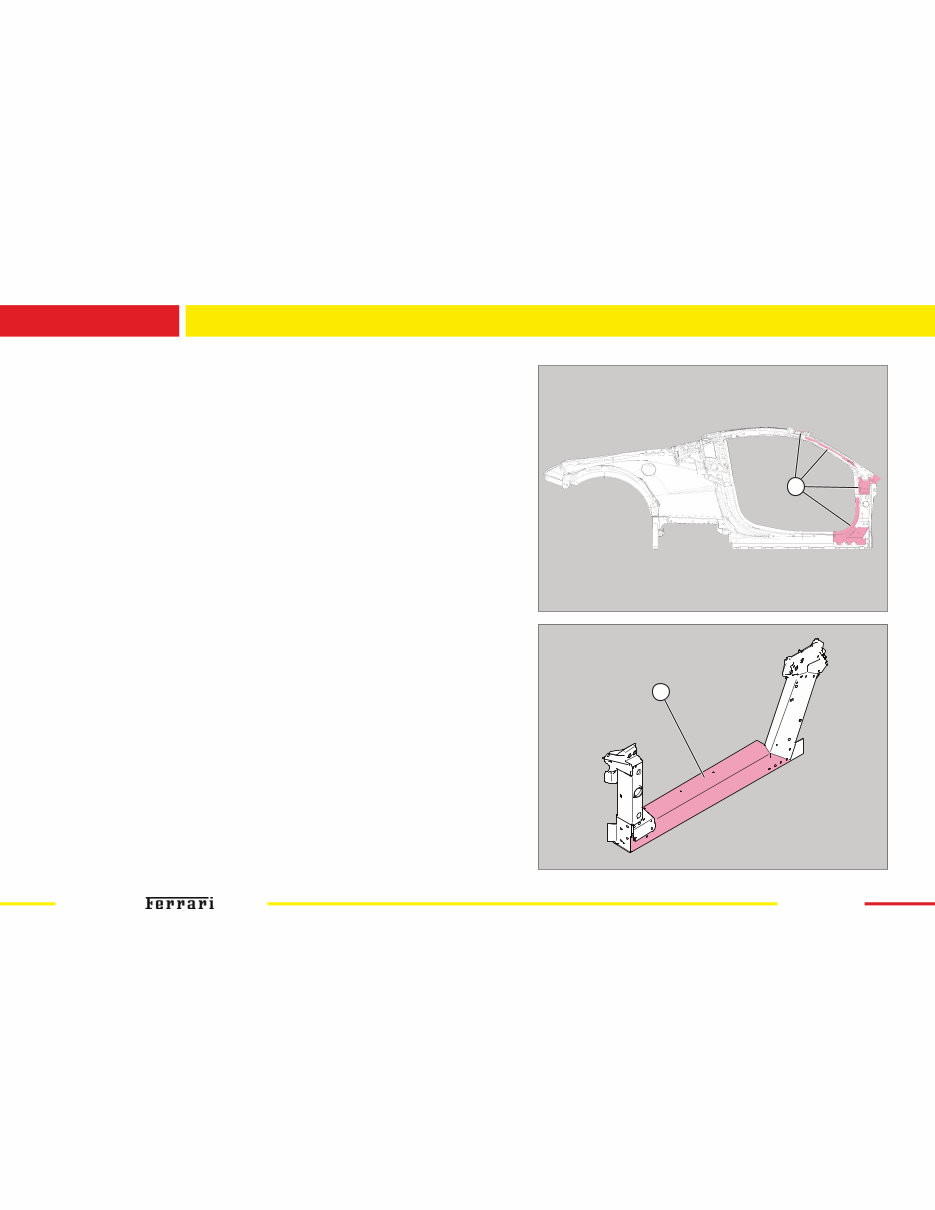
1.2 The bodywork concept of the Ferrari F458 Italia
In addition to extruded members, aluminium parts and sheet
metal elements, the Ferrari F458 Italia also features new joint
reinforcements for the space frame structure; together, they
form the bodywork structure.
These ultra-high strength steel reinforcements (A) , installed
in the two A -pillars, offer occupants greater safety in critical
situations.
A
The ultra-strong extruded sections of the A -pillars are concealed
below the steel reinforcements. The sections are joined to the
extruded members of the sill (B) by die-cast node joints.
The sill (B) of the Ferrari F458 Italia is oversized, as on a
B
cabriolet type vehicle. This means that the Ferrari F458 Italia
makes no compromises where crash safety is concerned.
Copyright © 2010
1.3 General safety instructions
Explanation of safety instructions
Danger!
“Danger” indicates imminent hazards that may result
in death or serious injury.
Warning!
“Warning” indicates potential hazards that may result
in death or serious injury.
Caution!
“Caution” indicates potential hazards that may result
in slight injury.
This symbol also indicates hazards to property.
NOTE!
“Note” indicates important information.
Copyright © 2010
1.3 General safety instructions
When carrying out any of the procedures described in this 1.3.2 Handling body and assembly components with sharp
repair manual, please observe all national accident safety
edges
regulations.
1.3.1 Lifting vehicles
Caution!
Risk of injury from sharp-edged burrs on body and
accessories.
Danger!
Risk of death from the vehicle toppling or slipping off
the vehicle lift.
• Align vehicle centrally between the vehicle lift columns.
• Raise the vehicle only at the specific locating points.
• Ensure the lifting pads are seated correctly, lifting the
vehicle slowly while monitoring the vehicle visually.
• Before removing any components and significantly shifting
the centre of gravity of the vehicle, ensure that the vehicle
itself is securely fastened to the vehicle.
Copyright © 2010
• Always wear protective gloves when working in the vicinity
of sharp-edged body and assembly components.
1.3 General safety instructions
1.3.3 Working in presence of aluminium dust
Warning!
Risk of explosion from high concentrations of aluminium
dust. Risk of injury from breathing in fine particulate.
• When carrying out any work that creates fine particles of
dust, wear a fine dust mask, safety goggles and protective
gloves.
• Any grinding work must be carried out with explosion-
protected air extraction systems; do not blow off dust
deposits with compressed air.
• Clean the work area and the extraction system regularly.
• To prevent a dust explosion, all extraction systems must
be earthed and suitable powder extinguishers must be
provided.
• Any vehicle parts in the repair area which may be damaged
by dust should be removed from the area or covered with
fire-resistant covers.
Copyright © 2010
1.3.4 Handling batteries
Warning!
Risk of explosion and fire from flying sparks during
grinding and welding work. Risk of damage to vehicle
components and other vehicles from flying sparks.
• Before carrying out any welding work, always remove both
battery terminal clamps and cover the battery terminals.
• Remove the vehicle battery before carrying out any work
that may produce sparks in the vicinity of the battery itself.
• Disconnect the battery earth strap when carrying out any
vehicle body repair work and when working on the airbag
system.
1.3 General safety instructions
1.3.5 Grinding and welding • When welding, wear suitable, non-flammable protective
clothing and gloves.
Warning!
Risk of explosion and fire when welding in the vicinity
of highly flammable substances. Irritation of the
respiratory tract caused by toxic gases produced
during welding. Risk of injury from the extremely bright
arc and welding splashes when welding. Risk of injury
as a result of inadvertent activation of pyrotechnic
safety components.
Risk of explosion and fire from flying sparks during
grinding and welding work. Risk of damage to vehicle
components and other vehicles from flying sparks.
• When carrying out grinding and welding work around the
fuel tank or fuel-carrying parts, ensure that these parts do
not heat up. If in doubt, remove such parts.
• Cover the grinding and welding area with fire-resistant
covers.
• Use the specific visor when welding.
• Partition off workstations with spark protection curtains.
• A fire extinguisher must always be accessible in the
immediate vicinity of the welding area.
• Remove or cover any vehicle parts located in the repair
area.
• Always carry out grinding and welding work with an
extraction system.
• Clean the air extraction system at regular intervals.
• Never carry out welding and grinding work at the same time
in the same room.
Copyright © 2010
1.3 General safety instructions
1.3.6 Removing sealants
Danger!
Risk of death from inhaling toxic vapours. Risk of burns
in the event of direct skin contact with hydrochloric
acid.
• Hydrochloric acid is produced when PVC sealant is heated
to over 180 °C.
• PVC sealant must only be removed with a rotary wire
brush or by heating to max. 180 °C with a hot air gun and
removing with a spatula.
• Always wear a dust mask and protective goggles when
removing sealant with a rotary brush.
• Always ensure there is sufficient air extraction and fresh air
ventilation.
Copyright © 2010
1.3.7 Handling chemicals
Caution!
Handling chemicals may cause allergic skin and
respiratory tract reactions.
• Always ensure that there is sufficient air extraction
and ventilation, and extract any vapours released by
adhesives.
• Prevent chemicals from coming into direct contact with the
eyes and skin.
• Wear protective gloves, protective goggles and, where
necessary, an apron.
• Immediately change out of work clothes that are soiled with
adhesive or solvent.
• At the end of the job, wash your hands and apply protective
cream.
• Always keep a bottle of eye wash ready for use.
• Only store adhesive products in the safety cupboard and
keep them away from naked flames and other sources of
ignition.
1.3 General safety instructions
1.3.8 Working with the air conditioning system
Warning!
Risk of injury from the charged air conditioning system
exploding during welding work.
Do not weld, solder or work with a hot air gun in the vicinity of
the components of a charged air conditioning system. Similarly,
do not perform any welding work on a vehicle if the work will
cause parts of the air conditioning system to heat up.
When carrying out a paint repair, object temperatures in the
drying oven or preheating zone must not exceed 80 °C as
the overpressure caused by heating process may cause the
system to explode.
Copyright © 2010
1.3.9 Handling the airbag system
Caution!
Risk of injury from activation of airbag units if earth
strap is not disconnected.
Disconnect the battery earth strap when carrying out any vehicle
body repair work and when working on the airbag system.
Wash hands thoroughly after touching airbag units that have
been fired.
1.3.10 Working with tools
Warning!
Risk of injury. All tools pose potential hazards to health
and life. Always observe the safety instructions and
warnings of the tool manufacturers.
1.4 Important information
1.4.1 Assessing the extent of the damage 1.4.2 Instructions for body repairs
In the case of accidents involving substantial areas of the
vehicle, examine the following components carefully to
prevent any damage to vehicle or suspension parts from going
undiscovered:
• Check tyres and wheel rims for damage.
• Check that the steering tie-rod, steering linkages and
steering system are working correctly. Also check for
external damage and cracks.
• Check all chassis components, such shock absorbers,
suspension and steering joints, links, axles, anti-roll bars
and their fasteners, for external damage or cracks.
• Check brake system components such as brake discs,
brake pads, brake callipers, hydraulic lines and hydraulic
hoses and their respective fastenings for external damage,
stretching or leaks.
• Check engine, gearbox, axle and exhaust system mounts
for damage.
• Before returning the vehicle to the customer following a
repair, test drive the vehicle carefully to ensure that it is
roadworthy.
• Repair work on the Ferrari F458 Italia must only be carried
out by repair personnel who have been trained, tested and
certified by the Ferrari Customer Service department.
• Use only Ferrari-approved tools, spare parts and
consumables for repair and maintenance work.
• If, in the course of the repair work, special cases arise that
are not envisaged by the repair instructions, contact the
Ferrari Technical Customer service to establish how to
proceed further.
• All the main repair operations possible for the Ferrari
F458 Italia are described in this repair manual. Combined
instructions may be used to differentiate between different
repair procedures. Only the right or left hand components
are illustrated in the description of a repair.
• To ensure that the original crash safety of the vehicle is
maintained after a body repair, always used the same
chassis joint points.
• Cuts that may affect the crash safety of the body, and
thereby the safety and roadworthiness of the vehicle, must
always be approved by Ferrari.
Copyright © 2010
You're Reading a Preview
What's Included?
Lifetime Access
Access PDF Contents & Bookmarks
Print one or all pages of your manual



 Lifetime Access