



1995 DODGE INTREPID Service and Repair Manual
What's Included?
 Lifetime Access
Fast Download Speeds
Offline Viewing
Access Contents & Bookmarks
Full Search Facility
Print one or all pages of your manual

ENGINES
CONTENTS
page page
3. 3L ENGINE .......................... 12
3. 5L ENGINE .......................... 48
ENGINE DIAGNOSIS ...................... 7
STANDARD SERVICE INFORMATION ........ 1
STANDARD SERVICE INFORMATION
INDEX
page page
GENERAL INFORMATION
CHECKING ENGINE OIL LEVEL ............. 3
ENGINE OIL SERVICE .................... 4
ENGINE PERFORMANCE ................. 2
FORM-IN-PLACE GASKETS ................ 1
MEASURING MAIN BEARING AND
CONNECTING ROD BEARING
CLEARANCES ........................ 2
SERVICE PROCEDURES
ENGINE CORE PLUGS ................... 6
HONING CYLINDER BORES ............... 5
HYDROSTATIC LOCKED ENGINE ........... 5
REPAIR OF DAMAGED OR WORN THREADS .. 5
GENERAL INFORMATION
FORM-IN-PLACE GASKETS
There are numerous places where form-in-place
gaskets are used on theengine. Care must be taken
when applying form-in-place gaskets to assure
obtaining the desired results. Do not use form-in-
place gasket material unless specified. Bead size,
continuity , and location are of great importance. T oo
thin a bead can result in leakage while too much can
result in spill-over which can break off and obstruct
fluid feed lines. A continuous bead of the proper
width is essential toobtain a leak-free gaskets.
There are numerous types of form-in-place gasket
materials are used in the engine area. Mopar Sili-
cone Rubber Adhesive Sealant and Mopar Gasket
Maker gasket materials, eachhave different proper-
ties and cannot be used in place of the other .
MOPAR SILICONE RUBBER ADHESIVE
SEALANT
Mopar Silicone Rubber Adhesive Sealant or equiv-
alent, normally black in color , is available in three
ounce tubes. Moisture in the air causes the Mopar
Silicone Rubber Adhesive Sealant material tocure.
This material is normally used on flexible metal
flanges. It has a shelf life of one year and will not
properly cure ifover age. Always inspectthe package
for theexpiration date before use.
MOPAR GASKET MAKER
Mopar Gasket Maker is an anaerobic type gasket
material. The material cures in the absence of air
when squeezed between two metallic surfaces. It will
not cure if left in the uncovered tube. The anaerobic
material is for use between two machined surfaces.
Do not use on flexible metal flanges.
GASKET DISASSEMBLY
Parts assembled with form-in-place gaskets may be
disassembled without unusual effort. In some
instances, it may be necessary to lightly tap the part
with a mallet or other suitable tool to break the seal
between the mating surfaces. Aflat gasket scraper
may also be lightly tapped into the joint but care
must be takennotto damage the mating surfaces.
SURFACE PREPARATION
Scrape clean or wire brush all gasket surfaces
removing all loose material. Inspect stampedparts to
assure gasket rails are flat. Flatten rails with a ham-
mer on a heavy steel plate if required. Gasket sur-
faces must be free of oil and dirt. Make sure old
gasket material is removed from blind attaching
holes.
LH ENGINES 9 - 1
FORM-IN-PLACE GASKET APPLICATION
Assembling parts using a form-in-place gasket
requires care but it’s easier thenusing precut gas-
kets.
Mopar Gasket Maker material should be applied
sparingly 1 mm (0.040 inch.) diameter or less of seal-
anttoone gasket surface. Be certain the material
surrounds each mounting hole. Excess material can
easily be wiped off. Componentsshould be torqued in
place within 15 minutes. The use of a locating dowel
is recommended during assembly to prevent smear-
ing material off the location.
The Mopar Silicone Rubber Adhesive Sealant gas-
ket material or equivalent should be applied in a con-
tinuous bead approximately 3 mm (0.120 inch) in
diameter . All mounting holes must be circled. For
corner sealing, a 3.17 or 6.35 mm (1/8 or 1/4 inch.)
drop is placed in the center of the gasket contact
area. Uncured sealant may be removed with a shop
towel. Componentsshould be torqued in place while
the sealant isstill wetto the touch (within 10 min-
utes). The usage of a locating dowelis recommended
during assembly to prevent smearing material off the
location.
ENGINE PERFORMANCE
If a loss of performance is noticed, ignition timing
should be checked. If ignition timing is retarded by 9,
18 or 27° “it indicates” 1, 2 or 3 (timing belt or chain)
teeth may have skipped. The camshaft and crank-
shafttiming should be checked. Refer to Engine Tim-
ing Sprockets and Oil Seals of the Engine Section.
T o provide best vehicle performance and lowest
vehicle emissions, it is most important that the
tune-up be done accurately . Use the specifications
listed on the V ehicle Emission Control Information
label found in theengine compartment.
(1) T est cranking amperage draw. See Starting
Motor Cranking Amperage Draw ElectricalSection of
this manual.
(2) Tighten the intake manifold bolts to specifica-
tions.
(3) Perform cylinder compression test. See diagno-
sis and testing in thissection.
(4) Clean orreplace spark plugs as necessary and
adjust gap asspecified in Electrical Group 8. Tighten
to specifications.
(5) T est resistance of spark plug cables. Refer to
Ignition System Secondary Circuit Inspection Electri-
calSection Group 8.
(6) Inspectthe primary wire. T est coil output volt-
age, primary and secondary resistance. Replace parts
as necessary . Refer to Ignition System and make nec-
essary adjustment.
(7) T est fuel pump for correct pressure. Refer to
FuelSystem Group 14, Specifications.
(8) The air filter elements should be replaced as
specified in Lubrication and Maintenance, Group 0.
(9) Inspect crankcase ventilation system as out
lined in Lubrication and Maintenance, Group 0. For
emission controlssee Emission Controls Group 25 for
service procedures.
(10) Inspect and adjust accessory belt drives refer-
ring to Accessory Belt Drive in Cooling System,
Group 7 for proper adjustments.
(11) Road test vehicle as a final test.
MEASURING MAIN BEARING AND CONNECTING
ROD BEARING CLEARANCES
PLASTIGAGE METHOD
Engine crankshaft bearing clearances can be deter-
mined by use of Plastigage or equivalent. The follow-
ing is the recommended procedure for the use of
Plastigage:
NOTE: The total clearance of the main bearings
can only be determined by removing the weight of
the crankshaft. This can be accomplished by either
of two methods:
PREFERRED METHOD
Shimming the bearings adjacentto the bearing to
be checked in order to remove the clearance between
upper bearing shell and the crankshaft. This can be
accomplished by placing a minimum of 0.254 mm
(0.010 in.) shim (e. g. cardboard, matchbook cover ,
etc.) between the bearing shell and the bearing cap
on the adjacent bearings and tightening bolts to
14-20 N·m (10-15 ft. lbs.). The number of main bear-
ing will vary from engine to engine.
ENGINE WITH 5 MAIN BEARINGS
• When checking #1 main bearing shim #2 main
bearing.
• When checking #2 main bearing shim #1 & 3
main bearing.
• When checking #3 main bearing shim #2 & 4
main bearing.
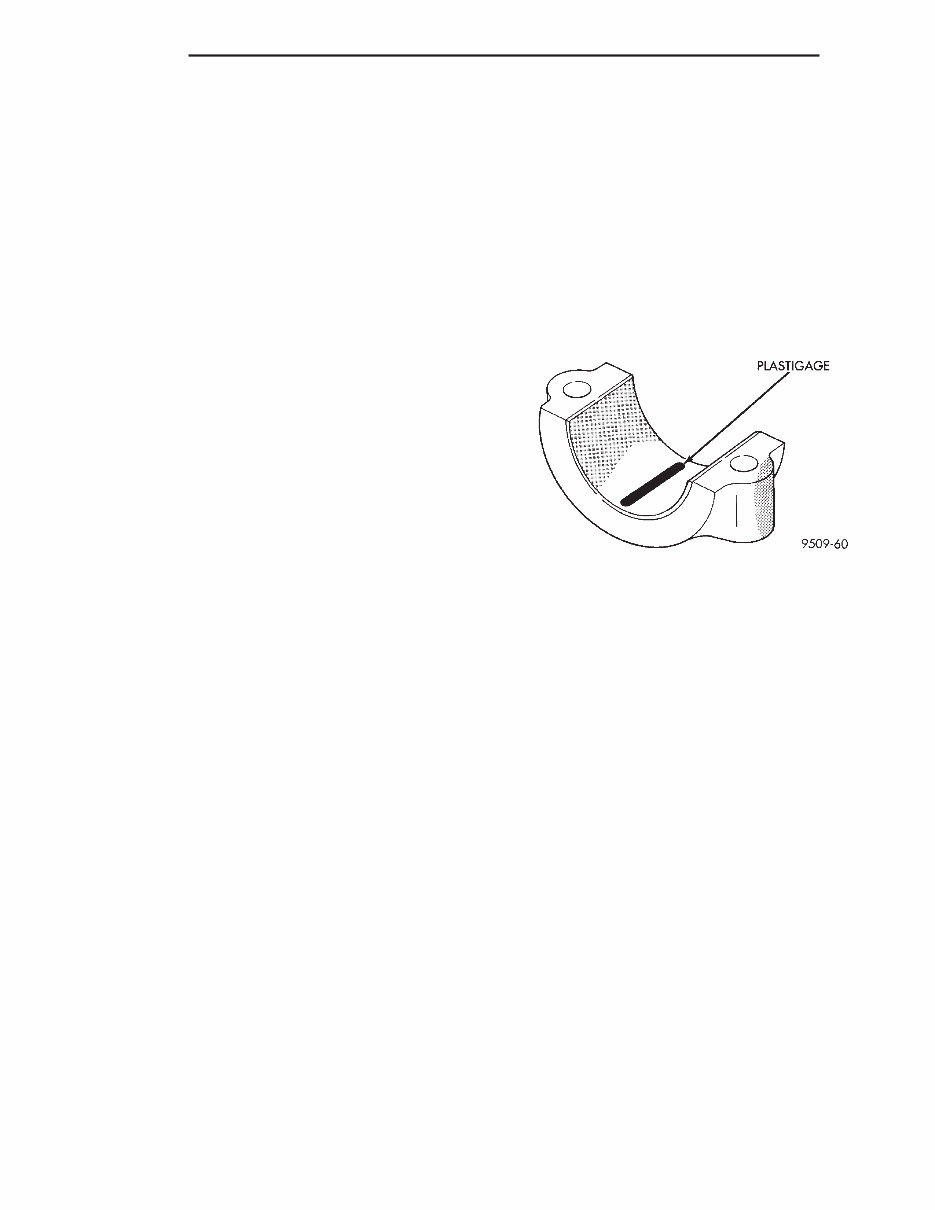
Fig. 1 Plastigage Placed in Lower Shell
PLASTIGAGE
9 - 2 ENGINES LH
GENERAL INFORMATION (Continued)
• When checking #4 main bearing shim #3 & 5
main bearing.
• When checking #5 main bearing shim #4 main
bearing.
ENGINE WITH 4 MAIN BEARING
• When checking #1 main bearing shim #2 main
bearing.
• When checking #2 main bearing shim #1 & #3
main bearing.
• When checking #3 main bearing shim #2 & #4
main bearing.
• When checking #4 main bearing shim #3 main
bearing.
NOTE: REMOVE ALL SHIMS BEFORE REASSEM-
BLING ENGINE
ALTERNATIVE METHOD
The weight of the crankshaft can be supported by a
jack under the counterweight adjacentto the bearing
being checked.
PLASTIGAGE PROCEDURE
(1) Remove oil film from surface to be checked.
Plastigage issoluble in oil.
(2) Place a piece of Plastigage across the entire
width of the bearing shell in the cap approximately
6.35 mm (1/4 in.) off center and away from the oil
holes (Fig. 1). (In addition, suspected areas can be
checked by placing the Plastigage in the suspected
area). T orque the bearing cap bolts of the bearing
being checked to the proper specifications.
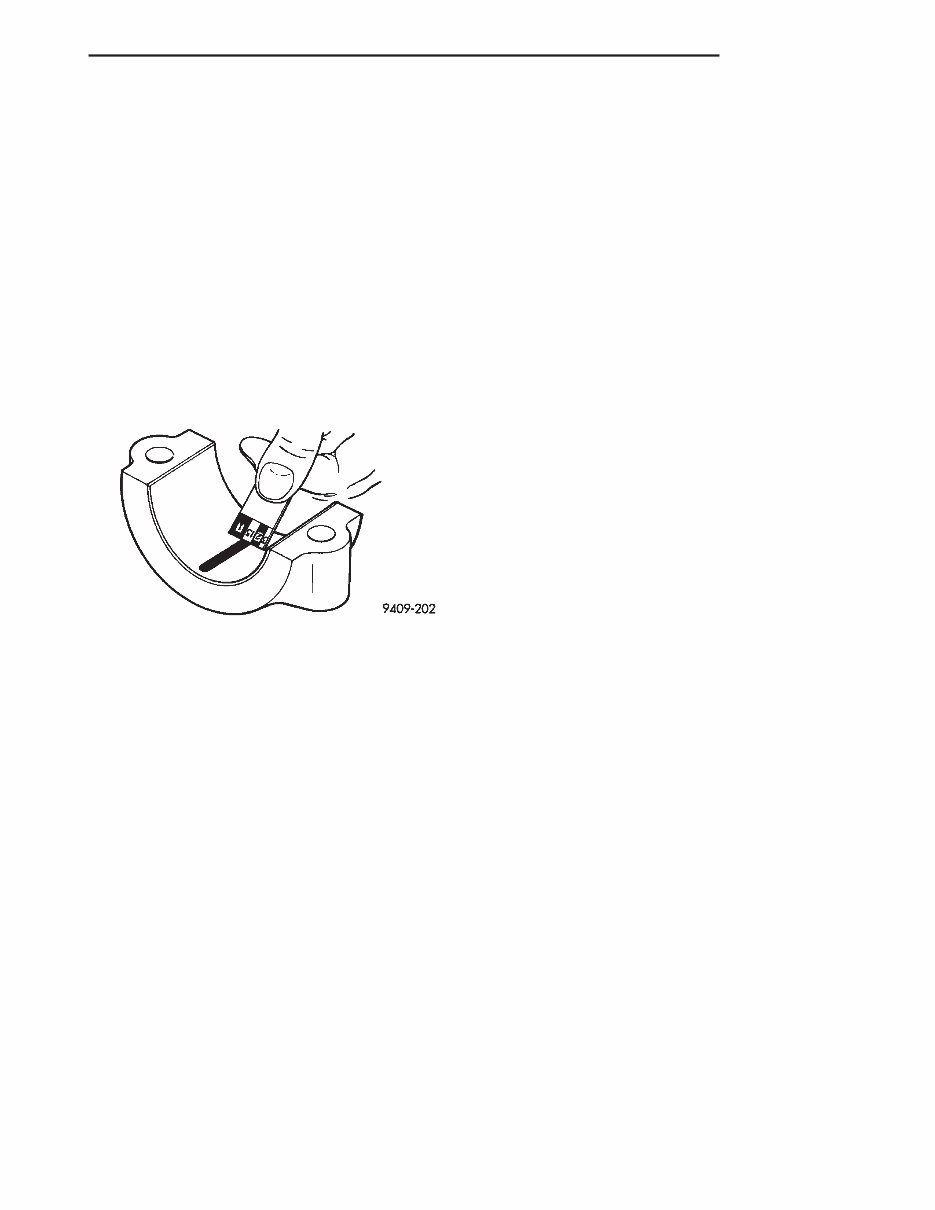
(3) Remove the bearing cap and compare the
width of the flattened Plastigage (Fig. 2) with the
metric scale provided on the package. Locate the
band closestto the same width. This band shows the
amount of clearance in thousandths of a millimeter .
Differences in readings between theends indicate the
amount of taper present. Record all readings taken.
Refer to Engine Specifications. Plastigage gener-
ally is accompanied by two scales. Onescale is
in inches, the other is a metric scale.
NOTE: Plastigage is available in a variety of clear-
ance ranges. Use the most appropriate range for
the specifications you are checking.
CONNECTING ROD BEARING CLEARANCE
Engine connecting rod bearing clearances can be
determined by use of Plastigage or equivalent. The
following is the recommendedprocedure for the use
of Plastigage:
(1) Rotate the crankshaft until the connecting rod
to be checked is atthe bottom of itsstroke.
(2) Remove oil film from surface to be checked.
Plastigage issoluble in oil.
(3) Place a piece of Plastigage across the entire
width of the bearing shell in the bearing cap approx-
imately 6.35 mm (1/4 in.) off center and away from
the oil hole (Fig.1). In addition, suspect areas can be
checked by placing plastigage in the suspect area.
(4)Assemble the rod cap with Plastigage in place.
Tighten the rod cap to the specified torque. Do not
rotate the crankshaft while assembling the cap
orthe Plastigage may besmeared, giving inac-
curate results.
(5) Remove the bearing cap and compare the
width of the flattened Plastigage (Fig. 2) with the
scale provided on the package. Locate the band clos-
est to the same width. This band indicates the
amount of oil clearance. Differences in readings
between the ends indicate the amount of taper
present. Record all readings taken. Refer to Engine
Specifications. Plastigage generally is accompa-
nied by two scales. Onescale is in inches, the
other is a metric scale. If the bearing clearance
exceeds 0.076 mm (0.003 in.) replace bearing.
NOTE: Plastigage is available in a variety of clear-
ance ranges. Use the most appropriate range for
the specifications you are checking.
CHECKING ENGINE OILLEVEL
The besttime tocheck engine oil levelis after it
hassat overnight, or if theengine has been running,
allow theengine to be shut off for at least 5 minutes
before checking oil level.
Checking the oil while the vehicle is on level
ground will improve the accuracy of the oil level
reading. Add only when the levelis at or below the
ADD mark.
Fig. 2 Clearance Measurement
LH ENGINES 9 - 3
GENERAL INFORMATION (Continued)
ENGINE OIL SERVICE
WARNING: NEW OR USED ENGINE OIL CAN BE
IRRITATING TO THE SKIN. AVOID PROLONGED OR
REPEATED SKIN CONTACT WITH ENGINE OIL.
CONTAMINANTS IN USED ENGINE OIL, CAUSED BY
INTERNAL COMBUSTION, CAN BE HAZARDOUS TO
YOUR HEALTH. THOROUGHLY WASH EXPOSED
SKIN WITH SOAP AND WATER. DO NOT WASH
SKIN WITH GASOLINE, DIESEL FUEL, THINNER, OR
SOLVENTS, HEALTH PROBLEMS CAN RESULT. DO
NOT POLLUTE, DISPOSE OF USED ENGINE OIL
PROPERLY. CONTACTYOUR DEALER OR GOVERN-
MENT AGENCY FOR LOCATION OF COLLECTION
CENTER IN YOUR AREA.
API SERVICE GRADE CERTIFIED
Use an engine oil that is API Service Grade Certi-
fied or an oil that conforms to the API Service Grade
SH or SH/CD. MOPAR provides engine oils that con-
form to all of these service grades.
SAE VISCOSITY
An SAE viscositygrade is used to specify the vis-
cosity of engine oil. SAE 30 specifies a single viscos-
ity engine oil. Engine oils also have multiple
viscosities. These are specified with a dualSAE vis-
cositygrade which indicates the cold-to-hottempera-
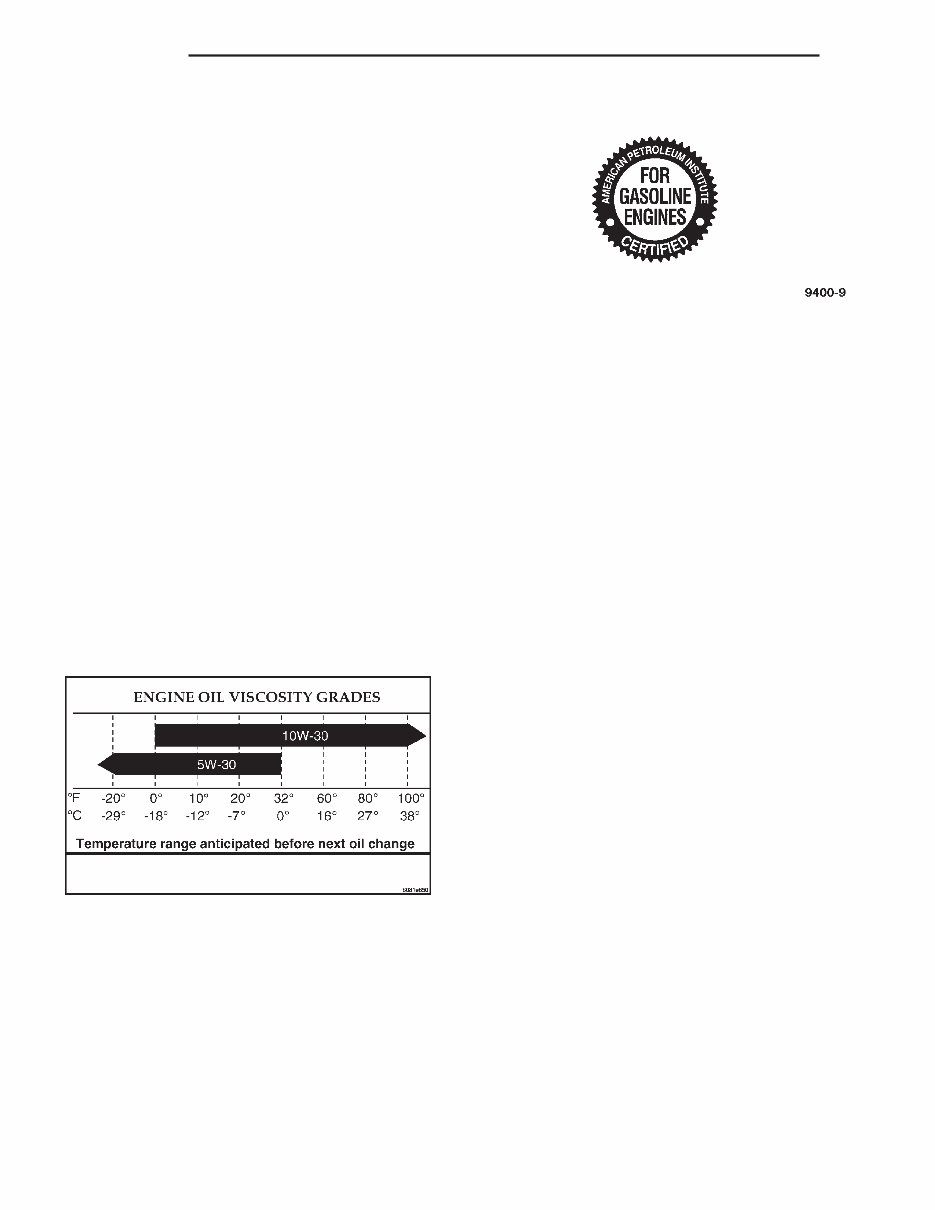
ture viscosity range. Select an engine oil that is best
suited to your particular temperature range and vari-
ation (Fig.3).
ENERGY CONSERVING OIL
An Energy Conserving type oil is recommended for
gasoline engines. They are designated as either
ENERGY CONSERVING or ENERGY CONSERV-
ING II.
CONTAINER IDENTIFICATION
Standard engine oil identification notations have
been adopted to aid in the proper selection of engine
oil. The identifying notations are located on the label
of engine oil plastic bottles and the top of engine oil
cans (Fig.4).
ENGINE OIL CHANGE
Change engine oil at mileage and time intervals
described in the Maintenance Schedule.
TO CHANGEENGINE OIL
Run engine until achieving normal operating tem-
perature.
(1) Position the vehicle on a level surface and turn
engine off.
(2) Hoist and support vehicle on safety stands.
Refer to Hoisting and Jacking Recommendations.
(3) Remove oil fill cap.
(4) Place a suitable drain pan under crankcase
drain.
(5) Remove drain plug from crankcase and allow
oil to drain into pan. Inspect drain plug threads for
stretching or other damage. Replace drain plug and
gasket if damaged.
(6) Install drain plug in crankcase.
(7) Lower vehicle and fill crankcase with specified
type and amount of engine oil described in thissec-
tion.
(8) Install oil fill cap.
(9) Start engine and inspect for leaks.
(10) Stop engine and inspect oil level.
ENGINE OIL FILTER CHANGE
FIL TERSPECIFICATION
All engines areequipped with a high quality full-
flow, disposable type oil filter . Chrysler Corporation
recommends a Mopar or equivalent oil filter be used.
OIL FIL TERREMOVAL
Refer to Removal and Installation Section in Group
9, Engine for procedure.
USED ENGINE OIL DISPOSAL
Care should be exercised when disposing used
engine oil after it has been drained from a vehicle
engine. Refer to the WARNING listed above.
Fig. 3 Temperature/Engine Oil Viscosity
ENGINE OIL VISCOSITY GRADES Tem erature range antici ated before next oil change
Fig. 4 Engine Oil Container Standard Notations
9 - 4 ENGINES LH
GENERAL INFORMATION (Continued)
SERVICE PROCEDURES
REPAIR OF DAMAGED OR WORN THREADS
Damaged or worn threads (including aluminum
head spark plug threads)can be repaired. Essen-
tially , this repair consists of drilling out worn or
damaged threads, tapping the hole with a special
Heli-Coil Tap, (or equivalent) and installing an insert
into the tapped hole. This brings the hole back to its
original thread size.
CAUTION: Be sure that the tapped holes maintain
the original centerline.
Heli-Coil tools and inserts are readily available
from automotive parts jobbers.
HONING CYLINDER BORES
(1) Used carefully , the cylinder bore resizing hone
C-823 equipped with 220 grit stones, is the besttool
for this job. In addition to deglazing, it will reduce
taper and out-of-round as well as removing light
scuffing, scoring or scratches. Usually a few strokes
will cleanup a bore and maintain the required lim-
its.
(2) Deglazing of the cylinder walls may be done
using a cylinder surfacing hone, T ool C-3501,
equipped with 280 grit stones, if the cylinder bore is
straight and round. 20-60 strokes depending on the
bore condition, will be sufficientto provide a satisfac-
tory surface. Inspect cylinder walls after each 20
strokes, using a light honing oil. Do not use engine
or transmission oil, mineral spirits or kerosene.
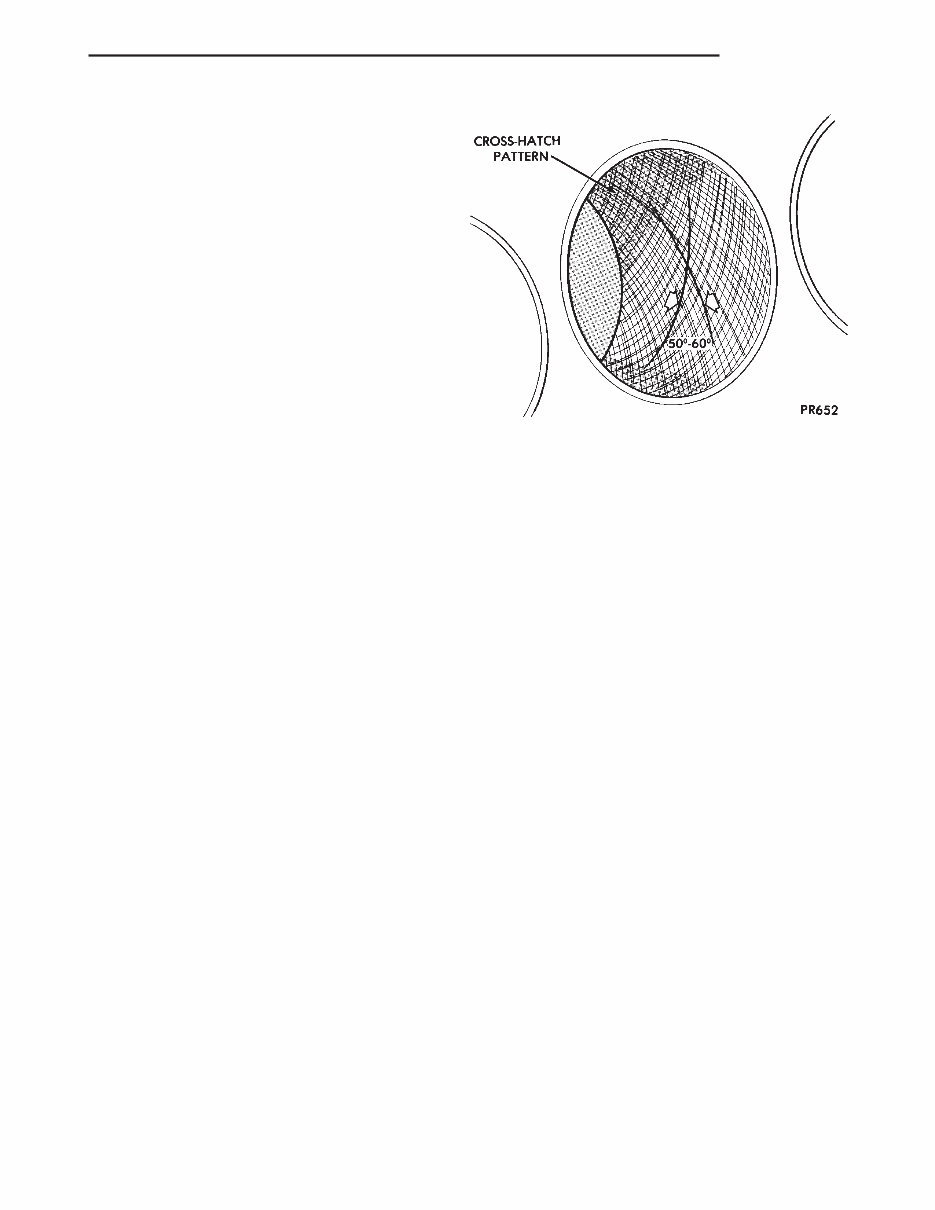
(3) Honing should be done by moving the hone up
and down fast enough to get a cross-hatch pattern.
When hone marks intersect at 50-60 degrees, the
cross hatch angle is most satisfactory for proper seat-
ing of rings (Fig.5).
(4) A controlled hone motor speed between
200-300 RPM is necessary toobtain the proper cross-
hatch angle. The number of up anddown strokes per
minute can be regulated to get the desired 50-60
degree angle. Faster up and down strokes increase
the cross-hatch angle.
(5) After honing, it is necessary thatthe block be
cleaned again to remove all traces of abrasive.
CAUTION: Ensure all abrasives are removed from
engine parts after honing. It is recommended that a
solution of soap and hot water be used with a
brush and the parts then thoroughly dried. The bore
can be considered clean when it can be wiped
clean with a white cloth and cloth remains clean.
Oil the bores after cleaning to prevent rusting.
HYDROSTATIC LOCKED ENGINE
When an engine issuspected to be hydrostatically
locked, regardless of what caused the problem, these
stepsshould be used.
CAUTION: Do Not Use Starter Motor To Rotate
Engine, severe damage may occur.
(1) Inspect air cleaner , induction system and
intake manifold to insure system is dry and clear of
foreign material.
(2) Remove negative battery cable.
(3) Place a shop towel around the spark plugs
when removing them from theengine. This will catch
any fluid that may possibly be in the cylinder under
pressure.
(4) With all spark plugs removed, rotate engine
crankshaft using a breaker bar and socket.
(5) Identify the fluid in the cylinder(s)(i.e., cool-
ant, fuel, oil or other).
(6) Make sure all fluid has been removed from the
cylinders. Inspect engine for damage (i.e., Connecting
Rods, Pistons, V alves etc.)
(7) Repair engine or components as necessary to
preventthis problem from occurring again.
CAUTION: Squirt approximately 1 teaspoon of oil
into cylinders, rotate engine to lubricate the cylin-
der walls to prevent damage on restart.
(8) Install new spark plugs.
(9) Drain engine oil and remove oil filter .
(10) Fill engine with specified amount of approved
oil and install new oil filter .
(11) Connect negative battery cable.
(12) Start engine and check for any leaks.
Fig. 5 Cylinder Bore Cross-Hatch Pattern
CROSS-HATCH PATTERN
LH ENGINES 9 - 5
You're Reading a Preview
What's Included?
Lifetime Access
Fast Download Speeds
Offline Viewing
Access Contents & Bookmarks
Full Search Facility
Print one or all pages of your manual
$37.99
$49.99
Viewed 95 Times Today


Secure transaction
What's Included?
Lifetime Access
Fast Download Speeds
Offline Viewing
Access Contents & Bookmarks
Full Search Facility
Print one or all pages of your manual
$37.99
$49.99
The 1995 DODGE INTREPID Service and Repair Manual is a comprehensive guide designed to assist you in maintaining and repairing your 1995 DODGE INTREPID vehicle.
With detailed step-by-step instructions, this manual provides you with the necessary knowledge and skills to perform a wide range of repairs and maintenance tasks on your 1995 DODGE INTREPID.
- Includes detailed instructions for engine repairs and maintenance
- Covers transmission repairs and servicing procedures
- Provides guidance on electrical system troubleshooting and repairs
- Includes information on suspension, steering, and brake system maintenance
- Offers troubleshooting tips and diagnostic procedures for common issues
- Explains the various systems and components of the 1995 DODGE INTREPID
- Includes specifications, diagrams, and illustrations to aid in your understanding
Whether you are a professional mechanic or a DIY enthusiast, this service and repair manual is an indispensable tool for ensuring the optimal performance and longevity of your 1995 DODGE INTREPID.
Invest in the 1995 DODGE INTREPID Service and Repair Manual today and take control of your vehicle's maintenance and repair needs.


