


The BEST 1996-1997 Dodge Caravan Factory Service Manual
What's Included?
 Lifetime Access
Fast Download Speeds
Offline Viewing
Access Contents & Bookmarks
Full Search Facility
Print one or all pages of your manual

TRANSAXLE AND POWER TRANSFER UNIT
CONTENTS
page page
31TH AUTOMATIC TRANSAXLE ............. 1
41TE AUTOMATIC TRANSAXLE ............ 71
POWER TRANSFER UNIT ................ 154
31TH AUTOMATIC TRANSAXLE
INDEX
page page
GENERAL INFORMATION
31TH TRANSAXLE ....................... 2
FLUID LEVEL AND CONDITION ............. 2
SELECTION OF LUBRICANT ............... 3
SPECIAL ADDITIVES ..................... 3
DESCRIPTION AND OPERATION
CLUTCHES, BAND SERVOS, AND ACCUMULATOR . 3
FLOW CONTROL VALVES ................. 3
GEARSHIFT AND PARKING LOCK CONTROLS . 4
GOVERNOR ............................ 4
HYDRAULIC CONTROL SYSTEM ............ 3
PRESSURE REGULATING VALVES .......... 3
PRESSURE SUPPLY SYSTEM .............. 3
TORQUE CONVERTER CLUTCH SOLENOID
WIRING CONNECTOR ................... 4
TORQUE CONVERTER CLUTCH ............ 3
DIAGNOSIS AND TESTING
CLUTCH AND SERVO AIR PRESSURE TESTS . 15
FLUID LEAKAGE-TRANSAXLE TORQUE
CONVERTER HOUSING AREA ........... 16
HYDRAULIC PRESSURE TESTS ........... 13
ROAD TEST ........................... 13
THREE SPEED TRANSAXLE DIAGNOSIS AND
TESTS ............................... 4
SERVICE PROCEDURES
ALUMINUM THREAD REPAIR .............. 17
FLUID AND FILTER CHANGE .............. 17
FLUID DRAIN AND REFILL ................ 17
FLUSHING COOLERS AND TUBES .......... 17
OIL COOLER FLOW CHECK ............... 18
REMOVAL AND INSTALLATION
FRONT PUMP OIL SEAL .................. 20
PARK/NEUTRAL STARTING AND BACK-UP
LAMP SWITCH ........................ 18
TRANSAXLE AND TORQUE CONVERTER
REMOVAL ........................... 19
VEHICLE SPEED SENSOR PINION GEAR .... 18
DISASSEMBLY AND ASSEMBLY
ACCUMULATOR-RECONDITION ............ 36
DIFFERENTIAL REPAIR .................. 45
FRONT CLUTCH-RECONDITION ........... 31
FRONT PLANETARY & ANNULUS GEAR-
RECONDITION ........................ 34
KICKDOWN SERVO (CONTROLLED LOAD)-
RECONDITION ........................ 36
LOW/REVERSE (REAR) SERVO-RECONDITION .. 35
OIL PUMP-RECONDITION ................. 28
OUTPUT SHAFT REPAIR ................. 42
PARKING PAWL ........................ 41
REAR CLUTCH-RECONDITION ............. 32
TRANSAXLE ........................... 20
TRANSFER SHAFT REPAIR ............... 37
VALVE BODY RECONDITION .............. 24
CLEANING AND INSPECTION
VALVE BODY .......................... 50
ADJUSTMENTS
BAND ADJUSTMENT .................... 51
BEARING ADJUSTMENT PROCEDURES ..... 51
DIFFERENTIAL BEARING ................. 52
GEARSHIFT CABLE ADJUSTMENT .......... 50
HYDRAULIC CONTROL PRESSURE
ADJUSTMENTS ....................... 51
OUTPUT SHAFT BEARING ................ 52
THROTTLE PRESSURE LINKAGE
ADJUSTMENT ........................ 51
TRANSFER SHAFT BEARING .............. 53
SCHEMATICS AND DIAGRAMS
31TH TRANSAXLE HYDRAULIC SCHEMATIC . . 54
SPECIFICATIONS
31 TH TRANSAXLE SPECIFICATIONS ....... 63
31TH TORQUE SPECIFICATIONS ........... 65
SPECIAL TOOLS
SPECIAL TOOLS—31TH AUTOMATIC
TRANSAXLE ......................... 66
NS/GS TRANSAXLEAND POWER TRANSFER UNIT 21 - 1

GENERAL INFORMATION
31TH TRANSAXLE
NOTE: Safety goggles should be worn at all times
when working on these transaxles.
This transaxle combines torque converter , three
speed transmission, final drive gearing, anddifferen-
tial into a front wheel drive system. The identifica-
tion markings and usage of the transaxle are charted
in Diagnosis and T ests.
NOTE: Transaxle operation requirements are differ-
ent for each vehicle and engine combination. Some
internal parts will be different to provide for this.
Therefore, when replacing parts, refer to the seven
digit part number stamped on rear of the transaxle
oil pan flange.
Within this transaxle, there are three primary
areas:
(1) Main center line plus valve body .
(2) Transfer shaft center line (includes governor
andparking sprag).
(3) Differential center line.
(4) Center distances between the main rotating
parts in these three areas are heldprecise to main-
tain a low noise level.
(5) The torque converter , transaxle area, and dif-
ferential are housed in an integral aluminum die
casting. The differential oil sump is common
with the transaxlesump. Separate filling of the
differential is NOT necessary .
(6) The torque converter is attached to the crank-
shaftthrough a flexible driving plate. Cooling of the
converter is accomplished by circulating the tran-
saxle fluid through a remote cooler . There are two
types of coolers used. An oil-to-water type cooler
located in the radiator side tank and/or an oil-to air
heat exchanger . The torque converter assembly is a
sealed unitthat cannot be disassembled.
(7) The transaxle fluid is filtered by an internal fil-
ter attached to the lower side of the valve body
assembly .
(8) Engine torque is transmitted to the torque con-
verter then, through the input shaftto multiple-disc
clutches in the transaxle. The power flow depends on
the application of the clutches and bands. Refer to
Elements in Use Chart in Diagnosis and T estssec-
tion.
(9) The transaxle consists of:
• Two multiple-discclutches
• An overrunning clutch
• Two servos
• A hydraulic accumulator
• Two bands
• Two planetarygear sets
This provides three forward ratios and a reverse
ratio. The common sun gear of the planetary gear
sets is connected to the front clutch by a driving
shell. The drive shell issplined to the sun gear and
front clutch retainer . The hydraulic system consists
of an oil pump, and a single valve body which con-
tains all of the valves exceptthe governor valves.
The transaxle sump and differential sump are both
vented through the dipstick. Outputtorque from the
main center line is delivered throughhelical gears to
the transfer shaft. This gear set is a factor of the
final drive (axle) ratio. The shaft alsocarries the gov-
ernor andparking sprag. An integral helical gear on
the transfer shaft drives the differential ring gear .
The final drive gearing is completed with one of two
gearratios of 2.98 or 3.19 depending on model and
application.
FLUID LEVEL AND CONDITION
NOTE: The transmission and differential sump have
a common oil sump with a communicating opening
between the two.
The torque converter fills in both the PPark and N
Neutral positions. Place the selector lever in PPark
to be sure thatthe fluid level check is accurate. The
engineshould be running at idlespeed for at
least one minute, with the vehicle on level
ground. This will assure complete oillevel sta-
bilization between differential and transmis-
sion. The fluid should be at normal operating
temperature (approximately 82 C. or 180 F .). The
fluid levelis correct if it is in the HOT region (cross-
hatched area)on the dipstick.
Low fluid level can cause a variety of conditions
because it allows the pump to take in air along with
the fluid. As in any hydraulic system, air bubbles
make the fluid spongy , therefore, pressures will be
low and build up slowly .
Improper filling can also raise the fluid level too
high. When the transaxle has too much fluid, the
gears churnup foam and cause the same conditions
which occur with a low fluid level.
In either case, the air bubbles can cause overheat-
ing, fluid oxidation, and varnishing. This can inter-
fere withnormal valve, clutch, and servooperation.
Foaming can also result in fluid escaping from the
transaxle dipstick where it may be mistaken for a
leak.
Along with fluid level, it is importanttocheck the
condition of the fluid. When the fluid smells burned,
and is contaminated with metal or friction material
particles, a complete transaxle overhaul is needed.
Be sure to examine the fluid on the dipstick closely .
21 - 2 TRANSAXLEAND POWER TRANSFER UNIT NS/GS

If there is any doubt about its condition, drain out a
sample for a double check.
SELECTION OF LUBRICANT
It is importantthatthe proper lubricant be used in
these transmissions. Mopar ATF PLUS (Automatic
Transmission Fluid-Type 7176) should be used to aid
in assuring optimum transmission performance. Flu-
ids of the type labeled DEXRON II Automatic Trans-
mission Fluid should be used only if the
recommended fluid is not available. If more than a
small amount of Dexron fluid is used, shudder or
shift quality problems may be encountered. It is
importantthatthe transmission fluid be maintained
atthe prescribed level using the recommended fluids.
SPECIAL ADDITIVES
Chrysler Corporation does not recommend the
addition of any fluids to the transmission, other than
fluid listed above. An exception to this policy is the
use of special dyes to aid in detecting fluid leaks. The
use of transmission sealersshould be avoided, since
they may adversely affect seals.
DESCRIPTION AND OPERATION
TORQUECONVERTER CLUTCH
A torque converter clutch isstandard on all vehi-
cles. The torque converter clutch is activated only in
direct drive and is controlled by theengineelectron-
ics. A solenoid on the valve body , is powered by the
powertrain control module to activate torque con-
verter clutch.
HYDRAULIC CONTROL SYSTEM
The hydraulic control systemmakes the transaxle
fully automatic, and has four important functions to
perform. The components of any automatic control
system may be grouped into the following basic
groups:
The pressure supply system, the pressure regulat-
ingvalves, the flow control valves, the clutches, and
band servos.
Taking each of these basic groups or systems in
turn, the control systemmay be described as follows:
PRESSURE SUPPL Y SYSTEM
The pressure supply system consists of an oil pump
driven by the engine through the torque converter .
The single pump furnishes pressure for all the
hydraulic and lubrication requirements. Oil pump
housing assemblies are available with prese-
lectedpump gears.
PRESSURE REGULATING VAL VES
The pressure regulating valve controls line pres-
sure dependent on throttle opening. The governor
valve transmits regulatedpressure to the valve body
(in conjunction with vehicle speed) to control upshift
anddownshift.
The throttle valve transmits regulatedpressure to
the transaxle (dependent on throttle position) to con-
trol upshift anddownshift.
FLOW CONTROL VAL VES
The manual valve provides the differenttransaxle
drive ranges asselected by the vehicle operator .
The 1-2 shift valve automatically shifts the tran-
saxle from firstto second or from second tofirst,
depending on the vehicle operation.
The 2-3 shift valve automatically shifts the tran-
saxle from second to third or from third to second
depending on the vehicle operation.
The kickdown valve makes possible a forceddown-
shift from third to second, second tofirst, or third to
first (depending on vehicle speed). This can be done
by depressing the accelerator pedal pastthe detent
feel near wide open throttle.
The shuttle valve has two separate functions and
performs each independently of the other . The first is
providing fast release of the kickdown band, and
smooth front clutch engagement when a lift-foot
upshift from second to third is made. The second
function is to regulate the application of the kick-
down servo and band when making third to second
kickdown.
The by-pass valve provides for smooth application
of the kickdown band on 1-2 upshifts.
The torque converter clutch solenoid allows for the
electronic control of the torque converter clutch. It
also disengages the torque converter at closed throt-
tle. This is done during engine warm-up, and part-
throttle acceleration.
The switch valve directs oil to apply the torque
converter clutch in one position. The switch valve
releases the torque converter clutch in the other posi-
tion.
CLUTCHES, BANDSERVOS, AND ACCUMULATOR
The front and rear clutch pistons, and both servo
pistons are moved hydraulically to engage the
clutches and apply the bands. The pistons are
released by spring tension whenhydraulic pressure
is released. On the 2-3 upshift, the kickdown servo
piston is released by spring tension and hydraulic
pressure.
The accumulator controls the hydraulic pressure
on the apply side of the kickdown servo during the
1-2 upshift; thereby , cushioning the kickdown band
application at any throttle position.
NS/GS TRANSAXLEAND POWER TRANSFER UNIT 21 - 3
GENERAL INFORMATION (Continued)
GEARSHIFTAND PARKING LOCK CONTROLS
The transaxle is controlled by a lever type gear-
shift incorporated within the steering column. The
control has six selector lever positions: P (park), R
(reverse), N (neutral), and D (drive),2 (second), and
1 (first). The parking lock is applied by moving the
selector lever past a gate to the P position. Do not
apply the parkinglock until the vehicle has
stopped; otherwise, a severe ratchet noise will
occur .
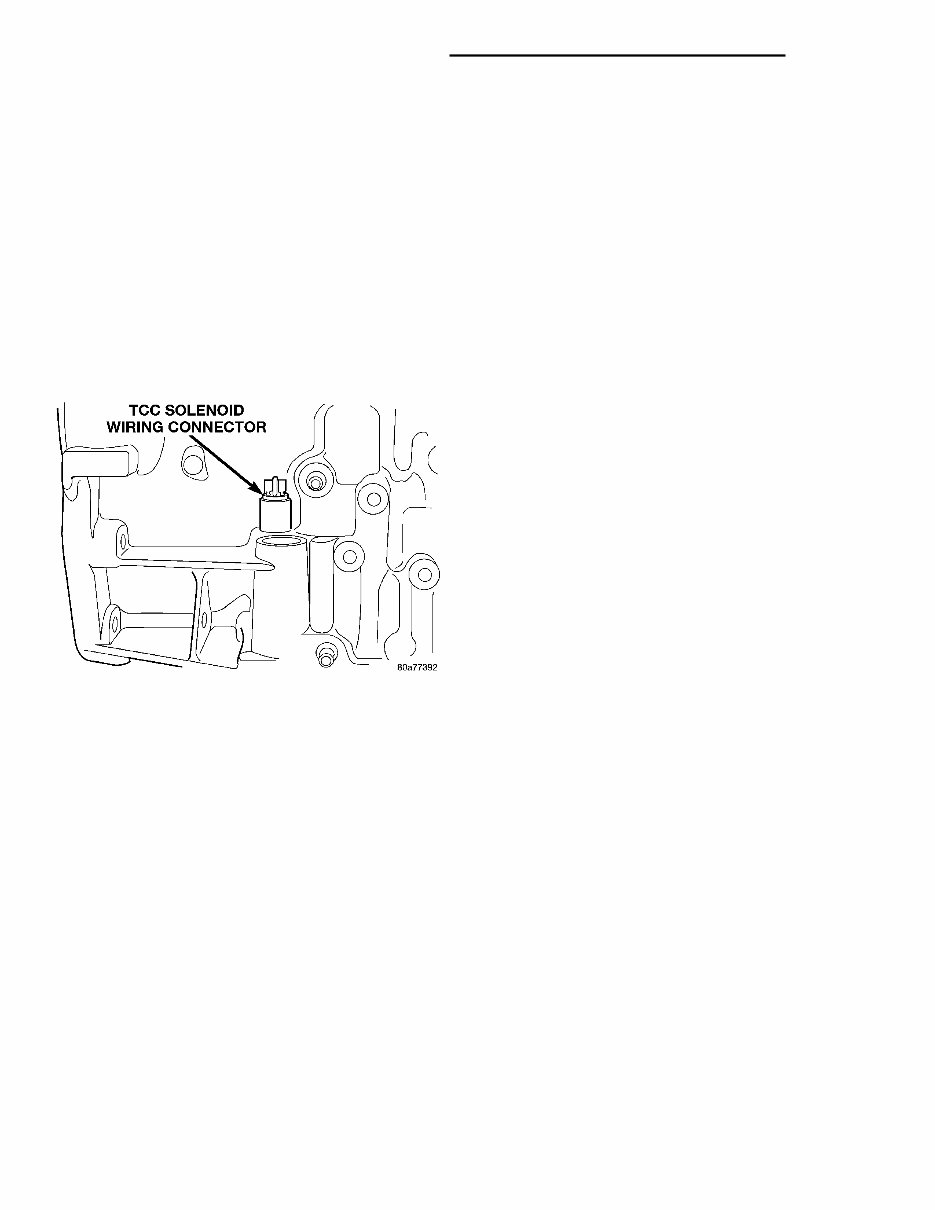
TORQUECONVERTER CLUTCH SOLENOID WIRING
CONNECTOR
If wiring connector is unplugged, the torque con-
verter will not engage (Fig.1).
GOVERNOR
The governor may be serviced by removing the
transaxle oil pan and valve body assembly . The gov-
ernor may be unbolted from the governor support
and removed from the transaxle forreconditioning or
replacement.
When cleaning or assembling the governor , make
sure the governor valves move freely in the bores of
the governor body .
DIAGNOSIS AND TESTING
THREE SPEED TRANSAXLE DIAGNOSIS AND
TESTS
Automatic transaxle malfunctions may be caused
by four general conditions:
(1) Poor engine performance
(2) Improper adjustments
(3) Hydraulic malfunctions
(4) Mechanical malfunctions
Diagnosis of these problems should always begin
by checking theeasily accessible variables;fluid level
and condition, gearshift cable adjustment, and throt-
tle pressure cable adjustment. Then perform a road
testto determine if the problem has been corrected
or that more diagnosis is necessary . If the problem
exists after the preliminary tests and corrections are
completed, hydraulic pressure tests should be per-
formed
31TH HYDRAULIC TROUBLE CODE CHARTS
The following chartsshould be used to helpdiag-
nose hydraulicor mechanical faults in the transaxle.
Fig. 1 Torque Converter Clutch Solenoid Wiring
Connector
TCC SOLENOID WIRING
21 - 4 TRANSAXLEAND POWER TRANSFER UNIT NS/GS
DESCRIPTION AND OPERATION (Continued)

CONDITION POSSIBLE CAUSES CORRECTION
HARSH ENGAGEMENT FROM
NEUTRAL TO DRIVE
1. Engine idle speed too high. 1. Set engine curb idle.
2. Valve body malfunction. 2. Inspect valve body and repair.
3. Hydraulic pressure too high. 3. Check fluid pressure at ports.
4. Worn or faulty rear clutch. 4. Replace discs and seals at rear
clutch.
5. Engine performance. 5. Set engine to specs.
HARSH ENGAGEMENT FROM
NEUTRAL TO REVERSE
1. Low reverse band misadjusted. 1. Adjust bands to specs.
2. Engine idle speed too high. 2. Set up engine to specs.
3. Low reverse band worn out. 3. Replace low reverse band.
4. Low reverse band, servo or
linkage malfunction.
4. Repair low reverse servo. Adjust
reverse band and linkage.
5. Hydraulic pressure too high. 5. Check fluid pressure at ports.
6. Worn or faulty rear clutch. 6. Replace discs and seals at rear
clutch.
7. Engine performance. 7. Set engine to specs.
DELAYED ENGAGEMENT FROM
NEUTRAL TO DRIVE
1. Hydraulic pressure too low. 1. Check fluid pressure at ports.
2. Valve body malfunction. 2. Inspect valve body and repair.
3. Low fluid level. 3. Fill trans. to level.
4. Incorrect gearshift linkage
adjustment.
4. Adjust gearshift linkage.
5. Oil filter clogged. 5. Replace oil filter.
6. Faulty oil pump. 6. Replace oil pump.
7. Worn input shaft seal rings. 7. Replace input shaft seal rings.
8. Aerated fluid. 8. Replace trans. fluid.
9. Engine idle speed too low. 9. Set up engine to specs.
10. Worn or faulty rear clutch. 10. Replace discs and seals at rear
clutch.
Diagnosis Guide
NS/GS TRANSAXLEAND POWER TRANSFER UNIT 21 - 5
DIAGNOSIS AND TESTING (Continued)
You're Reading a Preview
What's Included?
Lifetime Access
Fast Download Speeds
Offline Viewing
Access Contents & Bookmarks
Full Search Facility
Print one or all pages of your manual
$31.99
Viewed 70 Times Today


Secure transaction
What's Included?
Lifetime Access
Fast Download Speeds
Offline Viewing
Access Contents & Bookmarks
Full Search Facility
Print one or all pages of your manual
$31.99
The BEST 1996-1997 Dodge Caravan Factory Service Manual is an essential resource for anyone who owns or works on a Dodge Caravan model from 1996 to 1997. This comprehensive manual provides detailed instructions and illustrations for maintaining, repairing, and servicing your Dodge Caravan.
With the BEST 1996-1997 Dodge Caravan Factory Service Manual, you will have access to:
- Step-by-step procedures for routine maintenance tasks
- Detailed troubleshooting guides for identifying and resolving common issues
- Comprehensive diagrams, illustrations, and schematics for easy understanding
- Specifications and technical data for precise repairs
- Electrical wiring diagrams for accurate electrical system diagnoses
Whether you are a DIY enthusiast or a professional mechanic, this manual will be your go-to guide for keeping your Dodge Caravan in top condition. Say goodbye to costly repair bills and rely on the BEST 1996-1997 Dodge Caravan Factory Service Manual to help you save time, money, and effort.
Models covered in this manual:
- 1996 Dodge Caravan
- 1997 Dodge Caravan


