



2002 BMW 530i E39 Service and Repair Manual
What's Included?
 Lifetime Access
Fast Download Speeds
Offline Viewing
Access Contents & Bookmarks
Full Search Facility
Print one or all pages of your manual

BMW 3- & 5-Series
Service and Repair Manual
A K Legg LAE MIMI and Larry Warren
Models covered
3-Series (E30)
316 (83 to 88), 316i (88 to 91), 318i (83 to 91), 320i (87 to 91), 325i (87 to 91).
Also Touring and Convertible versions of these models
5-Series (E28)
518 (81 to 85), 518i (85 to 88), 525i (81 to 88), 528i (81 to 88), 535i (85 to 88), M535i (85 to 88)
5-Series (E34)
518i (90 to 91), 520i (88 to 91), 525i (88 to 91), 530i (88 to 91), 535i (88 to 91)
Engines covered
1596 cc, 1766 cc, 1795 cc, 1990 cc, 2494 cc, 2788 cc, 2986 cc & 3430 cc
Does not cover Diesel, dohc or V8 engines, or four-wheel-drive models
© Haynes Publishing 1997
A book in the Haynes Service and Repair Manual Series
All rights reserved. No part of this book may be reproduced or transmitted
in any form or by any means, electronic or mechanical, including
photocopying, recording or by any information storage or retrieval system,
without permission in writing from the copyright holder.
ISBN 1 85960 236 3
British Library Cataloguing in Publication Data
A catalogue record for this book is available from the British Library.
Printed by J H Haynes & Co. Ltd, Sparkford, Nr Yeovil,Somerset
BA22 7JJ, England
Haynes Publishing
Sparkford, Nr Yeovil, Somerset BA22 7JJ, England
Haynes North America, Inc
861 Lawrence Drive, Newbury Park, California 91320, USA
Editions Haynes S.A.
147/149, rue Saint Honoré, 75001 PARIS, France
Haynes Publishing Nordiska AB
Box 1504, 751 45 Uppsala, Sweden
(1948-256-11AA3)
ABCDE
FGHIJ
KLMNO
PQRST
1 2 3

LIVING WITH YOUR BMW
Introduction Page 0•4
Safety First! Page 0•6
Anti-theft audio system Page 0•7
Instrument panel language display Page 0•7
Roadside Repairs
Jacking, towing and wheel changing Page 0•8
Jump starting Page 0•9
Identifying leaks Page 0•10
ROUTINE MAINTENANCE
Routine Maintenance and Servicing Page 1•1
Lubricants and fluids Page 1•3
Maintenance schedule Page 1•4
Weekly checks Page 1•7
Every 6000 miles Page 1•11
Every 12 000 miles Page 1•16
Every 24 000 miles Page 1•23
Every 60 000 miles Page 1•26
Contents

REPAIRS & OVERHAUL
Engine and Associated Systems
In-car engine repair procedures Page 2A•1
General engine overhaul procedures Page 2B•1
Cooling, heating and air conditioning systems Page 3•1
Fuel and exhaust systems Page 4•1
Engine electrical systems Page 5•1
Engine management and emission control systems Page 6•1
Transmission
Manual transmission Page 7A•1
Automatic transmission Page 7B•1
Clutch and driveline Page 8•1
Brakes
Braking system Page 9•1
Suspension
Suspension and steering systems Page 10•1
Body Equipment
Bodywork and fittings Page 11•1
Electrical
Body electrical systems Page 12•1
Wiring Diagrams Page 12•10
REFERENCE
MOT Test Checks
Checks carried out from the driver’s seat Page REF•1
Checks carried out with the vehicle on the ground Page REF•2
Checks carried out with the vehicle raised Page REF•3
Checks carried out on your vehicle’s exhaust emission system Page REF•4
Tools and Working Facilities Page REF•5
General Repair Procedures Page REF•8
Fault Finding Page REF•9
Conversion factors Page REF•17
Automotive chemicals and lubricants Page REF•18
Buying spare parts and vehicle identification numbers Page REF•19
Glossary of Technical Terms Page REF•20
Index Page REF•25
Contents
0•4 Introduction
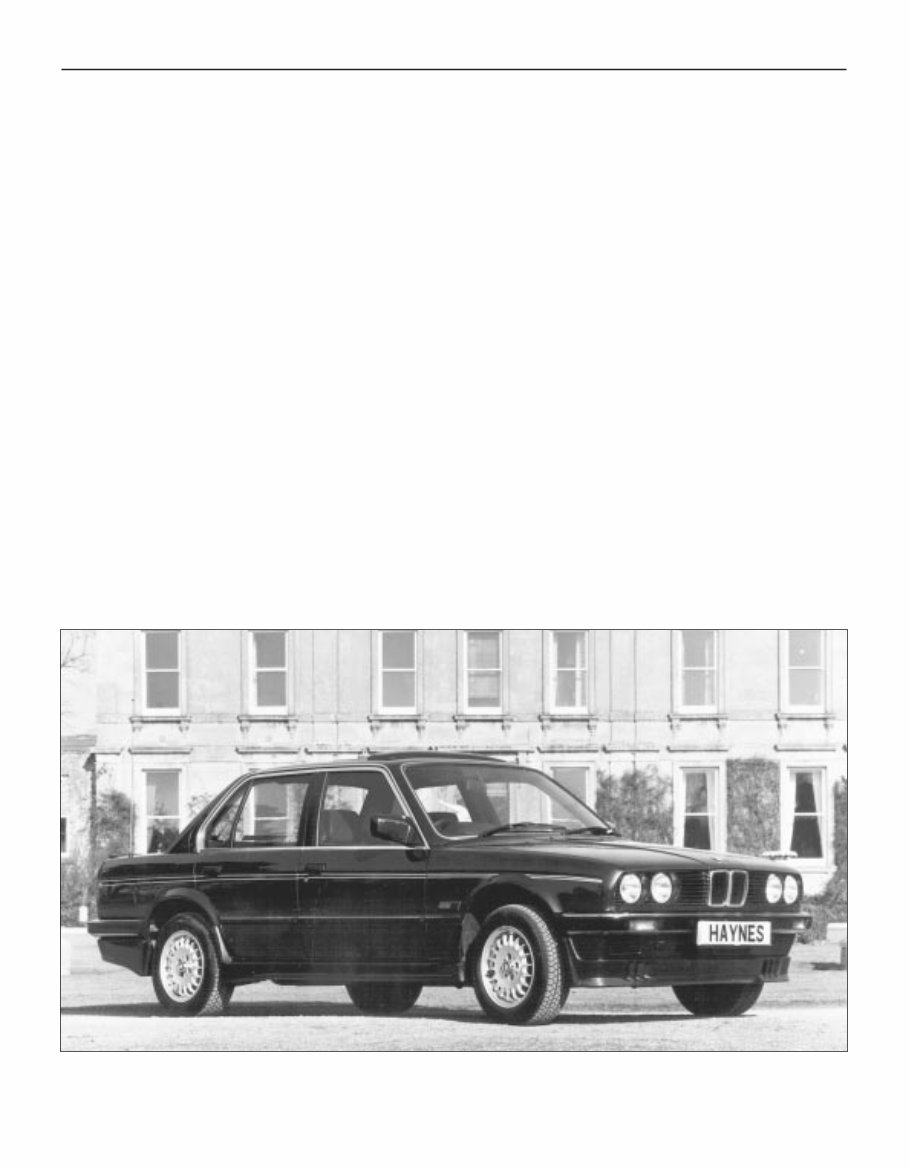
The E30 3-Series range first became
available in the UK in March 1983, and
continued in production until April 1991, when
the revised E36 3-Series range (not covered
by this manual) was introduced. Convertible
and Touring (Estate) models were introduced
for 1988, and these models have continued in
E30 form to date.
The E28 5-Series models were introduced
in October 1981, and were superseded in
June 1988 by the revised E34 5-Series range,
Touring versions of which became available
from March 1992. Throughout this manual,
E28 models are also referred to as “old-
shape”, while E34 models are designated
“new-shape”.
The models covered by this manual are
equipped with single overhead cam in-line
four- and six-cylinder engines. Early 316 and
518 models are fitted with carburettors, but all
other models are fitted with fuel injection
systems. Transmissions are a five-speed
manual, or three- or four-speed automatic.
The transmission is mounted to the back of
the engine, and power is transmitted to the
fully-independent rear axle through a two-
piece propeller shaft. The final drive unit is
bolted solidly to a frame crossmember, and
drives the rear wheels through driveshafts
equipped with inner and outer constant
velocity joints.
The front suspension is of MacPherson
strut type, with the coil spring/shock absorber
unit making up the upper suspension link. The
rear suspension is made up of coil spring-
over-shock absorber struts, or coil springs
and conventional shock absorbers,
depending on model.
The brakes are disc type at the front, with
either drums or discs at the rear, depending
on model. Servo assistance is standard on all
models. Some later models are equipped with
an Anti-lock Braking System (ABS).
All models are manufactured to fine limits,
and live up to the BMW reputation of quality
workmanship. Although many of the models
covered by this manual appear complex at
first sight, they should present no problems to
the home mechanic.
Note for UK readers
The greater part of this manual was
originally written in the USA. Some of the
photographs used are of American-market
models, but the procedures given are fully
applicable to right-hand-drive models (or have
been amended where necessary).
Acknowledgements
Thanks are due to Champion Spark Plug,
who supplied the illustrations showing spark
plug conditions. Thanks are also due to
Sykes-Pickavant Limited, who provided some
of the workshop tools, and to all those people
at Sparkford who helped in the production of
this manual. Technical writers who
contributed to this project include Robert
Maddox, Mark Ryan and Mike Stubblefield.
We take great pride in the accuracy of
information given in this manual, but
vehicle manufacturers make alterations
and design changes during the production
run of a particular vehicle of which they do
not inform us. No liability can be accepted
by the authors or publishers for loss,
damage or injury caused by any
errors in, or omissions from, the
information given.
Project vehicles
The main project vehicle used in the
preparation of this manual for the UK market
was a 1988 BMW 318i with an M40/B18
engine.
Introduction to the BMW 3- and 5-Series
BMW 320i Saloon (E30)
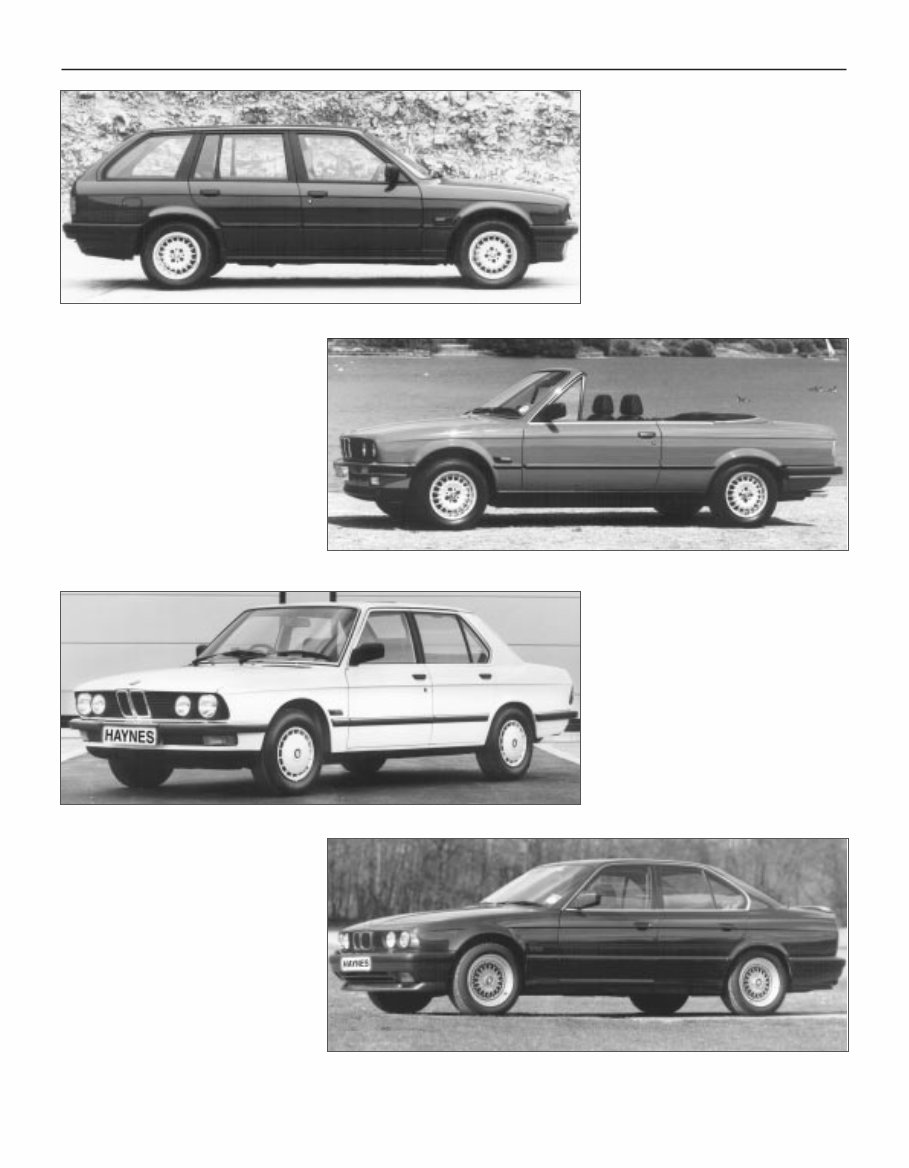
0•5 Introduction
BMW 518i (E28)
BMW 325i Touring (E30)
BMW 535i (E34)
BMW 325i Convertible (E30)
You're Reading a Preview
What's Included?
Lifetime Access
Fast Download Speeds
Offline Viewing
Access Contents & Bookmarks
Full Search Facility
Print one or all pages of your manual
$36.99
Viewed 23 Times Today


Secure transaction
What's Included?
Lifetime Access
Fast Download Speeds
Offline Viewing
Access Contents & Bookmarks
Full Search Facility
Print one or all pages of your manual
$36.99
This 2002 BMW 530i E39 Service and Repair Manual is an essential tool for any BMW owner. Whether you're a professional mechanic or a DIY enthusiast, this manual will provide you with detailed instructions, diagrams, and specifications to help you service and repair your 2002 BMW 530i E39 with ease.
- Includes comprehensive step-by-step procedures for all aspects of vehicle maintenance
- Covers engine, transmission, suspension, brakes, electrical systems, and more
- Provides detailed troubleshooting guides to help diagnose and fix common problems
- Includes wiring diagrams and electrical component locations
- Features detailed specifications for all parts and components
- Written by industry experts and BMW enthusiasts
- Compatible with the 2002 BMW 530i E39 model
With this service and repair manual, you'll have all the information you need to keep your 2002 BMW 530i E39 running smoothly. Whether you're performing routine maintenance or tackling a major repair, this manual is your go-to resource for accurate and reliable information.


