2003-2005 BMW 5 Series 545i Service & Repair Manual
What's Included?
Lifetime Access
Fast Download Speeds
Online & Offline Access
Access PDF Contents & Bookmarks
Full Search Facility
Print one or all pages of your manual
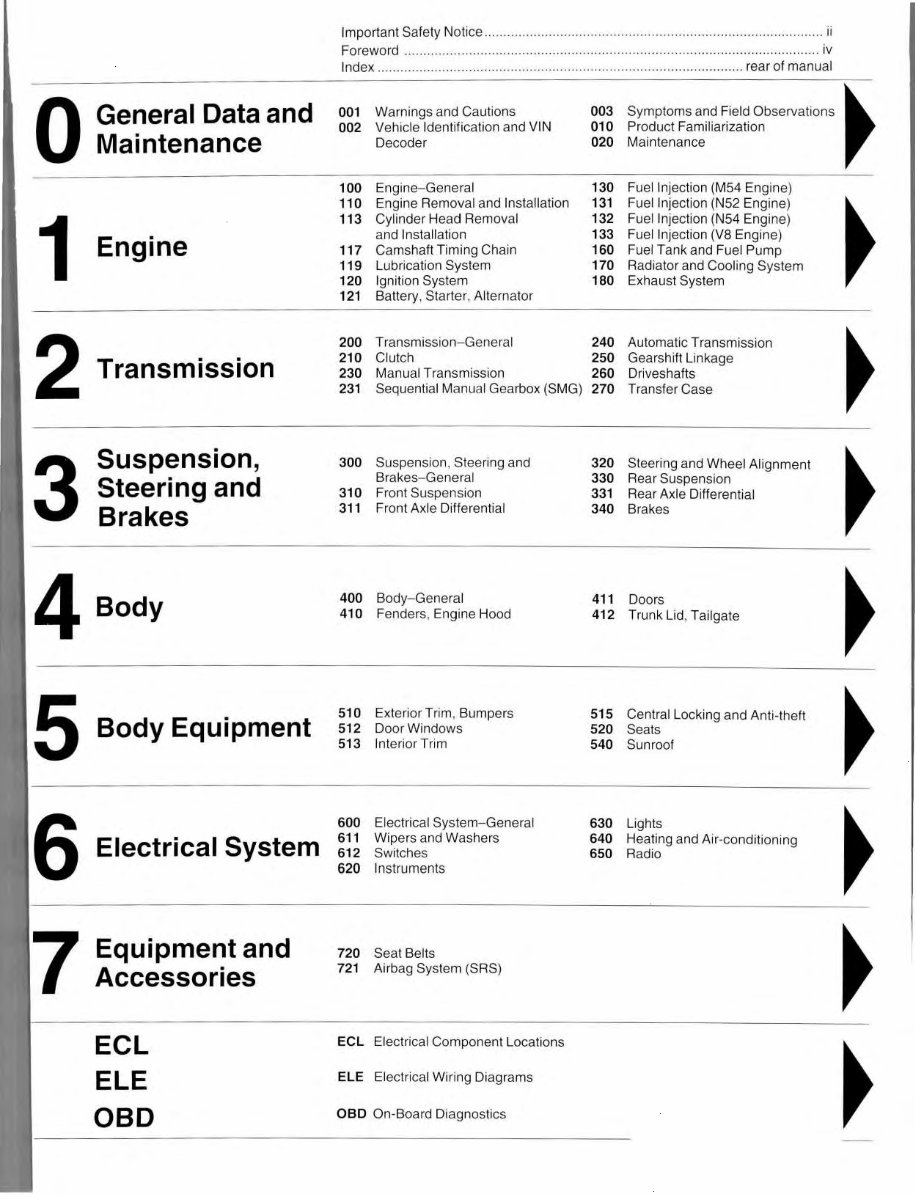
Important Safety Notice .... .. ... .. .... ..... .... .. .... ....... ..... ......... .... ... ... .. ....... .......... ..... .... ii Foreword .... .. ..... ....... .. .. ........ .. ........ ... ........ .. ........ ....... ..... ........ ..... ...... ... ... .. .. ....... iv In dex ......... .... ... ... .. ....... ... ................. ..... ... .. .. ....... .... . .. .. ......... .. ......... rear of manual 0 General Data and 001 Warnings and Cautions 003 Symptoms and Field Observations ~ 002 Vehicle Identification and VIN 010 Product Fami li arization Maintenance Decoder 020 Maintenance 100 En gine-General 130 Fu el In jection (M54 En gine) 110 Engine Removal and Installation 131 Fuel Injection (N52 En gine) ~ 1 113 Cylinder Head Removal 132 Fu el Injection (N54 Eng ine) Engine and Installation 133 Fu el Injection (V8 Engin e) 117 Camshaft Timing Chain 160 Fuel Tank and Fu el Pum p 119 Lubrication System 170 Radiator and Cooling System 120 Igniti on System 180 Exhaust System 121 Battery, Starter, Alternator 2 200 Transmission- General 240 Automatic Transmission ~ Transmission 210 Clutch 250 Gearshift Linkage 230 Manual Transmission 260 Drives hafts 231 Sequential Manu al Gearbox (S MG) 270 Trans fe r Case 3 Suspension, 300 Suspension, Steering and 320 Steering and Wh eel Al ignment ~ Steering and Brakes-General 330 Rear Suspension 310 Front Suspension 331 Rear Axle Differential Brakes 311 Front Axle Differential 340 Brakes 4 Body 400 Body-General 411 Doors ~ 410 Fenders, Engine Hood 412 Trunk Lid , Tailgate 5 Body Equipment 510 Exterior Trim , Bumpers 515 Central Locking and Anti-theft ~ 512 Door Windows 520 Seats 513 Interior T rim 540 Sunroof 6 600 Electrical System- General 630 Lights ~ Electrical System 611 Wipers and Washers 640 Heating and Air-conditioning 612 Switches 650 Radio 620 In struments 7 Equipment and 720 Seat Belts ~ Accessories 721 Airbag System (SRS) ECL ECL Electrical Component Locations ~ ELE ELE El ectrical Wiring Diagrams OBD OBD On-Board Di agnostics
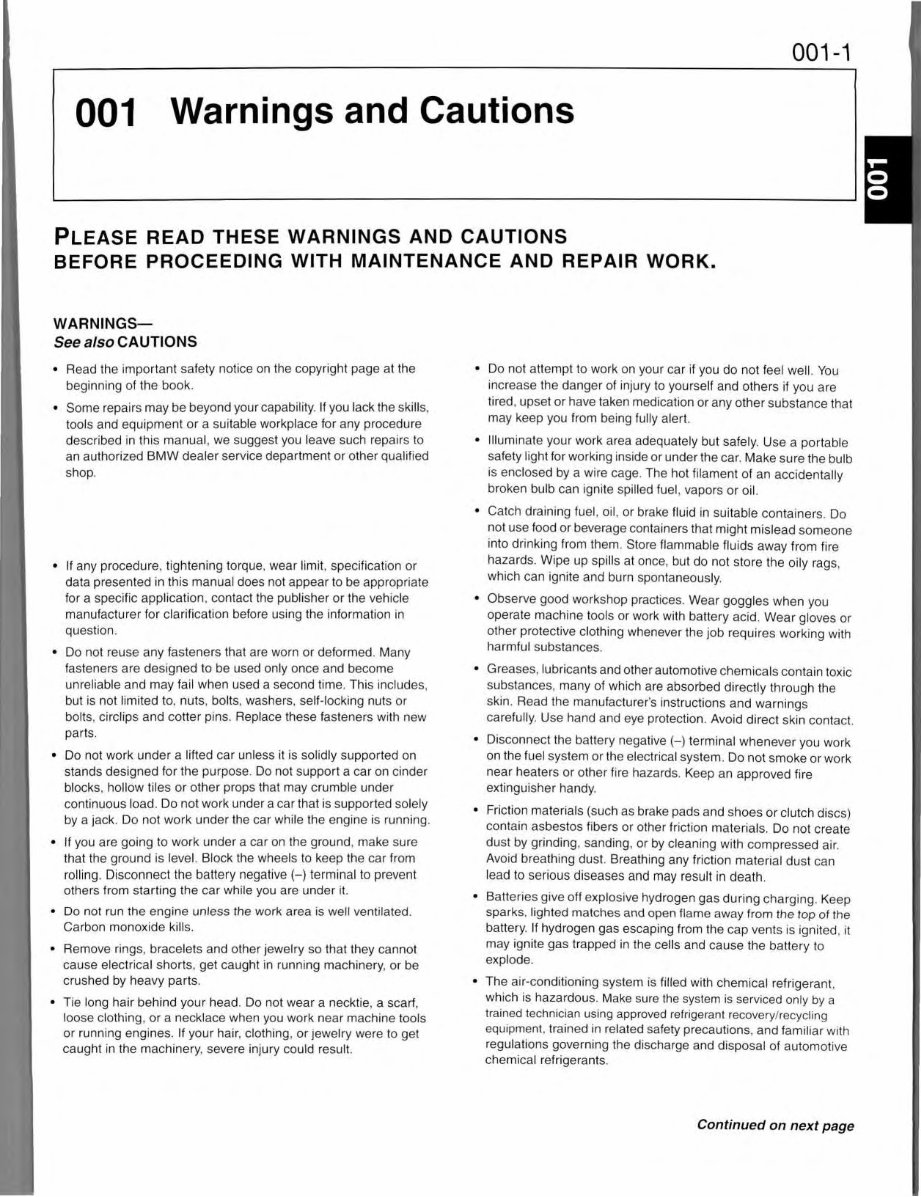
001-1 001 Warnings and Cautions PLEASE READ THESE WARNINGS AND CAUTIONS BEFORE PROCEEDING WITH MAINTENANCE AND REPAIR WORK. WARNINGS- See also CAUTIONS • Read the important safety notice on the copyright page at the beginning of the book. • Some repairs may be beyond your capability. If you lack the skills, tools and equipment or a suitable workplace for any procedure described in this manual , we suggest you leave such repairs to an authorized BMW dealer service department or other qualified shop. • If any procedure, tightening torque, wear limit, specification or data presented in this manual does not appear to be appropriate for a specific app li cation, contact the publisher or the vehicle manufacturer for clarification before using the information in question . • Do not reuse any fasteners that are worn or deformed. Many fasteners are designed to be used only once and become unreliable and may fail when used a second time. This includes. but is not limited to, nuts, bo lts, washers, self-locking nuts or bolts, circlips and cotter pins. Replace these fasteners with new parts. • Do not work under a li fted car unless it is solidly supported on stands designed for the purpose. Do not support a car on cinder blocks, hollow tiles or other props that may crumble under cont inu ous load. Do not work under a car that is supported solely by a jack. Do not work under the car while the engine is running . • If you are going to work under a car on the ground, make sure that the ground is leve l. Block the wheels to keep the car from rolling. Disconnect the battery negati ve (-) terminal to prevent others from starting the car whi le you are under it . • Do not run th e engine unless the work area is we ll venti lated . Carbon monoxide kills. • Remove rings, bracelets and other jewelry so that they cannot cause electrical shorts, get caught in running machinery, or be crushed by heavy parts. • Ti e long hair behind your head. Do not wear a necktie, a scarf, loose clothing, or a necklace when you work near machine tools or running engines. If your hair, clothing, or jewelry were to get caught in the machinery, severe injury could result. • Do not attempt to work on your car if yo u do not feel we ll. You increase the danger of injury to yourse lf and others if you are tired, upset or have taken medication or any other substance that may keep you from being fully aler t. • Illuminate your work area adequately but safely. Use a portable safety light for working inside or under the car. Make sure the bulb is enclosed by a wire cage. The hot filament of an accidentally broken bu lb can ignite spilled fuel , vapors or oil. • Catch drain ing fuel , oi l, or brake fluid in suitable containers. Do not use food or beverage containers that might mislead someone into drinking from them. Store flammable fluids away from fire hazards. Wipe up spi ll s at once, but do not store the oi ly rags, which can ignite and burn spontaneousl y. • Observe good workshop practices. Wear goggles when you operate machine tools or work with battery acid. Wear gloves or other protective clothing whenever the job requires working with harmful substances. • Greases. lubricants and oth er automotive chemicals contain toxic substances. many of whi ch are absorbed directly through the skin. Read the manufacturer's instructions and warnings carefu ll y. Use hand and eye protection . Avoid direct skin contact. • Disconnect the battery negative (-)termina l whenever you work on the fuel system or the electrical system. Do not smoke or work near heaters or other fire hazards. Keep an approved fire ext in guisher handy. • Fri ction materials (such as brake pads and shoes or clutch discs) contain asbestos fibers or other friction materials. Do not create dust by grinding, sanding, or by cleaning with compressed air. Avoid breathing dust. Breathing any friction material dust can lead to serious diseases and may result in death . • Batteries give off explosive hydrogen gas during charging. Keep spark s, li ghted matches and open flame away from the top of the battery. If hydrogen gas escaping from the cap vents is ignited, it may ignite gas trapped in the ce ll s and cause the battery to exp lode. • The air-conditioning system is fi ll ed with chemical refrigerant, which is hazardous. Make sure the system is serviced only by a train ed technician using app roved refrigerant recovery/recycling equipment, trained in related safety precautions, and familiar with regulations govern in g the discharge and disposal of automotive chemical refrigerant s. Continued on next page
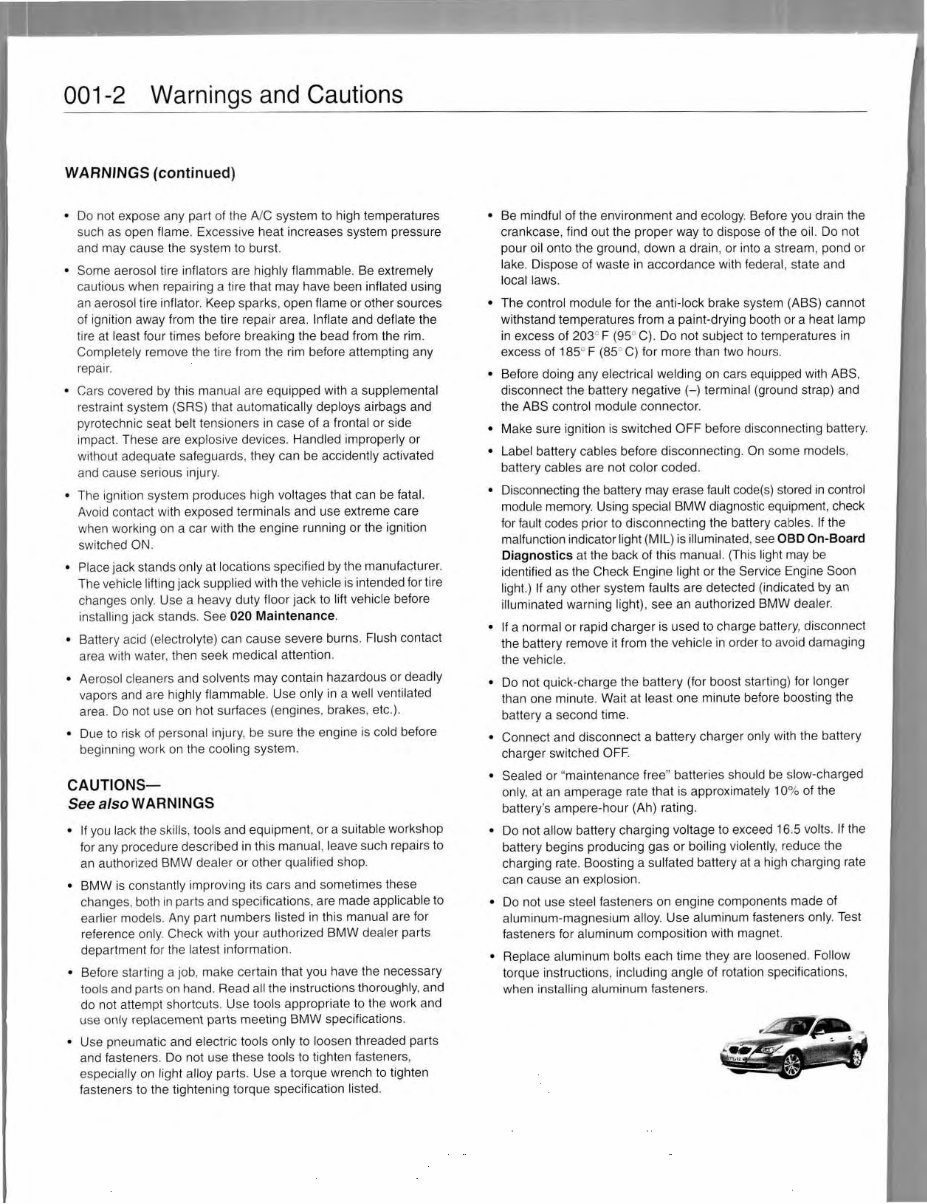
001-2 Warnings and Cautions WARNINGS (continued) • Do not expose any part of the A/C system to high temperatures such as open flame. Excessive heat increases system pressure and may cause the system to burst. • Some aerosol tire inflators are highly flammable. Be extremely cautious when repairing a tire that may have been inflated using an aerosol tire inflator. Keep sparks, open flame or other sources of ignition away from th e tire repair area. Inflate and deflate the ti re at least four times before breaking the bead from the rim. Completely remove the tire from the rim before attempting any repair. • Cars covered by this manual are equipped with a supplemental res traint system (SRS) that automatically deploys airbags and pyrotechnic seat belt tensioners in case of a frontal or side impact. Th ese are explosive devices. Handled improperly or without adequate safeguards, they can be accidently activated and cause serious injury. • The ignition system produces high voltages that can be fatal. Avoid contact with exposed terminals and use extreme care when working on a car with the engine running or the ignition switched ON . • Place jack stands only at locations specified by the manufacturer. The vehicle lifting jack supp li ed with the vehic le is intended for tire changes only. Use a heavy duty floor jack to lift vehicle before installing jack stands. See 020 Maintenance. • Battery acid (electrolyte) can cause severe burns. Flush contact area with water, then seek medical attention. • Aerosol cleaners and sol ve nts may contain hazardous or deadly vapors and are highly flammable. Use on ly in a well venti lated area . Do not use on hot surfaces (engines, brakes, etc.). • Due to ri sk of personal injury, be sure the engine is cold before beginning work on the coo lin g system . CAUTIONS- See also WARNINGS • If you lack the skills, tools and equipment, or a su itable workshop for any procedure described in this manual, leave such repairs to an authorized BMW dealer or other qualified shop. • BMW is constantly improving its cars and sometimes these changes, both in parts and specifications, are made appli cable to earlier model s. Any part numbers listed in this manual are for reference only. Check with your authorized BMW dealer parts department fo r the latest information. • Before starting a job, make certain that you have the necessary tool s and part s on hand . Read al l the instructions thoroughly, and do not attempt shortcuts. Use tools approp ri ate to the work and use only replacement parts meeting BMW specifications. • Use pneumatic and electric tools only to loosen threaded parts and fasteners. Do not use these tools to tighten fasteners, especially on light all oy parts. Use a torque wrench to tighten fasteners to the tightening torque specification listed. • Be mindful of the environment and ecology. Before yo u drain the crankcase, find out the proper way to dispose of the oil. Do not pour oil onto the ground, down a drain , or into a stream , pond or lake. Di spose of waste in accordance with federal, state and local laws. • The control module for the anti-lock brake system (ABS) cannot withstand temperatures from a paint-drying booth or a heat lamp in excess of 203° F (95° C). Do not subject to temperatures in excess of 185° F (85° C) for more than two hours. • Before doing any electrical welding on cars equipped with ABS, disconnect the battery negative (- ) terminal (ground st rap) and the ABS control module connector. • Make sure ignition is switched OFF before disconnecting battery. • Label battery cables before disconnecting. On some models, battery cables are not color coded. • Disconnecting the battery may erase fault code(s) stored in control module memory. Using special BMW diagnostic equipment, check for fault codes prior to disconnecting the battery cables. If the malfunction indicator light (M IL) is illuminated, see 080 On-Board Diagnostics at the back of this manual. (Thi s lig ht may be id entified as the Check Engine light or th e Service Engine Soon light.) If any other system faults are detected (indicated by an illuminated warning light), see an authorized BMW dealer. • If a normal or rap id charger is used to charge battery, disconnect the battery remove it from the vehicle in order to avoid damaging th e vehicle. • Do not quick-charge the battery (for boost starting) for longer than one minute. Wait at least one minute before boosting the battery a second time. • Connect and disconnect a battery charger only with the battery charger switched OFF. • Sealed or "maintenance free" batteries sho uld be slow-charged on ly, at an amperage rate that is approximately 10% of the battery's ampere-hour (Ah ) rating. • Do not allow battery charging vo ltage to exceed 16.5 vo lt s. If the battery begins producing gas or boiling violently, reduce the charging rate. Boosting a sulfated battery at a high charging rate ca n cause an explosion. • Do not use steel fasteners on engine components made of aluminum-magnesium alloy. Use aluminum fasteners on ly. Test fasteners for aluminum composition with magnet. • Replace aluminum bolts each time they are loosened. Follow torque instructions, including angle of rotation specifica ti ons, when installing aluminum fasteners.
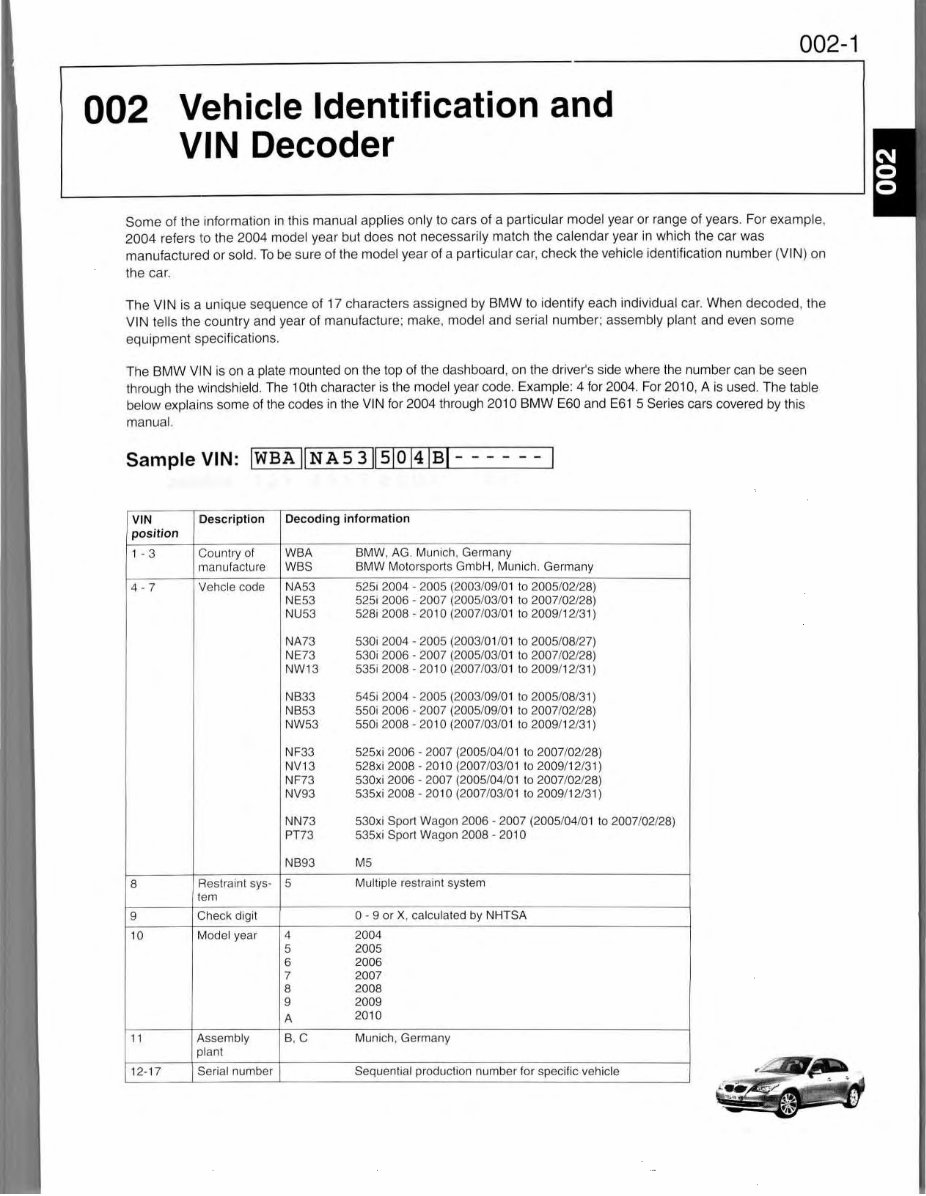
002 Vehicle Identification and VIN Decoder 002-1 Some of the information in this manual app li es only to cars of a particular model year or range of years. For example, 2004 refers to the 2004 model year but does not necessarily match the calendar year in which the car was manufactured or sold. To be sure of the model year of a particular car, check the vehicle identification number (VIN) on the car. The VIN is a unique sequence of 17 characters assigned by BMW to identify each individual car. When decoded, the VIN tells the country and year of manufacture; make, model and serial number; assembly plant and even some equipment specifications. The BMW VIN is on a plate mounted on the top of the dashboard, on the driver's side where th e number can be seen through the windshie ld . Th e 10th character is the model year code. Example: 4 for 2004. For 2010, A is used. The table below explains some of the codes in the VIN for 2004 through 2010 BMW E60 and E61 5 Series cars covered by this manual. Sample VIN: IWBA llNAS 3 llSIOl4IBI- -----I VIN Description Decoding information position 1 - 3 Country of WBA BMW, AG . Munich, Germany manufacture WBS BMW Motorsports GmbH, Munich. Germany 4-7 Vehcle code NA53 525i 2004 - 2005 (2003/09/01 to 2005/02/28) NE53 525i 2006 - 2007 (2005/03/ 01 to 2007/02/28) NU53 528i 2008 - 2010 (2007/03/ 01 to 2009/12/3 1) NA73 530i 2004 - 2005 (2003/ 01 /01 to 2005/08/27) NE73 530i 2006 - 2007 (2005/03/ 01 to 2007/02/28) NW1 3 535i 2008 - 2010 (2007/03/ 01to2009/12/31) NB33 545i 2004 - 2005 (2003/09/01 to 2005/08/31) NB53 550i 2006 - 2007 (2005/09/01 to 2007/02/28) NW53 550i 2008 - 201O (2007/03/01 to 2009/12/31) NF33 525xi 2006 - 2007 (2005/04/01 to 2007/02/28) NV1 3 528xi 2008 - 2010 (2007/03/01 to 2009/12/31) NF73 530xi 2006 - 2007 (2005/04/01 to 2007/02/28) NV93 535xi 2008 - 2010 (2007/03/01 to 2009/12/31) NN73 530xi Sport Wagon 2006 - 2007 (2005/04/ 01 to 2007/02/28) PT73 535xi Sport Wagon 2008 - 2010 NB93 M5 8 Restraint sys- 5 Multiple restraint system tern 9 Check digit O - 9 or X, calcu lated by NHTSA 10 Mode l year 4 2004 5 2005 6 2006 7 2007 8 2008 9 2009 A 2010 11 Assembly B, C Munich, Germany plant 12-17 Serial number Sequential production number for specific vehicle
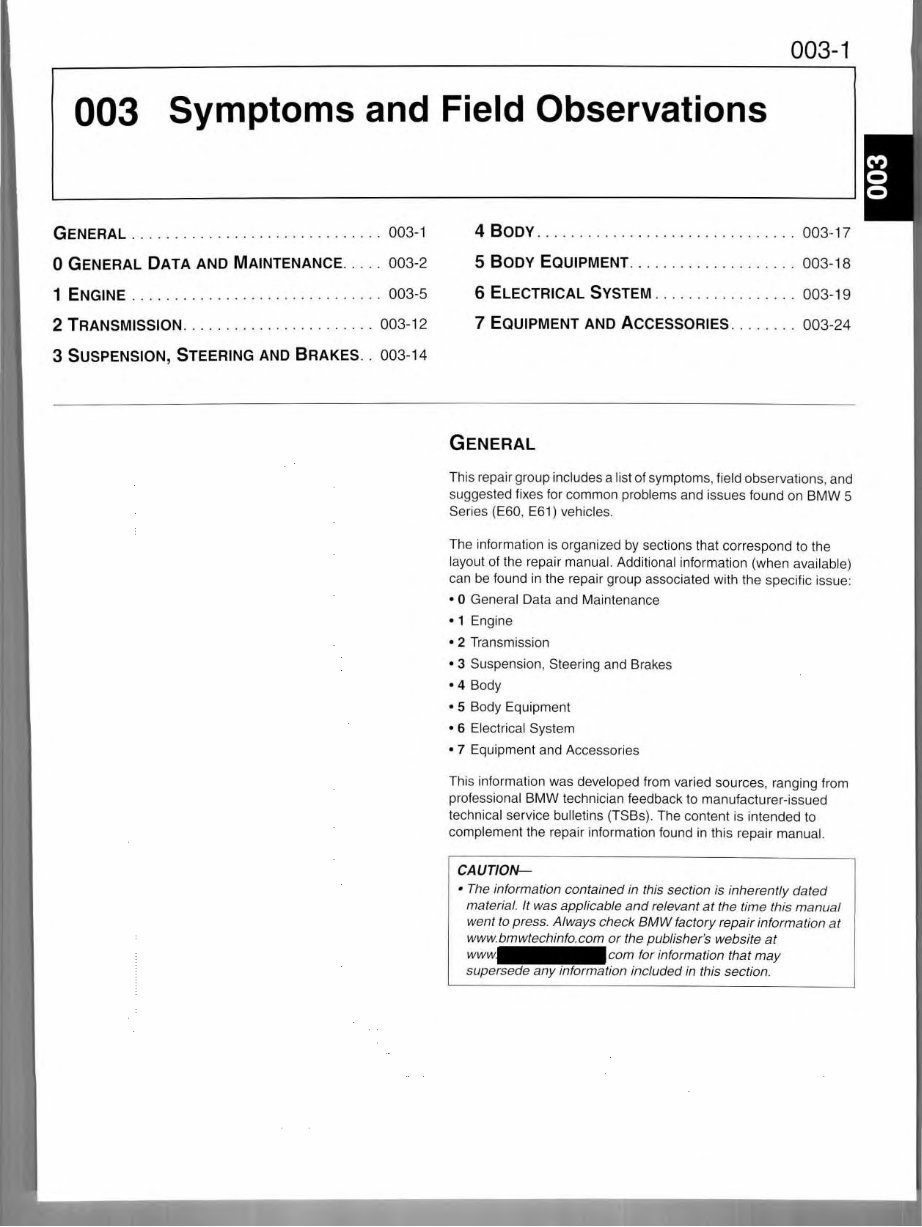
003-1 003 Symptoms and Field Observations GENERAL ..... ... ... ..... ... . .......... 003-1 0 GENERAL DATA AND MAINTENANCE .. . .. 003-2 1 ENGINE ....... . .. ... .. .. ... . .. ... . .. . 003-5 2 TRANSMISSION . .. ........ .. ... .. .. ... 003-12 3 SUSPENSION, STEERING AND BRAKES .. 003- 14 4 BODY . .. .... ....... .. ...... . ..... . .. 003-17 5 BODY EQUIPMENT ..... . .. .. .. .. ... . .. 003-18 6 ELECTRICAL SYSTEM ............... .. 003-19 7 EQUIPMENT AND ACCESSORIES . . .. .... 003-24 GENERAL This repair group includes a list of symptoms, field observations, and suggested fixes for common problems and issues found on BMW 5 Series (E60, E61) vehicles. Th e information is organized by sections that correspond to the layout of the repair manual. Additional information (when available) can be found in the repair group associated with the specific issue: • O General Data and Maintenance • 1 Engine • 2 Transmission • 3 Suspension, Steering and Brakes • 4 Body • 5 Body Equipment • 6 El ectrical System • 7 Equipment and Accessories T hi s information was developed from varied sources, ranging from professional BMW technician feedback to manufacturer-issued technical service bulletins (TSBs). The content is intended to complement the repair information found in this repair manual. CAUTION- • The information contained in this section is inherently dated material. It was applicable and relevant at the time this manual went to press. Always check BMW factory repair information at www.bmwtechinfo.com or the publisher's website at www com for information that may supersede any information included in this section.
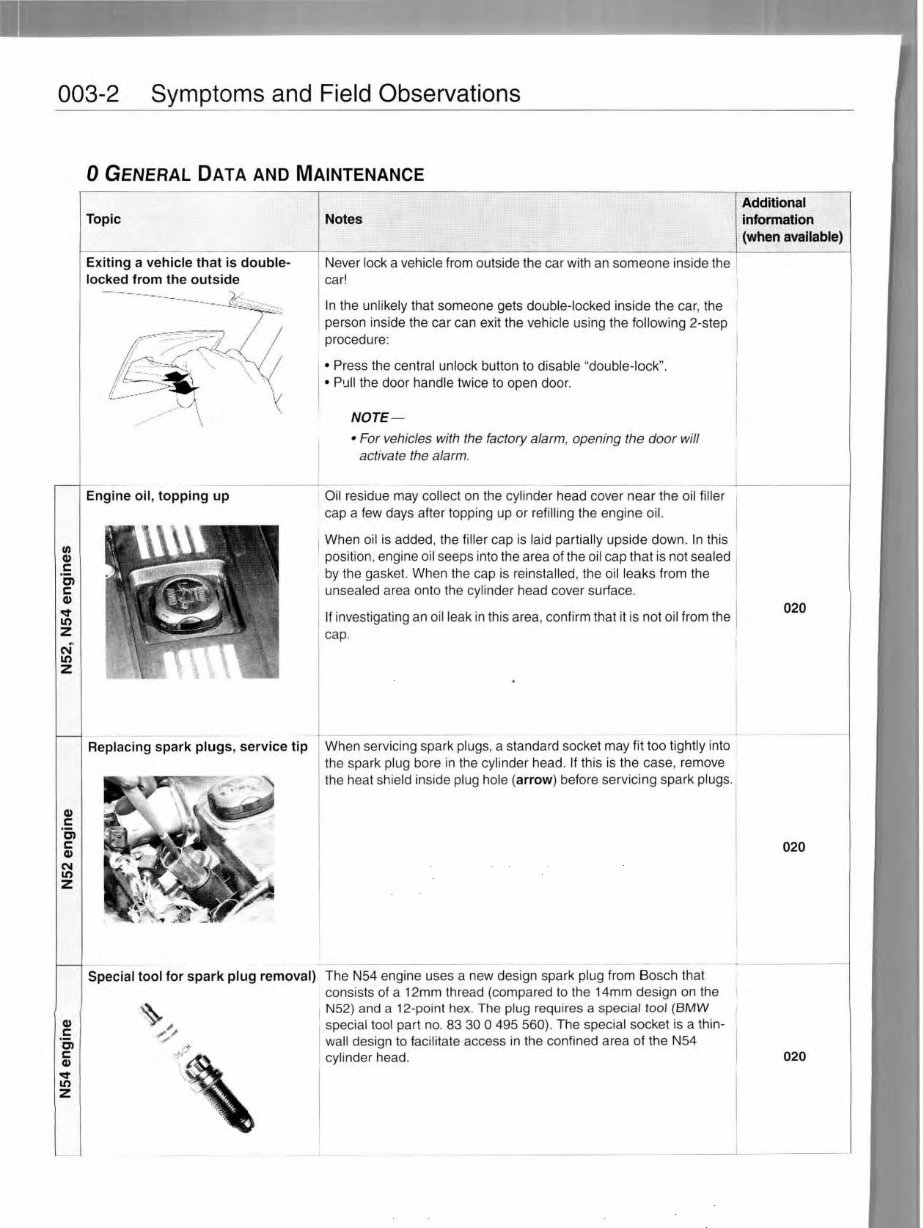
003-2 Symptoms and Field Observations Ill Q) c: en c: Q) '<:!' LO z C'lf LO z Q) c: ·c;, c: Q) '<:!' LO z 0 GENERAL DATA AND MAINTENANCE Topic Exiting a vehicle that is double- locked from the outside Engine oil, topping up Notes Never lock a vehicle from outside the car with an someone inside the car! In the unlikely that someone gets double-locked inside the car, the ' person inside the car can exit the vehicle using the following 2-step procedure: • Press the central unlock button to disable "double-lock". • Pull the door handle twice to open door. NOTE- • For vehicles with the factory alarm, opening the door will activate the alarm. Oil residue may collect on the cylinder head cover near the oil filler I cap a few days after topping up or refilling the engine oil. I When oil is added, the filler cap is laid partially upside down. In this position, engine oil seeps into the area of the oil cap that is not sealed by the gasket. When the cap is reinstalled , the oil leaks from the unsealed area onto the cylinder head cover surface. If investigating an oil leak in this area, confirm that it is not oil from the cap. Replacing spark plugs, service tip When servicing spark plugs, a standard socket may fit too tightly into Special tool for spark plug removal) the spark plug bore in the cylinder head. If this is the case, remove the heat shield inside plug hole (arrow) before servicing spark plugs. The N54 engine uses a new design spark plug from Bosch that consists of a 12mm thread (compared to the 14mm design on the N52) and a 12-point hex. The plug requires a special tool (BMW special tool part no. 83 30 0 495 560). The special socket is a thin- wall design to facilitate access in the confined area of the N54 cylinder head. Additional information (when available) 020 020
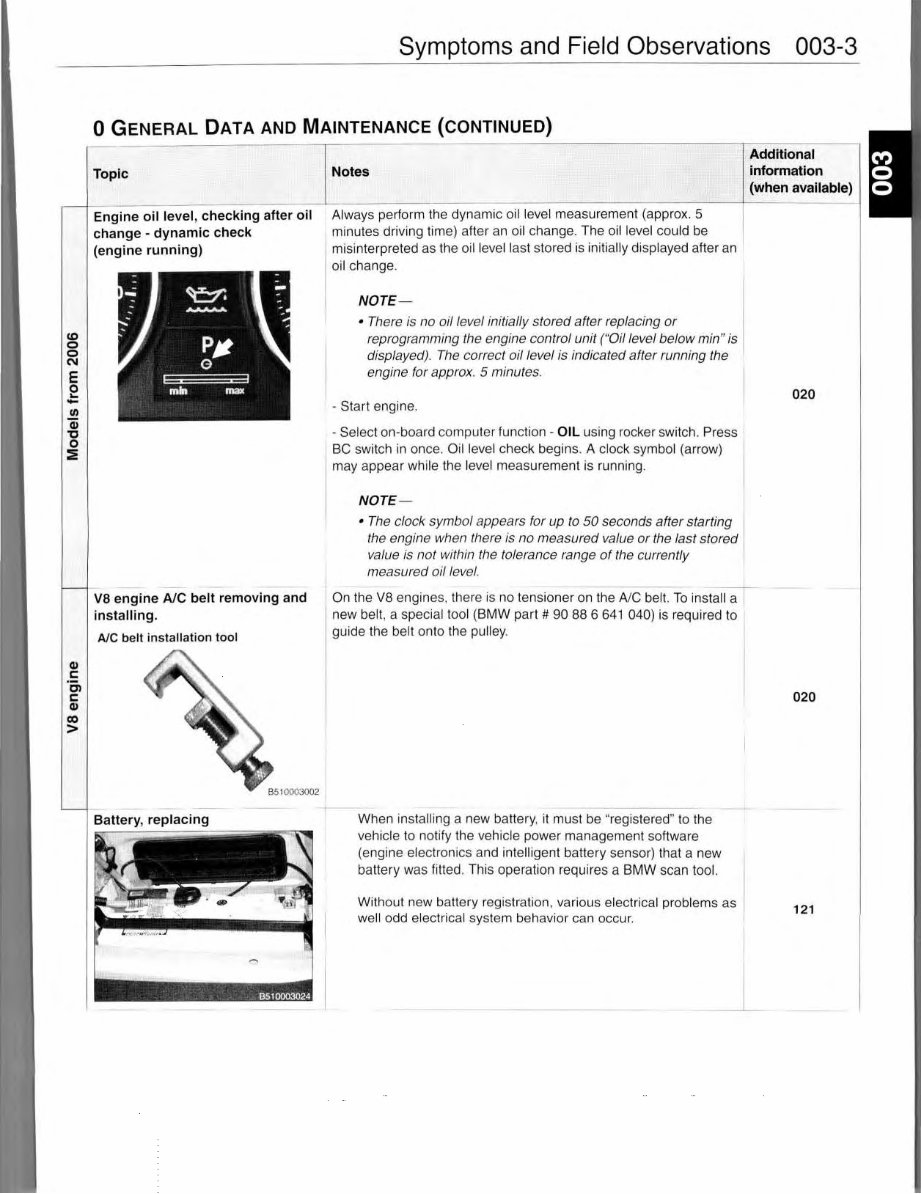
CD 0 0 N E 0 ... - (/) Q) "C 0 :? Q) c: Cl c: Q) CXI > Symptoms and Field Observations 003-3 0 GENERAL DATA AND MAINTENANCE (CONTINUED) Topic Engine oil level, checking after oil change - dynamic check (engine running) VB engine A/C belt removing and installing. A/C belt installation tool Battery, replacing 8510003024 Notes Always perform the dynamic oil level measurement (approx. 5 minutes driving time) after an oil change. The oi l level could be misinterpreted as the oil level last stored is initially displayed after an oil change. NOTE - • Th ere is no oil level initially stored after replacing or reprogramming the engine control unit ("Oil level below min" is displayed). The correct oil level is indicated after running the engine for approx. 5 minutes. - Start engine. - Select on-board computer function - OIL using rocker switch. Press BC switch in once. Oil level check begins. A clock symbol (arrow) may appear while the level measurement is running. NOTE - • Th e clock symbol appears for up to 50 seconds after starting the engine when there is no measured value or the last stored value is not within the tolerance range of the currently measured oil level. On the VS engines, th ere is no tensioner on the A/C belt. To install a I new belt, a special tool (BMW part # 90 88 6 641 040) is required to guide the belt onto the pu ll ey. When installing a new battery, it must be "registered" to the vehicle to notify the vehicle power management software (engine electronics and intelligent battery sensor) that a new battery was fitted. This operation requires a BMW scan tool. Without new battery registration , various electrical problems as well odd electrical system behavior can occur. I _J Additional information (when available) 020 020 121
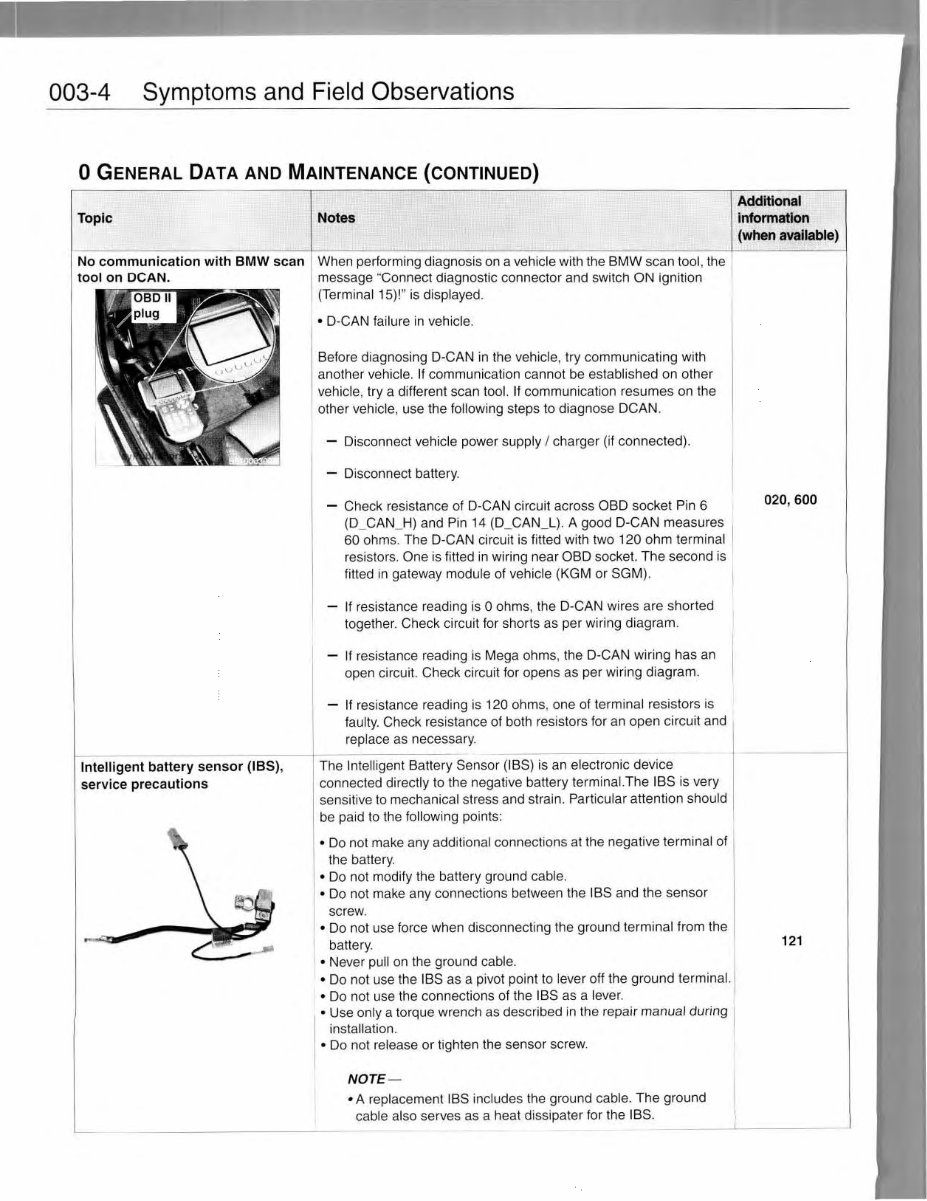
003-4 Symptoms and Field Observations 0 GENERAL DATA AND MAINTENANCE (CONTINUED) Topic Notes No communication with BMW scan When performing diagnosis on a vehicle with the BMW scan tool , the tool on DCAN. message "Connect diagnostic connector and switch ON ignition OBD 11 (Terminal 15) !" is displayed . Intelligent battery sensor (IBS), service precautions • D-CAN failure in vehicle . Before diagnosing D-CAN in the vehicle, try communicating with another vehicle. If communication cannot be established on other vehicle, try a different scan tool. If communication resumes on the other vehicle, use the following steps to diagnose DCAN. - Disconnect vehicle power supply I charger (if connected). - Disconnect battery. - Check resistance of D-CAN circuit across OBD socket Pin 6 (D_CAN_H) and Pin 14 (D_CAN_L). A good D-CAN measures 1 60 ohms. The D-CAN circuit is fitted with two 120 ohm terminal resistors. One is fitted in wiring near OBD socket. The second is fitted in gateway module of vehicle (KGM or SGM). \ - If resistance reading is 0 ohms, the D-CAN wires are shorted together. Check circuit for shorts as per wiring diagram. - If resistance reading is Mega ohms, the D-CAN wiring has an open circuit. Check circuit for opens as per wiring diagram. - If resistance reading is 120 ohms, one of terminal resistors is faulty. Check resistance of both resistors for an open circuit and replace as necessary. The Intelligent Battery Sensor (IBS) is an electronic device connected directly to the negative battery terminal.The IBS is very sensitive to mechanical stress and strain. Particular attention should be paid to the following points: • Do not make any additional connections at the negative terminal of the battery. • Do not modify the battery ground cable. •Do not make any connections between the IBS and the sensor screw. • Do not use force when disconnecting the ground terminal from the Additional information (when available) 020,600 battery. 121 • Never pull on the ground cable. • Do not use the IBS as a pivot point to lever off the ground terminal. I •Do not use the connections of the IBS as a lever. • Use only a torque wrench as described in the repair manual during I installation. • Do not release or tighten the sensor screw. NOTE- • A replacement IBS includes the ground cable . The ground cable also serves as a heat dissipater for the IBS.
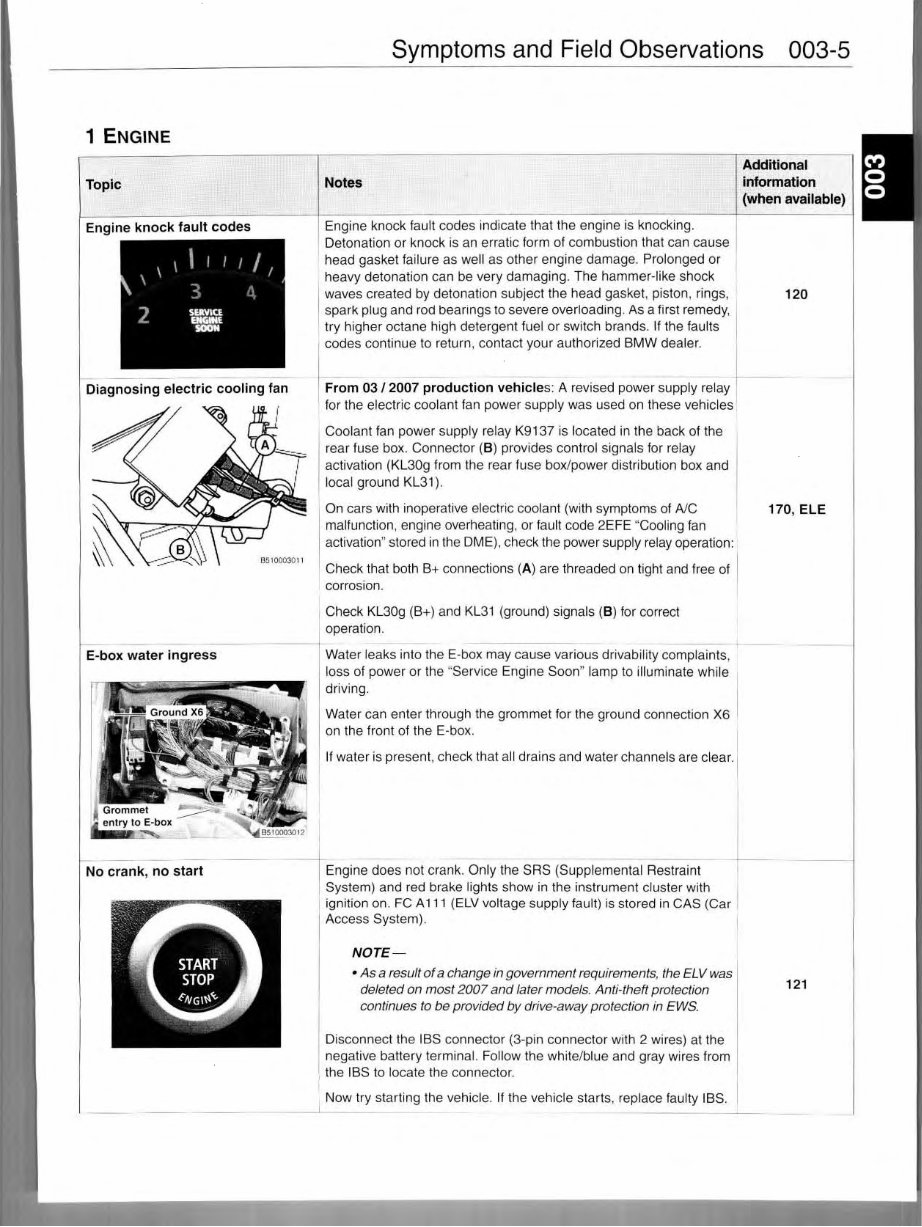
1 ENGINE Topic Notes Engine knock fault codes Symptoms and Field Observations 003-5 Additional information (when available) ' I \ \ I I I Engine knock fault codes indicate that the engine is knocking . Detonation or knock is an erratic form of combustion that can cause head gasket failure as well as other engine damage. Prolonged or heavy detonation can be very damaging. The hammer-like shock ., .) 2 SERVICE £NGIN£ SOOH J I waves created by detonation subject the head gasket, piston, rings, spark plug and rod bearings to severe overloading As a first remedy, I try higher octane high detergent fuel or switch brands. If the faults 120 Diagnosing electric cooling fa n I code' contm"e to mt"m, contact yooc a"thoc,,ed BMW dealec. 1 3 / 2007 production vehicle s: A revised power supply rela~ for the electric coolant fan power supply was used on these vehicles E-box wate r ingress 1 No crank, no start 85100030 11 Coolant fan power supply relay K9137 is located in the back of the rear fuse box. Connector (B) provides control signals for relay activation (K L30g from the rear fuse box/power distribution box and local ground KL31). On cars with inoperative electric coolant (with symptoms of A/C mal fu nction , engine overheating , or fau lt code 2EFE "Cooling fan activation" stored in the DM E), check the power supply relay operation : Check_ that both B+ connections (A) are threaded on tight and free of I co rr osion. Check KL30g (B+) and KL31 (ground) signals (B) for correct operation. Water leaks into the E-box may cause various drivability complaints, loss of power or the "Service Engine Soon" lamp to illuminate while I driving. Water can enter through the grommet for the ground connection X6 on the front of the E-box. If water is present, check that all drains and water channels are clear. 170, ELE ' 85 100030 12·1 I/I i- i ngine does not crank. Only the SRS (Supplemental Restraint System) and red brake lights show in the instrument cluster with gni tion on . FC A 111 (ELV voltage supply fault) is stored in CAS (Car I Access System) . NOTE- • As a result of a change in government requirements, the ELV was deleted on most 2007 and later models. Anti-theft protection continues to be provided by drive-away protection in EWS. Disconnect the IBS connector (3-pin connector with 2 wires) at the negative battery terminal. Follow the white/blue and gray wires from , the IBS to locate the connector. I I Now try starting the vehicle. If the ve hi cle starts, replace faulty IBS. 121
The BMW 5 Series 545i 2003 2004 2005 Workshop Service Manual for Repair is an essential resource for both professional mechanics and DIY enthusiasts. This comprehensive manual provides detailed data, characteristics, instructions, and methodology for performing repair interventions on the vehicle and its components.
It includes special notes, important points, service data, precautions, and comprehensive step-by-step procedures, explanations, and pictorial diagrams from bumper to bumper. The manual covers installation, removal, disassembly, assembly, repair, and check procedures in sequential order.
Illustrations, exploded diagrams, drawings, and photos guide you through every service repair procedure. It also provides information on service tool numbers and wear limits, ensuring accurate measurements and safe operation.
This service manual is viewable on any computer, zoomable, and printable. It has been specially prepared to be easily understandable, even for relatively new personnel, enabling satisfactory after-services and vehicle maintenance.
The manual contains general descriptions, troubleshooting information, servicing specifications, tightening torque, checking and adjusting procedures, and information on construction and function. It is divided into groups containing general information, diagnosis, testing, adjustments, removal, installation, disassembly, and assembly procedures for the systems and components.
It is important to note that the illustrations in the manual are used to highlight fundamental principles and procedures of basic interventions and may not exactly match the BMW 5 Series 545i 2003 2004 2005 in your possession.
To ensure complete repair work and vehicle maintenance, it is crucial to follow the maintenance requirements, investigate and rectify problems promptly, use genuine parts, and adhere to the procedures outlined in the manual. The manual also provides valuable reference data for adjustment values and emphasizes the importance of observing accident prevention guidelines and safety measures.
It is designed primarily for use by trained technicians in a properly equipped workshop but contains enough detail and basic information to be useful to owners who desire to perform their own basic maintenance and repair work. However, it is essential to have the necessary hand and special service tools and a basic knowledge of mechanics to carry out maintenance and repair work satisfactorily.
This BMW 5 Series 545i 2003 2004 2005 Workshop Service Manual for Repair is a quality, complete, and intact resource, providing technical information, design, function, disassembly, adjusting work, and troubleshooting on the components and model of the BMW 5 Series 545i 2003 2004 2005.
It is important to note that this manual does not include any explicit mentions of being an original equipment manufacturer (OEM) manual or details suggesting it is aftermarket.
Recently Viewed
5,521,897Happy Clients
2,594,462eManuals
1,120,453Trusted Sellers
15Years in Business
Price:
Actual Price:
2003-2005 BMW 5 Series 545i Service & Repair Manual



 Lifetime Access