MAHINDRA ML114 Series Loader Operator and Installation Instr
What's Included?
Lifetime Access
Fast Download Speeds
Online & Offline Access
Access PDF Contents & Bookmarks
Full Search Facility
Print one or all pages of your manual
INDEX Main Menu contactus@almats.com Click here to go on OPERATOR'S MANUAL & INSTALLATION INSTRUCTION 'ML114' Series
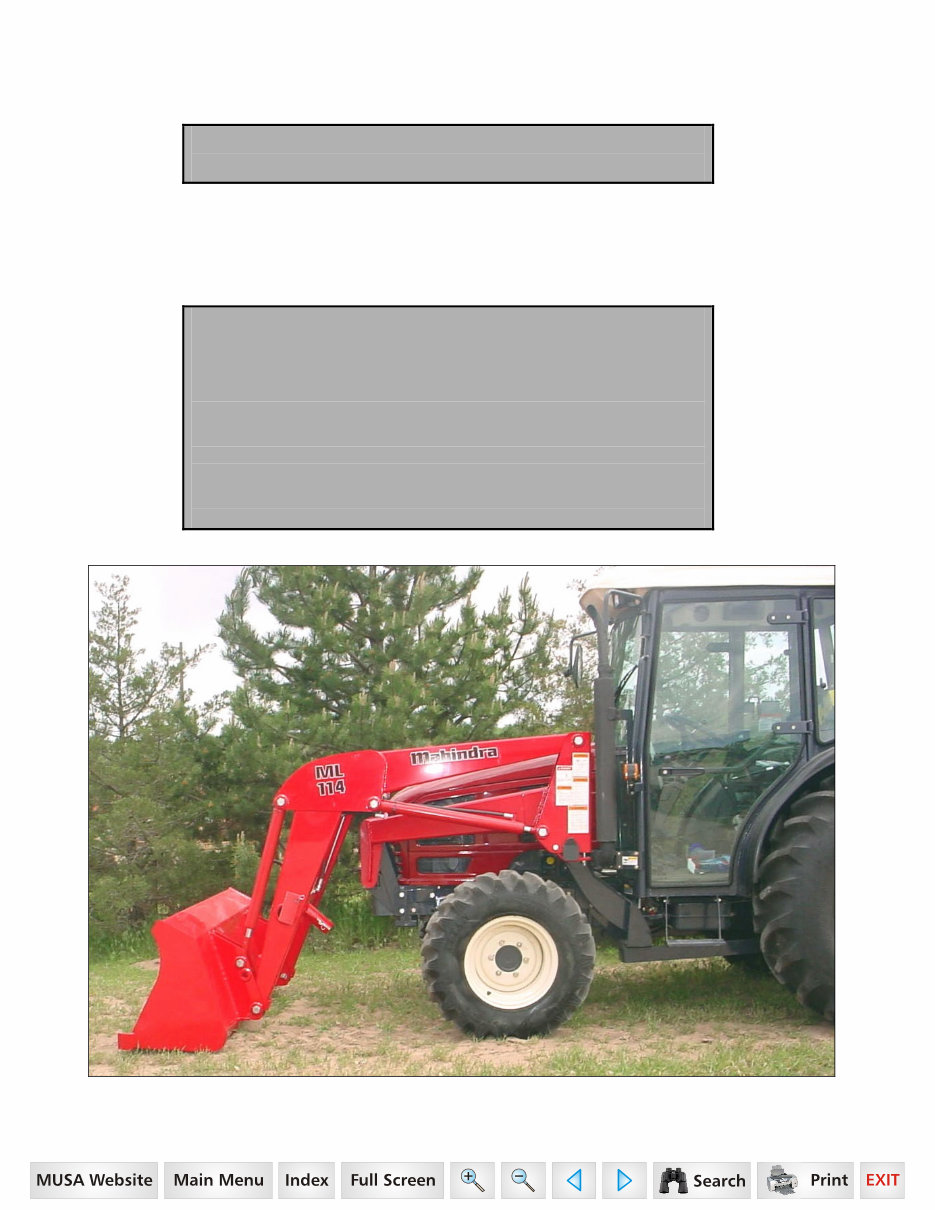
Includes: Operator’s Manual and Installation Instructions Mahindra USA Model ML114 Front End Loader Rev. March 2005 1503-1059
2 WARRANTY CONDITIONS Warranty Coverage: Mahindra USA, Inc., herein referred to as Mahindra, undertakes to replace or repair any part of a Mahindra loader where damage has been proven to be caused by defects in material or workmanship. This Warranty is valid for a period of 1 year for all hydraulic components and attachments and for a period of 2 years for all other loader components from the date of the original retail sale. Parts replaced or repaired under the terms of this Warranty are guaranteed only until the original warranty expires. It is further understood and agreed that the defect should be immediately reported to the Selling Dealer. The Selling Dealer will generally perform Warranty repairs or replacements and the Purchaser shall deliver the Mahindra Loader to the Dealer’s place of business for repair. In the event Purchaser is located more than 75 miles from the Selling Dealer, any Mahindra Dealer authorized to sell and service Mahindra Products may perform the repair at its dealership. The obligation of Mahindra to the Purchaser under this Warranty is limited to the repair or replacement of defective parts by an authorized Mahindra dealer. Repair or replacement in accordance with this Warranty shall constitute fulfillment of all liabilities of Mahindra and the Selling Dealer in respect to Mahindra Loaders. There are no warranties beyond those which expressly appear herein. Any implied warranty of merchantability or fitness for a particular purpose is specifically excluded here from. Warranty Provisions: Mahindra’s liability under this Warranty is subject to the observance by the Purchaser of the following provisions: - The purchaser shall at all times in the operation of any Mahindra Product, use those brands and grades of lubricating oils, lubricants or fuel and spare parts officially approved by Mahindra. - The Mahindra Loaders shall have been used in accordance with the procedures specified in the Operator’s Manual. This Warranty does not extend to damage resulting from misapplication, abuse, misuse, failure to perform maintenance, negligence, fire, accidents or changes or faulty mounting carried out by the Purchaser. When making a Warranty exchange of parts, the Purchaser shall compensate Mahindra for the time that the parts have been used if they have been exposed to extreme wear. - Compensation is not paid for physical harm, deadlock, resulting damages, or other losses. - To obtain warranty service, the Purchaser must (1) report the product defect to an authorized Mahindra dealer and request repair within the applicable warranty term and (2) present evidence of purchase or date of original use. - The Warranty shall be void if the Mahindra Loader has been altered or repaired outside of a Mahindra dealership in a manner, which, in the sole judgment of Mahindra, affects its performance, stability, or reliability. - The customer shall be responsible for transportation expenses for the Mahindra Loader to the dealership or travel of dealer personnel to customer location for Warranty repair. The customer shall also pay any premium for overtime labor requested by the customer. - Temporary repairs or additional costs due to the work being performed after normal working hours will not be compensated. - The above warranty is in lieu of all other warranties on Mahindra’s behalf and neither party assumes any other liability in connection with Mahindra’s Products. - Any dispute arising between Mahindra and the Purchaser concerning the liability of Mahindra under this warranty shall be subject to the laws of the State of Texas. Right To Make Design and Product Changes: Mahindra reserves the right to make changes in the design and other changes in its Mahindra Products at any time without incurring any obligation with respect to any product previously ordered, sold or shipped.
3 CONGRATULATIONS You are now the proud owner of a MAHINDRA ML114 Loader. This loader is a product of quality engineering and manufacturing. It is made of fine materials and under a rigid quality control system. It will give you long, satisfactory service. To obtain the best use of your loader, please read this manual carefully. It will help you become familiar with the operation of the loader and contains many helpful hints about loader maintenance. The immediate use of new techniques in the manufacture of products may cause some small parts of this manual to be outdated. Mahindra dealers will have the most up-to-date information. Please do not hesitate to consult with them. SAFETY ALERTS This symbol, the industry’s "Safety Alert Symbol," is used throughout this manual and on labels to warn of the possibility of personal injury. When you see this symbol, carefully read the messages and be alert to the possibility of injury or death. It is essential you read these instructions and safety regulations before you attempt to assemble or use this unit. DANGER: Indicates an imminently hazardous situation which, if not avoided, will result in death or serious injury. WARNING: Indicates a potentially hazardous situation which, if not avoided, could result in death or serious injury. CAUTION: Indicates a potentially hazardous situation which, if not avoided, may result in minor or moderate injury. IMPORTANT: Indicates that equipment or property damage could result if instructions are not followed. NOTE: Gives helpful information.
4 SAFETY Most tractor and/or loader equipment accidents can be avoided by following simple safety precautions. The safety information given in this manual does not replace safety codes, insurance requirements, federal, state, and local laws. Make sure your machine has the correct equipment required by your local laws and regulations. Understand that your safety and the safety of other persons are measured by how you service and operate this loader. Know the position and operations of all controls before you try to operate. Make sure you check all controls in a safe area before starting. Read this manual completely and thoroughly and make sure you understand all controls. All equipment has a limit. Make sure you are aware of the stability and load characteristics of this loader before you begin operation. This safety alert symbol indicates important safety messages in this manual. When you see this symbol, carefully read the message that follows and be alert to the possibility of personal injury or death. SAFETY PRECAUTIONS READ MANUALS AND DECALS 1. Read and understand both the tractor and the loader Operator Manuals and all decals before using the loader. 2. Lack of knowledge can lead to accidents. 3. It is the loader owner’s responsibility to make sure anyone operating the loader reads and understands this manual first before operating the machine. 4. Follow all safety, operating, and service instructions. 5. Replace damaged or illegible safety labels. See following pages for required labels. ROPS AND SEAT BELT 6. Equip your tractor with an approved rollover-protective structure (ROPS) or ROPS Cab and seat belt for your protection. 7. ROPS (Roll-Over Protective Structures) and seat belt equipped tractors are recommended for operator use in all loader operations. 8. Operator should wear safety hard hat, safety glasses, safety shoes, and other PPE. Avoid wearing loose clothing or jewelry that may catch in moving parts. 9. Use seat belt as specified by tractor/ROPS manufacturer. YOURSELF 10. Do not stand, walk, or work under a raised loader bucket or attachment unless it is securely blocked and held in position. 11. Operate controls only when properly seated in the operator’s seat. 12. Only one person, the operator, should be on the machine when it is in operation. 13. Accidental movement of valve handle/handles or leak in the hydraulic system could cause the loader to drop, or attachment to dump, causing severe injury. OTHERS 14. Do not allow anyone in loader work area, under raised loader, or to reach through the loader boom when the bucket or attachment is raised. 15. A frequent cause of personal injury or death is persons falling off and being run over. Inadvertent movement of the loader or attachment could result in serious injury or death. 16. Do not permit others to ride on your tractor, loader, bucket, or any attachment. 17. Do not lift or carry anyone on buckets, forks, probes, or any other portion of the loader or loader attachments. 18. Do not allow children or unqualified persons to operate equipment.
5 SAFETY PRECAUTIONS PREPERATION 19. Move the wheels to the tractor manufacturer’s widest recommended settings to increase stability. 20. For better stability, always use a tractor equipped with a wide front axle, never use a tractor equipped with a tricycle type front axle. 21. Add rear ballast or rear weight to the tractor to compensate for the load and increase stability. 22. Add recommended rear tire liquid weight or rear wheel weights for increased stability. 23. Do not modify, alter, or permit anyone else to modify or alter the loader, any of its components, or any loader function without first consulting a Mahindra dealer. 24. Assemble, remove, and reinstall the loader only as directed in this manual. Failure to do this could result in serious personal injury or death. 25. The loader may shift during shipping and handling, making it unstable on the pallet. Support loader with an overhead hoist or other suitable means prior to removing bands or attaching straps securing loader to pallet. Failure to do so could result in accidental tip-over of the loader that could cause serious injury to you and/or bystanders. BEFORE OPERATION 26. Before starting the engine of your tractor, make sure all operating controls are in park lock or neutral position. 27. Be certain lights and safety markings, as provided by the tractor manufacturer, are clean and operating when transporting the tractor/loader on public roads. Be certain that the Slow Moving Vehicle (SMV) emblem is visible. Check with local law enforcement for specific requirements. OPERATION 28. Add wheel ballast and/or rear weight to counterbalance tractor/loader for stability at maximum loader capacity. 29. Additional counterweight requirements will vary with loader attachments and equipment application. 30. Move and turn the tractor at low speeds. 31. Carry loader boom at a low position during normal operation. 32. Never travel at high speeds with bucket loaded. 33. Use caution when operating the loader with a raised bucket or attachment. 34. Avoid driving over loose fill, rocks, holes, or anything that may be dangerous for loader operation or movement. 35. Allow for the loader length when making turns. 36. Use caution when handling loose or unstable loads. 37. Gradually stop the loader boom when lowering or lifting loads. 38. When using remote hydraulic tractor valves on some tractors, the loader lift and dump cylinders will continue moving unless the valve handle/handles are manually returned to neutral, or until relief pressure is reached at the ends of piston strokes. Observe the bucket movement and maintain control with valve handle/handles. 39. Travel speed should be such that complete control and machine stability is maintained at all times. Where possible, avoid operating near ditches, embankments, and holes. Reduce speed when turning, crossing slopes, and on rough, slick or muddy surfaces. 40. A loader attachment should be transported in a low position at slow ground speeds. Make turns slowly and use the tractor brakes cautiously. A loaded attachment in the raised position alters the center of gravity location of the machine and increases the possibility of mishaps. 41. Be careful during loading, transporting, and stacking to minimize rolling bales and tractor tip over. 42. Do not use buckets, forks, or other attachments without bale retaining devices. 43. Operate the tractor and loader such that complete control and machine stability is maintained at all times. 44. When using a loader, be alert of bucket or attachment position at all times. Loader in raised position with bucket or attachment rolled back can dump material onto tractor causing damage or injury to tractor and/or operator. LARGE HEAVY OBJECTS 45. Never use loader for handling large heavy objects, such as large round or rectangular bales, logs, and oil drums unless loader is equipped with attachment that is designed to handle such objects. 46. Handling large heavy objects can be extremely dangerous due to danger of rolling the tractor over. 47. Handling large heavy objects can be extremely dangerous due to danger of upending the tractor. 48. Handling large heavy objects can be extremely dangerous due to danger of the object rolling or sliding down the loader boom onto the operator.
6 SAFETY PRECAUTIONS 49. If you must handle large heavy objects, protect yourself by using caution, moving slowly, and avoiding bumps and rough ground. 50. If you must handle large heavy objects, protect yourself by never lifting load higher than necessary to clear the ground. 51. If you must handle large heavy objects, protect yourself by adding rear ballast to the tractor to compensate for weight of load. 52. If you must handle large heavy objects, protect yourself by never lifting large heavy objects that may roll or fall on the operator. 53. Never lift any load from any point of the loader with a chain, rope, or cable unless loader is equipped with a Factory approved attachment that was designed and built for this type of lifting. Always follow lifting instructions included with these attachments. 54. Use only Factory bale probe or bale retaining devise handler attachment when handling round bales. 55. Do not handle large square bales without a retaining device handler attachment. 56. Do not use buckets, forks, or other attachments without bale retaining devices. 57. Do not use loader for handling large, heavy objects such as logs, tanks, etc. SLOPES 58. Stay off of slopes too steep for safe operation. 59. Shift down before you start up or down a hill with a heavy load. Avoid "free wheeling." 60. Use extreme caution when operating on a slope. 61. Always operate up and down the slope, never across the slope. ELECTRICAL 62. Avoid contact with overhead wires, power lines, and obstacles when loader bucket or attachment is raised. 63. Electrocution from power lines can occur with or without contact. 64. Check for underground utilities before digging below grade level. 65. Contact with overhead power lines can cause severe electrical burns or death from electrocution. Make sure there is enough clearance between raised equipment and overhead power lines. HYDRAULIC 66. Do not tamper with the relief valve setting. This will void warranty and could cause damage to loader and/or tractor. 67. Escaping hydraulic fluid under pressure can have sufficient force to penetrate the skin, causing serious personal injury. Do not use HANDS to search for suspected leaks. If injured by escaping fluid, obtain medical treatment immediately. 68. Visually check for hydraulic leaks and broken, missing, or malfunctioning parts. Never use your hand to check for suspected leaks under pressure. Use a piece of cardboard or wood for this purpose. Escaping hydraulic fluid or diesel fuel leaking under pressure can have sufficient force to penetrate the skin and cause serious infection or other personal injury. If injured by leaking fluid, seek medical attention immediately. 69. To prevent personal injury, relieve all pressure before disconnecting fluid lines. 70. Before applying hydraulic pressure, make sure all hydraulic connections are tight and components are in good condition. 71. Be sure to purge all the air from the hydraulic system before attempting to raise or lower this machine. 72. When using remote hydraulic tractor valves on some tractors, the loader lift and dump cylinders will continue moving unless the valve handle/handles are manually returned to neutral, or until relief pressure is reached at the ends of piston strokes. Observe the bucket or attachment movement and maintain control with valve handle/handles. 73. Raised loader or boom can fall due to hydraulic system failure. 74. To avoid serious injury or death: Block up or securely support loader and boom before working underneath. 75. To avoid serious injury or death: Purge all air from hydraulic system before attempting to raise or lower loader or boom. 76. To avoid serious injury or death: Stand clear if lowering or raising loader or boom. 77. Do not use hand or skin to check for hydraulic leaks. Use cardboard or wood. Wear eye protection. 78. High pressure oil leaks can penetrate skin causing serious injury and gangrene. Consult a physician immediately. 79. Lower the loader or boom and release hydraulic pressure before loosening fittings.
7 SAFETY PRECAUTIONS AFTER OPERATION 80. Before leaving the tractor seat, lower attachment or loader boom to ground, stop engine, lock parking brakes, put all controls in neutral, relieve hydraulic pressure, and remove key before leaving operator's seat. 81. Before disconnecting hydraulic lines, relieve all hydraulic pressure. 82. Make sure all parked loaders on stands are on a hard level surface with all safety devices engaged to prevent loader from falling and being damaged or injuring someone. 83. Always park loader with bucket attached to loader. 84. When a front loader is mounted on the tractor, enter and exit the operator’s seat only from left side of the tractor. 85. Always park loader with a Factory attachment attached to the loader. 86. Special care should be taken to park or store attachments with points or sharp edges in a safe manner. 87. Make sure all parked loaders are on a hard level surface. Engage all safety devices to prevent loader from falling and being damaged or injuring someone. Do not repair loader if it is not mounted on the tractor. Loss of hydraulic fluid or removal of parts could cause loader to collapse resulting in injury. REPAIR 88. Visually check for hydraulic leaks and broken, missing, or malfunctioning parts. Make necessary repairs before operation. 89. To keep mounting kit hardware from loosening during loader operation, hardware must be torqued to specifications noted in operator manual. 90. Always wear safety goggles when servicing or repairing the machine. 91. When servicing or replacing pins in cylinder ends, bucket, etc., always use a brass drift and hammer. Failure to do so could result in injury from flying metal fragments. 92. Never tow from any point of the loader with a chain, rope, or cable. Doing so could cause a roll over or serious damage to the loader.
8 DANGER, WARNING, AND CAUTION DECAL SAFETY MESSAGES 0595-3000 WARNING DECAL 1. Add recommended rear wheel ballast and/or rear counter-weight for stability. 2. Move wheels to widest recommended setting to increase stability. 3. Move and turn tractor at low speeds. 4. In transport carry the load low. 5. Lower loader to the ground when parked. 6. Before servicing or adjusting equipment: * lower loader to the ground. * shut off engine. 7. Relieve hydraulic pressure before disconnecting oil lines. 8. Observe safety recommendations in Loader Operations Manual. 0595-3001 WARNING DECAL Crushing Hazard 9. Stay away from under lift arms and bucket! 10. Do not stand or work under a raised loader. 11. Support bucket and lift arms before working under loader. 12. Lower loader to the ground before leaving seat. 0595-3002 DANGER DECAL 13. Keep machine clear of overhead power lines to avoid death or serious injury. 0595-3003 WARNING DECAL 14. To prevent rollback onto operator use special loader attachments for handling large objects such as stumps and large round bales. 15. Transport load as low as possible to avoid overturning. 0595-3004 WARNING DECAL 16. Read the operator’s manual for complete operating instructions and safety information before operating the loader. 17. Be certain anyone operating the loader is aware of safe operating practices and potential hazards. 18. Operate the loader from the operator’s seat only. 19. Do not lift or carry anyone on loader or work from bucket or attachment. 20. Do not walk or work under raised loader or bucket or attachment unless it is securely supported. 21. Avoid loose fill, rocks, and holes; they can be dangerous for loader operation or, movement. 22. Use extra caution when working on inclines. 23. Avoid overhead powerlines or obstacles when loader is raised.
9 DANGER, WARNING, AND CAUTION DECAL SAFETY MESSAGES 0595-2190 CAUTION DECAL 24. To prevent bodily injury and loader instability when detaching loader, equip loader with a material bucket. 0595-3050 DANGER DECAL To avoid serious injury or death: 25. Unload only on a level surface. 26. Keep bystanders clear of work area when loading and unloading bales. 0595-3051 WARNING DECAL 27. Do not operate without confirmation that coupler pins are fully engaged. 28. Loader attachment can fall off if not properly attached. To avoid serious injury or death: 29. Only use loader manufacturer approved attachments. 30. Read all operators manuals and decals before operating. Follow all safety operating and service instructions. Contact dealer for replacement parts. 0595-3052 WARNING DECAL To avoid serious injury or death: 31. Do not use pallet fork attachment to lift large objects, round bales, or items that may roll or slide down loader arms onto the operator. 32. Never operate pallet fork without attaching plate guard. 33. Keep loads below pallet forks attaching plate guard heights. 34. Always transport loads with pallet forks low and level to ground. 35. Always keep pallet forks level when raising loads. 36. Avoid raising loads to full heights with pallet forks rolled back. 37. ROPS (Roll-Over Protective Structures) and seat belt equipped tractors are recommended for operator use in all pallet fork operations. 38. Do not lift or carry anyone on buckets, forks, probes, or any other portion of the loader or loader attachments. 39. Do not allow riders on tractor, loader, or forks. 40. Avoid contact with electrical power lines by loader or attachments. 0595-3053 WARNING DECAL 41. Maximum load limit on combined pair of forks is 5700 pounds. 0595-3054 CAUTION DECAL To avoid serious injury or death: 42. Read operators manual and decals before operating. 43. Follow all safety operating, and service instructions. Contact dealer for replacement. 44. Be careful during loading transporting, and stacking to minimize rolling bales and tractor tip over. ROPS (Roll- Over Protective Structures) and seat belt equipped tractors are recommended for operator use in all bale probe operations. 45. Do not allow riders on tractor loader or bale probe. 46. Avoid loading/unloading bales on sloping or uneven surfaces. 47. Avoid transporting with bales raised high. Keep bales tilted back and low to the surface while moving. 48. Approach, penetrate, and transport bales at low speeds. Reduce speeds on curves, hills rough ground, or when turning. 49. Do not lift anything with bale probe except round bales. 50. Never raise round bale to full height with bale probe rolled back. 51. Park and store bale probe points pointed against bale, building, or other stable object.
The MAHINDRA ML114 Series Loader Operator and Installation Instruction Manual is an essential guide for both professional mechanics and DIY enthusiasts. Similar to an automotive manual, it provides operating instructions, shift patterns, oil & antifreeze capacities, and maintenance procedures. This manual covers a wide range of topics including MOT test checks, roadside repairs, routine maintenance, engine and associated systems, cooling, heating and air conditioning systems, fuel and exhaust systems, engine electrical systems, emissions control systems, transmission, manual and automatic transmission, clutch and driveshafts, brakes, braking system, suspension, suspension and steering systems, body equipment, bodywork and fittings, electrical systems, wiring diagrams, reference, tools and working facilities, general repair procedures, buying spare parts and vehicle identification numbers, fault finding, and a glossary of technical terms.
Recently Viewed
5,521,897Happy Clients
2,594,462eManuals
1,120,453Trusted Sellers
15Years in Business
Price:
Actual Price:
MAHINDRA ML114 Series Loader Operator and Installation Instr




 Lifetime Access